Normal world we’re living in
Posted: August 30, 2018 Filed under: business Leave a comment
from today’s WSJ
The Ten Day MBA
Posted: August 26, 2018 Filed under: business Leave a comment
My New Years’ resolution this year was to learn business. So I finally took off the shelf and read this one, which had been recommended to me years ago by a business school graduate.
Friends, this book is fantastic. Funny and informative and clarifying. Shortly after finishing it, I overheard a loud, obnoxious conversation between two young businessmen at a bar, and I was able to follow all the acronyms and MBA gibberish they spewed at each other, as well as see many flaws in their thinking. 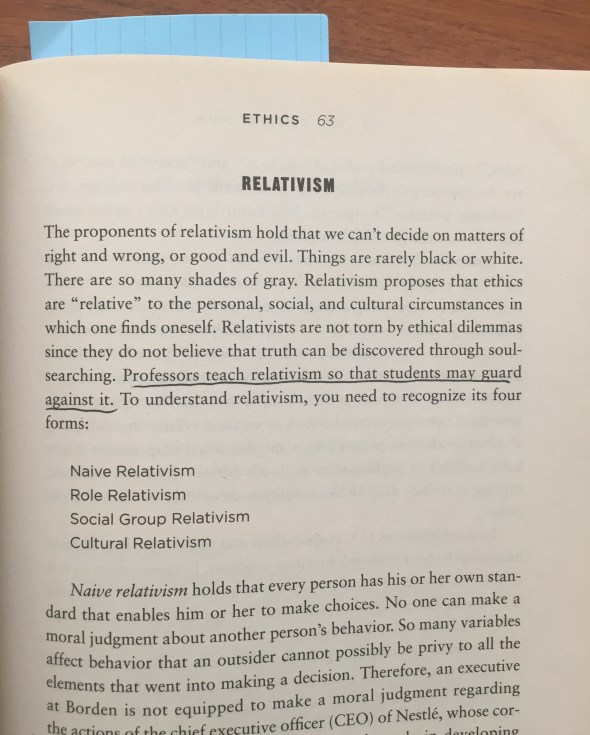
I thought this was a funny part. The chapter on ethics is of course the shortest, and much of it is devoted to a “I’m telling you this so you know not to do it” kind of moral reasoning.
How about Genichi Taguchi, from the chapter on Operations?:
This book is worth the cost just for the summaries of leadership and public speaking books included at the end. 
Highest praise to author Steven Silbiger. I don’t know how much business you can learn from a book but this felt like a good start.
Nassim Nicholas Taleb
Posted: August 25, 2018 Filed under: business 1 Comment

Has any writer ever distilled his key ideas into his titles so well?
Great example from this book. Casinos employ all kinds of mathematicians to build sophisticated models of probability to ensure their edge. These probabilities work within the rule-bound world of games, but to imagine life exists within the controlled parameters of a game is what Taleb calls “the ludic fallacy” (from the Latin for game). In real life, crazy things you couldn’t have predicted may happen:

You almost don’t need to read these books, once you grasp the implications of the titles. Our brains have difficulty grasping the implications of probability. 
Prepare yourself and live a life that accepts and can absorb risk.

You’d be crazy to armchair psychoanalyze as feisty a Twitter arguer as Nassim Nicholas Taleb, but I did feel like this passage in Fooled By Randomness suggests hints to an origin story for a man obsessed with probability:

I’ve now read all these books and found them entertaining, eccentric, inventive, infectious, and fun. I even liked:

Felt like my brain was getting steady nutrition as well as entertainment from these books.
This commencement address he gave is one of many samples available for free over at Medium.
Why Ben Graham wouldn’t hire Warren Buffett
Posted: August 18, 2018 Filed under: business, money Leave a comment
If you read anything at all about investing, pretty soon you will hear about Ben Graham, father of value investing and teacher of Warren Buffett.

Young Warren Buffett got an A+ in Graham’s class at Columbia Business School, and would later work for Graham. But when he first asked Graham for a job, in fact offered to work for free, Graham (born Grossbaum) wouldn’t hire Buffett. Why? The story in Buffett’s own words:
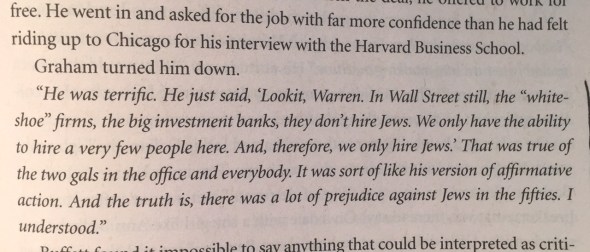
I’d never heard that one before. It’s in:

Later, Graham would hire Buffett, and he got to wear the signature gray jacket that absorbed ink stains from writing down rows of figures.
I found this book more compelling than I expected. By the time Buffett was in tenth grade he owned a forty acre farm in Nebraska he’d bought with paper route money. You can read an interesting interview with author Alice Schroeder here:
Miguel: Give us advice to becoming better communicators.
Alice: Well…this is not anything profound. But you see that he uses very short parables, stories, and analogies. He chooses key words that resonate with people —that will stick in their heads, like Aesop’s fables, and fairytale imagery. He’s good at conjuring up pictures in people’s minds that trigger archetypal thinking. It enables him to very quickly make a point … without having to expend a lot of verbiage.
He’s also conscientious about weaving humor into his material. He’s naturally witty, but he’s aware that humor is enjoyable and disarming if you’re trying to teach something.
And here’s Michael Lewis reviewing the book.
Ben Graham by the way ultimately got kinda bored of investing and retired to California where he had a relationship with his late son’s girlfriend.

A great detail:

the workings of capitalism
Posted: August 11, 2018 Filed under: America Since 1945, business Leave a comment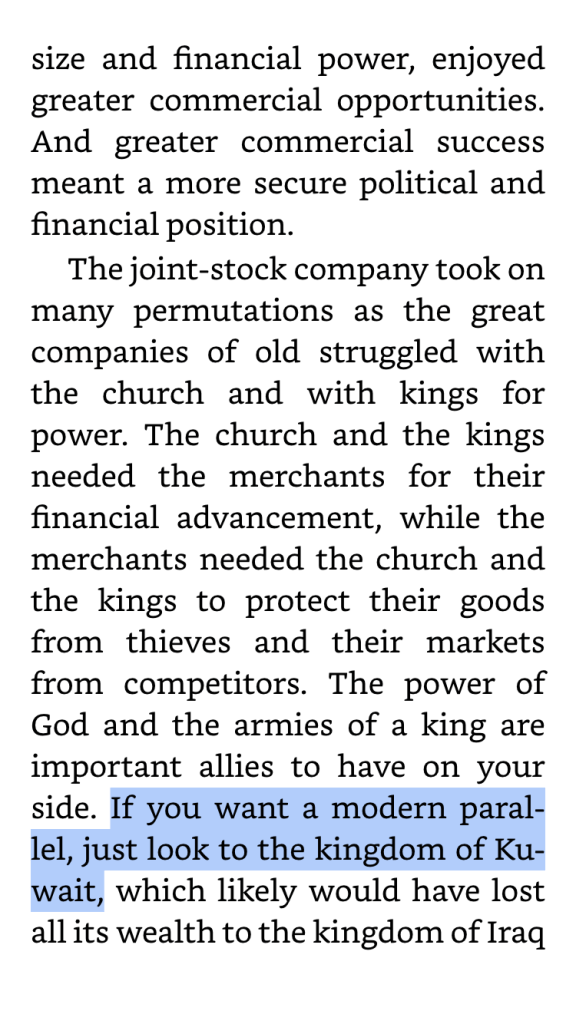

found that blunt history, which sounds like it would fit in a socio-anarchist pamphlet, in

Munger on grubstake
Posted: August 3, 2018 Filed under: business Leave a comment
“The first $100,000 is a bitch, but you gotta do it. I don’t care what you have to do—if it means walking everywhere and not eating anything that wasn’t purchased with a coupon, find a way to get your hands on $100,000. After that, you can ease off the gas a little bit.”
found that Munger quote in this long but interesting post about Jim O’Shaughnessy on 25iq by Tren Griffin.
There’s a trick of capitalism, which is if you have capital, it’s not that hard to multiply it into more capital. The hard part is getting capital in the first place. Charlie Munger acknowledges that yes, that is a challenge, there’s no easy solution.
If you prefer Oprah to Munger, 25iq has a roundup on her lessons as well!

Never listened to a corporate earnings call
Posted: July 30, 2018 Filed under: business, the California Condition Leave a comment
but there’s a first for everything. I am pretty curious about the Tesla call, Weds Aug 1 at 2:30 PDT
Schumpeter
Posted: July 29, 2018 Filed under: business Leave a comment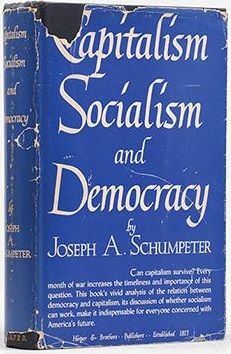
This process of Creative Destruction is the essential fact about capitalism. It is what capitalism consists in and what every capitalist concern has got to live in.
The Economist has a column named after Joseph Schumpeter and it’s been giving me a lot of ideas. Who was Schumpeter?
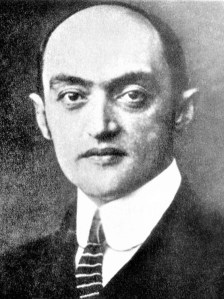
Schumpeter claimed that he had set himself three goals in life: to be the greatest economist in the world, to be the best horseman in all of Austria and the greatest lover in all of Vienna. He said he had reached two of his goals, but he never said which two, although he is reported to have said that there were too many fine horsemen in Austria for him to succeed in all his aspirations.
On what would happen:
Schumpeter’s most popular book in English is probably Capitalism, Socialism and Democracy. While he agrees with Karl Marx that capitalism will collapse and be replaced by socialism, Schumpeter predicts a different way this will come about. While Marx predicted that capitalism would be overthrown by a violent proletarian revolution, which actually occurred in the least capitalist countries, Schumpeter believed that capitalism would gradually weaken by itself and eventually collapse. Specifically, the success of capitalism would lead to corporatism and to values hostile to capitalism, especially among intellectuals. “Intellectuals” are a social class in a position to critique societal matters for which they are not directly responsible and to stand up for the interests of other classes. Intellectuals tend to have a negative outlook of capitalism, even while relying on it for prestige, because their professions rely on antagonism toward it. The growing number of people with higher education is a great advantage of capitalism, according to Schumpeter. Yet, unemployment and a lack of fulfilling work will cause intellectual critique, discontent and protests. Parliaments will increasingly elect social democratic parties, and democratic majorities will vote for restrictions on entrepreneurship. Increasing workers’ self-management, industrial democracy and regulatory institutions would evolve non-politically into “liberal capitalism”. Thus, the intellectual and social climate needed for thriving entrepreneurship will be replaced by some form of “laborism”. This will exacerbate “creative destruction” (a borrowed phrase to denote an endogenous replacement of old ways of doing things by new ways), which will ultimately undermine and destroy the capitalist structure.
Schumpeter emphasizes throughout this book that he is analyzing trends, not engaging in political advocacy.
Any day now!
Schumpeter was interested in the wave theories of Nikolai Kondratiev, a Soviet economist who ended up executed.
He is best known for proposing the theory that Western capitalist economies have long term (50 to 60 years) cycles of boom followed by depression. These business cycles are now called “Kondratiev waves“.
I can’t claim to understand Kondratiev, but the idea that waves are a good metaphor for the cycles of capitalism seems like a start.

Nassim Nicholas Taleb on lions
Posted: July 28, 2018 Filed under: Africa, business Leave a comment
The Fooled By Randomness author and deadlifter describes going to Africa and seeing lots of giraffes and impalas but only one lion:
It turned out that I had squarely made the error that I warn against, of mistaking the lurid for the empirical: there are very, very few predators compared to what one can call collaborative animals. The camp in the wild reserve was next to a watering hole, and in the afternoon it got crowded with hundreds of animals of different species who apparently got along rather well with one another. But of the thousands of animals that I spotted cumulatively, the image of the lion in a state of majestic calm dominates my memory. It may make sense from a risk-management point of view to overestimate the role of the lion — but not in our interpretation of world affairs.
If the “law of the jungle” means anything, it means collaboration for the most part, with a few perceptional distortions caused by our otherwise well-functioning risk management intuitions. Even predators end up in some type of arrangement with their prey.
The origin of algorithm
Posted: July 28, 2018 Filed under: business, Islam Leave a comment
The word “algorithm” comes up a lot these days. We’ve spoken before about the origin of this word, in the name of Muhammad ibn Musa al-Khwarizmi, author of The Compendious Book on Calculation by Completion and Balancing.
written around 820 CE in the city of Baghdad.

The man from Khwarizm.

source: Wiki user Fulvio Spada
The Khwarazam region today doesn’t look too great.

Becoming over time becomes being
Posted: July 16, 2018 Filed under: business, California, war Leave a comment
“The goal is to become HBO faster than HBO can become us,” Netflix’s chief content officer, Ted Sarandos, once famously said.
(source is this Vanity Fair article). The ancient sages and strategists would’ve enjoyed that one. The intersection of becoming and fighting.
The supreme art of war is to subdue the enemy without fighting
Sun Tzu said. Maybe. Can’t vouch for the translation. Elsewhere rendered as:
To subdue the enemy without fighting is the acme of skill.
or:
to defeat the enemy without battle is the whole of my art
Nanette and Domino’s Pizza and Taxonomies
Posted: July 13, 2018 Filed under: America Since 1945, business Leave a comment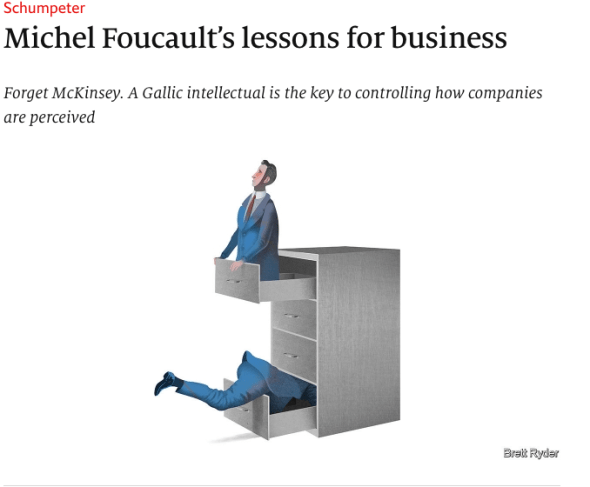
Really interested in this Schumpeter column in a recent issue of The Economist:
NOT many businesspeople study post-war French philosophy, but they could certainly learn from it. Michel Foucault, who died in 1984, argued that how you structure information is a source of power. A few of America’s most celebrated bosses, including Jeff Bezos and Warren Buffett, understand this implicitly, adroitly manipulating how outsiders see their firms. It is one of the most important but least understood skills in business.
Foucault was obsessed with taxonomies, or how humans split the world into arbitrary mental categories in order “to tame the wild profusion of existing things”. When we flip these around, “we apprehend in one great leap…the exotic charm of another system of thought”. Imagine, for example, a supermarket organised by products’ vintage. Lettuces, haddock, custard and the New York Times would be grouped in an aisle called “items produced yesterday”. Scotch, string, cans of dog food and the discounted Celine Dion DVDs would be in the “made in 2008” aisle.
I’m always into it when CEOs have a bold claim on what kind of company they are, redefining their own classification. Here are some examples:


Or in Ugly Delicious when Dave Chang says Domino’s is a technology company:

Was thinking about how important taxonomy is. Take, for instance, Nanette:

How much of the staggered, overpowered reaction to this special comes from approaching it in the taxonomy “standup comedy” / “Netflix comedy special” and then having that classification broken/subverted?
Would it have a different effect if you experienced it in the category “Edinburgh Fringe Festival-style personal show,” an overlapping but different taxonomy?
What about how the Emmys has the categories “comedy” and “drama,” when it seems to me the cool nominees in both categories tend to blur and push the limits of those definitions?
Another example of taxonomic power from Charles C. Mann’s Reddit AMA:
I am so grateful for the W&P book. Thank you for exploring these issues. I work in Oil and Gas and I’m very concerned about that unfortunate byproduct climate change. I’m also tired of being the bad guy at dinner parties. Is responsible oil and gas development a contradiction in terms? I’m wondering if you could sketch a possible social imaginary in which people like me have a beneficial role in contributing to our needed energy switch, while at the same time, you know, maybe keeping my job for a few years???
My son is in the energy business, too. He worries about this.
I always tell him, there is no reason to be the “bad guy” at parties. First, fossil fuels have contributed immensely to human well-being—there’s just no question about that. And, until we learned about climate change, there was little reason to doubt they had, on balance, a good ecological role. I live in a cold place (Massachusetts) that requires heating for people to survive. It would be a wasteland if people were still heating with wood. Wood heat denuded the entire NE, causing massive erosion and soil loss. Fossil fuels had in this case profound positive effects.
Now… climate change is a different matter.
Broadly speaking, it seems to me that there are two kind of fossil fuel companies, those which have decided they are energy companies, and those which have decided they are oil and gas companies. The former are adapting to the new reality, heavily investing in alternative energy and working to innovate; the latter are fighting progress. (I hope you are lucky enough to work for one of the former!) The former will continue to be indispensable to modern society. Note that almost all of the essential development of solar panels–what transformed them from laboratory curiosities at Bell Labs to a workable product–was done by oil and gas companies, which needed to power offshore oil platforms. Until China entered the market, Big Oil made the overwhelming majority of solar panels. Some companies will continue in that tradition and eventually build and maybe operate huge renewable facilities, especially with technologies like offshore wind.
What about the latter type of company? They will become, eventually and grudgingly, suppliers of raw materials for other industries–oil, gas, coal tar, etc., are essential modern raw materials. That’s a smaller role, but not one to be ashamed of. Still, I’d rather be working inside one of the first type, working to push the transition to renewables, which is what my son is doing.
Readers, what do you think about taxonomies?
Glenn D. Fogel, CEO and the significance or not of headset mics
Posted: July 12, 2018 Filed under: business Leave a commentGot interested recently in Bookings Holdings (BKNG) when I learned the company that owns Booking.com is the seventh largest internet company in the world (and largest in the category “travel”).
An early step if you are curious about a company is to do a Google image search of the CEO.
Let’s run this test for Glenn D. Fogel, CEO of Booking Holdings.
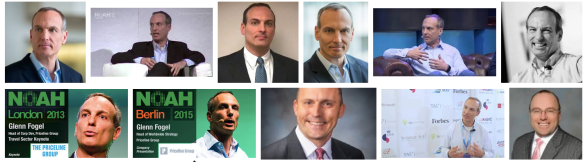
On first two rows of first page: one two three photos where Glenn Fogle is wearing a TED talk style headset mic.
Is this:
- the sign of a successful CEO in a booming field in 2018?
- possible mark of a true TED talk era huckster?
There may be more options than that, such as “both.”
What about Booking.com CEO Gillian Tans?
Tans was ranked by the organization Inspiring Fifty on their 50 Most Inspirational Women in Dutch Technology list.
Warren Buffett on why Coke is so good
Posted: July 2, 2018 Filed under: America Since 1945, business 2 Commentsjump to 6:42:
(h/t Naval Ravikant. )
Ended up watching this whole Buffett Q&A. If you watch other Buffett talks he does tend to repeat himself. This one is good.
Interesting to me how much Buffett talks about two companies, See’s and Coca-Cola, that have an emotional connection to the consumer. The results of that might be in the balance sheet, but the reason is beyond numbers. A genius of Buffett to combine cold technical investment analysis with being, like, the ultimate late 20th century American consumer.
As for Coke, the only new drink I know of that people drink five or six of a day is:

John Lanchester
Posted: July 1, 2018 Filed under: America Since 1945, business Leave a commentOne example I saw when I was researching Whoops!, my book on the crisis, was in Baltimore. There people going to buy houses for the first time would turn up at the mortgage company’s office and be told: ‘Look, I’m really sorry, I know we said we’d be able to get you a loan at 6 per cent, but something went wrong at the bank, so the number on here is 12 per cent. But listen, I know you want to come out of here owning a house today – that’s right isn’t it, you do want to leave this room owning your own house for the first time? – so what I suggest is, since there’s a lot of paperwork to get through, you sign it, and we sort out this issue with the loan later, it won’t be a problem.’ That is a flat lie: the loan was fixed and unchangeable and the contract legally binding, but under Maryland law, the principle is caveat emptor, so the mortgage broker can lie as much as they want, since the onus is on the other party to protect their own interests. The result, just in Baltimore, was tens of thousands of people losing their homes. The charity I talked to had no idea where many of those people were: some of them were sleeping in their cars, some of them had gone back to wherever they came from outside the city, others had just vanished. And all that predatory lending was entirely legal.
strikes again in LRB (link, free).
Napoleon said something interesting: that to understand a person, you must understand what the world looked like when he was twenty. I think there’s a lot in that.
[…]
I notice, talking to younger people, people who hit that Napoleonic moment of turning twenty since the crisis, that the idea of capitalism being thought of as morally superior elicits something between an eye roll and a hollow laugh. Their view of capitalism has been formed by austerity, increasing inequality, the impunity and imperviousness of finance and big technology companies, and the widespread spectacle of increasing corporate profits and a rocketing stock market combined with declining real pay and a huge growth in the new phenomenon of in-work poverty. That last is very important. For decades, the basic promise was that if you didn’t work the state would support you, but you would be poor. If you worked, you wouldn’t be. That’s no longer true: most people on benefits are in work too, it’s just that the work doesn’t pay enough to live on. That’s a fundamental breach of what used to be the social contract. So is the fact that the living standards of young people are likely not to be as high as they are for their parents. That idea stings just as much for parents as it does for their children.
Shake Shack fries
Posted: June 29, 2018 Filed under: business, food Leave a comment
The fries at Shake Shack are what I hoped Micro Magic fries would taste like, in my boyhood:

Anybody ever eat things? The packaging was attractive. They fooled me quite a few times.
Perhaps they failed in attempting to live up to an idea of a “fry.” A fry is firm, and Micro Magic just couldn’t get there. But they were making a salty mushed potato product that might’ve been attractive on its own terms.
A taxonomy error, perhaps.
Google led me to that image of Micro Magic fries on the website of New Adult Contemporary Romance author Jennifer Friess (don’t know if it’s a coincidence that her name is fries)
There was really a period there where the expectations put on the microwave were insane. Supermarkets were full of hallucinatory projections of what was gonna come out of the microwave.
The word amid
Posted: June 28, 2018 Filed under: business 1 Comment
In attempts to make narratives out of the movements of a stock’s price on a given day, the word “amid” does a lot of work.

Other articles at different places cited the Trump administration’s confused policies towards Chinese investment in tech as “stoking investor fears.”
That’s another phrase you come across a lot.
“Making investors jittery.” “Market jitters amid fears of…”

I’m struggling to decide whether, when we talk about why a stock or the stock market does something, we’re all that much different than those ancient diviners who pored over sheep entrails for clues to the future.
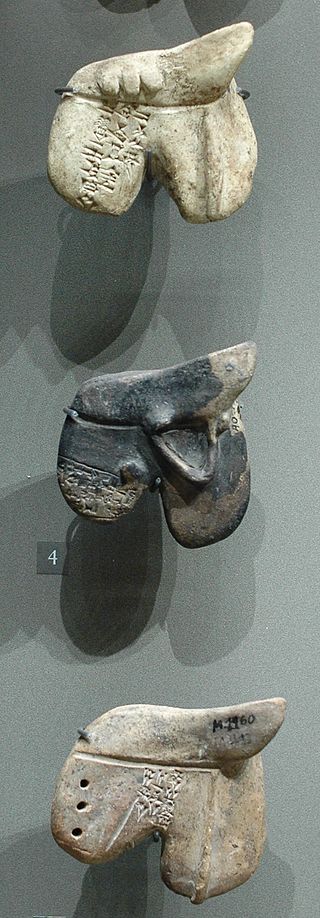
Jastrow on Wikipedia did the service of taking this photo of Akkadian liver models at the Louvre (of Jay Z and Beyonce fame)
In the popular business press, the explanations given for stock price movement are so often oversimplified or misleading. The gun stocks fallacy an insidious case.
‘Twas ever thus I guess. “Amid” is a safe choice if the real answer is “who can say why it went up or down?”
I here perceive a bias towards narrative in a world that’s absurd and often ridiculous.
Reminded of E. M. Forster in Aspects Of The Novel.
Let us define a plot. We have defined a story as a narrative of events arranged in their time-sequence. A plot is also a narrative of events, the emphasis falling on causality. “The king died and then the queen died” is a story. “The king died, and then the queen died of grief” is a plot.
Amid is a word that lets you muddy up the distinction between story and plot.
Perspective on Bitcoin
Posted: June 12, 2018 Filed under: business, money Leave a comment
Eric Guinthier put this on Wikipedia.
was thinking about this as I tried to remember some login or another: there’s no way in Hell all these numbnutses are gonna remember all their blockchain passwords and cryptokeys and what have you. The panicked runs on cryptocurrencies are gonna be crazy.
Maybe I should start a dump or an ewaste junkyard, eight bucks to throw away your old hard drive, and wait around for some panicked nerd to come screaming that he threw away seventeen million dollars in unharvested Ripple or whatnot.
that picture above is of Yap stone money. When someone tries to explain the history of money, sooner or later they’ll mention the stone money of Yap, usually avoiding an opinion on whether or not using enormous stone wheels as money is completely ridiculous.
Because these stones are too large to move, buying an item with one simply involves agreeing that the ownership has changed. As long as the transaction is recorded in the oral history, it will now be owned by the person it is passed on to and no physical movement of the stone is required.[citation needed]
(lol at citation needed. God bless Wikipedia. You try and write up Yap money in your spare time and someone comes along demanding footnotes).

Beades on Wikipedia took this picture of a rai stone at the Bank of Canada Currency Museum in Ottawa. How much do you think they paid for it?
Ominous remark from Charlie Munger
Posted: May 14, 2018 Filed under: business Leave a comment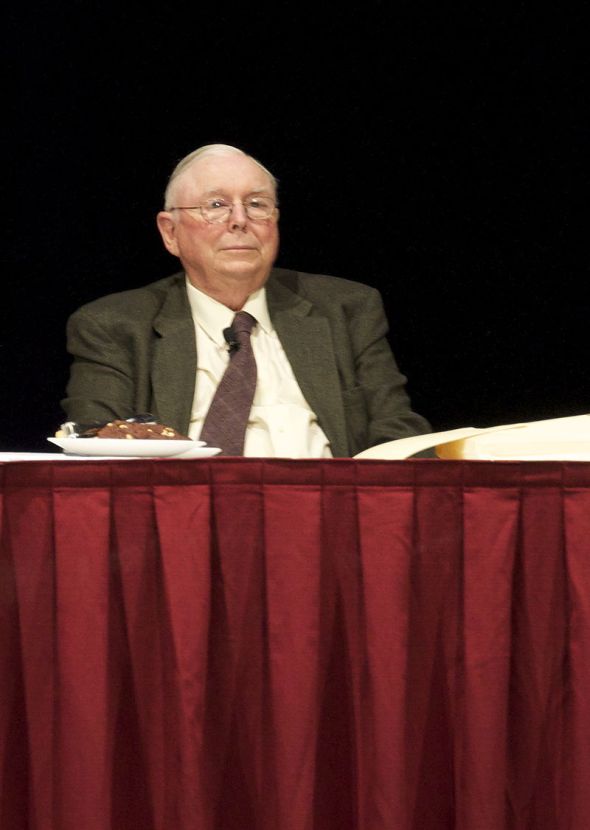
Nick on Wikipedia. Thanks Nick!
Andy Serwer, editor in chief of Yahoo Finance, reports on our favorite former weatherman:
Finally, I asked Munger about Trump and reminded him he had previously said that the president’s behavior exhibited a form of “sickness.”
“I’ve mellowed because I consider it counterproductive to hate as much as both parties now hate, and I have disciplined myself,” Munger said. “I now regard all politicians higher than I used to. I did that as a matter of self-preservation.” He said that he had re-read “The Decline and Fall of the Roman Empire,” and it made him “feel a lot better about the current political scene. We’re way ahead of the Romans at the end.”
That’s a pretty low bar, I pointed out.
“It’s very helpful — I suggest you try it,” Munger replied. “Politicians are never so bad that you don’t live to want them back. There will come a time when the people who hate Trump will wish that he was back
Highlights from Warren Buffett’s 2018 letter
Posted: February 24, 2018 Filed under: business, money Leave a comment
Another good one drops from Warren Buffett and the Berkshire Hathaway team.
In America, equity investors have the wind at their back.
We’ve learned a great deal here at Helytimes from studying Buffett’s writings. Here’s a writeup on the 2017 letter and on the 2016 letter and from a book of quotes from his letter.
A highlight from this year, worth noting:
The $65 billion gain is nonetheless real – rest assured of that. But only $36 billion came from Berkshire’s operations. The remaining $29 billion was delivered to us in December when Congress rewrote the U.S. Tax Code.
Did not know about the stake in Pilot Flying J:

How did Warren Buffett get so rich? Some answers he will tell you.
- By gathering money, eventually including the enormous pools of money (“float”) collected by insurance companies like GEICO
- Using the money to buy shares of businesses with a durable competitive advantage (here’s a critical take on what that can mean)
- Never selling anything so that he’s never taxed on the gains and the results compound and compound.
For the last 53 years, the company has built value by reinvesting its earnings and letting compound interest work its magic.
(Also he just seems to have an intuitive and unusually focused mind for business:
As a teenager, he took odd jobs, from washing cars to delivering newspapers, using his savings to purchase several pinball machines that he placed in local businesses.
Also he did some arbitrage things I don’t understand.)
In this letter, he discusses the result of a bet he made that an unmanaged index fund would beat selected hedge funds over a ten year period:
I made the bet for two reasons: (1) to leverage my outlay of $318,250 into a disproportionately larger sum that – if things turned out as I expected – would be distributed in early 2018 to Girls Inc. of Omaha; and (2) to publicize my conviction that my pick – a virtually cost-free investment in an unmanaged S&P 500 index fund – would, over time, deliver better results than those achieved by most investment professionals, however well-regarded and incentivized those “helpers” may be.
Addressing this question is of enormous importance. American investors pay staggering sums annually to advisors, often incurring several layers of consequential costs. In the aggregate, do these investors get their money’s worth? Indeed, again in the aggregate, do investors get anything for their outlays?
More:
A final lesson from our bet: Stick with big, “easy” decisions and eschew activity. During the ten-year bet, the 200-plus hedge-fund managers that were involved almost certainly made tens of thousands of buy and sell decisions. Most of those managers undoubtedly thought hard about their decisions, each of which they believed would prove advantageous. In the process of investing, they studied 10-Ks, interviewed managements, read trade journals and conferred with Wall Street analysts. 13 Protégé and I, meanwhile, leaning neither on research, insights nor brilliance, made only one investment decision during the ten years. We simply decided to sell our bond investment at a price of more than 100 times earnings (95.7 sale price/.88 yield), those being “earnings” that could not increase during the ensuing five years. We made the sale in order to move our money into a single security – Berkshire – that, in turn, owned a diversified group of solid businesses. Fueled by retained earnings, Berkshire’s growth in value was unlikely to be less than 8% annually, even if we were to experience a so-so economy.
Fewer good jokes this year, in our opinion, but also fewer dire warnings.
 Helytimes

