The Head of John The Baptist on a Charger
Posted: April 22, 2012 Filed under: art, beheadings, Christianity, Met, MFA Boston, museum, painting, pictures, religion Leave a commentWe here at The Hely Times are shameless about catering to our readers. We’ve discovered that pictures depicting beheadings are among our most popular subjects. So, today, a review of one of the great themes in Western Art, John the Baptist’s head on a charger. NOTE: some other day we’ll do actual action-shot beheadings of John the Baptist. Today, we’re just dealing with the paintings that include the charger as well.
Caravaggio did it twice. There’s the National Gallery, London:

And the Palacio Real, Madrid:

Met has a good one by Aelbert Bouts:

MFA has one by Bernardo Luini:

Lucas Cranach the Elder, now hanging in the Museum of Fine Arts in Budapest:

That’s enough.
Last stop on the Hemingway/Lillian Ross tour of the Met
Posted: April 21, 2012 Filed under: art, Cezanne, Hemingway, Met, museum, painting, pictures Leave a comment
We came to El Greco’s green “View of Toledo” and stood looking at it a long time. “This is the best picture in the Museum for me, and Christ knows there are some lovely ones,” Hemingway said.

After we reached the Cezannes and Degases and the other Impressionists, Hemingway became more and more excited, and discoursed on what each artist could do and how and what he had learned from each. Patrick listened respectfully and didn’t seem to want to talk about painting techniques any more. Hemingway spent several minutes looking at Cezanne’s “Rocks – Forest of Fontainebleu.” “This is what we try to do in writing, this and this, and the woods, and the rocks we have to climb over,” he said. “Cezanne is my painter, after the early painters. Wonder, wonder painter…
As we walked along, Hemingway said to me, “I can make a landscape like Mr. Paul Cezanne. I learned how to make a landscape from Mr. Paul Cezanne by walking through the Luxembourg Museum a thousand times with an empty gut, and I am pretty sure that if Mr. Paul was around, he would like the way I make them and be happy that I learned it from him.”
Wiki, close out Cezanne for us:
One day, Cézanne was caught in a storm while working in the field. Only after working for two hours under a downpour did he decide to go home; but on the way he collapsed. He was taken home by a passing driver. His old housekeeper rubbed his arms and legs to restore the circulation; as a result, he regained consciousness. On the following day, he intended to continue working, but later on he fainted; the model with whom he was working called for help; he was put to bed, and he never left it again. He died a few days later, on 22nd October 1906. He died of pneumonia and was buried at the old cemetery in his beloved hometown of Aix-en-Provence.
Captain George K. H. Coussmaker (Joshua Reynolds, 1782)
Posted: April 20, 2012 Filed under: art, Hemingway, Joshua Reynolds, Met, museum, painting, pictures, writing Leave a comment
“What the hell!” Hemingway said suddenly. “I don’t want to be an art critic. I just want to look at pictures and be happy with them and learn from them. Now, this for me is a damn good picture.” He stood back and peered at a Reynolds entitled “Colonel George Coussmaker,” which shows the Colonel leaning against a tree and holding his horse’s bridle. “Now, this Colonel is a son of a bitch who was willing to pay money to the best portrait painter of his day just to have himself painted,” Hemingway said, and gave a short laugh. “Look at the man’s arrogance and the strength in the neck of the horse and the way the man’s legs hang. He’s so arrogant he can afford to lean against a tree.”
remembers Miss Ross.
Coussmaker sat for Reynolds 21 times and his horse 8 times between February 9 and April 16, 1782 – an exceptional number of times.
Van Dyck, Portrait Of The Artist (possibly 1620-21)
Posted: April 19, 2012 Filed under: art, Hemingway, Met, museum, painting, pictures, writing 1 Comment
Weighed in already but let’s get Hemingway’s take:
Mrs. Hemingway called to us. She was looking at “Portrait of the Artist” by Van Dyck. Hemingway looked at it, nodded approval, and said, “In Spain, we had a fighter pilot named Whitey Dahl, so Whitey came to me one time and said, ‘Mr. Hemingway, is Van Dyck a good painter?’ I said ‘Yes, he is.’ He said, ‘Well, I’m glad, because I have one in my room and I like it very much, and I’m glad he’s a good painter because I like him.’ The next day, Whitey was shot down.”
– from Miss Ross again.
Still more on Francesco Francia’s Portrait of Federigo Gonzaga
Posted: April 18, 2012 Filed under: art, Francesco Francia, Met, museum, painting, pictures, Raphael Leave a comment
Raphael’s Santa Cecilia is supposed to have produced such a feeling of inferiority in Francia that it caused him to die of depression. However, as his friendship with Raphael is now well-known, this story has been discredited.
Here it is, anyway:

Go see that next time you’re in Bologna. What’s that? In no hurry to get to Bologna? Perhaps Mr. James Salter can persuade you:
“Bologna is famous for three things,” she said. “It’s famous for its learning – it has the oldest university in Italy, founded in the twelfth century. It’s famous for its food. The cuisine is the finest in the country. You can eat in Bologna as nowhere else, that’s well known. And lastly, it’s famous for fellatio.” She used another word.
“It’s a specialty,” she said. “All the various forms are called by the names of pasta. Rigate, for instance,” she explained, “which is a pasta with thin, fluted marks. For that the girls gently use their teeth. When there used to be brothels there was always a Signorina Bolongese – that was her specialty.”
More on Francisco Francia’s Portrait of Federigo Gonzaga
Posted: April 17, 2012 Filed under: art, Francesco Francia, Met, museum, painting, pictures, Titian 1 Comment
In July 1510 the ten-year-old Federigo Gonzaga was sent from Mantua to Rome as a hostage. On his way to Rome he stopped in Bologna, where Francia astounded everyone by painting and delivering his portrait in twelve days. The picture was subsequently taken to Rome for the admiration of the papal court and was only reluctantly returned to Isabella d’Este, Federigo’s mother. The fine execution of this famous portrait is typical of Francia’s best work.
– says the Met, where this painting is NOT ON DISPLAY. Later in life, Titian would take a crack at Federigo:

Portrait of Federigo Gonzaga (Francesco Francia, 1510)
Posted: April 16, 2012 Filed under: art, Hemingway, Met, museum, painting, pictures, writing Leave a comment
“Here’s what I like, Papa,” Patrick said, and Hemingway joined his son in front of “Portrait of Federigo Gonzaga (1500-1540) by Francesco Francia. It shows, against a landscape, a small boy with long hair and a cloak.
“This is what we try to do when we write, Mousie,” Hemingway said, pointing to the trees in the background. “We always have this in when we write.”
– “How Do You Like It Now, Gentleman,” by Lillian Ross, The New Yorker, May 13, 1950
Herb Keeper
Posted: April 15, 2012 Filed under: family, supplies Leave a comment

My sister, who is awesome, bought me this. Why? No one knows.
“high as a Georgia pine”
Posted: April 14, 2012 Filed under: baseball Leave a commentht our Toronto office. Apparently some debate about the veracity of this story but here at The Hely Times we print the legend.
Yuri Gagarin
Posted: April 12, 2012 Filed under: heroes, photography, pictures, science Leave a commentGood Artwork of the Day from the Met today:

The sudden rise to national and international fame took its toll on Gagarin. In attending various functions and receptions in his honour, he consumed large amounts of vodka and other alcoholic beverages, even though otherwise he was not a regular drinker. His physical appearance changed and he became noticeably heavier. The attention of female fans took a toll on his marriage. It was rumoured that his wife once caught him in a hotel room with another woman and Gagarin jumped out of the second floor window and hit his face on a kerbstone, which resulted in a deep cut above his left eye. The scar remained visible after the incident.
The photographer is Yousef Karsh:
As Karsh wrote of his own work inKarsh Portfolio in 1967, “Within every man and woman a secret is hidden, and as a photographer it is my task to reveal it if I can. The revelation, if it comes at all, will come in a small fraction of a second with an unconscious gesture, a gleam of the eye, a brief lifting of the mask that all humans wear to conceal their innermost selves from the world. In that fleeting interval of opportunity the photographer must act or lose his prize.”
“…solitude like a dream, half-horrific and half-glorious…”
Posted: April 12, 2012 Filed under: New England, painting, pictures, Winslow Homer Leave a comment
“The cost of transformative art must be paid by the artist alone. The ridiculous honors we bestow on the few artists we discover – or think we discover – are our gauche attempts at collective repayment. But to the great artist there comes a realization that he must pay it alone.
He pays anyway. The bill is paid, in large part, with solitude. A solitude like a dream, half-horrific and half-glorious, a loneliness so deep that it becomes a kind of companion.
Again and again in [Winslow] Homer’s work the subject turns away, casts off, looks to some task, to some turn of the weather that seems to offer nothing but a reminder of this cosmic indifference. We look at the fisherman; he doesn’t look back. Hemingway would crib much of this. But it was Homer, first, who stared deep into the river, into the ocean, accepting that he might see nothing in return. Yet he finds in the nothing a comfort. An unluxurious comfort but a comfort nonetheless. By the later paintings he has dissolved completely. Only the waves remain.”
– from J. A. Ellison’s Winslow Homer On Prouts Neck: A Rumination (1957).

The Green Cathedral
Posted: April 11, 2012 Filed under: architecture, medieval studies, music, nature, trees, UNESCO Leave a comment
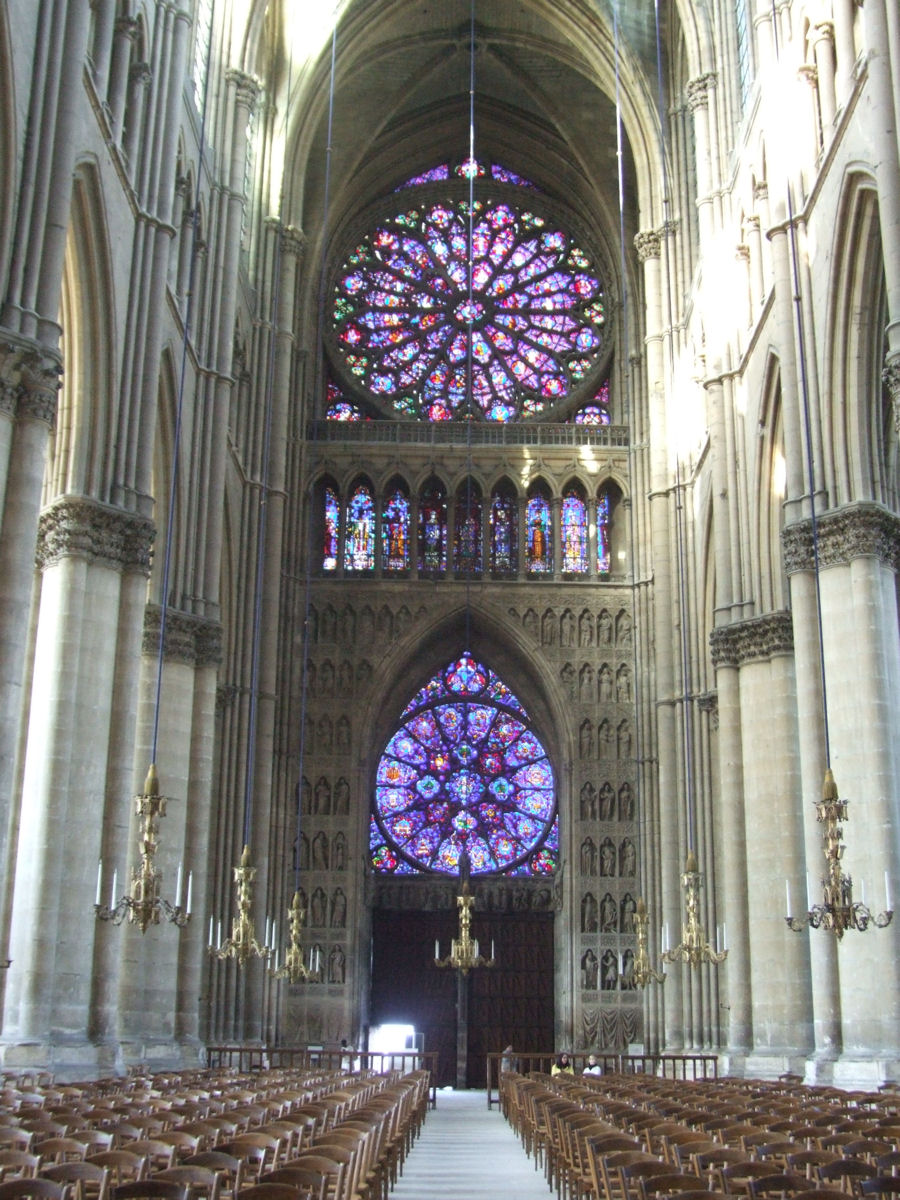
The Green Cathedral or De Groene Kathedraal located near Almere Netherlands, is an artistic planting of Lombardy poplars (Populus nigra italica) that mimics the size and shape of the Cathedral of Notre-Dame, Reims, France….The work was planted by Marinus Boezem (b. 1934) on April 16, 1987 in Southern Flevoland, Nederland.

While walking there I assume you should listen to Guillaume de Machaut’s Messe de Notre Dame (1360s), composed for the cathedral at Reims (which isn’t too shabby in stone either).
Machaut survived the Black Death which devastated Europe, and spent his later years living in Rheims composing and supervising the creation of his complete-works manuscripts. His poem Le voir dit(probably 1361–1365) purports to recount a late love affair with a 19-year-old girl, Péronne d’Armentières, although the accuracy of the work as autobiography is contested.
Pictures from wikipedia and from inhabit.com
Caravaggio, “Judith Beheading Holofernes” (1598-99)
Posted: April 9, 2012 Filed under: art, painting, pictures Leave a comment
The model for Judith is probably the Roman courtesan Fillide Melandroni, who posed for several other works by Caravaggio around this year; the scene itself, and especially the details of blood and decapitation, were presumably drawn from his observations of the public execution of Beatrice Cenci a few years before.
Alberto Korda
Posted: April 9, 2012 Filed under: Cuba, from wikipedia, photography, pictures Leave a comment
In the early years Korda was most interested in fashion because it allowed him to pursue his two favorite things, photography and beautiful women. Korda became Cuba’s premiere fashion photographer. Korda disliked artificial lighting he said it was “a travesty of reality” and only used natural light in his studio…. “My main aim was to meet women”, he once confessed. His second wife, Natalia (Norka) Menendez, was a well known Cuban fashion model.

The Pogues And The Dubliners – The Irish Rover
Posted: April 7, 2012 Filed under: heroes, Ireland, Irish traditional music, the ocean Leave a commentWas anyone ever uglier than Shane McGowan? Not criticizing, just saying.
MacGowan claims to have been introduced to alcohol and cigarettes by his aunt on the promise he would not worship the devil. In a 2007 interview with the Daily Mirror he told a reporter: “I was actually four when I started drinking. I just remember that Ribena turned into stout and I developed an immediate love for it.” MacGowan says he tried whiskey when he was 10 and continued to drink heavily thereafter.
The wikipedia page on Shane no longer claims, as it once did, that his dental troubles were at least partially due to attempting to eat a vinyl record of “Sgt. Pepper” while on LSD.
Sister Nancy
Posted: April 7, 2012 Filed under: Jamaica, music Leave a commentRussell-Myers is married to her longtime sweetheart of over twenty years. They reside with the rest of her family in New Jersey, where she works as an accountant at a bank.[citation needed]
This song is a good way to remember the population of Jamaica (actually just shy of “3 million,” says wikipedia (2,868,380 is their 2011 estimate))
Sundown (Gordon Lightfoot), 1974
Posted: April 6, 2012 Filed under: love, music, women 5 Comments
There are rumours that “Sundown” was inspired by his then girlfriend, Cathy Smith, later more infamously known for her involvement in the death of John Belushi. Lightfoot has commented in interviews that she was “the one woman in my life who most hurt me.”
More, from Cathy Smith’s wikipedia page:
Catherine Evelyn Smith (born Catherine Evelyn Smith, 1948 in Hamilton, Ontario) is an occasional backup singer, rock star girlfriend, “groupie” and drug dealer, who served 15 months in the California state prison system for injecting John Belushi with a fatal dose of heroin and cocaine in 1982…
…Smith became an employee and then mistress of Canadian singer-songwriter Gordon Lightfoot in the early to mid-1970s. At one point, she even drove their tour bus. Smith sang backup on Lightfoot’s song “High and Dry” which was on the Sundown album. She apparently sang more backup on the album but Lightfoot mixed most of it out.
By several accounts, the Smith-Lightfoot affair was volatile and illustrated in the lyrics of “Sundown”, Lightfoot’s Number One hit and most financially lucrative song. It reflects the dark feelings Lightfoot was experiencing at the time. Drinking too much and married to another woman, he on one occasion broke Smith’s cheekbone in a fight. Lightfoot has stated of his three-year relationship with Smith, “I was sometimes crazy with jealousy”.
Picture of Cathy Smith, from this amazing website:
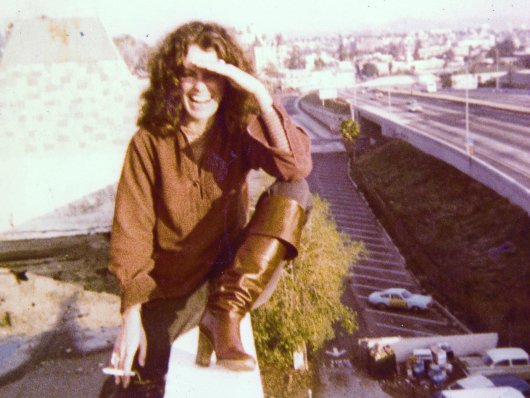
Once, on a bus between Vancouver and Whitehorse, I heard a woman tell the story of how Gordon Lightfoot kissed her one time.
The Atlantic encourages us to start “Remembering Project Gemini”
Posted: April 5, 2012 Filed under: explorers, heroes, photography, pictures, the ocean Leave a commentWill do! That there is the same Intrepid that’s docked in the Hudson River, seen here some twenty years after surviving two crashes from kamikazes.


St. Bridget of Sweden, from an altarpiece in Salem, Södermanland, restored digitally.
Posted: April 5, 2012 Filed under: art, Christianity, painting, religion Leave a comment
Coup in Mali, 3
Posted: April 5, 2012 Filed under: books, Mali Leave a comment
I thought this writing, in the NY Times by Lydia Polgreen, is good, concise, and informative.
The Tuaregs are a nomadic people who live largely in the Sahara, spanning Niger, Mali, Algeria and Libya. For centuries they plied caravan routes across the desert, but colonial borders turned them into citizens of several nations. In the 1960s and 1990s, Tuareg rebellions erupted in the Sahara, seeking autonomy or independence. Violence flared again in 2007 in Niger, where Tuareg rebels seeking to wrest control of the country’s rich uranium deposits mounted a rebellion.
It allowed me to understand how complicated the Tuareg situation must be. More:
Col. Muammar el-Qaddafi, Libya’s former leader, supported Tuareg rebellions in Mali and Niger over several decades, and analysts in the region say the current uprising is closely linked to the fall of Colonel Qaddafi, whose weapons are suspected of playing a major role in the Malian rebels’ success.
But Lydia Polgreen is reporting from Johannesburg, apparently. Is anyone in towns like Tinzaouaten, which wikipedia tells me was “wrested from control” of the government on Feb. 8, I wondered? So I went looking for pictures of Tinzaouaten. I found this person’s flickr stream. I think she is just an amateur, not a journalist? Don’t want to post them here as she reserves her rights. But jeez.
The rebels attacked the town of Niafunké in January. Ali Farka Toure was born in Niafunke and was the mayor there. Here is a video of him:
Photo up top is of “Timbuktu Manuscripts.”
 Helytimes