go with the emotion
Posted: December 5, 2025 Filed under: actors Leave a commentI would just add that some directors, you have to fit into a context or a perception of a world they create. You know what I mean? There’s a lot of plots that are hard to unravel, that are very intricate, that doesn’t allow a lot of movement. But even those directors, if they allow you as an actor to say… Scorsese says this all the time. He says, I don’t care about plot. I don’t care about plot. He goes, I want to go with the emotion of what the actor does because that’s the story to me. Sometimes it could be less, sometimes it could be more. But When I watch a movie, those are the moments that I remember. I don’t think about, Oh, this happened in the plot. That happened. I was like, That moment with those actors, that felt like real life to me. It’s funny. It’s crazy. Joe Pesci and Goodfellas It was that moment. He’s trying to capture those moments of real life that make you feel something, that make you feel like you’re a part of the story in a way.
Leo DiCaprio talking on Kelce Bros “New Heights” podcast.
Val Kilmer
Posted: April 2, 2025 Filed under: actors 1 CommentCan’t forget him doing his one man show as Mark Twain at the Hollywood Cemetery. Afterwards he stayed on stage while he was taking his elaborate makeup off and asked the audience if they uncomfortable with him saying the n word so much.
The Doors, Tombstone, Heat, Spartan… he wasn’t just pretending, he was in it.
Kilmer briefly considered running for Governor of New Mexico in 2010, but decided against it.
What if?
Sigourney
Posted: June 29, 2024 Filed under: actors Leave a commentThe debate was so distressing that I started clicking around and landed on PBS where they were showing an episode of Doc Martin guest starring… Sigourney Weaver?

Very soothing!
Turns out Sigourney is good friends with Doc Martin actress Selina Cadell:
I loved Selina as soon as we met in that London pub. We stayed in touch the old-fashioned way after that first summer in London, sending letters and postcards. When I found out I’d got the part of Ripley in Alien, I phoned my parents and then Selina. I was thrilled that I was going to be filming in London.
When you have a friend who’s also an actress, but is as generous and as well-balanced as Selina, then you can call them up and tell them about a great job. There were plenty of friends I wouldn’t have been able to call, because their first instinct would’ve been, “Why am I not getting a movie?” But I knew she’d be happy for me.
And:
I said, “Are you kidding? I’d love to!” They sent messages via Selina asking if I’d appear in series seven and again in series eight. Of course I did! I made Avatar rework their schedules so I could be here.
People expect me to behave in a grand manner, but it’s not like I’m John Travolta. Having a cameo in Doc Martin is a dream job for me. Cornwall is the most beautiful place. I’ve read every novel about it I can and I watch Poldark on my iPad.
…
I admire you British: when things get tough, you reach for humour. Not firearms. I’d love to live closer to Selina, but however far away she might be, she is always with me. When I’m working I start each day by listening to a tape she recorded for me ten years ago. She tells me how to relax, how to catch my breath. It’s my safe place.
Source. Would Sigourney run?
loneliness
Posted: November 25, 2023 Filed under: actors, writing Leave a commentAll the great plays [are] about loneliness,” [Tom Hanks] says, recounting an insight delivered to him by the theatre director Vincent Dowling. “It’s about the battle we all have to be part of something big.” It was only as an adult, says Hanks, that he realised “that’s the reason I would go to the [movie] theatre by myself as an 18-year-old kid, to be exposed to that language of loneliness”.
so says Hanks having lunch with the Financial Times, free link provided for you here. Always a little disappointed when the lunch with FT guest opts for expensive bottled water instead of a nice white wine.

Kate Corbaley, Storyteller
Posted: July 29, 2022 Filed under: actors, Hollywood, screenwriting, the California Condition, writing Leave a commentAnother staff writer with a rather unconventional but valued talent was Kate Corbaley. At $150 a week, Corbaley was one of the few staffers whose salary was in the same range as Selznick’s…
Her specialty was not in editorial but rather as Louis Mayer’s preferred “storyteller.” Mayer was not a learned or highly literate man, and he rarely read story properties, scripts, or even synopses. He preferred to have someone simply tell him the story and he found Mrs. Corbaley’s narrational skills suited him. She never received a writing credit on an MGM picture, but many in the company considered her crucial to Mayer’s interest in stories being considered for purchase or production at any given time.
That’s from Thomas Schatz, The Genius of the System: Hollywood Filmmaking in the Studio Era.
Corbaley’s brother was Admiral S. C. Hooper, “the father of naval radio,” if The New York Times is to be believed. What a family of communicators!
Storytelling is a current obsession in business. A few days ago I searched “storyteller” under Jobs on LinkedIn and found 35,831 results. Amazon, Microsoft, and Pinterest are all hiring some version of “storyteller,” as are Under Armor, Eataly and “X, the Moonshot Factory.” The accounting firm Deloitte is hiring Financial and Strategic Storytellers (multiple listings, financial and strategic storytellers are sought in San Diego, Miami, Chicago, Charlotte, Tampa, Las Vegas, and Phoenix).
Cool job.
It’s reported in City of Nets: A Portrait of Hollywood in the 1940s that one afternoon in May, 1936, Kate Corbaley summarized a novel that was already perceived as hot property. She told Louis B. Mayer
a new story about a tempestuous southern girl named Scarlett O’Hara.
Mayer wasn’t sure what to think, so he sent for Irving Thalberg, who declared:
Forget it, Louis. No Civil War picture ever made a nickel.
(This seems improbable: in 1936 Birth of A Nation would’ve held the record as one of if not the biggest movie of all time? Must track this tale to its source, will report.)
method
Posted: February 5, 2022 Filed under: actors, Hemingway, writing, writing advice from other people Leave a commentIn one famous Brando origin story, Adler asked her students to pretend to be chickens as an atomic bomb drops. While everyone else was flapping in a panic, Brando peaceably squatted down. “I’m laying an egg,” he told Adler. “What does a chicken know of bombs?”
reading Alexandra Schwartz on Isaac Butler’s book about method acting in The New Yorker. A shifting concept, perhaps we can agree?
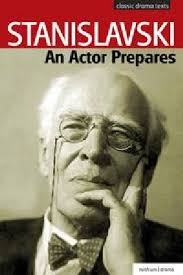
“the Method” is describes a set of techniques, practices, and concepts for helping actors achieve emotional life and truth in their performances. The Method is based on the teachings of Stanislavski, developed at the Moscow Art Theater, interpreted in the United States by teachers like Lee Strasburg, Stella Adler, and Sanford Meisner and by actors like Marlon Brando and Marilyn Monroe.
Defining things is hard, I’m already quibbling with myself!
Maybe Wikipedia’s is better, Wikipedia really is a miracle, isn’t it folks? Sainthood for Jimmy Wales.
Some of what the Method seems to get at, like chunks of reality, precision of memory, the blend of emotional and physical experience, reminded me of Hemingway on focusing as specifically as possible on the connection of sensation to specific detail. What did you feel, what exactly made you feel it in the moment?
MICE: How can a writer train himself?
Y.C.: Watch what happens today. If we get into a fish see exact it is that everyone does. If you get a kick out of it while he is jumping remember back until you see exactly what the action was that gave you that emotion. Whether it was the rising of the line from the water and the way it tightened like a fiddle string until drops started from it, or the way he smashed and threw water when he jumped. Remember what the noises were and what was said. Find what gave you the emotion, what the action was that gave you the excitement. Then write it down making it clear so the reader will see it too and have the same feeling you had. Thatʼs a five finger exercise.
…
Y.C.: Listen now. When people talk listen completely. Donʼt be thinking what youʼre going to say. Most people never listen. Nor do they observe. You should be able to go into a room and when you come out know everything that you saw there and not only that. If that room gave you any feeling you should know exactly what it was that gave you that feeling. Try that for practice. When youʼre in town stand outside the theatre and see how people differ in the way they get out of taxis or motor cars. There are a thousand ways to practice. And always think of other people.
more on that.
Politics and drama in ancient Athens
Posted: December 16, 2020 Filed under: actors, politics Leave a commentAll art has a political dimension, but tragedy actually began life in fifth-century Athens as a political institution, locked into the structures of the state. The authorities appointed an official to train and pay the Chorus, the city preserved play scripts in its archives, and there was a state fund which poor Athenians could draw on for the entry fee. Tragedy was a form of ethicopolitical education for the city state as a whole, not just a night off for the toffs.
Wild. What if the US government paid for movie tickets? They probably should! We were pretty close to a merger like this during World War II I suppose, when they’d show the GIs Mrs. Miniver and stuff.
That’s Terry Eagleton reviewing A Cultural History of Tragedy: Vols I-VI edited by Rebecca Bushnell in LRB back in February. Cleaning out my files!
Will Kempe, Will Shakespeare, and Falstaff
Posted: June 7, 2018 Filed under: actors, shakespeare, writing 1 Comment
In Shakespeare’s time, there was a comic actor who was more famous than any playwright. His name was Will Kempe. His most popular bit was morris dancing from London to Norwich.
In February and March 1600, he undertook what he would later call his “Nine Days Wonder”, in which he morris danced from London to Norwich (a distance of over a hundred miles) in a journey which took him nine days spread over several weeks, often amid cheering crowds. Later that year he published a description of the event to prove to doubters that it was true.
Perhaps Kempe originated the part of Falstaff in Shakespeare’s plays.
Kempe’s whereabouts in the later 1580s are not known, but that his fame as a performer was growing during this period is indicated by Thomas Nashe’s An Almond for a Parrot (1590).
An Almond for a Parrot is a great title.

Perhaps he was the Will Ferrell of his day.
Although he had been a sharer in the plans to construct the Globe Theatre, he appeared in no productions in the new theatre, which was open by mid-1599, and evidence from Shakespeare’s Henry V, in which there is no promised continued role for Falstaff, and Hamlet, containing its famous complaint at improvisational clowning (Act 3, Scene 2), indicates some of the circumstances in which Kempe may have been dropped
The lines in question:
HAMLET
O, reform it altogether! And let those that play your clowns speak no more than is set down for them, for there be of them that will themselves laugh to set on some quantity of barren spectators to laugh too, though in the meantime some necessary question of the play be then to be considered. That’s villainous, and shows a most pitiful ambition in the fool that uses it. Go, make you ready.

“Just say the lines dude.”
In real life Will Kempe was the Shakespearean clown who was the superstar of his day.
Audiences would flock for miles around to watch the great man perform his Falstaff or famous jig at the Globe theatre after one of the plays by the great darling of the stage – and the age – Will Shakespeare.
And in Upstart Crow, Ben Elton’s BBC2 comedy reimagining of the life of the great poet and dramatist, Kempe is presented as… a cocky C16th Ricky Gervais.
Henry IV, Part One (and Richard II)
Posted: May 28, 2018 Filed under: actors, plays, shakespeare, writing Leave a comment
Time to read Henry IV: Part One. Let’s just dive right in. 
Dammit! Fine.

Didn’t get a ton out of Richard II, to be honest with you. Professor McHugh tells me I’ll appreciate it if I read:

It’s all about how weird and hard it is for frail, weak Richard to be king. He’s got his actual human body, which sucks, trying to rise up to be the Body Politic, the kingly body. Or something.

I appear to have marked this for some reason. 
Anyway.
The play is mainly about a king waffling and reversing himself and causing problems. Much of the play is people introducing themselves at a long tournament scene.
We do meet Henry Bolingbroke, who has a son whose thing is prostitutes and being a wastrel:
HENRY BOLINGBROKE
Can no man tell me of my unthrifty son?
‘Tis full three months since I did see him last;
If any plague hang over us, ’tis he.
I would to God, my lords, he might be found:
Inquire at London, ‘mongst the taverns there,
For there, they say, he daily doth frequent,
With unrestrained loose companions,
Even such, they say, as stand in narrow lanes,
And beat our watch, and rob our passengers;
Which he, young wanton and effeminate boy,
Takes on the point of honour to support
So dissolute a crew.HENRY PERCY
My lord, some two days since I saw the prince,
And told him of those triumphs held at Oxford.HENRY BOLINGBROKE
And what said the gallant?
HENRY PERCY
His answer was, he would unto the stews,
And from the common’st creature pluck a glove,
And wear it as a favour; and with that
He would unhorse the lustiest challenger.
That’s really gonna be the problem for the next couple plays: Henry Bolingbrook trying to get help from his son who would rather be unto the stews.
Without his unthrifty son, Bolingbroke still manages to depose Richard.

I got deposed
This makes him King Henry IV, but it’s kind of an unsteady position.

Henry IV feels bad when Richard ends up murdered, so he promises to go on a crusade to Jerusalem:
I’ll make a voyage to the Holy Land
To wash this blood off from my guilty hand.
March sadly after; grace my mournings here,
In weeping after this untimely bier.
And with that we:
FINIS
OK. We’re ready for:
Now, listen. Is reading Shakespeare even a worthwhile thing to do?
The plays were written to be heard, not read.
Right.
When Ben Jonson published his first folio, he was considered uppity for imagining that his plays were worthy of consideration. They were sketches for a whorehouse. You have to imagine Shakespeare’s plays being written between strippers carrying on.
so says Mark Rylance in this New Yorker profile.

Somewhere I can’t find now — the playbill for Jerusalem? — I read an interview with Rylance where he said something like.
In Shakespeare’s day you wouldn’t say have you seen Hamlet, you’d say have you heard Hamlet. In that sense it was something more like a concert.
(Not an exact quote but close-ish). More from Rylance, in The Telegraph:
He believes that Shakespeare “did not write literature”, claiming it is as bizarre to read his work on paper as it would be to study the Rolling Stones as poets.
“To take a song like Honky Tonk Woman and study it for its literature is fair enough, but if you’re going to then revere it as literature I think you’re doing a disservice to Mick Jagger and Keith Richards who would like it to be revered as a great rock and roll song,” he says.
Cool take.
Is reading Shakespeare as foolish as like, reading Nas raps written down?
So stay civilized, time flies. Though incarcerated your mind dies, I hate it when your moms cries. It kinda makes me want to murder, for real a/I even got a mask and gloves to bust slugs but one love
Both are bursts of verbal exuberance from a chaotic, semi-criminal urban world of blended culture and language.

illustrating a Smithsonian article, “William Shakespeare, Gangster?“
How much was Shakespeare’s Southwark like Crown Heights?

There are some powerful phrases in Henry IV, Part One. I like when Sir Walter Blunt arrives, and the King says he is
Stained with the variation of each soil
Betwixt that Holmedon and this seat of ours.
The story of this play is that Henry (The King) is having a hard time with rebellious Henry Percy, aka Hotspur. Not helping him is his son, Prince Hal, who just likes to party and drink with his pal Falstaff.

An 1829 watercolor by Johann Heinrich Ramberg of Act II, Scene iv: Falstaff enacts the part of the king.
Hotspur the rebel is a better, more viral example than his own son, and Henry knows it! Driving him nuts.
Spoiler alert: by the end of the play Prince Hal gets his act together somewhat.
He and Hotspur face off at the battle of Shrewsbury.
Hal kills Hotspur.
Hotspur. O Harry, thou hast robbed me of my youth!
I better brook the loss of brittle life
Than those proud title thou hast won of me.
They wound my thoughts worse than thy sword my flesh.
But thought, the slaves of life, and life, time’s fool,
And time, that takes survey of all the world,
Must have a stop. O, I could prophesy,
But that the earthy and cold hand of death
Lies on my tongue. No, Percy, thou art dust,
And food for —
[Dies]
The big star of Henry IV, Part One, the guy who gets a lot of stage time for his clowning, is Falstaff.
Falstaff. Why, there it is! Come, sing me a bawdy song, make me merry. I was as virtuously given as a gentleman need to be, virtuous enough: swore little, diced not above seven times a week, went to a bawdy house not above once in a quarter of an hour, paid money that I borrowed three or four times, lived well, and in good compass, and now I live out of all order, out of all compass.
Are you laughing your ass off yet?
Look, we’ll have more to say about Falstaff

Orson Welles as Falstaff
who will soon be played, right here in Los Angeles in a limited run next month, at the Japanese Garden of the West Los Angeles VA Healthcenter, by Tom Hanks.

(I believe tickets are free to veterans).

We intend to file a dispatch.

Just when one is about to give up on the whole project of reading the Henriad, you get to Henry IV, Part II.
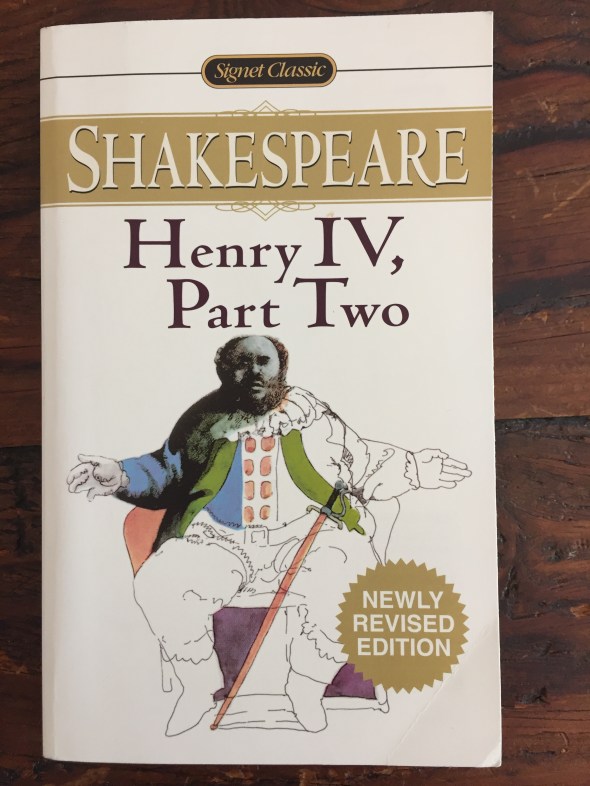
which starts off with a friggin bang:
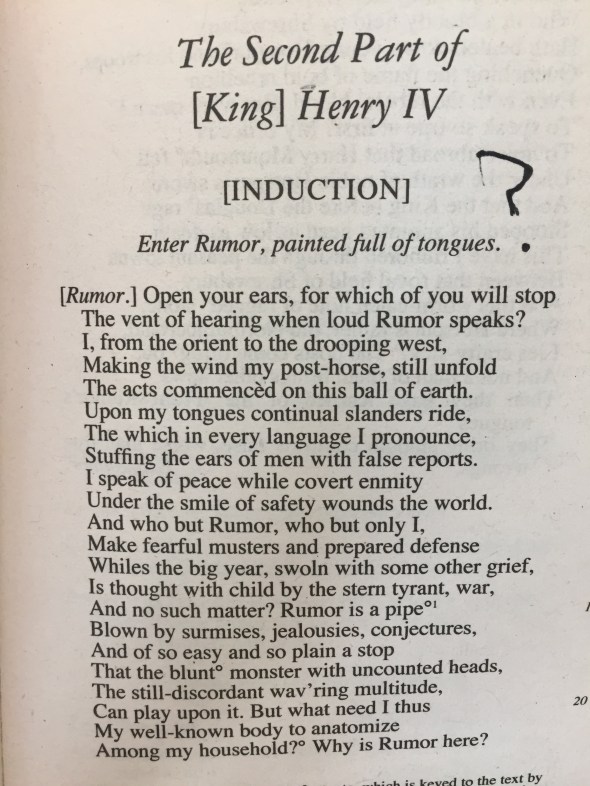
for which of you will stop
The vent of hearing when loud Rumor speaks?
Now we’re getting somewhere.

Will Kempe
Let’s pick up there next time! Thanks for joining Henry IV study buddies!
PTA
Posted: January 19, 2018 Filed under: actors, writing Leave a comment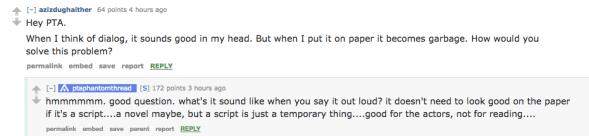
Liked this quote from PTA’s AMA where he says the script is “just a temporary thing”
Is this interesting: The Usual Suspects
Posted: December 5, 2017 Filed under: actors Leave a comment
Kevin Spacey first came to my (and many people’s) attention playing a character in The Usual Suspects who pretends to be harmless if annoying, but who is actually an evil monster.
Now, Kevin Spacey the real man, is revealed to have been pretending to be harmless if annoying when he was in fact a bit of an evil monster.
Interesting?
Uma’s example
Posted: November 16, 2017 Filed under: actors, buddhism, heroes Leave a comment
into Uma’s example of not speaking in anger and waiting to be ready to speak on stuff.
feel like Twitter Internet etc. has made everyone feel like they need to have a Take on everything instantly. I enjoy a good Take a much as anybody. But feel like I can’t remember the last time I heard someone say “I need to reflect on this before I comment.”
Remembering that Uma’s father is a scholar of Buddhism.

The Man From Onion Valley. source.
Was the last joke Abe Lincoln heard funny?
Posted: September 20, 2017 Filed under: actors, comedy 1 Comment
I can’t be the first amateur historian / comedy writer to get interested in this question.
It’s presumed that John Wilkes Booth, who knew the play, waited for what he knew would be a big laugh line, which was:
Don’t know the manners of good society, eh? Well, I guess I know enough to turn you inside out, old gal — you sockdologizing old man-trap.
Let’s back up a bit.

Lincoln, as errbody knows, was watching Our American Cousin at the time of his death.
The plot of Our American Cousin is a coarse but honest American goes to the UK to claim an inheritance and gets involved in the various shenanigans of his snooty distant relatives who are trying to keep up appearances and marry off daughters and so on. Seems like a pretty good premise. A Frasier-esque farce satirizing pretension and manners.

good source for these images is BoothieBarn, though not sure how to feel about the name
Our American Cousin was written by Tom Taylor.

He had a career as a lawyer and bureaucrat and magazine editor.

Our American Cousin doesn’t seem to have been his biggest hit, that might’ve been:

which isn’t a comedy. They made that one into a movie a few times, most recently in 1937.
Our American Cousin premiered in New York in 1858 and was a hit.
Stealing the show was Edward Askew Sothern as Lord Dundreary:

Askew Sothern almost hadn’t taken the part:
At first, he was reluctant to accept the role; it was so small and unimportant that he felt it beneath him and feared it might damage his reputation.[7][8] He mentioned his qualms to his friend, Joseph Jefferson, who had been cast in the leading role of Asa Trenchard in the play. Jefferson supposedly responded with the famous line: “There are no small parts, only small actors.”[9]
Huh.
After a couple of unhappy weeks in the small role, Sothern began portraying the role as a lisping, skipping, eccentric, weak-minded fop prone to nonsensical references to sayings of his “bwother” Sam. His ad-libs were a sensation, earning good notices for his physical comedy and spawning much imitation and merry mockery on both sides of the Atlantic. His exaggerated, droopy side-whiskers became known as “Dundrearys”. Sothern gradually expanded the role, adding gags and business until it became the central figure of the play. The most famous scene involved Dundreary reading a letter from his even sillier brother.
Sounds funny enough. Kind of like this:
I can’t determine if Sothern was in the Ford’s Theater production, or if they got a different Dundreary. Appears on this night Dundreary may have been played by one E. A. Emerson.
But top bill the Ford’s Theater night went to Laura Keene.

Born Mary Francis Moss, she married a former British Army officer who committed some crime or another and got transported to Australia on a prison ship. To support herself and her kids she became Laura Keene, a popular actress.
She appeared with Edwin Booth many times, they even toured Australia together.
At this point, she lined up investors, along with an architect who specialized in theaters, and a new theater was constructed to her specifications. Named the Laura Keene’s Theatre, it opened on 18 November 1856. In 1858, Our American Cousin debuted in Laura Keene’s Theater.
A badass, as they say. A strong female multi-hyphenate.
Some years later they revived the play for a kind of benefit night, and that’s how Lincoln ended up there.
John Wilkes Booth waited for a big laugh line:
Halfway through Act III, Scene 2, the character of Asa Trenchard, played that night by Harry Hawk, utters this line, considered one of the play’s funniest, to Mrs. Mountchessington:
Don’t know the manners of good society, eh? Well, I guess I know enough to turn you inside out, old gal — you sockdologizing old man-trap.

Harry Hawk in costume:

I found that image through the website for The Persistence of Dreams, this four minute recreation movie of that night at the theater (warning: violence):
Sockdologizing was a made up word, invented in this play. It seems that around this time people found the word “doxology” to be funny. It may have been a play on that.
The phrase sounds weird to our ears. But I bet if you heard it, delivered with solid timing by a charming actor like Harry Hawk, playing into the role of the lovably blunt Asa Trenchard, it was probably amusing.
Anyway, I conclude that yes, the last joke Abe Lincoln heard was pretty funny, even if it may not be exactly hilarious to us these many years later.
Career. Woman.
Posted: May 10, 2017 Filed under: actors, comedy, Japan Leave a comment
Asked an Osaka resident what was going on in Japanese comedy these days, and he directed me to Buruzon Chiemi.
All I Gotta Do Is Act Naturally
Posted: April 24, 2017 Filed under: actors, the California Condition Leave a comment
When I first got to California a real curiosity was Bakersfield and the Bakersfield Sound.
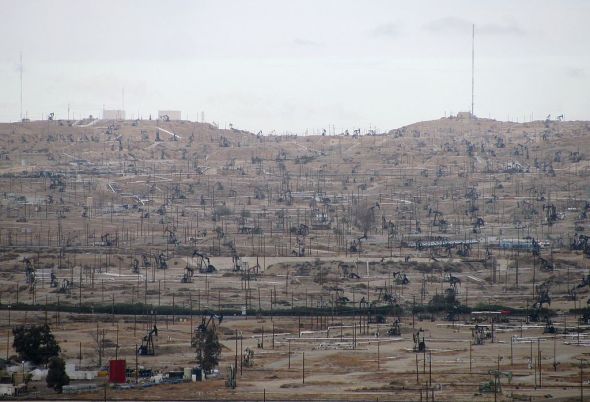
from wiki’s article on the Kern River Oilfield. Photo by Antantrus
What the hell was going on up there in Bakersfield? There were four Basque restaurants in town.

Buck Owens was the king of the Bakersfield sound, he had the Crystal Palace. He died before I got to see him. From Wiki:
The Los Angeles Times interviewed longtime Owens spokesman (and Buckaroos keyboard player) Jim Shaw, who said Owens “had come to the club early and had a chicken fried steak dinner and bragged that it’s his favorite meal.”
bragged?
Afterward, Owens told band members that he wasn’t feeling well and was going to skip that night’s performance. Shaw said a group of fans introduced themselves while Owens was preparing to drive home; when they told him that they had traveled from Oregon to hear him perform, Owens changed his mind and took the stage anyway.
Shaw recalled Owens telling the audience, “If somebody’s come all that way, I’m gonna do the show and give it my best shot. I might groan and squeak, but I’ll see what I can do.” Shaw added, “So, he had his favorite meal, played a show and died in his sleep. We thought, that’s not too bad.”
The alpha song of the Bakersfield sound has to be Act Naturally. The Beatles had Ringo sing it:
I’ve probably listened to the Buck Owens version between 50 and 100 times. It continues to reveal itself. How about the the paradox of acting naturally.
Only very very good actors are capable of truly acting naturally.
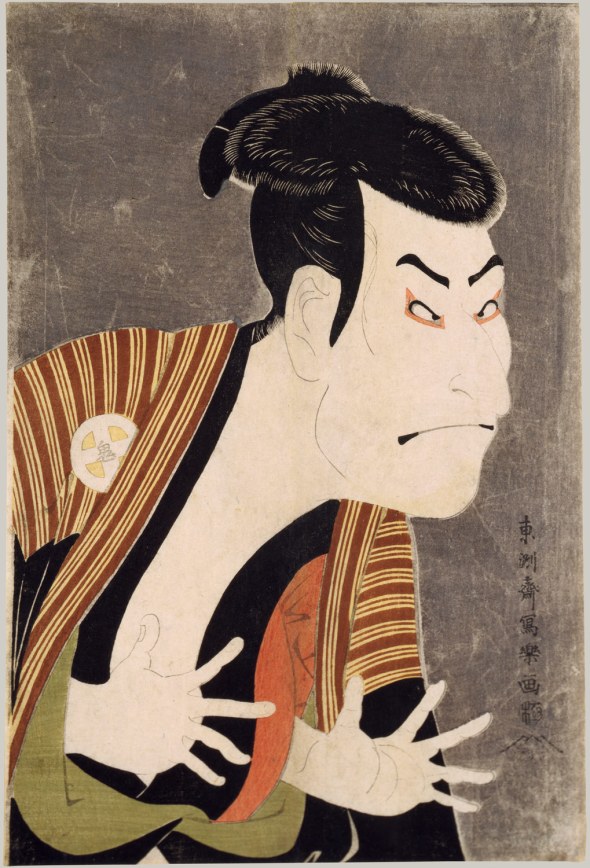
Otani Oniji II as Yakko Edobei in the Play “Koinyabo Somewake Tazuna”
Saraku, Toshusai (worked 1794-1795)
Polychrome woodblock print with mica ground
h. 15 in. w. 9-7/8 in.
from the Met.
Did Otani Onjii act naturally?
Whole acting schools are devoted to teaching people how to act naturally.
Why do people have so much trouble acting naturally?
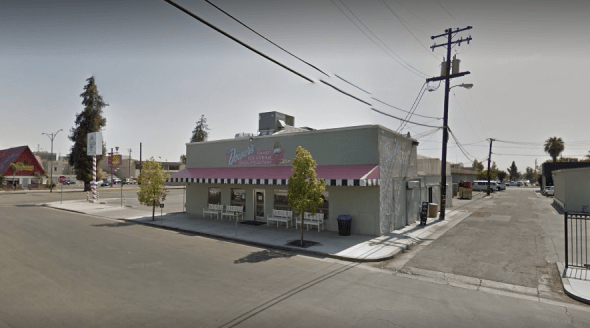
If you’re in Bakersfield get an ice cream sundae at Dewar’s.

History of theater
Posted: April 2, 2017 Filed under: actors, Japan Leave a comment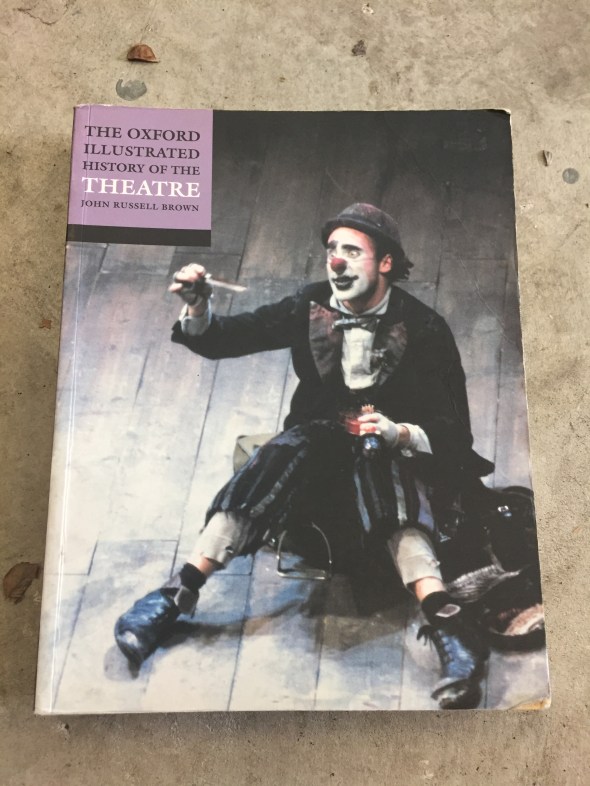
Trying to help Filip and Fredrik out on their commedia del’arte question, I pull down my Oxford Illustrated History of the Theater.
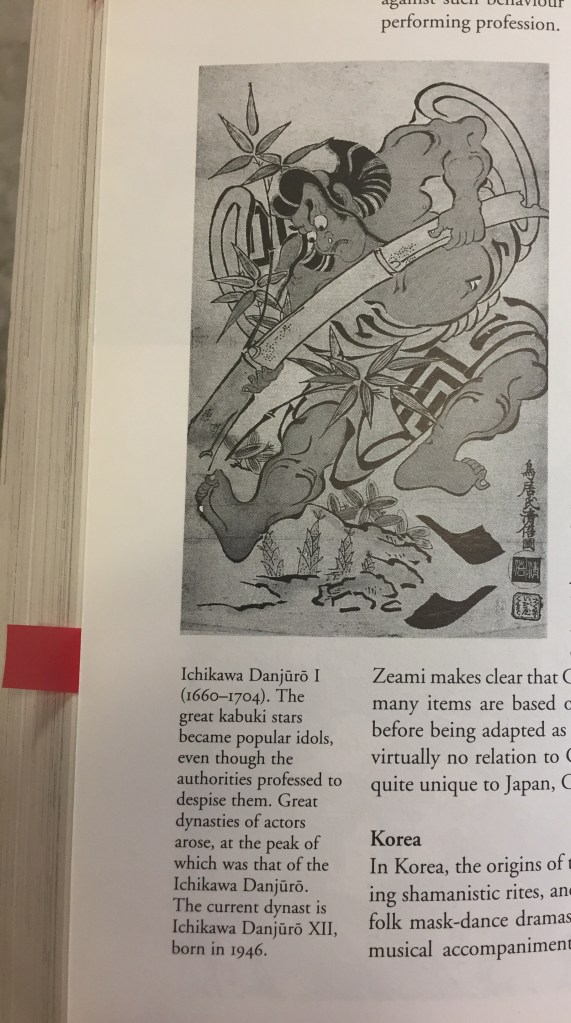
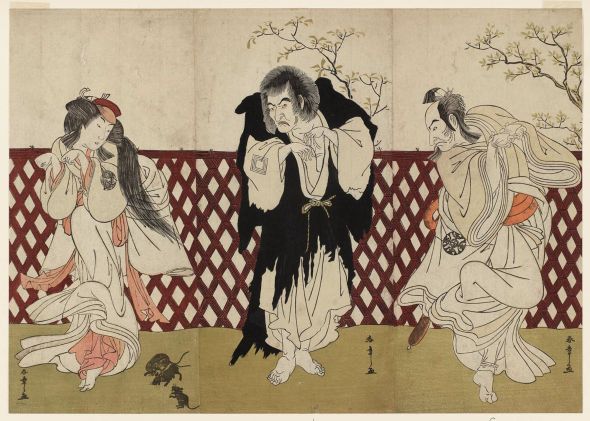
There I learn the reason there are no female kabuki actresses:
The earliest kabuki performers were women, but later all roles, including female, were played by men. This was because the government banned women from the stage in 1629, their policy being that nobody should follow more than one profession: this prevented women from being both prostitutes and actresses.
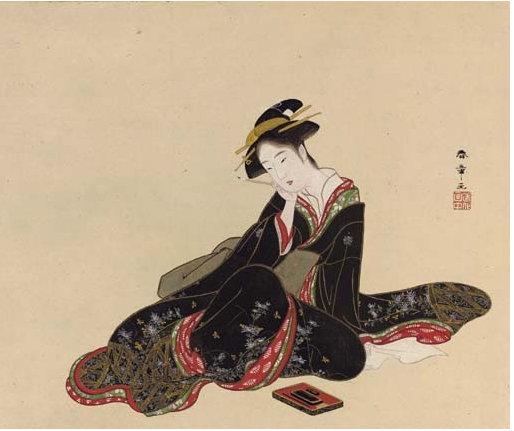
source: ukiyo-e.org
McConaughey Story
Posted: January 23, 2017 Filed under: actors, Texas Leave a comment
Study of McConaughey is always rewarding. The best part of the above video is the first few seconds :12-:36
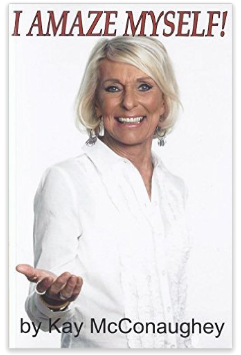
It’s unfortunate that used copies of I Amaze Myself!, McConaughey’s mother’s autobiography, are unreasonably priced. I’m interested in more stories like this.
Thoughts of a Philosophical Fighter Pilot
Posted: November 20, 2016 Filed under: actors, America Since 1945, heroes, Vietnam Leave a comment
Remember this guy? For some reason or another I bought this pamphlet of a speech he gave at King’s College, London, November 1993:
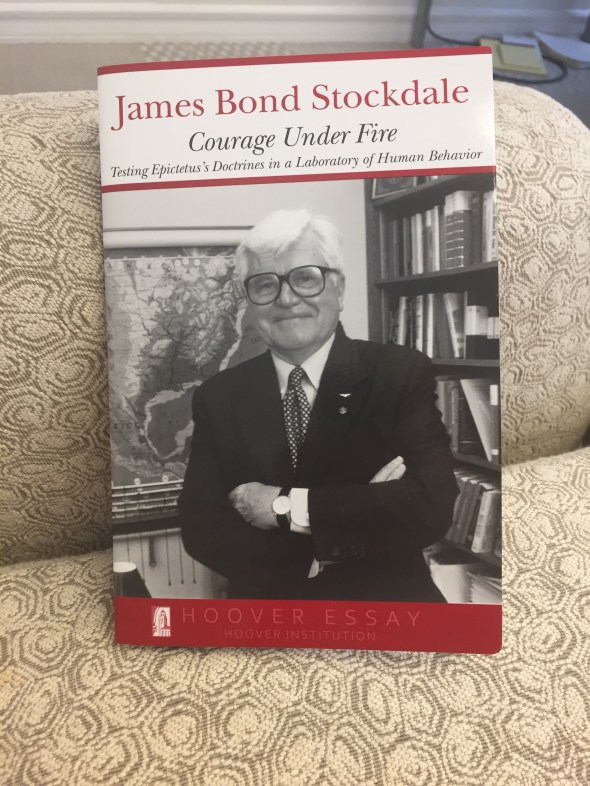
Stockdale was a 38 year old naval aviator when he got sent to Stanford for two years of study. He was pretty bored until a professor handed him a copy of The Enchiridion, a collection of the teachings of Epictetus.
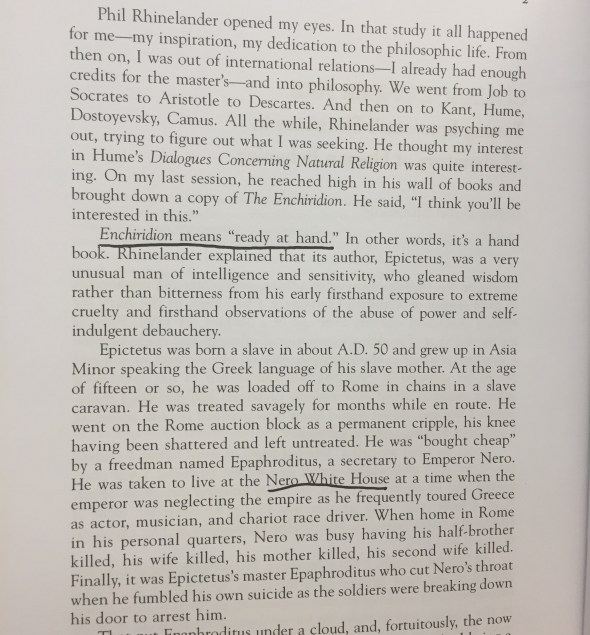
What does Epictetus teach?

He taught how to play the game of life with perspective: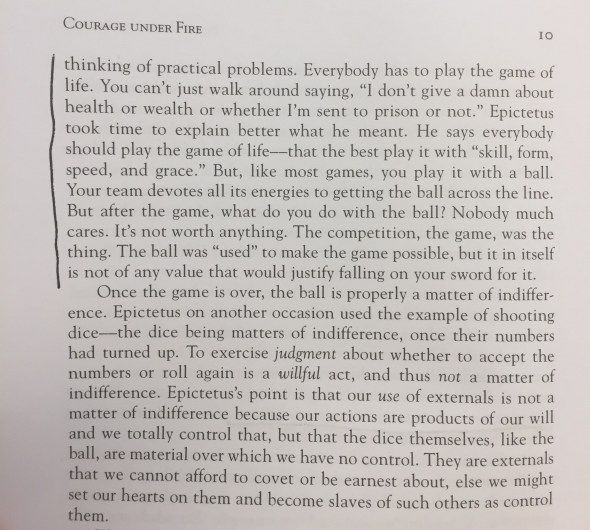
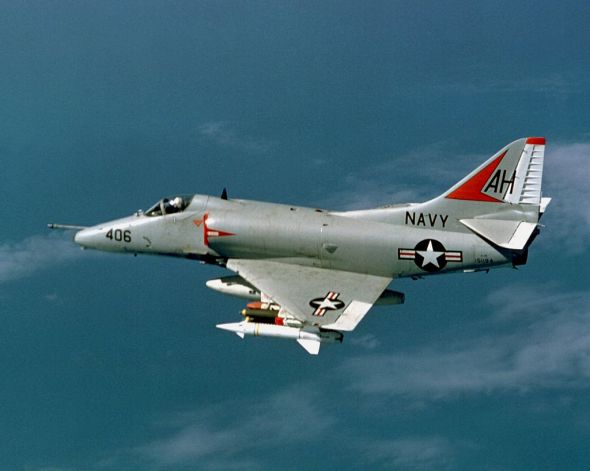
an A-4
Five years later, this is what happened to Stockdale:
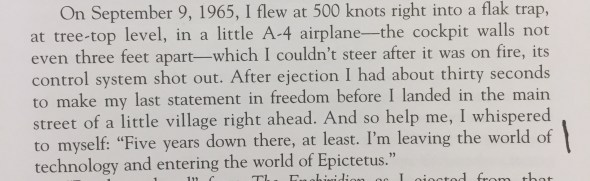
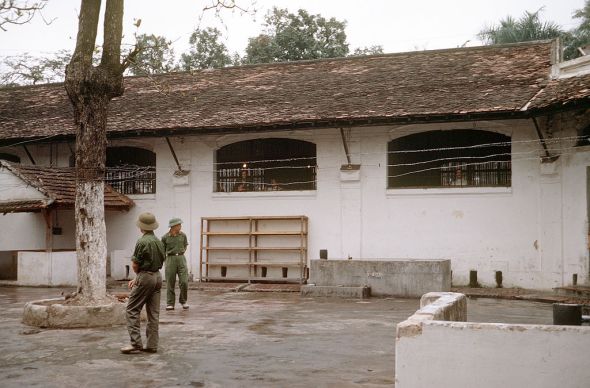
Stockdale was wrong about how long he’d be there. He was there for 7 1/2 years, much of it in solitary confinement:
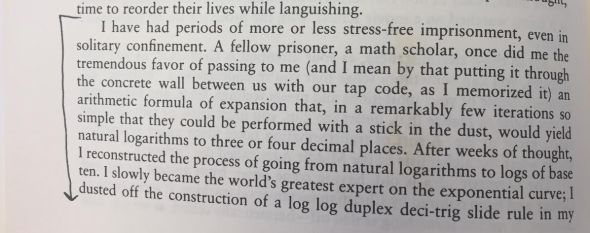
How did he spend his time? Well, for one thing he constructed a sliderule in his mind from equations tapped to him in code through a concrete wall::
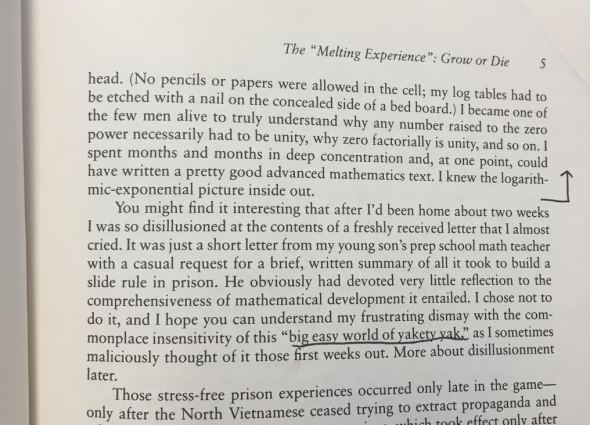
A bigger collection of Stockdale’s speeches and essays:
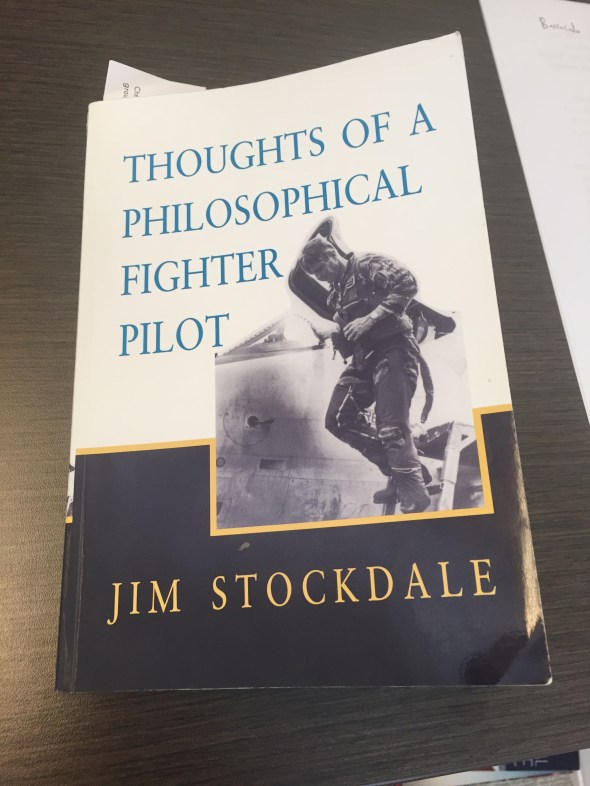
where he distills what he learned through his prison experience down to “one all-purpose idea, plus a few corollaries”:
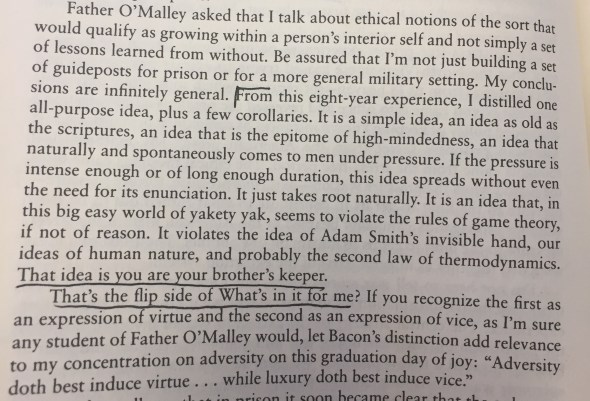
What he has to say about public virtue is distressing as I watch the future president:

A badass:
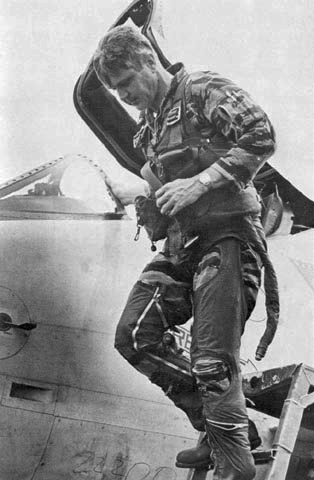
Recommend Courage Under Fire, which costs five bucks or $3.85 on Kindle. Thoughts Of A Philosophical Fighter Pilot is for the serious Stockdale student.
I think you can appreciate the greatness of Stockdale and also find this funny:
http://www.nbc.com/saturday-night-live/video/joyride-with-perot/n10313
Coverage of another philosophical fighter pilot, John Boyd, here.
http://www.hulu.com/watch/4123
Microsociology
Posted: July 12, 2016 Filed under: actors, America Since 1945, how to live, sexuality, war Leave a commentHow many interesting things are in sociologist Randall Collins’ latest post (which is maybe the text of a speech or something?) Let me excerpt some for us. I have highlighted some nuggets:

I will add a parallel that is perhaps surprising. Those who know Loic Wacquant would not expect to find silent harmony. Nevertheless, Wacquant’s study of a boxing gym finds a similar pattern: there is little that boxers do in the gym that they could not do at home alone, except sparring; but in the gym they perform exercises like skipping, hitting the bags, strengthening stomach muscles, all in 3-minute segments to the ring of the bell that governs rounds in the ring. When everyone in the gym is in the same rhythm, they are animated by a collective feeling; they become boxers dedicated to their craft, not so much through minds but as an embodied project.
A large proportion of violent confrontations of all kinds– street fights, riots, etc.– quickly abort; and most persons in those situations act like Marshall’s soldiers– they let a small minority of the group do all the violence. Now that we have photos and videos of violent situations, we see that at the moment of action the expression on the faces of the most violent participants is fear. Our folk belief is that anger is the emotion of violence, but anger appears mostly before any violence happens, and in controlled situations where individuals bluster at a distant enemy. I have called thisconfrontational tension/fear; it is the confrontation itself that generates the tension, more than fear of what will happen to oneself. Confrontational tension is debilitating; phenomenologically we know (mainly from police debriefings after shootings) that it produces perceptual distortions; physiologically it generates racing heart beat, an adrenaline rush which at high levels results in loss of bodily control.
This explains another, as yet little recognized pattern: when violence actually happens, it is usually incompetent. Most of the times people fire a gun at a human target, they miss; their shots go wide, they hit the wrong person, sometimes a bystander, sometimes friendly fire on their own side. This is a product of the situation, the confrontation. We know this because the accuracy of soldiers and police on firing ranges is much higher than when firing at a human target. We can pin this down further; inhibition in live firing declines with greater distance; artillery troops are more reliable than infantry with small arms, so are fighter and bomber crews and navy crews; it is not the statistical chances of being killed or injured by the enemy that makes close-range fighters incompetent. At the other end of the spectrum, very close face-to-face confrontation makes firing even more inaccurate; shootings at a distance of less than 2 meters are extremely inaccurate. Is this paradoxical? It is facing the other person at a normal distance for social interaction that is so difficult. Seeing the other person’s face, and being seen by him or her seeing your seeing,is what creates the most tension. Snipers with telescopic lenses can be extremely accurate, even when they see their target’s face; what they do not see is the target looking back; there is no mutual attention, no intersubjectivity. Mafia hit men strike unexpectedly and preferably from behind, relying on deception and normal appearances so that there is no face confrontation. This is also why executioners used to wear hoods; and why persons wearing face masks commit more violence than those with bare faces.
NOTE THE POLICY IMPLICATION: The fashion in recent years among elite police units to wear balaclava-style face masks during their raids should be eliminated.

How does violence sometimes succeed in doing damage? The key is asymmetrical confrontation tension. One side will win if they can get their victim in the zone of high arousal and high incompetence, while keeping their own arousal down to a zone of greater bodily control. Violence is not so much physical as emotional struggle; whoever achieves emotional domination, can then impose physical domination. That is why most real fights look very nasty; one sides beats up on an opponent at the time they are incapable of resisting. At the extreme, this happens in the big victories of military combat, where the troops on one side become paralyzed in the zone of 200 heartbeats per minute, massacred by victors in the 140 heartbeat range. This kind of asymmetry is especially dangerous, when the dominant side is also in the middle ranges of arousal; at 160 BPM or so, they are acting with only semi-conscious bodily control. Adrenaline is the flight-or-fight hormone; when the opponent signals weakness, shows fear, paralysis, or turns their back, this can turn into what I have called a forward panic, and the French officer Ardant du Picq called “flight to the front.” Here the attackers rush forward towards an unresisting enemy, firing uncontrollably. It has the pattern of hot rush, piling on, and overkill. Most outrageous incidents of police violence against unarmed or unresisting targets are forward panics, now publicized in our era of bullet counts and ubiquitous videos.

Another pathway is where the fight is surrounded by an audience; people who gather to watch, especially in festive crowds looking for entertainment; historical photos of crowds watching duels; and of course the commercial/ sporting version of staged fights. This configuration produces the longest and most competent fights; confrontational tension is lowered because the fighters are concerned for their performance in the eyes of the crowd, while focusing on their opponent has an element of tacit coordination since they are a situational elite jointly performing for the audience. Even the loser in a heroic staged fight gets social support. We could test this by comparing emotional micro-behavior in a boxing match or a baseball game without any spectators.
(among the photos that come up if you Google “crowd watching a duel”:

Title: Crowd reflected in water while watching Sarazen and Ouimet duel at Weston Country Club

Beardsley vs Salazar in the 1982 Boston Marathon
Finally, there are a set of techniques for carrying out violence without face confrontation. Striking at a distance: the modern military pathway. Becoming immersed in technical details of one’s weapons rather than on the human confrontation. And a currently popular technique: the clandestine attack such as a suicide bombing, which eliminates confrontational tension because it avoids showing any confrontation until the very moment the bomb is exploded. Traditional assassinations, and the modern mafia version, also rely on the cool-headedness that comes from pretending there is no confrontation, hiding in Goffmanian normal appearances until the moment to strike.
All this sounds rather grisly, but nevertheless confrontational theory of violence has an optimistic side. First, there is good news: most threatening confrontations do not result in violence. (This is shown also in Robert Emerson’s new book on quarrels among roommates and neighbours.) We missed this because, until recently, most evidence about violence came from sampling on the dependent variable. There is a deep interactional reason why face-to-face violence is hard, not easy. Most of the time both sides stay symmetrical. Both get angry and bluster in the same way. These confrontations abort, since they can’t get around the barrier of confrontational tension. Empirically, on our micro-evidence, this zero pathway is the most common. Either the quarrel ends in mutual gestures of contempt; or the fight quickly ends when opponents discover their mutual incompetence. Curtis Jackson-Jacobs’ video analysis shows fist-fighters moving away from each other after missing with a few out-of-rhythm punches. If no emotional domination happens, they soon sense it.
More:
Anne Nassauer, assembling videos and other evidence from many angles on demonstrations, finds the turning points at which a demo goes violent or stays peaceful. And she shows that these are situational turning points, irrespective of ideologies, avowed intent of demonstrators or policing methods. Stefan Klusemann, using video evidence, shows that ethnic massacres are triggered off in situations of emotional domination and emotional passivity; that is, local conditions, apart from whatever orders are given by remote authorities. Another pioneering turning-point study is David Sorge’s analysis of the phone recording of a school shooter exchanging shots with the police, who nevertheless is calmed down by an office clerk; she starts out terrified but eventually shifts into an us-together mood that ends in a peaceful surrender. Meredith Rossner shows that restorative justice conferences succeed or fail according to the processes of interaction rituals; and that emotionally successful RJ conferences result in conversion experiences that last for several years, at least. Counter-intuitively, she finds that RJ conferences are especially likely be successful when they concerns not minor offenses but serious violence; the intensity of the ritual depends on the intensity of emotions it evokes.

High authorities are hard to study with micro methods, since organizational high rank is shielded behind very strong Goffmanian frontstages. David Gibson, however, analyzing audio tapes of Kennedy’s crisis group in the Cuban Missile Crisis of 1962, penetrated the micro-reality of power in a situation in which all the rationally expectable scenarios led toward nuclear war. Neither JFK nor anyone else emerges as a charismatic or even a decisive leader. The group eventually muddled their way through sending signals that postponed a decision to use force, by tacitly ignoring scenarios that were too troubling to deal with. This fits the pattern that conversation analysts call the preference for agreement over disagreement, at whatever cost to rationality and consistency.
How about how social interactions affect job interviews?:
We have a long way to go to generalize these leads into a picture of how high authority really operates. Does it operate the same way in business corporations? The management literature tells us how executives have implemented well thought-out programs; but our information comes chiefly from retrospective interviews that collapse time and omit the situational process itself. Lauren Rivera cracks the veneer of elite Wall Street firms and finds that hiring decisions are made by a sense of emotional resonance between interviewer and interviewee, the solidarity of successful interaction rituals. Our best evidence of the micro details of this process comes from another arena, where Dan McFarland and colleagues analyze recorded data on speed dating, and find that conversational micro-rhythms determine who felt they “clicked” with whom.
OK what about sex?
I will end this scattered survey with some research that falls into the rubric of Weberian status groups, i.e. social rankings by lifestyle. David Grazian has produced a sequence of books,Blue Chicago and On the Make, that deal with night life. This could be considered a follow-up to Goffman’s analysis of what constitutes “fun in games” as well as “where the action is.” For Grazian, night-life is a performance of one’s “nocturnal self,” characterized by role-distance from one’s mundane day-time identity. By a combination of his own interviewing behind the scenes and collective ethnographies of students describing their evening on the town, from pre-party preparation to post-party story-telling, Grazian shows how the boys and the girls, acting as separate teams, play at sexual flirtation which for the most part is vastly over-hyped in its real results. It is the buzz of collective effervescence that some of these teams generate that is the real attraction of night life. And this may be an appropriate place to wind up. Freud, perhaps the original micro-sociologist, theorized that sexual drive is the underlying mover behind the scenes. Grazian, looking at how those scenes are enacted, finds libido as socially constructed performance. As is almost everything else.

In conclusion. Will interaction ritual, or for that matter micro-sociology as we know it, become outdated in the high-tech future? This isn’t futuristic any more, since we have been living in the era of widely dispersed information technology for at least 30 years, and we are used to its pace and direction of change. A key point for interaction ritual is that bodily co-presence is one of its ingredients. Is face contact needed? Rich Ling analyzed the everyday use of mobile phones and found that the same persons who spoke by phone a lot also met personally a lot. Cell phones do not substitute for bodily co-presence, but facilitate it. Among the most frequent back-and-forth, reciprocated connections are people coordinating where they are. Ling concluded that solidarity rituals were possible over the phone, but that they were weaker than face-to-face rituals; one was a teaser for the other.
…
Conceivably future electronic devices might wire up each other’s genitals, but what happens would likely depend on the micro-sociological theory of sex (chapter 6 in Interaction Ritual Chains): the strongest sexual attraction is not pleasure in one’s genitals per se, but getting the other person’s body to respond in mutually entraining erotic rhythms: getting turned on by getting the other person turned on. If you don’t believe me, try theorizing the attractions of performing oral sex. This is an historically increasing practice, and one of the things that drives the solidarity of homosexual movements. Gay movements are built around effervescent scenes, not around social media.
I will try theorizing the attractions of performing oral sex, Professor!
I recommend Collins’ book written with Maren McConnell, Napoleon Never Slept: How Great Leaders Leverage Social Energy, which I bought and read though I do wish there was a print edition.
Previous coverage about Collins’ work. Shoutout to Brent Forrester, who I think put me on to him.
 Helytimes
.jpg)

#/media/File:Ticket_of_leave_man_-_Weir_Collection.jpg)
