Suttree
Posted: March 27, 2019 Filed under: America Since 1945, books, cormac, writing Leave a comment
Moving stuff around in my house I found the handwritten list of words I had to look up from Suttree, by Cormac McCarthy, and their definitions.


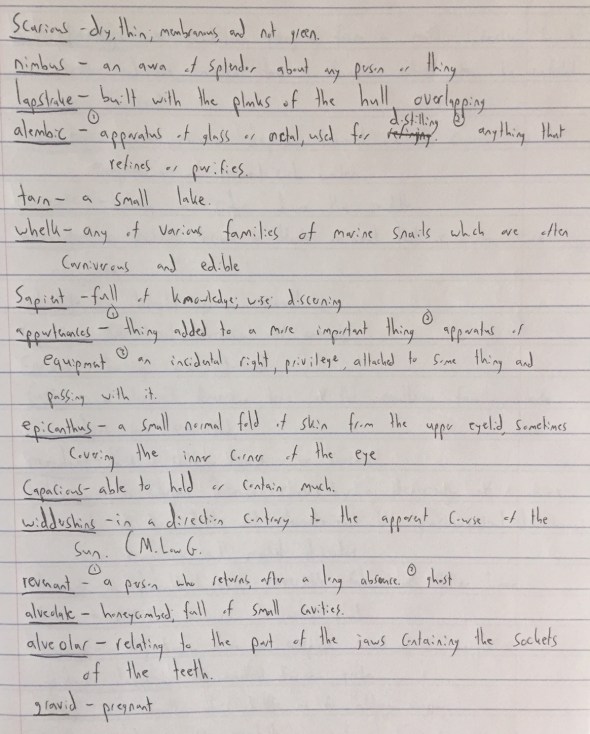

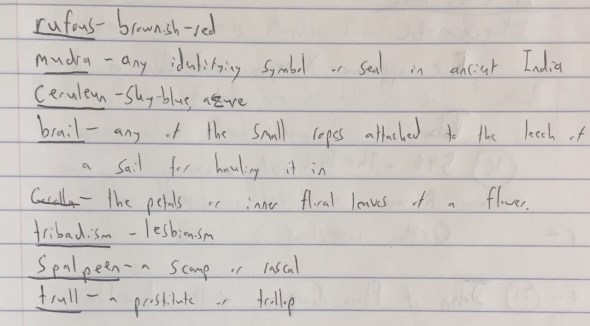
Trull: a prostitute or a trollop.
Tellurian: an inhabitant of Earth.
Feels like I used to have a lot more spare time.
Suttree is set along the river in Knoxville, TN.

If you think Suttree might be for you, try the first sentence:
Dear friend now in the dusty clockless hours of the town when the streets lie black and steaming in the wake of the watertrucks and now when the drunk and the homeless have washed up in the lee of walls in alleys or abandoned lots and cats go forth highshouldered and lean in the grim perimeters about, now in these sootblacked brick or cobbled corridors where lightwire shadows make a gothic harp of cellar doors no soul shall walk save you.

Marijuana and psychosis
Posted: March 26, 2019 Filed under: America Since 1945, business, coffee Leave a comment
This was in today’s Economist newsletter, and I’ve seen it elsewhere too. Scary! But then again, what is the definition of psychosis?

Isn’t getting your thought and emotions so impaired that you lose contact with external reality the point of high THC content marijuana? Is this a feature not a bug? External reality can be rough.
The study, in The Lancet, used the ICD-10 Criteria (F20-33), so schizophrenia and manic/bipolar episodes. The study compared people hospitalized for that kind of thing versus a control general population. Here’s how the study worked:
We included patients aged 18–64 years who presented to psychiatric services in 11 sites across Europe and Brazil with first-episode psychosis and recruited controls representative of the local populations.
Then this part:
We applied adjusted logistic regression models to the data to estimate which patterns of cannabis use carried the highest odds for psychotic disorder. Using Europe-wide and national data on the expected concentration of Δ9-tetrahydrocannabinol (THC) in the different types of cannabis available across the sites, we divided the types of cannabis used by participants into two categories: low potency (THC <10%) and high potency (THC ≥10%). Assuming causality, we calculated the population attributable fractions (PAFs) for the patterns of cannabis use associated with the highest odds of psychosis and the correlation between such patterns and the incidence rates for psychotic disorder across the study sites.
“expected” and “assuming” are two words that do a lot of work here, but I don’t have time to read the whole study, I have to write cartoons.
In my neighborhood the most booming new shops sell either marijuana or cold brew coffee. Personally I wonder if drinking huge amounts of highly caffeinated cold brew might be more crazy-making than marijuana.
There is certainly ample psychosis in Los Angeles, so much so that it might be necessary to induce mild psychosis just so you can understand what’s going on with everybody. The chicken and egg, correlation and causation on psychosis / drug use is a tough one to unravel, as the study’s authors acknowledge. The study also notes that patients presenting with psychosis were more likely to have smoked ten or more cigarettes a day.
Cornel West and Peter Thiel
Posted: March 25, 2019 Filed under: America Since 1945 Leave a comment
This isn’t content for everybody but watching Cornel West and Peter Thiel in convo is appealing to me.
Had a class with Professor Unger and what I most remember is him describing an infantilization he was perceiving among young people. Perhaps old people always think that the next crop of young people is infantile.
How to tell Bruce Springsteen bad news
Posted: February 21, 2019 Filed under: America Since 1945, business, music Leave a comment
DEADLINE: What parallels were there between Silvio and Miami Steve? You can see the affection between you and Springsteen onstage, and in the stories Bruce tells between songs about the old days.
VAN ZANDT: The common dynamic is, as a best friend you have an obligation to tell the truth and you’ve got to know when to do that and how to do that, and it’s never going to be easy when it’s bad news. But once in a while, hopefully rarely, but once in a while you’ve got to be the one to bring the bad news because nobody else is going to do it, so you’re obligated. That’s your responsibility as a best friend. Sometimes they will get mad at you and then, as happened on the show, you see occasionally Jimmy will be screaming at me over something and that’s how it is in real life.
It’s just one of those things that goes with that job, that relationship, in being the only one who’s not afraid of the boss because you grew up together and that puts you in a special category that is very, very useful and very helpful to that boss whether they like it or not. No boss likes to hear bad news or hear they made a mistake. You can’t do it every day or even that often, but when it’s really, really important, you pick your moment and you’ve got to take the consequences and you just have to live with that. That’s the job. And ironically, right after we filmed, Bruce decides to put the band back together that same year.
from this Deadline oral history of The Sopranos.
John Wayne
Posted: February 20, 2019 Filed under: America Since 1945, writing 1 Comment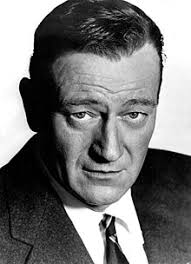
some recent Twitter stir about John Wayne’s unwoke Playboy interview from the ’70s got me looking up a phrase that stuck in my craw since I read it. It’s Charles Portis, author of True Grit, telling his impression of seeing Wayne on a movie set.
What impressions do you have of John Wayne from the film?
“Wayne was a bigger man than I expected. He was actually bigger than his image on screen, both in stature and presence. One icy morning, very early, before sunrise, we were all having breakfast in a motel…. A tourist came over to speak. Wayne rose to greet her. He stood there, not fidgeting and just hearing her out, but actively listening, and chatting with her in an easy way, as his fried eggs congealed on the plate. I took this to be no more than his nature. A gentleman at four o’clock on a cold morning is indeed a gentleman.”
Found that here on the Fort Smith National Historic Site website.
Munger speaks
Posted: February 15, 2019 Filed under: America Since 1945, business Leave a comment
Looking forward to getting a transcript of Charlie Munger yesterday at the Daily Journal shareholders’ conference. Here the 95 year old former meteorologist and HelyTimes Hero talks to CNBC’s Becky Quick:
BECKY QUICK: Anything that rises to your radar screen now that may be under the radar for other people?
CHARLIE MUNGER: Well, nobody knows how much of this money printing we can do. And of course we have politicians who like– and are in both parties, who like to believe that it doesn’t matter how much you do. That we can ignore the whole subject and just print money as convenient. Well, that’s the way the Roman Empire behaved, then it was ruined. And that’s the way the Weimar Republic was ruined. And– it’s– there is a point where it’s dangerous. You know, and of course, my attitude when something is big and dangerous is to stay a long way away from it. Other people want to come as close as possible without going in. That’s too tricky for me. I don’t like it.
BECKY QUICK: In terms of possibly getting sucked up into it?
CHARLIE MUNGER: Yes. I– I– if there’s a big whirlpool in the river, I stay a long way away from it. There were a bunch of canoeists once that tried to– to run the Aaron Rapids. I think they were from Scandinavia. And– and the fact that the whirlpools were so big made them very eager to tackle this huge challenge. The death rate was 100%. I regard that as a normal result.
Are we in The Great Stagnation?
CHARLIE MUNGER: The opportunities that we all remember came from a demoralized period when about 90% of the natural stock buyers got very discouraged with stocks. That’s what created the opportunity for these fabulous records that my generation had. And that was a rare opportunity that came to a rare group of people of whom I was one. And Warren was another.
BECKY QUICK: So you’re talking–
CHARLIE MUNGER: And people who start now have a much less– they have lower opportunity.
BECKY QUICK: Do you think we saw a generational low after 2008, beginning of 2009?
CHARLIE MUNGER: Generational? Maybe.
Life advice:
BECKY QUICK: Charlie, so many of the people who come here come because they’re looking for advice not on business or investments as much as they’re looking for just advice on life. There were a lot of questions today, people trying to figure out what the secret to life is, to a long and happy life. And– and I just wonder, if you were–
CHARLIE MUNGER: Now that is easy, because it’s so simple.
BECKY QUICK: What is it?
CHARLIE MUNGER: You don’t have a lot of envy, you don’t have a lot of resentment, you don’t overspend your income, you stay cheerful in spite of your troubles. You deal with reliable people and you do what you’re supposed to do. And all these simple rules work so well to make your life better. And they’re so trite.
BECKY QUICK: How old were you when you figured this out?
CHARLIE MUNGER: About seven. I could tell that some of my older people were a little bonkers. I’ve always been able to recognize that other people were a little bonkers. And it helped me because there’s so much irrationality in the world. And I’ve been thinking about it for a long time, its causes and its preventions, and so forth, that I– sure it’s helped me.
I noticed a glitch in the transcript, btw. It’s written as follows:
BECKY QUICK: Do you think we saw a generational low after 2008, beginning of 2009?
CHARLIE MUNGER: Generational? Maybe.
BECKY QUICK: We–
CHARLIE MUNGER: Yeah, I don’t think the market is going to be cheaper.
But if you listen closely it’s pretty clear Munger says “I don’t think Bank of America is going to be cheaper.” Almost exactly nine years ago today, Feb 2009, BAC was trading at $5.57. Today it’s at $29.12.
On Tactics by B. A. Friedman
Posted: February 15, 2019 Filed under: America Since 1945, war, writing Leave a comment This book is an excellent size and weight. Small, portable, yet solid. It’s published by the Naval Institute Press, they who took a chance on an unknown insurance man named Tom Clancy who’d written a thriller called The Hunt For Red October.
Amazon suggested this book to me as I was browsing translations of Sun Tzu. Military history has interested me since I was a boy, maybe because 1) the stakes are so high and 2) the stories are so vivid. Metaphors and similes drawn from famous war events are powerful and stark. Consider for example Friedman’s description of the Battle of the Bulge:
… Although the Germans had caught the Allies at their culminating point, the Germans reached their own far too early. Newly created infantry units were filled with hastily trained and inexperienced conscripts. These green units could not effectively hold the territory gained by the leading panzer units. On 22 December the fog cleared and Allied air units hammered the German formations from the skies. Despite the prestaged fuel reserves, panzer units still ran out of fuel, just when they needed it to escape the Allied aerial counterattack.
Buried in there is a tactical lesson, and also an intense story about some poor children getting blown up right before Christmas.
The author was a second lieutenant in the Marine Corps. If I understand right, might make this book the equivalent of a book called like Writing A Hit TV Show by a staff writer. But Friedman seems like he’s gone deep on the knowledge, and there’s a quote from Gen. Anthony Zinni on the back. Good enough for me.
Alexander The Great would not be in the least bit perplexed by the enemy that we face right now in Iraq, and our leaders going into this fight do their troops a disservice by not studying — studying, vice just reading – the men who have gone before us. We have been fighting on this planet for 5,000 years and we should take advantage of their experience.
So goes a quote from James Mattis that opens this book. Friedman cites the example of Cortes in 1520 CE, referring to written accounts of Alexander’s battle at Gaugamela eighteen hundred years before to design his tactics against the Mexica/Aztec.
What is strategy? What is tactics? Where do they divide? Friedman summarizes Clausewitz:
Clausewitz divided warfare into tactics, actual combat between opposed military forces, and strategy, the latter being the overarching plan for using tactical engagements to achieve the ends as set forth by policy… The strategy acts as a bridge between the tactical actors (military forces) and the desired political end state of the entity those forces serve.
Much of this book is summaries of Clausewitz, really and Sun Tzu as well. How could it not be?
What I thought I remembered most of all from Clausewitz is the concept of Fingerspitzengefühl, fingertips-feel, a sensing of what’s going on, and where. But I don’t have my copy of Vom Kriege at hand, and searching for fingerspitzengefühl it seems possible the term may be of later origin. Maybe it was discussed in the introduction.
Clausewitz is very concerned with will, the imposing of one’s will on the enemy, breaking the will of the enemy. Given the time and place where Clausewitz was coming from, 1800s what’s now-Germany, I can’t help but think this idea of will was connected to other philosophers like Kant who were pondering the meanings and dimensions of will around then.
Friedman picks up on the idea of will, or what he refers to as moral cohesion. He digs in on the idea of destroying the enemy’s moral cohesion.
Clausewitz defined the destruction of an enemy as “they must be put in such a condition that they can no longer carry on the fight” (emphasis added). This does not mean that the enemy force must be totally destroyed. Indeed, he went on to say, “when we speak of destroying the enemy’s forces we must emphasize that nothing obliges us to limit this idea to physical forces: the moral element must be considered. In other words, breaking the moral cohesion of the opposing force is destruction of that force as an effective unit and the true goal of tactics.
In a whole chapter on moral cohesion, Friedman quotes Marine Major Earl “Pete” Ellis speaking of how important it was to marines fighting insurgents in the Philippines to believe that the United States was acting from “purely altruistic motives.” Jim Storr’s The Human Face of War is quoted as well: “In general, defeat occurs when the enemy believes he is beaten… Defeat is a psychological state.”
Friedman brings out Clausewitz’s concept of “the center of gravity,” too, and points out, in a thought-provoking way that it’s not totally clear what Clausewitz meant or understood by “gravity,” and what Clausewitz understood about physics. Clausewitz died in 1831 — have we even figured out gravity now? Clausewitz noted that the center of gravity could be a capital city, an ally, the shared interests of an alliance, particular leaders, or popular opinion. The North Vietnamese correctly located the center of gravity of the US in the Vietnam War as American political will. They destroyed our moral cohesion.
Friedman is tough on the U.S war in Iraq, which he says is “a glaring example of tactics, strategy, and policy in disarray.” We need to maintain our sense of moral cohesion. It’s slipping away from us.
We get some Boyd, too, a favorite here at HelyTimes. As a bottom line lesson on tactics, this is pretty clear and cool:
Boyd says if you move and decide faster than your enemy, you will win.
Friedman concludes by pointing out that tactics are subordinate to strategy.
The tactician employs tactics that will best serve the strategy, but he must also know when a flawed strategy cannot be achieved with reasonable tactics. Duty might still demand that he try to accomplish the mission, but he will need to inform the strategist that his aims are improbable.
Taking on a big concept like tactics and attempting to codify and create a short, comprehensible theory or unified system is a nobel mission. I found On Tactics profitable to read and full of stimulating ideas and examples.
Lying politicians
Posted: February 12, 2019 Filed under: America Since 1945, writing Leave a comment
Sometimes, for instance watching Trump talk about the wall, I wonder how much of politics is just people enjoying and wallowing in different kinds of lies. Reminds me of this passage from Mark Helprin’s novel A Winter’s Tale. A mayoral election is going on in New York:
He never talked about garbage, electricity, or police. He only talked about winter, horses and the countryside. He spoke almost hypnotically about love, loyalty, and esthetics … He promised them love affairs and sleigh races, cross-country skiing on the main thoroughfares, and the transfixing blizzards that howled outside and made the heart dance.
They thought, or so it was generally stated at the time, that if they were going to be lied to, they might as well pick the liar who did it best.
Looking for this quote in my old files I found F. Scott Fitzgerald, in The Beautiful and the Damned, talking about Congress:
he tried to imagine himself in Congress rooting around in the litter of that incredible pigsty with the narrow and porcine brows he saw pictured sometimes in the rotogravure sections of the Sunday newspapers, those glorified proletarians babbling blandly to the nation the ideas of high school seniors! Little men with copy-book ambitions who by mediocrity had thought to emerge from mediocrity into the lustreless and unromantic heaven of a government by the people – and the best, the dozen shrewd men at the top, egotistic and cynical, were content to lead this choir of white ties and wire collar-buttons in a discordant and amazing hymn, compounded of a vague confusion between wealth as a reward of virtue and wealth as a proof of vice, and continued cheers for God, the Constitution, and the Rocky Mountains!

What to make of Beto?
Posted: January 25, 2019 Filed under: America Since 1945 1 Comment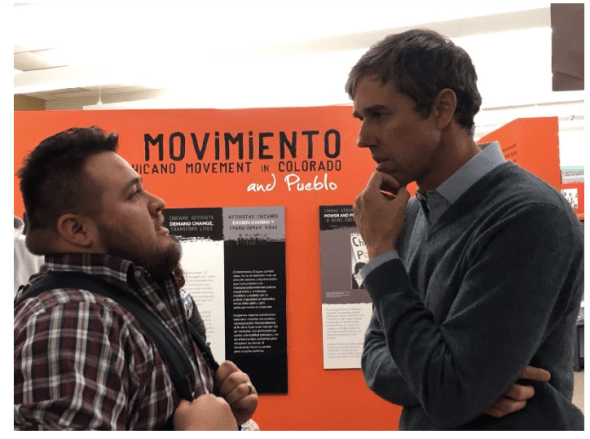
credit: Beto?
Jeff and I talked about immigration, about his travels in the U.S. and then about Isaac Asimov’s Foundation series. He had just read it again after finding it for a dollar at a used book shop. I told him I read it as a kid and really liked it, and wondered if it held up. Surprisingly well he said. He then moved down to the other side of the table, I think to make sure that the students could more freely engage in the conversation.
Reading some of the former Texas congressman’s travel dispatches. He was just where I was, Taos pueblo:
We walked further into the village where I was struck by the magnificent beauty of the adobe homes, built next to and on top of one another. The Pueblo was established in the 15th century, had these homes been here that long? Men were shoveling snow off of the roofs against the backdrop of the breathtaking Taos mountains in the distance. As we walked, Tina shared with me history, of the Taos people and of her family. She talked about the role of the Catholic church and of the religion of the Taos pueblo. We talked about family, the village home she had just inherited from her mother, about the role of dance in her life, about her hopes for her community and her children.

In my grandparents’ time, Debbie said after a long while, we were not allowed to go into those mountains. When Teddy Roosevelt created the national forest, he took those mountains away from us. They are sacred mountains, so you can imagine what that felt like. We had to get special permission, a pass, to go beyond the fence line into what had been our home for centuries. It was only until Richard Nixon’s administration that those lands were opened up to us again. So, she said with a laugh, while most people admire Roosevelt and detest Nixon, we feel just the opposite.
The combo of hipster travel writing and political engagement. (Is travel writing always political?) The work to demonstrate you are listening, not proclaiming. Obama’s rise was partly due to his skill as a writer, the acclaim for his self-revelatory memoirs, why shouldn’t Beto’s?
A hazard of this kind of writing, of writing your life in close sync with living it, is becoming a character you’re trying to create on the page, of enacting scenes that you might imagine will become good copy. The danger then becomes manipulating what you really thought, and felt, of trying to pilot the course of your explorations a little too much. That doesn’t work, as writing or life, it’s inauthentic, you get yourself spun around and caught in whirlpools that way.
That’s always a danger when you’re a presidential candidate. Your soul’s at hazard. Somehow it feels extra tough though when your way of getting yourself there is your show of authenticity.
When you claim to report your very thoughts, almost in realtime, you need either an extreme level of mental self-control, or to have your actual self and your presentational self in some very real and genuine and hard-earned harmony. Maybe you need both. The first is terrifying to ponder. The second is rare, difficult both technically and at like a soul level. And scary to practice for any long amount of time, like walking a mountain ledge. If you fall you will suffer, somewhere from being revealed as a phony to breaking mentally and morally.
I know we can do it. I can’t prove it, but I feel it and hear it and see it in the people I meet and talk with. I saw it all over Texas these last two years, I see it every day in El Paso. It’s in Kansas and Oklahoma. Colorado and New Mexico too. It’s not going to be easy to take the decency and kindness we find in our lives and our communities and apply it to our politics, to all the very real challenges we face. And as Tina says, it’s complicated. But a big part of it has got to be just listening to one another, learning each other’s stories, thinking “whatever affects this person, affects me.”
We’re in this together, like it or not. The alternative is to be in this apart, and that would be hell.
A way to defend against inauthenticity when you’re writing/living is to make yourself the fool of your story when you really were a fool, and everyone’s a fool sometimes. But it’s tempting to exaggerate that direction, too. Writers can make themselves look foolish but maybe presidential candidates can’t.
I left the Pueblo heading south toward Chimayo, aiming to be back in El Paso by bedtime. Snow was starting to fall. I thought about all of the places I’d seen over the last week, all of the people I’d met. Communities within communities. Nations within nations.
Would it be terrible to hear, every once in awhile, like:
I could feel horrible diarrhea coming over me coming down the 291. I was so relieved when I saw a Wendy’s in Espanola. But also troubled. I thought, ‘what if they recognize me, racing into the toilet at Wendy’s? Do I have to stop and buy something? What if buying something is when they recognize me? What if they recognize me buying something at Wendy’s and that becomes a thing, like ‘Beto O’Rourke skips local New Mexico food for corporate Frostie’? Well expedience trumped discretion in this case, I made it to the blissfully clean Wendy’s toilet a second ahead of a bottomside avalanche. I left without buying anything. Or apologizing. How could I? Should I have? I’d wonder that, on the road back to El Paso.
Good news bad news kinda thing: nobody at Wendy’s recognized me.
I can hear the Peggy Noonans groaning, that’s just what we need, to hear about candidates’ bowel movements! OK, sure, and Donald J. Trump is the president. Any candidate who wants to get the votes of anyone under forty will need to project authenticity. For anyone truly authentic, that’s not hard. Among the schemers, where will the quest for that end?
Anyway as for Beto good luck to him.
It’s almost like a powder
Posted: January 14, 2019 Filed under: America Since 1945, moon Leave a comment
It’s sometimes left out of the clips you see, but I like what Neil Armstrong says right before he steps on the moon.

… the surface appears to be very, very fine grained, as you get close to it. It’s almost like a powder. Down there, it’s very fine.
JTree
Posted: January 12, 2019 Filed under: America Since 1945, the California Condition Leave a comment
Today’s top story on Hi Desert Star. Photo is captioned:

article by Kurt Schauppner.
What good is bad news in a crisis? I’m more of an evangelist — a good news guy. Hoping reports of damage to trees and such during shutdown is overblown.

Take strength from local heroes?
From the local Facebook page, it sounds like there may be some exaggeration or misunderstanding.
Like so many problems, a few assholes are doing most of the damage. Good people do outnumber assholes, is my experience, and by a wide margin.

obviously don’t chainsaw me, or even shove me too hard, I could be hundreds of years old and I’m very fragile! I’m terrible firewood anyway I’m pretty much made of dust!
Back to good news next post!
Promise and glamour
Posted: December 17, 2018 Filed under: America Since 1945 Leave a commentYou’re not gonna get what you were promised.
An angry making idea. Maybe one of the most angry-making ideas possible.

I’ve been wondering if anger about the feeling of a broken promise is a major driver in US politics. We were promised something, and we’re not gonna get it.
But what, exactly?
The United States is the absolute best as promising. All of our greatest politicians were great promisers. Our founding fathers were great promisers.
John Lanchester, writing in LRB:
Napoleon said something interesting: that to understand a person, you must understand what the world looked like when he was twenty. I think there’s a lot in that.
[…]
I notice, talking to younger people, people who hit that Napoleonic moment of turning twenty since the crisis, that the idea of capitalism being thought of as morally superior elicits something between an eye roll and a hollow laugh. Their view of capitalism has been formed by austerity, increasing inequality, the impunity and imperviousness of finance and big technology companies, and the widespread spectacle of increasing corporate profits and a rocketing stock market combined with declining real pay and a huge growth in the new phenomenon of in-work poverty. That last is very important. For decades, the basic promise was that if you didn’t work the state would support you, but you would be poor. If you worked, you wouldn’t be. That’s no longer true: most people on benefits are in work too, it’s just that the work doesn’t pay enough to live on. That’s a fundamental breach of what used to be the social contract. So is the fact that the living standards of young people are likely not to be as high as they are for their parents. That idea stings just as much for parents as it does for their children.
But it’s not just politics. If you live in the USA and you turn on your TV, you are being tempted, teased, and promised.
The illusionary promise.
There’s a connection here, I believe, to the world glamour. What is glamour?
Etymology
From Scots glamer, from earlier Scots gramarye (“magic, enchantment, spell”).
The Scottish term may either be from Ancient Greek γραμμάριον (grammárion, “gram”), the weight unit of ingredients used to make magic potions, or an alteration of the English word grammar (“any sort of scholarship, especially occult learning”).
A connection has also been suggested with Old Norse glámr (poet. “moon,” name of a ghost) and glámsýni (“glamour, illusion”, literally “glam-sight”).
A magic spell. An illusion.
Here is Larry McMurtry talking about glamour, and its lack:
Kids in the midwest only get to see even modest levels of glamour if they happen to be on school trips to one or another of the midwestern cities: K.C., Omaha, St. Louis, the Twin Cities. In some, clearly, this lack of glamour festers. Charles Starkweather, in speaking about his motive for killing all those people, had this to say: “I never ate in a high-class restaurant, I never seen the New York Yankees play, I never been to Los Angeles…”
He was teased with something he could never have. Here is Andrew Sullivan on Sarah Palin:
One of the more amazing episodes in Sarah Palin’s early political life, in fact, bears this out. She popped up in the Anchorage Daily News as “a commercial fisherman from Wasilla” on April 3, 1996. Palin had told her husband she was going to Costco but had sneaked into J.C. Penney in Anchorage to see … one Ivana Trump, who, in the wake of her divorce, was touting her branded perfume. “We want to see Ivana,” Palin told the paper, “because we are so desperate in Alaska for any semblance of glamour and culture.”
Interested in readers’ takes on glamour and glimmers.
Movie Reviews: The Favourite, Mary Queen of Scots, Schindler’s List
Posted: December 14, 2018 Filed under: America Since 1945, everyone's a critic, film, movies, the California Condition, Uncategorized Leave a comment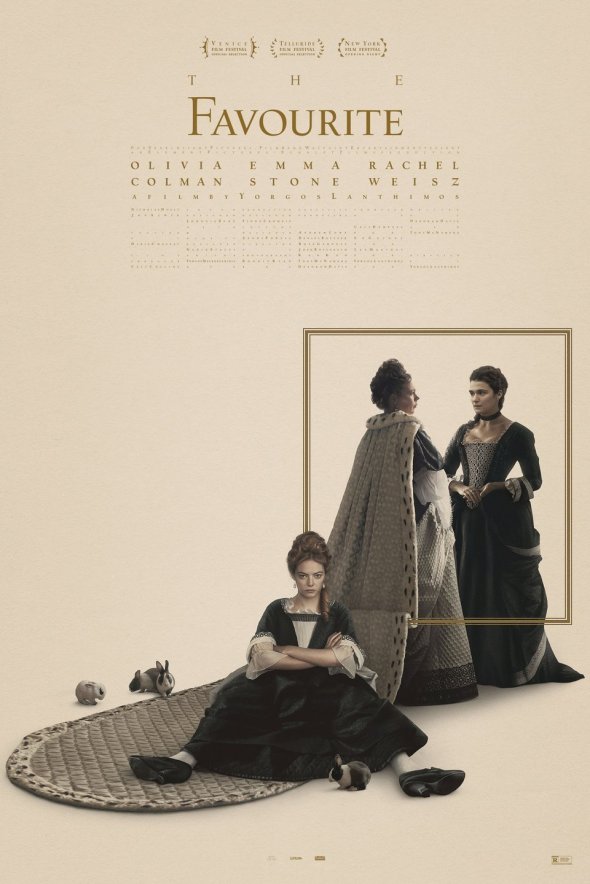
Finding myself with an unexpectedly free afternoon, I went to see The Favourite at the Arclight,
You rarely see elderly people in central Hollywood, but they’re there at the movies at 2pm. While we waited for the movie to start, there was an audible electrical hum. The Arclight person introduced the film, and then one of the audience members shouted out “what’re you gonna do about the grounding hum?”
The use of the phrase “grounding hum” rather than just “that humming sound” seemed to baffle the Arclight worker. Panicked, she said she’d look into it, and if we wanted, we could be “set up with another movie.”
After like one minute I took the option to be set up with another movie because the hum was really annoying. Playing soon was Mary Queen of Scots.

Reminded as I thought about it of John Ford’s quote about Monument Valley. John Ford assembles the crew and says, we’re out here to shoot the most interesting thing in the world: the human face.
Both Saoirse Ronan and Margot Robbie have incredible faces. It’s glorious to see them. The best parts of this movie were closeups.
Next I saw Schindler’s List.
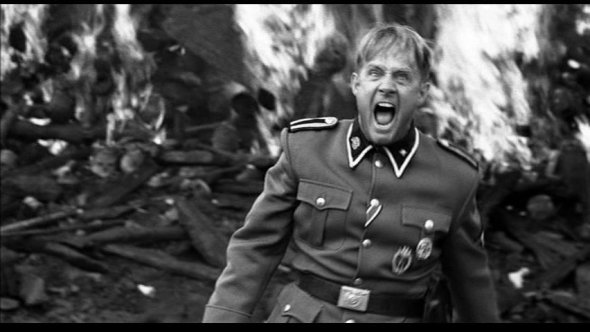
This movie has been re-released, with an intro from Spielberg, about the dangers of racism.
This movie knocked my socks off. I forgot, since the last time I saw it, what this movie accomplished.
When the movie first came out, the context in which people were prepared for it, discussed it, saw it, were shown it in school etc took it beyond the realm of like “a movie” and into some other world of experience and meaning.
I feel like I saw this movie for the first time on VHS tapes from the public library, although I believe we were shown the shower scene at school.

My idea in seeing it this time was to see it as a movie.
How did they make it? How does it work? What’s accomplished on the level of craft? Once we’ve handled the fact that we’re seeing a representation of the Holocaust, how does this work as a movie?
It’s incredible. The craft level accomplishment is on the absolute highest level.
Take away the weight with which this movie first reached us, with what it was attempting. Just approach it as “a filmmaker made this, put this together.”
Long, enormous shots of huge numbers of people, presented in ways that feel real, alive. Liam Neeson’s performance, his mysteries, his charisma, his ambiguity. We don’t actually learn that much about Oscar Schindler. So much is hidden.
Ralph Fiennes performance, the humanity, the realness he brings to someone whose crimes just overload the brain’s ability to process.
The moving parts, the train shots, the wide city shots. Unreal accomplishment of filmmaking.
Some thoughts:
- water, recurring as an image, theme in the movie.
- there are a bunch of scenes of just factory action, people making things with tools and machines. that was the cover. was not the Holocaust an event of the factory age, a twisted branch of Industrial Revolution and efficiency metric spirit?
- reminded that people didn’t know, when it began, “we’re in The Holocaust, this is the Holocaust.” It built. It got worse and worse. there were steps and stages along the way.

- what happened in the the Holocaust happened in a particular time and place in history, focused in an area of central and eastern Europe that had its own, centuries long, context for what you were, who belonged where, history, which tribes go where, what race or nationality meant, how these were understood. Göth’s speech about how the centuries of Jewish history in Kraków will become a rumor. I felt like this movie kind of captured and helped explain some of that, without a ton of extra labor.
- In a way Schindler could almost be seen as like a comic character. He didn’t start his company to save Jews. He starts it to make money from cheap labor. He’s a schemer who sees an opportunity. A rascal out to make a quick buck, a con man and shady dealer who ended up in the worst crime in history, an honest crook who finds he’s in something of vastness and evil beyond his ability to even comprehend.
- There is a scene in this movie that could almost be called funny, or at least comic, when Oscar Schindler (Neeson) tries to explain to Stern (Ben Kingsley) the good qualities of the concentration camp commandant Göth that nobody ever seems to mention!
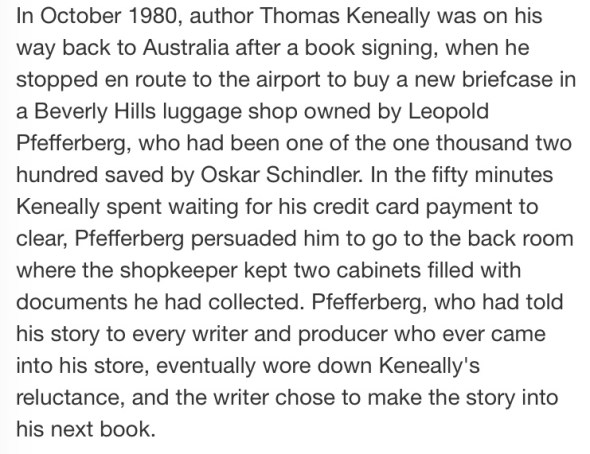
- Kenneally’s story of how he heard about Schindler:
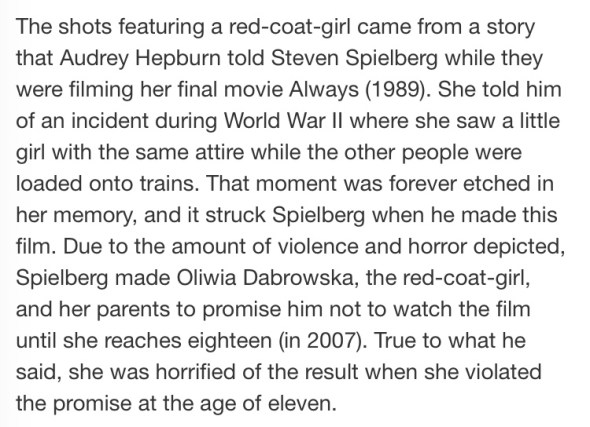
- The theme of sexuality, Goth’s sexuality, Schindler’s, what it means to love and express your nature versus trying to suppress and kill. Spielberg is not really known for having tough explorations of sexuality in his films but I’d say he took this one pretty square on with a lot bravery?

- if I had a criticism it was maybe that the text on the little intermediary passages that appear on screen a few times and explain the context felt not that clear and kind of unnecessary.
- I feared this movie would have a kind of ’90s whitewash, I felt maybe takes exist, the “actually Schindler’s List is BAD” take is out there, with the idea being that Spielberg put in too much sugar with the medicine which when we talk about the Shoah, unspeakable, unaddressable, is somehow wrong, but damn. I was glad for the sugar myself and I don’t think Spielberg looked away. The Holocaust occurred in a human context, and human contexts, no matter how dark, always have absurdity.

- the scene, for instance, were the Nazis burn in an enormous pyre the months-buried, now exhumed bodies of thousands of people executed during the liquidation of the Krakow ghetto, Spielberg took us as close to the mouth of the abyss as you’re gonna see at a regular movie theater.
What does it mean that Spielberg made a movie about the Holocaust and the two leads are both handsome Nazis?
*As a boy I was attracted to the history of Britain and Ireland as well as Celtic and Anglo-Saxon peoples in America. The peoples of those islands recorded a dramatic history that I felt connected to. They also developed a compelling tradition of telling these history stories with as much drama and excitement as possible eg. Shakespeare.
At a library book sale, I bought, for 50 cents a volume, three biographies from a numbered set from like 1920 of “notable personages,” something like that.
These just looked like the kind of books that a cool gentleman had. Books that indicated status and intelligence.
One of this set that I got was Hernando Cortes. I started that one, but even at that tender age I perceived Cortes was not someone to get behind. The biography had a pro-Cortes slant I found distasteful.
Another volume was about Mary Queen of Scots.
Just on her name, really, I started reading that one.
Mary Queen of Scots’ life was a thrilling story, and this one was melodramatically told. Affairs, murder plots, insults, rumor, execution.
Sometime thereafter, at school, we were all assigned like a book report. To read a biography, any biography, and write a report about it.
Since I’d already read Mary’s biography, I picked her.
As it happened, I overheard my dad confusedly ask my mom why, of all people on Earth, I’d chosen Mary Queen of Scots as the topic for my biography project. My dad did not know the backstory, which my mom patiently explained.
My dad’s reaction on hearing I’d picked Mary Queen of Scots, while not as harsh as Kevin Hart’s imagined reaction on hearing his son had a dollhouse, helps me to understand where Kevin Hart was coming from. Confusion, for starters. Upsetness.
At the time the guys I thought were really heroes were probably like JFK and Hemingway.
George HW Bush
Posted: December 5, 2018 Filed under: America Since 1945, politics, presidents Leave a comment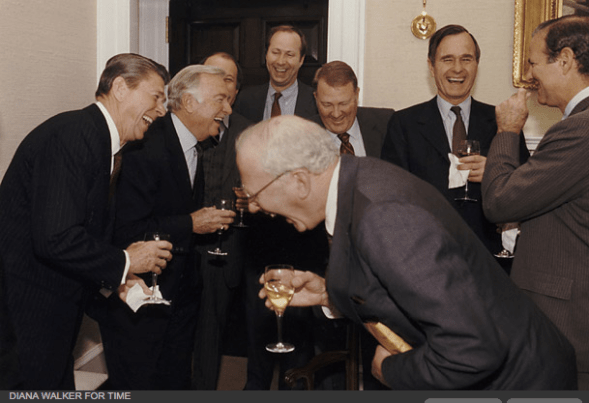
Thought of this photo today.
(what’s David Gergen doing there? sometimes I’ve been that guy).
All posts related to any Bush.
Anybody remember this one?
Posted: December 5, 2018 Filed under: America Since 1945, music Leave a comment
it’s possible attempts were made to record this song onto an audio cassette.
Best Email Subject Line of the Week
Posted: December 5, 2018 Filed under: America Since 1945 Leave a comment
The Riddle of Chaco Canyon
Posted: December 3, 2018 Filed under: America Since 1945, desert, native america Leave a comment
Sure, we’ve all heard of Chaco Canyon. It’s one of the 23 UNESCO World Heritage sites in the USA. But I tended to lump it in with Mesa Verde and the other cliff dwellings and move on.
Then an ad in High West (“for people who care about the West”) caught my eye. $25 for a year’s subscription to Archaeology Southwest, PLUS the Chaco archaeology report? Yes!
Once you get going on Chaco Canyon, it’s hard to stop.

Bob Adams at Wikipedia
What was it? Who built it? How? What happened? What were they up to? Why there?

Room 170 at source: this Gamblers House post
One of the most important conclusions that leaps out of this book is that most of the societies examined had attitudes toward nature that were fairly compatible with a responsible, sustainable relationship with the environment, but that nearly all of them ended up destroying their environment anyway, either because they lacked the scientific and technological knowledge to know how to act best or because they let their values change as they became wealthier and more powerful through exploitation of natural resources.
from this post.
Sometimes you start looking for something, more information, help, and you find exactly what you’re looking for. You find a guide who can give you exactly the information you’re looking for, in a digestible way.

That’s what I found when I found The Gambler’s House. A dense, rich blog about Chaco by a former Park Service seasonal guide, he / she seems to know this stuff at a deep level. Here are two of the closest I find to autobiography.

source: Gambler’s House
The author, who signs the name Teofilio, writes with clarity, patience, intelligence, respect for the reader, restrained but confident style, and a steady, calm voice, walking us through questions, debates, and controversies within the scholarship:
So if great houses weren’t pueblos, what were they? Here’s where contemporary archaeologists tend to break into two main camps. One sees them as elite residences, part of some sort of hierarchical system centered on the canyon or, alternatively, of a decentralized system of “peer-polities” with local elites who emulated the central canyon elites in the biggest great houses. In either case, note that the great houses are still presumed to have been primarily residential. The difference from the traditional view is quantitative, rather than qualitative. These researchers see the lack of evidence for residential use in most rooms, but they also see that there is still some evidence for residential use, and they emphasize that and interpret the other rooms as evidence of the power and wealth of the few people who lived in these huge buildings and were able to amass large food surpluses or trade goods (or whatever). The specific models vary, but the core thing about them is that they see the great houses as houses, not for the community as a whole (most people lived in the surrounding “small houses” both inside and outside of the canyon) but for a lucky few.
In this camp are Steve Lekson, Steve Plog, John Kantner, probably Ruth Van Dyke (although she doesn’t talk about the specific functions of great houses much), and others.
On the other side are those who see the difference between pueblos and great houses as qualitative. To these people, the great houses were not primarily residential in function, although they may have housed some people from time to time. Most of these researchers see the primary function of the sites as being “ritual” in some sense, although what that means is not always clearly specified. In many cases a focus on pilgrimage (based on questionable evidence) is posited. This group tends to make a big deal out of the astronomical alignments and large-scale planning evident in the layouts and positions of the great houses within their communities. They tend to see the few residents of the sites as caretakers, priests, or other individuals whose functions allowed them to reside in these buildings. Importantly, they don’t see these sites as equivalent to other residences in any meaningful way. They are instead public architecture, perhaps built by egalitarian communities as an act of religious devotion. Examples of monumental architecture built by such societies are known throughout the world (Stonehenge is a famous example), and this view fits with the traditional interpretation of modern Pueblo ethnography, which sees the Pueblos as peaceful, egalitarian, communal villagers. There is a long tradition of projecting this image back into the prehistoric past based on the obvious continuities in material culture, so while these scholars are in some ways breaking with tradition in not seeing great houses as residential, they are also staying true to tradition in other ways by interpreting them as a past manifestation of cultural tendencies still known in the descendant societies but expressed in different ways.
(from this post).

While many archaeologists have made valiant attempts to fit the rise of Chaco into models based on local and/or regional environmental conditions, they have been generally unsuccessful in finding a model that convincingly explains the astonishing florescence of the Chaco system in the eleventh and early twelfth centuries. This has inspired some other archaeologists more recently to try a different tack involving less environmental determinism and more historical contingency. This seems promising, but finding sufficient evidence for this sort of approach is difficult when it comes to prehistoric societies like Chaco. The various camps of archaeologists will likely continue to argue about the nature of Chaco for a long time, I think. Meanwhile, the mystery remains.

from the post “Plaster“
I doubt this mystery will ever be totally solved. There’s just too much information that is no longer available for various reasons. That’s not necessarily a problem, though. At this point the mysteries of Chaco are among its most noteworthy characteristics. Sometimes not knowing everything, and accepting that lack of knowledge, is useful in coming to terms with something as impressive, even overwhelming, as Chaco. One way to deal with it all is to stop trying to figure out every detail and to just observe. The experience that results from this approach may have nothing to do with the original intent of the builders of the great houses of Chaco, but then again it may have everything to do with that intent. There’s no way to be sure, and there likely never will be. But that’s okay. Sometimes mysteries are better left unsolved.

What of the Gambler legend for the origin of Chaco? Alexandria Witze at Archaeology Conservancy tells us:
Navajo oral histories tell of a Great Gambler who had a profound effect on Chaco Canyon, the Ancestral Puebloan capital located in what is now northwestern New Mexico. His name was Nááhwiilbiihi (“winner of people”) or Noqóilpi (“he who wins men at play”), and he travelled to Chaco from the south. Once there, he began gambling with the locals, engaging in games such as dice and footraces. He always won.
Faced with such a formidable opponent, the people of Chaco lost all their possessions at first. Then they gambled their spouses and children and, finally, themselves, into his debt. With a group of slaves now available to do his bidding, the Gambler ordered them to construct a series of great houses—the monumental architecture that fills Chaco Canyon today.

when I picture The Gambler
What was up with Chaco Canyon’s roads? They were thirty feet wide, perfectly straight, and seem to go… nowhere?
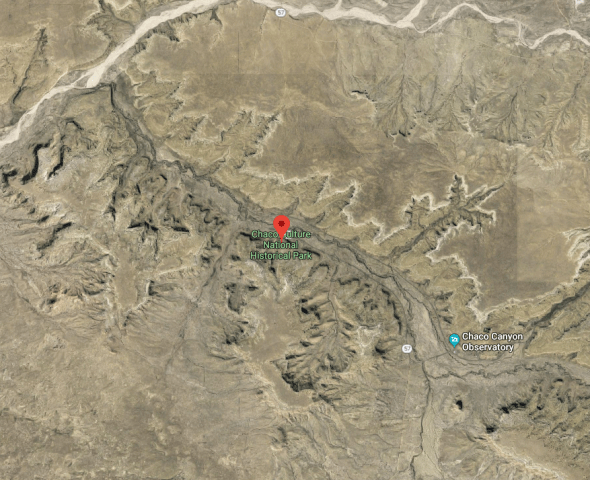
Once you’re into Chaco Canyon before you know it you’re into Hovenweep.

and where does Mesa Verde fit into this?
So what was the relationship between the two? The short answer is that no one knows.

source: rationalobserver for wikipedia
This is a great post with a possible Chaco theory:
Briefly, what I’m proposing is that the rise of Chaco as a regional center could have been due to it being the first place in the Southwest to develop detailed, precise knowledge of the movements of heavenly bodies (especially the sun and moon), which allowed Chacoan religious leaders to develop an elaborate ceremonial calendar with rituals that proved attractive enough to other groups in the region to give the canyon immense religious prestige. This would have drawn many people from the surrounding area to Chaco, either on short-term pilgrimages or permanently, which in turn would have given Chacoan political elites (who may or may not have been the same people as the religious leaders) the economic base to project political and/or military power throughout a large area, and cultural influence even further.
The “sexiest” post title:

Vivian Maier
Posted: December 2, 2018 Filed under: America Since 1945, art history, photography Leave a comment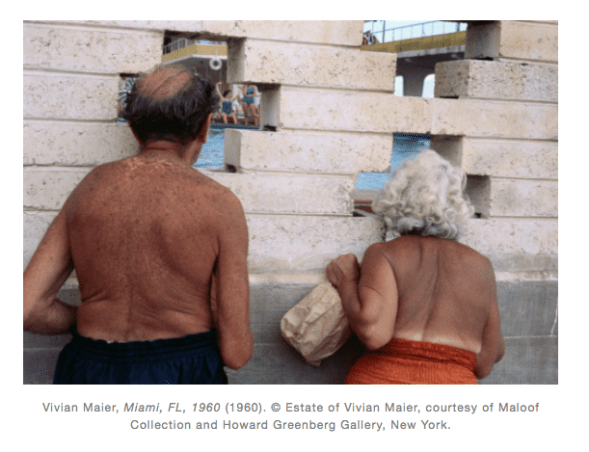
stole that straight from Artnet.
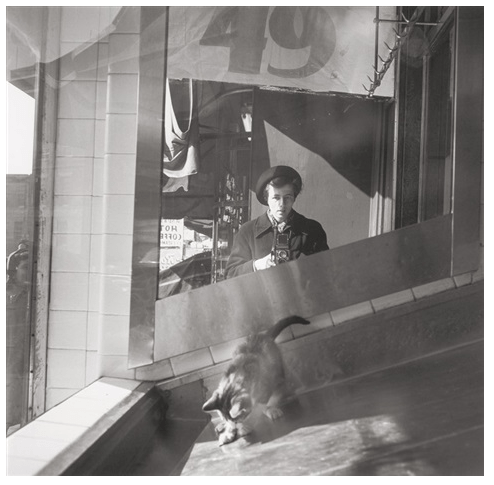
The tale of who owns Vivian Maier’s work is interesting. Through some twists, John Maloof, the Chicago real estate developer (?) who found and bought most of the physical photos at a storage auction, does not at present own the copyright:
Until those heirs are determined, the Cook County Administrator will continue to serve as the supervisor of the Maier Estate.
TMI
Posted: November 29, 2018 Filed under: America Since 1945, brain, the ocean, WW2 Leave a comment
CIC of USS Spruance, 1975. USN-1162165.
But the most intriguing chapter is Hone’s study of a critical but largely unrecognized reorganization that transformed Navy operations beginning in late 1942. The problem was that commanders of warships were being cognitively overwhelmed by all the new information thrown at them in battle. In addition to traditional sightings and signaling, they were now receiving reports by radio from aircraft and from other ships, as well as from radar readings. The Navy’s answer was to design a new Combat Information Center on each ship. Through it, all that data could be continually funneled, sifted, integrated and passed to the captain and others on the vessel who might need it, like gunners. Such an improvement may seem mere common sense, but then many great innovations do seem obvious — in retrospect. Interestingly, Adm. Chester Nimitz told skippers what to do (establish the new centers) but not how to do it. This meant that different ships devised different approaches, which provided the basis for subsequent refinements.
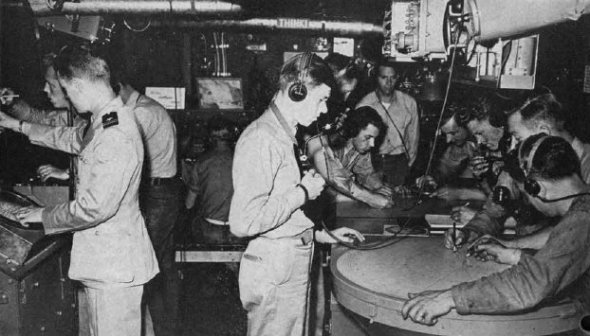
CIC aboard an unknown destroyer escort during WWII, found here
Really interesting paragraph from Thomas Ricks, writing about this book:
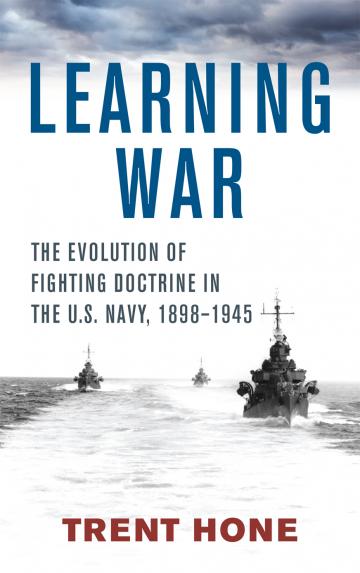
which I will read when I have time, Trent Hone sounds serious!
Late 1942: is that the point in time where the age of information overload began? Sorting, digesting, processing the enormous amounts of information that flow our way, telling signal from noise, is that a/the prevailing cognitive problem of the post 1942 world?
Tom Ricks=boss.
Flying cars
Posted: November 28, 2018 Filed under: America Since 1945 Leave a comment
Horst Faas, found here.
We have flying cars, they are called helicopters and they suck!
Are helicopters a net good or bad?
Surely many lives have been saved by medivacs and so on, but how much disturbance and disaster has been caused by these machines?
Have they gotten us into more trouble than they’ve gotten us out of?
 Helytimes

