Fitful sleep on the moon
Posted: July 13, 2017 Filed under: America Since 1945, moon Leave a comment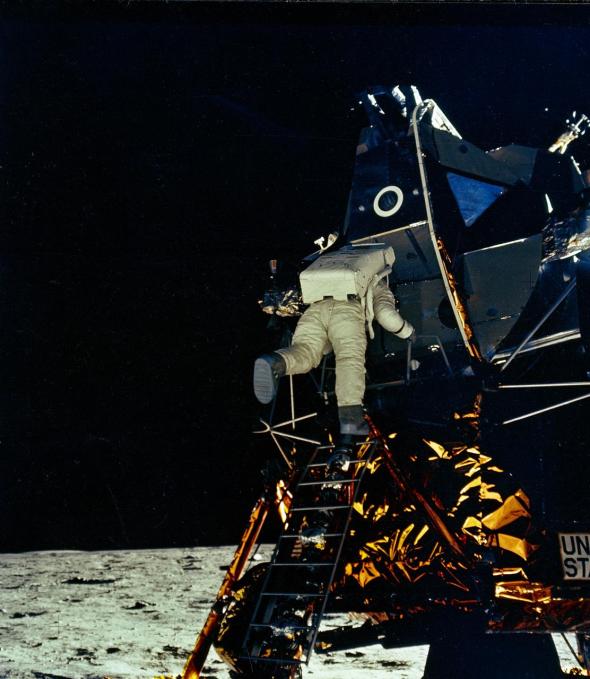
source. Photographer: Neil Armstrong.
After our heroes walked around for two hours, it was time for a restful nap on the surface of the Moon.


from:

About Deke:


One reason why the moon landing is so compelling is that it was pointless. Sure, the Cold War blah blah but really we did it just because it was cool.

Like climbing Mount Everest: the point is just to see if we (humans) can.

Imagine sleeping in this thing:

Where is the capsule now? Crashed on the moon someplace.
The fate of the LM is not known, but it is assumed that it crashed into the lunar surface sometime within the following 1 to 4 months.
Mattis interviewed by a high schooler
Posted: July 10, 2017 Filed under: America Since 1945 Leave a comment
Mercer Island by Wiki user Dllu
In a photo published alongside this article by The Washington Post on May 11, Trump’s bodyguard, Keith Schiller, could be seen carrying a stack of papers with a yellow sticky note stuck on the top. Written on it, in black ink, was the name “Jim ‘Mad Dog’ Mattis” and a phone number.
A high school student in Mercer Island, Washington, followed up and asked Secretary of Defense Mattis for an interview, which you can find here.
TEDDY: Out of thousands of calls, why did you respond to this one?
MATTIS: You left a message there and I was going through listening to the messages and deleting them. But you’re from Washington state. I grew up in Washington state on the other side of the mountains there on the Columbia River. I just thought I’d give you a call.

State Dept photo, source
Hard not to find Mattis a pretty compelling American character, imo.
On the education, I sometimes wonder how much better the world would be if we funded for nations where they have ideology problems, where the ideologies are hateful, full of hatred. I wonder what would happen if we turned around and we helped pay for high school students, a boy and girl at each high school in that country to come to America for one year and don’t do it just once, but do it ten years in a row. Every high school whether it be in Afghanistan or Syria or wherever, would send one boy and one girl for one year to Mercer island or to Topeka, Kansas or wherever.
It wouldn’t cost that much if you had sponsoring families that would take them in. Most American families are very generous, unless they’ve lived in places where they’ve adopted kind of a selfish style. But, that’s only a few pockets of the country that really have that bad. Although they’re big pockets in terms of population, most of the country is not like that. I bet we could do that.
Where is he talking about? Name names!
Could he be talking about New York City, where the President, a notably non-generous person, comes from?
Later, Mattis gives advice on how to avoid the psychiatrist:
TEDDY: Any advice for graduating seniors?
MATTIS: I would just tell you that there’s all sorts of people that are going to give you advice and you should listen to the people you respect, but I think if you guide yourself by putting others first, by trying to serve others, whether it be in your family, in your school, in your church or synagogue or mosque or wherever you get your spiritual strength from, you can help your state, you can help your country, if you can help the larger community in the world, you won’t be lying on a psychiatrist’s couch when you’re 45-years-old wondering what you did with your life.
Go out of your way. Not everyone has to join the military, it’s not for everyone. For one thing it’s scary as all get out at times, but whether it be the Peace Corp or the Marine Corps, whether it be serving on your local school board when you’re still not even 30-years-old, by running for office and trying to get a good education for the kids in your community, just try to put others first and it will pay back in so many ways that you’d be a lot happier in life. So just look for ways to help others all the way along, Teddy, and you’ll never go far wrong if you’re always looking to do that. You won’t get all caught up in your own problems if you’re out helping others overcome theirs.

Happy birthday America
Posted: July 4, 2017 Filed under: America Since 1945, history Leave a comment
Check out this letter Abigail Adams sent to her son, John Quincy Adams, when he was ELEVEN:

(Funny to read that as I sit here at what could be described as a literal Pacific station)
That is from:

which is a collection of David McCullough’s speeches.
Many of the speeches were given in the triumphant mid-late-1990s, when History was ending and it was easy to be fooled into thinking it was one long hike to the sunny meadows where we would now reside forever.
In that context this book can be almost painful to read.
Here, for example, McCullough talks about the history of the White House:

If there’s a single American out there who wants to claim the current occupant is either wise or honest, would love to have you on Great Debates.

After McCullough wrote a book about the Johnstown Flood, it was suggested he write about other disasters. He didn’t. He didn’t want to be “bad news McCullough,” he says.

We need more McCulloughism.

Unless you’re a McCullough completist I’d suggest bypassing The American Spirit and going instead to:


A Norm gem from the Bookbinder
Posted: July 1, 2017 Filed under: America Since 1945, comedy Leave a comment
always such excellent dispatches over there
Us vs Them
Posted: July 1, 2017 Filed under: America Since 1945, politics Leave a comment
This NRA ad is so twisted and vicious that I hate to sully Helytimes with it. You don’t have to watch it, I will tell you the key parts.
From the woman’s tone to the images it is so intense, so designed to provoke fear and anger.
Imagine something less helpful than showing this to a fearful person or a deranged person who also owned a gun.
I learned a tiny bit about the woman in the ad and I don’t want to ever think about her again.
I do want to examine the use of the words “us” and “them” in the ad.
Sometimes I felt frustrated by the attempt to over-explain Trump’s popularity as just racism because I felt that like while racism was absolutely in the mix, that wasn’t a big enough word. What I really heard was something like “themism.”
Themism
It was obvious to anyone I talked to at Trump’s rally or the RNC that I was a “them” even though I felt like we were and could be and should be an “us.”
Who is them and who is us?
In the first twenty seconds of this ad, you hear about how “they use”:
- “their media”
- “their schools”
- “their movies stars
- their singers
- their comedy shows
- their awards shows”
(with lots of exterior shots of LA, by the way, including Disney Hall)
- “their ex-president”
As a media-working school-liking person who works on a comedy show in LA who loves and gave money to my ex-president, I am obviously a them.
What the hell? I want to be an us!
I am an us!
Who is the us, according to the ad?
Well, against the them is:
- “the law-abiding”
Me, definitely, I love the law, some of the people closest to me are professional law enforcers.
- “the police”
Same, I love one police in my own life and like the police in general.
So, I am also an us.
Right?
Can I be an us and a them?
What kind of wicked, nasty person would try and drive us apart like that? What sinister agenda would be behind that?
Anyone trying to divide us is wicked.
Which is better: united or divided?
Uniter or divider?
Everyone knows the answer to that. This is the United States.
If you are trying to divide, if you are sowing division, you doing wickedness. This is simple.
This ad is some kind of vicious dog-whistle designed make some loose category of people who feel angry and put upon and threatened feel more angry, put upon, and threatened. This ad uses the language of violence to suggest channeling those feelings into violence.
In this world you will see so much wickedness that you can’t possibly handle it all but somehow this one got to me.
Part of what makes me made is that a club for people who like shooting guns could be so positive. Lots of people in this country have guns because they like hunting or because guns are exciting. What if they were in a club that made them feel proud and noble instead of vicious and afraid?
The language about the “well-regulated militia” in the Second Amendment is so important. Adding those words was not an accident. The Founders didn’t want every gun-haver running around on his own kick deciding who to blast away. Read

or

A militia was a community. It brought people together. And it was a responsibility. To call this NRA video irresponsible is a wild understatement.
I suspect I have no more than two Helytimes readers who are in the NRA. There has to be a faction of the NRA that can see how wrong this ad is, how destructive. I could be wrong but my guess is this strategy of marketing for the NRA will not be successful.
My purpose in writing this was just to bore down and clarify mostly for myself what is so wrong and wicked about this ad and what larger principle that leads us to.
Also to shine a light on why the message is not just wicked but un-American.
A Smaller Thing That Made Me Mad From This Ad
:16
“make them march, make them protest”
let’s pause here and remember you can say whatever the hell you want about movie stars and comedy shows but marching and protesting in American history is maybe not all the time but by an overwhelming margin a pretty darn heroic and positive thing in American history.

A Leonard Freed Magnum photo from the 1963 March on Washington. Am I allowed to use this? Maybe not technically but is it ok because I direct you to the source? Hmm am I as law-abiding as I thought?
the ad is ignorant as well as wicked, the two often go hand in hand.

Tranquility Base
Posted: June 27, 2017 Filed under: America Since 1945, moon Leave a comment
photo credit: Neil Armstong
The same society that was doing Vietnam, at the same time, did this.

During training, Armstrong and Aldrin had exclusively used the callsign “Eagle” in simulated ground conversations, both before and after landing. Armstrong and Aldrin decided on using “Tranquility Base” just before the flight, telling only Capsule Communicator Charles Duke before the mission, so Duke would not be taken by surprise.

We came in peace for all mankind.
Wild. America: a land of contrasts.
Ken Burns Vietnam
Posted: June 26, 2017 Filed under: America Since 1945, Vietnam, war 1 Comment
This fall, Ken Burns new documentary about the Vietnam War will be on PBS.
Any one of these clips from it will make you still for a minute.
The intensity of what happened with the US in Vietnam is insane. The magnitude of the scar is unspeakable. Literally: we can’t talk about it.
When Ken Burns made The Civil War, about something 150 years ago, it made people cry. What is it going to be like to watch The Vietnam War, a thing every person in my parent’s generation had to reckon with in some serious way?
I saw that one of the talkers is Karl Marlantes. His book What It Is Like To Go To War is astounding.

I’m not sure enough people heard about it. At one time I had the same publisher as Karl Marlantes, which I was very proud of, they sent me his books for free.
Marlantes tells this story about running into Joseph Campbell, by chance:

Absolution.

Imagine having whiskey with Joseph Campbell.
The best discipline:


The other day on Reddit “Today I Learned” I saw this.

I went to check the source, the Lodi News Sentinel, 1971:
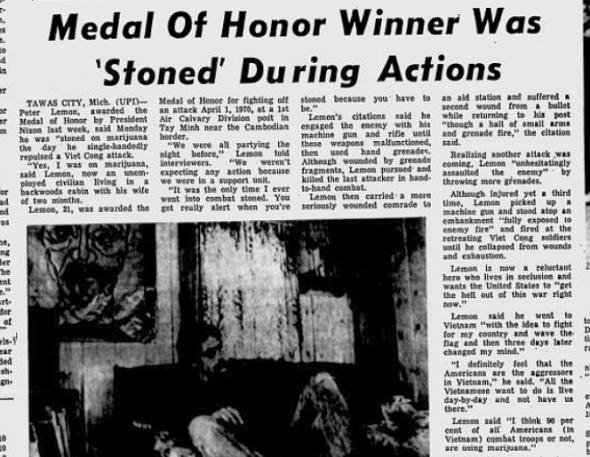
Preserved at this blog:

There the author gives a question and answer about his own time in Vietnam and after that I would describe as harrowing and illuminating and powerful.
Ken Burns made some darn good movies.
Island Fighting
Posted: June 18, 2017 Filed under: America Since 1945, WW2 Leave a comment
Picked up the Island Fighting volume of the Time Life World War II series and found this incredible picture:
Couldn’t find a name of a photographer.
Mysterious Notes
Posted: June 17, 2017 Filed under: America Since 1945, mysteries Leave a comment
I’ve come into possession of someone’s mysterious notes on a printed out copy of Alan Weisman’s book The World Without Us. Reason to suspect the note-taker is a Helytimes reader.
If they belong to you, claim them, otherwise I intend to auction them to the highest bidder. God only knows what these insights could be worth.
Beyond Meat
Posted: June 14, 2017 Filed under: America Since 1945, food Leave a comment
Grilled some Beyond Meat burgers yesterday (over a combo of mesquite briquettes and mesquite chips). As a noted burger enthusiast I declare this: pretty darn good.
File this under: Long June news you can use.

Helytimes Classic: D*-Day
Posted: June 6, 2017 Filed under: America Since 1945 Leave a commentReprinting this beloved post from a year ago:
 * the D is for Dave!
Happy birthday, tomorrow, June 6, to Dave King (the Great Debates co-host, not the Bad Plus drummer)
A promise made in Host Chat is a promise kept so here is a selection of D-Day readings for Davis.

scene from the Bayeux Tapestry

New Yorker’s July 15, 1944 parody of the Bayeux Tapestry
The single best thing to read about D-Day
is online and free. It is S. L. A. Marshall writing for The Atlantic in November, 1950.

During World War II, Marshall became an official Army combat historian, and came to know many of the war’s best-known Allied commanders, including George S. Patton and Omar N. Bradley. He conducted hundreds of interviews of both enlisted men and officers regarding their combat experiences, and was an early proponent of oral history techniques. In particular, Marshall favored the group interview, where he would gather surviving members of a frontline unit together and debrief them on their combat experiences of a day or two before.

The article is called “First Wave On Omaha Beach” here is an excerpt:
Even among some of the lightly wounded who jumped into shallow water the hits prove fatal. Knocked down by a bullet in the arm or weakened by fear and shock, they are unable to rise again and are drowned by the onrushing tide. Other wounded men drag themselves ashore and, on finding the sands, lie quiet from total exhaustion, only to be overtaken and killed by the water. A few move safely through the bullet swarm to the beach, then find that they cannot hold there. They return to the water to use it for body cover. Faces turned upward, so that their nostrils are out of water, they creep toward the land at the same rate as the tide. That is how most of the survivors make it. The less rugged or less clever seek the cover of enemy obstacles moored along the upper half of the beach and are knocked off by machine-gun fire.
Within seven minutes after the ramps drop, Able Company is inert and leaderless. At Boat No. 2, Lieutenant Tidrick takes a bullet through the throat as he jumps from the ramp into the water. He staggers onto the sand and flops down ten feet from Private First Class Leo J. Nash. Nash sees the blood spurting and hears the strangled words gasped by Tidrick: “Advance with the wire cutters!” It’s futile; Nash has no cutters. To give the order, Tidrick has raised himself up on his hands and made himself a target for an instant. Nash, burrowing into the sand, sees machine gun bullets rip Tidrick from crown to pelvis. From the cliff above, the German gunners are shooting into the survivors as from a roof top.
Captain Taylor N. Fellers and Lieutenant Benjamin R. Kearfoot never make it. They had loaded with a section of thirty men in Boat No. 6 (Landing Craft, Assault, No. 1015). But exactly what happened to this boat and its human cargo was never to be known. No one saw the craft go down. How each man aboard it met death remains unreported. Half of the drowned bodies were later found along the beach. It is supposed that the others were claimed by the sea.
After the war, Marshall would write Men Against Fire:

which claimed that only about 25% of American combat soldiers actually fired their guns at the enemy:
Marshall’s work on infantry combat effectiveness in World War II, titled Men Against Fire, is his best-known and most controversial work. In the book, Marshall claimed that of the World War II U.S. troops in actual combat, 75% never fired at the enemy for the purpose of killing, even though they were engaged in combat and under direct threat. Marshall argued that the Army should devote significant training resources to increasing the percentage of soldiers willing to engage the enemy with direct fire.
Marshall has been harshly criticized:

General Marshall said soldiers who did not fire were motivated by fear, a desire to minimize risk and a willingness, as in civilian life, to let a minority of other people carry the load.
In his 1989 memoir, About Face, Hackworth described his initial elation at an assignment with a man he idolized, and how that elation turned to disillusion after seeing Marshall’s character and methods first hand. Hackworth described Marshall as a “voyeur warrior,” for whom “the truth never got in the way of a good story” and went so far as to say, “Veterans of many of the actions he ‘documented’ in his books have complained bitterly over the years of his inaccuracy or blatant bias”.
Omaha Beach was the worst of it, but experiences on D-Day were vastly different.

stolen from the Daily Mail: http://www.dailymail.co.uk/news/article-2336753/Back-beaches-final-time-D-Day-heroes-return-Normandy-mark-69th-anniversary-landings.html
Twenty-one miles away on Juno Beach the Canadian Ninth Division landed with their bikes:
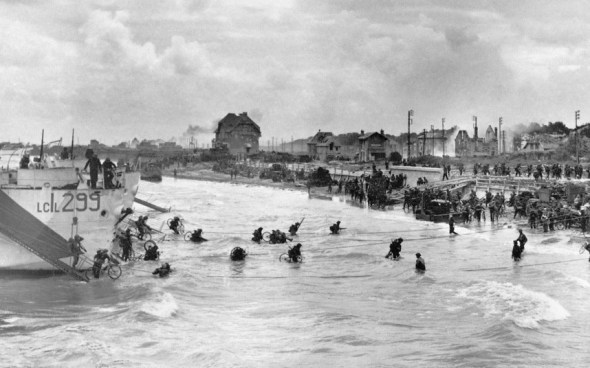
Picture: STF/AFP/Getty Images
Leave it to Canadians to bring their bikes. (900 Canadians died in a botched semi-practice D-Day in 1942).
Best Single Book To Read About D-Day
Looking around I can’t find my copy of Normandy Revisited by AJ Liebling:

Image by © Bettmann/CORBIS found here
Liebling, a vivacious fatso who had spent a lot of time in Normandy pre-war, describes going through with the Army and eating at spots he remembered from before. Definitely a different kind of war corresponding.
This book

was wildly popular for a reason: it’s thrilling, readable, and full of epic American hero stories.
Maybe starting with Andrew J. Higgins of Nebraska and Mobile, Alabama:

who developed shallow-draft boats for logging in the bayou (or for bootlegging?) and then took on the job of making similar boats for amphibious landings:

Higgins Industries
Anthony Beevor has a blunter take. Major takeaway from his book:

was that the Allies came up way short of their goals on D-Day. Unsurprisingly, many of those who got off the beaches in one piece considered their work done for the day. They were literally in Calvados,
 it was pretty easy to find bottles of highly alcoholic apple brandy, and a lot of survivors got hammered at first opportunity.

Who can blame them? But the failure to achieve the ambitious goals had costs. Caen was the biggest city around:

British and Canadian troops had intended to capture the town on D-Day. However they were held up north of the city until 9 July, when an intense bombing campaign during Operation Charnwood destroyed 70% of the city and killed 2,000 French civilians.
From this Washington Post review of Beevor, some excerpts:
US Army medical services had to deal with 30,000 cases of combat exhaustion in Normandy,” and:
“Nothing . . . seemed to reduce the flow of cases where men under artillery fire would go ‘wide-eyed and jittery’, or ‘start running around in circles and crying’, or ‘curl up into little balls’, or even wander out in a trance in an open field and start picking flowers as the shells exploded. Others cracked under the strain of patrols, suddenly crying, ‘We’re going to get killed! We’re going to get killed!’ Young officers had to try to deal with ‘men suddenly whimpering, cringing, refusing to get up or get out of a foxhole and go forward under fire’. While some soldiers resorted to self-inflicted wounds, a smaller, unknown number committed suicide.”
But the single best book to read about D-Day I would say is The Boys’ Crusade by Paul Fussell:

Amazon reviewer Bill Marsano sums it up nicely:
It’s probably all that “good war” and “greatest generation” stuff that drove Fussell to write this book; he doesn’t have much truck with gooey backward glances, and that will probably make some readers mad. Well, you don’t come to Fussell–author of, among other things, “Thank God for the Atom Bomb, and Other Essays”–for good times. You come to Fussell for the hard stuff.
And here it is his contention that behind and beneath all that “greatest generation” nonsense was the Boys’ Crusade–that last year of the war in Europe when too many things went wrong too often. The generals who’d convinced themselves that this war would not be a war of attrition–i.e., human slaughter–like the last one found they’d guessed wrong. Casualties were horrifyingly high and so huge numbers of children–kids 17-19 years–old were flung into combat. And they were, with the help of the generals, ill-trained, ill-clothed and ill-equipped.
They were also faceless ciphers. As Fussell points out, the US Army’s policy was to break up training units by sending individual replacements up to the line piecemeal–one at a time–so they often arrived as strangers among strangers, often addressed merely as “Soldier” because no one knew their names. The result was too many instances of cowardice–both under fire and behind the lines–too many self-inflicted wounds to escape combat. Too many disgraces of every kind because the Army’s system, Fussell says, destroyed the most important factor in the fighting morale of the “poor bloody infantry”–the shame and fear of turning chicken in front of your comrades. Many of these boys–and Fussell is properly insistent on the word boys–funked because they had no comradeship to value.
This is not in the least a personal journal. Fussell was serriously wounded as a young second lieutenant; he was also decorated. But he wisely leaves himself out of this narrative. There’s no special pleading here, no showing of the wounds on Crispin’s Day. Instead this is a passionate but straightforward report on what that last year was like for the poor bloody infantry–those foot soldiers, those dogfaces, those 14 percent of the troops who took more than 70 percent of the casualties.
And yet there were those who stood the gaff, who survived “carnage up to and including bodies literally torn to pieces, of intestines hung on trees like Christ,mas festoons,” and managed not to dishonor themselves. They weren’t heroes, Fussell says, just men who earned the Combat Infantryman’s Badge, which was the only honor they respected. In a brief but moving passage, he explains why: It said they’d been there, been through it, and toughed it out.
Horrible as it is I found this book refreshing when I first read it, because it felt like somebody was telling me the unvarnished truth, which is that even for the good guys this was a series of catastrophes, fuckups, and massacres.
All Fussell’s books are good. This one in particular I was obsessed with:

and I talk about it in The Wonder Trail: True Stories From Los Angeles To The End Of The World, out June 14:
Those photos are by Robert Capa, who lost all but 11 of the 106 or so photos he risked his life shooting when the guy developing them was in such a hurry he fudged up the negatives.
Let’s give the last word to Fussell:
One wartime moment not at all vile occurred on June 5, 1944, when Dwight Eisenhower, entirely alone and for the moment disjunct from his publicity apparatus, changed the passive voice to active in the penciled statement he wrote out to have ready when the invasion was repulsed, his troops torn apart for nothing, his planes ripped and smashed to no end, his warships sunk, his reputation blasted: “Our landings in the Cherbourg-Havre area have failed to gain a satisfactory foothold and I have withdrawn the troops.” Originally he wrote, “the troops have been withdrawn,” as if by some distant, anonymous agency instead of by an identifiable man making all-but-impossible decisions. Having ventured this bold revision, and secure in his painful acceptance of full personal accountability, he was able to proceed unevasively with “My decision to attack at this time and place was based on the best information available.” Then, after the conventional “credit,” distributed equally to “the troops, the air, and the navy,” came Eisenhower’s noble acceptance of total personal responsibility: “If any blame or fault attaches to the attempt, it is mine alone.” As Mailer says, you use the word shit so that you can use the word noble,and you refuse to ignore the stupidity and barbarism and ignobility and poltroonery and filth of the real war so thatit is mine alone can flash out, a bright signal in a dark time.

Happy Birthday Dave!

Denis Johnson, Walt Whitman
Posted: May 29, 2017 Filed under: America Since 1945, heroes, writing Leave a comment
We’ve been thinking a lot about the glow of some of your poems, the visionary language seeping through parts of Angels, and the electric way in which the border between Fuckhead’s consciousness and the outside world is always being dissolved throughout Jesus’ Son. Could you talk a bit more about Whitman’s influence in your poetry and prose?
I’m not sure I could trace the lines of his influence on my language, particularly, or the way his work affects the strategies in my work, or anything like that. His expansive spirit, his generosity, his eagerness to love – those are the things that influence me, not just as a writer, but as a person. His introduction to LEAVES OF GRASS I take as a sort of personal manifesto, especially the passage:
This is what you shall do: Love the earth and sun and the animals, despise riches, give alms to every one that asks, stand up for the stupid and crazy, devote your income and labor to others, hate tyrants, argue not concerning God, have patience and indulgence toward the people, take off your hat to nothing known or unknown or to any man or number of men, go freely with powerful uneducated persons and with the young and with the mothers of families, read these leaves in the open air every season of every year of your life, re-examine all you have been told at school or church or in any book, dismiss whatever insults your own soul, and your very flesh shall be a great poem and have the richest fluency not only in its words but in the silent lines of its lips and face and between the lashes of your eyes and in every motion and joint of your body. . . .
found in this interview with Denis Johnson. Oddly or presciently or synchronistically enough I’d been looking for Denis Johnson materials as I did ever so often. How did this guy know this stuff? was what I was looking for as usual.
 so good!

May I please recommend to you you have actor Will Patton read you the audiobook of:

I loved the experience so much I got into the full unabridged 23+ hours of:

Will Patton is such a gifted, subtle performer of audiobooks.

from a profile in AudioFile
Let’s give the last word to DJ:
I love McDonald’s double cheeseburgers and I don’t care if they’re made of pink slime and ammonia, I eat them all the time because they’re delicious.

Morrissey / Noonan
Posted: May 23, 2017 Filed under: America Since 1945, politics Leave a comment
Compare what Morrissey said on Facebook (via Vulture) to this Peggy Noonan piece from February:
There are the protected and the unprotected. The protected make public policy. The unprotected live in it. The unprotected are starting to push back, powerfully.
The protected are the accomplished, the secure, the successful—those who have power or access to it. They are protected from much of the roughness of the world. More to the point, they are protected from the world they have created. Again, they make public policy and have for some time.
Anne R. Dick
Posted: May 22, 2017 Filed under: America Since 1945, writing Leave a comment
Obit worth reading in the NY Times:
Bored with science fiction and unable to interest publishers in his mainstream novels, Dick quit writing to help his new wife in her jewelry business. He liked that even less, and so he pretended to work on a new novel. To make it look realistic, he said in a 1976 interview with Science Fiction Review, he had to start typing.
What emerged was “The Man in the High Castle.” It was dedicated, cryptically and not altogether favorably, to his wife, “without whose silence this book would never have been written.” (In the 1970s, Dick changed the dedication, dropping Anne Dick entirely.)
Ms. Dick said she saw only the pilot of the Amazon series, finding the Nazis a little too threatening.
If you are interested in hearing some ideas that flutter between profound and totally bonkers might I suggest:


How paranoia is natural:

How about this?:

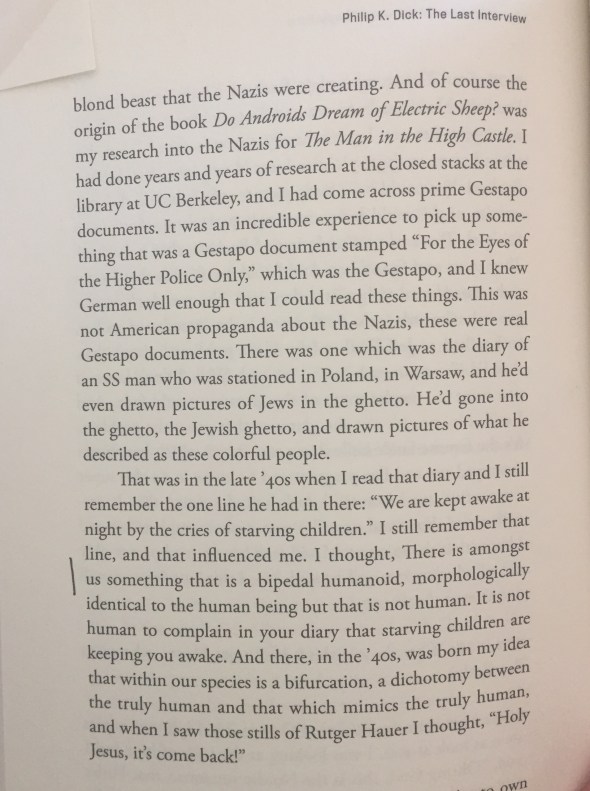
Just a guy with a fragile mind hanging out reading Gestapo documents in German up at UC Berkeley:

In Sweden there’s a fashion brand called Filippa K and I thought it would be funny for someone to do a mashup Filippa K Dick.

But who has the time.
Robert Caro’s two hour audiobook
Posted: May 19, 2017 Filed under: America Since 1945, New York, politics, presidents, Texas Leave a comment
Strong endorse to an audio only, 1 hour 42 minute semi-memoir by Robert Caro, boiling down the central ideas of The Power Broker and the LBJ series. If you’ve read every single extant interview with Robert Caro, as I have, some of its repetitive but I loved it and loved listening to Caro’s weird New York accent.

Two details: he tells how James Rowe, an aide to FDR, told him that FDR was such a genius about politics that when he discussed it almost no one could even understand him. But Lyndon Johnson understood everything.

James Rowe, from the LOC
Caro tells that when LBJ ran for Congress the first time, he promised to bring electricity. Women had to haul water from the well with a rope. A full bucket of water was heavy. Women would become bent, a Hill Country term for stooped over. LBJ campaigned saying, if you vote for me, you won’t be bent. You won’t look at forty the way your mother looked at forty.

from the Austin American Statesman collection at the LBJ Library. The woman’s name is Mrs. Mattie Malone.
TAKE: vote yes on WGA strike authorization
Posted: April 18, 2017 Filed under: America Since 1945, the California Condition Leave a comment
The Writers’ Guild is weird. For one thing, some of the members are owners or bosses. Writers who become showrunners and share in the profits of a show can have an owner’s interest. Another: writers have agents who negotiate for them.
Some writers make lots and lots of money. Others are unemployed, or at least unemployed as writers. It’s not really a union, it’s a guild, like a medieval guild, an association of craftspeople who work a certain trade.

Why is Staalmesters translated as “Syndics”? Rembrandt’s Syndics of the Drapers’ Guild. The Sampling Officials sounds cooler.
Or maybe something like London’s livery companies?:

A writers union going on strike can seem silly when you picture a union like this:

and a strike like this:

I find this on the Post-Bulletin: Steve Martell, Charles Brown, and an unidentified third man stand on the picket line on the morning of August 17, 1985, outside the Hormel Foods plant in Austin, Minnesota. Did Trump steal that style of hat consciously?
and writers like this:

But, if you’re in the Writers Guild, and you’re a Helytimes reader, I think you should vote yes on the strike authorization.
If you’re not in the Writers’ Guild, here are the facts, as I misremember them:
- TV writers are making less and less money but working the same amount of time. As shows have smaller orders of episodes, ten instead of twenty-two, writers are still working the same amount of days, but since many of us get paid per episode, we’re getting paid less for the same or more amount of days working.
- The studios are making enormous profits.*
- The studios sort of owe it to us to maintain our healthcare and pension plans, due to deals that were made over the years, and they’re saying they’re not going to do that.
Like all workers, we’re getting squeezed as much as possible by companies whose mandate is to be as profitable as possible for shareholders.
Workers can and should use every tool they can to fight for as much as they can. Our guild’s leaders are negotiating and have asked us to vote to authorize a strike, so they can bargain as effectively as possible.

Gunawan Kartapranata provided Wikipedia’s photo for the article on Bargaining
That’s pretty much my take. I hope it doesn’t happen. It will be very painful and hurt a lot of people. It shuts down production, which means grips, PAs, electricians, etc. are all out of work too. And actors, lots of whom have really struggled to get a shot and are going to continue to struggle.
I think the studios should just give us what we asked for. Disney is one of the studios we’re negotiating with. They have a market cap of $178 billion. I appreciate that Bob Iger has his strategic challenges with ESPN and so on but it seems wise and reasonable to me to say “fine let’s give the creators of our highly profitable content their not ridiculous demands and continue generating money from some of the world’s most popular entertainment, TV shows and movies.”

During the last strike my dad sent me his book of AFL-CIO songs
If we do go on strike, I think we shouldn’t picket. That was unhelpful. There should be some human shows of solidarity, but daily picketing got to be a weird ritual, some kind of bizarre martyrdom that in the end made us look more ridiculous. I am proud to say I feel like I did my duty, but I preferred my days answering the phones at Strike Headquarters to making small talk with Tom Bergeron while I held a sign outside CBS. Although that was fun too.

We discussed Rap Around. Source.
A dissenting opinion from a writer with always interesting takes:
The idea of a WGA strike in these times, when freedom of expression is a far more fundamental issue than small differences between comparatively large amounts of money, is stunningly tone deaf and offensive.
That’s on a moral level.
On a strategic level, strikes are only effective when one side has both desperation and leverage. The WGA has neither.
I voted for the WGA strike in 2008. I regret it. The tangible benefits to the lives of working writers have never been explained in any relevant or understandable terms. The tangible losses to writers’ lives were painfully clear.
This is a bad idea masquerading as the right thing to do. On every level, it is not.
The issues at stake in the last strike were complex. I thought it was important for writers to get some kind of residual for streaming content. Whether it was necessary or well-executed, I’m not informed enough to answer. There was a layer of silliness to it for sure.
I do feel some energy like “one strike is fine, but two in this short a time is awful much.”
I kind of get that? But: the WGA is sort of the first union down the chain. We’re on the frontier here, that’s why we keep having to fight.
So, that’s my take.
* I saw the number $51 billion thrown around. I have no idea where that came from. Does it include, for instance, Disney’s theme park division? It’s hard to assess how much profit the studios are making. The AMPTP represents over 350 companies. I’m sure some of them are doing terribly!
But, here are some numbers for the bigger companies, from a 2015 Forbes magazine rundown by Natalie Robehmed:
Once the theatrical run of a film is over, studios make money from home video, video on demand, and through syndicating hit TV shows, as 21st Century Fox was able to do with Modern Family. Rupert Murdoch’s 21st Century Fox clocked the second highest profit of the publicly traded studios, earning $1.5 billion in 2014. It measured revenue of $10.3 billion, largely from betting big on books that turned into box office hits hits such as Gone Girl and The Fault in Our Stars.
Undeterred by the failed Comcast/Time Warner merger, NBCUniversal outdid itself and recorded its most profitable year ever. The studio notched $711 million in profit on $5 billion in revenue – the second best ratio in Hollywood.
Warner Bros.’ films grossed a collective $4 billion in 2014, but the studio pocketed $1.2 billion in profit from $12.5 billion in revenue. This was up 23% on 2013’s tally. The studio weathered its fair share of flops: Transcendence, Blended and Winter’s Tale all failed to perform. Its pockets were fattened by the last Hobbit movie, plus popcorn cruncher The Lego Movie which has a sequel in the works. The studio is also expanding its $5 billion television business internationally, paying $267 million for production company Eyeworks which operates in 15 countries
etc. There is poor baby Paramount:
The title of least profitable studio goes to the Viacom-owned Paramount. Despite an increase in its films’ performance at the international box office, the filmed entertainment division tallied just $219 million on revenues of $3.7 billion. This was a decrease from 2013, when profit surged thanks to selling distribution rights for Marvel movies to Disney.


Hit me up if you disagree, find factual errors, want to express a contrary view!
Roundup of books I haven’t read all the way through but have in a crate in my garage
Posted: April 3, 2017 Filed under: advice, America Since 1945, heroes Leave a comment

Wow.

PFC Albert Bullock took this one of the damaged Franklin.
My copy is pre-owned and comes already highlighted:


I’ve always hated Hugo’s. On acting technique:

How about this one, about Australian historians?
Geoffrey Blainey’s recipe for peach-tin eggs:

Graeme Davison on the wrong side of the law in Melbourne:

There are no wasted humans:

from the boss Thomas Cleary:

And finally, some Daily Drucker:


ECLIPSE SAFETY UPDATE
Posted: March 6, 2017 Filed under: America Since 1945 Leave a commentAs the date of the August 21 eclipse draws near, keep this important safety information in mind: You MUST use special eclipse safety glasses to view a partial eclipse and the partial phases of a total eclipse. To do otherwise is risking permanent eye damage and even blindness. The ONLY time it’s safe to look at a TOTAL eclipse without proper eye protection is during the very brief period of totality when the Sun is 100 percent blocked by the Moon. If you’re in a location where the eclipse won’t be total, there is NEVER a time when it’s safe to look with unprotected eyes.
NationalEclipse.com sends that along.

Great info at their site. Plus Eclipse Classifieds:

Can’t help but note the Path Of Totality is pretty red. Then again, I guess any path is:

Map by the great Brilliant Maps.
NOW?!
Posted: March 6, 2017 Filed under: America Since 1945 Leave a comment
This appears in the News section of my phone.
Warren Buffett
Posted: March 4, 2017 Filed under: America Since 1945, business, writing Leave a comment
New Berkshire Hathaway letter is out. Free insight and humor for capitalism’s cheery uncle, a great read every year, even if I understand at most 1/12 of it.

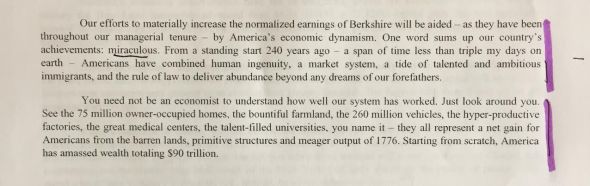
Sunny American optimism:
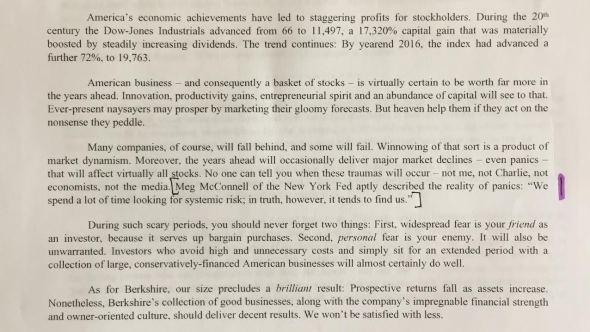
The infectious, enthusiastic amateur style of writing reminds me of Bill James:

Some of the companies Berkshire owns:


9.3% of your Coke is Berkshire’s.
An unlikely hero:
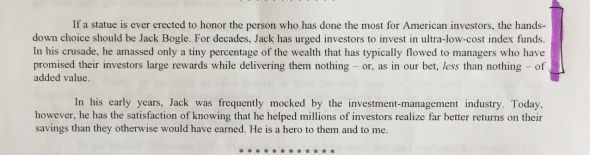
Jack Bogle founded Vanguard, and created a simple, low cost index fund for everyday investors.

found that at JL Collins impressive website.
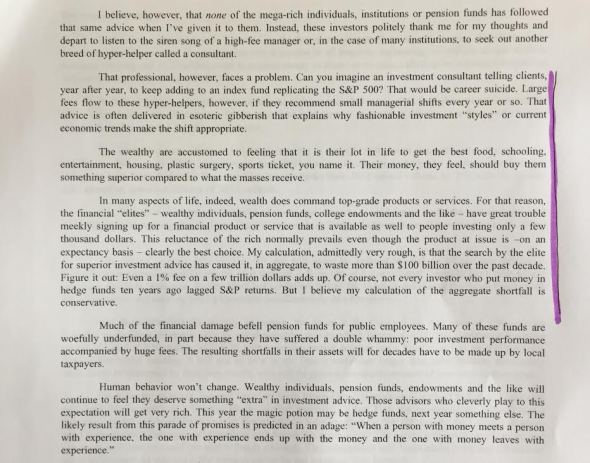
Buffett tells you, in simple terms, how to get rich:

Why people don’t do that:
On the other hand here’s the S&P 500 chart since 1980:

Doesn’t look like a washtubs moment to me.
Over at marketplace.org, Allan Sloan points out some of the things Buffett leaves out:
Allan Sloan: Two things are missing. One was how wonderful the management of Wells Fargo was, which he wrote the previous year. The second thing is he lavished praise on this company called 3G, what’s known as a private equity company, from Brazil, which manages a company called Kraft Heinz, which is Berkshire Hathaway’s biggest investment. And what it does is it goes around, it buys companies — now with the help of a lot of financing from Berkshire Hathaway — it fires zillions of people, the profits go up, and then after a while, it goes out and buys another company and does the same thing.
Buffett makes me think of Andrew Carnegie, a zillionaire of a hundred years ago who also had some kind of public conscience. If some percentage billionaires weren’t also lovable characters like Buffett, would capitalism collapse? Does his dad humor, like Carnegie’s library building, plug a dyke that holds back revolution?

At the Berkshire Hathaway shareholders conference, you can challenge table tennis champ Ariel Hsing:


_van_het_Amsterdamse_lakenbereidersgilde_-_Google_Art_Project.jpg)
#/media/File:Attack_on_carrier_USS_Franklin_19_March_1945.jpg)