Captain George K. H. Coussmaker (Joshua Reynolds, 1782)
Posted: April 20, 2012 Filed under: art, Hemingway, Joshua Reynolds, Met, museum, painting, pictures, writing Leave a comment
“What the hell!” Hemingway said suddenly. “I don’t want to be an art critic. I just want to look at pictures and be happy with them and learn from them. Now, this for me is a damn good picture.” He stood back and peered at a Reynolds entitled “Colonel George Coussmaker,” which shows the Colonel leaning against a tree and holding his horse’s bridle. “Now, this Colonel is a son of a bitch who was willing to pay money to the best portrait painter of his day just to have himself painted,” Hemingway said, and gave a short laugh. “Look at the man’s arrogance and the strength in the neck of the horse and the way the man’s legs hang. He’s so arrogant he can afford to lean against a tree.”
remembers Miss Ross.
Coussmaker sat for Reynolds 21 times and his horse 8 times between February 9 and April 16, 1782 – an exceptional number of times.
Van Dyck, Portrait Of The Artist (possibly 1620-21)
Posted: April 19, 2012 Filed under: art, Hemingway, Met, museum, painting, pictures, writing 1 Comment
Weighed in already but let’s get Hemingway’s take:
Mrs. Hemingway called to us. She was looking at “Portrait of the Artist” by Van Dyck. Hemingway looked at it, nodded approval, and said, “In Spain, we had a fighter pilot named Whitey Dahl, so Whitey came to me one time and said, ‘Mr. Hemingway, is Van Dyck a good painter?’ I said ‘Yes, he is.’ He said, ‘Well, I’m glad, because I have one in my room and I like it very much, and I’m glad he’s a good painter because I like him.’ The next day, Whitey was shot down.”
– from Miss Ross again.
Still more on Francesco Francia’s Portrait of Federigo Gonzaga
Posted: April 18, 2012 Filed under: art, Francesco Francia, Met, museum, painting, pictures, Raphael Leave a comment
Raphael’s Santa Cecilia is supposed to have produced such a feeling of inferiority in Francia that it caused him to die of depression. However, as his friendship with Raphael is now well-known, this story has been discredited.
Here it is, anyway:

Go see that next time you’re in Bologna. What’s that? In no hurry to get to Bologna? Perhaps Mr. James Salter can persuade you:
“Bologna is famous for three things,” she said. “It’s famous for its learning – it has the oldest university in Italy, founded in the twelfth century. It’s famous for its food. The cuisine is the finest in the country. You can eat in Bologna as nowhere else, that’s well known. And lastly, it’s famous for fellatio.” She used another word.
“It’s a specialty,” she said. “All the various forms are called by the names of pasta. Rigate, for instance,” she explained, “which is a pasta with thin, fluted marks. For that the girls gently use their teeth. When there used to be brothels there was always a Signorina Bolongese – that was her specialty.”
More on Francisco Francia’s Portrait of Federigo Gonzaga
Posted: April 17, 2012 Filed under: art, Francesco Francia, Met, museum, painting, pictures, Titian 1 Comment
In July 1510 the ten-year-old Federigo Gonzaga was sent from Mantua to Rome as a hostage. On his way to Rome he stopped in Bologna, where Francia astounded everyone by painting and delivering his portrait in twelve days. The picture was subsequently taken to Rome for the admiration of the papal court and was only reluctantly returned to Isabella d’Este, Federigo’s mother. The fine execution of this famous portrait is typical of Francia’s best work.
– says the Met, where this painting is NOT ON DISPLAY. Later in life, Titian would take a crack at Federigo:

Portrait of Federigo Gonzaga (Francesco Francia, 1510)
Posted: April 16, 2012 Filed under: art, Hemingway, Met, museum, painting, pictures, writing Leave a comment
“Here’s what I like, Papa,” Patrick said, and Hemingway joined his son in front of “Portrait of Federigo Gonzaga (1500-1540) by Francesco Francia. It shows, against a landscape, a small boy with long hair and a cloak.
“This is what we try to do when we write, Mousie,” Hemingway said, pointing to the trees in the background. “We always have this in when we write.”
– “How Do You Like It Now, Gentleman,” by Lillian Ross, The New Yorker, May 13, 1950
Yuri Gagarin
Posted: April 12, 2012 Filed under: heroes, photography, pictures, science Leave a commentGood Artwork of the Day from the Met today:

The sudden rise to national and international fame took its toll on Gagarin. In attending various functions and receptions in his honour, he consumed large amounts of vodka and other alcoholic beverages, even though otherwise he was not a regular drinker. His physical appearance changed and he became noticeably heavier. The attention of female fans took a toll on his marriage. It was rumoured that his wife once caught him in a hotel room with another woman and Gagarin jumped out of the second floor window and hit his face on a kerbstone, which resulted in a deep cut above his left eye. The scar remained visible after the incident.
The photographer is Yousef Karsh:
As Karsh wrote of his own work inKarsh Portfolio in 1967, “Within every man and woman a secret is hidden, and as a photographer it is my task to reveal it if I can. The revelation, if it comes at all, will come in a small fraction of a second with an unconscious gesture, a gleam of the eye, a brief lifting of the mask that all humans wear to conceal their innermost selves from the world. In that fleeting interval of opportunity the photographer must act or lose his prize.”
“…solitude like a dream, half-horrific and half-glorious…”
Posted: April 12, 2012 Filed under: New England, painting, pictures, Winslow Homer Leave a comment
“The cost of transformative art must be paid by the artist alone. The ridiculous honors we bestow on the few artists we discover – or think we discover – are our gauche attempts at collective repayment. But to the great artist there comes a realization that he must pay it alone.
He pays anyway. The bill is paid, in large part, with solitude. A solitude like a dream, half-horrific and half-glorious, a loneliness so deep that it becomes a kind of companion.
Again and again in [Winslow] Homer’s work the subject turns away, casts off, looks to some task, to some turn of the weather that seems to offer nothing but a reminder of this cosmic indifference. We look at the fisherman; he doesn’t look back. Hemingway would crib much of this. But it was Homer, first, who stared deep into the river, into the ocean, accepting that he might see nothing in return. Yet he finds in the nothing a comfort. An unluxurious comfort but a comfort nonetheless. By the later paintings he has dissolved completely. Only the waves remain.”
– from J. A. Ellison’s Winslow Homer On Prouts Neck: A Rumination (1957).

The Green Cathedral
Posted: April 11, 2012 Filed under: architecture, medieval studies, music, nature, trees, UNESCO Leave a comment
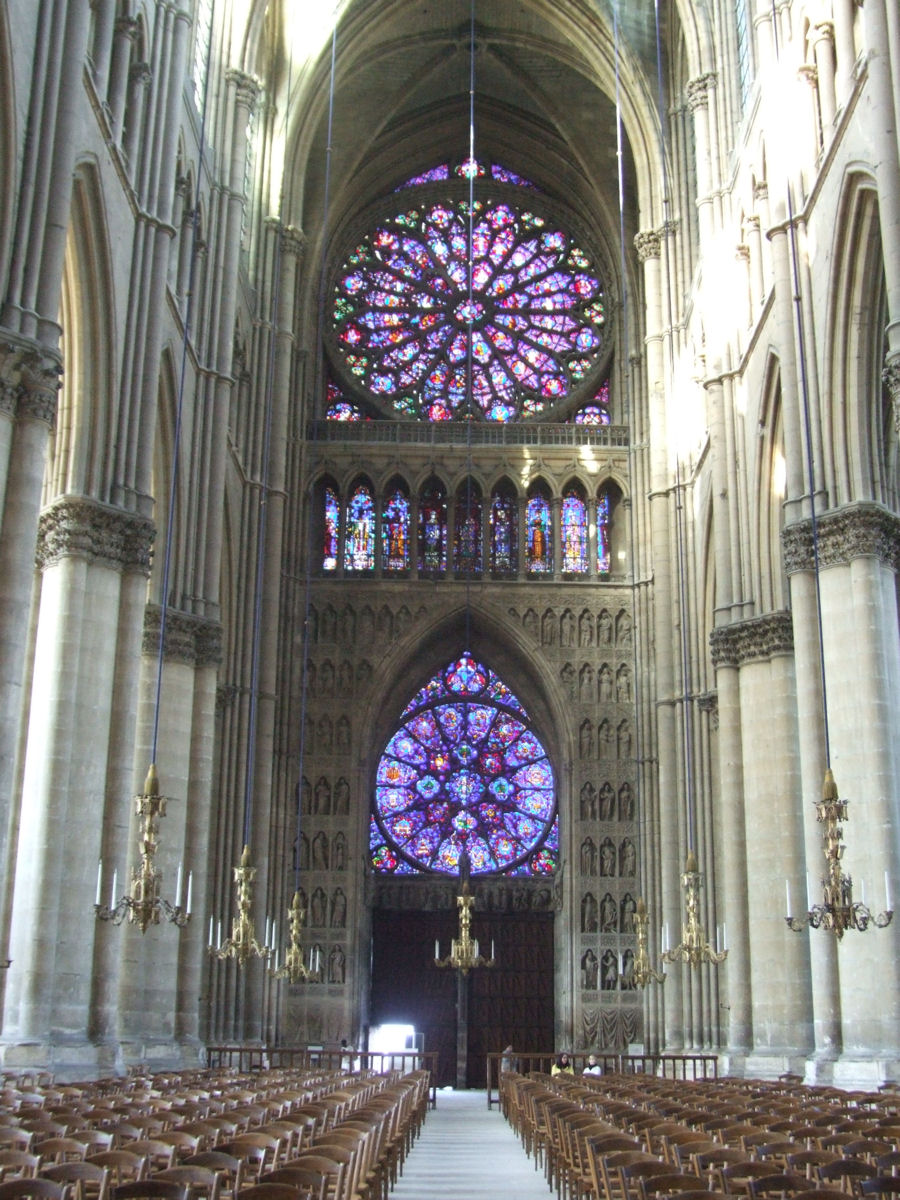
The Green Cathedral or De Groene Kathedraal located near Almere Netherlands, is an artistic planting of Lombardy poplars (Populus nigra italica) that mimics the size and shape of the Cathedral of Notre-Dame, Reims, France….The work was planted by Marinus Boezem (b. 1934) on April 16, 1987 in Southern Flevoland, Nederland.

While walking there I assume you should listen to Guillaume de Machaut’s Messe de Notre Dame (1360s), composed for the cathedral at Reims (which isn’t too shabby in stone either).
Machaut survived the Black Death which devastated Europe, and spent his later years living in Rheims composing and supervising the creation of his complete-works manuscripts. His poem Le voir dit(probably 1361–1365) purports to recount a late love affair with a 19-year-old girl, Péronne d’Armentières, although the accuracy of the work as autobiography is contested.
Pictures from wikipedia and from inhabit.com
Caravaggio, “Judith Beheading Holofernes” (1598-99)
Posted: April 9, 2012 Filed under: art, painting, pictures Leave a comment
The model for Judith is probably the Roman courtesan Fillide Melandroni, who posed for several other works by Caravaggio around this year; the scene itself, and especially the details of blood and decapitation, were presumably drawn from his observations of the public execution of Beatrice Cenci a few years before.
Alberto Korda
Posted: April 9, 2012 Filed under: Cuba, from wikipedia, photography, pictures Leave a comment
In the early years Korda was most interested in fashion because it allowed him to pursue his two favorite things, photography and beautiful women. Korda became Cuba’s premiere fashion photographer. Korda disliked artificial lighting he said it was “a travesty of reality” and only used natural light in his studio…. “My main aim was to meet women”, he once confessed. His second wife, Natalia (Norka) Menendez, was a well known Cuban fashion model.

The Atlantic encourages us to start “Remembering Project Gemini”
Posted: April 5, 2012 Filed under: explorers, heroes, photography, pictures, the ocean Leave a commentWill do! That there is the same Intrepid that’s docked in the Hudson River, seen here some twenty years after surviving two crashes from kamikazes.


St. Bridget of Sweden, from an altarpiece in Salem, Södermanland, restored digitally.
Posted: April 5, 2012 Filed under: art, Christianity, painting, religion Leave a comment
The Boston Globe’s Big Picture Blog
Posted: April 5, 2012 Filed under: photography, pictures, the world around us Leave a comment
Moses Shown The Promised Land (1801)
Posted: April 3, 2012 Filed under: art, Benjamin West, Met, painting, pictures Leave a commentMet’s Artwork of the Day drills it (to use a term frequently thrown around in Rob Lowe’s autobiography) today:

Benjamin West.
The family later moved to Newtown Square, Pennsylvania, where his father was the proprietor of the Square Tavern, still standing in that town.
So it is! Regrettably it doesn’t look like you can have a drink there anymore. LAME.

The Jolly Flatboatmen (1846)
Posted: April 3, 2012 Filed under: art, George Caleb Bingham, heroes, people, pictures Leave a comment
George Caleb Bingham was, among other things, the first chief of police in Kansas City. I’d like to visit his house next time I’m in Arrow Rock, Missouri.
This painting is apparently in the collection of Detroit industrialist Richard Manoogian. Manoogian’s father was a refugee from the Armenian genocide. Arriving in America at age 19, he worked as a machinist before founding the Masco Screw Company.
Manoogian’s redesign and production of the Delta faucet, which allowed one-handed use, resulted in best-selling status for the plumbing fixture and generated substantial profits for his business wealth. In 1995 his company had $3 billion dollars in sales and had 38 percent of the domestic market for faucets.
A Delta faucet:

Scott Prior
Posted: March 24, 2012 Filed under: art, Boston, MFA Boston, museum, New England, painting, pictures 1 Comment
This guy is good at painting, right? Am I crazy?
His “Nanny and Rose” used to hang in the lobby of the MFA and whenever I saw it as a kid I was like, oh that guy must be the best painter in the world.

But nobody ever talks about him.
Images from his website.
Theodosius Is Shown The Cave Of The Seven Sleepers
Posted: March 23, 2012 Filed under: art, Christianity, Islam, museum, pictures, religion 1 Comment
What? You’ve never heard of the Seven Sleepers of Ephesus? Remember? The persecutions of Decius? Instead of submitting to his authority they went into a cave to pray? Remember? And they fell asleep? Decius sealed the cave? Then two centuries later Theodosius decides to open the cave, to use as a cattle pen? They’re still alive? One of them tries to spend his coins with the face of Decius? When the sleepers see crosses they’re like, “oh? all of you worship Christ? how wonderful the Lord has proved to be.” People lose it? When the bishop heard about it he dropped dead?
Did you just, what, did you just sleep through CCD?
Oh, you’re Muslim? NICE TRY STILL A BIG DEAL IN THE Q’URAN TOO! They would’ve made pictures if the Q’uran didn’t also ban images of humans.
(photo from The Cloisters, great place to learn about a lot of “off center” medieval Christianity)
Look at this asshole
Posted: March 22, 2012 Filed under: art, museum, painting, pictures, villains Leave a comment
Anthony Van Dyck, Self-Portrait.
“Possibly 1620-1.” Art historians, DO YOUR JOBS and get that “possibly” out of there.
“A precocious talent…” yeah I bet he was, The Met.
Trying to learn how to pronounce “Childe Hassam,” found this.
Posted: March 21, 2012 Filed under: art, heroes, painting, pictures 1 Comment
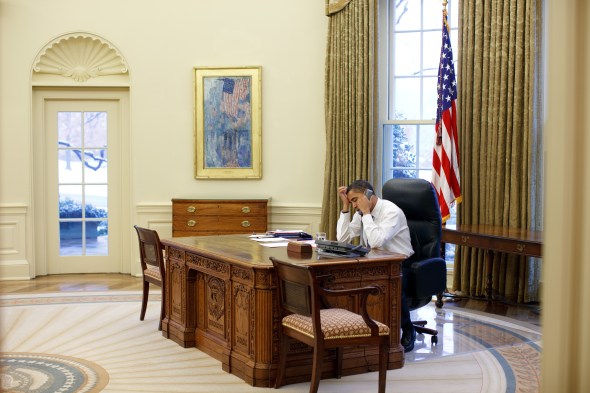
President Barack Obama in the Oval Office 1/28/09. Official White House Photo by Pete Souza
That’s his “The Avenue In The Rain” past Barry. Pronounced “Child HASS-m.”
Hildegard von Bingen receives a vision and dictates it to the monk Volmar
Posted: March 19, 2012 Filed under: art, pictures, religion Leave a comment
(if I don’t cite a picture’s source it’s from wikipedia commons or I took it myself)
 Helytimes