




MONTREAL, Oct. 27— In an eruption of national pride, tens of thousands of Canadians poured into Montreal from across Canada today to call for unity and to urge Quebec to remain part of their country.
Buffett
Posted: February 3, 2017 Filed under: advice, America Since 1945, business, politics, presidents Leave a comment
Warren Buffett’s advice always sounds simple, which isn’t the same as easy to follow.

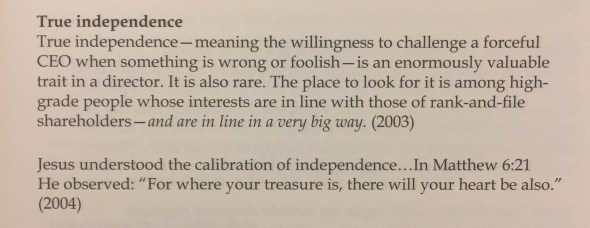
Loved the doc about him on HBO. The first scene is him advising high school kids to take care of their minds and bodies. The second scene is him in the drive-through line at McDonald’s.
Shoddy
Posted: January 31, 2017 Filed under: America Since 1945, politics, presidents Leave a comment
from Whitehouse.gov, a shoddy website
- badly made or done
- lacking moral principle; sorid
poor-quality
inferior
second-rate
cheap
trashy
careless
sloppily-made
worthless
prone to falling apart, disintegrating
valueless
unworthy
inadequate
Arabic
Posted: January 30, 2017 Filed under: Islam, Islam, Middle East, politics, religion Leave a comment

The challenge: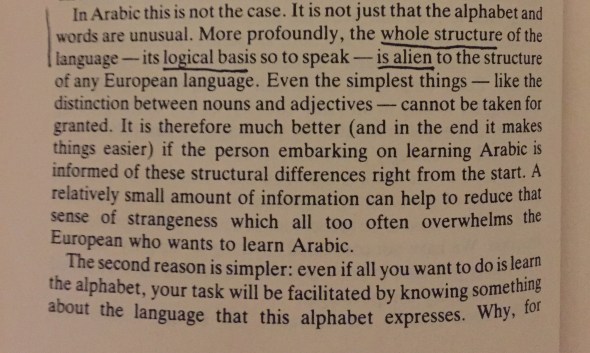
How to react:

Bloggers = B Players?
Posted: January 27, 2017 Filed under: politics, presidents Leave a comment
Working my noggin on this quote from Justin Peters’ review of Thomas Friedman’s book over at Slate:
A very perceptive barfly once explained it to me like this. In the corporate world, you’ve got A players, B players, and C players stacked top to bottom like a pyramid. There’s this documentary called Jiro Dreams of Sushi, about a perfectionist Japanese sushi chef. When an A player sees that movie, the barfly explained, she will come to work the next day determined to work harder and smarter than ever before. A B player will spend the next day raving about the movie to anyone who’ll listen; maybe she’ll write a review for her blog. A C player sees Jiro Dreams of Sushi and comes to work the next day inspired to order Japanese food for lunch.
Tom Friedman is a B player interpreting A players for the benefit of C players, and there are lots of C players, and maybe it’s that simple. But both B players and C players habitually miss the point—and, in the end, so does Thank You for Being Late
Let’s consider this:
- this sentence occurs in a review on what is essentially a blog, so is Justin Peters self-identifying as a B player?
- quoting a “very perceptive barfly” is a very Thomas Friedmany kind of thing to do. Is that the joke/point Justin Peters is making?
- are we really calling Thomas Friedman a B player? The dude is the dominant NY Times columnist, consistently crushing it with bestselling books.
The bloggers I enjoy are all A players, I would say.
Sensitive to the fact that the word “blog” has come to connote “loserish.” Have been struck by the fact that Stephen Miller and Steve Bannon, who are today writing the President’s executive orders, are, essentially, bloggers.

Breitbart News Daily Stephen K. Bannon interviews Stephen Miller for SiriusXM Broadcasts’ New Hampshire Primary Coverage Live From Iconic Red Arrow Diner on Feb. 8 in Manchester, New Hampshire. | Getty. Source.
Consider this Politico profile of Stephen Miller by Julia Ioffe. At Duke:
But mostly he used the column as a lightning rod, a way to court angry reaction and put himself at the center of major campus controversies. He wrote that interacting with the population outside the campus was overrated. “Durham isn’t a petting zoo,” he chided. “The residents won’t get lonely or irritable if we don’t play with them.” He was a strong supporter of the war in Iraq and called Ted Kennedy a “traitor” for criticizing American use of torture.
Miller invited another media figure, David Horowitz, to Duke, and that led him to Jeff Sessions:
The name he made for himself in fighting the university establishment, through his column and in inviting Horowitz to speak, would later reap benefits. It was Horowitz who, in 2009, would recommend Miller to his old friend, Jeff Sessions.
President DT himself would not be president if his Twitter micro-blog were not so stimulating and provocative. The Trump movement comes out of provocative media networks. How on Earth is the left losing that battle?
Wonder if — hear me out — an effective force for anti-Trumpism and resistance could be mini-networks, newspapers, arguments, alternatives, ideas, forums for strong takes. Reach people and really change their minds, is the idea.
Write to me, lemme know what you think!
“The messenger of this incredible movement”
Posted: January 23, 2017 Filed under: Islam, politics Leave a comment
Muhammad leads Abraham, Moses and Jesus in prayer. from medieval Persian manuscript Source: ”The Middle Ages. An Illustrated History” by Barbara Hanawalt (Oxford University Press, 1998). Source.
is that
a) how Muhammad is described in the Quran
or
b) how Sean Spicer describes President Donald Trump?
Thurgood’s take, and Yoichi Okamoto
Posted: January 2, 2017 Filed under: America Since 1945, photography, politics, presidents Leave a comment
From Stephen L. Carter’s 2017 predictions, via Tyler Cowen. (Helytimes is increasingly becoming a Tyler Cowen processing center).
Thurgood:
That photo is by Yoichi Okamoto:

Looking a bit like Fredrik Wikingsson there, and here are more by Yoichi:


found at this NYT slideshow of his work from 2013.
The Generals by Thomas Ricks
Posted: December 23, 2016 Filed under: America Since 1945, politics, war, WW2 1 Comment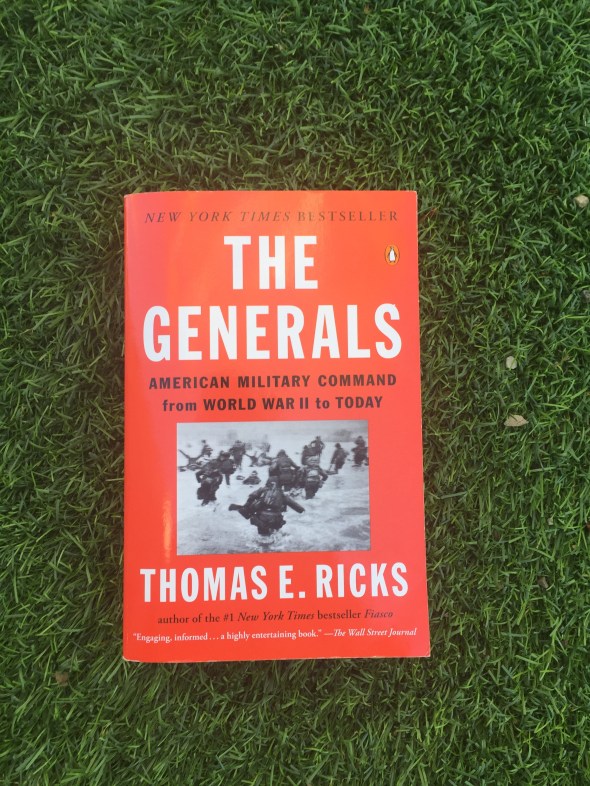
This book is so full of compelling anecdotes, character studies, and surprising, valuable lessons of leadership that I kind of can’t believe I got to it before Malcolm Gladwell or David Brooks or somebody scavenged it for good stories.
Generaling
Consider how hard it would be to get fifteen of your friends to leave for a road trip at the same time. How much coordination and communication it would take, how likely it was to get fucked up.
Now imagine trying to move 156,000 people across the English Channel, and you have to keep it a surprise, and on the other side there are 50,350 people waiting to try and kill you.

The Puerto Rican 65th Infantry Regiment’s bayonet charge against a Chinese division during the Korean War. Dominic D’Andrea, commissioned by the National Guard Heritage Foundation
Even at a lower scale, say a brigade, a brigadier general might oversee say 4,500 people and hundreds of vehicles. Those people must be clothed, fed, housed, their medical problems attended to. Then they have to be armed, trained, given ammo. You have to find the enemy, kill them, evacuate the wounded, stay in communication, and keep a calm head as many people are trying to kill you and the situation is changing rapidly and constantly.

32nd Brigade Command Sgt. Maj. Ed Hansen, on floor in front of podium, accepts reports from battalion command sergeants major as the brigade forms at the start of the Feb. 17 send-off ceremony at the Dane County Veterans Memorial Coliseum, Madison, Wis. Family members and public officials bade farewell to some 3,200 members of the 32nd Infantry Brigade Combat Team and augmenting units, Wisconsin Army National Guard, in the ceremony. The unit is bound for pre-deployment training at Fort Bliss, Texas, followed by a deployment of approximately 10 months for Operation Iraqi Freedom. Wisconsin Department of Military Affairs photo by Larry Sommers.
Being a general is a challenging job, I guess is my point.

U.S. Army Gen. Martin E. Dempsey, left, chairman of the Joint Chiefs of Staff, and U.S. Marine Corps Gen. James N. Mattis, commander of U.S. Central Command, talk on board a C-17 while flying to Baghdad, Dec. 15, 2011. Source.
I saw this post about Gen. Mattis, possible future Secretary of Defense, on Tom Ricks blog:
A SecDef nominee at war?: What I wrote about General Mattis in ‘The Generals’
The story was so compelling that I immediately ordered Mr. Ricks’ book:

A fantastic read. Eye-opening, shocking, opinionated, compelling.
The way that Marc Norman’s book on screenwriting works as a history of Hollywood:

The Generals works as a kind of history of the US since World War II. I’d list it with 1491: New Revelations On The Americas Before Columbus as a book I think every citizen should read.
The observation that drives The Generals is this: commanding troops in combat is insanely difficult. Many generals will fail. Officers who performed well at lower ranks might completely collapse.
During World War II, generals who failed to perform were swiftly relieved of command. (Often, they were given second chances, and many stepped up).
Since World War II, swift relief of underperforming generals has not been the case. The results for American military effectiveness have been devastating. Much of this book describes catastrophe and disaster, as I guess war is even under the best of circumstances and the finest leadership.
Ricks is such a good writer, so engaging and compelling. He knows to include stuff like this:

Ricks describes the catastrophes that result from bad military leadership. How about this, in Korea?:
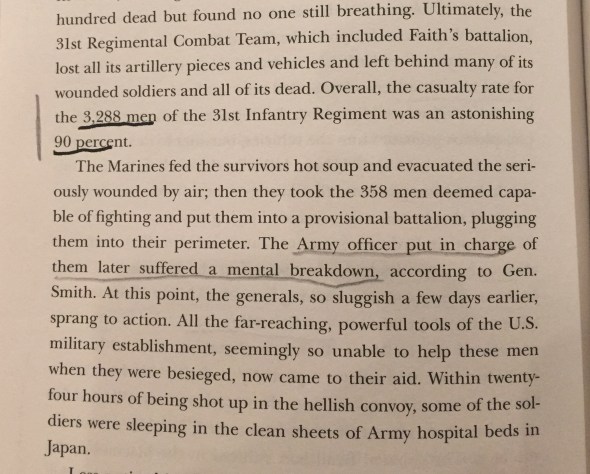
What kind of effect did this leadership have, in Vietnam?:

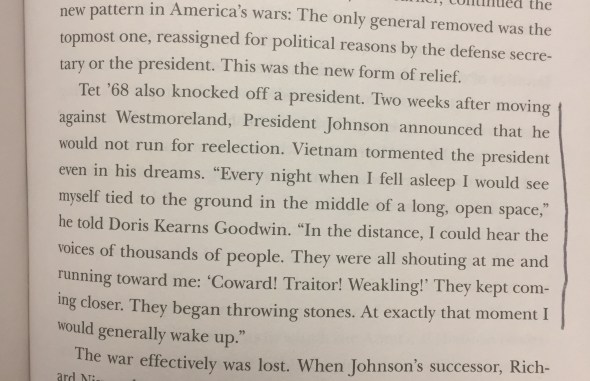
He discusses the relationship of presidents and their generals:


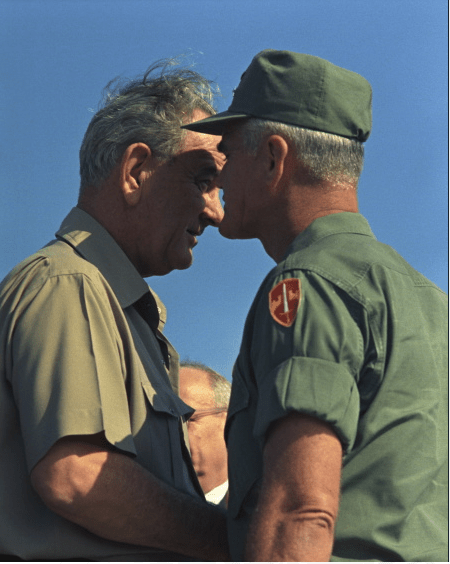
Here is LBJ, years later, describing his nightmares:
Ricks can be blunt:
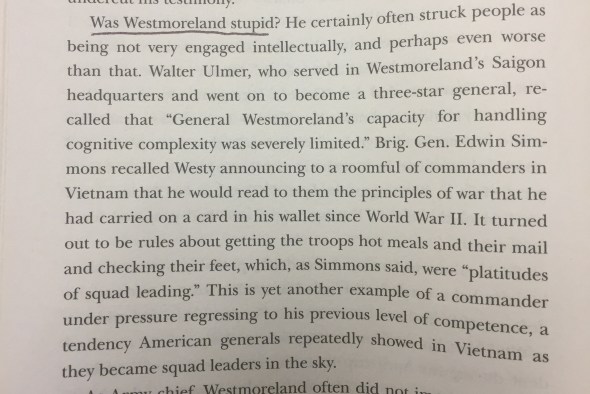
Hard lessons the Marines had learned:


Symbolically, There’s a Warning Signal Against Them as Marines Move Down the Main Line to Seoul From RG: 127 General Photograph File of the U.S. Marine Corps National Archives Identifier: 5891316 Local Identifier: 127-N-A3206
A hero in the book is O. P. Smith

who led the Marines’ reverse advance at the Chosin Resevoir, when it was so cold men’s toes were falling off from frostbite inside their boots:

The story of what they accomplished is incredible, worth a book itself. Here’s Ricks talking about the book and Smith.
A continued challenge for generals is to understand the strategic circumstances they are operating under, and the political limitations that constrain them.

031206-F-2828D-373
Secretary of Defense Donald H. Rumsfeld walks with Army Lt. Gen. Ricardo Sanchez after arriving at Baghdad International Airport in Iraq on Dec. 6, 2003. Rumsfeld is in Iraq to meet with members of the Coalition Provisional Authority, senior military leaders and the troops deployed there. DoD photo by Tech. Sgt. Andy Dunaway, U.S. Air Force. (Released) source

Recommend this book. One of the best works of military history I’ve ever read, and a sobering reflection on leadership, strategy, and the United States.
One last chance?
Posted: December 16, 2016 Filed under: America Since 1945, heroes, politics, presidents, the California Condition Leave a comment
stirred the pot the other day with this tweet.
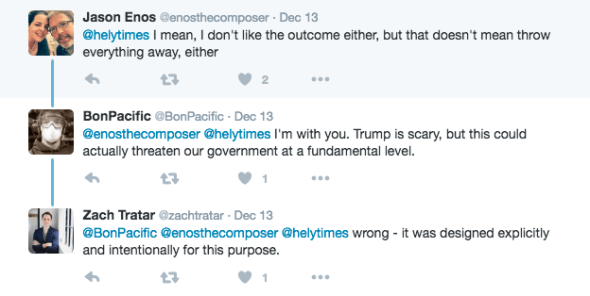


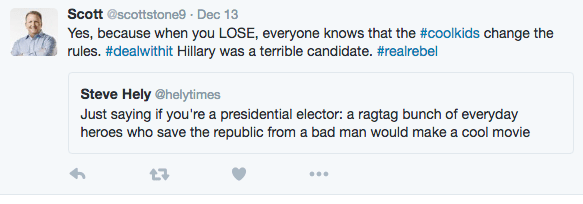
I mean, I like being lumped in with the #coolkids.
When I tweeted that, I meant what I said: it would be a cool movie. The Electoral College members are mostly, as I understand it, a bunch of ordinary schmoes. 99 times out of a hundred their job is rubber stamping, a comical bit of leftover political inanity.
But what if, one day, it wasn’t so easy?
What if, one day, these ordinary citizens were called upon to make a tough choice.
A choice that would bring them right into the line of fire.
A choice that would change history.
The idea of Trump in the White House makes me sick. 61,900,651 Americans disagree, obvs. An Electoral College revolt is a crazy fantasy. But I enjoy thinking about it!
What is right and wrong for the Electoral College to do?
Says the National Archives:
There is no Constitutional provision or Federal law that requires Electors to vote according to the results of the popular vote in their states. Some states, however, require Electors to cast their votes according to the popular vote. These pledges fall into two categories—Electors bound by state law and those bound by pledges to political parties.
The U.S. Supreme Court has held that the Constitution does not require that Electors be completely free to act as they choose and therefore, political parties may extract pledges from electors to vote for the parties’ nominees. Some state laws provide that so-called “faithless Electors” may be subject to fines or may be disqualified for casting an invalid vote and be replaced by a substitute elector. The Supreme Court has not specifically ruled on the question of whether pledges and penalties for failure to vote as pledged may be enforced under the Constitution. No Elector has ever been prosecuted for failing to vote as pledged.
Today, it is rare for Electors to disregard the popular vote by casting their electoral vote for someone other than their party’s candidate. Electors generally hold a leadership position in their party or were chosen to recognize years of loyal service to the party. Throughout our history as a nation, more than 99 percent of Electors have voted as pledged.
The National Association of Secretaries of State (NASS) has compiled a brief summary of state laws about the various procedures, which vary from state to state, for selecting slates of potential electors and for conducting the meeting of the electors. The document, Summary: State Laws Regarding Presidential Electors, can be downloaded from the NASS website.

From the NASS website, here’s how it goes down in my home state of California:
Whenever a political party submits to the Secretary of State its certified list of nominees for electors of President and Vice President of the United States, the Secretary of State shall notify each candidate for elector of his or her nomination by the party. The electors chosen shall assemble at the State Capitol at 2 o’clock in the afternoon on the first Monday after the second Wednesday in December next following their election. In case of the death or absence of any elector chosen, or if the number of electors is deficient for any other reason, the electors then present shall elect, from the citizens of the state, as many persons as will supply the deficiency. The electors, when convened, if both candidates are alive, shall vote by ballot for that person for President and that person for Vice President of the United States, who are, respectively, the candidates of the political party which they represent, one of whom, at least, is not an inhabitant of this state.
That seems pretty standard. In some states they meet in the governor’s office or the office of the secretary of state. In Massachusetts they will meet in the Governor’s office:

Barry Chin for The Boston Globe, found here.
Here’s what the good ol’ Constitution says about the EC.
Now, what is the point of all this? If you’ve read at all about the EC, you will know that Hamilton made the case for it in Federalist 68, which you can read a summary of here or the real thing here.

You’ve probably seen this quote:
Talents for low intrigue, and the little arts of popularity, may alone suffice to elevate a man to the first honors in a single State; but it will require other talents, and a different kind of merit, to establish him in the esteem and confidence of the whole Union, or of so considerable a portion of it as would be necessary to make him a successful candidate for the distinguished office of President of the United States
But to me, the more interesting one is this one:
Nothing was more to be desired than that every practicable obstacle should be opposed to cabal, intrigue, and corruption. These most deadly adversaries of republican government might naturally have been expected to make their approaches from more than one querter, but chiefly from the desire in foreign powers to gain an improper ascendant in our councils.
Wow!
Now, I hear the argument that the cool kids are always changing the rules. I don’t think I agree with the logic of this petition, which is half “Hillary won the popular vote” (who cares, that’s not the rules we were playing by) and half “Trump is unfit to serve.”
The Trump being unfit to serve bit was up to the voters. Seems very dangerous to me for the Electoral College to start making that call. That is some wonked aristocratic bullshit that the Constitution maybe intended, but which the Constitution as practiced and understood has moved away from?
But if it were proven Trump colluded with a foreign power, then I think hell yeah! If you believe, as I do, that the Constitution is a genius mechanism full of checks and failsafes, isn’t the Electoral College designed exactly to be one last chance for good old-fashioned citizens to stop a presidential candidate who allowed a foreign power to gain an improper ascendant in our councils?
I don’t think we have the proof that Trump did that. But I think the Electors are totally within their rights to think about it and decide what to do.
In closing my feelings are well summarized by Ben White:

Meet Farkas
Posted: November 18, 2016 Filed under: politics, Wonder Trail Leave a comment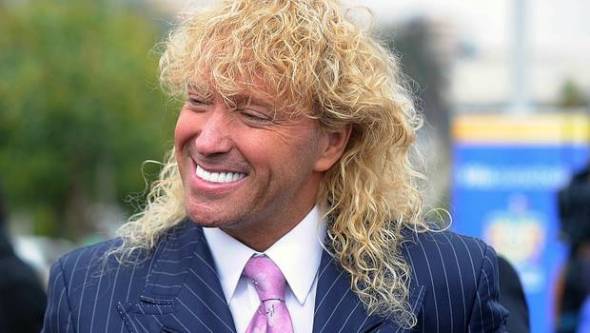
Meet Farkas.
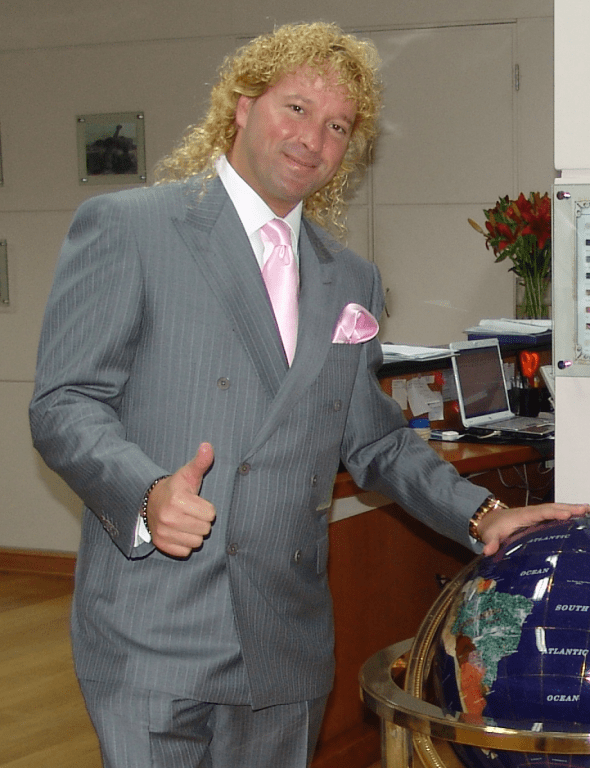
He’s Chile’s own Donald Trump. 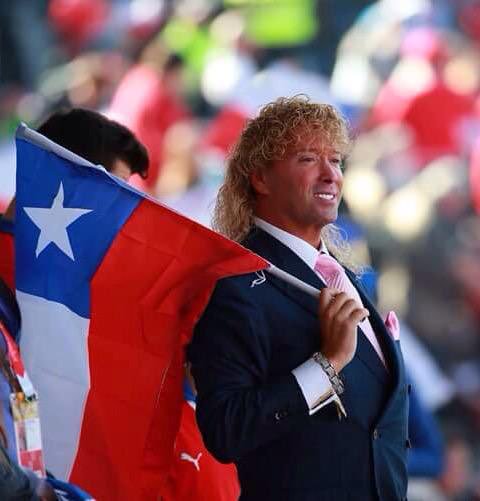
Shoutout to my pal Fabrizio Copano for telling me about him. 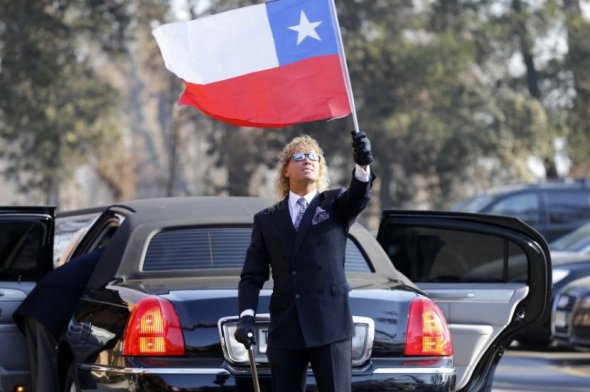
TO lighten the mood deep down in the San José Mine, the 33 trapped miners would playfully imitate Leonardo Farkas Klein, donning makeshift wigs to simulate the long curly blond mane of the mining executive.
Faithless electors
Posted: November 16, 2016 Filed under: America Since 1945, politics, presidents Leave a comment
Salving myself with fantasies of whole state delegations of presidential electors tossing out Trump when the Electoral College voting goes down.
The Electoral College never actually meets as one body. Electors meet in their respective state capitals (electors for the District of Columbia meet within the District) on the Monday after the second Wednesday in December, at which time they cast their electoral votes on separate ballots for president and vice president.
The history of “faithless electors” doesn’t break a five on a 1-10 scale of interesting (with 10 being reasonably interesting) but the case of the last faithless elector is kind of funny:
1 – 2004 election: An anonymous Minnesota elector, pledged for Democrats John Kerry and John Edwards, cast his or her presidential vote for John Ewards [sic],[8]rather than Kerry, presumably by accident
There’s some talk of the Electoral College in The Federalist 68, which seems a little optimistic at the moment:
The process of election affords a moral certainty, that the office of President will never fall to the lot of any man who is not in an eminent degree endowed with the requisite qualifications. Talents for low intrigue, and the little arts of popularity, may alone suffice to elevate a man to the first honors in a single State; but it will require other talents, and a different kind of merit, to establish him in the esteem and confidence of the whole Union, or of so considerable a portion of it as would be necessary to make him a successful candidate for the distinguished office of President of the United States.
Seinfeld –> Trump?
Posted: November 15, 2016 Filed under: politics Leave a comment

Read this Bloomberg profile by Joshua Green of the president-elect’s “chief strategist and senior counselor,” Steve Bannon:
And then, serendipitously, Bannon wound up in the entertainment business himself. Westinghouse Electric, a client, was looking to unload Castle Rock Entertainment, which had a big TV and movie presence, including Billy Crystal’s films. Bannon reeled in an eager buyer: Ted Turner. “Turner was going to build this huge studio,” he says, “so we were negotiating the deal at the St. Regis hotel in New York. As often happened with Turner, when it came time to actually close the deal, Ted was short of cash. … Westinghouse just wanted out. We told them, ‘You ought to take this deal. It’s a great deal.’ And they go, ‘If this is such a great deal, why don’t you defer some of your cash fee and keep an ownership stake in a package of TV rights?’ ” In lieu of a full adviser’s fee, the firm accepted a stake in five shows, including one in its third season regarded as the runt of the litter: Seinfeld. “We calculated what it would get us if it made it to syndication,” says Bannon. “We were wrong by a factor of five.”
This has been reported elsewhere. Nearly unbelievable. Tried to do the digging and found out the other four shows. Best I could find:
That’s where Bannon popped up. He had left Goldman Sachs to start Bannon & Co., a boutique banking firm specializing in media companies. His firm was representing Westinghouse, and when Turner didn’t have the cash to close both deals, he offered as partial payment the right to participate in some of Castle Rock’s TV shows. Most were unremarkable titles that even insiders can’t quite recall (though some say The Ed Begley Jr. Show and Julie Brown: The Show were included). There also was Seinfeld, which was struggling to find an audience even in its third season. Bannon advised Westinghouse to accept Turner’s terms. Westinghouse executives countered that if Bannon was so confident, he should also accept participation rights instead of a portion of his bank’s $3 million fee. Bannon took the chance. Neither Seinfeld, Horn, Reiner nor anyone at Castle Rock were even aware of the arrangement.

Amazing!
What lessons are in this profile?
But this “conspiracy,” at least under Bannon, has mutated into something different from what Clinton described: It’s as eager to go after establishment Republicans such as Boehner or Jeb Bush as Democrats like Clinton.
Engineered Weiner downfall?:
Tipped to Weiner’s proclivity for sexting with female admirers, Bannon says, the site paid trackers to follow his Twitter account 24 hours a day and eventually intercepted a crotch shot Weiner inadvertently made public. The ensuing scandal culminated in the surreal scene, carried live on television, of Andrew Breitbart hijacking Weiner’s press conference and fielding questions from astonished reporters.
Let us be careful about punditry with oversold conclusions:
For Bannon, the Clinton Cash uproar validated a personal theory, informed by his Goldman Sachs experience, about how conservatives can influence the media and why they failed the last time a Clinton was running for the White House. “In the 1990s,” he told me, “conservative media couldn’t take down [Bill] Clinton because most of what they produced was punditry and opinion, and they always oversold the conclusion: ‘It’s clearly impeachable!’ So they wound up talking to themselves in an echo chamber.”
Interesting lessons:
In response, Bannon developed two related insights. “One of the things Goldman teaches you is, don’t be the first guy through the door because you’re going to get all the arrows. If it’s junk bonds, let Michael Milken lead the way,” he says. “Goldman would never lead in any product. Find a business partner.” His other insight was that the reporters staffing the investigative units of major newspapers aren’t the liberal ideologues of conservative fever dreams but kindred souls who could be recruited into his larger enterprise. “What you realize hanging out with investigative reporters is that, while they may be personally liberal, they don’t let that get in the way of a good story,” he says. “And if you bring them a real story built on facts, they’re f—ing badasses, and they’re fair.”
Used the media outlets of his opponents to his advantage:
“It seems to me,” says Brock of Bannon and his team, “what they were able to do in this deal with the Times is the same strategy, but more sophisticated and potentially more effective and damaging because of the reputation of the Times. If you were trying to create doubt and qualms about [Hillary Clinton] among progressives, theTimes is the place to do it.” He pauses. “Looking at it from their point of view, theTimes is the perfect host body for the virus.”
The takeover boom:
Bannon landed in Goldman’s New York office at the height of the hostile takeover boom. “Everything in the Midwest was being raided by Milken,” he says. “It was like a firestorm.” Goldman didn’t do hostile takeovers, instead specializing in raid defense for companies targeted by the likes of Drexel Burnham and First Boston. The first few years, he worked every day except Christmas and loved it: “The camaraderie was amazing. It was like being in the Navy, in the wardroom of a ship.” Later, he worked on a series of leveraged buyouts, including a deal for Calumet Coach that involved Bain Capital and an up-and-comer named Mitt Romney.
Two big things were going on at Goldman Sachs in the late ’80s. The globalization of world capital markets meant that size suddenly mattered. Everyone realized that the firm, then a private partnership, would have to go public. Bankers also could see that the Glass-Steagall Act separating commercial and investment banking was going to fall, setting off a flurry of acquisitions. Specialists would command a premium. Bannon shipped out to Los Angeles to specialize in media and entertainment. “A lot of people were coming from outside buying media companies,” he says. “There was huge consolidation.”
The narrative:
Breitbart’s genius was that he grasped better than anyone else what the early 20th century press barons understood—that most readers don’t approach the news as a clinical exercise in absorbing facts, but experience it viscerally as an ongoing drama, with distinct story lines, heroes, and villains. Breitbart excelled at creating these narratives, an editorial approach that’s lived on. “When we do an editorial call, I don’t even bring anything I feel like is only a one-off story, even if it’d be the best story on the site,” says Alex Marlow, the site’s editor in chief. “Our whole mindset is looking for these rolling narratives.” He rattles off the most popular ones, which Breitbart News covers intensively from a posture of aggrieved persecution. “The big ones won’t surprise you,” he says. “Immigration, ISIS, race riots, and what we call ‘the collapse of traditional values.’ But I’d say Hillary Clinton is tops.”
Wow:
Schweizer grew disillusioned with Washington and became radicalized against what he perceived to be a bipartisan culture of corruption. “To me, Washington, D.C., is a little bit like professional wrestling,” he told me. “When I was growing up in Seattle, I’d turn on Channel 13, the public-access station, and watch wrestling. At first I thought, ‘Man, these guys hate each other because they’re beating the crap out of each other.’ But I eventually realized they’re actually business partners.”
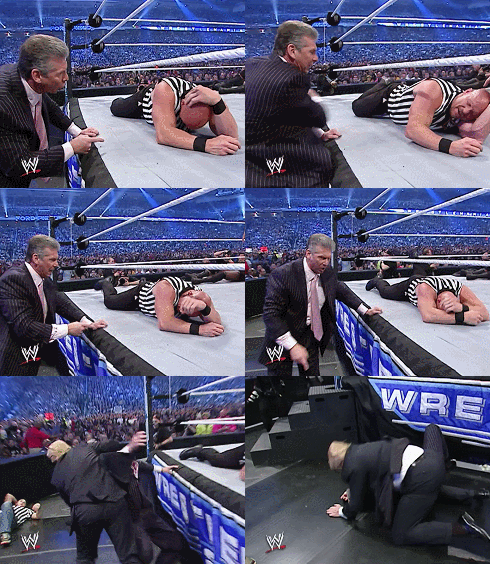
Mission… accomplished? How about this:
Hillary Clinton’s story, they believed, was too sprawling and familiar to tackle in its entirety. So they’d focus only on the last decade, the least familiar period, and especially on the millions of dollars flowing into the Clinton Foundation. Bannon calls this approach “periodicity.”
Ewwwwww:
“The modern economics of the newsroom don’t support big investigative reporting staffs,” says Bannon. “You wouldn’t get a Watergate, a Pentagon Papers today, because nobody can afford to let a reporter spend seven months on a story. We can. We’re working as a support function.”
UPDATE:
More insight from this Hollywood Reporter article:
The Democratic Party betrayed its working-man roots, just as Hillary Clinton betrayed the long-time Clinton connection — Bill Clinton’s connection — to the working man. “The Clinton strength,” he says, “was to play to people without a college education. High school people. That’s how you win elections.”
And:
To say that he sees this donor class — which in his telling is also “ascendant America,” e.g. the elites, as well as “the metrosexual bubble” that encompasses cosmopolitan sensibilities to be found as far and wide as Shanghai, London’s Chelsea, Hollywood and the Upper West Side — as a world apart, is an understatement. In his view, there’s hardly a connection between this world and its opposite — fly-over America, left-behind America, downwardly mobile America — hardly a common language. This is partly why he regards the liberal characterization of himself as socially vile, as the politically incorrect devil incarnate, as laughable — and why he is stoutly unapologetic. They —liberals and media — don’t understand what he is saying, or why, or to whom. Breitbart, with its casual provocations — lists of its varied incitements (among them: the conservative writer David Horowitz referred to conservative pundit Brill Kristol as a “renegade Jew,” and the site delighting in headlines the likes of “Trannies 49Xs Higher HIV Rate” and “Birth Control Makes Women Unattractive and Crazy”) were in hot exchange after the election among appalled Democrats — is as obtuse to the liberal-donor-globalist class as Lena Dunham might be to the out-of-work workingman class. And this, in the Bannon view, is all part of the profound misunderstanding that led liberals to believe that Donald Trump’s mouth would doom him, instead of elect him.
Plus:
“The globalists gutted the American working class and created a middle class in Asia. The issue now is about Americans looking to not get f—ed over. If we deliver—” by “we” he means the Trump White House “—we’ll get 60 percent of the white vote, and 40 percent of the black and Hispanic vote and we’ll govern for 50 years. That’s what the Democrats missed, they were talking to these people with companies with a $9 billion market cap employing nine people. It’s not reality. They lost sight of what the world is about.”
Much of this is the same kind of stuff which can be found in this book:
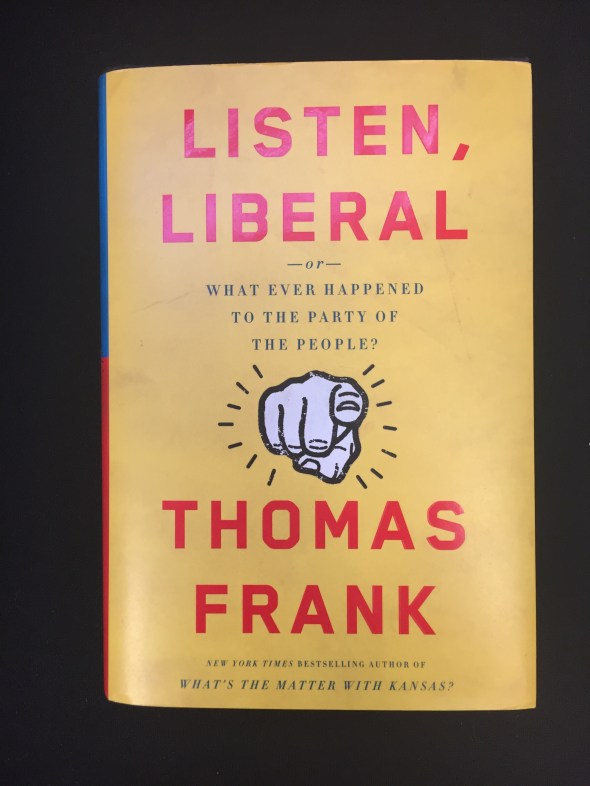
A good detail from it:
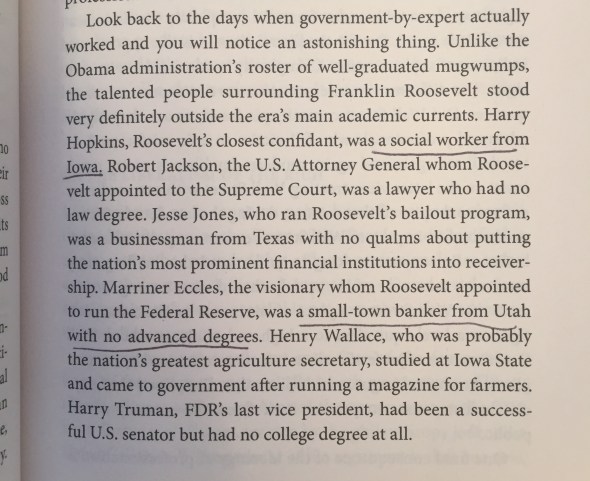
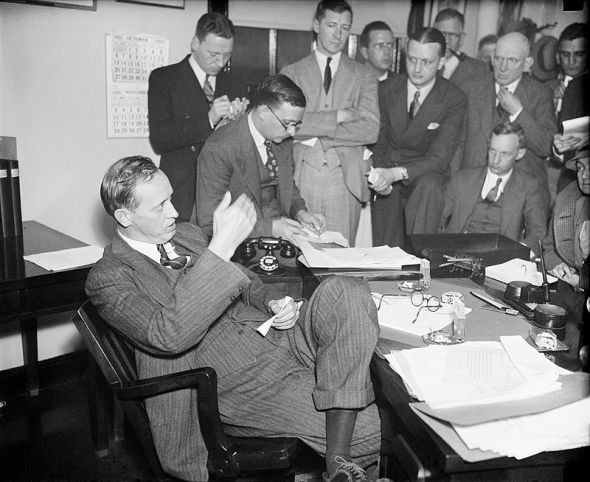
The closing note from that HR Bannon profile, btw:
“I am,” he says, with relish, “Thomas Cromwell in the court of the Tudors.”
How did it end for Cromwell, I can’t remember?

Small note
Posted: November 11, 2016 Filed under: politics, presidents Leave a comment
in the wilderness
After seeing Horrible Trump at the RNC, I was in a terrible mood, you can hear it in my voice in the episode of Great Debates we recorded right after.
Talked about it afterwards in Great Debates News, and I get upset anew when I remember what I thought then:
Here’s the simplest and worst thing I can say about a Trump rally: you’re way more likely to say “I hate you” to somebody afterwards.
Can already feel this feeling happening again, to me and to people around me. This is a nasty guy and hearing him and seeing him makes you feel nasty. For myself, gonna try hard to not get worse, ruder.
Need to think on some new judo.
Election Day
Posted: November 8, 2016 Filed under: politics Leave a comment
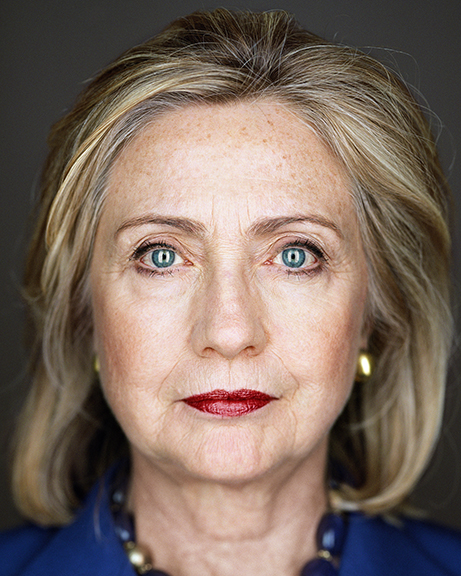
portrait of Hillary by Martin Schoeller
Election coverage can be found here.
Two of the more popular posts in this site’s history are Fred Trump and American historical figure who reminds me of Trump
Ran into four all-star Americans at the polls:

Kevin Drum voting guide if you live in California. (Interesting to note that Mother Jones herself didn’t want women to vote:
Jones was ideologically separated from many of the other female activists of the pre-Nineteenth Amendment days due to her aversion to female suffrage. She was quoted as saying that “you don’t need the vote to raise hell!”[14] Her opposition to women taking an active role in politics was based on her belief that the neglect of motherhood was a primary cause of juvenile delinquency.
)
Is it ridiculous or cool that a California voter has to make themselves a sheet like this:
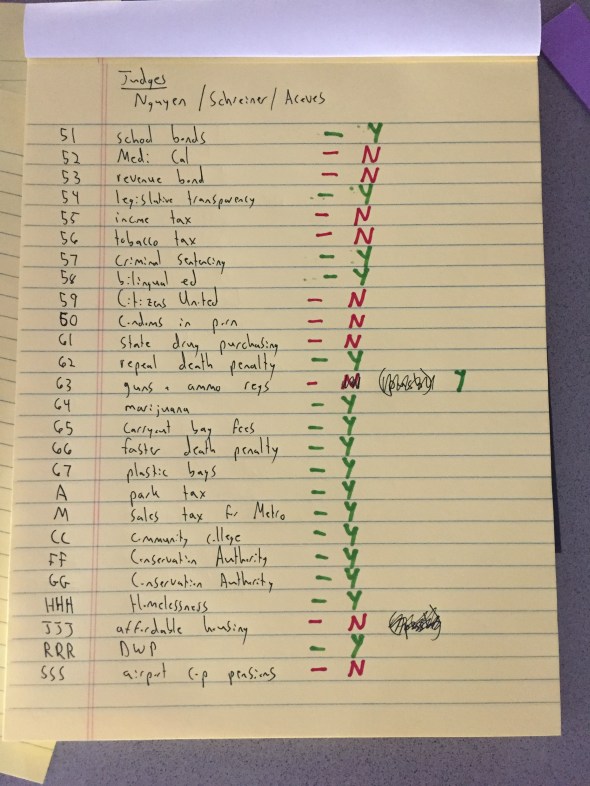
I say: ridiculous! Tempted to vote no on 63 because this seems like a legislative issue, as do many of these.
Would love to hear it if I’m wrong! helphely at gmail or the comments.
If you’re looking for something to read while rechecking Nate Silver, let us suggest:
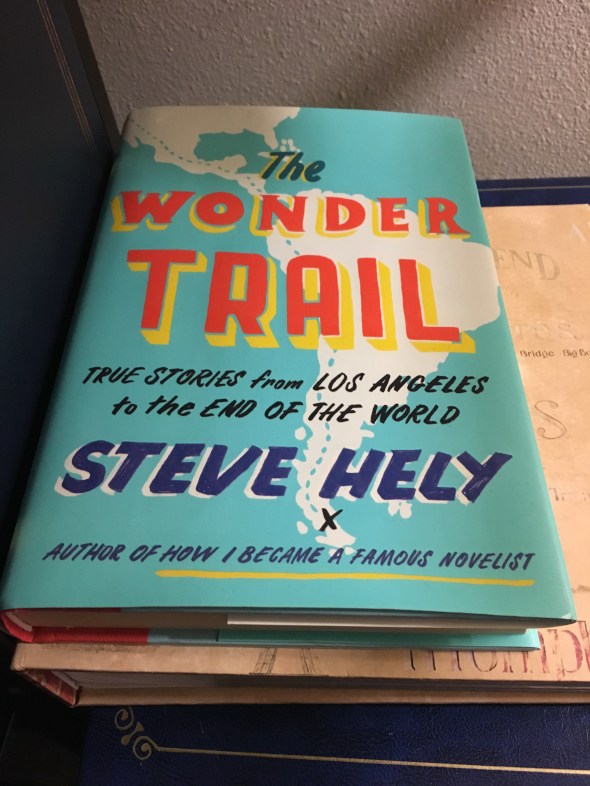
Available at Amazon or your local indie bookstore.
12 Takes on the Al Smith Dinner
Posted: October 23, 2016 Filed under: America Since 1945, comedy, New York, politics Leave a comment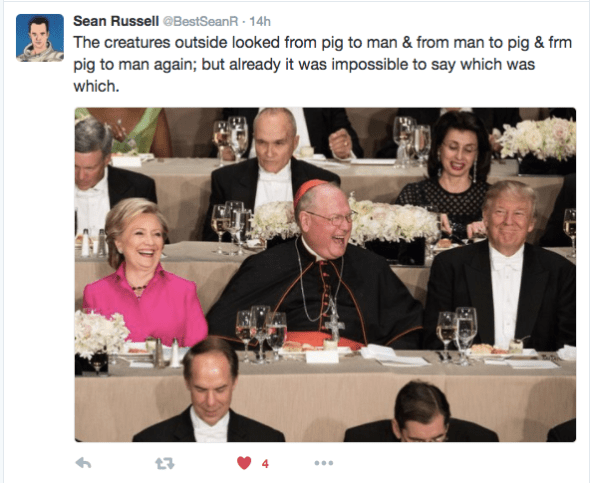
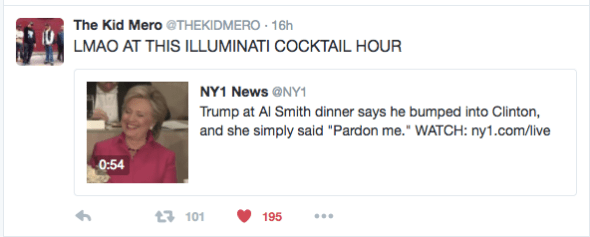
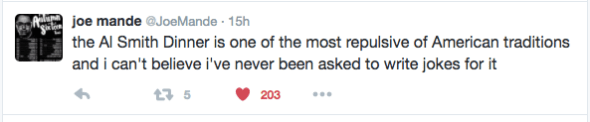
Hearing all these points about The Al Smith Dinner.
There is something grotesque about a white-tie banquet with the wealthy and powerful laughing about how they’re all on the same team. On the flip side, there’s something great about the wealth and powerful laughing about how they’re all on the same team if the team has some common, positive values.
The Al Smith Foundation raises money for the sick, the poor, and the orphans of New York. It honors a great, cheerful, positive public figure who rose up from poverty to run for president despite religious prejudice.
The dinner is an old-fashioned truce. Swallowing the noxious flavor of eating with your opponent is how societies can function and remain peaceful.
History offers many stories about how deeply fucked up things get when someone violates the tradition of a ceremonial truce:

People who jockey for political power should have to sit there and be made to at least pretend to be humble.
IMO this is a great tradition even if only for giving us this wonderful gif of Mitt Romney ironing himself.

Through a friend from my Catholic childhood, I got to go and sit up in the rafters a couple times. McCain, who must’ve known he was about to lose, gave one of the best performances I’ve ever seen.
Obama smashed too, of course.
Perhaps the two funniest candidates in American history?
Made it to the Romney/Obama one as well.
I remember a guy younger than me in the crowd was pumped, felt sure Romney was gonna win.
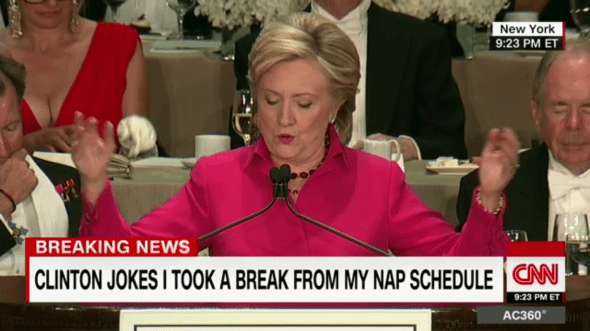
Watched this year’s on C-Span. Man, it was gnarly. Here are some takes:
- The #1 thing holding Donald Trump back is that he’s too sensitive. If he had a thicker skin, if he could laugh off attacks on himself, believe he could’ve won. Hillary was right about the “baited with a tweet” thing. If he had one ounce of Reagan’s ability to laugh something off Trump could’ve pulled it off.
- Al Smith’s nickname was The Happy Warrior.

Pic found here
Which candidate can be said to be more Happy Warrior? Thought Hillary did a good job of Happy Warrioring at the second debate, under very tough conditions:

and it worked for her!
- Much of the preliminary business of the Al Smith Dinner is talking about how much money has been raised for charity. As you listen to that, it’s hard not to be revolted by Trump’s total scumminess on charity. My perception was the room grew angrier and angrier at Trump as they heard this, and so were primed against him by the time he got up there. A politician is one thing, but a rich guy who gives nothing to charity? That sucks. That’s the complete opposite of the values of this dinner.
- For someone on the verge of achieving a lifelong dream she’s worked impossibly hard for, Hillary seems miserable. What is the lesson there? Is it campaign fatigue and going to bed every night with a knot in the pit of her stomach? Is it the regular reminders that a lot of people, probably a majority, just kind of don’t like her? There’s something real devil’s bargainy in the cruel twists that seem to meet Hillary’s ambitions.
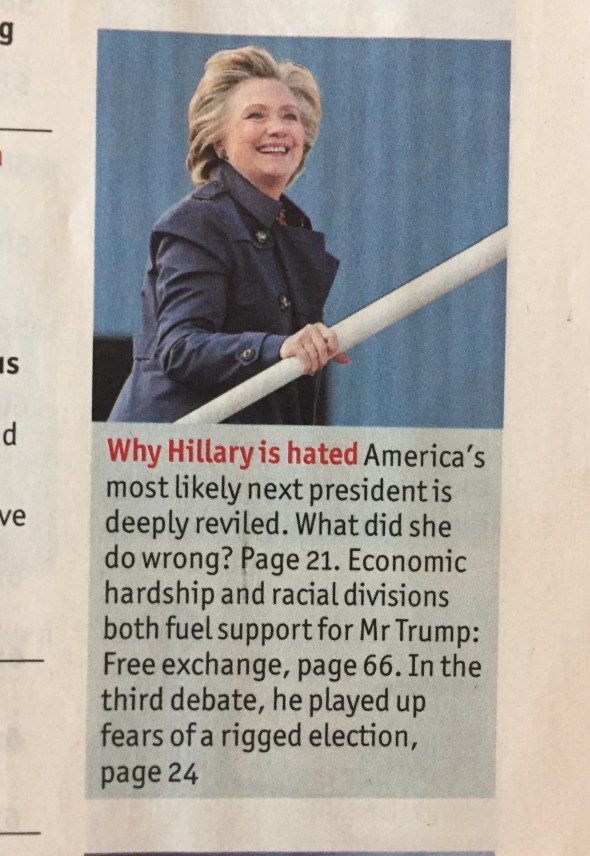
Deeply reviled.
(should admit I am 100% in the tank for Hillary. Even her soldiering on in the face of all this I admire. Will the rest of the media admit as much?)
- This event must be as close as possible to a pure nightmare for Donald. New York’s elites laughing and booing at him. In front of him and behind his back. Read anything by or about Trump: his greatest fear/source of rage is being mocked by Manhattan.

This headline would’ve appeared to Trump if he summoned the vision serpent. We are caught in a snobs vs slob death spiral. A sharp commentator points out there was a real Nelson Muntz aspect to Donald at this dinner:

Is Nelson in his way a sympathetic character? Trump’s father was a nasty piece of work, has there ever been a bully who wasn’t bullied?
- Hillary had some great jokes but she is not great at comic delivery. Then again, who’s the best over-70 year old joke deliverer? (Gotta thank Medina for asking that one). My first picks: Mel Brooks or Bill Cosby.
- Katie Dunn’s parents would only let Al Smith marry their daughter when he promised he would never become a professional actor (per Caro’s The Power Broker, p. 117). In those days you went into politics because everybody liked you.

Katie and Al
- There’s a lot terrible about the Catholic Church, but in my experience growing up around the Catholic church I saw a lot more attention to and help for the sick, the old, the poor, the dying, the disabled, the mentally ill and the homeless than I’ve seen outside of it.
In Al Smith’s day the Catholic Church provided a social welfare system for the poor and the unfortunate and the immigrant. Other churches did the same thing. Think how many hospitals are named after saints. As far as I understand it the Mormon church still does. The Catholic Church in America is in a managed decline.
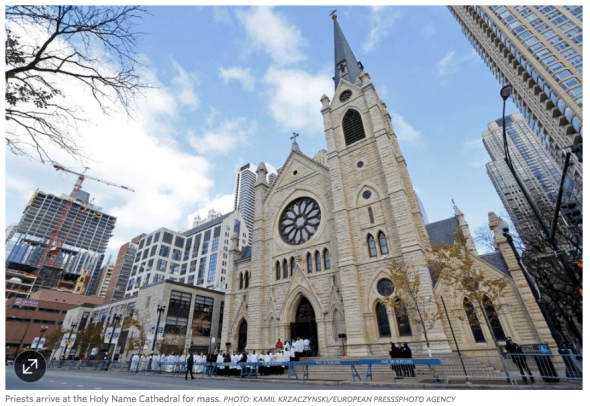
Now for Sale in Chicago: Prime Catholic Church Real Estate: Experts estimate site near Windy City’s Holy Name Cathedral could be worth $100 million. from the Wall Street J.
What will fill the social welfare vacuum? Who will take care of the poor, the sick, the immigrant, they dying? Who should?
Sometimes it seems like the domestic political argument in America is between two answers: “the government” and “nobody/family/somebody’ll handle it/I don’t know but not the government.”
Bill Clinton and George Bush both succeeded at least in pretending to find happy compromises, “the third way,” “compassionate conservatism,” etc. For awhile I felt like Paul Ryan was doing a decent job of at least pretending, too. But man when Trump came along he went the sniveling way. Is he more dangerous and more vile than Trump?
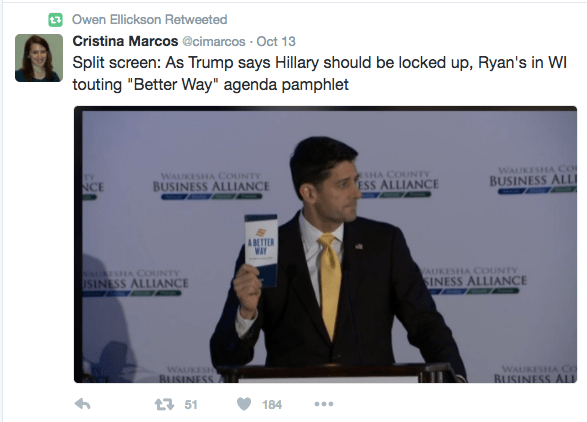
- “They’re laughing at us” might be Donald’s campaign theme. From The Washington Post:

It’s a horrible feeling to be laughed at and it takes dignity to rise above it. Watching him at the Al Smith dinner, in a way I almost felt bad for him. If I could give Donald Trump advice I would tell him to relax and return to being a clown version of a rich guy. It was a good job and he was well-compensated. But he doesn’t listen.
In a way DT feels like a dangerous, bitter, vile version of this guy:
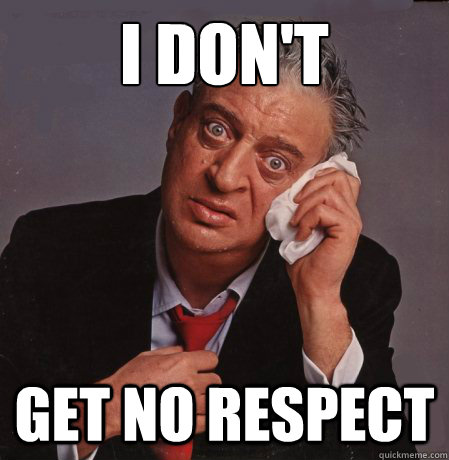
- Al Smith’s father was an immigrant. Not from Ireland though, from Italy. (Ferraro = blacksmith = smith). His mother’s parents were immigrants from Ireland. A frustrating thing about this election is we couldn’t have a serious talk about immigration. How much should we have? From where? Infinite? If not infinite how do we sort out who can come?
Who is this?
Posted: October 19, 2016 Filed under: America Since 1945, politics, presidents Leave a comment.jpg)
I’ll give you a hint. She is running for Vice-President of the United States.
It’s Mindy Finn! Alert reader Dave sends this our way. Ms. Finn used to work at Twitter, she’s a former reporter for the Waterbury, CT Republican-American, she’s a mother of two and she’s either 34 or 35.
Here’s a ready for primetime interview with her:
She’s running with former CIA operative Evan McMullin. I gotta say, I’m won over a bit by the homespun nature of this campaign and I wish them well.
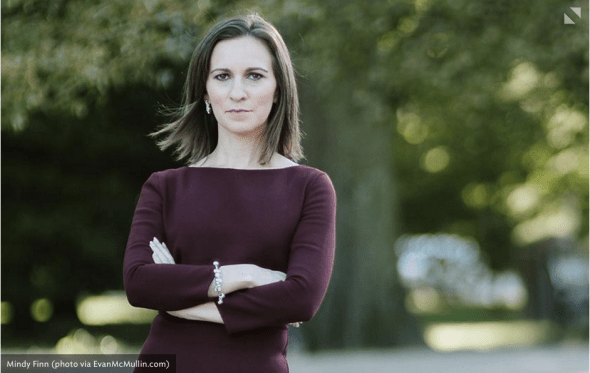
She reports she was shocked for “a couple minutes” when she was asked to join the ticket.
Experience vs. Incompetence
Posted: September 26, 2016 Filed under: America Since 1945, politics, presidents Leave a comment Recommend investing the considerable mental energy required to read this Tyler Cowen post, entitled “Are lies better than hypocracy? with special reference to some current events.” An excerpt:
You are more worried about the hypocrite when you see bigger decisions and announcements down the road than what is being faced now. You are more worried about the hypocrite when you fear disappointment, and have experienced disappointment repeatedly in the past. You are more worried about the hypocrite when you fear it is all lies anyway. Lies, in a way, give you a chance to try out “the liar relationship,” whereas hypocrisy does not. You thus fear that hypocrisy may lead to a worse outcome down the road or at the very least more anxiety along the way.
But note: for a more institutional and distanced principal-agent relationship, it is often incorrect, and indeed dangerous, to rely on your intuitions from personalized principal-agent problems.
When it comes to how the agent speaks to allies and enemies, you almost always should prefer hypocrisy to bald-faced lies. The history and practice of diplomacy show this. Allies and enemies, especially from other cultures, don’t know how to process the lies the way you can process the blatant lies of your children, friends, and spouse. They will think some of these lies are mere hypocrisy and that can greatly increase uncertainty and maybe lead to open conflict. North Korea aside, the prevailing international equilibrium is “hypocrisy only,” and those are the signals everyone has decades of experience in reading.
No / Leave / Trump
Posted: September 15, 2016 Filed under: America Since 1945, Canada, politics, presidents Leave a comment
I thought the UK Remain camp would win in the Brexit vote, because I could remember following the 1995 Quebec separation referendum. (What teen boy isn’t mesmerized by Canadian politics?) Canadian Tanya Krywiak remembers:
It was a night many will never forget. Twenty years ago, on Monday, October 30, 1995,citizens across Quebec went to the polls to decide the future of their province — and Canada.
The 1995 Quebec vote seems like an apt analogy to Brexit. Really close, emotional, a kind of impractical vote that came to pass due to political posturing. And then:
An astounding 93.5 per cent of those eligible turned up to vote either yes or no to sovereignty. At 10:20 p.m., the “no” side was declared the winner with 50.58 per cent.
Quebec voted, just barely, to remain in Canada.

At the time the narrow win for No was partly chalked up to the huge Unity rally and similar rallies across Canada:
The Unity Rally was a rally held on October 27, 1995, in downtown Montreal, where an estimated 100,000 Canadians from in and outside Quebec came to celebrate a united Canada, and plead with Quebecers to vote “No” in the Quebec independence referendum, 1995 (held three days after the rally). Held at the Place du Canada, it was Canada’s biggest political rally until 2012.
Highlighting the celebrate a united Canada part. Because maybe that’s what the Remain people in the UK failed to do.
The Canadian Unity Rally was a celebration, it was for something, even just a feeling and a song. It countered an emotional argument with an emotional argument.
There was something exciting and satisfying about exiting the EU. Did the Remain people offer anything to celebrate?
In fairness there’s not a ton there. I mean the EU’s flag sucks:

Sucks
There’s no good song, either. (There’s the “Anthem of Europe” I guess).
Compare that to the 1995 Unity rally. From the NY Times:
150,000 Rally To Ask Quebec Not to Secede
By CLYDE H. FARNSWORTH
Published: October 28, 1995
At the Place du Canada in downtown Montreal, a crowd estimated at 150,000 waved the maple leaf flag of Canada and the fleurs-de-lis flag of Quebec and sang the national anthem, hoping to convince the Quebecers to vote No on Monday in their referendum on whether their province should secede from Canada.
Take this to the most visceral level. In the Trump vs. Hillary election, if you’re undecided, which side feels more emotionally satisfying?
Voting for Obama was emotionally satisfying, a celebration:
Role Play: you are Hillary’s top advisor (or Hillary herself). How do make a vote for Hillary feel like something more emotionally satisfying than anti-Trump? A celebration of what’s best about the USA?
Feel like she did a decent job of this with the help of both Obamas at the DNC:

American historical figure who reminds me of Trump
Posted: July 31, 2016 Filed under: America Since 1945, politics 2 Comments
George Armstrong Custer.
Hear me out. It’s true that Trump’s not a military man, but as he says:
And he was educated at the New York Military Academy which went bankrupt and was sold to Chinese investors.

Trump

Custer
Both were weird about their hair.
Trump obvs, but Custer had a toupee and used all kinds of scented pomades.
Neither drank.
It’s interesting that Trump never drinks. Maybe it would take the edge off? Custer gave up drinking after an ugly episode in his youth and would drink milk at cocktail parties.
Vain about appearance to an almost absurd degree.
Both kind of OCD.
Trump is a self-described germaphobe. Custer during the Civil War compulsively washed his hands.
Wrote popular self-aggrandizing books.

(Custer’s fellow officer Frederick Benteen, who hated Custer’s preening and vanity and bragging and “pretentious silliness,” called it My Lie On The Plains, which is a good slam.)

Survived stupid moves that cost others dearly.
Trump blunders forward, somehow ending up ok but leaving defaulted creditors in his wake. Custer’s Civil War and post-Civil War career can sound similar, but with dead cavalry instead of money:
Custer’s abrupt withdrawal without determining the fate of Elliott and the missing troopers darkened Custer’s reputation among his peers. There was deep resentment within the 7th Cavalry that never healed.
A lot of plunging in blindly.
Impulsive, jump in and figure it out style marks both of their careers.

Wild swings in career.
Trump’s companies declared bankruptcy four times. Custer was courtmartialed and relieved of duty only to be called back in time to get everybody killed.
Had ambition to be president?
This one’s debatable but the argument’s been made that it’s possible when Custer was driving into the Indian encampment at Little Bighorn without waiting for anyone else he had the idea that the news might get out in time for him to get the 1876 nomination for president. A crazy plan.
Not sure what will happen to Trump and his followers.
We know how it ended for Custer:
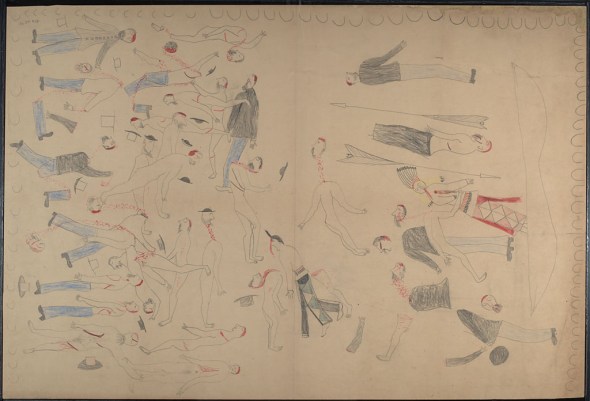
Drawn for us by Red Horse, who was there.
One significant difference is that Custer was physically brave and very good with animals, whereas Trump appears to be a huge wuss and bad with animals.
(Got this idea from reading Son Of The Morning Star for possibly the fifth time? How cool was Evan S. Connell?:
Cleveland
Posted: July 25, 2016 Filed under: America Since 1945, politics Leave a comment

First step? Let’s get our credentials.


Great Debates headquarters in the Press Filing Center


photo credit to Medina for this one
Hey! It’s former Senator Bob Dole!
 He waved us over, we’re not being weird here. asked us to send him a million dollars for the Eisenhower Memorial. I sent him fifty bucks.

 Pierogi:

At the Polish American Legion:

Cops:

photo credit: DAK
Let’s get this party started:
Here is Florida’s attorney general Pam Bondi:
 I did not care for her.

Day Two begins at Corky and Lenny’s (thanks to Chloe and Warburton for the recs):
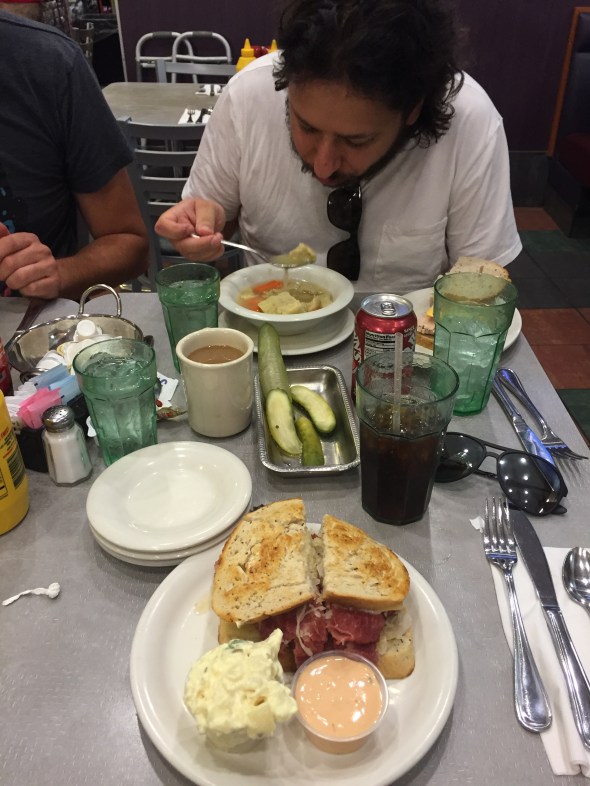
During some downtime was reading some of David Reynolds’ Summits: Six Meetings That Shaped The Twentieth Century.

Can you imagine Trump having this kind of openness and curiosity? And we’re talking about Reagan here man!

The press was in the cheap seats:

Absolutely unacceptable aesthetic for the United States of America.

A stray balloon brings some small relief:

In the Uber on the ride home, read this Peggy Noonan response. I love Peggy Noonan’s writing but was rattled by her clever dodgings of any kind of stand against what she’d just witnessed.

Can she possibly mean “the literal lay of the land,” like the actual physical features of the landscape? Let’s hope not! I believe it’s time for Ms. Noonan to stop dodging as a curious observer and speak up about whether she finds the nominee of her party to be unacceptable or not.
 One last corned beef sandwich with Dubbin.


Asked Dan to rate the convention as a convention, can’t remember if the scoring system was out of 20 or 25:
David McCullough on Trump
Posted: July 22, 2016 Filed under: America Since 1945, politics 1 Comment
coming in JUST under the Helytimes three minute video limit*. Here’s a piece if you hate watching videos:
So much that Donald Trump spouts is so vulgar and so far from the truth and mean-spirited. It is on that question of character especially that he does not measure up. He is unwise. He is plainly unprepared, unqualified and, it often seems, unhinged. How can we possibly put our future in the hands of such a man?
More info here. As the Times notes:
The videos are mostly homemade, smartphone productions.
Maybe I’m an optimist, but a better shot version of this with McCullough could be very effective, I think. Certainly more than current 3,383 views. Embedded in the Times article but that’s no way to get videos out there!
*often violated
 Helytimes
