Montecito: the little wood
Posted: August 27, 2022 Filed under: the California Condition Leave a comment
The site of Montecito was originally part of the Santa Barbara pueblo lands of which allotments were given to soldiers when their enlistments at the presidio expired. From earliest times it was a region of exceptional beauty, with its leafy canyons and its forested valley, and the Spanish called it El Montecito, the little wood. Even today it is not infrequently referred to as “the Montecito.” Quail, deer, bear, and strayed cattle still roamed the valley in 1847, by which time a small settlement had developed, consisting of a few little ranches with the houses not more than a quarter mile apart…
In the late 1860s the first of the Montecito estate builders had erected a fine old-fashioned Southern home on Hot Springs Road and made the first landscaped garden in the valley. This was Colonel W. A. Haynes. With others soon to follow Haynes’ lead, bears were still so common in the region that a $50 bounty was set on every one taken within the limits of the settlement, and horse thieves and highwaymen were using Montecito as a hideout.
…In the 1870s the bears gradually retreated into the Santa Ynez Mountains and the freebooters all met one form of justice or other, leaving the future of Montecito tottering for awhile between those who wish to keep its natural beauty for homes and estates, and a few hustling Americans who wanted to make it a health center by exploiting the hot springs which had been discovered there in 1801 by an Indian wandering in the foothills.
later:
Montecito embarked on an ambitious landscaping project, to emerge from its chrysalis a gay and exclusive suburb with luxurious estates.
California is full of strange microclimates, and Montecito has one: it’s foresty and cool in there. Eucalyptus trees abound. These are not native, but Australians introduced them during the gold rush, and many were planted in the following years. Jack London planted at least 16,000 eucalyptus trees up on his northern California lands during a speculative craze around 1900. Eucalyptus trees can grow thick and tall and are pleasant to see, but the planting of trees with the potential to explode during wildfires has been a mixed blessing for the state.
Whenever we’re in Montecito we think about Prince Harry and Meghan in exile up there. Something tragic about it, like Wallis and the Duke of Windsor lounging around in the Bahamas with nothing to do. You’re in Heaven but it’s a tiny heaven, there’s not much to do, and you’re sort of trapped. Maybe Harry finds satisfaction in his polo, and Meghan in her podcast.
In 2018 mudslides killed twenty three people in Montecito. The mudflow reached Oprah’s backyard, yet her house was spared.
John Steinbeck on San Francisco
Posted: August 23, 2022 Filed under: San Francisco, Steinbeck, Steinbeck, the California Condition Leave a comment
Thomas Wolf took that one for Wikipedia.
Can you remember anywhere in John Steinbeck’s fiction where he discusses San Francisco? Whole books about Monterey, but does he even mention the place? I couldn’t remember. A friend’s been working on Steinbeck’s letters, he couldn’t think of any mention either.
Turns out Steinbeck does talk about San Francisco in Travels with Charley in Search of America. The chapter begins:
I find it difficult to write about my native place, northern California. It should be easiest, because I knew that strip angled against the Pacific better than any place in the world. But I find it not one thing but many – one printed over another until the whole thing blurs.
He mentions growth:
I remember Salinas, the town of my birth, when it proudly announced four thousand citizens. Now it is eighty thousand and leaping pell mell on in mathematical progression – a hundred thousand in three years and perhaps two hundred thousand in ten, with no end in sight.
(The population of Salinas is, in 2022, 156,77.)
Then he writes some about mobile home parks, and property taxes, concluding:
We have in the past been forced into reluctant change by weather, calamity, and plague. Now the pressure comes from our biologic success as a species.
Then he gets going on San Francisco:
Once I knew the City very well, spent my attic days there, while others were being a lost generation in Paris. I fledged in San Francisco, climbed its hills, splet in its parks, worked on its docks, marched and shouted in its revolts. In a way I felt I owned the City as much as it owned me.
…
A city on hills has it over flat-land places. New York makes its own hills with craning buildings, but this gold and white acropolis rising wave on wave against the blue of the Pacific sky was a stunning thing, a painted thing like a picture of a medieval Italian city which can never have existed.
Steinbeck can’t stay though. He has to hurry on to Monterey to cast his absentee ballot (it’s 1960; he’s voting for John F. Kennedy).
Alice Marble
Posted: August 17, 2022 Filed under: California, San Francisco, the California Condition Leave a comment
(Paul T. submitted this photo to FourSquare)
Several times in walks around San Francisco I’ve stopped at the Alice Marble Tennis Courts, at the top of Russian Hill, for the view from Alcatraz to the bridge.

Alice Marble was a tennis champ of the 1930s and ’40s. Wikipedia informs us:
For a brief time after retirement, she worked on the editorial advisory board of DC Comics and was credited as an associate editor on Wonder Woman. She created the “Wonder Women of History” feature for the comics, which told the stories of prominent women of history in comic form.
In her second autobiography Courting Danger (released after her death in 1990), Marble mentions that, back in the 1940s, she had married Joe Crowley around World War II, a pilot, who was killed in action over Germany. Only days before his death, she miscarried their child following a car accident. After an attempt to kill herself, she recuperated, and in early 1945, agreed to spy for U.S. intelligence. Her mission involved renewing contact with a former lover, a Swiss banker, and obtaining Nazi financial data. The operation ended when a Nazi agent shot her in the back after chasing her while she was trying to escape in a car, but she recovered. Few details of this operation have been corroborated by journalists and authors who tried to investigate this part of her life in the years from the time of her death to the present. No Swiss banker has been discovered, leading to suspicions that this man of mystery might have been a Nazi, someone who Marble may have been trying to avoid having had an association.
Marble greatly contributed to the desegregation of American tennis by writing an editorial in support of Althea Gibson for the July 1, 1950 issue of American Lawn Tennis Magazine. The article read “Miss Gibson is over a very cunningly wrought barrel, and I can only hope to loosen a few of its staves with one lone opinion. If tennis is a game for ladies and gentlemen, it’s also time we acted a little more like gentle-people and less like sanctimonious hypocrites…If Althea Gibson represents a challenge to the present crop of women players, it’s only fair that they should meet that challenge on the courts.”

Female tennis champs of that era are honored all over San Francisco. Alice Marble’s career followed that of Helen Willis Moody, painted by Diego Rivera in his mural inside the former Pacific Stock Exchange. It’s cool that California is still producing world class tennis champs.
The Alice Marble courts are surrounded by George Sterling Park:

Kevin Starr (1973) wrote:
The uncrowned King of Bohemia (so his friends called him), Sterling had been at the center of every artistic circle in the San Francisco Bay Area. Celebrated as the embodiment of the local artistic scene, though forgotten today, Sterling had in his lifetime been linked with the immortals, his name carved on the walls of the Panama-Pacific International Exposition next to the great poets of the past.
Lots of people around George Sterling’s life died of poison, including finally the man himself, who poisoned himself inside the San Francisco clubhouse of the Bohemian Club. Next time I’m up there, I’ll have to stop by the Bohemian Club and see the bronze relief by Jo Mora.
The style of poetry Sterling practiced is no longer really in fashion:
The winds of the Future wait
At the iron walls of her Gate,
And the western ocean breaks in thunder,
And the western stars go slowly under,
And her gaze is ever West
In the dream of her young unrest.
Her sea is a voice that calls,
And her star a voice above,
And her wind a voice on her walls—
My cool, grey city of love.
How did the Bohemian Club go from being a scene of outré artists to having like Richard Nixon as a member? Probably the same way Carmel went from being an out there semi-commune to being a rich person retirement place. And the same way San Francisco was a cool place to drop out in 1965, and is now unaffordable unless you’re making mid six figures programming algorithms.
A lesson from California history: wherever the outcast artists are setting up camp, you’d be wise to buy real estate, and hang onto it for a hundred years. Although maybe that kind of thinking is contrary to the Bohemian Club motto:
Weaving spiders come not here.
The Golden West: Hollywood Stories, by Daniel Fuchs
Posted: August 14, 2022 Filed under: Hollywood, the California Condition, writing, writing advice from other people Leave a comment
Critics and bystanders who concern themselves with the plight of the Hollywood screenwriter don’t know the real grief that goes with the job. The worst is the dreariness in the dead sunny afternoons when you consider the misses, the scripts you’ve labored on and had high hopes for and that wind up on the shelf, when you think of the mountains of failed screenplays on the shelf at the different movie companies…
brother, I hear you, but also c’mon, it beats working for a living.
An old-timer in the business, a sweet soul of other days, drops into my room. “Don’t be upset,” he says, seeing my face. “They’re not shooting the picture tomorrow. Something will turn up. You’ll revise.” I ask him what in his opinion there is to write, what does he think will make a good picture. He casts back in his mind to ancient successes, on Broadway and on film, and tries to help me out. “Well, to me, for an example – now this might sometimes come in handy – it’s when a person is trying to do something to another person, and the second fellow all the time is trying to do it to him, and they both of them don’t know.” Another man has once told me the secret of motion picture construction: “A good story, for the houses, it’s when the ticket buyer, if he should walk into the theater in the middle of the picture – he shouldn’t get confused but know pretty soon what’s going on.” “The highest form of art is a man and a woman dancing together,” still a third man has told me.
Didion on Reagan’s day
Posted: August 9, 2022 Filed under: America Since 1945, the California Condition 1 Comment
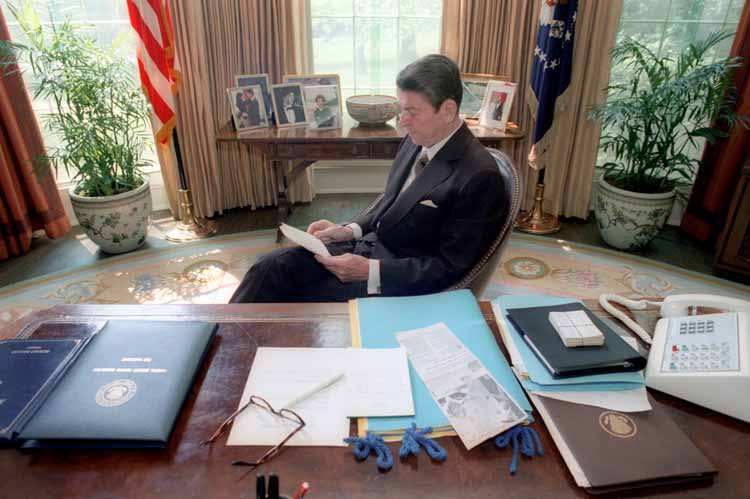
The aides gave us the details, retold now like runes. Promptly at nine o’clock on most mornings of the eight years he spent as President of the United States, Ronald Reagan arrived in the Oval Office to find on his desk his personal schedule, printed on green stationery and embossed in gold with the presidential seal. Between nine and ten he was briefed, first by his chief of staff and the vice president and then by his national security adviser. At ten, in the absence of a pressing conflict, he was scheduled for downtime, an hour in which he answered selected letters from citizens and clipped items that caught his eye in Human Events and National Review. Other meetings followed, for example with the congressional leadership. “I soon learned that those meetings lasted just one hour, no more, no less,” Tony Coelho, at the time majority whip in the House, tells us in Recollections of Reagan: A Portrait of Ronald Reagan. “If the agenda—which he had written out on cards—wasn’t completed at the end of the hour, he would excuse himself and leave. If it was finished short of an hour, he would fill the rest of the time with jokes (and he tells a good one).” During some meetings, according to his press secretary, Larry Speakes, the President filled the time by reciting Robert Service’s “The Cremation of Sam McGee.”
source. Martin Anderson, who was there, had a different perspective.
Catholic gentlemen in neckties
Posted: August 9, 2022 Filed under: California, the California Condition Leave a comment
The passing of Vin Scully, beloved Los Angeles icon, has occasioned an outpouring of expressions of both loss that we should no longer have this man and gratitude that we ever did. Scully’s skills as a baseball announcer have been the focus of course. We offered some appreciation for the man’s gifts in that field a few years ago. His was a voice we loved and that we’ll miss.
We’d like to note today though another aspect of Scully, and consider him as an example of something that’s passing away. Scully was a Catholic gentleman in a necktie.
For Scully’s gentlemanliness, see any tribute to him. For his Catholicism, note that he narrates a 2 CD recording of the Rosary (you can listen on YouTube). As for the necktie, he didn’t always wear one, but it was part of the presentation, and this was a presenter.
We know this type. They were everywhere in greater Boston circa 1990. The Catholic gentleman in a necktie has national expression in President Joe Biden, though maybe Biden’s roguish side distracts us from his essential typology.
The Catholic gentleman in a necktie was an important part of Los Angeles life as well. Former LA mayor Richard Riordan was one (whether he was a true gentleman couldn’t say, he was before our time, but you’ll accept the point). Rick Caruso, current mayoral candidate, could be another case. Kevin Starr was one. The late John Bowman is one we knew personally, though he didn’t always wear a tie.
Is this type dying away? Current LA mayor Eric Garcetti is a second-generation, copy of a copy version, but he often skips the necktie, and he’s in trouble at the moment for basically not being a gentleman.
Josh Brolin’s character Eddie Mannix in Hail, Caesar (based on the real Eddie Mannix) is shown several times going to confession. This isn’t the outre decadent Catholicism described in The New York Times, it was the real deal, with all the contradictions.
Consider this merely some notes towards a sociological type.
Rest in Heaven Vin. The way he calls this brawl is delightful. (And Greinke demonstrates a pretty good example of a smaller man handling a much bigger opponent).
Senator Alan Cranston (D-California)
Posted: August 8, 2022 Filed under: the California Condition Leave a comment
Served four terms in the US Senate.
As a young man he was sued by Adolf Hitler for publishing an unauthorized translation of Mein Kampf. (Cranston felt the existing translations expunged too much, hiding the true nature of Hitler’s thought).
In the wake of World War II, Mr. Cranston became a strong advocate for world government. In 1945, he published a book, ”The Killing of The Peace,” about how the League of Nations had been defeated in the United States Senate.
In 1947, he took over his father’s real estate firm in Palo Alto.
(from his obituary)
How did he get into office? He made a lot of money, and then he organized:
In 1952, Cranston co-founded the California Democratic Council (CDC), and served as chairman. Since that time, the CDC has served as an unofficial coalition of local Democratic clubs that coordinate electoral activities and activism throughout California. The CDC provided substantial support to Cranston in his bid for State Controller in 1958 and his numerous runs for the U.S. Senate.
Also:
The New York Times called Cranston a “bald, craggy-looking, none-too-charismatic man.”
While on his many political trips, Cranston would spend time sprinting in long hotel hallways to maintain his fitness.
He wanted to abolish nuclear weapons, an idea fellow California politician Ronald Reagan also had. Could they have done it?
Is Alan Cranston’s lasting legacy to history that the Eagles broke up after Glenn Frey and Don Felder erupted in a screaming match at one of his fundraisers, 1980?
On July 31, 1980, in Long Beach, California, tempers boiled over into what has been described as the “Long Night at Wrong Beach”.[58][59] The animosity between Felder and Frey boiled over before the show began, when Felder said, “You’re welcome – I guess” to California Senator Alan Cranston‘s wife as the politician was thanking the band backstage for performing a benefit for his re-election.[60] Frey and Felder spent the entire show telling each other about the beating each planned to administer backstage. “Only three more songs until I kick your ass, pal,” Frey recalled Felder telling him near the end of the band’s set.[61] Felder recalls Frey telling him during “Best of My Love”, “I’m gonna kick your ass when we get off the stage.”
from the Global Security Institute, where we got the photo:
Alan Cranston used as a guide for leadership a quote by the Chinese philosopher Lao-Tzu, which he carried in his wallet for years:
A leader is best
When people barely know
That he exists,Less good when
They obey and acclaim him,Worse when
They fear and despise him.Fail to honor people
And they fail to honor you.But of a good leader,
When his work is done,
His aim fulfilled,
they will all say,
‘We did this ourselves.’
deer showers
Posted: August 5, 2022 Filed under: the California Condition Leave a commentsad situation on dry Catalina Island:
The famed Catalina Island fox, as well as the island’s non-native deer and bison, are “suffering mightily” due to the lack of moisture, which is tied closely to their food supply, according to Deni Porej, senior conservation director with the Catalina Island Conservancy. Lately, he said, deer have been appearing on the island’s golf course in the evenings, when they know the sprinklers will turn on and provide them with a spot of relief.
from this LA Times piece by Hayley Smith
Where is Hollywood?
Posted: August 3, 2022 Filed under: Hollywood, the California Condition Leave a comment
Hollywood and Highland, 1907. Source.
There was a municipality called Hollywood. It existed from 1903 to 1910. This Hollywood gave up its independence to Los Angeles in exchange for water. Los Angeles was about to arrange for a steady supply via William Mulholland’s Los Angeles Aqueduct, and thirsty Hollywood needed in. (Will this happen to other cities? Countries?)
What is the definition of Hollywood? Here is a map that appears to show the old municipality, I found it on Pinterest (barf) and cannot trace it to a source, this is the closest I get:

Here’s how the LA Times defines Hollywood:

Also seems to be a dead link, I found it here.
AboutHollywood.com tells us this:
Although it is not the typical practice of the City of Los Angeles to establish specific boundaries for districts or neighborhoods, Hollywood is a recent exception. On February 16, 2005, Assembly Members Goldberg and Koretz introduced a bill to require the State to keep specific records on Hollywood as though it were independent. For this to be done, the boundaries were defined. This bill was unanimously supported by the Hollywood Chamber of Commerce and the LA City Council. Assembly Bill 588 was approved by the Governor on August 28, 2006, and now the district of Hollywood has official borders. The border is shown at the right, and can be loosely described as the area east of Beverly Hills and West Hollywood, south of Mulholland Dr., Laurel Canyon, Cahuenga Blvd. and Barham Blvd., and the cities of Burbank and Glendale, north of Melrose Avenue, and west of the Golden State Freeway and Hyperion Avenue.
But how to explain this sign, found on Melrose and Flores (the southwest corner, in fact!) which would push the boundary of Hollywood further west than anyone is prepared to acknowledge?

Kate Corbaley, Storyteller
Posted: July 29, 2022 Filed under: actors, Hollywood, screenwriting, the California Condition, writing Leave a commentAnother staff writer with a rather unconventional but valued talent was Kate Corbaley. At $150 a week, Corbaley was one of the few staffers whose salary was in the same range as Selznick’s…
Her specialty was not in editorial but rather as Louis Mayer’s preferred “storyteller.” Mayer was not a learned or highly literate man, and he rarely read story properties, scripts, or even synopses. He preferred to have someone simply tell him the story and he found Mrs. Corbaley’s narrational skills suited him. She never received a writing credit on an MGM picture, but many in the company considered her crucial to Mayer’s interest in stories being considered for purchase or production at any given time.
That’s from Thomas Schatz, The Genius of the System: Hollywood Filmmaking in the Studio Era.
Corbaley’s brother was Admiral S. C. Hooper, “the father of naval radio,” if The New York Times is to be believed. What a family of communicators!
Storytelling is a current obsession in business. A few days ago I searched “storyteller” under Jobs on LinkedIn and found 35,831 results. Amazon, Microsoft, and Pinterest are all hiring some version of “storyteller,” as are Under Armor, Eataly and “X, the Moonshot Factory.” The accounting firm Deloitte is hiring Financial and Strategic Storytellers (multiple listings, financial and strategic storytellers are sought in San Diego, Miami, Chicago, Charlotte, Tampa, Las Vegas, and Phoenix).
Cool job.
It’s reported in City of Nets: A Portrait of Hollywood in the 1940s that one afternoon in May, 1936, Kate Corbaley summarized a novel that was already perceived as hot property. She told Louis B. Mayer
a new story about a tempestuous southern girl named Scarlett O’Hara.
Mayer wasn’t sure what to think, so he sent for Irving Thalberg, who declared:
Forget it, Louis. No Civil War picture ever made a nickel.
(This seems improbable: in 1936 Birth of A Nation would’ve held the record as one of if not the biggest movie of all time? Must track this tale to its source, will report.)
Genius of the system
Posted: July 15, 2022 Filed under: America Since 1945, Hollywood, the California Condition Leave a comment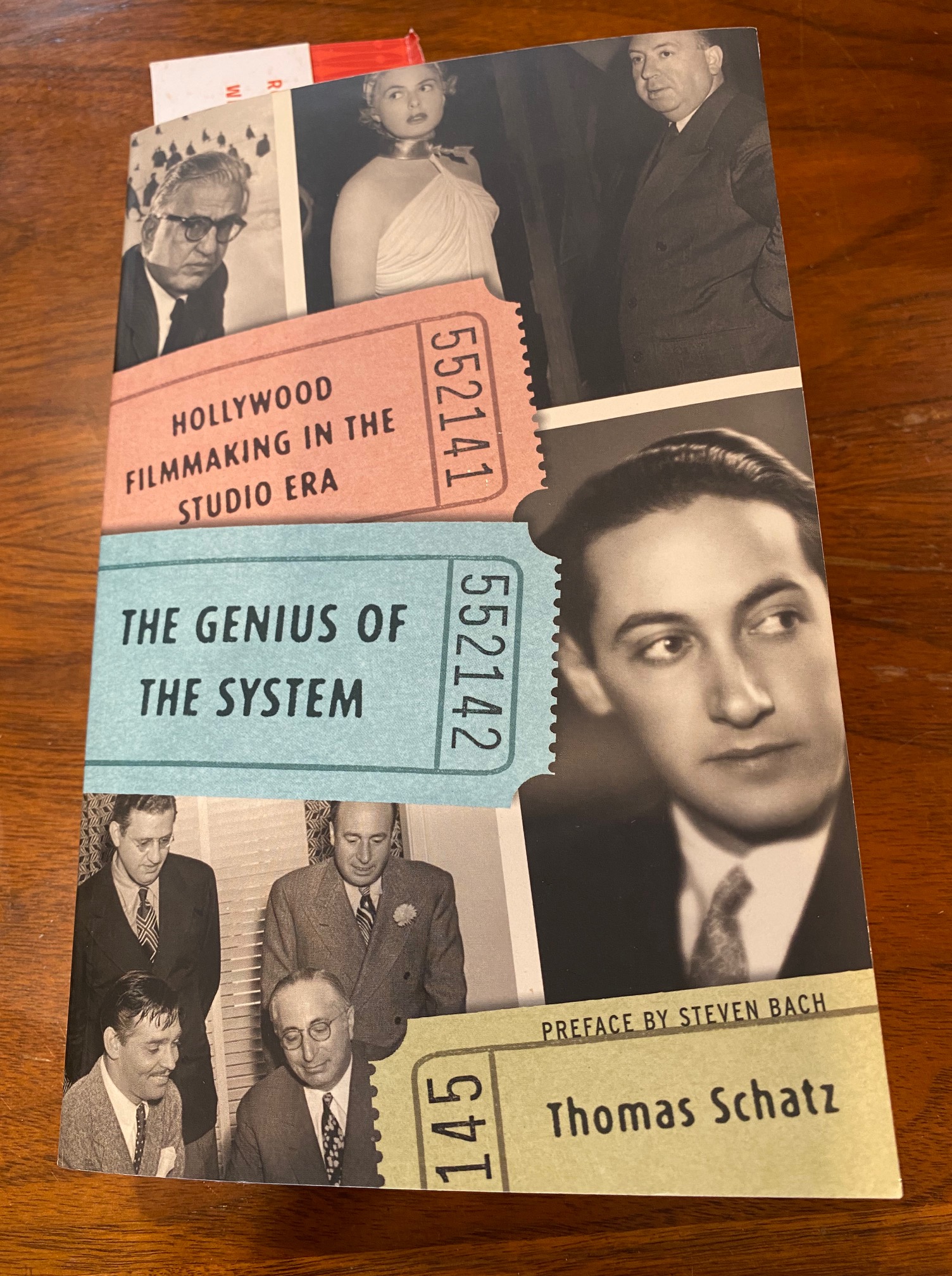
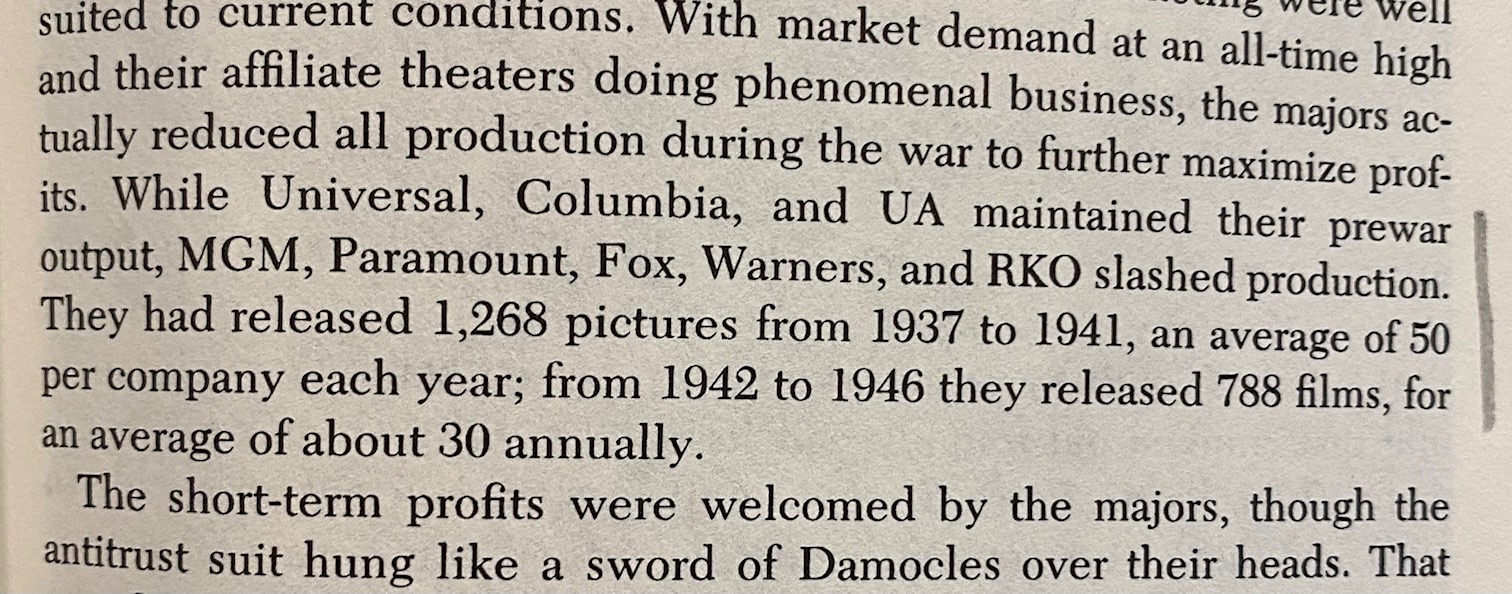
The sheer number of movies Hollywood cranked out during the peak of the studio system is wild. In 1936, for example, Paramount released 69 movies, RKO had 39, Fox had 50 movies, MGM put out 48 movies, Warner 56, Universal 34.
This was the factory-like story production processes Faulkner was working under.
Thomas Schatz’s book The Genius of the System is of daunting thickness, but it’s very readable, and I like the thesis: despite the factory nature and control by the money guys rather than the directors, real style and art was achieved.
Auterism itself would not be worth bothering with if it hadn’t been so influential, effectively stalling film history and criticism in a prolonged stage of adolescent romanticism. But the closer we look at Hollywood’s relations of power and hierarchy of authority during the studio era, at its division of labor and assembly-line production process, the less sense it makes to assess filmmaking or film style in terms of the individual director – or any individual, for that matter.
Should we look at the old studio system trying to find cases where a rare director snuck art past the suits? Or should we look at it and see a miraculous time, when thousands of artists and craftspeople came together for a brief period to create the collective dreams of a nation?
Schatz gives a good short summary of his work and the rise and fall of the studio system in this 1989 Fresh Air interview.
In The Offer, Paramount +’s show about the making of Paramount Pictures’ The Godfather, you can see dramatized some of the problems from the end of the true studio system days. The show was shot on the Paramount lot, doubling as the Paramount lot from 1971. There’s a studio, but when they start a movie, they start from scratch. Casting, finding the right people for technical roles, chain of command, getting a workflow going, dealing with the unions, the mob: all these are begun anew for each production. Poor Al Ruddy has to solve each problem fresh. Robert Evans is there, but he’s no Thalberg, with central command over all the gears in the machine. When the movie’s, it’s over. Everything resets. In the year The Godfather came out, Paramount put out sixteen pictures.
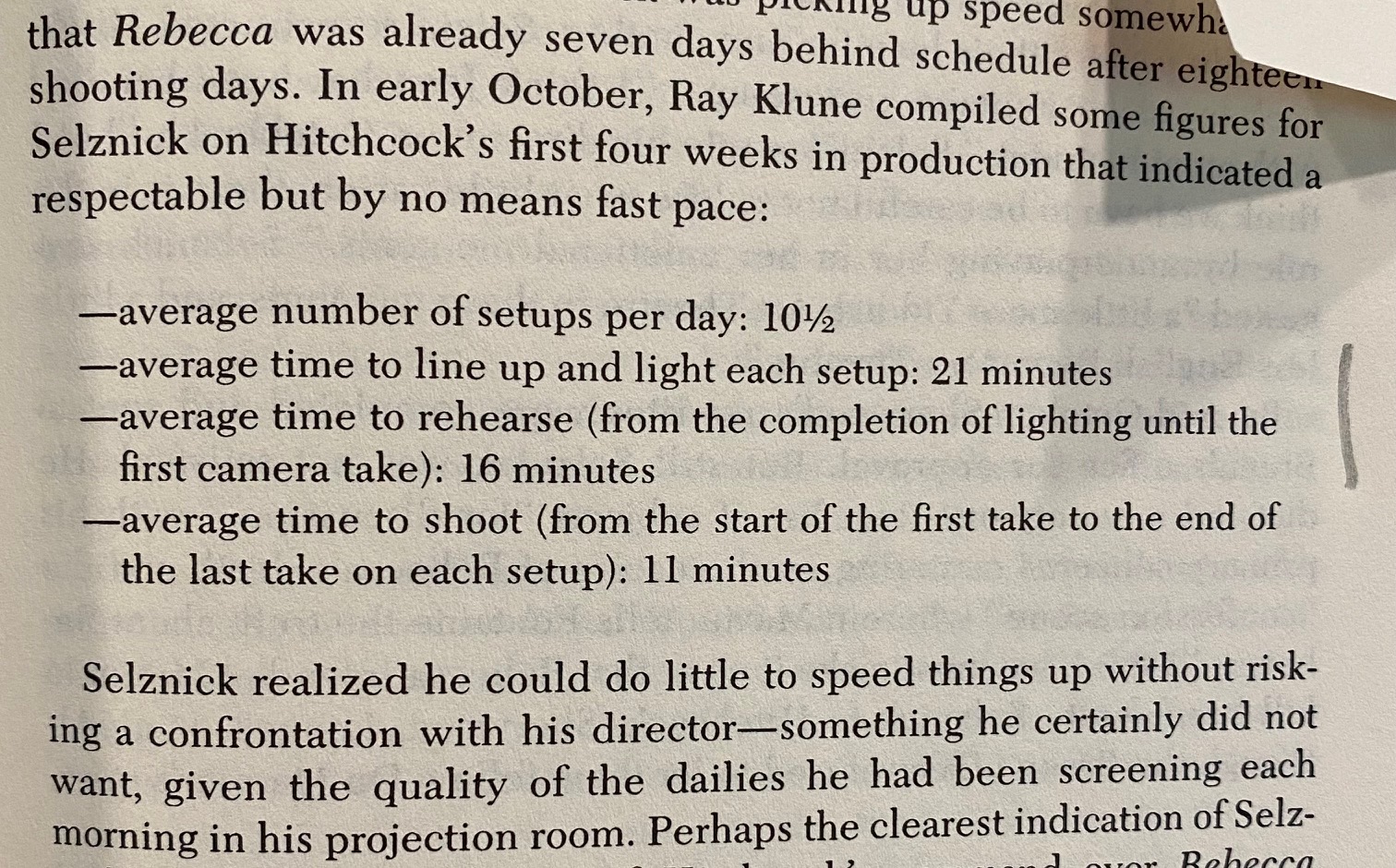
Sometimes companies manage to recreate the cohesion of the studio system. Take Pixar, for example, or the Marvel movies. How about Hallmark movies? Individual directors and producers can have runs like this too: Selznick was doing it by 1935. But at nowhere like the studio scale.
Studios had specialties, flavors: MGM had musicals, Universal had monster movies, Warner Brothers had gangster pictures. In 2022, do the streamers have anything like this? I know what BritBox is.
Even on our startup model, plenty of dreams get produced. Movies might be uncountable, how many are there? 403? How many scripted TV shows are there? 532?
Gracenote, a Nielsen company, listed more than 817,000 unique program titles across U.S. traditional TV and streaming services, with many of those titles featuring hundreds of individual episodes and chapters. Back in December 2019, there were just over 646,000 unique program titles.
So says Nielsen’s State of Play report. I found this Hollywood Reporter piece citing an FX report from 2016 that lists all 1,400 primetime shows, starting with Big Bang Theory and ending with:

The Paramount decree in 1948 stopped the studios from owning the theaters. One of many blows, along with TV, shifting lifestyles, etc that forced change on the system. But we’ve re-evolved back around on vertical integration. Disney, for example, is a studio yet owns its own distribution: Disney +. Is that a violation of the Paramount decree? Let’s look into it:
As part of a 2019 review of its ongoing decrees, the Department of Justice issued a two-year sunsetting notice for the Paramount Decree in August 2020, believing the antitrust restriction was no longer necessary as the old model could never be recreated in contemporary settings.
Oh!
Dead pool
Posted: July 5, 2022 Filed under: the American West, the California Condition Leave a comment
from a June 20, 2022 LA Times piece, “As water crisis worsens on Colorado River, an urgent call for Western states to ‘act now’” by Ian James.
I must admit that as catastrophic as it would be, kind of curious to see how the dead pool would play out. Would they have to shut down Las Vegas?

Meanwhile in Lake Mead, they keep discovering weird stuff as the water level sinks. There was the dead body found in a barrel:
Investigators are dating the crime to the late 1970s or early ’80s, with KLAS quoting Las Vegas Lt. Ray Spencer as saying, “The victim’s clothes and shoes were sold at Kmart in the mid-to-late 1970s.”
Who were the forensic fashion investigators who put that together? Human ingenuity is remarkable, maybe with that kind of brainpower and creativity we’ll solve the southwestern water crisis before we deadpool.
Mishopshnow
Posted: July 3, 2022 Filed under: the California Condition Leave a comment
land acknowledgments can ring hollow, but who wouldn’t support returning some California places to their native names? For example Carpinteria could revert to the name the Chumash apparently gave it.

A Climate for Health and Wealth
Santa Barbara, 1834
Posted: July 2, 2022 Filed under: the California Condition Leave a comment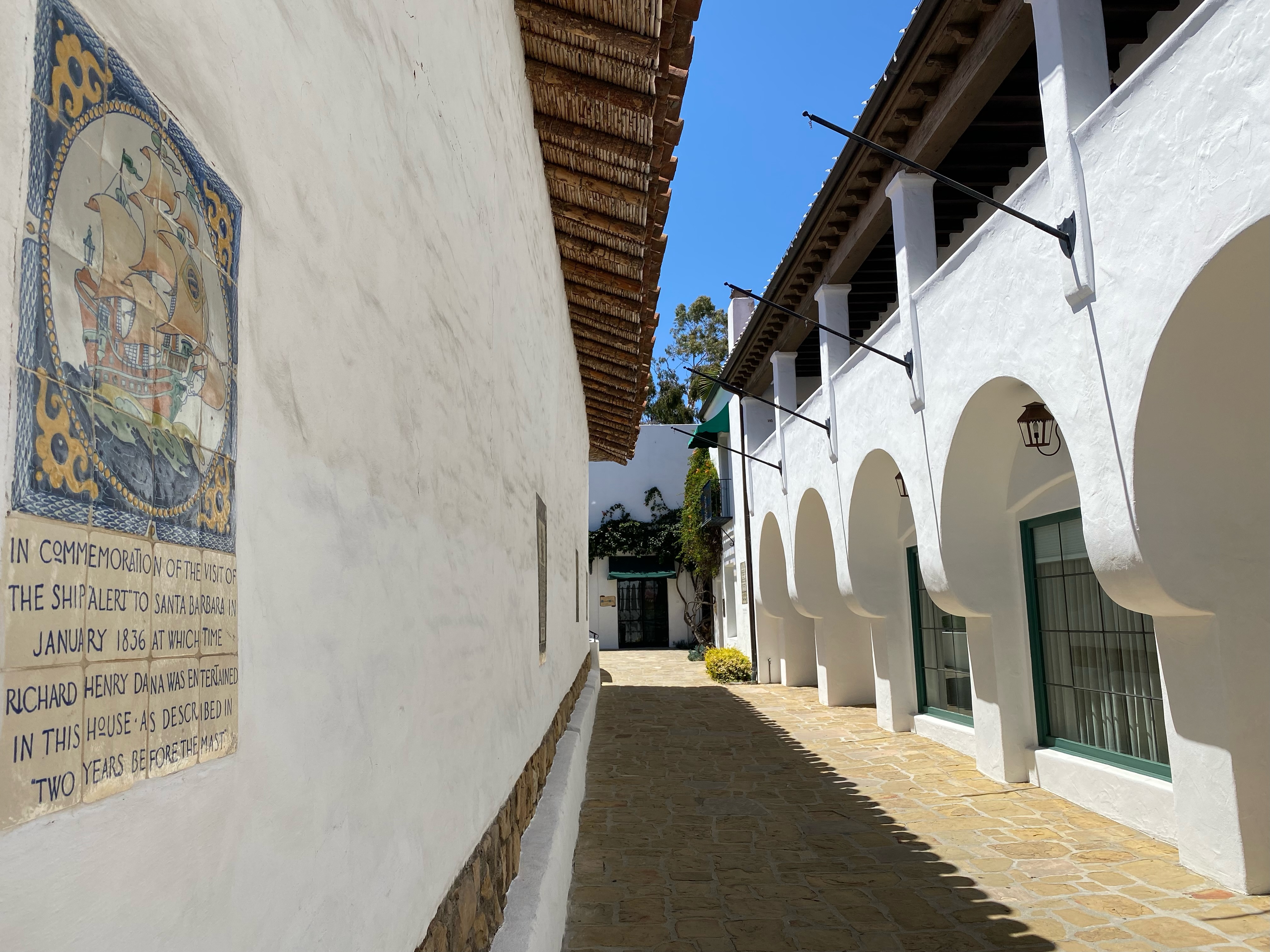
Strolling through El Paseo in Santa Barbara, I saw this on the wall and got to thinking about Dana.
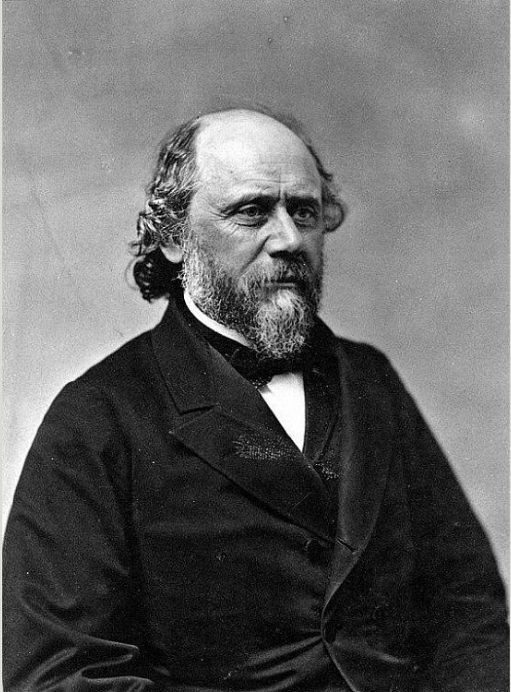
The year was 1834. Richard Henry Dana Jr was a Harvard student who caught the measles and then noticed he was losing his eyesight. Thinking it might be good for him, he left school and enlisted as a sailor on a trip around Cape Horn to California.
The ship’s trade was in buying up cow hides from the ranches of Mexican California:
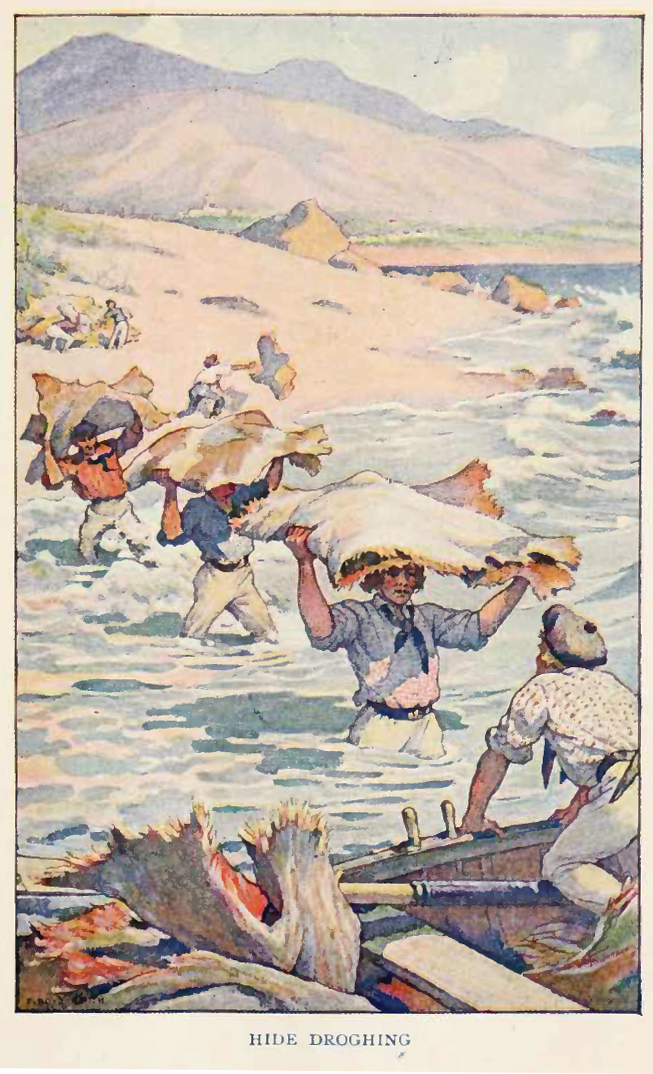
(from illustrations for a 1911 edition. Wikipedia credits this one to Sidney Chase but I think it’s by E. Boyd Smith.)
At one point, finding themselves at the top of a cliff, threw the hides down to the ocean over the edge. The site where this occurred is now Dana Point, California.
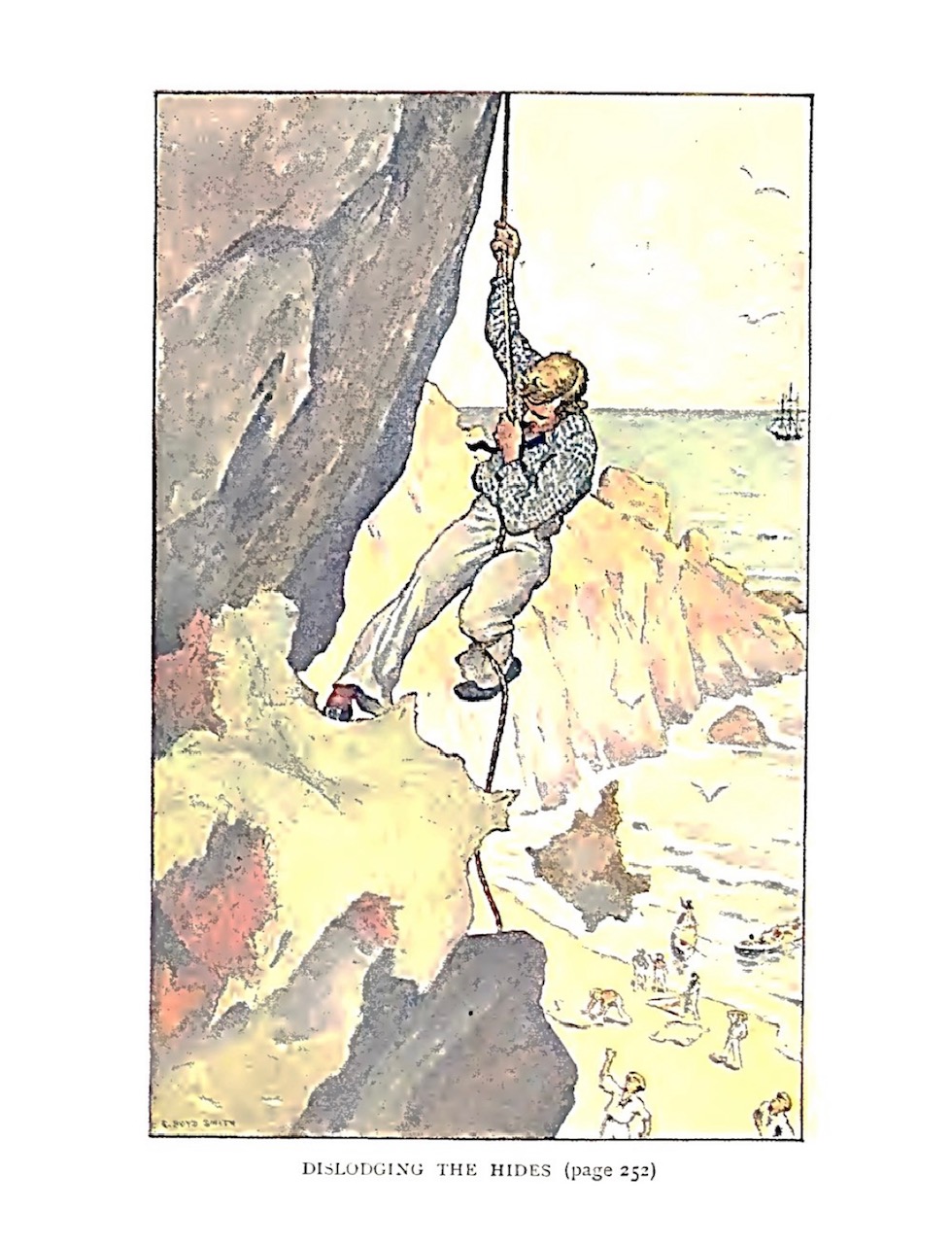
Dana doesn’t have much to say about Los Angeles, although he spent some miserable time doing hard work in San Pedro. Here he is on Santa Barbara, where he had a chance to get a slice of life:
In the middle of this crescent, directly opposite the anchoring ground, lie the mission and town of Santa Barbara, on a low, flat plain, but little above the level of the sea, covered with grass, though entirely without trees, and surrounded on three sides by an amphitheatre of mountains, which slant off to the distance of fifteen or twenty miles. The mission stands a little back of the town, and is a large building, or rather a collection of buildings, in the centre of which is a high tower, with a belfry of five bells; and the whole, being plastered, makes quite a show at a distance, and is the mark by which vessels come to anchor. The town lies a little nearer to the beach—about half a mile from it—and is composed of one-story houses built of brown clay—some of them plastered—with red tiles on the roofs. I should judge that there were about an hundred of them; and in the midst of them stands the Presidio, or fort, built of the same materials, and apparently but little stronger. The town is certainly finely situated, with a bay in front, and an amphitheatre of hills behind. The only thing which diminishes its beauty is, that the hills have no large trees upon them, they having been all burnt by a great fire which swept them off about a dozen years before, and they had not yet grown up again. The fire was described to me by an inhabitant, as having been a very terrible and magnificent sight. The air of the whole valley was so heated that the people were obliged to leave the town and take up their quarters for several days upon the beach.
He goes ashore:
We were then pulled ashore in the stern of the boat, and, with orders to be on the beach at sundown, we took our way for the town. There, everything wore the appearance of a holyday. The people were all dressed in their best; the men riding about on horseback among the houses, and the women sitting on carpets before the doors. Under the piazza of a “pulperia,” two men were seated, decked out with knots of ribbons and bouquets, and playing the violin and the Spanish guitar. These are the only instruments, with the exception of the drums and trumpets at Monterey that I ever heard in California; and I suspect they play upon no others, for at a great fandango at which I was afterwards present, and where they mustered all the music they could find, there were three violins and two guitars, and no other instrument. As it was now too near the middle of the day to see any dancing and hearing that a bull was expected down from the country, to be baited in the presidio square, in the course of an hour or two we took a stroll among the houses. Inquiring for an American who, we had been told, had married in the place, and kept a shop, we were directed to a long, low building, at the end of which was a door, with a sign over it, in Spanish. Entering the shop, we found no one in it, and the whole had an empty, deserted appearance. In a few minutes the man made his appearance, and apologized for having nothing to entertain us with, saying that he had had a fandango at his house the night before, and the people had eaten and drunk up everything.
“Oh yes!” said I, “Easter holydays?”
“No!” said he, with a singular expression to his face; “I had a little daughter die the other day, and that’s the custom of the country.”
Here I felt a little strangely, not knowing what to say, or whether to offer consolation or no, and was beginning to retire, when he opened a side door and told us to walk in. Here I was no less astonished; for I found a large room, filled with young girls, from three or four years of age up to fifteen and sixteen, dressed all in white, with wreaths of flowers on their heads, and bouquets in their hands. Following our conductor through all these girls, who were playing about in high spirits, we came to a table, at the end of the room, covered with a white cloth, on which lay a coffin, about three feet long, with the body of his child. The coffin was lined on the outside with white cloth, and on the inside with white satin, and was strewed with flowers. Through an open door we saw, in another room, a few elderly people in common dresses; while the benches and tables thrown up in a corner, and the stained walls, gave evident signs of the last night’s “high go.” Feeling, like Garrick, between tragedy and comedy, an uncertainty of purpose and a little awkwardness, I asked the man when the funeral would take place, and being told that it would move toward the mission in about an hour, took my leave.
A funeral procession, a cockfight, a horse race:
Here was as peculiar a sight as we had seen before in the house; the one looking as much like a funeral procession as the other did like a house of mourning. The little coffin was borne by eight girls, who were continually relieved by others, running forward from the procession and taking their places. Behind it came a straggling company of girls, dressed as before, in white and flowers, and including, I should suppose by their numbers, nearly all the girls between five and fifteen in the place. They played along on the way, frequently stopping and running all together to talk to some one, or to pick up a flower, and then running on again to overtake the coffin. There were a few elderly women in common colors; and a herd of young men and boys, some on foot and others mounted, followed them, or walked or rode by their side, frequently interrupting them by jokes and questions. But the most singular thing of all was, that two men walked, one on each side of the coffin, carrying muskets in their hands, which they continually loaded, and fired into the air. Whether this was to keep off the evil spirits or not, I do not know. It was the only interpretation that I could put upon it.
As we drew near the mission, we saw the great gate thrown open, and the pádre standing on the steps, with a crucifix in hand. The mission is a large and deserted-looking place, the out-buildings going to ruin, and everything giving one the impression of decayed grandeur. A large stone fountain threw out pure water, from four mouths, into a basin, before the church door; and we were on the point of riding up to let our horses drink, when it occurred to us that it might be consecrated, and we forbore. Just at this moment, the bells set up their harsh, discordant clang; and the procession moved into the court. I was anxious to follow, and see the ceremony, but the horse of one of my companions had become frightened, and was tearing off toward the town; and having thrown his rider, and got one of his feet caught in the saddle, which had slipped, was fast dragging and ripping it to pieces. Knowing that my shipmate could not speak a word of Spanish, and fearing that he would get into difficulty, I was obliged to leave the ceremony and ride after him. I soon overtook him, trudging along, swearing at the horse, and carrying the remains of the saddle, which he had picked up on the road. Going to the owner of the horse, we made a settlement with him, and found him surprisingly liberal. All parts of the saddle were brought back, and, being capable of repair, he was satisfied with six reáls. We thought it would have been a few dollars. We pointed to the horse, which was now half way up one of the mountains; but he shook his head, saying, “No importe!” and giving us to understand that he had plenty more.
Having returned to the town, we saw a great crowd collected in the square before the principal pulperia, and riding up, found that all these people—men, women, and children—had been drawn together by a couple of bantam cocks. The cocks were in full tilt, springing into one another, and the people were as eager, laughing and shouting, as though the combatants had been men. There had been a disappointment about the bull; he had broken his bail, and taken himself off, and it was too late to get another; so the people were obliged to put up with a cock-fight. One of the bantams having been knocked in the head, and had an eye put out, he gave in, and two monstrous prize-cocks were brought on. These were the object of the whole affair; the two bantams having been merely served up as a first course, to collect the people together. Two fellows came into the ring holding the cocks in their arms, and stroking them, and running about on all fours, encouraging and setting them on. Bets ran high, and, like most other contests, it remained for some time undecided. They both showed great pluck, and fought probably better and longer than their masters would have done. Whether, in the end, it was the white or the red that beat, I do not recollect; but, whichever it was, he strutted off with the true veni-vidi-vici look, leaving the other lying panting on his beam-ends.
This matter having been settled, we heard some talk about “caballos” and “carrera” and seeing the people all streaming off in one direction, we followed, and came upon a level piece of ground, just out of the town, which was used as a race-course. Here the crowd soon became thick again; the ground was marked off; the judges stationed; and the horses led up to one end. Two fine-looking old gentlemen—Don Carlos and Don Domingo, so called—held the stakes, and all was now ready. We waited some time, during which we could just see the horses twisting round and turning, until, at length, there was a shout along the lines, and on they came—heads stretched out and eyes starting;—working all over, both man and beast. The steeds came by us like a couple of chain-shot—neck and neck; and now we could see nothing but their backs, and their hind hoofs flying in the air. As fast as the horses passed, the crowd broke up behind them, and ran to the goal. When we got there, we found the horses returning on a slow walk, having run far beyond the mark, and heard that the long, bony one had come in head and shoulders before the other. The riders were light-built men; had handkerchiefs tied round their heads; and were bare-armed and bare-legged. The horses were noble-looking beasts, not so sleek and combed as our Boston stable-horses, but with fine limbs, and spirited eyes. After this had been settled, and fully talked over, the crowd scattered again and flocked back to the town.
Returning to the large pulperia, we found the violin and guitar screaming and twanging away under the piazza, where they had been all day. As it was now sundown, there began to be some dancing. The Italian sailors danced, and one of our crew exhibited himself in a sort of West India shuffle, much to the amusement of the bystanders, who cried out, “Bravo!” “Otra vez!” and “Vivan los marineros!” but the dancing did not become general, as the women and the “gente de razón” had not yet made their appearance. We wished very much to stay and see the style of dancing; but, although we had had our own way during the day, yet we were, after all, but ‘foremast Jacks; and having been ordered to be on the beach by sundown, did not venture to be more than an hour behind the time; so we took our way down
A return:
Santa Barbara looked very much as it did when I left it five months before: the long sand beach, with the heavy rollers, breaking upon it in a continual roar, and the little town, imbedded on the plain, girt by its amphitheatre of mountains. Day after day, the sun shone clear and bright upon the wide bay and the red roofs of the houses; everything being as still as death, the people really hardly seeming to earn their sun-light. Daylight actually seemed thrown away upon them.
He attends a wedding:
The great amusement of the evening,—which I suppose was owing to its being carnival—was the breaking of eggs filled with cologne, or other essences, upon the heads of the company. One end of the egg is broken and the inside taken out, then it is partly filled with cologne, and the whole sealed up. The women bring a great number of these secretly about them, and the amusement is to break one upon the head of a gentleman when his back is turned. He is bound in gallantry to find out the lady and return the compliment, though it must not be done if the person sees you. A tall, stately Don, with immense grey whiskers, and a look of great importance, was standing before me, when I felt a light hand on my shoulder, and turning round, saw Donna Angustia, (whom we all knew, as she had been up to Monterey, and down again, in the Alert,) with her finger upon her lip, motioning me gently aside. I stepped back a little, when she went up behind the Don, and with one hand knocked off his huge sombrero, and at the same instant, with the other, broke the egg upon his head, and springing behind me, was out of sight in a moment. The Don turned slowly round, the cologne, running down his face, and over his clothes, and a loud laugh breaking out from every quarter. He looked round in vain, for some time, until the direction of so many laughing eyes showed him the fair offender. She was his niece, and a great favorite with him, so old Don Domingo had to join in the laugh. A great many such tricks were played, and many a war of sharp manoeuvering was carried on between couples of the younger people, and at every successful exploit a general laugh was raised.
Another singular custom I was for some time at a loss about. A pretty young girl was dancing, named, after what would appear to us the sacrilegious custom of the country—Espiritu Santo, when a young man went behind her and placed his hat directly upon her head, letting it fall down over her eyes, and sprang back among the crowd. She danced for some time with the hat on, when she threw it off, which called forth a general shout; and the young man was obliged to go out upon the floor and pick it up. Some of the ladies, upon whose heads hats had been placed, threw them off at once, and a few kept them on throughout the dance, and took them off at the end, and held them out in their hands, when the owner stepped out, bowed, and took it from them. I soon began to suspect the meaning of the thing, and was afterward told that it was a compliment, and an offer to become the lady’s gallant for the rest of the evening, and to wait upon her home. If the hat was thrown off, the offer was refused, and the gentleman was obliged to pick up his hat amid a general laugh. Much amusement was caused sometimes by gentlemen putting hats on the ladies’ heads, without permitting them to see whom it was done by. This obliged them to throw them off, or keep them on at a venture, and when they came to discover the owner, the laugh was often turned upon them.
Twenty-four years later, 1859, he returns:
Santa Barbara has gained but little. I should not know, from anything I saw, that she was now a seaport of the United States, a part of the enterprising Yankee nation, and not still a lifeless Mexican town. At the same old house, where Señor Noriego lived, on the piazza in front of the court-yard, where was the gay scene of the marriage of our agent, Mr. Robinson, to Doña Anita, where Don Juan Bandini and Doña Augustia danced, Don Pablo de la Guerra received me in a courtly fashion. I passed the day with the family, and in walking about the place; and ate the old dinner with its accompaniments of frijoles, native olives and grapes, and native wines. In due time I paid my respects to Doña Augustia, and notwithstanding what Wilson told me, I could hardly believe that after twenty-four years there would still be so much of the enchanting woman about her.
A visit to Los Angeles:
The Pueblo de los Angeles I found a large and flourishing town of about twenty thousand inhabitants, with brick sidewalks, and blocks of stone or brick houses. The three principal traders when we were here for hides in the Pilgrim and Alert are still among the chief traders of the place,—Stearns, Temple, and Warner, the two former being reputed very rich.
There used to be a replica of Dana’s ship, the Pilgrim, in Dana Point, CA, but I’m just now learning it keeled over and sank in 2020!
Sorry these excerpts are kinda long, I just wanted to have all of Dana’s thoughts on Santa Barbara in one place.
How is this a house?
Posted: June 30, 2022 Filed under: the California Condition 1 Comment
Seen in Malibu not long ago.
Vintage
Posted: June 24, 2022 Filed under: the California Condition Leave a comment
just one of those vintage sunsets
Unusual view of a seagull
Posted: June 19, 2022 Filed under: the California Condition Leave a comment
Cattle as weapon of invasion
Posted: June 16, 2022 Filed under: the California Condition Leave a comment

thought that was a well-articulated historical insight, from a writeup about the Cuyama Valley by Judith Dale in the Lompoc Record.
That picture of cows I found at the California Bureau of Livestock Identification.
amply gooey
Posted: June 13, 2022 Filed under: food, the California Condition Leave a comment
food writing is wild. That’s from a LA Times piece suggesting places to pick up a picnic before a concert at the Hollywood Bowl. You’re bringing a smashburger to see Dudamel? I guess I must respect it!
The Price of Gas
Posted: June 12, 2022 Filed under: America Since 1945, business, the California Condition Leave a comment
It’s so high! How can people do anything? Yet shouldn’t we want the price of gas to be high, so we don’t cook up the planet quite as fast? Though, won’t the high prices cause estimates and spreadsheets and algorithms across the oil and gas companies to be adjusted? When the calculations are revised, it suddenly makes sense to drill more and deeper and in crazier ways in more chaotic countries? They’ll capitalize new and more projects, dredging up our oil faster than ever.
Is this merely the boom and bust cycle we all must toil under, written many times over in the history of every boomtown and oil craze? From Nantucket to Houston to the Bakken to Bakersfield to Alaska we are told this story. Above LA looms the Getty, named for a man whose father left Minnesota for a boom in Bartlesville, Oklahoma. The son took the lesson and was early in on Saudi Arabia. To get to the Getty from here you’d have to cross Doheny, he of Teapot Dome. But look, you saw the oil wells when you came in from the airport (in a car), and if you looked out the window of your plane as you landed at LAX you saw the diesel tankers and maybe even an oil tanker filling up at the offshore spigot. You get the idea.

Not so long ago I watched the documentary version of The Prize in small chunks, just before bed. Though the content can be bracing it is soothingly narrated by Donald Sutherland, and there is something relaxing about seeing how the pieces fit together. Finding the doc compelling I read Daniel Yergin’s original book, which is full of great characters and strange scenes:
In early March 1983 the oil ministers and their retinues hurriedly convened, ironically in London, the home court of their leading non-OPEC competitor, Great Britain. They met at the Intercontinental Hotel at Hyde Park Corner, for what turned out to be twelve interminable, frustrating days – an experience that would leave some of them with an allergic reaction whenever, in future years, they set foot inside the hotel.
and:
Later in the day, Silva Herzog was glumly eating a hamburger at the Mexican embassy, preparing to leave, when a call came from the United States Treasury saying that the $100 million fee had been rescinded. The Americans could not risk a collapse. Who knew what the effects would be on Monday? And with that, the Mexican Weekend concluded, with the first part of the emergency package now in place.
Some takeaways of value:
- it’s not just the getting of the oil. It’s the refining. Rockefeller controlled the refining, and the shipping, and eventually everything
- one of Rockefeller’s killer qualities: he was a visionary accountant. Can there be such a thing? Yes. Rockefeller.
- The Great War, later World War One, was a gamechange for oil. Railroads had been key in the US Civil War, but in World War One, the tank and the truck, oil powered vehicles, proved to be the crucial transport. Churchill, head of the Admiralty at the time, switched the Royal Navy to oil from coal. At the end of the war, the destruction of the Ottoman Empire left the British and French in control of oil fields in Mesopotamia.
- both on the Eastern Front and in the Pacific in World War Two, oil was the key strategic factor. Really everywhere, but those offer clear examples. Decisions on how to invade the Soviet Union were based on gaining control of oil fields before the German forces ran out of oil. The Japanese navy’s decisions were bounded by limits on oil. The fleet had to be stationed near Singapore. The “Marianas turkey shoot” was a result of decisions made based on saving oil. There was not enough oil not only for active operations, but for pilot training.
How about this?:
When [J. Paul] Getty died in 1976, age eighty-three, the eulogy at his funeral was delivered by the Duke of Bedford. “When I think of Paul,” said the Duke, “I think of money.”
Many people and groups of people have attempted to control oil, but it’s unpredictable. Sometimes the board gets reshuffled: North Sea oil fields, Saudi, Alaska. The North Sea oil fields saved the UK economy. Or did it ruin the UK economy? It saved Margaret Thatcher. You can’t send ships and helicopters to the coast of Argentina if you don’t have oil.
Look how rich Norway is. It doesn’t have to be this way, Norway used to be poor, that’s why Rose on Golden Girls is from St. Olaf.
Obama’s presidency coincided with a huge boom in US oil extraction. Is “coincided” the right word? Was it a coincidence? What’s at work here?
A character worth some study: Marcus Samuel. (Shell, the first oil tanker, Lord Mayor of London).

It was called Shell because his Iraqi Jewish family used to import and sell seashells. (That’s the story, anyway.)
Here’s a solid summary of The Prize.
Recall that Moby-Dick is about the oil business, and Ahab like Daniel Plainview is an oilman.