Helytimes Classic: D*-Day
Posted: June 6, 2017 Filed under: America Since 1945 Leave a commentReprinting this beloved post from a year ago:
 * the D is for Dave!
Happy birthday, tomorrow, June 6, to Dave King (the Great Debates co-host, not the Bad Plus drummer)
A promise made in Host Chat is a promise kept so here is a selection of D-Day readings for Davis.

scene from the Bayeux Tapestry

New Yorker’s July 15, 1944 parody of the Bayeux Tapestry
The single best thing to read about D-Day
is online and free. It is S. L. A. Marshall writing for The Atlantic in November, 1950.

During World War II, Marshall became an official Army combat historian, and came to know many of the war’s best-known Allied commanders, including George S. Patton and Omar N. Bradley. He conducted hundreds of interviews of both enlisted men and officers regarding their combat experiences, and was an early proponent of oral history techniques. In particular, Marshall favored the group interview, where he would gather surviving members of a frontline unit together and debrief them on their combat experiences of a day or two before.

The article is called “First Wave On Omaha Beach” here is an excerpt:
Even among some of the lightly wounded who jumped into shallow water the hits prove fatal. Knocked down by a bullet in the arm or weakened by fear and shock, they are unable to rise again and are drowned by the onrushing tide. Other wounded men drag themselves ashore and, on finding the sands, lie quiet from total exhaustion, only to be overtaken and killed by the water. A few move safely through the bullet swarm to the beach, then find that they cannot hold there. They return to the water to use it for body cover. Faces turned upward, so that their nostrils are out of water, they creep toward the land at the same rate as the tide. That is how most of the survivors make it. The less rugged or less clever seek the cover of enemy obstacles moored along the upper half of the beach and are knocked off by machine-gun fire.
Within seven minutes after the ramps drop, Able Company is inert and leaderless. At Boat No. 2, Lieutenant Tidrick takes a bullet through the throat as he jumps from the ramp into the water. He staggers onto the sand and flops down ten feet from Private First Class Leo J. Nash. Nash sees the blood spurting and hears the strangled words gasped by Tidrick: “Advance with the wire cutters!” It’s futile; Nash has no cutters. To give the order, Tidrick has raised himself up on his hands and made himself a target for an instant. Nash, burrowing into the sand, sees machine gun bullets rip Tidrick from crown to pelvis. From the cliff above, the German gunners are shooting into the survivors as from a roof top.
Captain Taylor N. Fellers and Lieutenant Benjamin R. Kearfoot never make it. They had loaded with a section of thirty men in Boat No. 6 (Landing Craft, Assault, No. 1015). But exactly what happened to this boat and its human cargo was never to be known. No one saw the craft go down. How each man aboard it met death remains unreported. Half of the drowned bodies were later found along the beach. It is supposed that the others were claimed by the sea.
After the war, Marshall would write Men Against Fire:

which claimed that only about 25% of American combat soldiers actually fired their guns at the enemy:
Marshall’s work on infantry combat effectiveness in World War II, titled Men Against Fire, is his best-known and most controversial work. In the book, Marshall claimed that of the World War II U.S. troops in actual combat, 75% never fired at the enemy for the purpose of killing, even though they were engaged in combat and under direct threat. Marshall argued that the Army should devote significant training resources to increasing the percentage of soldiers willing to engage the enemy with direct fire.
Marshall has been harshly criticized:

General Marshall said soldiers who did not fire were motivated by fear, a desire to minimize risk and a willingness, as in civilian life, to let a minority of other people carry the load.
In his 1989 memoir, About Face, Hackworth described his initial elation at an assignment with a man he idolized, and how that elation turned to disillusion after seeing Marshall’s character and methods first hand. Hackworth described Marshall as a “voyeur warrior,” for whom “the truth never got in the way of a good story” and went so far as to say, “Veterans of many of the actions he ‘documented’ in his books have complained bitterly over the years of his inaccuracy or blatant bias”.
Omaha Beach was the worst of it, but experiences on D-Day were vastly different.

stolen from the Daily Mail: http://www.dailymail.co.uk/news/article-2336753/Back-beaches-final-time-D-Day-heroes-return-Normandy-mark-69th-anniversary-landings.html
Twenty-one miles away on Juno Beach the Canadian Ninth Division landed with their bikes:
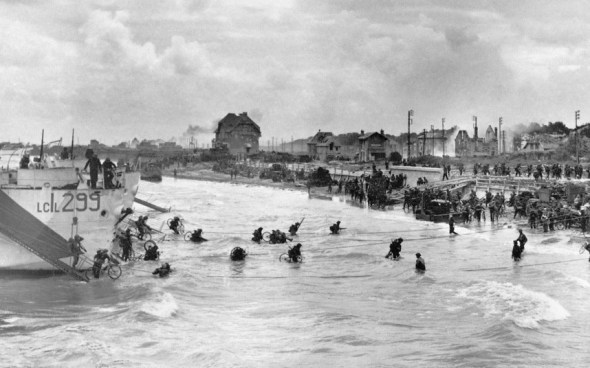
Picture: STF/AFP/Getty Images
Leave it to Canadians to bring their bikes. (900 Canadians died in a botched semi-practice D-Day in 1942).
Best Single Book To Read About D-Day
Looking around I can’t find my copy of Normandy Revisited by AJ Liebling:

Image by © Bettmann/CORBIS found here
Liebling, a vivacious fatso who had spent a lot of time in Normandy pre-war, describes going through with the Army and eating at spots he remembered from before. Definitely a different kind of war corresponding.
This book

was wildly popular for a reason: it’s thrilling, readable, and full of epic American hero stories.
Maybe starting with Andrew J. Higgins of Nebraska and Mobile, Alabama:

who developed shallow-draft boats for logging in the bayou (or for bootlegging?) and then took on the job of making similar boats for amphibious landings:

Higgins Industries
Anthony Beevor has a blunter take. Major takeaway from his book:

was that the Allies came up way short of their goals on D-Day. Unsurprisingly, many of those who got off the beaches in one piece considered their work done for the day. They were literally in Calvados,
 it was pretty easy to find bottles of highly alcoholic apple brandy, and a lot of survivors got hammered at first opportunity.

Who can blame them? But the failure to achieve the ambitious goals had costs. Caen was the biggest city around:

British and Canadian troops had intended to capture the town on D-Day. However they were held up north of the city until 9 July, when an intense bombing campaign during Operation Charnwood destroyed 70% of the city and killed 2,000 French civilians.
From this Washington Post review of Beevor, some excerpts:
US Army medical services had to deal with 30,000 cases of combat exhaustion in Normandy,” and:
“Nothing . . . seemed to reduce the flow of cases where men under artillery fire would go ‘wide-eyed and jittery’, or ‘start running around in circles and crying’, or ‘curl up into little balls’, or even wander out in a trance in an open field and start picking flowers as the shells exploded. Others cracked under the strain of patrols, suddenly crying, ‘We’re going to get killed! We’re going to get killed!’ Young officers had to try to deal with ‘men suddenly whimpering, cringing, refusing to get up or get out of a foxhole and go forward under fire’. While some soldiers resorted to self-inflicted wounds, a smaller, unknown number committed suicide.”
But the single best book to read about D-Day I would say is The Boys’ Crusade by Paul Fussell:

Amazon reviewer Bill Marsano sums it up nicely:
It’s probably all that “good war” and “greatest generation” stuff that drove Fussell to write this book; he doesn’t have much truck with gooey backward glances, and that will probably make some readers mad. Well, you don’t come to Fussell–author of, among other things, “Thank God for the Atom Bomb, and Other Essays”–for good times. You come to Fussell for the hard stuff.
And here it is his contention that behind and beneath all that “greatest generation” nonsense was the Boys’ Crusade–that last year of the war in Europe when too many things went wrong too often. The generals who’d convinced themselves that this war would not be a war of attrition–i.e., human slaughter–like the last one found they’d guessed wrong. Casualties were horrifyingly high and so huge numbers of children–kids 17-19 years–old were flung into combat. And they were, with the help of the generals, ill-trained, ill-clothed and ill-equipped.
They were also faceless ciphers. As Fussell points out, the US Army’s policy was to break up training units by sending individual replacements up to the line piecemeal–one at a time–so they often arrived as strangers among strangers, often addressed merely as “Soldier” because no one knew their names. The result was too many instances of cowardice–both under fire and behind the lines–too many self-inflicted wounds to escape combat. Too many disgraces of every kind because the Army’s system, Fussell says, destroyed the most important factor in the fighting morale of the “poor bloody infantry”–the shame and fear of turning chicken in front of your comrades. Many of these boys–and Fussell is properly insistent on the word boys–funked because they had no comradeship to value.
This is not in the least a personal journal. Fussell was serriously wounded as a young second lieutenant; he was also decorated. But he wisely leaves himself out of this narrative. There’s no special pleading here, no showing of the wounds on Crispin’s Day. Instead this is a passionate but straightforward report on what that last year was like for the poor bloody infantry–those foot soldiers, those dogfaces, those 14 percent of the troops who took more than 70 percent of the casualties.
And yet there were those who stood the gaff, who survived “carnage up to and including bodies literally torn to pieces, of intestines hung on trees like Christ,mas festoons,” and managed not to dishonor themselves. They weren’t heroes, Fussell says, just men who earned the Combat Infantryman’s Badge, which was the only honor they respected. In a brief but moving passage, he explains why: It said they’d been there, been through it, and toughed it out.
Horrible as it is I found this book refreshing when I first read it, because it felt like somebody was telling me the unvarnished truth, which is that even for the good guys this was a series of catastrophes, fuckups, and massacres.
All Fussell’s books are good. This one in particular I was obsessed with:

and I talk about it in The Wonder Trail: True Stories From Los Angeles To The End Of The World, out June 14:
Those photos are by Robert Capa, who lost all but 11 of the 106 or so photos he risked his life shooting when the guy developing them was in such a hurry he fudged up the negatives.
Let’s give the last word to Fussell:
One wartime moment not at all vile occurred on June 5, 1944, when Dwight Eisenhower, entirely alone and for the moment disjunct from his publicity apparatus, changed the passive voice to active in the penciled statement he wrote out to have ready when the invasion was repulsed, his troops torn apart for nothing, his planes ripped and smashed to no end, his warships sunk, his reputation blasted: “Our landings in the Cherbourg-Havre area have failed to gain a satisfactory foothold and I have withdrawn the troops.” Originally he wrote, “the troops have been withdrawn,” as if by some distant, anonymous agency instead of by an identifiable man making all-but-impossible decisions. Having ventured this bold revision, and secure in his painful acceptance of full personal accountability, he was able to proceed unevasively with “My decision to attack at this time and place was based on the best information available.” Then, after the conventional “credit,” distributed equally to “the troops, the air, and the navy,” came Eisenhower’s noble acceptance of total personal responsibility: “If any blame or fault attaches to the attempt, it is mine alone.” As Mailer says, you use the word shit so that you can use the word noble,and you refuse to ignore the stupidity and barbarism and ignobility and poltroonery and filth of the real war so thatit is mine alone can flash out, a bright signal in a dark time.

Happy Birthday Dave!

Planet Earth 2
Posted: June 6, 2017 Filed under: animals Leave a comment
Important to remember some things such as nature documentaries are better than ever!
Seal of Acceptance
Posted: June 5, 2017 Filed under: fashion Leave a comment
shopping for shoes today. I see this on one of them:

Would love to attend this banquet.
Astronomers
Posted: June 5, 2017 Filed under: space Leave a comment
I follow a bunch of astronomers on Twitter. One of them got a new ergonomic chair today and she’s so happy about it!
Sappho
Posted: June 4, 2017 Filed under: women, writing Leave a comment
cool book.


I find Mary Barnard’s photo on the Oregonencyclopedia:

Her literary career took her from a childhood in the Oregon backwoods, where she often traveled with her timber-wholesaler father, to Reed College in Portland, where she was introduced to the classics and to the modern poetic revolution by Lloyd Reynolds.

MOA
Posted: June 4, 2017 Filed under: Canada Leave a comment





Very cool place: MOA – Museum of Anthropology, on the campus of University of British Columbia in Vancouver.
Bag Balm
Posted: June 4, 2017 Filed under: animals, Canada Leave a comment
My feet were kinda messed up (from walking?). Mentioned this to my friend Hana. She knows how to bring forth bounty from the Earth, I knew she would have some wondrous cure. She thought about it and came back with this medicine they use for messed up cow udders.

Gotta say it seems like a miracle product. 
If you are cool buy some of Hana’s blankets and yarn:

Best mayor name
Posted: June 1, 2017 Filed under: Canada Leave a comment
It’s got to go to Victoria, British Columbia’s Lisa Helps.

Mayor Lisa Helps has a very cool city she’s entrusted with. 
a constituent
Design of Big Wheel Burger by our buds at Caste Projects

More about Victoria can be found in A Trip To Canada.
Denis Johnson, Walt Whitman
Posted: May 29, 2017 Filed under: America Since 1945, heroes, writing Leave a comment
We’ve been thinking a lot about the glow of some of your poems, the visionary language seeping through parts of Angels, and the electric way in which the border between Fuckhead’s consciousness and the outside world is always being dissolved throughout Jesus’ Son. Could you talk a bit more about Whitman’s influence in your poetry and prose?
I’m not sure I could trace the lines of his influence on my language, particularly, or the way his work affects the strategies in my work, or anything like that. His expansive spirit, his generosity, his eagerness to love – those are the things that influence me, not just as a writer, but as a person. His introduction to LEAVES OF GRASS I take as a sort of personal manifesto, especially the passage:
This is what you shall do: Love the earth and sun and the animals, despise riches, give alms to every one that asks, stand up for the stupid and crazy, devote your income and labor to others, hate tyrants, argue not concerning God, have patience and indulgence toward the people, take off your hat to nothing known or unknown or to any man or number of men, go freely with powerful uneducated persons and with the young and with the mothers of families, read these leaves in the open air every season of every year of your life, re-examine all you have been told at school or church or in any book, dismiss whatever insults your own soul, and your very flesh shall be a great poem and have the richest fluency not only in its words but in the silent lines of its lips and face and between the lashes of your eyes and in every motion and joint of your body. . . .
found in this interview with Denis Johnson. Oddly or presciently or synchronistically enough I’d been looking for Denis Johnson materials as I did ever so often. How did this guy know this stuff? was what I was looking for as usual.
 so good!

May I please recommend to you you have actor Will Patton read you the audiobook of:

I loved the experience so much I got into the full unabridged 23+ hours of:

Will Patton is such a gifted, subtle performer of audiobooks.

from a profile in AudioFile
Let’s give the last word to DJ:
I love McDonald’s double cheeseburgers and I don’t care if they’re made of pink slime and ammonia, I eat them all the time because they’re delicious.

Today’s I Ching
Posted: May 25, 2017 Filed under: China, mysticism, religion 1 Comment
In some translations springtime is rendered as Long June
from:

the only book I’ll ever need?!
if I want to learn more about China I can pick up this month’s Westways:

Lol did somebody pitch Westways “how about a story about China?”
WESTWAYS EDITOR: what angle?
PITCHER: Everything from cities to cuisine! All the facets!
EDITOR: All?!
PITCHER: Well, many facets.
EDITOR: Is there enough there?
PITCHER: I think so. Did you know it is a 5,000 year old civilization?
EDITOR: Wow! OK let’s also have a piece on Iceland and car racing for amateurs and I think we’re good!
Morrissey / Noonan
Posted: May 23, 2017 Filed under: America Since 1945, politics Leave a comment
Compare what Morrissey said on Facebook (via Vulture) to this Peggy Noonan piece from February:
There are the protected and the unprotected. The protected make public policy. The unprotected live in it. The unprotected are starting to push back, powerfully.
The protected are the accomplished, the secure, the successful—those who have power or access to it. They are protected from much of the roughness of the world. More to the point, they are protected from the world they have created. Again, they make public policy and have for some time.
Anne R. Dick
Posted: May 22, 2017 Filed under: America Since 1945, writing Leave a comment
Obit worth reading in the NY Times:
Bored with science fiction and unable to interest publishers in his mainstream novels, Dick quit writing to help his new wife in her jewelry business. He liked that even less, and so he pretended to work on a new novel. To make it look realistic, he said in a 1976 interview with Science Fiction Review, he had to start typing.
What emerged was “The Man in the High Castle.” It was dedicated, cryptically and not altogether favorably, to his wife, “without whose silence this book would never have been written.” (In the 1970s, Dick changed the dedication, dropping Anne Dick entirely.)
Ms. Dick said she saw only the pilot of the Amazon series, finding the Nazis a little too threatening.
If you are interested in hearing some ideas that flutter between profound and totally bonkers might I suggest:


How paranoia is natural:

How about this?:

Just a guy with a fragile mind hanging out reading Gestapo documents in German up at UC Berkeley:
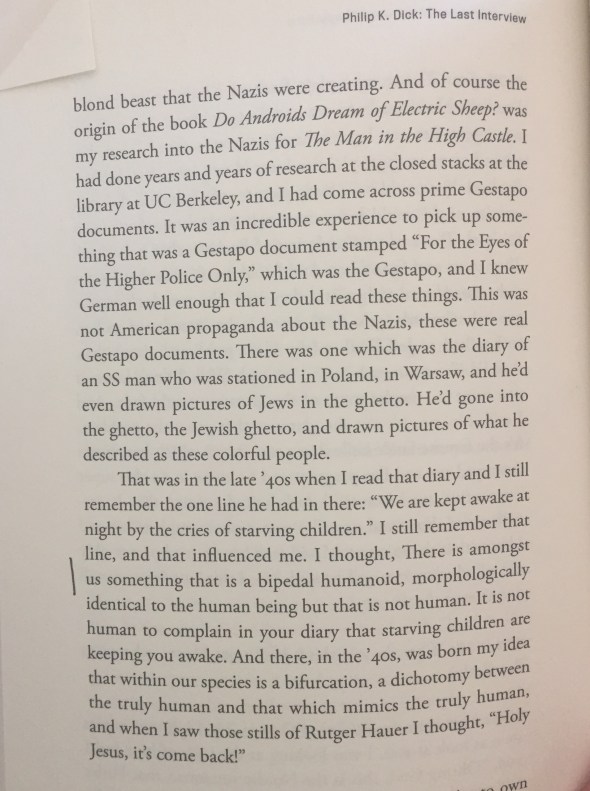

In Sweden there’s a fashion brand called Filippa K and I thought it would be funny for someone to do a mashup Filippa K Dick.

But who has the time.
Dreaming The Beatles / The Love You Make
Posted: May 20, 2017 Filed under: music 2 Comments
Devoured this book after reading Tyler Cowen’s endorsement. Here are two samples:

And:
How freaking interesting are the Beatles?! Even their names. John and Paul.

If you had a Catholic boyhood like I did and Paul did how can it not have some meaning that these guys are named John and Paul?!

from this Globalnews.ca article about a John Lennon letter
The world these guys came out of!

Postwar England. source: the Daily Mail
Mentioned reading Dreaming The Beatles to my buddy, who looked at me like I was an adorable if foolish schoolchild and suggested I get serious and read The Love You Make, written by Peter Brown, who was Brian Epstein’s assistant.

My God, this book! Incredible tale! Brian Epstein:

from wiki:
Koch, Eric / Anefo – [1] Dutch National Archives, The Hague, Fotocollectie Algemeen Nederlands Persbureau (ANeFo), 1945-1989

Both books talk about how phenomenon of being the Beatles almost overwhelmed the Beatles, and everyone around them. At its best it felt something like living in a yellow submarine with all your friends aboard, suggests Sheffield.
At its worst it seems so oppressive and scary it nearly / did kill them. At least once the Beatles were almost crushed to death in their car from the pressure of fans.

Started listening on Spotify to all the Beatles albums, in order.

I would say the biggest leap that hits me is when you get to the third song on this one. You’re listening to like two hours of very solid pop music, and then you get to You’ve Got To Hide Your Love Away.
Then, you get to this:
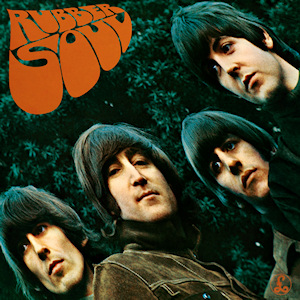
from Wiki:
This is the cover art for the album Rubber Soul by the artist The Beatles. The cover art copyright is believed to belong to the label, Parlophone/EMI, or the graphic artist(s), Robert Freeman/David Julian Beard. Resampled from digital copy included on The Beatles USB Box Set
and we’re on another planet.
On their first album the Beatles covered this:
Hard to find some Beatles songs on YouTube. The hash that was made of the Beatles’ finances and rights is a whole interesting story on its own. Epstein meant the best for the Beatles, can he be blamed for not realizing that lunchbox and doll rights would be worth millions?
The predators that descended on the Beatles later are a dark parade. When Allen Klein heard on the radio that Brian Epstein had died at 32 of a drug overdose, his reaction was to snap his fingers and say “I got em!”
The Beatles were taxed at something like 94%. Various tax avoidance schemes like investing in “related businesses” were somewhat doomed by John’s, especially, disgust at the idea of becoming anything like a businessman.
A publicly traded company, Northern Songs, owned the Lennon-McCartney songs for awhile:
During 1965 it was decided to make Northern Songs a public company to save on capital gains tax. 1,250,000 shares were traded on the London Stock Exchange, which were worth 17 pence each ($0.28), but were offered at 66 pence ($1.09) each. Although the trade was scoffed at by various financial institutions, it was expected that the application lists would not remain open for more than 60 seconds, which is exactly what happened, as the lists were oversubscribed. After the offer was closed, Lennon and McCartney owned 15% each, worth £195,200 ($320,000), NEMS a 7.5% interest, and James and Silver (who served as Northern Songs’ chairmen), controlling 37.5%, with Harrison and Starr sharing 1.6%. The remaining shares were owned by various financial institutions.
At some point Paul bought up more shares without telling John, a bit of sneakiness which Peter Brown treats very harshly. Peter Brown is, in my opinion, a little too brutal on Paul, but then again he was there and I wasn’t. It does seem like all the Beatles could be rather heartless to Brian Epstein, who meant a lot to Peter Brown.
To me, a degree of forgiveness comes in when you think that everything we think of as The Beatles happened to these guys by age thirty. When they were recording the White Album, George Harrison was twenty five. How would you be at twenty-five if you’d been world famous since you were eighteen?

I find this photo at the Telegraph, credited to Rex
None of them were from stable homes. Ringo’s childhood, in particular, was like some cruel Roald Dahl story. (OK fine it was Dickensian). At age six he’d regularly be left at home all night alone while his mom was at work. Says Brown:
At the age of six, only a year after starting St. Silas’s Junior School, Ritchie developed what was thought to be a simple stomachache. But when the pain lasted through the night he was finally taken to the hospital in an ambulance. It was too late; his appendix had already burst and periontis had set in. He remained in a coma for ten weeks, and with various complications including falling out of his hospital bed on his seventh birthday, he spent a solid year in the hospital. By the time he was back in school he was so far behind the other children he couldn’t read or write, and what little he learned from that point on was taught to him by a sympathetic neighborhood girl.
Later:
One rainy morning a big black car came to fetch him in the Dingle and took him away to the Heswall Children’s Hospital, a huge, gray children’s sanitorium in the Wirral. There he was put to bed, where he remained for the next two years.
Ringo is underappreciated, in my view. I’m not qualified to speak to his drumming, which was believed by Paul at least as well as some producers to be not too great. Ringo was treated rather cruelly by the other Beatles but without his good-natured willingness to play diplomat and either forgive or ignore slights and insults it seems clear the Beatles probably would’ve collapsed.
Now it’s time to declare what I consider to be the single most beautiful Beatles song and I declare it to be:
I may be projecting but I believe in the runup to the White Album you can feel a competition of insane excellence between John and Paul. With Blackbird the competition is over. In my opinion some subsequent tension between Paul and John had to do with John’s belief that it was semi-criminal a guy who could write Blackbird would also write some of the stuff Paul McCartney later put out. Thus what was best and greatest about Paul was, to John, tangled up with what was most frustrating about him, as can so often happen with lovers and friends.
Robert Mueller
Posted: May 19, 2017 Filed under: Uncategorized Leave a comment
Reading up on him on Wikipedia:
He went on to study at Princeton University (receiving an A.B. in 1966), where he continued to play lacrosse; he has cited his teammate David Spencer Hackett’s death in the Vietnam War as an influence on his decision to pursue military service. Hackett was a Marine Corps First Lieutenant in the infantry and was killed in 1967 by small arms fire.
Mueller earned an M.A. in international relations from New York University in 1967 and a Juris Doctor from the University of Virginia School of Law in 1973, where he served on the Virginia Law Review.
Mueller enlisted in the United States Marine Corps in 1968, attending officer candidate school, Army Ranger School and Army jump school. He then served as an officer leading a rifle platoon of the 3rd Marine Division during the Vietnam War; he eventually became aide-de-camp to 3rd Marine Division’s commanding general. He received the Bronze Star, two Commendation Medals, the Purple Heart and the Vietnamese Cross of Gallantry.
If my friend was killed in Vietnam I don’t think my reaction would be I should go to Vietnam.
Impressive man.
Robert Caro’s two hour audiobook
Posted: May 19, 2017 Filed under: America Since 1945, New York, politics, presidents, Texas Leave a comment
Strong endorse to an audio only, 1 hour 42 minute semi-memoir by Robert Caro, boiling down the central ideas of The Power Broker and the LBJ series. If you’ve read every single extant interview with Robert Caro, as I have, some of its repetitive but I loved it and loved listening to Caro’s weird New York accent.

Two details: he tells how James Rowe, an aide to FDR, told him that FDR was such a genius about politics that when he discussed it almost no one could even understand him. But Lyndon Johnson understood everything.

James Rowe, from the LOC
Caro tells that when LBJ ran for Congress the first time, he promised to bring electricity. Women had to haul water from the well with a rope. A full bucket of water was heavy. Women would become bent, a Hill Country term for stooped over. LBJ campaigned saying, if you vote for me, you won’t be bent. You won’t look at forty the way your mother looked at forty.

from the Austin American Statesman collection at the LBJ Library. The woman’s name is Mrs. Mattie Malone.
Democracy plaything
Posted: May 19, 2017 Filed under: China, politics Leave a comment
Indeed, it has long been in the Chinese government’s interest to sow cynicism among its citizens about the mechanisms of democracy. The current Administration and its steady stream of blunders have made Beijing’s task appreciably less difficult.
From this New Yorker thing by Jiayang Fan.
Some years ago at a dinner in Shanghai a smart person gave me his a somewhat jaded take on what would happen if China got democracy. He described how some huckster demagogue from TV would get elected and be terrible.

Peggy Noonan worth reading as usual. She got me to subscribe to the WSJ:
Here’s an idea.
It would be good if top Hill Republicans went en masse to the president and said: “Stop it. Clean up your act. Shut your mouth. Do your job. Stop tweeting. Stop seething. Stop wasting time. You lost the thread and don’t even know what you were elected to do anymore. Get a grip. Grow up and look at the terrain, see it for what it is. We have limited time. Every day you undercut yourself, you undercut us. More important, you keep from happening the good policy things we could have done together. If you don’t grow up fast, you’ll wind up abandoned and alone. Act like a president or leave the presidency.”
As Ms. Noonan points out that’s unlikely to be effective for long but it’s something positive.
A Trip To Japan
Posted: May 19, 2017 Filed under: Japan Leave a comment
cool
one please!

Randy Messenger endorsed ramen set. 
A horse race
Let’s go to the mall
in the temple courtyard
Tourists
With this man as your guide? Who could fail
Yes boat.

By the harbor
Feeling homesick, visited Cape Cod
Everything’s cool
The vibe here. 
The lonely squash.

Burnt cedar fades as it ages.
This cat from a Murakami story. 
Rice
Tree lovers
All aboard.
Career. Woman.
Posted: May 10, 2017 Filed under: actors, comedy, Japan Leave a comment
Asked an Osaka resident what was going on in Japanese comedy these days, and he directed me to Buruzon Chiemi.
E. B. White in the Paris Review
Posted: April 26, 2017 Filed under: advice, writing Leave a comment
Found here, what a great interview:
INTERVIEWER
You have wondered at Kenneth Roberts’s working methods—his stamina and discipline. You said you often went to zoos rather than write. Can you say something of discipline and the writer?
WHITE
Kenneth Roberts wrote historical novels. He knew just what he wanted to do and where he was going. He rose in the morning and went to work, methodically and industriously. This has not been true of me. The things I have managed to write have been varied and spotty—a mishmash. Except for certain routine chores, I never knew in the morning how the day was going to develop. I was like a hunter, hoping to catch sight of a rabbit. There are two faces to discipline. If a man (who writes) feels like going to a zoo, he should by all means go to a zoo. He might even be lucky, as I once was when I paid a call at the Bronx Zoo and found myself attending the birth of twin fawns. It was a fine sight, and I lost no time writing a piece about it. The other face of discipline is that, zoo or no zoo, diversion or no diversion, in the end a man must sit down and get the words on paper, and against great odds. This takes stamina and resolution. Having got them on paper, he must still have the discipline to discard them if they fail to measure up; he must view them with a jaundiced eye and do the whole thing over as many times as is necessary to achieve excellence, or as close to excellence as he can get. This varies from one time to maybe twenty.
The whole thing is good. White describes how he came to draw the above New Yorker cover, his only one. And he talks about the diaries of Francis Kilbert, which sure do sound interesting. (Jump to “4. Relations With Girls”)

Meanwhile, out in the desert
Posted: April 26, 2017 Filed under: the California Condition Leave a comment
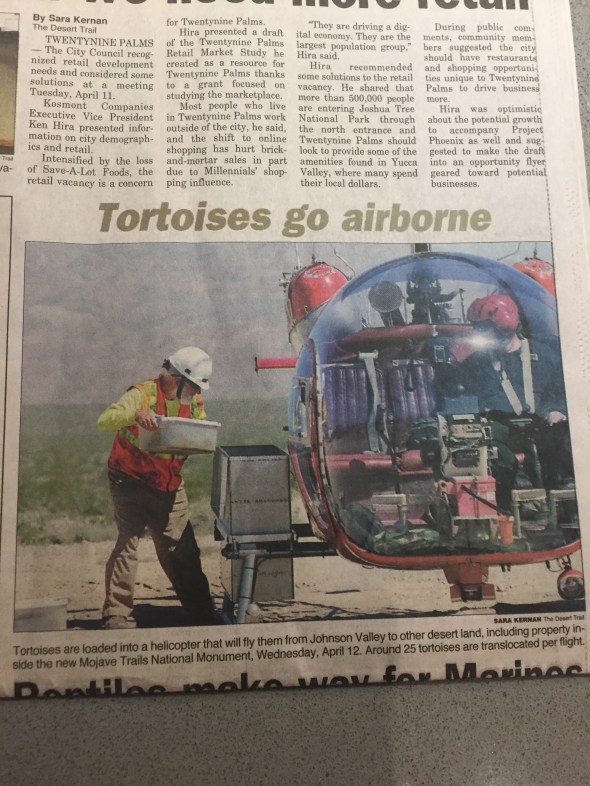
The top story in both the Hi-Desert Star and The Desert Trail is the removal of 1,100 desert tortoises from the Marine Corps base to safer lands.


Was Defense Secretary Mattis personally briefed on the operation?

It may seem silly but the story made me feel good.
find happy homes guys.

 Helytimes