Blog I Endorse
Posted: September 21, 2015 Filed under: America Since 1945, animals, art history, film, the California Condition Leave a comment

He turned to animated television commercials, most notably the Raid commercials of the 1960s and 1970s (in which cartoon insects, confronted by the bug killer, screamed “RAID!” and died flamboyantly) and Frito-Lay’s controversial mascot, the Frito Bandito.

Frito Bandito

Warlimpirrnga Tjapaltjarri
Posted: September 19, 2015 Filed under: art history, Australia 1 Comment
Karsten Moran for NY Times
Somebody or another on Twitter directed me to this NY Times article by Randy Kennedyabout Warlimpirrnga Tjapaltjarri, Australian Aboriginal artist:
Until he was in his 20s, he and his family, part of the Pintupi Aboriginal group, lived in a part of the Western Australia desert so remote that even after other Pintupi were forcibly relocated into settlements in the 1950s and 1960s, his family remained out of view, hunting lizards and wearing no clothes except for human-hair belts, as its ancestors had for tens of thousands of years. When they were encountered by chance in 1984 and persuaded to move to a Pintupi community, they instantly became famous, known in newspaper accounts as the Pintupi Nine and described as the last “lost tribe.”
They moved to bustling Kiwirrkiri:

Here is one of Warlimpirrnga’s paintings at the National Gallery of Victoria:

The lines and switchbacks, painted on linen canvas while it is flat on the ground, correspond to mythical stories about the Pintupi and the formation of the desert world in which they live. Some of the stories, which are told in song, can be painted for public consumption, but others are too sacred or powerful to be revealed to outsiders. “My land, my country,” said Mr. Tjapaltjarri, the only English words he uttered during an interview, pointing at a painting with a circle made out of dots. He said it represented a group of ancestral women who appear only at night in the desert around Lake Mackay, a vast saltwater flat that is the primary focus of his paintings.
The way that the lines and curves tell the stories remains mostly a mystery. “I’ve been asking that question for 40 years, and I’ve never really gotten the same answer twice — it’s very inside knowledge,” said Fred R. Myers, an anthropologist at New York University who has studied the Pintupi and their art since the early 1970s and as a doctoral student helped bring attention to the Papunya Tula Artists cooperative, which is owned and directed by Aboriginal people from the Western Desert. “The paintings operate more like mnemonic devices than like representations of a narrative.”
Here’s another one:
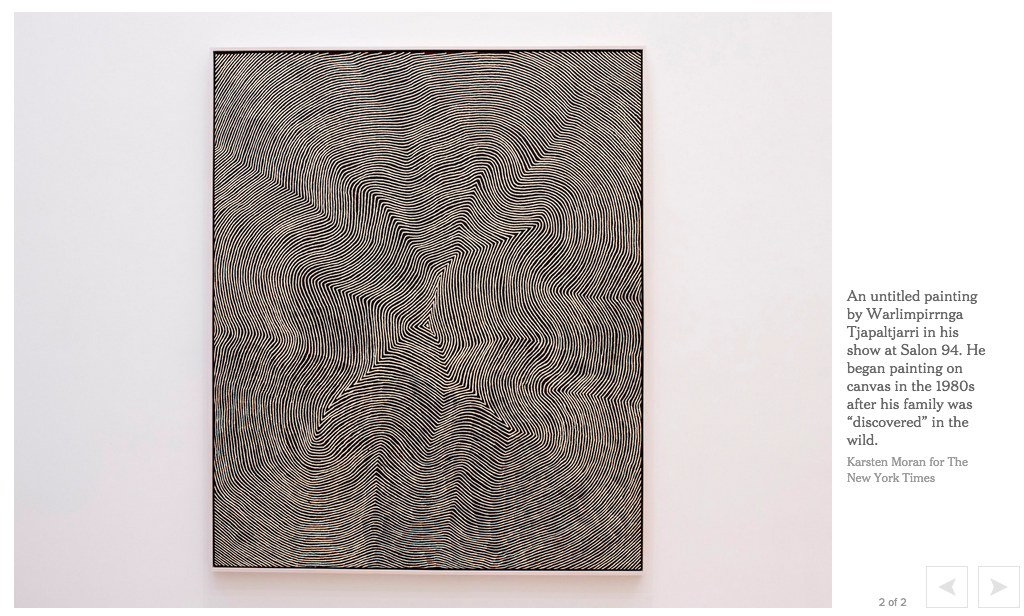
(gotta say I’m more into the newer stuff).
Here is a good article about the Pintupi Nine from The Australian:
The Pintupi Nine were certainly the last major group to come in, and enjoy a certain celebrity status in Kiwirrkurra that Warlimpirrnga in particular seems happy to trade on. During our interview in his front yard he told a fanciful story of going to New York and hunting rabbits with a boomerang; I was later assured he has never travelled outside Australia.
Welp, now he has:
Dressed in jeans, a checked shirt, Everlast tennis shoes and a black cowboy hat that would have been right at home at Gilley’s nightclub in Houston in the ’70s, Mr. Tjapaltjarri said through an interpreter that he was enjoying the attention his paintings were receiving but that the city itself was a little intimidating. He liked the subway, but the Top of the Rock at Rockefeller Center not so much.

Reading about all this led me to the Wiki page for Aussie anthropologist Donald Thomson, which has this great line:
Thomson lived with the Pintupi, and liked them, through much of the 1950s and 60s.
Maybe on their tour of Australia Dave and Little Esther will have a chance to check out Lake Mackay:

photo by “Viking” found here: http://www.panoramio.com/photo/100106
Office Life!
Posted: September 17, 2015 Filed under: America Since 1945 Leave a comment
From the wikipedia page for “office” — The Division of Classification and Cataloging, National Archives, 1937.
Embracing office life today. Two episodes from lunch:
- Kathy singing “What is lunch?” to the tune of “What is love?”
- A guy in the elevator asking aloud, “is it Friday yet?” I laughed way too hard. Then he said “it is in Australia!”
Entrepreneurs in Italy
Posted: September 16, 2015 Filed under: America Since 1945, Italy Leave a comment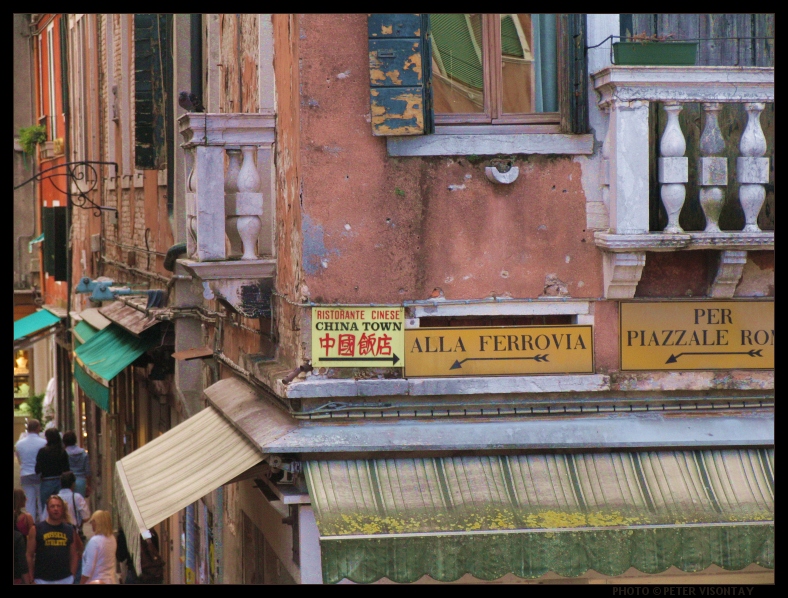
Photo of a Chinese restaurant in Venice by Peter Vistonay found here: http://www.earth-photography.com/Countries/Italy/Italy_Venice_Misc_Signs.html
from this convo between Tyler Cowen and Italian economist Luigi Zingales:
COWEN: Here’s an article from Quartz. Let me read you the headline. Maybe you saw it from a few months ago. “The most common surnames of new entrepreneurs in Italy are Hu, Chen, and Singh.” If you look at Milan, you have to go through 20 names, and at number 20 is the Italian name Colombo for the most common or most frequent names of entrepreneurs.
Is this sustainable culturally, or is this Italy’s future, in essence, to be economically colonized the way parts of Southeast Asia have been by Chinese, Indians, Sikhs, whoever it may be. Maybe Germans.
ZINGALES: One friend of mine was saying that the demise of the Italian firm family structure is the demise of the Italian family. In essence, when you used to have seven kids, one out of seven in the family was smart. You could find him. You could transfer the business within the family with a little bit of meritocracy and selection.
When you’re down to one or two kids, the chance that one is an idiot is pretty large. The result is that you can’t really transfer the business within the family. The biggest problem of Italy is actually fertility, in my view, because we don’t have enough kids. If you don’t have enough kids, you don’t have enough people to transfer. You don’t have enough young people to be dynamic.
Here’s more from Luigi, predicting the coming of Trump and comparing him to Italy’s Berlusconi:
Trump and Berlusconi are remarkably alike. They are both billionaire businessmen who claim that the government should be run like a business. They are both gifted salesmen, able to appeal to the emotions of their fellow citizens. They are both obsessed with their looks, with their hair (or what remains of it), and with sexy women. Their gross manners make them popular, perhaps because people think that if these guys could become billionaires, anyone could. Most important is that both Trump and Berlusconi made their initial fortunes in real estate, an industry where connections and corruption often matter as much as, or more than, talent and hard work. Indeed, while both pretend to stand for free markets, what they really believe in is what most of us would label crony capitalism.
Berlusconi’s policies have been devastating to Italy. He has been prime minister for eight of the last ten years, during which time the Italian per-capita GDP has dropped 4 percent, the debt-to-GDP ratio has increased from 109 percent to 120 percent, and taxes have increased from 41.2 percent to 43.4 percent. Italy’s score in the Heritage Foundation’s Index of Economic Freedom has dropped from 63 to 60.3, and in the World Economic Forum Index of Competitiveness from 4.9 to 4.37. Berlusconi’s tenure has also been devastating for free-market ideas, which now are identified with corruption.
How can such a pro-business prime minister wreak havoc on the economy and on the idea of free markets? Because “pro-business” doesn’t necessarily mean “pro-market.” While the two agendas sometimes coincide—as in the case of protecting property rights—they’re often at odds. Market competition threatens established firms, which often use their political muscle to restrict new entries into their industry, strengthening their positions but putting customers at a disadvantage. A pro-market strategy, by contrast, aims to encourage the best business conditions for everyone. That’s in fact the opposite of what a real-estate tycoon wants: to keep competitors out and enhance the value of his own properties. By capturing (or more precisely, purchasing) the free-market flag in the same way one might acquire a business brand, Berlusconi likely has destroyed the appeal of the free-market ideal in Italy for a generation.
Reader Reax: Steve Albini
Posted: September 15, 2015 Filed under: music Leave a comment
One reader writes:
You don’t like Steve Albini? You realise he made all of the best albums of the 90’s from
Nirvana to nick cave and he has own band that have been playing for 20 years for the love of it.Their MO is that you can’t tap your foot along to any of their songs and then they fuck around. They play primavera every year for the love of it.
Listen to his band Shellac’s ‘prayer to god’, ‘squirrel song’ ‘dude, incredible’ and ‘end of radio’. Tap your foot. Listen to how much he takes the piss.
He made an entire album about surveyors for god’s sake.
I’m trying here.
Steve Albini
Posted: September 14, 2015 Filed under: business, music Leave a comment
I have pretty much zero interest in the kind of music Steve Albini plays but whenever I come across an interview or something with him, he always strikes me as remarkably clear-headed about the realities of making money as an artist.
Take this profile in Psychology Today (what?) by Michael Friedman:
“There are kind of two perspectives on business. One of them is that a business exists to make money for the investor class that has a stake in that business. That’s one perspective. So, from a stock-market perspective, from a shareholder perspective, from an investor perspective, that from any publicly held company’s perspective, the company’s reason to exist is to make money for those people,” he explained. “And if you’re not making money, you’re a failing company. If its share price doesn’t go up, then the company’s failing, whether you’re making a profit or not. The idea is that the fundamental reason for that company to be there is to make money.”
Albini contrasts this approach to how he runs his business. “From an entrepreneurial standpoint, from someone like me — someone who builds a business for a reason — the reason my company exists is to make recordings of music. And in so doing, every now and again we’ll turn a profit. But that’s not why we’re in business. We’re not in business so that we can make money. And there’s a pretty strong argument that most businesses that are not part of the public sphere, not part of the investment transaction or equity management or whatever, most businesses operate on that level,” he said.
“Like a bakery opens because a guy wants to make bread. A tavern opens because a guy wants to serve beer to people. That’s why people start businesses. It’s because they want to do something with their time. They want that enterprise to be how they spend their days. But from an academic standpoint or from an analytical standpoint or from the standpoint of publicly held companies and investment class and everything, the reason the company started is meaningless. All they want to know is the share price going up. And for people like me that seems insane.”
“It’s like defining a marriage by the size of the house it occupies as opposed to defining the marriage by the love between two people and the life they build for themselves and the experience they share as part of the marriage. That’s the difference between the people who don’t get it (that you’re talking about), business people who can’t seem to buy into the greater culture of their business, and entrepreneurs, who started the business because the business itself means a lot to them.
“And there’s literally no way you can turn the second type of businessman into the first type. If somebody is hired to run a company and that company has investors who have expectations, then it is already impossible for that company to mean more to the employees as a concept than a paycheck. Because the value of the company has already been defined by the investor class. Now it is possible for somebody to start as an entrepreneur and then eventually sell off his company into the publicly held market and then he’s transformed from an entrepreneur into that second type of businessman. But it’s literally impossible to go the other way.”
I am a little baffled as to how this guy is, as he says, broke. More:
“Selfishness and greed are among the first things that we are instructed against as children. Like, ‘Don’t be selfish; share with your sister’ or whatever. And I feel like abandoning that principle when it’s money rather than gummy bears involved is fucking ridiculous.”
Albini takes heart that he is not alone: Other artists who have followed in a similar path. He explains: “There’s a Dutch band called The Ex who are an absolute inspiration. They’ve been going for 30 years now. And they originally started as sort of a squatter punk band in the squats in Amsterdam. And they have since built a sustainable, durable career, extraordinary body of work. They’ve been all over the world. They’ve made records with pop musicians and traditional musicians from Ethiopia. They’ve toured every flat spot on the globe. And they’ve all bought homes and raised families and all that sort of stuff — and all of it done in a very natural, very sustainable, very ethical way. They’re not a household name.”
“That’s the difference. If you want to be a household name, you kind of have to participate in the rock-star world of things where you’re either going to be a superstar or you’re going to be nobody. If you just want to play music for the rest of your life, that’s a completely attainable goal,” he said.

Superhenge?
Posted: September 9, 2015 Filed under: Life Leave a comment
from The Boston Globe.
They’d never checked for other henges two miles from Stonehenge?
See previous Helytimes coverage of prehistoric monoliths.
Reality can be hacky!
Posted: September 9, 2015 Filed under: America, America Since 1945 Leave a comment
Reading this Jeffrey Goldberg article about Angola prison.
If you tried to come up with a name for a Louisiana prison warden, and you came up with Burl Cain, you would chide yourself for being a little “on the nose.”
Nothing to be ashamed about
Posted: September 7, 2015 Filed under: New England Leave a commentA New England correspondent sends us this one:
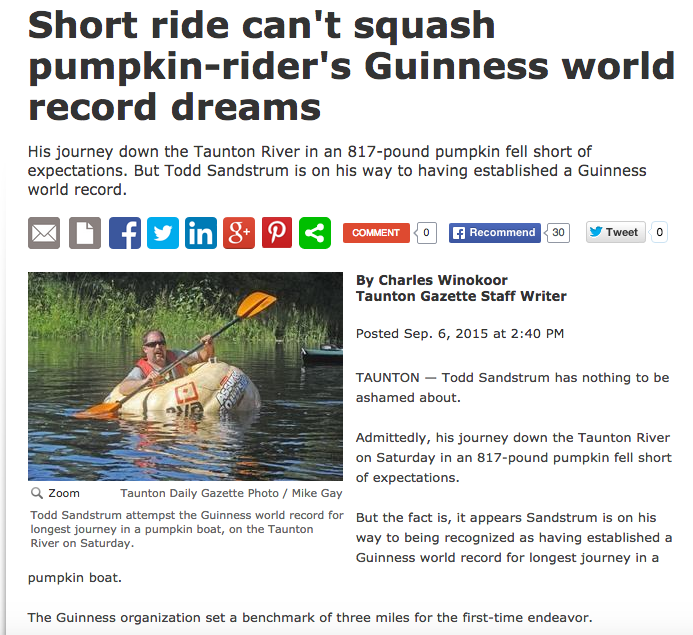
McKinley
Posted: August 31, 2015 Filed under: heroes, mountains, presidents Leave a comment
What with the news being abuzz with Mount McKinley fuss, really enjoyed this, from former Army Ranger Andrew Exum’s Twitter:

Here it is:


A Fuck You Ode To Flowers
Posted: August 28, 2015 Filed under: the California Condition Leave a comment
Walking down the street in the crazy heat recently I stopped into this spot to get some shade. A beautiful place! Here’s what was going on inside:
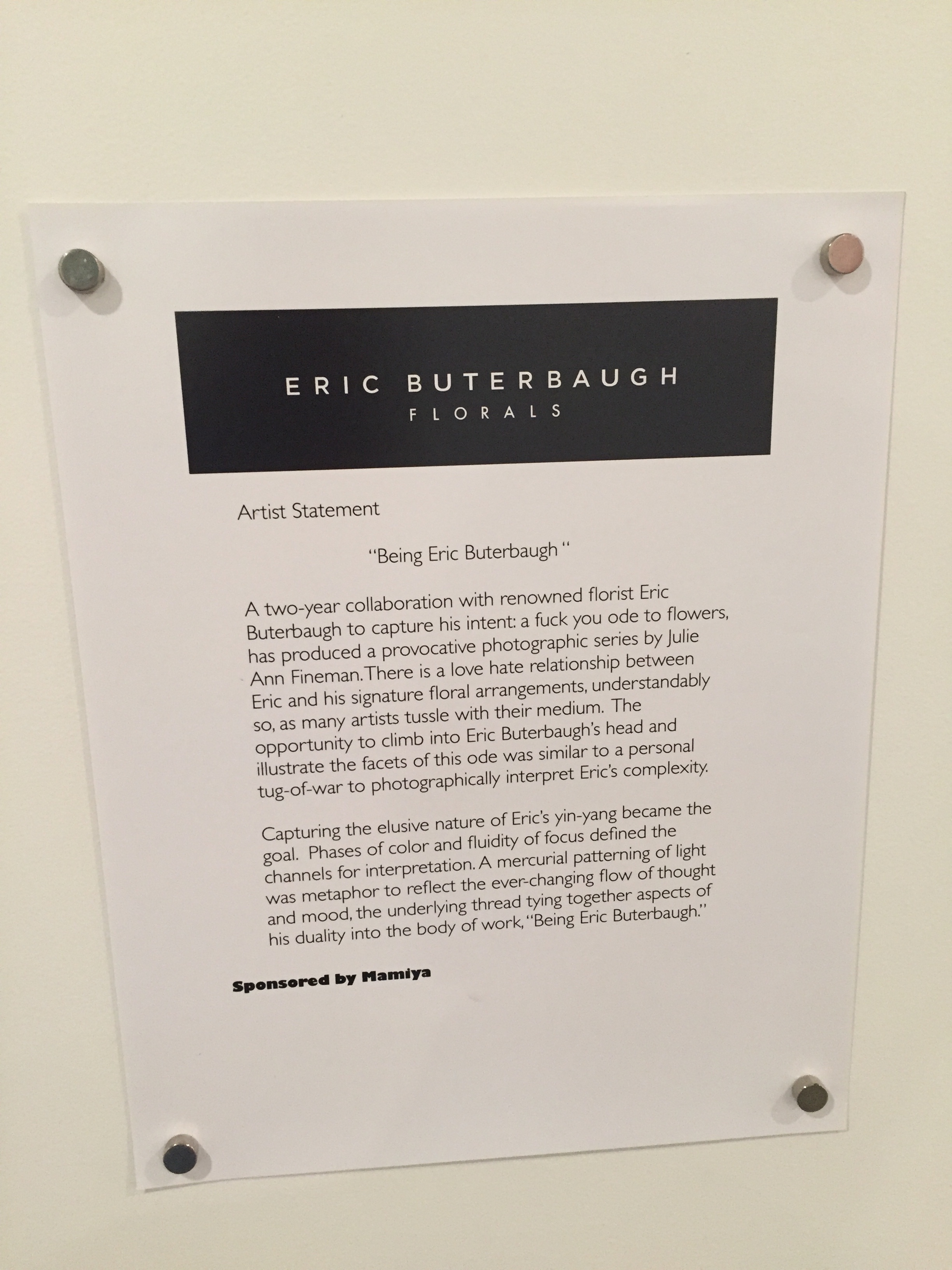
What do you guys think? Was it a successful fuck you ode?:

Story about what it was like to live in a house with John Quincy Adams
Posted: August 25, 2015 Filed under: Boston, New England, politics 3 Comments
John Quincy Adams isn’t our most cinematic president, but Anthony Hopkins does a grand old job playing him in Amistad.
(Never forget that McConaughey was in Amistad, by the way:
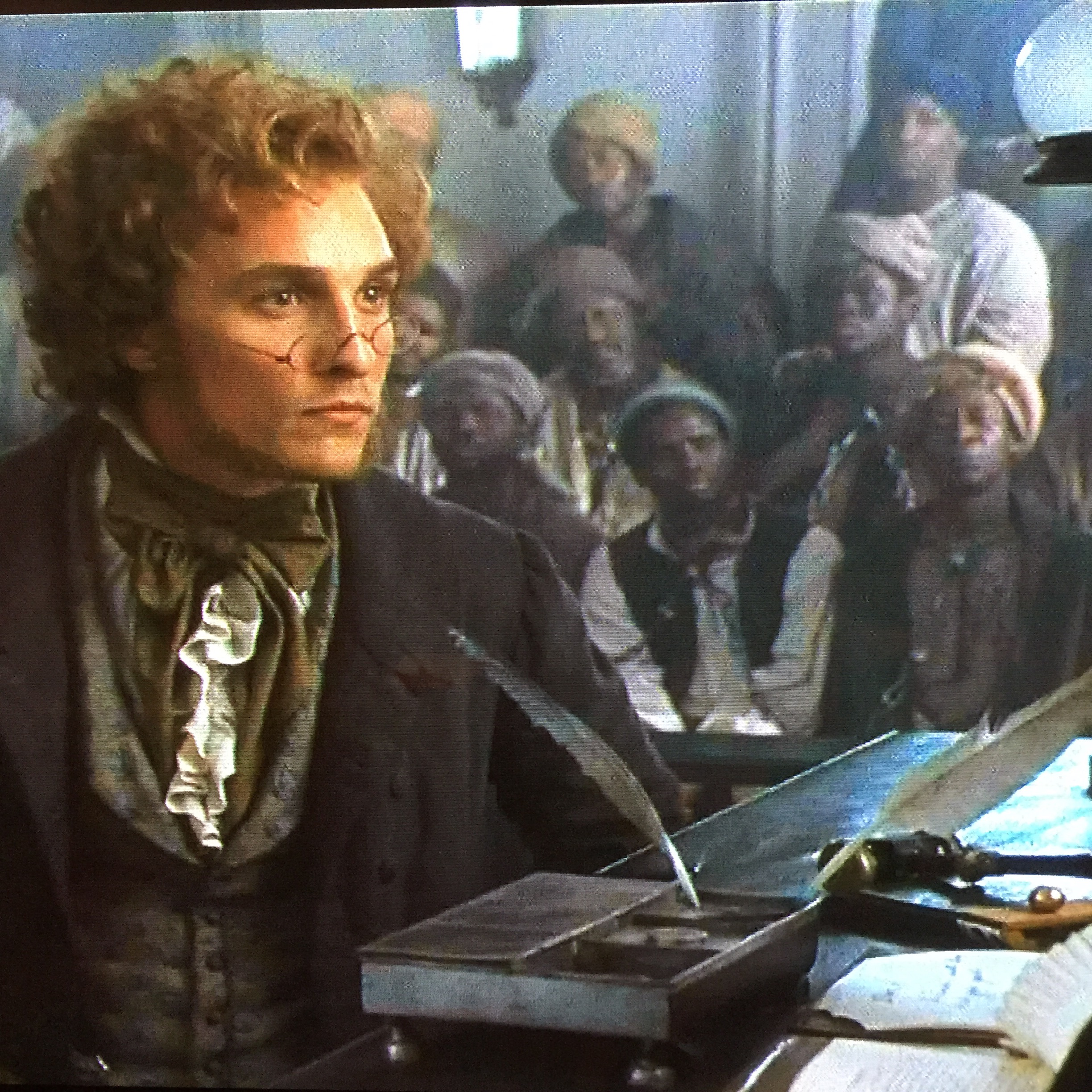
)
Now, if you ask me (nobody did) Amistad doesn’t totally nail it as a movie, because the courtroom battle, instead of being about the rightness or wrongness of slavery, ends up coming down to like some points of international and maritime law. But there’s a great speech by JQA, seen here starting at minute 1:30, about telling a story:
Recently I picked up recently Paul Johnson’s The Birth Of The Modern, a book I’d been seeing on distinguished bookshelves for years, with that great cover art by CDF:

What an absolute boss of a book, one of the highest interesting-information-per-page books I’ve ever come across. How did Paul Johnson write it, on top of everything else he was up to? From PJ’s Wikipedia page:
The following year, he attacked Ian Fleming’s James Bondnovel Dr No and in 1964 he warned of “The Menace of Beatlism” in an article contemporarily described as being “rather exaggerated” by Henry Fairlie in The Spectator.
Johnson started out as kind of a lefty it appears, but he’d end up working for Margaret Thatcher:
“‘I was instantly drawn to her,’ he recalls. ‘I’d known Margaret at Oxford. She was not a party person. She was an individual who made up her own mind. People would say that she was much influenced by Karl Popper or Frederick Hayek. The result was that Thatcher followed three guiding principles: truthfulness, honesty and never borrowing money.'”
Speaking of not a party person, Johnson has a great description the odd couple times that were had when John Quincy Adams, John Calhoun, and James Ashton Bayard went to negotiate the treaty that would end the War Of 1812.
Seems JQA could come off as a bit of a pill:


Imagine referring your bros to Martens, Book vii, chapter 55, section 3!
Poor guy. JQ was probably just trying to live up to his dad, who was no slouch either. Van Wyck Brooks sums up Adams The First in a footnote in The Flowering Of New England:

They don’t make ’em like they used to.
Miracle Man by Bob Carpenter
Posted: August 22, 2015 Filed under: music, Texas | Tags: Helys Leave a comment
in honor of cousin’s birthday, she put me on to this one.
Very positive way to spin the death of Tiffany 2
Posted: August 15, 2015 Filed under: America Since 1945, animals, cats Leave a comment
from the Guinness Book of World Records, exciting news from Oregon:

Professor James McHugh sends us a good one
Posted: August 13, 2015 Filed under: heroes, writing Leave a comment
Just a modest little book. That’s from The Diary of Abraham De La Pryme, the Yorkshire Antiquary. Prof. McHugh suggested reading pages 20-29, which I did and enjoyed. Some highlights:

And how about this?:


Newton
Coming soon: a review of a book about cricket!
Hole
Posted: August 11, 2015 Filed under: history Leave a comment
from this bit about an ancient Mediterranean monolith. Look you guys know I love monoliths but this one is failing to get me too excited.
Let’s Go Hiking!
Posted: August 10, 2015 Filed under: the American West, the California Condition Leave a comment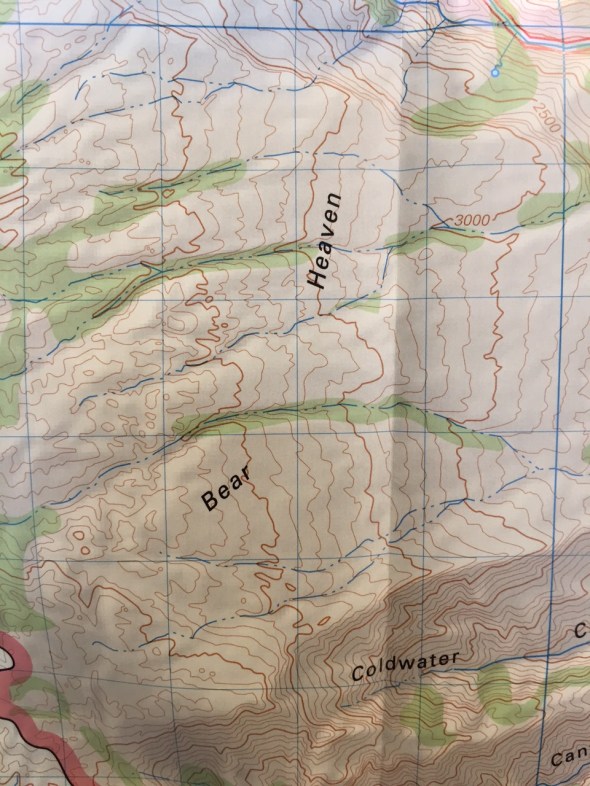
That’s a Tom Harrison map of course: http://www.tomharrisonmaps.com/
(check out this great photo of Bear Heaven on Mr. David Stillman’s blog)
 But be careful, you don’t want to get partially consumed.
Reader Matt W. writes: “Bear Heaven is people hell!”
Good things about True Detective
Posted: August 10, 2015 Filed under: actors, America Since 1945, the California Condition Leave a commentSomething was cheesing me off last night about critics on Twitter piling on to this show. I mean, I guess that can be fun, I’ve been guilty of it myself. But, also, what the hell? You try making a TV show.
Sure, it didn’t make all the sense in the world. But it’s hard to make good stuff. I guess it’s worthwhile to explore why something doesn’t land, so you can think about how to make better stuff. But what’s the point of ongoing negative criticism, especially when attention is at such a scarcity relative to content? There’s so much TV out there, if you don’t like something shouldn’t you just skip it and talk about something you do like?
Anyway, I watched every episode of the show and here are some things I enjoyed. 
- Rachel McAdams wears very comfortable-looking hoodies/sweatshirt
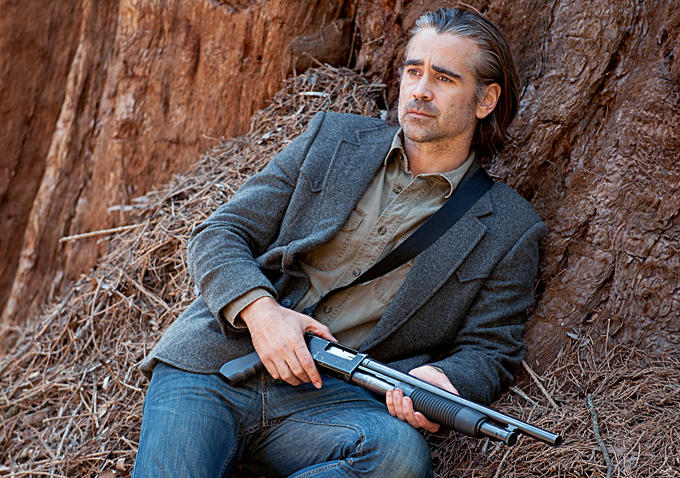
 Colin Farrell did a very good job I thought.
- I liked seeing the redwoods
- It was big and ambitious
- It was about secret evil/darkness/power/corruption at the heart of southern California, which is worth thinking about
- It was so unrelentingly bleak in a way that had to be a kind of pulpy choice, which is an interesting thing to do.
- I liked the way the girls were dancing in the shots of Venezuela
- The aerial footage of California was cool.
Archibald MacLeish
Posted: August 10, 2015 Filed under: America Since 1945 Leave a comment
Knew both Ernest Hemingway and Bob Dylan.
Was Laura Dern’s great-great-uncle.

 Helytimes