Napoleon meets Metternich
Posted: January 6, 2021 Filed under: politics Leave a commentIn the course of a face-to-face meeting in Dresden in June 1813, Metternich, by now the Austrian foreign minister, reminded Napoleon of the appalling human cost of his wars. ‘In ordinary times,’ Metternich observed, ‘armies are formed of only a small part of the population. Today it is the whole people that you have called to arms.’ This was a matter also of ‘future generations’, he remarked, in reference to the extreme youth of many in the latest cohort of recruits who had perished on the Russian campaign. Napoleon made an extraordinary reply. ‘You are no soldier,’ he barked, ‘and you do not know what goes on in the soul of a soldier. I was brought up in military camps, I know only the camps, and a man such as I am does not give a fuck about the lives of a million men’ – ‘un homme comme moi se f(out) de la vie d’un million d’hommes.’ Metternich sometimes wondered how Napoleon did not shrink from himself in horror at the pain and injury he had inflicted. Here was the answer. A lasting peace with such a man was not possible. That the Napoleon who turned up to meet Metternich the day after this chilling exchange was the soul of amiability and charm merely confirmed his intuition.
The Napoleon whom Metternich came to know resembled a Calabrian crime boss: tender to the point of indulgence with his family, formidably shrewd and utterly pitiless in his dealings with the wider world.
Must the history-makers be psychos? Reminded of the scene in Oliver Stone’s Nixon:


Ishiguro meets the Queen Mother
Posted: January 5, 2021 Filed under: UK, writing Leave a commentINTERVIEWER
It says in your biographies that you were a grouse beater. Please explain.
ISHIGURO
My first summer after leaving school I worked for the Queen Mother at Balmoral Castle, where the royal family spend their summer holidays. In those days they used to recruit local students to be grouse beaters. The royal family would invite people to shoot on their estate. The Queen Mother and her guests would get into Land Rovers with shotguns and whiskey and drive over bits of the moor from shooting butt to shooting butt. That’s where they would aim and shoot. Fifteen of us would walk in formation across the moor, spaced about a hundred yards apart in the heather. The grouse live in the heather, and they hear us coming, and they hop. By the time we arrive at the butts, all of the grouse in the vicinity have accumulated and the Queen Mum and her friends are waiting with shotguns. Around the butts there’s no heather, so the grouse have got no choice but to fly up. Then the shooting starts. And then we walk to the next butt. It’s a bit like golf.
INTERVIEWER
Did you meet the Queen Mother?
ISHIGURO
Yes, quite regularly. Once she came round to our quarters, frighteningly, when there was only me and this other girl there. We didn’t know what on earth to do. We had a little chat, and she drove off again. But it was very informal. You’d often see her on the moors, though she herself didn’t shoot. I think there was a lot of alcohol consumed and it was all very chummy.
from his Paris Review interview. How about this?
I was at a writers’ festival in Australia, sitting on a beach with Michael Ondaatje, Victoria Glendinning, Robert McCrum, and a Dutch writer named Judith Hertzberg. We were playing a semi-serious game of trying to find a title for my soon-to-be-completed novel. Michael Ondaatje suggested Sirloin: A Juicy Tale. It was on that level. I kept explaining that it had to do with this butler. Then Judith Hertzberg mentioned a phrase of Freud’s, Tagesreste, which he used to refer to dreams, which is something like “debris of the day.” When she translated it off the top of her head, it came out as “remains of the day.” It seemed to me right in terms of atmosphere.
Top 8 of 2020
Posted: December 27, 2020 Filed under: America Since 1945 Leave a comment
We’re pleased with our small, distinguished, growing audience. These were our most popular posts of the year.
about how JFK spent the night before the 1960 Wisconsin primary. Somebody wrote in to correct me that the movie in question was more like “sexploitation” than porn, but “porno” is the word Bradley used.
grateful this year that we got a chance to see Chaco Canyon, walking the site only increased the fascination
One Two Three Four: The Beatles In Time by Craig Brown.
The book has been released here as 150 Glimpses of the Beatles. What’s great about Craig Brown is that he goes to the sources, the primary sources, and tells you not just the details of the incident, but the historiography, the story of the story.
always a popular top.
another inspiration. Got a beautiful note from Vickers’ daughter which was really touching, glad we could add to the information available about this remarkable man.
The Wanderer’s Hávámal by Jackson Crawford
Glad to be introduced to this stunning work in a readable translation. Why not let the Norse gods advise you on how to conduct yourself when you travel?
This is just an image we found somewhere else, it’s illuminating.
Couple others that found their way: Marilyn Monroe gossip, How to Read A Racing Form, and Conversations With.
We had a nice guest post this year, Founding Documents by Billy Ouska. We’d love to have more of those in 2021.
Hope you’re all keeping well and safe.
Processing
Posted: December 27, 2020 Filed under: business Leave a comment
SF: Most of our businesses have more in common than might meet the eye. We take some form of commodity and we’ll process it through a very, very large plant that requires sophisticated technology and analysis to ensure that we have a competitive advantage and a capability to go to market in scale. Then we’ll optimize around that processing or manufacturing process because there is raw material risk, commodity risk, and counterparty risk.
We also have the capability to be very efficient and effective from a cost perspective and the capability to constantly innovate because the technology changes in these big plants. We must be adaptable to ensure that we don’t fall from the first quartile to the second, third, or fourth quartile in cost advantage.
Our other core capabilities besides innovation and operations excellence are Market-Based Management®; trading; transaction excellence; and public sector, which encompasses legal, communication, community relations, and government relations.
So, whether it’s crude oil going into refined products, natural gas going into fertilizer, naphtha going into chemicals, trees going into pulp, metals going into our manufacturing businesses — each of these businesses fit the capabilities described above.
fascinated by this interview with Steve Feilmeier, CFO of Koch Industries (from Graham & Doddsville).
I don’t agree with the Kochs on politics but I have wiped my ass with their toilet paper.
Stagolee Shot Billy
Posted: December 25, 2020 Filed under: Mississippi, music, Nick Cave Leave a comment
In a St. Louis tavern on Christmas night in 1895 Lee Shelton (a pimp also known as Stack Lee) killed William Lyons in a fight over a hat. There were other murders that night, but this one became the stuff of legend. Songs based on the event soon spread out of whorehouses and ragtime dives across the country. Within 40 years, Stagolee had evolved into a folk hero, a symbol of rebellion for black American males. With commendable scholarship and thoroughness, Brown shows how we got from the murder to the myth.
so says Leopold Froehlich in Playboy, quoted on the book’s back cover. I’ve been curious about this book since I first heard about it, finally pulled the trigger. Just that a book like this exists brings joy.
The murder was around 11th and Morgan in St. Louis, which today looks like this:

Should it be a UNESCO site? Paired perhaps with another St. Louis place of myth and violence, Cahokia?
The power of “Christmas Carol”
Posted: December 22, 2020 Filed under: writing 2 Comments
Was there ever a better charity sermon preached in the world than Dickens’s “Christmas Carol”? I believe it occasioned immense hospitality throughout England; was the means of lighting up hundreds of kind fires at Christmas time; caused a wonderful outpouring of Christmas good feeling, of Christmas punch-brewing; an awful slaughter of Christmas turkeys, and roasting and basting of Christmas beef. As for this man’s love of children, that amiable organ at the back of his honest head must be perfectly monstrous. All children ought to love him. I know two that do, and read his books ten times for once that they peruse the dismal preachments of their father. I know one who, when she is happy, reads “Nicholas Nickleby”; when she is unhappy, reads “Nicholas Nickleby”; when she is tired, reads “Nicholas Nickleby”; when she is in bed, reads “Nicholas Nickleby”; when she has nothing to do, reads “Nicholas Nickleby”; and when she has finished the book, reads “Nicholas Nickleby” over again. This candid young critic, at ten years of age, said, “I like Mr. Dickens’s books much better than your books, papa”; and frequently expressed her desire that the latter author should write a book like one of Mr. Dickens’s books. Who can? Every man must say his own thoughts in his own voice, in his own way; lucky is he who has such a charming gift of nature as this, which brings all the children in the world trooping to him, and being fond of him.
so said William Makepeace Thackeray, arguing for a connection between humorous writers and “the sweet mission” of love and tenderness, in his 1852 speech “On Charity and Humor.”
A footnote adds:
Note 2. This generous tribute to Dickens, at the time of the greatest rivalry between him and Thackeray, has been much admired and often quoted to Thackeray’s credit.
The jackrabbit
Posted: December 20, 2020 Filed under: animals, art history, California, the American West, the California Condition Leave a comment
Word went out on the community message board that people were finding dead jackrabbits. Healthy looking jackrabbits that appeared to have just dropped dead. There was a plague going around. A jackrabbit plague. RHD2. Rabbit hemorrhagic disease two. The two distinguishes it from original RHD. Bad news, a plague of any kind. Sure enough, a few days later, I saw on the remote camera on the back porch of my cabin out in the Mojave a bird picking at what looked like the muscles and bones of what used to be a jackrabbit.
I drove out there, and found that yes indeed, this had been a jackrabbit. Whether it had died of plague, I don’t know, it seemed possible. I bagged it for disposal, and poured some disinfectant on the ground, as recommended by the California Department of Fish and Wildlife.
The next day, I found another dead jackrabbit. This jackrabbit did not appear to have been hurt in any way. Her eye was open to me. This jackrabbit appeared to have gone into the shade and died. There was no visible trauma and no blood. I didn’t want to get too close, but this was the best chance to examine a jackrabbit, up close and at rest, that I’d ever had. Usually the jackrabbits are fast and on the move. Once they sense you seeing them, they take off.
I won’t put a picture of it here, in case a picture of a dead jackrabbit would upset you. In a way the lack of damage and the animal’s beauty made it much more sad and eerie. It reminded me of Dürer’s drawing of a young hare. I read the Wikipedia page about Dürer’s drawing, which departs from the usual impartial tone to quote praise for the drawing’s mastery:
it is acknowledged as a masterpiece of observational art alongside his Great Piece of Turf from the following year. The subject is rendered with almost photographic accuracy, and although the piece is normally given the title Young Hare, the portrait is sufficiently detailed for the hare to be identified as a mature specimen — the German title translates as “Field Hare” and the work is often referred to in English as the Hare or Wild Hare.
Dürer’s drawing of a walrus is less acclaimed:

The drawing is generally considered as not successful; and is viewed as curious attempted depiction that is neither aesthetically pleasing nor anatomically true to life. Art historians assume the artist drew it from memory having viewed a dead example during a 1520 visit to Zeeland to see a stranded whale which had decomposed before his arrival. Referring to the depiction departure for nature, Durer’s animal has been described as “amusing…it looks more like a hairless puppy with tusks. When Dürer drew from life his accuracy was unquestionable, but he had only briefly seen a walrus, and had only fleeting memory and an elaborate verbal description from which to reconstruct the image”.
The jackrabbit is very similar to the European hare. The suggestion of the magical power of hares is a common theme in Celtic literature and the literature and folklore of the British Isles. We all remember the March Hare.
Most Americans are confused as to just what hares are, chiefly because we are accustomed to calling some of them jackrabbits. Biologically, the chief differences between hares and rabbits are that hares are born with hair and open eyes and can hop about immediately, while rabbits are naked, blind and helpless as birth.
I learned from this book:

which contains recipes for hares, including jugged hare, hasenpfeffer, and hare civit.

Of all the game animals you can hunt in California: elk, wild big, bear, turkey, bighorn sheep, deer, duck, chukar, dove, quail, the jackrabbit alone can be hunted all year round*. There is no season, and there’s no limit. On one of my first trips to California, I was taken out to the desert with the Gamez boys on a jackrabbit hunt. We only saw a few jackrabbits. Nobody got off a good shot at one. I doubt we really wanted to kill one, we just wanted to drive around the desert, shoot guns, and have fun, which we did very successfully.
During the pandemic I got my California hunting license, you could do it entirely online due to Covid restrictions. But I don’t intend to hunt jackrabbits, I don’t want to be like Elmer Fudd.

The meat is said to be quite dry, tough, and gamey. Most recipes call for long simmerings.
If you ever find out in the desert where you must hunt a jackrabbit for food, here’s the Arizona Game and Fish Department telling you how to butcher one.
* non-game animals, like weasels, you can go nuts
Politics and drama in ancient Athens
Posted: December 16, 2020 Filed under: actors, politics Leave a commentAll art has a political dimension, but tragedy actually began life in fifth-century Athens as a political institution, locked into the structures of the state. The authorities appointed an official to train and pay the Chorus, the city preserved play scripts in its archives, and there was a state fund which poor Athenians could draw on for the entry fee. Tragedy was a form of ethicopolitical education for the city state as a whole, not just a night off for the toffs.
Wild. What if the US government paid for movie tickets? They probably should! We were pretty close to a merger like this during World War II I suppose, when they’d show the GIs Mrs. Miniver and stuff.
That’s Terry Eagleton reviewing A Cultural History of Tragedy: Vols I-VI edited by Rebecca Bushnell in LRB back in February. Cleaning out my files!
Göpeti Tepli, Askili Höyük, and Chaco Canyon
Posted: December 15, 2020 Filed under: archaeology, native america, New Mexico Leave a comment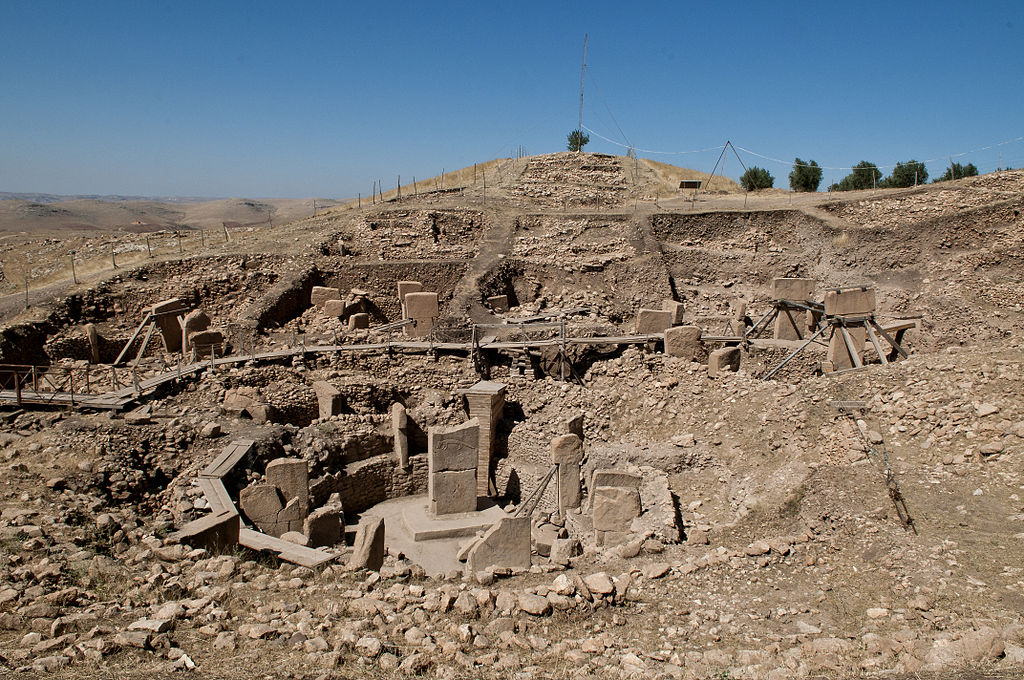
Reading up on some of these Turkish archaeological sites. Göbekli Tepe is sometimes described as “the world’s oldest town,” but it may have been more like a ritual site that people went to sometimes, rather than lived in all the time. I’m not totally up on recent archaeological literature about the sites, but they seem to have been something more like seasonal or periodic gathering places. This was around 9,000 BCE.

Askili Höyük, similar deal.
People who were still hunter gatherers, or at least semi-nomadic, would gather seasonally or sometimes at these places, to build, do ceremonies maybe, and party.
The time frame is completely off, but I wonder if the concept of these sites can be applied to Chaco Canyon, in what’s now New Mexico, which was peaking in around 900 AD.

Steve Lekson, who wrote several books on Chaco and the ancient Southwest, suggests Chaco was more permanent, something like a Mesoamerican city state.
Jared Diamond, in Collapse, presents Chaco in “city” terms as well.
But what if it was more like the playa of Burning Man than like Chichen Itza or Teotihuacan?

If it wasn’t a city, but a ceremonial/festival/party location for people who were still semi-nomadic?
Or what if it were a city, but one like Las Vegas, with locals who ran the place but a big, shifting population of tourists?

What if there’s a stage between “primitive hunter gatherer bands” and “agricultural early cities” that’s like “semi agricultural nomads who occasionally meet to party”? Just musing!
Empire States of Mind
Posted: December 15, 2020 Filed under: America Since 1945, economist, New York Leave a comment
Peter Thiel cites the fact that the Empire State Building was built in 15 months as a sign that maybe our society has stagnated. Can we build things any more? Why not?
I’ve wondered if part of the answer was the political power of Al Smith, who was appointed head of Empire State Inc, and various other elements of the former Tammany/Democratic machine that controlled New York City at the time. An argument for the efficiency of political machines?
But what if the answer was: fairness?
The Empire State Building was constructed in just 13* months, and that included the dismantling of the Waldorf-Astoria hotel that sat on the site. Paul Starrett, the builder, treated his workers rather well by the standards of the time, paying much attention to safety and paying employees on days when it was too windy to work. Daily wages were more than double the usual rate and hot meals were provided on site.
The concept is known as “efficiency wages”. Companies that compensate workers well and treat them fairly can attract better, more motivated staff. Unlike most construction projects, the Empire State Building had low staff turnover, and workers suggested productivity improvements such as building a miniature railway line to bring bricks to the site.
That’s Bartleby in the Dec 12, 2020 Economist, reviewing a book called The Art of Fairness, by David Bodanis. Starrett was not “naively generous,” the article also notes. He checked worker attendance four times a day.
I’d kind of resolved to stop reading these books that are just collections of neat anecdotes under some big umbrella, but maybe I’ll make an exception here. Another example cited: Danny Boyle used thousands of volunteers for the 2012 London Olympic Ceremonies, but he also had to keep details of the show secret:
The conventional approach would have been to make the volunteers sign a non-disclosure agreement. Instead, he asked them to keep the surprise – and trusted them to do so. They did, thanks to the grown up way he treated them.
Also in this week’s Economist, Buttonwood reports on a study in India:
The study’s main finding is that retail investors who were randomly allocated shares in successful IPOS view their good fortune as evidence of skill.
* note the revision to Thiel’s figure
Layers of Christmas songs
Posted: December 12, 2020 Filed under: music Leave a commentBy 1958, when Brenda Lee is singing “Rockin Around The Christmas Tree,” we have a Christmas song that’s playing on the existing corpus of Christmas music. “Let’s rock up those old Christmas classics,” is the theme of a song from sixty years ago.
In 1957, Elvis sings “Blue Christmas,” already playing on “White Christmas,” a song from 1940.
Accounts vary as to when and where Berlin wrote the song. One story is that he wrote it in 1940, in warm La Quinta, California, while staying at the La Quinta Hotel, a frequent Hollywood retreat also favored by writer-director-producer Frank Capra, although the Arizona Biltmore also claims the song was written there. He often stayed up all night writing. One day he told his secretary, “I want you to take down a song I wrote over the weekend. Not only is it the best song I ever wrote, it’s the best song anybody ever wrote.”
The Charlie Brown Christmas Special aired in 1965. If you saw it as a ten year old, you are now eligible for Social Security.
Schulz was adamant about Linus’ reading of the Bible, despite Mendelson and Melendez’s concerns that religion was a controversial topic, especially on television. Melendez recalled Schulz turned to him and remarked, “If we don’t do it, who will?”. Schulz’s estimation proved accurate, and in the 1960s, less than 9 percent of television Christmas episodes contained a substantive reference to religion, according to university researcher Stephen Lind. It could also be worth noting that Linus’s recitation of Scripture was incorporated in such a way that it forms the climax of the film, thus making it impossible to successfully edit out.
Just musing on both the meta quality of Christmas music and the accruing of material in a way that is both comforting and emotionally potent.
It has often been noted that the mix of melancholy—”just like the ones I used to know”—with comforting images of home—”where the treetops glisten”—resonated especially strongly with listeners during World War II. A few weeks after the attack on Pearl Harbor, Crosby introduced “White Christmas” on a Christmas Day broadcast. The Armed Forces Network was flooded with requests for the song. The recording is noted for Crosby’s whistling during the second chorus.
Already we’re deep in nostalgia.
The poetry in some of these songs:
So I’m offering this simple phrase
To kids from one to ninety two
And of course, most powerful:
Someday soon we all will be together
If the fates allow
Until then, we’ll have to muddle through somehow
So have yourself a merry little Christmas now
The Coen Brothers Interviews
Posted: December 12, 2020 Filed under: advice, film, movies 3 Comments
If you’re out in Hollywood, you probably have a relationship with the movies. Even just at the most basic level, the movie theaters are better here. There are the big movie palaces, Grauman’s Chinese and all that, for special occasions, and The Aero and the Egyptian, but just for everyday moviegoing, I’ll take the Arclight over any place I went to in New York City. There’s now an Arclight in Boston, and a few elsewhere, but man, when I first got to LA I was like OK, here’s how to see a movie.
Of course, you may think you’re pretty into movies, and then you dive in and realize, whoa, some of these people are into movies. I remember hearing a talk by Steve Zalian at some Writers Guild thing where he mentioned he’d seen Serpico ninety times. Doesn’t appear to be online, but there’s a 2014 Playboy interview with David Fincher where he talks about movies he’d seen a hundred times or so. Listen to Brad Pitt and Leo on Maron talk about watching movies with Quentin Tarantino.
You’re liable to be quickly humbled as just a movie fan once you encounter the level of movie fan out here. Some people make their whole identity as film enthusiasts and amateur or semi-pro critics. Not everyone who’s obsessed with movies is a big success at them:
INTERVIEWER
What happens to those girls, those aspiring starlets? Do they sit around in Schwab’s drugstore, or the Brown Derby, or whatever?
SOUTHERN
In the beginning, they come to Hollywood, presumably, with the idea of the action. Then they find out that you can’t even get into any of these buildings without an agent, that there’s no possibility of getting in, that even a lot of the agents can’t get in. Meanwhile a substitute life begins, and they get into the social scene, you know. They’re working as parking attendants, waitresses, doing arbitrary jobs . . .
INTERVIEWER
Hoping that somebody will see them?
SOUTHERN
Finally they forget about that, but they’re still making the scene. They continue to have some vague peripheral identification with films—like they go to a lot of movies, and they talk about movies and about people they’ve seen on the street, and they read the gossip columns and the movie magazines, but you get the feeling it’s without any real aspiration any longer. It’s the sort of vicariousness a polio person might feel for rodeo.
Terry Southern, talking to The Paris Review. Not clear what year that interview was conducted, certainly well before 1995, when Southern died.
I’d been obsessing over the Conversations With Writers series from the University Press of Mississippi. Browsing their website, I saw they had a whole Conversations With Filmmakers series. The website had a spot where you could request a review copy, so I asked for a review copy of The Coen Brothers Interviews, and Courtney at UP of Miss very kindly sent me one.
These books take the form of collections of interviews published elsewhere. There are 28 in this case, including a transcript of a Terry Gross interview, an Onion A.V. Club interview with Nathan Rabin, a Vogue profile (? was Vogue different in 1994) by Tad Friend. The interviews are often keyed to a particular movie out or in production at the time of the piece. This volume came out in 2006, and the last two short pieces, more articles than interviews, are focused on the soon to be released The Ladykillers.
There’s a thoughtful introduction as well by William Rodney Allen, who explores in particular and appropriately enough the connection the brothers have to the Mississippi Delta, as seen in O Brother Where Art Thou. I was surprised to learn from this book that Miller’s Crossing was shot in New Orleans.
“We looked around San Francisco, but you know what that looks like: period but upscale – faux period,” says Ethan. Then someone suggested New Orleans, parts of which surprisingly fit the bill. Outside of the distinctive French Quarter, there were plenty of places that could pass for a generic Anytown in the late 1920s. “New Orleans is sort of a depressed city; it hasn’t been gentrified,” says Ethan. “There’s a lot of architecture that hasn’t been touched, storefront windows that haven’t been replaced in the past sixty years.”
The Coen Brothers don’t seem particularly interested in being interviewed. Don’t take my word for it:
We often resist the efforts of… people who are interviewing us to enlist us in the process ourselves. And we resist it not because we object to it but simply because it ins’t something that particularly interests us.
so says Joel in an interview with Damon Wise of Moving Pictures magazine, which itself isn’t reprinted in this book, but is quoted in a Boston Phoenix piece from 2001 by Gerald Peary which you will find here. True enough, in most of the conversations the Coens seem game enough but not effusive, and the interviewers or profilers often have to do a bit of legwork themselves to find some meat. They ask why Hudsucker Proxy wasn’t more successful (“I dunno, why was Fargo not a flop?” replies Joel. “It’s as much a mystery to me that people went to see Fargo, which was something we did thinking ah, y’know, about three people will end up seeing it, but it’ll be fun for us”). They ask why the brothers are drawn to James M. Cain (“what intrigues us about Cain is that the heroes of his stories are nearly always schlubs – loser guys involved in dreary, banal existences,” says Joel, again).
One aspect of their career I hadn’t realized before I read this book was Joel’s relationship with Sam Raimi, who gave him a job as an assistant editor on Evil Dead.
Raimi had remarked that the Coens have several thematic rules: The innocent must suffer; the guilty must be punished; you must taste blood to be a man… Joel and Ethan shrugged, separately.
Barry Sonnenfeld was their first director of photography, I also hadn’t known that, perhaps common knowledge to true Coenheads.
In terms of moviemaking secrets, how to get them made, without interference and while maintaining a vision, as the Coens so consistently have, this might be the closest we come. Joel once more, talking to Kristine McKenna for Playboy, 2001:
Our movies are inexpensive because we storyboard our films in the the same highly detailed way Hitchcock did. As a result, there’s little improvisation. Preproduction is cheap compared with trying to figure things out on a set with an entire crew standing around.
Amazon has a couple other glitzier books on the Coens. This book is more raw data than polished product. Sometimes the interviews cover similar turf, or bore down on the specifics of some upcoming project. To me, I find you get a great deal from going to the source. Going to the source is a theme of Helytimes. This book is really a sourcebook, and that’s very valuable.
If not the Coens, perhaps another in the Conversations with Filmmakers series. There are 105! Errol Morris? David Lynch? Jane Campion? I’d like to read all of them, if I had but the time!
In my opinion, a book review should 1) give you some summary, basic idea, and nuggets of insight from the book and 2) give you enough info to know whether you should buy it or not.
I hope I’ve done that for you!
BJ and Ursula
Posted: December 10, 2020 Filed under: food, politics Leave a comment
Struck by how much the visuals of these two, Boris Johnson and EU president Ursula von der Leyen, look like a Black Mirror version of Trump and Hillary.
The group dined on a starter of pumpkin soup with scallops; a main of steamed turbot, mashed potatoes with wasabi and vegetables; and a desert of pavlova with exotic fruit and coconut sorbet. It was fitting that fish featured on the menu, given arrangements for fisheries is one of three outstanding sticking points in the trade talks, and particularly scallops, which were the subject of clashes between British and French fishermen in 2018.
source. Love the idea of pointedly serving someone fish.
Ursula von der Leyen is interesting. She has seven children? And maybe plagarized her doctoral thesis?
Von der Leyen’s father’s grandparents were the cotton merchant Carl Albrecht (1875–1952) and Mary Ladson Robertson (1883–1960), an American who belonged to a plantation owning family of the southern aristocracy from Charleston, South Carolina. Her American ancestors played a significant role in the British colonization of the Americas, and she descends from many of the first English settlers of Carolina, Virginia, Pennsylvania and Barbados, and from numerous colonial-era governors. Among her ancestors were Carolina governors John Yeamans, James Moore, Robert Gibbes, Thomas Smith and Joseph Blake, Pennsylvania deputy governor Samuel Carpenter, and the American revolutionary and lieutenant governor of South Carolina James Ladson. The Ladson family were large plantation owners and her ancestor James H. Ladson owned over 200 slaves by the time slavery in the United States was abolished; her relatives and ancestors were among the wealthiest in British North America in the 18th century, and she descends from one of the largest British slave traders of the era, Joseph Wragg.
Boris Johnson for his part has been getting away with stuff his whole life. As with the naughty schoolboys of my youth, I have a desire both to see him “caught” and punished and also to see him get away with it. He seems to thrive in the space where, like, a Dec 31 deadline looms, and there’s lots of technical details to work out, and he’s barely started.
Finally, some good news
Posted: December 6, 2020 Filed under: mountains Leave a comment
Eric Bellman, Krishna Pokharal, Xiao Xiao and Yin Yijun report for the Wall Street Journal that China and Nepal have agreed on an official height for Chomolungma aka Mount Everest:
China’s official height for Chomolungma—its Tibetan name for Everest—was 29,017 feet, from a 2005 survey. China used “rock height,” estimating where the peak lay under the snow.
Nepal has used a “snow height” of 29,028 feet for the peak it calls Sagarmatha, from a 1954 survey India did. That’s where people stand, atop the snow, and the measure is standard practice in most countries.
Wade Davis in his Into The Silence has some great stuff about the early surveying expeditions in this region. Carrying drafting tables on their backs into the Himalayas to meticulously calculate and record measurements.
The official new height has not been declared. I’d speculate it will be between 29,017 feet and 29,028 feet, maybe somewhere around 29,021 or 29,022 feet or 8,845 meters.
But the 2015 earthquake means there could be a surprise here!

San Bernardino by Edward Leo Lyman
Posted: November 30, 2020 Filed under: California Leave a comment
San Bernardino is a city (pop, 215, 941) and a county (pop. just over two million) east of Los Angeles (the city and the county).
County:

The county is close to the size of West Virginia.
In the southwestern section the county is urban, then there’s a band of wooded, alpine mountains and national forest, and Joshua Tree National Park, and on the western edge are some of the emptiest parts of the Mojave Desert, including the Mojave National Preserve.
City:

I’ve become reasonably well informed about the history of the central and western part of this county, but I know very little about the city of San Bernardino. Inspired by this Julia Wick thread on Twitter, I bought Edward Lyman’s book about the city.

Fascinating! Already I know more than I did!
After the Mormon exodus the city got itself on the expanded Atchison, Topeka and Santa Fe Railroad subsidiary line, the California Southern, and thus connected to the rest of the country and to Los Angeles.

Route 66 ran through San Bernardino. Richard and Maurice McDonald established their first hamburger restaurant there.
If I finish the book I’ll let you know.
Interested by this developing story
Posted: November 19, 2020 Filed under: politics Leave a commentabout a possible job for Pete Buttigieg in a Biden administration:
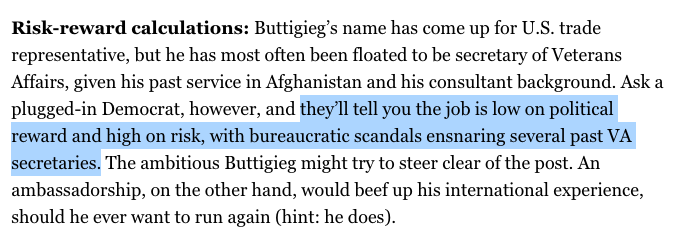
(from Politico, 10/22). Low on reward and high on risk. Sounds like a job for a hero who’s interested in taking on tough problems.
But it sounds like, reasonably enough, Buttigieg wants an easier, more fun job. From CBS:
Buttigieg, meanwhile, is under consideration for U.N. ambassador. Aides to the military veteran and former South Bend, Indiana mayor were told that some transition officials envisioned him serving as secretary of the Department of Veterans Affairs. But the mayor made clear, along with his team, his preference for representing the U.S. before the world body or in another Cabinet position, two people familiar with the Cabinet discussions explained. A representative for Buttigieg declined to comment.
One factor in picking a VA secretary will be finding someone with experience managing large organizations, according to people involved in the transition. The VA is one of the largest federal departments and one of the largest hospitals systems in the world, requiring management of hundreds of thousands of employees.
It’ll be interesting to see what happens!
E in P
Posted: November 17, 2020 Filed under: TV Leave a commentThe purpose of “Emily in Paris” is to provide sympathetic background for staring at your phone, refreshing your own feeds—on which you’ll find “Emily in Paris” memes, including a whole genre of TikTok remakes. It’s O.K. to look at your phone all the time, the show seems to say, because Emily does it, too. The episodic plots are too thin to ever be confusing; when you glance back up at the television, chances are that you’ll find tracking shots of the Seine or cobblestoned alleyways, lovely but meaningless. If you want more drama, you can open Twitter, to augment the experience. Or just leave the show on while cleaning the inevitable domestic messes of quarantine.
from a New Yorker piece, “‘Emily in Paris’ and the Rise of Ambient TV,” in the NYer by Kyle Chayka.
I swear, meant to write about this very show and this very idea here on Helytimes but was too sluggish, kudos to Kyle Chayka . Watched the entire series of E in P. The outfits are funny, Emily is amusing, the shots are pretty and colorful, the plots don’t require any taxing neural processing. I don’t say that as a knock on the show at all, you try making one as appealing. But for me, ambient.
Other shows do this for others. Chayka doesn’t mention this one but Below Deck Med, I sense that might be part the appeal there.
Is this a reversion to what TV is meant for? Is TV truly just an appliance and the content is meant to be pablum you can sort of have on for an ambient effect? Was the “golden age of TV” just a glitch of art that emerged in between the end of movies being interesting and the arrival of all-consuming phone content?
What about rewatches? Does some of the ambient effect explain the popularity on streamers of F*R*I*E*N*D*S and The Office? You can tune it in and have some friends in the room without the stress of seeing what will happen with Jim and Pam?
We’ve been rewatching Game of Thrones, phones nearby if not in hand, and I find it very satisfying to watch while knowing what’s gonna happen. Come to think of it, spoilers never bothered me, almost all the famous spoiler things were “spoiled” for me by the time I saw them and I didn’t care. I thought The Crying Game was fantastic.
absolutely ridiculous
Posted: November 12, 2020 Filed under: Uncategorized Leave a commentBut here is a rough sense of how some senators see things. They are leaders in a sharply, at times violently divided country and represent a party half of whose base is fed, daily, algorithmic incitements to suspicion and anger. The president leads this, fans it, gains from it. They lack the credibility with Mr. Trump’s base that the president has. They don’t want to jeopardize themselves over something that will be resolved through time. So hold off, lower the temperature, support the system. Recounts and court decisions will reassure some voters that every effort was made to get at the truth. This can buttress confidence in democratic processes and encourage a sense of their fundamental soundness. Taking time to get it right will have the effect of tamping down a destructive stabbed-in-the-back mythology among Trump supporters inclined in that direction.
Here’s Peggy Noonan in her column, setting up the position of Republican senators who want a safe space, snowflake, sensitivity to their defeated voters, lest the facts hurt their feelings.
a haiku
Posted: November 5, 2020 Filed under: politics, presidents Leave a comment
The interviewer is Jon Wiener, LA Review of Books, Sept 11, 2003
JW: Most pundits emphasized the unique and unprecedented qualities of the Bush v. Gore contest in Florida that ended the 2000 election – but you wrote that the events in Florida were “not entirely predictable, but entirely familiar.” What do you mean.
JD: It was entirely predictable: at the most immediate level, the election was that close because both candidates had run the same campaign directed at the same small number of people. Florida had a certain poetry to it; it was like a haiku of what the process had become.
 Helytimes
