MONTREAL, Oct. 27— In an eruption of national pride, tens of thousands of Canadians poured into Montreal from across Canada today to call for unity and to urge Quebec to remain part of their country.
Experience vs. Incompetence
Posted: September 26, 2016 Filed under: America Since 1945, politics, presidents Leave a comment Recommend investing the considerable mental energy required to read this Tyler Cowen post, entitled “Are lies better than hypocracy? with special reference to some current events.” An excerpt:
You are more worried about the hypocrite when you see bigger decisions and announcements down the road than what is being faced now. You are more worried about the hypocrite when you fear disappointment, and have experienced disappointment repeatedly in the past. You are more worried about the hypocrite when you fear it is all lies anyway. Lies, in a way, give you a chance to try out “the liar relationship,” whereas hypocrisy does not. You thus fear that hypocrisy may lead to a worse outcome down the road or at the very least more anxiety along the way.
But note: for a more institutional and distanced principal-agent relationship, it is often incorrect, and indeed dangerous, to rely on your intuitions from personalized principal-agent problems.
When it comes to how the agent speaks to allies and enemies, you almost always should prefer hypocrisy to bald-faced lies. The history and practice of diplomacy show this. Allies and enemies, especially from other cultures, don’t know how to process the lies the way you can process the blatant lies of your children, friends, and spouse. They will think some of these lies are mere hypocrisy and that can greatly increase uncertainty and maybe lead to open conflict. North Korea aside, the prevailing international equilibrium is “hypocrisy only,” and those are the signals everyone has decades of experience in reading.
The Wheelchair President
Posted: September 21, 2016 Filed under: America Since 1945, presidents 1 Comment
This is what a documentary about FDR would be called in a Simpsons episode.
Pitt
Posted: September 20, 2016 Filed under: America Since 1945, celebrity, the California Condition Leave a comment

“It’s very difficult to cast a movie star as an ordinary person, and Brad can really only play extraordinary people. The other thing about Brad is he’s someone you never really feel like you know on screen. I don’t think, in any movie of his I’ve ever seen, I’ve identified with him, in the sense that he retains that sort of essential mystery like those old-time movie stars where you don’t really feel like you know him. And that seemed to be a really good thing for Jesse.”
from this interview with Assassination of Jesse James director Andrew Dominik.

No / Leave / Trump
Posted: September 15, 2016 Filed under: America Since 1945, Canada, politics, presidents Leave a comment
I thought the UK Remain camp would win in the Brexit vote, because I could remember following the 1995 Quebec separation referendum. (What teen boy isn’t mesmerized by Canadian politics?) Canadian Tanya Krywiak remembers:
It was a night many will never forget. Twenty years ago, on Monday, October 30, 1995,citizens across Quebec went to the polls to decide the future of their province — and Canada.
The 1995 Quebec vote seems like an apt analogy to Brexit. Really close, emotional, a kind of impractical vote that came to pass due to political posturing. And then:
An astounding 93.5 per cent of those eligible turned up to vote either yes or no to sovereignty. At 10:20 p.m., the “no” side was declared the winner with 50.58 per cent.
Quebec voted, just barely, to remain in Canada.

At the time the narrow win for No was partly chalked up to the huge Unity rally and similar rallies across Canada:
The Unity Rally was a rally held on October 27, 1995, in downtown Montreal, where an estimated 100,000 Canadians from in and outside Quebec came to celebrate a united Canada, and plead with Quebecers to vote “No” in the Quebec independence referendum, 1995 (held three days after the rally). Held at the Place du Canada, it was Canada’s biggest political rally until 2012.
Highlighting the celebrate a united Canada part. Because maybe that’s what the Remain people in the UK failed to do.
The Canadian Unity Rally was a celebration, it was for something, even just a feeling and a song. It countered an emotional argument with an emotional argument.
There was something exciting and satisfying about exiting the EU. Did the Remain people offer anything to celebrate?
In fairness there’s not a ton there. I mean the EU’s flag sucks:

Sucks
There’s no good song, either. (There’s the “Anthem of Europe” I guess).
Compare that to the 1995 Unity rally. From the NY Times:
150,000 Rally To Ask Quebec Not to Secede
By CLYDE H. FARNSWORTH
Published: October 28, 1995
At the Place du Canada in downtown Montreal, a crowd estimated at 150,000 waved the maple leaf flag of Canada and the fleurs-de-lis flag of Quebec and sang the national anthem, hoping to convince the Quebecers to vote No on Monday in their referendum on whether their province should secede from Canada.
Take this to the most visceral level. In the Trump vs. Hillary election, if you’re undecided, which side feels more emotionally satisfying?
Voting for Obama was emotionally satisfying, a celebration:
Role Play: you are Hillary’s top advisor (or Hillary herself). How do make a vote for Hillary feel like something more emotionally satisfying than anti-Trump? A celebration of what’s best about the USA?
Feel like she did a decent job of this with the help of both Obamas at the DNC:

Sassy Trump is so good
Posted: August 11, 2016 Filed under: America Since 1945 Leave a comment
Insurance on this Peter Serafinowicz brilliance a co-worker called to our attention.
More on his Twitter. So wonderful.
Virginia Thrasher
Posted: August 6, 2016 Filed under: America Since 1945 Leave a comment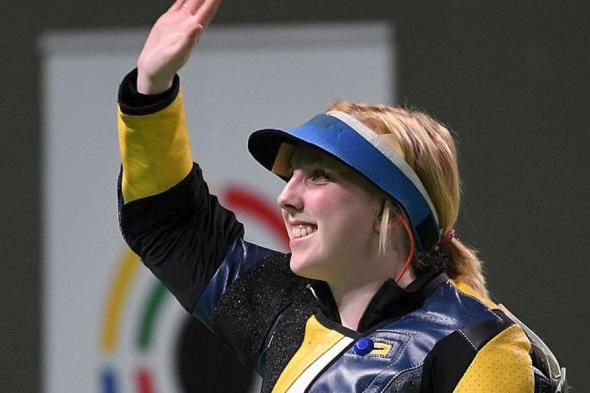
First US gold medalist at Rio and fashion inspiration.

American historical figure who reminds me of Trump
Posted: July 31, 2016 Filed under: America Since 1945, politics 2 Comments
George Armstrong Custer.
Hear me out. It’s true that Trump’s not a military man, but as he says:
And he was educated at the New York Military Academy which went bankrupt and was sold to Chinese investors.

Trump

Custer
Both were weird about their hair.
Trump obvs, but Custer had a toupee and used all kinds of scented pomades.
Neither drank.
It’s interesting that Trump never drinks. Maybe it would take the edge off? Custer gave up drinking after an ugly episode in his youth and would drink milk at cocktail parties.
Vain about appearance to an almost absurd degree.
Both kind of OCD.
Trump is a self-described germaphobe. Custer during the Civil War compulsively washed his hands.
Wrote popular self-aggrandizing books.

(Custer’s fellow officer Frederick Benteen, who hated Custer’s preening and vanity and bragging and “pretentious silliness,” called it My Lie On The Plains, which is a good slam.)

Survived stupid moves that cost others dearly.
Trump blunders forward, somehow ending up ok but leaving defaulted creditors in his wake. Custer’s Civil War and post-Civil War career can sound similar, but with dead cavalry instead of money:
Custer’s abrupt withdrawal without determining the fate of Elliott and the missing troopers darkened Custer’s reputation among his peers. There was deep resentment within the 7th Cavalry that never healed.
A lot of plunging in blindly.
Impulsive, jump in and figure it out style marks both of their careers.

Wild swings in career.
Trump’s companies declared bankruptcy four times. Custer was courtmartialed and relieved of duty only to be called back in time to get everybody killed.
Had ambition to be president?
This one’s debatable but the argument’s been made that it’s possible when Custer was driving into the Indian encampment at Little Bighorn without waiting for anyone else he had the idea that the news might get out in time for him to get the 1876 nomination for president. A crazy plan.
Not sure what will happen to Trump and his followers.
We know how it ended for Custer:
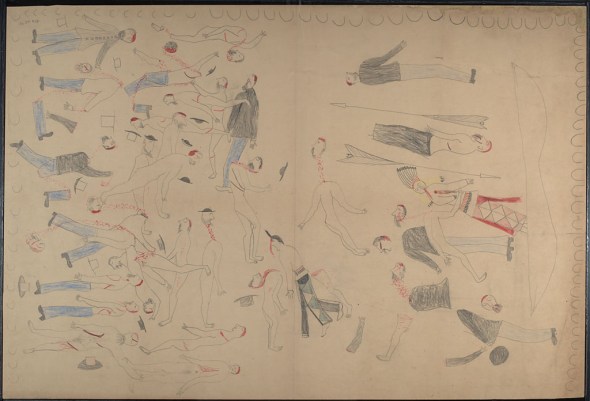
Drawn for us by Red Horse, who was there.
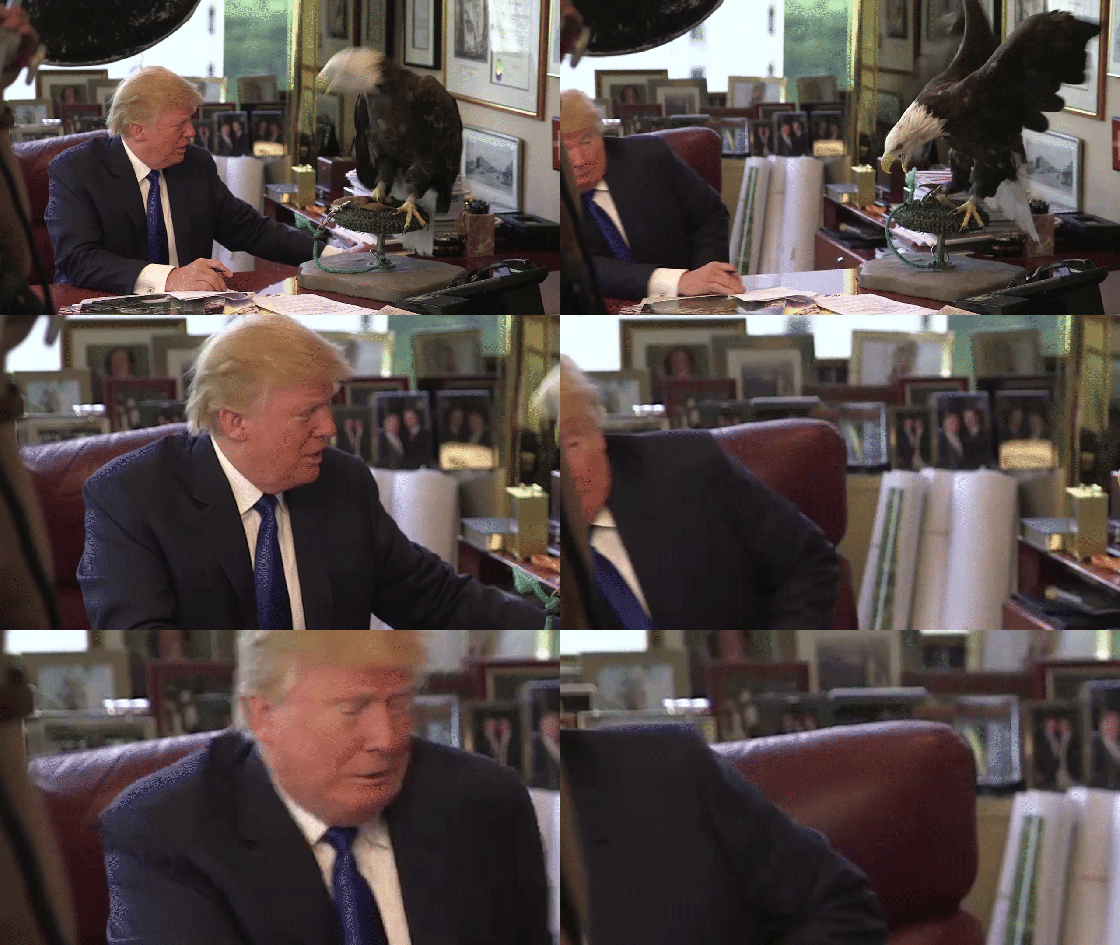
One significant difference is that Custer was physically brave and very good with animals, whereas Trump appears to be a huge wuss and bad with animals.
(Got this idea from reading Son Of The Morning Star for possibly the fifth time? How cool was Evan S. Connell?:
Cleveland
Posted: July 25, 2016 Filed under: America Since 1945, politics Leave a comment

First step? Let’s get our credentials.


Great Debates headquarters in the Press Filing Center


photo credit to Medina for this one
Hey! It’s former Senator Bob Dole!
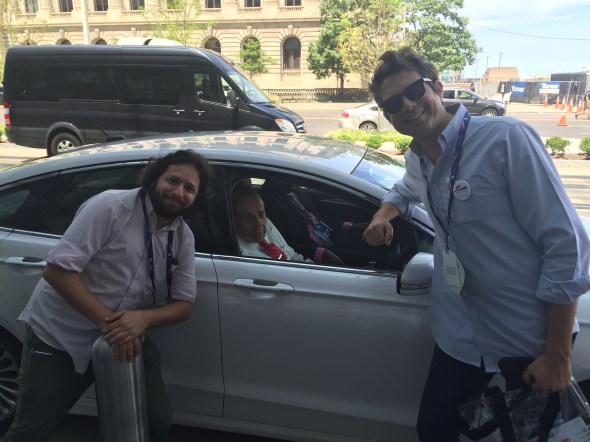 He waved us over, we’re not being weird here. asked us to send him a million dollars for the Eisenhower Memorial. I sent him fifty bucks.

 Pierogi:

At the Polish American Legion:

Cops:

photo credit: DAK
Let’s get this party started:
Here is Florida’s attorney general Pam Bondi:
 I did not care for her.

Day Two begins at Corky and Lenny’s (thanks to Chloe and Warburton for the recs):
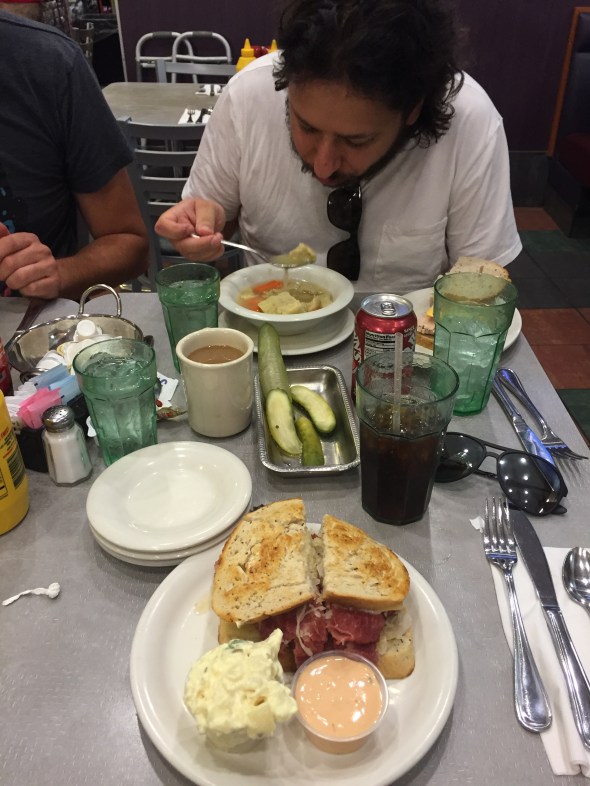
During some downtime was reading some of David Reynolds’ Summits: Six Meetings That Shaped The Twentieth Century.

Can you imagine Trump having this kind of openness and curiosity? And we’re talking about Reagan here man!

The press was in the cheap seats:

Absolutely unacceptable aesthetic for the United States of America.

A stray balloon brings some small relief:

In the Uber on the ride home, read this Peggy Noonan response. I love Peggy Noonan’s writing but was rattled by her clever dodgings of any kind of stand against what she’d just witnessed.

Can she possibly mean “the literal lay of the land,” like the actual physical features of the landscape? Let’s hope not! I believe it’s time for Ms. Noonan to stop dodging as a curious observer and speak up about whether she finds the nominee of her party to be unacceptable or not.
 One last corned beef sandwich with Dubbin.


Asked Dan to rate the convention as a convention, can’t remember if the scoring system was out of 20 or 25:
David McCullough on Trump
Posted: July 22, 2016 Filed under: America Since 1945, politics 1 Comment
coming in JUST under the Helytimes three minute video limit*. Here’s a piece if you hate watching videos:
So much that Donald Trump spouts is so vulgar and so far from the truth and mean-spirited. It is on that question of character especially that he does not measure up. He is unwise. He is plainly unprepared, unqualified and, it often seems, unhinged. How can we possibly put our future in the hands of such a man?
More info here. As the Times notes:
The videos are mostly homemade, smartphone productions.
Maybe I’m an optimist, but a better shot version of this with McCullough could be very effective, I think. Certainly more than current 3,383 views. Embedded in the Times article but that’s no way to get videos out there!
*often violated
Microsociology
Posted: July 12, 2016 Filed under: actors, America Since 1945, how to live, sexuality, war Leave a commentHow many interesting things are in sociologist Randall Collins’ latest post (which is maybe the text of a speech or something?) Let me excerpt some for us. I have highlighted some nuggets:

I will add a parallel that is perhaps surprising. Those who know Loic Wacquant would not expect to find silent harmony. Nevertheless, Wacquant’s study of a boxing gym finds a similar pattern: there is little that boxers do in the gym that they could not do at home alone, except sparring; but in the gym they perform exercises like skipping, hitting the bags, strengthening stomach muscles, all in 3-minute segments to the ring of the bell that governs rounds in the ring. When everyone in the gym is in the same rhythm, they are animated by a collective feeling; they become boxers dedicated to their craft, not so much through minds but as an embodied project.
A large proportion of violent confrontations of all kinds– street fights, riots, etc.– quickly abort; and most persons in those situations act like Marshall’s soldiers– they let a small minority of the group do all the violence. Now that we have photos and videos of violent situations, we see that at the moment of action the expression on the faces of the most violent participants is fear. Our folk belief is that anger is the emotion of violence, but anger appears mostly before any violence happens, and in controlled situations where individuals bluster at a distant enemy. I have called thisconfrontational tension/fear; it is the confrontation itself that generates the tension, more than fear of what will happen to oneself. Confrontational tension is debilitating; phenomenologically we know (mainly from police debriefings after shootings) that it produces perceptual distortions; physiologically it generates racing heart beat, an adrenaline rush which at high levels results in loss of bodily control.
This explains another, as yet little recognized pattern: when violence actually happens, it is usually incompetent. Most of the times people fire a gun at a human target, they miss; their shots go wide, they hit the wrong person, sometimes a bystander, sometimes friendly fire on their own side. This is a product of the situation, the confrontation. We know this because the accuracy of soldiers and police on firing ranges is much higher than when firing at a human target. We can pin this down further; inhibition in live firing declines with greater distance; artillery troops are more reliable than infantry with small arms, so are fighter and bomber crews and navy crews; it is not the statistical chances of being killed or injured by the enemy that makes close-range fighters incompetent. At the other end of the spectrum, very close face-to-face confrontation makes firing even more inaccurate; shootings at a distance of less than 2 meters are extremely inaccurate. Is this paradoxical? It is facing the other person at a normal distance for social interaction that is so difficult. Seeing the other person’s face, and being seen by him or her seeing your seeing,is what creates the most tension. Snipers with telescopic lenses can be extremely accurate, even when they see their target’s face; what they do not see is the target looking back; there is no mutual attention, no intersubjectivity. Mafia hit men strike unexpectedly and preferably from behind, relying on deception and normal appearances so that there is no face confrontation. This is also why executioners used to wear hoods; and why persons wearing face masks commit more violence than those with bare faces.
NOTE THE POLICY IMPLICATION: The fashion in recent years among elite police units to wear balaclava-style face masks during their raids should be eliminated.

How does violence sometimes succeed in doing damage? The key is asymmetrical confrontation tension. One side will win if they can get their victim in the zone of high arousal and high incompetence, while keeping their own arousal down to a zone of greater bodily control. Violence is not so much physical as emotional struggle; whoever achieves emotional domination, can then impose physical domination. That is why most real fights look very nasty; one sides beats up on an opponent at the time they are incapable of resisting. At the extreme, this happens in the big victories of military combat, where the troops on one side become paralyzed in the zone of 200 heartbeats per minute, massacred by victors in the 140 heartbeat range. This kind of asymmetry is especially dangerous, when the dominant side is also in the middle ranges of arousal; at 160 BPM or so, they are acting with only semi-conscious bodily control. Adrenaline is the flight-or-fight hormone; when the opponent signals weakness, shows fear, paralysis, or turns their back, this can turn into what I have called a forward panic, and the French officer Ardant du Picq called “flight to the front.” Here the attackers rush forward towards an unresisting enemy, firing uncontrollably. It has the pattern of hot rush, piling on, and overkill. Most outrageous incidents of police violence against unarmed or unresisting targets are forward panics, now publicized in our era of bullet counts and ubiquitous videos.

Another pathway is where the fight is surrounded by an audience; people who gather to watch, especially in festive crowds looking for entertainment; historical photos of crowds watching duels; and of course the commercial/ sporting version of staged fights. This configuration produces the longest and most competent fights; confrontational tension is lowered because the fighters are concerned for their performance in the eyes of the crowd, while focusing on their opponent has an element of tacit coordination since they are a situational elite jointly performing for the audience. Even the loser in a heroic staged fight gets social support. We could test this by comparing emotional micro-behavior in a boxing match or a baseball game without any spectators.
(among the photos that come up if you Google “crowd watching a duel”:

Title: Crowd reflected in water while watching Sarazen and Ouimet duel at Weston Country Club

Beardsley vs Salazar in the 1982 Boston Marathon
Finally, there are a set of techniques for carrying out violence without face confrontation. Striking at a distance: the modern military pathway. Becoming immersed in technical details of one’s weapons rather than on the human confrontation. And a currently popular technique: the clandestine attack such as a suicide bombing, which eliminates confrontational tension because it avoids showing any confrontation until the very moment the bomb is exploded. Traditional assassinations, and the modern mafia version, also rely on the cool-headedness that comes from pretending there is no confrontation, hiding in Goffmanian normal appearances until the moment to strike.
All this sounds rather grisly, but nevertheless confrontational theory of violence has an optimistic side. First, there is good news: most threatening confrontations do not result in violence. (This is shown also in Robert Emerson’s new book on quarrels among roommates and neighbours.) We missed this because, until recently, most evidence about violence came from sampling on the dependent variable. There is a deep interactional reason why face-to-face violence is hard, not easy. Most of the time both sides stay symmetrical. Both get angry and bluster in the same way. These confrontations abort, since they can’t get around the barrier of confrontational tension. Empirically, on our micro-evidence, this zero pathway is the most common. Either the quarrel ends in mutual gestures of contempt; or the fight quickly ends when opponents discover their mutual incompetence. Curtis Jackson-Jacobs’ video analysis shows fist-fighters moving away from each other after missing with a few out-of-rhythm punches. If no emotional domination happens, they soon sense it.
More:
Anne Nassauer, assembling videos and other evidence from many angles on demonstrations, finds the turning points at which a demo goes violent or stays peaceful. And she shows that these are situational turning points, irrespective of ideologies, avowed intent of demonstrators or policing methods. Stefan Klusemann, using video evidence, shows that ethnic massacres are triggered off in situations of emotional domination and emotional passivity; that is, local conditions, apart from whatever orders are given by remote authorities. Another pioneering turning-point study is David Sorge’s analysis of the phone recording of a school shooter exchanging shots with the police, who nevertheless is calmed down by an office clerk; she starts out terrified but eventually shifts into an us-together mood that ends in a peaceful surrender. Meredith Rossner shows that restorative justice conferences succeed or fail according to the processes of interaction rituals; and that emotionally successful RJ conferences result in conversion experiences that last for several years, at least. Counter-intuitively, she finds that RJ conferences are especially likely be successful when they concerns not minor offenses but serious violence; the intensity of the ritual depends on the intensity of emotions it evokes.

High authorities are hard to study with micro methods, since organizational high rank is shielded behind very strong Goffmanian frontstages. David Gibson, however, analyzing audio tapes of Kennedy’s crisis group in the Cuban Missile Crisis of 1962, penetrated the micro-reality of power in a situation in which all the rationally expectable scenarios led toward nuclear war. Neither JFK nor anyone else emerges as a charismatic or even a decisive leader. The group eventually muddled their way through sending signals that postponed a decision to use force, by tacitly ignoring scenarios that were too troubling to deal with. This fits the pattern that conversation analysts call the preference for agreement over disagreement, at whatever cost to rationality and consistency.
How about how social interactions affect job interviews?:
We have a long way to go to generalize these leads into a picture of how high authority really operates. Does it operate the same way in business corporations? The management literature tells us how executives have implemented well thought-out programs; but our information comes chiefly from retrospective interviews that collapse time and omit the situational process itself. Lauren Rivera cracks the veneer of elite Wall Street firms and finds that hiring decisions are made by a sense of emotional resonance between interviewer and interviewee, the solidarity of successful interaction rituals. Our best evidence of the micro details of this process comes from another arena, where Dan McFarland and colleagues analyze recorded data on speed dating, and find that conversational micro-rhythms determine who felt they “clicked” with whom.
OK what about sex?
I will end this scattered survey with some research that falls into the rubric of Weberian status groups, i.e. social rankings by lifestyle. David Grazian has produced a sequence of books,Blue Chicago and On the Make, that deal with night life. This could be considered a follow-up to Goffman’s analysis of what constitutes “fun in games” as well as “where the action is.” For Grazian, night-life is a performance of one’s “nocturnal self,” characterized by role-distance from one’s mundane day-time identity. By a combination of his own interviewing behind the scenes and collective ethnographies of students describing their evening on the town, from pre-party preparation to post-party story-telling, Grazian shows how the boys and the girls, acting as separate teams, play at sexual flirtation which for the most part is vastly over-hyped in its real results. It is the buzz of collective effervescence that some of these teams generate that is the real attraction of night life. And this may be an appropriate place to wind up. Freud, perhaps the original micro-sociologist, theorized that sexual drive is the underlying mover behind the scenes. Grazian, looking at how those scenes are enacted, finds libido as socially constructed performance. As is almost everything else.

In conclusion. Will interaction ritual, or for that matter micro-sociology as we know it, become outdated in the high-tech future? This isn’t futuristic any more, since we have been living in the era of widely dispersed information technology for at least 30 years, and we are used to its pace and direction of change. A key point for interaction ritual is that bodily co-presence is one of its ingredients. Is face contact needed? Rich Ling analyzed the everyday use of mobile phones and found that the same persons who spoke by phone a lot also met personally a lot. Cell phones do not substitute for bodily co-presence, but facilitate it. Among the most frequent back-and-forth, reciprocated connections are people coordinating where they are. Ling concluded that solidarity rituals were possible over the phone, but that they were weaker than face-to-face rituals; one was a teaser for the other.
…
Conceivably future electronic devices might wire up each other’s genitals, but what happens would likely depend on the micro-sociological theory of sex (chapter 6 in Interaction Ritual Chains): the strongest sexual attraction is not pleasure in one’s genitals per se, but getting the other person’s body to respond in mutually entraining erotic rhythms: getting turned on by getting the other person turned on. If you don’t believe me, try theorizing the attractions of performing oral sex. This is an historically increasing practice, and one of the things that drives the solidarity of homosexual movements. Gay movements are built around effervescent scenes, not around social media.
I will try theorizing the attractions of performing oral sex, Professor!
I recommend Collins’ book written with Maren McConnell, Napoleon Never Slept: How Great Leaders Leverage Social Energy, which I bought and read though I do wish there was a print edition.
Previous coverage about Collins’ work. Shoutout to Brent Forrester, who I think put me on to him.
Michael Herr
Posted: June 24, 2016 Filed under: America Since 1945, heroes, war Leave a comment

If you read Dispatches and you weren’t obsessed with learning everything you possibly could about Michael Herr, we are different!
Read it AGAIN just recently after reading Mary Karr yank out its gears and examine them in her:

Also recommended.
Just a sample of Dispatches:


What about?:
In my search for info on Herr I read this 1990 profile for the LA Times by Paul Ciotti:
Friends of friends invited him to dinner. Strangers wanted to meet him. Once, Herr recalls, he got a phone call from a guy who said he was standing in a phone booth in Nebraska in the middle of the night. “I could hear the wind blowing. He hadn’t read the book.” The caller said, “Time magazine says this. What does this mean?” Herr reversed the question: “What do you think it means?” “Oh, ho! Now that you’re rich and famous you don’t want to talk to people like me.”
:
One inspiration was Ernest Hemingway. “When I was a kid, I was obsessed with him and made some pathetic teen-age attempts to imitate him in my life. And I reinvented myself as this outdoorsman, hard-drinking and everything with it. I dare say that influence put my foot on the trail to Vietnam. Which is why that book is about acting out fantasy as much as anything.
“I had always wanted to go to war. I wanted to write a book. It was something I had to do. The networks kept referring to this as a TV war, which I didn’t believe it was. I sent a proposal to Harold Hayes. I was to write a monthly column, but once I got over there I realized this was not the way to approach the story. I wired Hayes. He said, ‘You do what you want to do. Have fun. Be careful.’ “
What do we make of this?:
What sets Herr’s book apart is the authoritative sense he conveys of the terror, ennui and ecstasy of what it felt like to be there. In a chapter about the siege of Khe Sanh, he offers a long series of conversations between two friends, a huge, gentle black Marine named Day Tripper and a little naive white Marine named Mayhew. The exchanges ring so true that one wonders, simply on a journalistic level, how he ever managed to record them.
He smiles. “They are totally fictional characters.”
They are ?
“Oh, yeah. A lot of ‘Dispatches’ is fictional. I’ve said this a lot of times. I have told people over the years that there are fictional aspects to ‘Dispatches,’ and they look betrayed. They look heartbroken, as if it isn’t true anymore. I never thought of ‘Dispatches’ as journalism. In France they published it as a novel.”
But, Herr says, “I always carried a notebook. I had this idea–I remember endlessly writing down dialogues. It was all I was really there to do. Very few lines were literally invented. A lot of lines are put into mouths of composite characters. Sometimes I tell a story as if I was present when I wasn’t, (which wasn’t difficult)–I was so immersed in that talk, so full of it and so steeped in it. A lot of the journalistic stuff I got wrong.”
My hunt for more Herr led me to this Dutch (?) documentary, First Kill, interviews with vets interspersed with film of contemporary Vietnam. Herr is interviewd first at minute 27:40 or so.
The story he tells starting around 40:20. Jeez.
I forget where I learned that Herr was living in upstate New York or sumplace, practicing a rigorous Buddhism. My trail on him brought me to this book:


What to make of this Buddhist-type idea:


On the lighter side: there’s great stuff too in Michael Herr’s book about Kubrick:


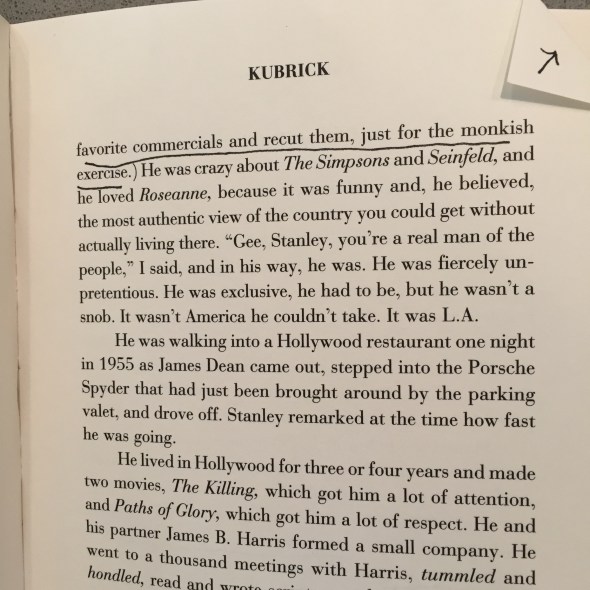
He’d tape his favorite commercials and recut them, just for the monkish exercise.
RIP.

Hydrogen bomb photos
Posted: June 13, 2016 Filed under: America Since 1945 Leave a comment

ca. 1951 – 1962, Nevada, USA — Mushroom Cloud From Nuclear Test — Image by © CORBIS


Between the show’s first and second seasons, the writers waited in the lobby of Andreessen’s office, where photographs of hydrogen-bomb blasts hang on the walls. (“They’re a good way to make sure people are awake,” Andreessen’s spokesperson told me.) Then the writers were ushered into a conference room, where, for more than an hour, they sat around a blond-wood conference table while Andreessen pitched them jokes. “They weren’t terrible, either,” one of the writers told me. “I have eight dense pages of notes from that meeting. I have never heard a man speak as fast as Marc Andreessen.” None of his jokes appeared on the show in their original form, but a concept he explained—the downside of accepting too much free money from investors—became a scene in season two. In the TV version, the venture capitalist is a young woman, and the conversation begins with her interrupting Richard while he’s in the bathroom.
(from this New Yorker thing by Andrew Marantz about Silicon Valley.)

.jpg)

Tough to find original sources for some of these photos, click through for the ends of my trails. More.
Bro you’re called the SECRET service
Posted: June 6, 2016 Filed under: America Since 1945 Leave a comment
Off We Go
Posted: May 15, 2016 Filed under: America Since 1945, explorers, heroes, history, people, the California Condition Leave a comment
Captain Ted W. Lawson of the Ruptured Duck
Watching Trumbo –> reading about 30 Seconds Over Tokyo
Before I knew it I was looking at the US Air Force’s photo archive specifically photos tagged “history.”

Several of the mission’s 16 B-25B bombers are lined up on the deck of the USS Hornet (CV-8). In the foreground is tail No. 40-2261, which was mission plane No. 7, piloted by 2nd Lt. Ted W. Lawson. The next plane is tail No. 40-2242, mission plane No. 8, piloted by Capt. Edward J. York. Both aircraft attacked targets in the Tokyo area. Lt. Lawson later wrote the book “Thirty Seconds over Tokyo.”
Note searchlight at left. (U.S. Navy photo)
Aviation history has never been a passion of mine but let’s just browse some of the highlights. Pearl Harbor:

A report entitled “7 December 1941: The Air Force Story” compiled by the Pacific Air Forces Office of History obtained this photo of Wheeler Air Field taken by a Japanese Empire pilot to record the battle damage to the U.S. Air Forces Dec. 7, 1941.
Homeward bound:

Newly freed prisoners of war celebrate as their C-141A aircraft lifts off from Hanoi, North Vietnam, on Feb. 12, 1973, during Operation Homecoming. The mission included 54 C-141 flights between Feb. 12 and April 4, 1973, returning 591 POWs to American soil. (U.S. Air Force photo)
Captain Mary T. Klinker:

Capt. Klinker was 27-years-old when she died April 4, 1975 when the first aircraft supporting Operation Babylife crashed. Klinker was the last nurse and the only member of the Air Force Nurse Corps to be killed in Vietnam. Capt. Mary T. Klinker was posthumously awarded the Airman’s Medal for Heroism and the Meritorious Service Medal.
Father and son:

Staff Sgt. Shaun Meadows shares a laugh with his son after completing his jump June 14, 2010. Sergeant Meadows is assigned to the 22nd Special Tactics Squadron at Joint Base Lewis-McChord, Wash. (U.S. Air Force photo/Airman Leah Young)
Fire retardant:

Approximately 3,000 gallons of fire retardant is deployed Oct. 25 over the Poomacha fire in North San Diego County, Calif. The C-130 Hercules and crew are assigned to the 302nd Airlift Wing from Peterson Air Force Base, Colo. The aircraft launched from Channel Islands Air National Guard Station, Calif. (U.S. Air Force photo/Tech. Sgt. Roy A. Santana)
Water:

On June 21, 1921, U.S. Army Air Service pilots bombed the captured German battleship Ostfriesland to demonstrate the effectiveness of aerial bombing on warships. At the time, the ship was one of the world’s largest war vessels.
An explosion 95 years ago:

An MB-2 hits its target, the obsolete battleship USS Alabama during tests. On Sep. 27, 1921, still operating with Mitchell’s provisional air brigade, the group’s MB-2 aircraft bombed and sank the ex-U.S. Navy battleship Alabama (BB-08) in Tangier Bay, Chesapeake Bay, Md.
Basic:

Basic cadets from the first Air Force Academy class line up for physical training here, the temporary location for the academy while permanent facilities were being constructed in Colorado Springs. (U.S. Air Force photo)
The Starlifter:

1970’s — MARCH 1978 — 3/4 front view of a C-141 Starlifter assigned to the 710th Military Airlift Squadron (AFRES), 60th Military Airlift Wing, in flight over the San Francisco Bay en route to Travis AFB, CA. (Photo by Ken Hackman)
How about Betty Gillies?:

Mrs. Betty Gillies was the first woman pilot to be “flight checked” and accepted by the Women’s Auxiliary Ferring Squadron. Mrs. Gillies 33 years of age, has been flying since 1928 and received her commercial license in 1930. She has logged in excess of 1400 hours flying time and is qualified to fly single and multi-engined aircraft. Mrs. Gillies is a member of the Aviation Country Club of Hicksville L.I. and is a charter member of ’99, an international club of women flyers formed by Amelia Earhardt in 1929. (U.S. Air Force photo)
Cool. Here is My Girl, 1945.

1940’s — A North American P-51 takes off from Iwo Jima, in the Bonin Islands. From this hard-won base our fighters escorted the B-29s on bombing missions to Japan, and also attacked the Empire on their own. (U.S. Air Force photo)
Goddard:

EARLY YEARS — Robert H. Goddard besides 1926 liquid- fueled rocket. The rocket is on top, receiving its fuel by two lines from the tank at the bottom. Goddard’s rockets made little impression upon government officials at the time. (U.S. Air Force photo)
That must be in New England someplace, believe it is near Auburn, MA:

Look, I’m not saying these Air Force photos are any Record Group 80: Series: General Photographic File of the Navy, 1939-1945, the Air Force wasn’t around yet. But some of them are great. I mean:
Dr. John Paul Stapp, the fastest man on Earth:

1950’s — Dr. John Paul Stapp was not only the “fastest human on earth;” he was the quickest to stop. In 1954, America’s original Rocketman attained a then-world record land speed of 632 mph, going from a standstill to a speed faster than a .45 bullet in five seconds on an especially-designed rocket sled, and then screeched to a dead stop in 1.4 seconds, sustaining more than 40g’s of thrust, all in the interest of safety.
The Hop A Long to the Rescue:

1950’s — An UH-19B Chickasaw at the Air Force Museum. Courtesy photo.
Can’t help but think of:

Connecting:

1960s — U.S. Air Force Sgt. Suzann K. Harry, of Wildwood, N.J., operates a switchboard in the underground command post at Strategic Air Command headquarters, Offutt Air Force Base, Neb., in 1967. (U.S. Air Force photo)
Four Bits About Trump
Posted: May 6, 2016 Filed under: America Since 1945, politics, presidents 1 Comment1) Trump as Tim Ferriss
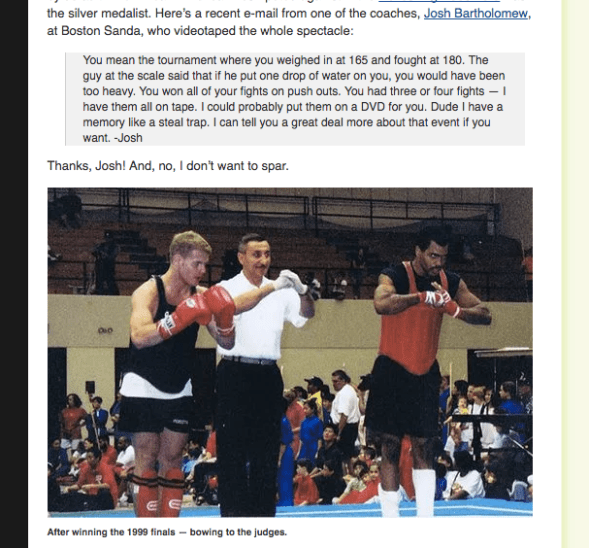
screenshot from Ferriss’ page here: http://fourhourworkweek.com/2007/08/08/the-7-commandments-of-blogosphere-and-life-self-defense/
Does the best analogy come to us from Tim Ferriss, who has written about how he won his weight class 1999 (US) Chinese kickboxing championship by exploiting anomalies in the rules? From Wiki:
Chinese kickboxing
Ferriss has stated that, prior to his writing career, he won in the 165 lb. weight class at the 1999 USAWKF national Sanshou (Chinese kickboxing) championship through a process of shoving opponents out of the ring and by dramatically dehydrating himself before weigh in, and then rehydrating before the fight in order to compete several classes below his actual weight – a practice known as “Weight cutting”.
Ferriss has acknowledged using anabolic steroids, specifically “a number of low-dose therapies, including testosterone cypionate,” under medical supervision following shoulder surgery, as well as using “stacks” consisting of testosterone enanthate, Sustanon 250, HGH, Deca-Durabolin, Cytomel, and other unnamed ingredients while training.
Shoving wasn’t part of the Chinese kickboxing game apparently, it was just assumed you wouldn’t shove. If you have no stake in the integrity of Chinese kickboxing turns out nobody can stop you once you start shoving.
Now, knowing no more details than how Ferriss tells the story, what Ferriss did sounds like clever if devilish fun with no real victim except maybe the guy who came in second or people really vested in the USAWKF.
Trump seemed like that too for awhile. Can’t deny taking pleasure in it. But it’s one thing to make a clown show of the 1999 national Sanshou championship, even the Republican Party primaries. But it’s a whole other category to make a clown show out of the United States.
An amazing move right now for Trump would be to bail. That’s what I would legit advise him to do. Would be hilarious. Republicans would pass out with relief and then maybe even beat Hillary. Meanwhile Trump goes out undefeated, can enjoy adoring crowds for the rest of his life without ever having to be President.
Some suggestion Trump does think of all this as no more than a fun competition:
“I have to tell you, I’ve competed all my life,” Trump said, his golden face somber, his gravity-defying pouf of hair seeming to hover above his brow. “All my life I’ve been in different competitions—in sports, or in business, or now, for 10 months, in politics. I have met some of the most incredible competitors that I’ve ever competed against right here in the Republican Party.”
No suggestion yet he thinks it’s best to stop here.
2) Anonymous Intelligence Analyst Weighs In
Our friend Anonymous Intelligence Analyst has been dead on in his Trump predictions for some time. He wrote me back in February with some thoughts, as well as a Master Plan that I think is well worth considering:
Caveat: please remember that I am not endorsing Trump. I’m not voting for him but I am fascinated by the whole thing.
- Sanders & Trump tap into the same frustration: middle to lower-class Americans have not seen their lot improve in a long time
- Sanders claims that large banks and corporations have captured the regulators and we should basically blow up our economic system and become socialists. At the core, he’s right about the regulatory capture.
- Trump claims that our trade and immigration policies have been a screwjob on Americans. I am rabidly pro-trade and pro-immigration but I do believe it’s benefited elites while not being a good thing for a lot of people in the bottom half.
- They both pitch that the parties are trying to screw the people, which is totally true. I mean the people are calling for Trump and the GOP is trying everything they can to sink him. The people are calling for Bernie but Hilary already bought all the super-delegates. The fix is in.
- I agree with you that a core attraction of Trump is that he says tons of stuff that no other politician would say and that’s refreshing. He is also authentic. He is definitely a giant douche, he speaks like a douche, and you are convinced he believes in his own bullshit. That’s so attractive! I like Bernie despite his crazy economic policies because I can tell he basically believes in them…I can respect that.
- Instead of debating Trump, here’s my master plan for defeating him. The establishment on both sides hates him so much. Republicans should cede the nomination to him as he has rightly won it. Then jam whoever they love (Rubio?) on him as VP. First day in office, conspire with the Dems to impeach Trump! President Rubio takes over. It’s a layup and would be incredible drama as well — can you imagine the look on Trump‘s face!
That’s great. Would be a hilarious prank on Trump.
What Is The President’s Job, Exactly?
Summarized in a not very long part (Article II) of the Constitution:
The President shall be Commander in Chief of the Army and Navy of the United States, and of the Militia of the several States, when called into the actual Service of the United States; he may require the Opinion, in writing, of the principal Officer in each of the executive Departments, upon any Subject relating to the Duties of their respective Offices, and he shall have Power to Grant Reprieves and Pardons for Offences against the United States, except in Cases of Impeachment.
He shall have Power, by and with the Advice and Consent of the Senate, to make Treaties, provided two thirds of the Senators present concur; and he shall nominate, and by and with the Advice and Consent of the Senate, shall appoint Ambassadors, other public Ministers and Consuls, Judges of the supreme Court, and all other Officers of the United States, whose Appointments are not herein otherwise provided for, and which shall be established by Law: but the Congress may by Law vest the Appointment of such inferior Officers, as they think proper, in the President alone, in the Courts of Law, or in the Heads of Departments.
The President shall have Power to fill up all Vacancies that may happen during the Recess of the Senate, by granting Commissions which shall expire at the End of their next Session.
SECTION 3
He shall from time to time give to the Congress Information on the State of the Union, and recommend to their Consideration such Measures as he shall judge necessary and expedient; he may, on extraordinary Occasions, convene both Houses, or either of them, and in Case of Disagreement between them, with Respect to the Time of Adjournment, he may adjourn them to such Time as he shall think proper; he shall receive Ambassadors and other public Ministers; he shall take Care that the Laws be faithfully executed, and shall Commission all the Officers of the United States.
SECTION 4
The President, Vice President and all Civil Officers of the United States, shall be removed from Office on Impeachment for, and Conviction of, Treason, Bribery, or other high Crimes and Misdemeanors.
That’s pretty much it. Tl;dr for “what is the President’s job” might be:
to preserve, protect and defend the Constitution of the United States.
That’s what it says in the Oath of Office laid out back in Article II, Section 1:
Before he enter on the Execution of his Office, he shall take the following Oath or Affirmation:-“I do solemnly swear (or affirm) that I will faithfully execute the Office of President of the United States, and will to the best of my Ability, preserve, protect and defend the Constitution of the United States.”
Well, ok, say what you want about Hillary Clinton.
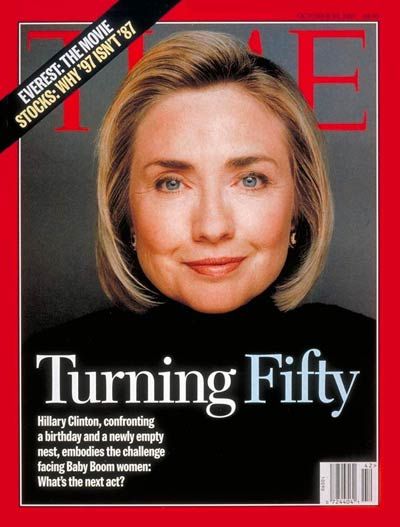
She is definitely a part of the problem of regulatory capture AIA identifies above. It’s cool that Bernie keeps putting her feet to the fire on that.
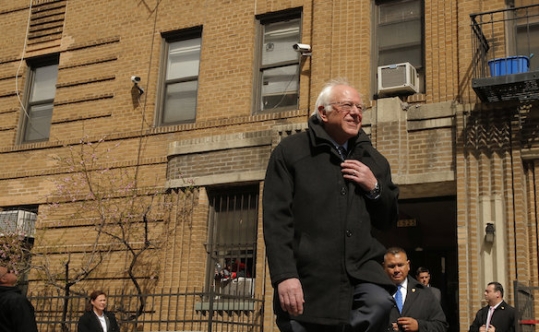
Democratic presidential candidate Bernie Sanders takes the stage for a campaign rally outside his childhood home (rear) in Brooklyn on April 8. Photo by Brian Snyder/Reuters
But I do think she would be better than Trump at all the above President jobs.
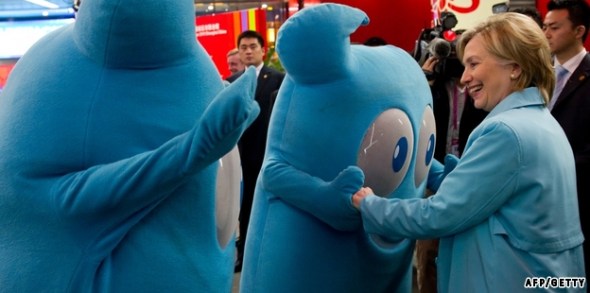
US Secretary of State Hillary Clinton greets Haibao, the mascot of the Shanghai World Expo 2010, while touring China’s Pavilion in Shanghai, May 22, 2010.AFP PHOTO / POOL / Saul LOEB (Photo credit should read SAUL LOEB/AFP/Getty Images)
Also Trump is a straight up jerk, unreal that this is even a conversation.
Constitutional Mischief
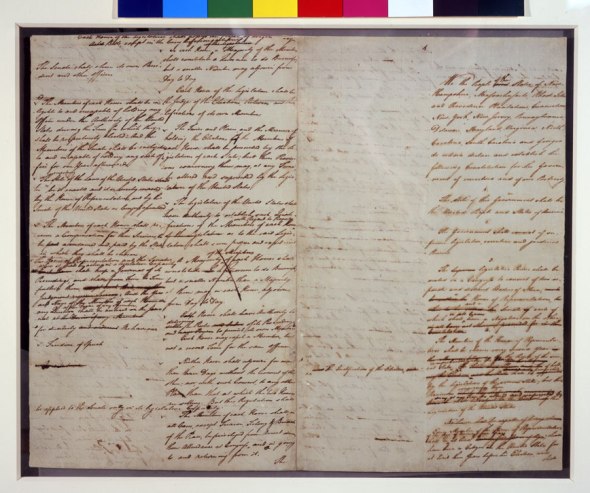
from this great blog, Process and Preserve, of the Historical Society of Pennsylvania, this post by Matt Shoemaker, don’t see more info about the photo: https://processandpreserve.wordpress.com/2010/02/05/what-constitutes-a-physical-copy-of-the-u-s-constitution/
The Constitution, re: The President, specifically says He. Would be funny* if Trump claimed it was unconstitutional for Hillary to be President.
*also unfunny all Trump stunts now tear further at American constitutional cohesion and make the United States and Earth a weakened and more unpleasant place to live.
Andrew Sullivan back
Posted: May 2, 2016 Filed under: America Since 1945, politics Leave a comment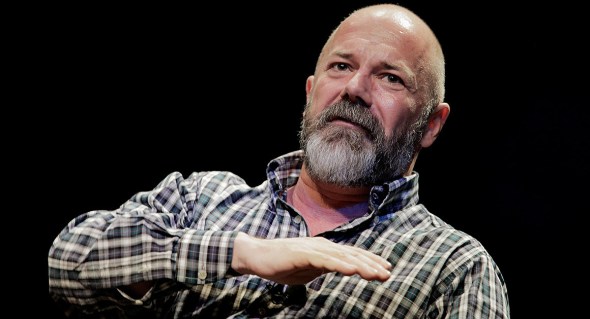
Sobering take!
And so those Democrats who are gleefully predicting a Clinton landslide in November need to both check their complacency and understand that the Trump question really isn’t a cause for partisan Schadenfreude anymore. It’s much more dangerous than that. Those still backing the demagogue of the left, Bernie Sanders, might want to reflect that their critique of Clinton’s experience and expertise — and their facile conflation of that with corruption — is only playing into Trump’s hands. That it will fall to Clinton to temper her party’s ambitions will be uncomfortable to watch, since her willingness to compromise and equivocate is precisely what many Americans find so distrustful. And yet she may soon be all we have left to counter the threat. She needs to grasp the lethality of her foe, moderate the kind of identity politics that unwittingly empowers him, make an unapologetic case that experience and moderation are not vices, address much more directly the anxieties of the white working class—and Democrats must listen.
More to the point, those Republicans desperately trying to use the long-standing rules of their own nominating process to thwart this monster deserve our passionate support, not our disdain. This is not the moment to remind them that they partly brought this on themselves. This is a moment to offer solidarity, especially as the odds are increasingly stacked against them. Ted Cruz and John Kasich face their decisive battle in Indiana on May 3. But they need to fight on, with any tactic at hand, all the way to the bitter end. The Republican delegates who are trying to protect their party from the whims of an outsider demagogue are, at this moment, doing what they ought to be doing to prevent civil and racial unrest, an international conflict, and a constitutional crisis. These GOP elites have every right to deploy whatever rules or procedural roadblocks they can muster, and they should refuse to be intimidated.
And if they fail in Indiana or Cleveland, as they likely will, they need, quite simply, to disown their party’s candidate. They should resist any temptation to loyally back the nominee or to sit this election out. They must take the fight to Trump at every opportunity, unite with Democrats and Independents against him, and be prepared to sacrifice one election in order to save their party and their country.
For Trump is not just a wacky politician of the far right, or a riveting television spectacle, or a Twitter phenom and bizarre working-class hero. He is not just another candidate to be parsed and analyzed by TV pundits in the same breath as all the others. In terms of our liberal democracy and constitutional order, Trump is an extinction-level event.

Artwork by Peter Arnold, Inc./Alamy found at http://science.nationalgeographic.com/science/prehistoric-world/mass-extinction/
This bit made me think of what Larry McMurtry said about glamour and Charlie Starkweather.
One of the more amazing episodes in Sarah Palin’s early political life, in fact, bears this out. She popped up in the Anchorage Daily News as “a commercial fisherman from Wasilla” on April 3, 1996. Palin had told her husband she was going to Costco but had sneaked into J.C. Penney in Anchorage to see … one Ivana Trump, who, in the wake of her divorce, was touting her branded perfume. “We want to see Ivana,” Palin told the paper, “because we are so desperate in Alaska for any semblance of glamour and culture.”
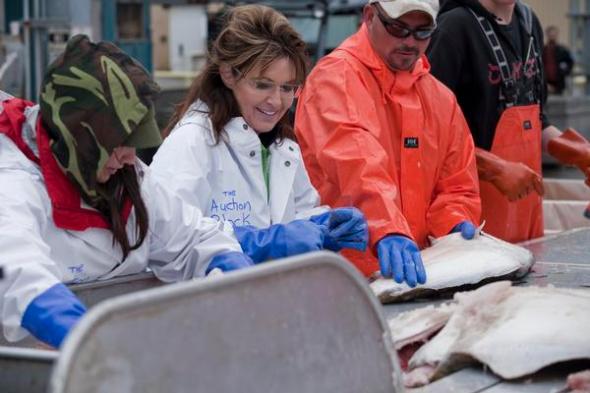
HOMER, ALASKA, AUGUST 06 2010: The day after she went fishing on the halibut boat Bear, Sarah Palin helps sort out the fish on the docks in Homer, the world’s halibut fishing capital, from where it will be taken to a local fish processing plant (photo Gilles Mingasson/Getty Images).
Jackie smoking pregnant
Posted: April 17, 2016 Filed under: America Since 1945, Kennedy-Nixon, New England, presidents 1 Comment

Trying to learn what brand of cigarette Jackie Kennedy smoked (no clear answer) I came across an evocative picture of Jackie Kennedy smoking while visibly pregnant, which you can see here.
I couldn’t and can’t find the source for it. Google Image searching leads me in an endless looparound of Tumblr and Pinterest. Maybe it’s in an old magazine. Maybe some Kennedy guest or family member took it and it got on the Internet somehow. Maybe a British tabloid published it, they go crazy for Kennedy goss.

Public domain pic of Jackie, August 31 1963, by Cecil Stoughton, found http://www.jfklibrary.org/Asset-Viewer/Archives/JFKWHP-ST-C283-50-63.aspx
Not mine to “print” I guess on Helytimes — we take sourcing semi-seriously. (But is it that different to link to it?)
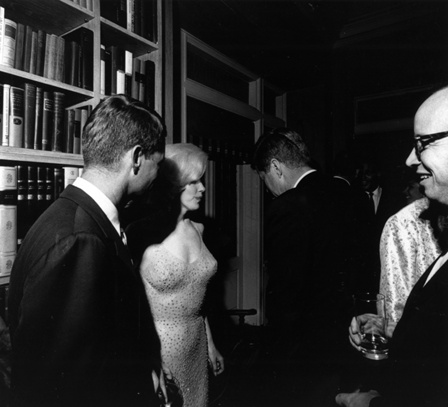
Public domain photo of Robert and John Kennedy with Marilyn Monroe, taken by Cecil Stoughton. Found here: http://www.jfklibrary.org/Asset-Viewer/9jndTasee0CsvxnFg6IWxg.aspx
This home movie footage, on the other hand, is in the public domain and online at the Kennedy Library. Some of these movies feel almost too private, too intimate — you can for instance see our current ambassador to Japan, then age six, jumping on the bed in her swimsuit with (possibly) the future first lady of California?
Here are two clips.
Jackie smokes:
The President’s golf swing:
If you know anything about golf would love to hear takes on JFK’s swing.
Like a Hockney painting
Posted: April 9, 2016 Filed under: America Since 1945, art history, Kennedy-Nixon, the American West Leave a comment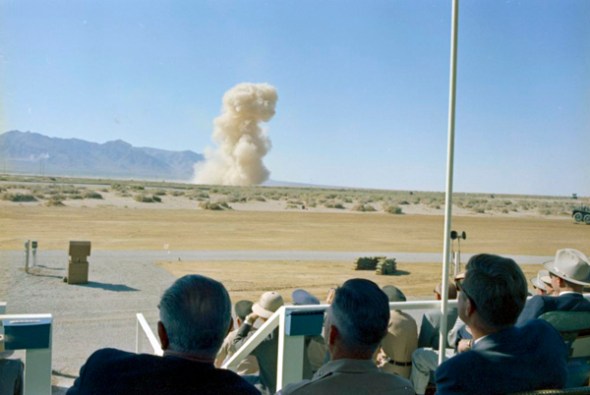
JFK checking out a missile test at White Sands, New Mexico.
Trip to Western States: White Sands Missile Range, New Mexico
Cecil Stoughton. White House Photographs. John F. Kennedy Presidential Library and Museum, Boston
Understanding politics
Posted: April 3, 2016 Filed under: America Since 1945, politics Leave a comment

The American people were so disgusted with the political process that they vomited up Trump. That’s why he’s orange. He’s barf.
that from the incomparable Dan Greaney:
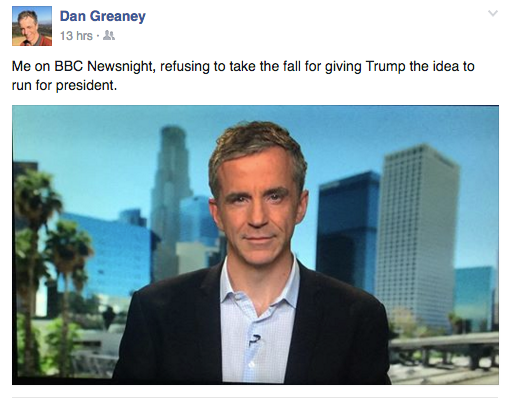
(here’s how he got mixed up in it)
If the political work degrades in a dysfunctional joke, soon enough people demand it at least be an entertaining dysfunctional joke.
A reaction to finding a disgusting process may be to make it more disgusting, visually , so that at least there is no trick or lie . The process will then be honest about its true repulsive character.
those both from Björn Skövde’s post about “Understanding Berlusconi and the European Future” (“Förstå Berlusconi och europeisk framtid“) published on Folket i Bild online, April 2009. Translated it myself using Google so may be a little wonky.

Grey old scolds from Vermont can generate excitement with the young, who yearn so for wisdom that they find it in every crusted Yankee pronouncement.
from reporter/novelist Vivien Kent’s sassy 1964 Life mag piece on:
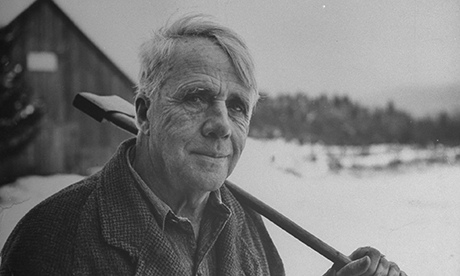

which is unforch not online.
Jim Harrison
Posted: March 28, 2016 Filed under: America Since 1945, food, how to live, women, writing Leave a comment
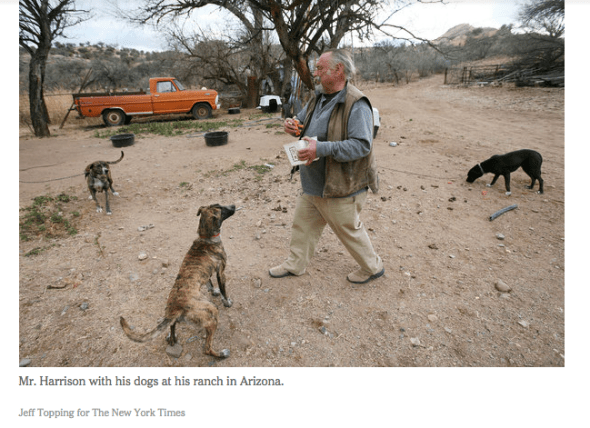
Briefly shared a publisher, Grove/Atlantic, with Jim Harrison, which made me feel cool. Some gems in his New York Times obituary:
There was the eating. Mr. Harrison once faced down 144 oysters, just to see if he could finish them. (He could.)
“If you’ve known a lot of actresses and models,” he once confided with characteristic plain-spokenness to a rapt audience at a literary gathering, “you return to waitresses because at least they smell like food.”
Mr. Harrison had his detractors. With its boozing and brawling and bedding, his fiction was often called misogynistic. He did himself no favors with a 1983 Esquire essay in which he called his feminist critics “brie brains” and added, in gleeful self-parody, “Even now, far up in the wilderness in my cabin, where I just shot a lamprey passing upstream with my Magnum, I wouldn’t have the heart to turn down a platter of hot buttered cheerleaders.”
 Helytimes
