Jedediah Smith Lunch
Posted: May 31, 2025 Filed under: the American West, the California Condition Leave a comment
Thinking of hosting an event where we eat the lunch Jedediah Smith has at the San Gabriel mission, California around November 7 in 1826:
At 11 O Clock [am] the Father came and invited us to dinner. We accompanied him to the office adjoining the dining room and after taking a glass of Gin and some bread and cheese we seated ourselves at the table which was furnished with Mutton Beef Chickens Potatoes Beans and Peas cooked in different ways. Wine in abundance made our reverend fathers appeared to me quite merry.
Gin, bread, cheese, mutton, beef, chicken, potatoes, beans, peas, wine in abundance, at eleven in the morning. (In fairness Jed has been up since sunup).
Smith notes that he enjoyed his meals at San Gabriel because it had been a long time since he’d sat at a table (he’d come overland through the Rockies and across the Mojave Desert). His first view of the mission:
Arrived in view of a building of ancient and castle-like appearance.

(from Wikipedia)
At that time what Smith calls “the village of the angels” was a minor outlying place. Smith records that the people of the village of the angels were master horsemen, and he describes their method. Those sensitive to animal suffering may wish to skip:
My guide informed me that the inhabitants of the village and of the vicinity collect whenever they consider the country overstocked and build a large and strong pen with a small entrance and two wings extending from the entrance some distance to the right and left. Then mounting their swiftest horses they scour the country and surrounding large bands they drive them into the enclosure by hundreds. They will there perhaps Larse a few of the handsomest and take them out of the pack. A horse selected in this manner is immediately thrown down and altered blindfolded saddled and haltered (for the Californians always commenc with the halter). The horse is then allowed to get up and a man is mounted. when he is firmly fixed in his seat and the halter in his hand an assistant takes off the blind the several men on horseback with handkerchiefs to frighten and some with whips to whip raise the yell and away they go. The poor horse having been so severely punished and frightened does not think of founcing but dashes off at no slow rate for a trial of his speed. After running until he is exhausted and finding he cannot get rid of his enemies he gives up. He is then kept tied for 2 or 3 days saddled and rode occasionally and if he proves docile he is tied by the neck to a tame horse until he becomes attached to the company and then turned Loose. But if a horse from the moment he is taken from the pen proves refractory they do not trouble themselves with him long but release him from his bondage by thrusting a knife to his heart. Cruel as this fate may seem it is a mercy compared to that of the hundreds left in the pack for they are shut up to die a death most lingering and most horrible, enclosed within a narrow space without the possibility of escape and without a morsel to eat they gradually loose their strength and sink to the ground making at time vain efforts to regain their feet and when at last all powerful hunger has left them but the strength to raise their heads from the dust with which they are soon to mingle: their eyes that are becoming dim with the approach of death may catch a glimpse of green and wide spread pastures and winding streams while they are perishing from want. one by one they die and at length the last and most powerful sinks down among his companions to the plain. No man of feeling can think of such a scene without surprise indignation and pity. Pity for the noblest of animals dying from want in the midst of fertile fields. Indignation and surprise that men are so barbarous and unfeeling. A fact so disgraceful to the Californians was not credited from a single narrator but has since been corroborated.
Perhaps worth considering here that Smith was writing in a tradition of Anglo/Protestant anti-Spanishism. Still. I’m prepared to believe Los Angeles has some history of horse crime to answer for.
The real center of power at this time, where Jedediah is eventually sent to answer to the governor, is San Diego. Smith says San Diego is “much decayed.” In a footnote, editor George R. Brooks says:
Smith was not alone in his opinion that things at San Diego were somewhat rundown. “Of all the places we had visited since our coming to California, excepting San Pedro, which is entirely deserted, the presidio at San Diego was the saddest. It is built on the slope of a barren hill, and has no regular form; it is a collection of houses whose appearance is made still more gloomy by the dark color of the bricks, roughly made, of which they are built.
The fine appearance of [the mission] loses much on nearing it; because the buildings, though well arranged, are low and badly kept up. A digusting slovenliness prevails in the padres’ dwelling.” (Carter, “Duhaut-Cilly,” 218-19).
Smith’s memoir has an interesting backstory, it’s a “found in an attic a hundred years later” kinda tale. My edition was published in 1977. I wonder if Cormac McCarthy had this at hand when writing the San Diego parts of Blood Meridian. I betcha he did.
Next time I’m in Omaha
Posted: October 7, 2024 Filed under: America, the American West Leave a comment
Spantsa / Olive Oatman
Posted: September 14, 2024 Filed under: the American West, the California Condition Leave a comment
OTLTA is a new acronym I’d like to get going. It stands for “one thing led to another.” Here it is in context: OTLA and I’m reading about captivity narratives of the American West. Accounts by white people who were captured or taken in by native tribes.
Captivity narratives are a whole serious category of study for academic historians. I’d fear to get over my skis here. There were commercial and political incentives to make these narratives as lurid as possible. How much to trust any one account is a historical puzzle. But, we love those.
Take for example Olive Oatman. When she was fourteen she was traveling with her family, who were Brewsterites, an splinter group of Mormons. Their intended destination was Yuma, Arizona, on the Colorado River. On Saturday, March 8, 1851, some eighty miles east of Yuma, they encountered some Yavapai people. (Already we need a footnote: were they really Yavapai? There are papers on this topic.) Everyone in the party was killed except Olive and her younger sister Mary Ann.
The Yavapai kept them but eventually traded them to some Mohave people.

Mary Ann did not survive.
After about four years among the Mohave, the post commander at Fort Yuma, on the California side, heard about a white woman living out there and sent word that he’d like her back.

We pick up the rest from Wikipedia:
Inside the fort, Olive was surrounded by cheering people.
Olive’s childhood friend Susan Thompson, whom she befriended again at this time, stated many years later that she believed Olive was “grieving” upon her forced return because she had been married to a Mohave man and had given birth to two boys.
Olive, however, denied rumors during her lifetime that she either had been married to a Mohave or had been sexually mistreated by the Yavapai or Mohave. In Stratton’s book, she declared that “to the honor of these savages let it be said, they never offered the least unchaste abuse to me.” However, her nickname, Spantsa, may have meant “rotten womb” and implied that she was sexually active, although historians have argued that the name could have different meanings.[5]: 73–74 [19]
from Violent Encounters: Interviews on Western Massacres (University of Oklahoma Press), by Deborah and Jon Lawrence, an interview with Margot Mifflin, an associat professor of English at Lehman College of the City University of New York who also directs the Arts and Cultire program at CUNY’s Graduate School of Journalism (“Her interest in tatoo art let to her work on the life of Olive Oatman.”):


History, getting towards the source, remains an engaging pastime.
I’ve been to a lot of California but I’ve never had the chance to visit Winterhaven, where we’d find the site of Fort Yuma. If I’m there I will surely check out the Museum of History in Granite:

Amazing if in four millennia the United States and the French Foreign Legion are remembered in equal proportion.
(User Kirs10 took that photo of the pyramid)
Teddy Blue
Posted: July 29, 2024 Filed under: cormac, Texas, the American West Leave a comment
I’ve been working my way through Larry McMurtry’s short syllabus for understanding the cowboy of the 19th century. Teddy Blue’s memoir is vivid:

A Yankee cowboy:

Conversation with a chippie:

(Gilt Edge appears to be no more).
strong phrase:

Reminded of Cormac McCarthy: I’d know your hide in a tanyard. Teddy weighs in on cowboy songs:

I like the version by Suzanne Vega.
June 25-26
Posted: June 26, 2024 Filed under: America, the American West, Uncategorized 3 CommentsLt. James Bradley led a detachment of Crow Indian scouts up the Bighorn Valley during the summer of 1876. In his journal he records that early Monday morning, June 26, they saw the tracks of four ponies. Assuming the riders must be Sioux, they followed these tracks to the river and came upon one of the ponies, along with some equipment which evidently had been thrown away. An examination of the equipment disclosed, much to his surprise, that it belonged to some Crows from his own command who had been assigned to General Custer’s regiment a few days earlier.
While puzzling over this circumstance, Bradley discovered three men on the opposite side of the river. They were about two miles away and appeared to be watching. He instructed his scouts to signal with blankets that he was friendly, which they did, but for a long time there was no response. Then the distant men built a fire, messages were exchanged by smoke signal, and they were persuaded to come closer.
They were indeed Crow scouts: Hairy Moccasin, Goes Ahead, White Man Runs Him. They would not cross the river, but they were willing to talk.
Bradley did not want to believe the story they told, yet he had a feeling it was true. In his journal he states that he could only hope they were exaggerating, “that in the terror of the three fugitives from the fatal field their account of the disaster was somewhat overdrawn.”
The news deeply affected his own scouts. One by one they went aside and sat down, rocking to and fro, weeping and chanting. Apart from relatives and friends of the slain soldiers, he later wrote, “there were none in this whole horrified nation of forty millions of people to whom the tidings brought greater grief.”
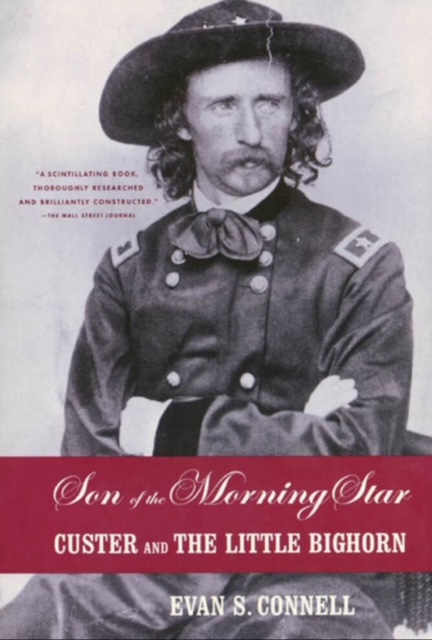
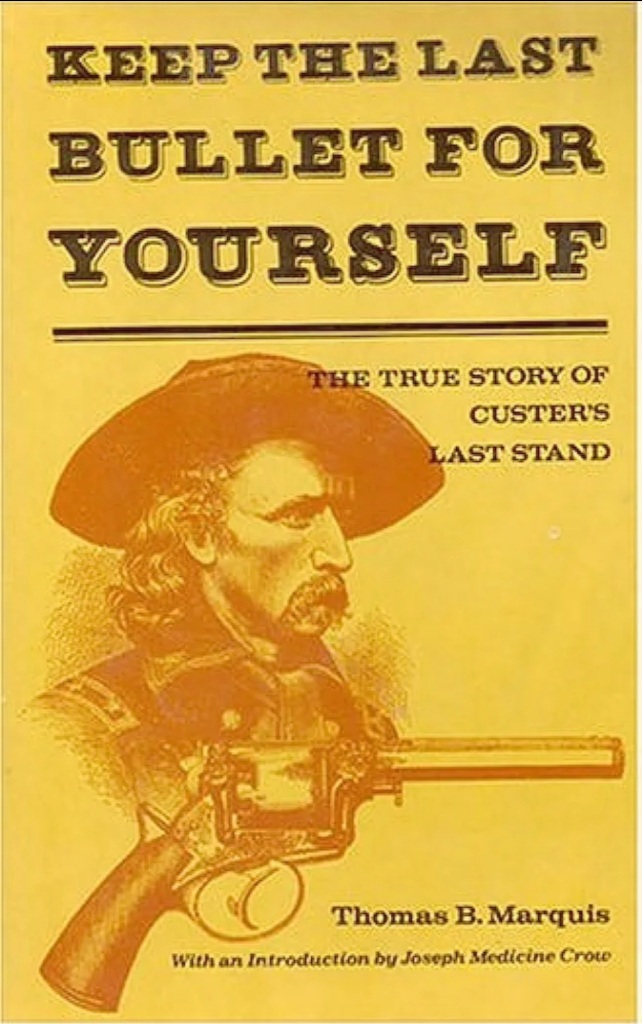
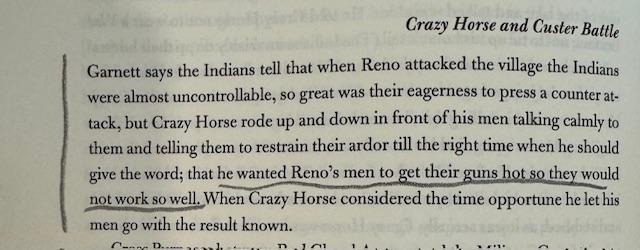
There were no literate survivors to the “last stand” event of June 25, 1876, so we have no firsthand written accounts. What happened was pieced together first from a sort of crime scene investigation. Later, interviews with participants were done, but cultural and linguistic gaps remained. Thomas Marquis, who lived among the Northern Cheyenne and knew many of them, wrote a book whose conclusions were so shocking it couldn’t be published in his lifetime.
Later, art, illustrations, apparently by eyewitnesses emerged, much of it quite vivid.
How about this:
or this:

Those found in:
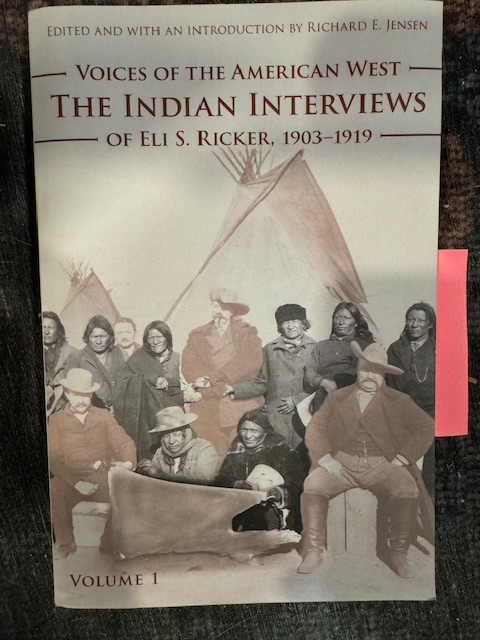
What was this war about, anyway?:
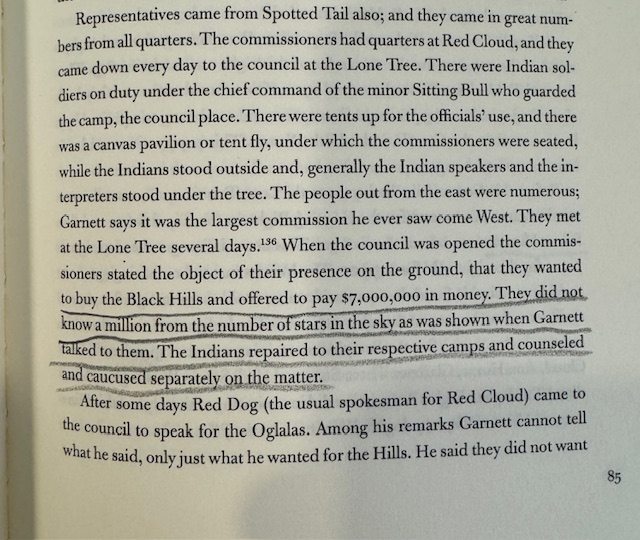
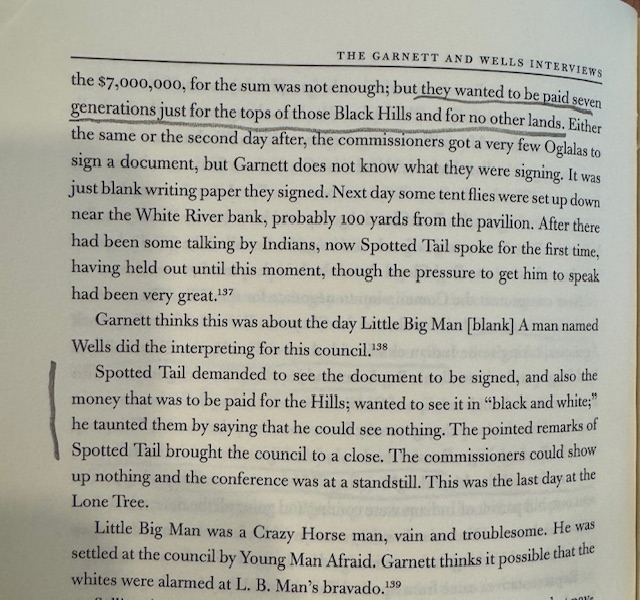
Hundred in the Hand
Posted: July 22, 2023 Filed under: murders, mysteries, native america, the American West, war Leave a comment
The Sioux were of two minds about winktes but considered them mysterious (wakan) and called on them for certain kinds of magic or sacred power. Sometimes winktes were asked to name children, for which the price was a horse. Sometimes they were asked to read the future. On December 20, 1866, the Sioux, preparing another attack on the soldiers at Fort Phil Kearny, dispatched a winkte on a sorrel horse on a symbolic scout for the enemy. He rode with a black cloth over his head, blowing on a sacred whistle made from the wing bone of an eagle as he dashed back and forth over the landscape, then returned to a group of chiefs with his fist clenched and saying, “I have ten men, five in each hand – do you want them?”
The chiefs said no, that was not enough, they had come ready to fight more enemies than that, and they sent the winkte out again.
Twice more he dashed off on a sorrel horse, blowing his eagle-bone whistle, but each time the number of enemy he brought back in his fists was not enough. When he came back the fourth time he shouted, “Answer me quickly – I have a hundred or more.” At this all the Indians began to shout and yell, and after the battle the next day it was often called the Battle of a Hundred in the Hand.
– so writes Thomas Powers in The Killing of Crazy Horse. In a footnote Powers says “This version of the story of the winkte was told to George Bird Grinnell in 1914 by the Cheyenne White Elk, who took part in the Fetterman fight when he was about seventeen years old. It can be found in George Bird Grinnell, The Fighting Cheyennes, 237-8.” You can also find White Elk’s testimony in Eyewitness to the Fetterman Fight: Indian Views, edited by John H. Monnett and published by the University of Oklahoma Press.
On the morning of the 21st ultimo at about 11 o’clock A.M. my picket on Pilot hill reported the wood train corralled, and threatened by Indians on Sullivan Hills, a mile and a half from the fort. A few shots were heard. Indians also appeared in the brush at the crossing of Piney, by the Virginia City road…
Brevet Lieutenant Colonel Fetterman also was well admonished, as well as myself, that we were fighting brave and desperate enemies who sought to make up by cunning and deceit, all the advantages which the white man gains by intelligence and better arms.
Hence my instructions to Brevet Lieutenant Colonel Fetterman, viz: – “Support the wood train, relieve it and report to me. Do not engage or pursue Indians at its expense. Under no circumstances pursue over the ridge viz; Lodge Trail Ridge, as per map in your possession.”
At 12 o’clock firing was heard towards Peno Creek, beyond Lodge Trail Ridge. A few shots were followed by constant shots, not to be counted. Captain Ten Eyck was immediately dispatched with infantry and the remaining cavalry and two wagons, and ordered to join Colonel Fetterman at all hazards.
The men moved promptly and on the run, but within little more than half an hour from the first shot, and just as the supporting party reached the hill overlooking the scene of action, all firing ceased.
Captain Ten Eyck sent a mounted orderly back with the report that he could see and hear nothing of Fetterman, but that a body of Indians, on the road below him, were challenging him to come down, while larger bodies were in all the valleys for several miles around.
Moving cautiously forward with the wagons, evidently supposed by the enemy to be guns, as mounted men were in advance, he rescued from the spot where the enemy had been nearest, forty nine bodies, including those of Brevet Lieutenant Colonel Fetterman and Captain F.H. Brown. …
The following morning, finding genuine doubt as to the success of an attempt to recover other bodies, but believing that failure to rescue them would dishearten the command and encourage the Indians who are so particular in this regard, I took eighty men and went to the scene of action..
The scene of action told its story. The road on the little ridge where the final stand took place was strewn with arrow heads, scalps, poles and broken shafts of spears. The arrows that were spent harmlessly from all directions, showed that the command was suddenly overwhelmed, surrounded and cut off while in retreat. Not officer or man survived. A few bodies were found at the north end of the divide over which the road runs just below Lodge Trail Ridge.
…
Fetterman and Brown had each a revolver shot in the left temple. As Brown always declared he would reserve a shot for himself as a last resort, so I am convinced that these two brave men fell, each by the other’s hand, rather than undergo the slow torture inflicted upon others…
The officers who fell believed that no Indian force could overwhelm that number of troops well held in hand.
…
Pools of blood on the road and sloping sides of the narrow divide showed where Indians bled fatally, but their bodies were carried off. I counted sixty five such pools in the space of an acre, and three within ten feet of Lieut. Grummond’s body.
At the northwest or further point, between two rocks, and apparently where the command first fell back from the valley, realizing their danger, I found citizen James S. Wheatly and Isaac Fisher of Blue Springs Nebraska, who, with “Henry rifles”, felt invincible, but fell, one having one hundred and five arrows in his naked body.
The widow and family of Wheatly are here. The cartridge shells about him, told how well they fought.
…
…
I was asked to “send all the bad news”. I do it as far as I can. I give some of the facts as to my men whose bodies I found just at dark, resolved to bring all in viz: –
Mutilations
Eyes torn out and laid on the rocks.
Noses cut off.
Ears cut off.
Chins hewn off.
Teeth chopped out.
Joints of fingers. [sic]Brains taken out and placed on rocks with other members of the body.
Entrails taken out and exposed.
Hands cut off.
Feet cut off.
Arms taken out from socket.
Private parts severed and indecently placed on the person.
Eyes, ears, mouth, and arms penetrated with spear heads, sticks and arrows.
Ribs slashed to separation with knifes.
Sculls [sic] severed in every form from chin to crown.
Muscles of calves, thighs, stomach, breast, back, arms and cheek, taken out.
Punctures upon every sensitive part of the body, even to the soles of the feet and palms of the hand.All this only approximates to the whole truth.
so wrote Colonel H. B Carrington in his report dated Jan 3, 1867, which you can find for yourself here if you’re so inclined.
Fetterman’s march ended on a knoll beside U.S. 87 a few miles below Sheridan—less than a hundred miles from Custer’s blind alley. Today a rough stone barricade encloses the site. A flagpole stands beside a cairn emblazoned with a bronze shield and a summary of the disaster. One farmhouse can be seen about a mile up the road, otherwise there is nothing to look at except a line of telephone poles. Not many people use the old highway, traffic cruises along 1-90 some distance east. Very few tourists leave the freeway to commune with the shade of this arrogant officer who, like Lt. Grattan twelve years earlier, thought a handful of bluecoats could ride straight through the Sioux nation. The black iron gate to this memorial frequently hangs open.
Capt. Fetterman was sucked to death by a stratagem antedating the Punic wars. He met a weak party of Oglalas just out of reach. Naturally he chased them. He almost caught them. A few yards farther—a few more yards. It is said that young Crazy Horse was among these decoys.
Meanwhile, the woodcutters got back safely. Fetterman could not have been very bright because two weeks earlier the Sioux just about bagged him in a similar ambush. From that experience he learned nothing. He entered the trap again. Why? Because he was new to the frontier, because of constitutional arrogance, perhaps because he had been educated at West Point to assume that one American soldier could handle a dozen savages. And he might possibly have been enraged by the decoys shouting in English: “You sons of bitches!”
Dunn, whose ponderous history of these sanguine days appeared in 1886, claims that many years after the fight he was shown an oak war club bristling with spikes—still clotted with blood, hair, and dried brains—which the Oglalas used on Fetterman’s troops. He does not excuse Fetterman, but at the same time he has no very high opinion of Col. Carrington, whom he labels a dress-parade officer. Carrington should not have been assigned to the frontier, says Dunn, he should have been teaching school: “He built a very nice fort, but every attack made on him and his men, during the building, was a surprise. There is nothing to indicate that he ever knew whether there were a thousand or only a hundred Indians within a mile of the fort. He seems to have disapproved of Indians. Perhaps he would have ostracized them socially, if he could have had his way.”
Two experienced civilians, James Wheatley and Isaac Fisher, had joined the party in order to try out their new sixteen-shot Henry repeating rifles. These men especially infuriated the Sioux, probably because they punctured a good many of Red Cloud’s finest before being dropped. Identification was tentative because their faces were reduced to pudding, and one of them—scholars disagree as to which—had been spitted with 105 arrows.
…
John Guthrie was one of the first troopers on the scene. He noted his impressions in a convulsive, agitated style. He wrote that the command lay on the old Holiday coach road near Stoney Creek ford just over a mile from the fort—which is not quite accurate, the true distance being at least twice that far.
The fate of Colonel Fetterman command all my comrades of the detail could see, the Indians on the bluff, the silver flashed with the glorious sunshine, flashed in the hair of the skulking Indians carrying away the clothing of the butchered, with arrows sticking in them, and a number of wolves, hyenas and coyotes hanging about to feast on the flesh of the dead men’s bodies. The dead bodies of our friends at the massacre lay out all night and were not touched or disturbed in any way again, and the cavalry horse of Co. C 2nd, those ferocious and devourers of bodies, did not even touch. Another rather peculiar feature in connection with those massacres is that it is thought by some that those wild animals that eat the dead bodies of the Indians are not so apt to disturb the white victims, and this is accounted for by the fact that salt generally permeates the whole system of the white race, and at least seems to protect to some extent even after death, from the practice of wild animals. Twenty four hours after death Dr. Report at Fort detailed we start to load the dead on the ammunition, all of the Fetterman boys huddled together on the small hill and rock some small trees nearly shot away on the old coach road, near the battle field or Massacre Hill, ammunition boxes we packed them, my comrades on top of the boxes terrible cuts left by the Indians, could not tell Cavalry from the Infantry, all dead bodies stripped naked, crushed skulls, with war clubs ears and noses and legs had been cut off, scalps torn away and the bodies pierced with bullets and arrows, wrist feet and ankles leaving each attached by a tendon. We loaded the officers first. Col. Fetterman of the 27th Infantry, Captain Brown of the 18th Infantry and bugler Footer of Co. C 2nd Cavalry were all huddled together near the rocks, Footer’s skull crushed in, his body on top of the officers … . Sargeant Baker of Co. C 2nd Cavalry, a gunnie sack over his head not scalped, little finger cut off for a gold ring; Lee Bontee the guide found in the brush near by the rest called Little Goose Creek, body full of arrows which had to be broken off to load him … . Some had crosses cut on their breasts, faces to the sky, some crosses cut on the back, face to the ground, a mark cut that we could not find out. We walked on top of their internals and did not know it in the high grass. Picked them up, that is their internals, did not know the soldier they belonged to, so you see the cavalry man got an infantry man’s gutts and an infantry man got a cavalry man’s gutts … .
Only one man, bugler Adolph Metzger, had not been touched. His bugle was so badly dented that he must have gone down swinging it like a club, and for some reason the Indians covered his body with a buffalo robe.
Years later an Oglala named Fire Thunder, who had been sixteen at the time, described with eloquent simplicity the Indian trap. He said that after finding a good place to fight they hid in gullies along both sides of the ridge and sent a few men ahead to coax the soldiers out. After a long wait they heard a shot, which meant soldiers were coming, so they held the nostrils of their ponies to keep them from whinnying at the sight of the American horses. Pretty soon the Oglala decoys came into view. Some were on foot, leading their ponies to make the soldiers think the ponies were tired. Soldiers chased them. The air filled with bullets. But all at once there were more arrows than bullets—so many arrows that they looked like grasshoppers falling on the soldiers. The American horses got loose, Fire Thunder said. Several Indians went after them. He himself did not because he was after wasichus. There was a dog with the soldiers which ran howling up the road toward the fort, but died full of arrows. Horses, dead soldiers, wounded Indians were scattered across the hill “and their blood was frozen, for a storm had come up and it was very cold and getting colder all the time.” Then the Indians picked up their wounded and went away. The ground felt solid underfoot because of the cold. That night there was a blizzard.
– so says Evan S. Connell in Son of the Morning Star.
American Horse (the elder?) drew a representation of the event in a winter count that’s now in the collection of the Smithsonian:

Red Cloud and other Oglala Sioux who took part in that whirlwind affair talked of it afterward to Captain James Cook, who resided for many years near their Pine Ridge Agency in South Dakota. Cook says they told him that the white soldiers seemed paralyzed, offered no resistance, and were simply knocked in the head. Old Northern Cheyenne Indians who were there have talked of it to the author. They say that Crazy Mule, a noted Cheyenne worker of magic, performed one of his miracles on that occasion. He caused the soldiers to become dizzy and bewildered, to run aimlessly here or there, to drop their guns, and to fall dead.
– Thomas Marquis in Keep The Last Bullet For Yourself, a valuable source with a provocative title. The manuscript was only published years after Marquis died. Marquis was a doctor on the Northern Cheyenne reservation and spoke to many eyewitnesses.

Marquis hearing from the old scout Tom Leforge, from Marquis wiki page
Eerie events on the American plains.
Picture of the site from Google Street View.
Dead pool
Posted: July 5, 2022 Filed under: the American West, the California Condition Leave a comment
from a June 20, 2022 LA Times piece, “As water crisis worsens on Colorado River, an urgent call for Western states to ‘act now’” by Ian James.
I must admit that as catastrophic as it would be, kind of curious to see how the dead pool would play out. Would they have to shut down Las Vegas?

Meanwhile in Lake Mead, they keep discovering weird stuff as the water level sinks. There was the dead body found in a barrel:
Investigators are dating the crime to the late 1970s or early ’80s, with KLAS quoting Las Vegas Lt. Ray Spencer as saying, “The victim’s clothes and shoes were sold at Kmart in the mid-to-late 1970s.”
Who were the forensic fashion investigators who put that together? Human ingenuity is remarkable, maybe with that kind of brainpower and creativity we’ll solve the southwestern water crisis before we deadpool.
The Big Room
Posted: June 26, 2021 Filed under: America Since 1945, painting, the American West 2 Comments
Michael Herr wrote Dispatches, he wrote a novel about Walter Winchell, he wrote a short book (an expanded article) about Stanley Kubrick, he collaborated on the screenplays for Apocalypse Now and Full Metal Jacket.
He also wrote the text for The Big Room, a collection of portraits by Belgian artist Guy Peellaert, centered around Las Vegas. Short essays about Howard Hughes, Milton Berle, Judy Garland, Marilyn Monroe, Frank Sinatra, FDR, Richard Nixon, Bugsy Siegel, Nat King Cole, Colonel Tom Parker, Martin & Lewis, more.
When they talk about luck in Las Vegas, it’s just the way they have there of talking about time. Luck is the local obsession, while time itself is a sore subject in the big rooms and casinos. It’s a corny old gag about Las Vegas, the temporal city if there ever was one, trying to camouflage the hours and retard the dawn, when everybody knows that if you’re feeling lucky you’re really feeling time in its rawest form, and if you’re not feeling lucky, they’ve got a clock at the bus station. For a speedy town like Vegas, having no time on the walls can only accelerate the process by which jellyfish turn into barracuda, grinders and dumpers become a single player, the big winners and big losers exchange wardrobes, while everyone gets ready for the next roll. The whole city’s a clock. The hotels change credit lines as fast and often as they change the sheets, and for a lot of the same reasons. The winners and the losers all have identical marks on them, bruised and chewed over by Las Vegas mitosis, with consolation prizes for anybody left who’s not already inconsolable. Don’t laugh, people. It could happen to you.

It’s fantastic.
The big room is not a clearing that anyone should charge into blindly, unarmed. The way in is hard, as dangerous as the approach to King Solomon’s Mines, and obscure as a tomb. In fact, many a headliner has had good reason to compare the room to the tomb, having experienced for themselves the non-contradiction that once you’ve made it here, it’s all over for you.
The jackrabbit
Posted: December 20, 2020 Filed under: animals, art history, California, the American West, the California Condition Leave a comment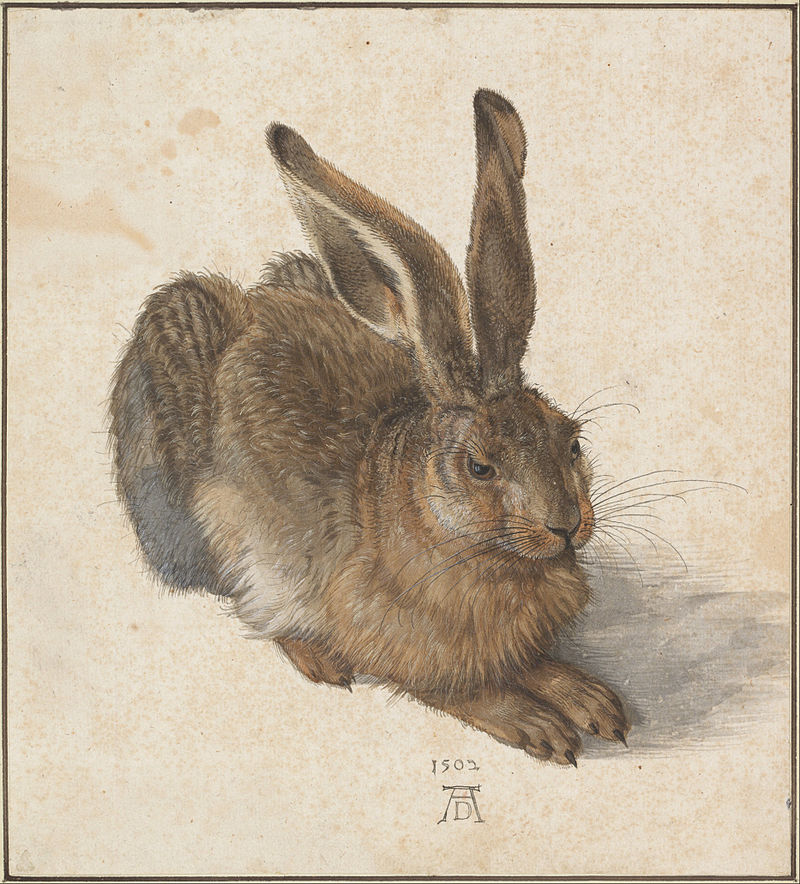
Word went out on the community message board that people were finding dead jackrabbits. Healthy looking jackrabbits that appeared to have just dropped dead. There was a plague going around. A jackrabbit plague. RHD2. Rabbit hemorrhagic disease two. The two distinguishes it from original RHD. Bad news, a plague of any kind. Sure enough, a few days later, I saw on the remote camera on the back porch of my cabin out in the Mojave a bird picking at what looked like the muscles and bones of what used to be a jackrabbit.
I drove out there, and found that yes indeed, this had been a jackrabbit. Whether it had died of plague, I don’t know, it seemed possible. I bagged it for disposal, and poured some disinfectant on the ground, as recommended by the California Department of Fish and Wildlife.
The next day, I found another dead jackrabbit. This jackrabbit did not appear to have been hurt in any way. Her eye was open to me. This jackrabbit appeared to have gone into the shade and died. There was no visible trauma and no blood. I didn’t want to get too close, but this was the best chance to examine a jackrabbit, up close and at rest, that I’d ever had. Usually the jackrabbits are fast and on the move. Once they sense you seeing them, they take off.
I won’t put a picture of it here, in case a picture of a dead jackrabbit would upset you. In a way the lack of damage and the animal’s beauty made it much more sad and eerie. It reminded me of Dürer’s drawing of a young hare. I read the Wikipedia page about Dürer’s drawing, which departs from the usual impartial tone to quote praise for the drawing’s mastery:
it is acknowledged as a masterpiece of observational art alongside his Great Piece of Turf from the following year. The subject is rendered with almost photographic accuracy, and although the piece is normally given the title Young Hare, the portrait is sufficiently detailed for the hare to be identified as a mature specimen — the German title translates as “Field Hare” and the work is often referred to in English as the Hare or Wild Hare.
Dürer’s drawing of a walrus is less acclaimed:
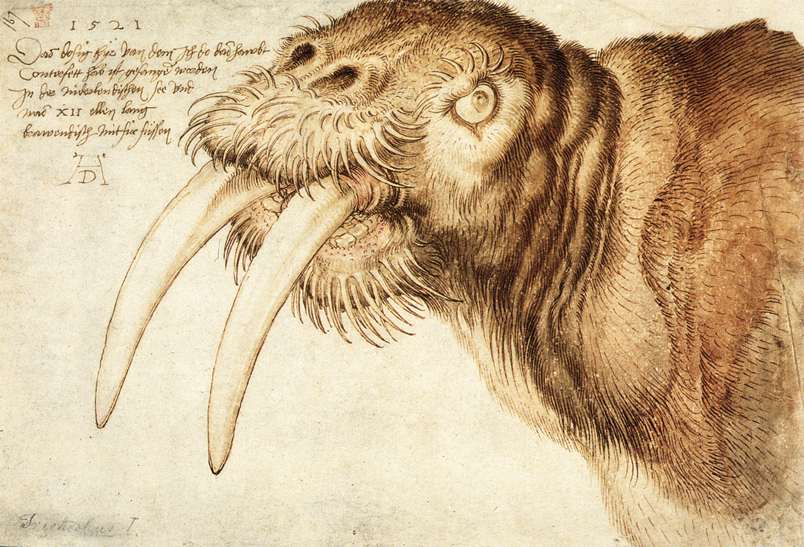
The drawing is generally considered as not successful; and is viewed as curious attempted depiction that is neither aesthetically pleasing nor anatomically true to life. Art historians assume the artist drew it from memory having viewed a dead example during a 1520 visit to Zeeland to see a stranded whale which had decomposed before his arrival. Referring to the depiction departure for nature, Durer’s animal has been described as “amusing…it looks more like a hairless puppy with tusks. When Dürer drew from life his accuracy was unquestionable, but he had only briefly seen a walrus, and had only fleeting memory and an elaborate verbal description from which to reconstruct the image”.
The jackrabbit is very similar to the European hare. The suggestion of the magical power of hares is a common theme in Celtic literature and the literature and folklore of the British Isles. We all remember the March Hare.
Most Americans are confused as to just what hares are, chiefly because we are accustomed to calling some of them jackrabbits. Biologically, the chief differences between hares and rabbits are that hares are born with hair and open eyes and can hop about immediately, while rabbits are naked, blind and helpless as birth.
I learned from this book:

which contains recipes for hares, including jugged hare, hasenpfeffer, and hare civit.

Of all the game animals you can hunt in California: elk, wild big, bear, turkey, bighorn sheep, deer, duck, chukar, dove, quail, the jackrabbit alone can be hunted all year round*. There is no season, and there’s no limit. On one of my first trips to California, I was taken out to the desert with the Gamez boys on a jackrabbit hunt. We only saw a few jackrabbits. Nobody got off a good shot at one. I doubt we really wanted to kill one, we just wanted to drive around the desert, shoot guns, and have fun, which we did very successfully.
During the pandemic I got my California hunting license, you could do it entirely online due to Covid restrictions. But I don’t intend to hunt jackrabbits, I don’t want to be like Elmer Fudd.

The meat is said to be quite dry, tough, and gamey. Most recipes call for long simmerings.
If you ever find out in the desert where you must hunt a jackrabbit for food, here’s the Arizona Game and Fish Department telling you how to butcher one.
* non-game animals, like weasels, you can go nuts
The Killing of Crazy Horse by Thomas Powers
Posted: September 12, 2020 Filed under: Custer, history, Indians, the American West Leave a comment
This book is fantastic. I read this like a thriller. I bought it when it came out, mainly just out of respect to the project itself. Powers took this strange and tragic incident that happened in 1877 at a dusty fort in northwestern Nebraska and produced a thick, apparently exhaustive, densely annotated book.
Crazy Horse, out of options, was persuaded to come into Camp Robinson, where it soon became clear he was going to be locked up. When he saw that he was being led into the guardhouse, he resisted, and in the struggle that followed he was stabbed. That night he died. That’s the gist of the story, what else is there to say, really?
Well, from time to time I’d open this book up and read a bit of it and always I found something curious or engaging that I wanted to know more about. Finally, summer vacation, I just decided to start at the beginning and read the whole thing.
The Little Bighorn event had my attention from when I first heard about it. Cowboys vs Indians. The setting: “a dusty Montana hillside.” A cavalry unit, wiped out to the last man. Custer, the boasting blowhard, his luck had never run out, and then it did. No survivor to tell the tale (with the exception of the alleged lone horse survivor, Comanche). The shock when the survivors of Reno’s stand a few miles away rode among the bodies days after (“how white they look!”).
The classic in this field is Son of the Morning Star, by Evan S. Connell.

How cool was Evan S.? source.
Maybe my favorite book. Connell doesn’t just tell us what happened, he follows the threads of how we might know what happened. The difficulty and ridiculousness of reconciling these accounts from often drunk, bitter, confused or otherwise untrustworthy characters of the American West.
But Powers has a great deal to add to the story. Take for example the awls of the Cheyenne. If you’ve read much about the Little Bighorn, you’ve heard that after the battle, some Cheyenne women recognized Custer’s body. They punctured his ears with what’re sometimes described as sewing needles, so he’d hear better in the next life. Here’s Powers, not just adding detail but evoking a way of life:
Every Cheyenne woman routinely carried on her person a sewing awl in a leather sheath decorated with beads or porcupine quills. The awl was used daily, for sewing clothing or lodge covers, and perhaps most frequently for keeping moccasins in repair. The moccasin soles were made of the heavy skin from a buffalo’s neck; this was the same material used for shields and it was prepared the same way – not tanned, but dried into rawhide. Pushing an awl through this hide required strength. “The making and keeping in repair of moccasins was a ceaseless task,” noted Lieutenant Clark in his notes for a book on the Indian sign language. “The last thing each day for the women was to look over the moccasins and see that each member of the family was supplied for the ensuing day.” In the many photos of the Plains Indians women taken during the nineteenth and early twentieth century their hands are notable for thickness and strength.
In the early days the awls of the Plains Indians consisted of a five- or six-inch sliver of bone, polished to a fine, slender point at one end for piercing leather, and rounded at the other to fit into the palm of the hand for pushing through tough animal hides. In later times Indian women acquired awls of steel from traders. It will be recalled that Custer’s wife, Elizabeth, had once worried that Mo-nah-se-tah would pull out a knife concealed about her person and stab her husband to death.
The Custer fight was just one occasion when Crazy Horse showed his kind of genius for cavalry battle. It looms over this story.
In a New Yorker capsule review of this book, it’s claimed:
Powers, who admits to a childhood passion for Indians, lovingly details spells and incantations—the importance of burning an offering in the proper way, even during a surprise attack; the right time to make use of a small bag of totems—but gives little insight into the larger meaning of these gestures.
This is totally ridiculous. One of the great strengths of Powers book is the care he takes with Sioux religion:
To speak of ultimate things like dying, death, and the spirit realm beyond this world, the Sioux used a kind of poetry of indeterminacy. They explained what they could and consigned the rest to a category of things humans cannot know, or had perhaps forgotten. There was no single correct way to explain these matters, and the hardest of all was to explain the wakan. Anything wakan was said to be sacred or powerful. The Oglala shaman Napsu (Finger) told a white doctor, “Anything that has a birth must have a death. The Wakan has no birth and it has no death.”
Powers never fails to help us see Crazy Horse in the context and worldview in which he saw himself.
This is a book where even the footnotes are interesting:


Now, be warned, this is a serious book. At one point I was reading it for about four hours a day and it still took me more than a week. I’m not sure this is a book for the general reader, although I’d be curious how it reads to someone who wasn’t very familiar with the Plains Indian Wars. If you’re such a reader, and you give it a try, write us!
Just the names alone: Crazy Horse’s father, who became Worm. No Water, They Are Afraid of Her, Grabber, Plenty Lice, Whirlwind, Rattle Blanket Woman.
Via an ad on Drudge Report we learn that Bill O’Reilly has a book out called Killing Crazy Horse. I doubt it will top this one. I associate O’Reilly with dishonesty and bullying, whereas Powers demonstrates in his book an integrity and devotion to taking care with the material.
Powers’ book led me to this one:

which is reigniting a passion for Ledger Art.
This is the death song Crazy Horse is said to have sung after he was wounded:

You gotta be careful or you’ll spend your whole life thinking about this stuff. People have done it!
Bob Dancer
Posted: October 6, 2017 Filed under: the American West Leave a comment
fascinated by this quote in this New York Times article about the Vegas shooter.
Made me think about Addiction By Design which we discussed here. Would love to hear Natasha Dow Schüll’s take on this guy.
Ansel in Playboy
Posted: July 20, 2017 Filed under: art history, photography, the American West, the California Condition Leave a comment
I’ll explain it this way: Both William Henry Jackson and Edward Weston photographed the American West extensively. But in my opinion, only Weston’s photographs qualify as art. Jackson, for all his devotion to the subject, was recording the scene. Weston, on the other hand, was actually creating something new. In his work, subject is of secondary importance to the total photograph. Similarly, while the landscapes that I have photographed in Yosemite are recognized by most people and, of course, the subject is an important part of the pictures, they are not “realistic.” Instead, they are an imprint of my visualization. All of my pictures are optically very accurate–I use pretty good lenses–but they are quite unrealistic in terms of values. A more realistic simple snapshot captures the image but misses everything else. I want a picture to reflect not only the forms but what I had seen and felt at the moment of exposure.
Playboy: Give us an example.Adams: My Moonrise, Hernandez, New Mexico has the emotion and the feeling that the experience of seeing the actual moonrise created in me, but it is not at all realistic. Merely clicking the camera and making a simple print from the negative would have created a wholly different–and ordinary–photograph. People have asked me why the sky is so dark, thinking exactly in terms of the literal. But the dark sky is how it felt.
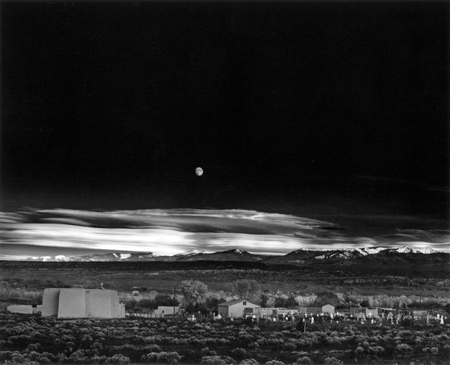
When photographer Alfred Stieglitz was asked by some skeptic, rather scornfully, “How do you make a creative photograph?” he answered, “I go out into the world with my camera and come across something that excites me emotionally, spiritually or aesthetically. I see the image in my mind’s eye. I make the photograph and print it as the equivalent of what I saw and felt.” That describes it well. What he called seeing in the mind’s eye, I call visualization. In my mind’s eye, I am visualizing how a particular revelation of sight and feeling will appear on a print. If I am looking at you, I can continue to see you as a person, but I am also in the habit of shifting from that consciously dimensional presence to a photograph, relating you in your surroundings to an image in my mind. If what I see in my mind excites me, there is a good chance it will make a good photograph. It is an intuitive sense and also an ability that comes from a lot of practice. Some people never can get it.

Playboy: When did you know you could accomplish it?Adams: I had my first visualization while photographing Half Dome in Yosemite in 1927. It was a remarkable experience. After a long day with my camera, I had only two photographic plates left. I found myself staring at Half Dome, facing the monolith, seeing and feeling things that only the photograph itself can tell you. I took the first exposure and, somehow, I knew it was inadequate. It did not capture what I was feeling. It was not going to reflect the tremendous experience. Then, to use Stieglitz’ expression, I saw in my mind’s eye what the picture should look like and I realized how I must get it. I put on a red filter and figured out the exposure correctly, and I succeeded! When I made the prints, it proved my concept was correct. The first exposure came out just all right. It was a good photograph, but it in no way had the spirit and excitement I had felt. The second was Monolith, the Face of Half Dome, which speaks for itself.

More:
They were the ones Weston called the fuzzy-wuzzies. They would go out into the street and find some old bum with a matted beard, and they’d get a tablet of Braille and make the old man put his fingers on the Braille. They would place him in an old chair, looking up through a cloud of cigarette smoke that was illuminated by a spotlight. The title would be Mine Eyes Have Seen the Glory. That must have been done a thousand times. There were also slimy nudes.

I am an Ansel Democrat:
Playboy: You said that earlier. We assumed you were speaking rhetorically. Weren’t you?Adams: Definitely not. We are on a disaster course. A revolution may happen first; and, of course, that may be a disaster anyway. I don’t say it would be a Soviet revolution, but it could very well result in a different order of society. It could be a socialist setup that might work for a while. We don’t know. The point is, I think there may be a revolution if there is not greater equality given to all citizens. We have consistently considered the employer, especially the large corporations, as the most valuable part of the American society. We have consistently overlooked the enormous importance of the farmer, the technician, the educator, the artist, the laborer. I’m not calling for a revolution; I’m calling for greater equality to all citizens. If that doesn’t happen, something will.You see, I believe in a Federalism under which you would pay your taxes to a properly elected and conducted central Government that would, in turn, provide essential services–which would include medical care and other essentials–to the population. I do think there is a basic obligation for everyone to make his maximum contribution to society, but we talk about opportunity for everyone, and the fact is that it is perfectly obvious that equal opportunity does not exist. It’s about time we woke to that fact and clarified the whole social-political structure. Or we’ll be awakened.Remember, ten percent unemployment, no matter how high that is, is an average. There are places and segments of the population with much higher unemployment. People will not continue to tolerate those conditions. What we need is a new set of political commandments that call to attention some of the basic provisions of the Constitution that are often overlooked by our contemporary leaders. There are inalienable rights that are supposed to be guaranteed. It is absolutely criminal that our Government has consistently supported rightist governments that deny citizens’ rights while being paranoid about any liberal concept, which is the concept upon which our country was founded. But, remember, it took a revolution here.

And finally, his martini recipe:
Playboy: While we’re on the subject, that is some strong martini we’ve sampled. Will you share your recipe with us?Adams: The martini I am drinking now is simply diluted–that way, I can have several. But the ones you’re sipping come from a Hotel Sonesta bartender in Cambridge. You take a good-sized glass and fill it with fine vermouth. Then you marinate some big lemon peels in there for days. As the vermouth evaporates or is used up, replenish it. All you need is a glass, ice, vodka and a lemon peel. Rub the lemon peel around the rim of the glass, drop it in, and you have a very dry martini.

Public Land, Part Two: What Happened with H. R. 621
Posted: February 12, 2017 Filed under: America, politics, the American West, the California Condition Leave a commentWe can’t all be experts on every outrage that’s going to come along. At Helytimes we’ve taken on the issue of
Our Public Land

up in the national forest
the land owned by the US government in the form of national parks, national forests, national monuments, and much more.’ The land we, the American People, own together, in other words.
Part One covered HJ Res 46, which proposes to ease up the rules for oil, gas, and mineral drilling and extraction in our national parkland.
Part Two:
Victory on H. R. 621 and What We Can Learn From It
Meet Utah Congressman Jason Chaffetz
You may have heard of him, he was in the news this week catching hell at his town hall:
You may have seen some these videos on Twitter.
Chaffetz is an interesting character.
- Born to a Jewish family in California
- he was the placekicker on BYU’s football team.
- Married a Mormon woman and converted to Mormonism.
- Utah campaign manager for Michael Dukakis in 1988
- at some point he became a Republican. Possibly after meeting Ronald Reagan in 1990 (when, remember, Reagan had a decent degree of dementia)
- Ran an aggressive Tea Party-style primary campaign in 2008 against a longtime Utah Republican, Chris Cannon, and knocked him out
- An aggressive Benghazi investigator
- Was all over the map on Trump: endorsing, unendorsing. In the end he did vote for him
- Has made it difficult for the residents of Washington DC to implement the legalization of marijuana they voted for
Here’s a funny article by Thomas Burr in the Salt Lake City Tribune about Chaffetz involving himself in DC local politics, and then getting payback where some DC politicians are like “fine Utah bitch you gonna tell us how to run our city then help us fix our potholes.”
Today though, we’re going to focus on a bill he introduced that comes up in the town hall.
H. R. 621: Story of a Victory
On Jan 24, Chaffetz introduced H. R. 621, which he titled “Disposal of Excess Federal Lands Act of 2017” which proposed to “dispose” – sell off – some land that is owned by you and me.

“The Cosumnes River Preserve is home to California’s largest remaining valley oak riparian forest, and is one of the few protected wetland habitat areas in the state.” Photo on BLM instagram by the legend, Bob Wick
Let’s back up.
Do the Republicans Want To Sell Off Our Land?


Is this true? Will Trump / The GOP Sell Off Our Public Land?!

JTree by Helytimes
My take: they definitely tried to do so. Given nearly complete power after the 2016 election, it was a top priority for several Republicans.
The rush to sell off public land has been beaten back, for now.
There’s a lot to learn from what went down about how to win against the Republican Party of Donald Trump.
Bias: Love for national lands
I love national lands. I love national parks and national forests and national historic sites and national seashores. I love national monuments and national battlefields.

Minuteman National Historical Park

from Acadia National Park’s Instagram

Crater Lake
The best of the United States is on display in a US Park Service uniform.

from the NPS instagram
The National Parks are the gems. Most federal land is not like this at all.
How much land does the federal government
– the US –
– us –
own?
The federal government owns a huge amount of land. For instance, the federal government owns about 84% of the total land area of Nevada.

Here is federal land ownership in California:

The federal government owns 47% of California.
As you can see, this is a much different issue for some states than others. Here is Utah:

The feds own 66.5% of Utah.

from Boston Kayaker
The feds own a mere .8% of Rhode Island, mainly coastal scrubland.
Getting all that from this great piece in the Deseret (UT) News by Jackie Hicken.
All told the federal government owns about 28% of the nation’s total surface, 2.27 billion acres.
Isn’t that crazy?
Here is a reasonable position:
The federal government shouldn’t own that much land. It’s not in the Constitution as a job for the federal government to own a buncha land.
Here’s a sample of that take:
Now: I think Lars Larson may even have a point about cutting down forests. Forestry is a science, I’m not well-informed enough to opine on it except to say I believe any forester will tell you burns are part of a life cycle of a forest.
But I disagree with Lars Larson on his first part. Because when we say “the government owns this land,” really we mean we own this land. What could be more “the people’s land” than land we all own together? “Give the people’s land back to the people?” It already is ours!
You and me. The taxpayers. The voters. The government is just us.
What Are The Kinds Of Our Lands?
Here are the percentages of our land, broken down by which agency manages them for us. The “Big Five”:

Proud of this chart I made.
(getting my data from here, from 2013. The pie would be slightly bigger if we included the Department of Energy, and there’s the Indian reservations, but that’s a whole other thing.)
As you can see, the National Park Service owns a mere 13% of US federal land.
National Park Service handles:
- National Parks
- National Monuments
- National Preserves
Plus battlefields, historic sites, seashores, etc. As I understand it, the only way to get rid of these would be to pass a bill through both houses of Congress and have the president sign it. A cool power of the President is that he can create a National Monument out of any existing federal land. Obama did this often.
The Forest Service under the Department of Agriculture handles:
our National Forests.
The US Fish and Wildlife Service handles:
our National Wildlife Refuges. (Their slice of the pie gets way bigger if you count marine acres.)
There are National Wildernesses, administered by various different folks because they’re usually part of some other land.
There’s lots of land owned by the Department of Defense,
Air Force, Marine Corps, and Army bases and such. The Navy owns a surprising amount of inland land here in California for dropping bombs on.

And there is a bunch of leftover extra land, BLM land, managed by the Bureau of Land Management.
The BLM owns about 47% of the west and one-eighth of the land of the United States.
(Here’s a good Gizmodo article by Wes Siller about this same topic).

The biggest chunk of public land is BLM land
On a trip to California in 2002 or so the Jeppson-Gamez brothers took me to some BLM land. I learned you can shoot a gun and drive a Jeep and do whatever the fuck you want on BLM land. What a great privilege as an American.
Here’s some BLM land in California:

from BLM’s instagram
Here are some facts:
A lot of federal land is already used, mined, logged, grazed, and exploited now
There’s logging in national forests, and mining and grazing on BLM land. The major operating principle for BLM land law is “multi use.” Please correct me if I’m wrong, I’m no expert just an interested citizen, but I believe most BLM rules stem from the Federal Land Policy and Management Act of 1976.
The National Forest Service, National Park Service, and now, the Bureau of Land Management, are commissioned in FLPMA to allow a variety of uses on their land (of greater concern for the BLM, who is the least restrictive in terms of uses) while simultaneously trying to preserve the natural resources in them. This concept is best summarized by the term ‘multiple-use.’ ‘Multiple use’ is defined in the Act as “management of the public lands and their various resource values so that they are utilized in the combination that will best meet the present and future needs of the American people.”
Who should handle this junk land has a long, contentious history
Here is a readable summary of some history on the subject. Who should own and manage land that looks like this?:

Should the states manage it? In the Depression the states didn’t want it.
Fights over which of the multiple uses should be favored come up all the time. The most newsworthy fight in recent years on this topic, the weird Oregon standoff originated with Nevada rancher Cliven Bundy’s dispute with the BLM over grazing his cattle on their lands:
the dispute started in 1993, when, in protest against changes to grazing rules, Bundy declined to renew his permit for cattle grazing on BLM-administered lands near Bunkerville, Nevada. According to the BLM, Bundy continued to graze his cattle on public lands without a permit. In 1998, Bundy was prohibited by the United States District Court for the District of Nevada from grazing his cattle on an area of land later called the Bunkerville Allotment.
Cliven Bundy refused to recognize federal ownership of the land, claiming it rightfully belonged to Nevada, which would maybe be chiller about letting him graze his cattle there.

Cliven, found on this CNN piece: Cliven Bundy says he’s not racist
This being the USA, Cliven’s stand led to, a few years later, Bundy’s sons sitting around with guns at a remote bird refuge while Dad reflected on his views on “the Negro“:
they abort their young children, they put their young men in jail, because they never learned how to pick cotton. And I’ve often wondered, are they better off as slaves, picking cotton and having a family life and doing things, or are they better off under government subsidy?

Where does the GOP Congress stand on federal land ownership?
All over the place, is the answer.
1) the Republican Party’s platform supports returning some federal land to the states.
See here for a Snopes breakdown of this. Here’s the language on federal land transfer in the Republican Platform:
The federal government owns or controls over 640 million acres of land in the United States, most of which is in the West. These are public lands, and the public should have access to them for appropriate activities like hunting, fishing, and recreational shooting. Federal ownership or management of land also places an economic burden on counties and local communities in terms of lost revenue to pay for things such as schools, police, and emergency services. It is absurd to think that all that acreage must remain under the absentee ownership or management of official Washington. Congress shall immediately pass universal legislation providing for a timely and orderly mechanism requiring the federal government to convey certain federally controlled public lands to states. We call upon all national and state leaders and representatives to exert their utmost power and influence to urge the transfer of those lands, identified in the review process, to all willing states for the benefit of the states and the nation as a whole. The residents of state and local communities know best how to protect the land where they work and live. They practice boots-on- the-ground conservation in their states every day. We support amending the Antiquities Act of 1906 to establish Congress’ right to approve the designation of national monuments and to further require the approval of the state where a national monument is designated or a national park is proposed.
Key word there is “certain”?
I think it’s possible to be passionate about maintaining our treasured national land, and still think some federal land could be better managed by the states.
There’s a lot of wack stuff in the GOP platform, like this:
A Republican administration should streamline personnel procedures to expedite the firing of bad workers, tax cheats, and scammers.
Obviously they’re not worried about the Commander in Chief who won’t release his tax returns. Maybe they will be similarly hypocritical about conveying federally controlled land to states.

Ah-Shi-Sie-Pah Wilderness Study Area in New Mexico
2) the Republican Congress changed rules to allow the federal government to give up land while counting it as “budget neutral”
Meet Rep. Rob Bishop of Utah:

A Republican Congressman. He is apparently responsible for a change in House of Representatives rules. Now, I don’t know anything about House budgeting rules. This article, from The Salt Lake City Tribune, written by Juliet Eilperin, seems fair and clear:
Under current Congressional Budget Office accounting rules, any transfer of federal land that generates revenue for the U.S. Treasury — whether through energy extraction, logging, grazing or other activities — has a cost. If lawmakers wanted to give land-generating receipts to a given state, local government or tribe, they would have to account for that loss in expected cash flow. If the federal government conveys land where there is no economic activity, such as wilderness, there is no estimated cost associated with it.
But House Natural Resources Committee Chairman [Rob] Bishop [Republican Congressman of Utah], who backs the idea of providing state and local officials with greater control over federal land, has authored language in the new rules package saying any such transfers “shall not be considered as providing new budget authority, decreasing revenues, increasing mandatory spending or increasing outlays.”
This was the same rules package that had the ethics loosening thing that got people to call their reps in an effective show of democratic displeasure. Here is a much-tweeted Guardian article on the topic.
There’s lots about public land on Rob Bishop’s website. One issue that seems to bother Rob Bishop in particular is Wilderness Study Areas. And I agree they represent the complex mess of interests when you deal with public land.
A Case Study: How A Wilderness Study Area Becomes A Wilderness
The Wilderness Study Areas are roadless sections of land that the BLM puts a hold on until Congress decides whether to designate them as wilderness or not.
Here’s my personal favorite:

Here’s what Rob Bishop says:
For decades, unsettled land-use designations, such as wilderness study areas, have fueled distrust and acrimony. The uncertainty about the future of these lands created conflict amongst those favoring differing types of uses. The diverse uses of public lands have an important role in making Utah healthy, viable, and inviting. The future of the state depends on a responsible balance of both conservation and development.
There are 86 Wilderness Study Areas in Utah. Myself, I think we should err on the side of keeping wildernesses — once they’re gone, they’ll never come back.
Once you’re a WSA, you either become a Wilderness, federally protected, or you get dropped and you can get chopped up and mineraled and whatnot like any old BLM land. Or you get downgraded to Conservation Area, or some other designation.
The most recent Wilderness Study Area bill I can find in Congress was from last year, when some WSAs inside federal conservation areas were proposed to get dropped. It’s been referred to committee. Here’s an article about it, it sounds like a complicated issue.
You can see how this all gets pretty slow-moving and bureaucratic.
Maybe Rob Bishop has a point
The bottom line of what Rep. Bishop wants to do is made pretty clear on his website:
Congressman Bishop’s views on public land use differ from mine, why should I trust that this is a good faith effort to make new conservation areas?
Congressman Bishop is committed to conservation and economic development as part of the Public Lands Initiative. Throughout his career, Congressman Bishop has had a strong record of both conservation and development. The Cedar Mountain Wilderness area was created in 2006 after Congressman Bishop facilitated a locally-driven, collaborative process similar to the Public Lands Initiative. As a former high school teacher, Congressman Bishop also has pushed for increased energy production in Utah to help support and fund public education. Congressman Bishop is committed to elements of both conservation and development as part of any Public Lands Initiative legislative proposal.
How will the state of Utah benefit from this?
The state of Utah’s public education system will benefit from increased energy and mineral production. Public land users will benefit from the regulatory certainty that comes from congressionally designated lands. Local governments will benefit from revenue generated from multiple use of the land, including recreation, mineral development, and energy production. The outdoor recreation businesses will benefit from the improved certainty about land use and conservation. Future generations will benefit by having responsible policies that utilize the land in the most responsible and reasonable ways that make sense now and into the future.
Here’s more:
Proponents argue, however, that taking the federal government out of the picture will help the budget and offer economic benefits for the many communities located near federally-guarded land.
“In many cases, federal lands create a significant burden for the surrounding communities,” Molly Block, spokeswoman for the House Natural Resources Committee, said. “Allowing communities to actually manage and use these lands will generate not only state and local income tax, but also federal income tax revenues.”
That’s from this UPI article by Stephen Feller and Doug C. Ware.
Look, Rob Bishop’s there in Utah. Maybe he knows best what should happen with this land. In tough Western areas he could see roped off federal preserves with no clear purpose, and point out those could be jobs and money for his district, or even just better managed wilderness under local control.
BUT:
Why shouldn’t disposed-of land be marked as a loss to the federal revenue, when it is? Isn’t this a form of the federal government lying to itself? Lying to its citizens? As an American taxpayer, I don’t see how this rather sneaky accounting change is at all good for me.
Plus what the hell?! This land belongs to us, American citizens. These guys want to sell away our inheritance?
High Desert News‘ Elizabeth Shongren puts it clearly:
Previously, when Congress wanted to transfer public lands managed by the Forest Service, Bureau of Land Management or other federal agency, the Congressional Budget Office, Congress’ research arm, calculated the cost to the U.S. Treasury by computing what revenues the lands provide over 10 years, such as grazing fees or oil and gas royalties. Under House rules, before a bill approving a transfer could be adopted, budget cuts would have to be made in other federal programs equal to the value of that land. The rules change eliminates that budgetary barrier to land transfer bills.
I’d have to explore this more, but I have a feeling the House somehow tied itself into knots on spending and budgetary rules to make various political points, and is trying to untangle this particular aspect so they can get rid of public land.

Can the government sell off our treasured national lands?
Yes, but it’s not that easy.
Let’s start with the BLM. Can the BLM sell off their land? From their website:
How are these lands selected for sale?
The law states that the BLM can select lands for sale if, through land use planning, they are found to meet one of three criteria: 1) they are scattered, isolated tracts, difficult or uneconomic to manage; 2) they were acquired for a specific purpose and are no longer needed for that purpose; or 3) disposal of the land will serve important public objectives, such as community expansion and economic development.
More:
The BLM does not offer much land for sale because of a congressional mandate in 1976 to generally retain these lands in public ownership. The BLM does, however, occasionally sell parcels of land where our land use planning finds disposal is appropriate.
Of the Big Five Agencies, only DoD and BLM lost land between 1990 and 2013 (again, source here). In those years, the BLM went down by 24, 777, 190 acres.
Where did those acres go?
This decline in Alaska is largely the result of the disposal of BLM land, under law, to the State of Alaska, Alaska Natives, and Alaska Native Corporations.
Seems fine to me. The Congressional Research Service goes on:
With regard to disposal, the NPS and FWS have virtually no authority to dispose of the lands they administer, and the FS disposal authorities are restricted.
Last big push to dispose of national lands failed. It was HR 350: State National Forest Management Act of 2015, introduced by Rep. Don Young of Alaska.

Didn’t pass.
HR 621: Story of A Victory
Let’s return to Utah rep Jason Chaffetz:

Which land did he try to sell away?
Great question.
It’s not immediately clear. Chaffetz’s website links to a 1997 report of disposable lands. Ryan Krogh at Men’s Journal identifies some of the choice land included in the 1997 report:
State: Wyoming
County: Sheridan
The Potential Land: 35,200 acres of BLM-managed land in the Powder River Basin, which is just east of the Bighorn Mountains, popular with hikers, campers, horseback riders, and hunters.
Here’s what’s going on on BLM land in the Powder River right now:

Powder River, from a BLM website
State: Wyoming
County: Park
The Potential Land: 27,300 acres surrounding the Shoshone River, a popular fly-fishing stream in northern Wyoming. Most of the BLM-managed land in Park County is downstream of the town of Cody, which sits between the Big Horn, Owl Creek, Bridger, and Absaroka mountain ranges. Tourism is the town’s primary industry.
State: Oregon
County: Harney
The Potential Land: 44,000 acres in a county that’s home to Steens Mountain, a 9,733-foot peak that’s popular with campers and hunters, and Malheur National Forest.
State: New Mexico
County: Catron
The Potential Land: 25,000 acres that contain “cultural resources,” meaning it’s probably home to pueblo ruins. The land is most likely a giant tract southwest of the town of Quemado, and some of the land abuts the Gila National Forest, home to the endangered Mexican gray wolf, the Gila trout, and some of the best elk hunting in the U.S.
State: Colorado
County: Montrose
The Potential Land: 2,105 acres that is home to endangered species and “historic/cultural resources.” The surrounding area contains the Gunnison Gorge, famous for its rafting and fly-fishing trips, and Uncompahgre National Forest, which is home to elk, mule deer, bighorn sheep, and mountain goat.
State: Nevada
County: Elko
The Potential Land: 208,900 acres that contains endangered species, historic resources, and is home to “wetlands/floodplain.” BLM-managed land makes up a giant percentage of land in Elko County, but exactly what land is up for consideration is unclear, or what the effects might be.
State: Arizona
County: Mohave
The Potential Land: 23,525 acres with mining claims and historic resources. A comment attached to the description notes that the land is “classified as habitat for the Desert Tortoise (a sensitive species).”
Now I heard about this, and I was pissed, because this land belongs to me. And you. And us. Any time we wanna go there, it’s there.
And Jason Chaffetz tried to sell it off.
Backcountry Backlash
Well this did not play. Word spread via strong, aggressive groups like Backcountry Hunters & Anglers:

Google HR 621 and you fill find angry, mobilized publicity from groups like TheMeatEater.com, BowHunter.com, WiredToHunt (“Deer Hunting Strategies for the Next Generation”), and TexasBowhunter.com.
There were rallies in Helena, MT and Santa Fe, NM which BHA says drew a thousand people.
Chaffetz backed down by last night — six days after introducing the bill:

What can we learn from the defeat (for now) of HR 621?
- Strong, organized, motivated, attentive citizens can win, easily, on issues that matter.
- Play to a politician’s fears. Jason Chaffetz got to Congress by primarying a guy in his own party. He’s got to watch his back constantly. His greatest fear has got to be somebody doing to him what he did to Chris Cannon, outrunning him on the right.
- Push the pushable. Chaffetz wasn’t moved by people who would never vote for him. He was moved by hunters and fishermen, people who probably would vote for him, as long as he doesn’t fuck them on something they care about.
- Look at the focus on these groups: bow-hunters, meat-eating hunters. They have clear interests, goals, and passions. They follow their issues and inform each other.
- Powerful allies. Look at the sponsors for Backcountry Hunters and Anglers. These are big corporations with big interests in keeping their customers happy and hunting and fishing. Yeti coolers has a partnership with MeatEater.com. What are rich companies that have interests that could align with yours?
- Specific targets. They learned something from all that bow-hunting.
- See how fast and aggressively they responded to the slightest hint of a challenge and you can get an answer to the seemingly baffling question of why gun control bills get crushed so easily. Strong, organized people are paying attention to the slightest threat to their gun rights and they do not let up.
The Trump hurricane has achieved an effect of constantly shifting focus. When we compare what bow-hunters did to the stammering, confused, bafflement of the Hollywood libtards we follow on Twitter, and my own flabbergasted reactions, we realize we have much to learn from Texas bow-hunters on how to stay focused on a few issues that matter to us most.
The biggest lesson:
This issue brought together, on the same side, Joyce Carol Oates:

and these kind of guys:

And the bros on the Texas Bowhunter forums.
They’re both passionate on the same side on this issue.
For me, the strongest takeaway is don’t insist on too much ideological purity.
Build coalitions on issues you care about.
That is the way to win in politics.
Plus who do you think Jason Chaffetz is most scared of?

I’m guessing it’s this kinda guy? (seen here killing a huge deer with a bow and arrow).

This guy and I may have different ideas about what to do with the land we share.
But we share an interest. We can team up.
One of the most illuminating things I read about the election was “David Wong”‘s piece on Cracked.com about the rural vs. urban divide. Here I am very far from Powder River, WY. The odds of me visiting it in the next ten years are small (but real). But here I am allied with people who live near there and use it all the time.
Gotta Hear Both Sides
Look, it’s fair to say maybe we should sell off some public land. The clearest expression I found of this ambiguity was put up by this poster on TexasBowhunter.com — I hope user 175gr7.62 won’t mind me quoting him, I think it’s a valid take (encourage you to read him in context):
I’m torn on it. The Constitutional side of me says the Fed should have never owned it anyway. The Constitution says the government can acquire and retain land necessary for carrying out its enumerated powers. This includes parcels for military bases, post offices and buildings to house federal employees undertaking enumerated functions. I don’t think anything the BLM or Forest Service does counts as anything enumerated. Several Supreme Court cases have said the govt can own it but I think that’s just case law.
The hunter in me said it could be bad if the Feds sell the land because it could be bought by a private citizen who can then prevent its use. That being said, if they sell it and I don’t have the money to buy it that’s my fault…I should have gotten a better education or made better investment decisions.
Tough call.
Reasonable people can disagree on how public land should be managed and who should managed it.
What bothers me, and what puts me on edge, is the sneakiness of what Bishop and Chaffetz appear to be doing.
And the misguided priorities. This is the first thing they got to post-election.
Well, Chaffetz at least got called to the carpet for it.
A Passionate Plea
Here’s a full video of Jason Chaffetz’s town hall. Listen to this guy at 11:39 say our free public lands are all he has.
Please write to us (helphely at gmail or in the comments) if we got something wrong or you have a strong take.
These are complicated issues, I did my best and in good faith but it’s easy to make an error.
In our Next Installment:

Part Three: Strange Allies.
And why this:

is better than this:

O Pioneers!
Posted: November 10, 2016 Filed under: America, history, nature, the American West, writing Leave a comment
Just finished reading:

A strange thing to read, maybe. Here is the story of how I came to read it.
Some years ago, filming the finale of The Office on Dwight Schrute’s farm:

I looked around at the inland Malibu landscape and got to wondering if there could be a show about the pioneers: people who arrived on empty* land and built their lives there.

So as research I picked up the first book I thought of:

Didn’t finish it. Got distracted before I got off the third page, probably at first by my phone and then by my life.
A true Save The Cat
On the first page of O Pioneers!, there is a true Save The Cat situation.

We’re in the middle of a blizzard, and Little Emil’s cat has gone up a telegraph pole, and he’s afraid it’ll freeze:

Reunited
Down in Australia in August, I saw the cool Penguin Classics edition:

and picked it up thinking, eh what the hell I should find out what happened to that cat.
Well, I found out, and I found out what happened to Emil and his sister Alexandra for the next forty years.
I believe an error was made in choosing this quote for the front page:
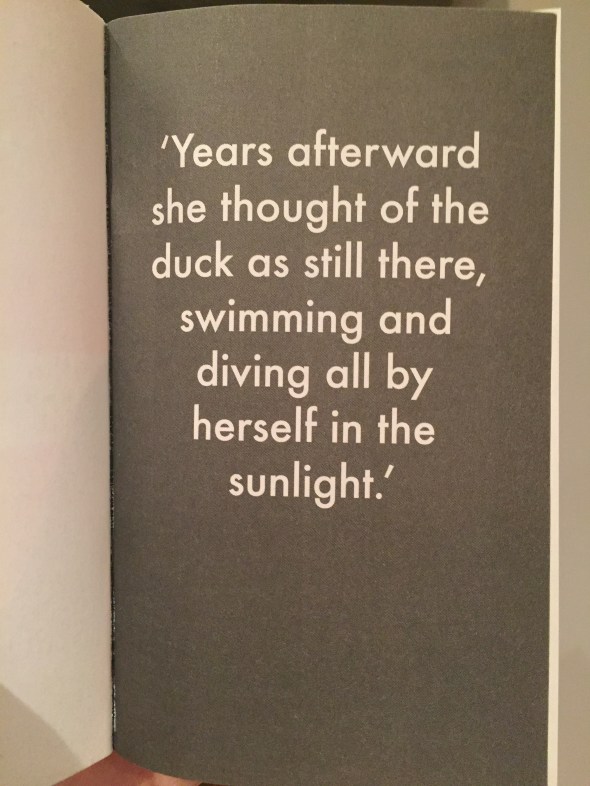
It isn’t the most interesting one from the book. I might’ve chosen this:

Or this:

Or even, if we’re going re: ducks, this:

Or this:

This quote made me think of the news:

Also can’t say that the epigraph is especially sexy:

Perhaps it’s better in the original Polish.

Mickiewicz is bae?
But still I pressed on, and in the end, I gotta give it up to O Pioneers!
The life of Willa Cather
Willa Cather must’ve been quite something. She was born in Gore, Virginia, but as a girl she was brought to Red Cloud, Nebraska:

where she made a real impression:

Was Willa Cather a lesbian?
Willa Cather shot out of Nebraska like a rocket.

The closest relationships in her life were with women, and she lived with one Edith Lewis:

for close to thirty years. Some biographers hesitate to call her a lesbian, though, saying she never identified herself that way.
Willa Cather Memorial Prairie
Willa died in 1947. She has a memorial prairie named after her, it’s the number 2 thing to do in Red Cloud, NE after her house:

it’s cool to have your own prairie
Willa on writing
O Pioneers! still holds up. I found myself moved by it, and it’s short. Cather has a way of summing up loneliness, heartache, longing, compassion, in a few short lines.
I went ahead and got Willa’s collected essays on writing.

Here she tells how she came to write O Pioneers!, her second book:


She wrote in some opposition to the detail-filled writing of Balzac:

Interesting point here:

Red Cloud, Nebraska
Here’s a picture of downtown Red Cloud from Google Maps:

About as solid a Trump country as you will find:
As of 2000 the median income for a household in the city was $26,389, and the median income for a family was $34,038. Males had a median income of $26,364 versus $17,232 for females. The per capita income for the city was $14,772. About 8.4% of families and 13.3% of the population were below the poverty line, including 20.9% of those under age 18 and 10.1% of those age 65 or over.
Brave Companions
David McCullough has something moving to say about Red Cloud and Willa and her other famous book:


from:

I found O Pioneers! very moving and powerful, let me share with you why:
Warning: O Pioneers! spoiler
Skip this if you intend to read the book with suspense in mind.
But I doubt you will. I found this the most moving passage, and worth all the reading. Let me set it up for you:
Emil, he of the lost cat on page 2, grows up under the guidance of his older sister, Alexandra. She’s really the focus of our story. Carl, the local boy who saves the cat, is in love with her, but he can’t really take it out on the plains, so he goes off, and leaves her behind. She’s left to care for her brothers.
Emil, youngest brother, does great. He goes on to college at the University of Nebraska, while Alexandra stays to watch over the farm. All the while Emil’s been in love with a neighbor girl, Marie. She marries another man, though.
Still, Emil and Marie are in love. Eventually Marie’s husband, Frank Shabata, finds his wife and Emil together. In a crazed rage he murders Marie and Emil both.
Alexandra, alone at age forty, is heartbroken, left adrift at the death of her brother. But still, she feels sympathy for Frank Shabata, who’s been sent to prison in Lincoln for his crime.
Alexandra, lost and in pain, decides to go visit Frank in prison. In afternoon/dusk, after arriving in Lincoln, she wanders the campus of the university, thinking of her murdered brother. Desperate for any kind of connection, she runs into a student:

Walt Whitman Reads: America
or
The Whitman Recording
The title of O Pioneers! comes from a poem by Walt Whitman.
Some years ago, a recording of Walt Whitman’s voice, said to have been recorded onto an Edison wax cylinder around 1889 or 1890, was rediscovered.
In these times when it seems maybe we lost our way, nationally, it made me feel good to hear this. Forty-six seconds long:
Bureau of American Ethnology
Posted: August 22, 2016 Filed under: the American West Leave a comment
The picture on the Wikipedia page for the Bureau of American Ethnology is perfect at conveying what exactly was the deal with the Bureau of American Ethnology.
Oh What A Slaughter and Sacagawea’s Nickname
Posted: July 11, 2016 Filed under: adventures, America, the American West, women, writing Leave a comment
Getting pretty close to having read all of Larry McMurtry’s nonfiction. LMcM has a rambling, conversational way in these books, I enjoy it. Here is some previous coverage about his book Hollywood, and his road trip book Roads, and the best one of all imo, Walter Benjamin at the Dairy Queen.
Oh What A Slaughter is definitely worth a read. A good quality of McMurtry and my all time favorite Evan S. Connell is that they really capture the weirdness of history.

How about this, as McMurtry describes the buildup to the Wounded Knee massacre?:


Wovoka / Jack Wilson
How can you not like a book that has this in it?
Sacagawea’s Nickname wasn’t as compelling to me.

It collects essays McMurtry wrote for the New York Review Of Books: a couple about Lewis & Clark, one about the great one-armed explorer/surveyor/ethnographer/proto-environmentalist John Wesley Powell:

But for title alone I was def gonna read it. Like every American kid I was taught about Sacagawea in school, whose name we were told was pronounced “Sack-a Jew-ee-uh.”

Imagine my shock years later when my friend Leila, who was schooled in Oregon and thus had some cred on the issue, told me her name was pronounced “Sack Ahj Way.” Well, sure. How could we know? Both Lewis and Clark, Clark especially, were crazy spellers, so their clues are confusing. From Wiki:
Clark used Sahkahgarwea, Sahcahgagwea, Sarcargahwea, and Sahcahgahweah, while Lewis used Sahcahgahwea, Sahcahgarweah, Sahcargarweah, and Sahcahgar Wea.
From McMurtry:

Anyway let me go ahead and give you a spoiler that Sar car Ja we a’s nickname was Janey.
Like a Hockney painting
Posted: April 9, 2016 Filed under: America Since 1945, art history, Kennedy-Nixon, the American West Leave a comment
JFK checking out a missile test at White Sands, New Mexico.
Trip to Western States: White Sands Missile Range, New Mexico
Cecil Stoughton. White House Photographs. John F. Kennedy Presidential Library and Museum, Boston
San Francisco
Posted: January 7, 2016 Filed under: America Since 1945, assorted, California, San Francisco, the American West, the California Condition, the ocean Leave a comment
Right before Christmas had a chance to visit San Francisco — always great!
In San Francisco you can really feel like you’re halfway in the ocean. 
Finding myself with an idle hour I went to go check out Diego Rivera’s mural Allegory of California over at the City Club in the former Pacific Stock Exchange building. The City Club was all done up for a Christmas party.

Pictures of the mural often leave out the amazing ceiling part:
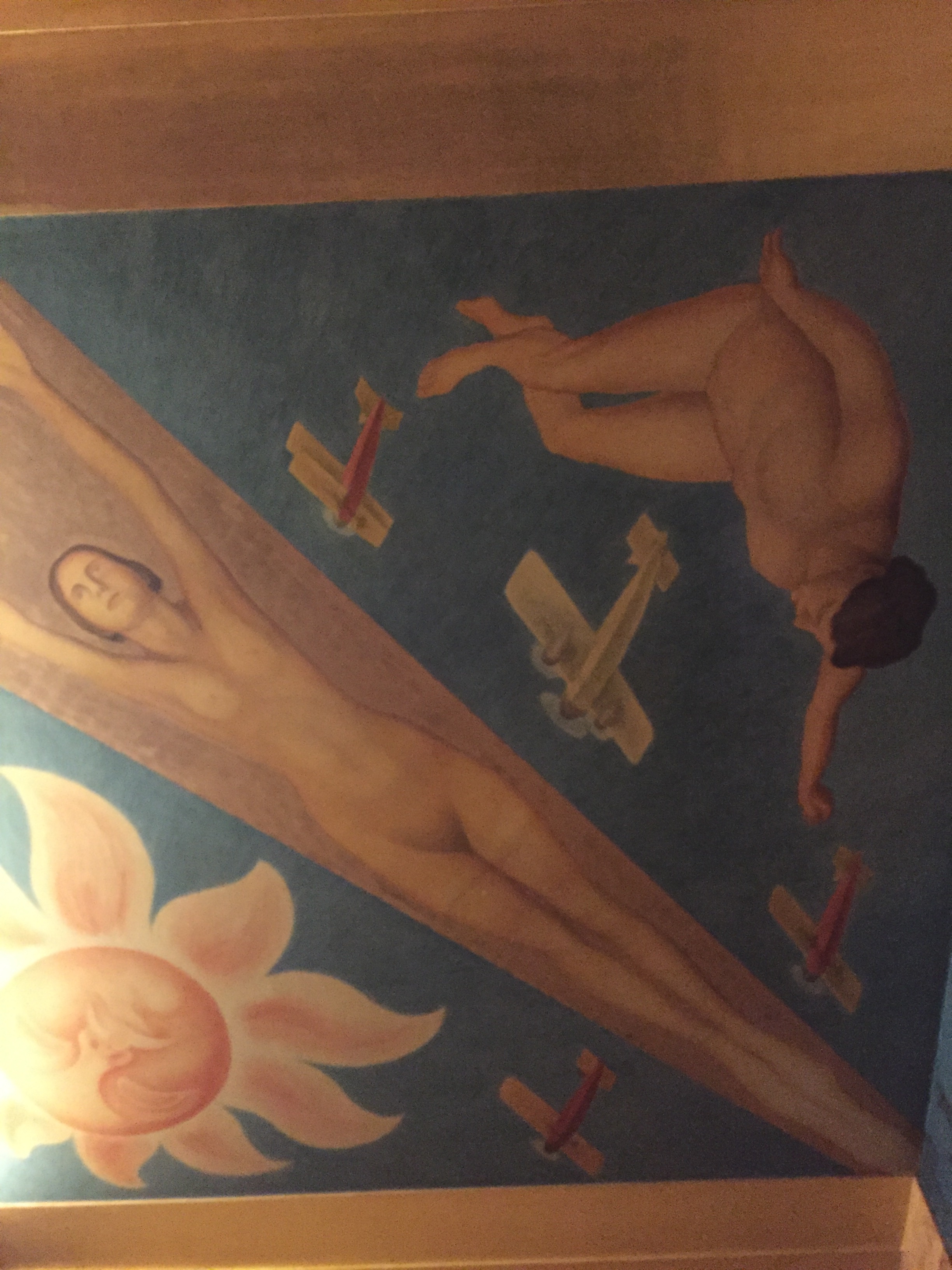
Rivera painted this one in 1931, He modeled the lady on tennis champ Helen Wills Moody, who was at that time one of California’s most famous daughters:

She was a painter herself:
Wills was an artist by avocation. She received a degree in fine arts along with a Phi Beta Kappa key from the University of California, and painted throughout her life. She was delighted to be chosen as the model for Diego Rivera’s two-story mural “The Riches of California,” commissioned for $2,500 in 1930. Wills and the first of her two husbands, the financier Frederick Moody, invited Rivera and his wife, the painter Frieda Kahlo, to a celebratory tea after the mural’s unveiling at the former San Francisco Stock Exchange.
For Wills, who confessed to suffering the intangible pangs of “a restless heart,” tennis and painting were the best antidotes for melancholy. She maintained an artist’s studio at her residences in San Francisco and later in Carmel, once sold 40 paintings for $100 each and illustrated her own articles for The Saturday Evening Post.
Here’s one of her own drawings:
 Lifting that one from San Francisco’s Lost Art Salon. Reader Schoboats calls our attention to a good detail from Wills Moody’s NY Times obit:
Perhaps Wills’s most infamous match, and certainly the one she extolled as the focal point of her playing career, was her only meeting with Lenglen, the queen of the continent, in a much ballyhooed showdown at Cannes in 1926. Lenglen was 26 and tactically superior; Wills was 20 and physically stronger. Lenglen won the raucous encounter, 6-3, 8-6.
There was a prizefight atmosphere, with tickets scalped at a then-shocking rate of $50 each, and an international gallery of spectators that included King Gustaf, a group of stowaway French schoolboys in a eucalyptus tree at one end of the court and Wills’s future husband, Frederick Moody, who introduced himself to her after the match. Wills was fond of noting that although she lost the match, she not only gained perspective on necessary changes to her game, which tended to be without nuance and relied on battering her opponents into submission with repetitious forehand ground strokes, but also gained a husband.

Maybe next time I’m up there I will get to see Making Of A Fresco:

A Trip To Mars
Posted: September 28, 2015 Filed under: the American West, the California Condition Leave a comment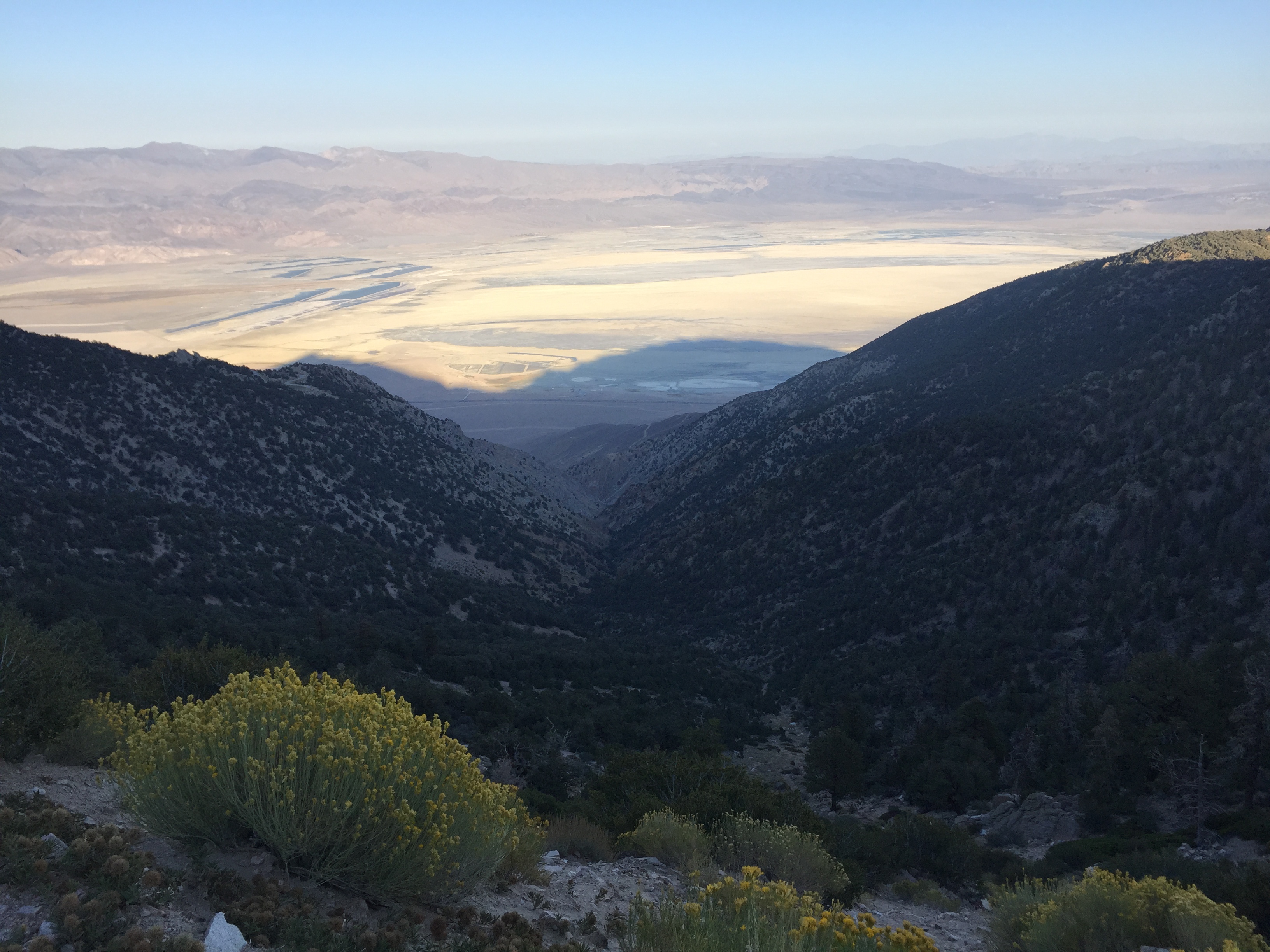
Just kidding, it’s the Owens Valley where LA gets its water!

There’s more water up in the lakes behind the mountains:

California is amazing.

The Alabama Hills:

How great are these Tom Harrison topo maps?:
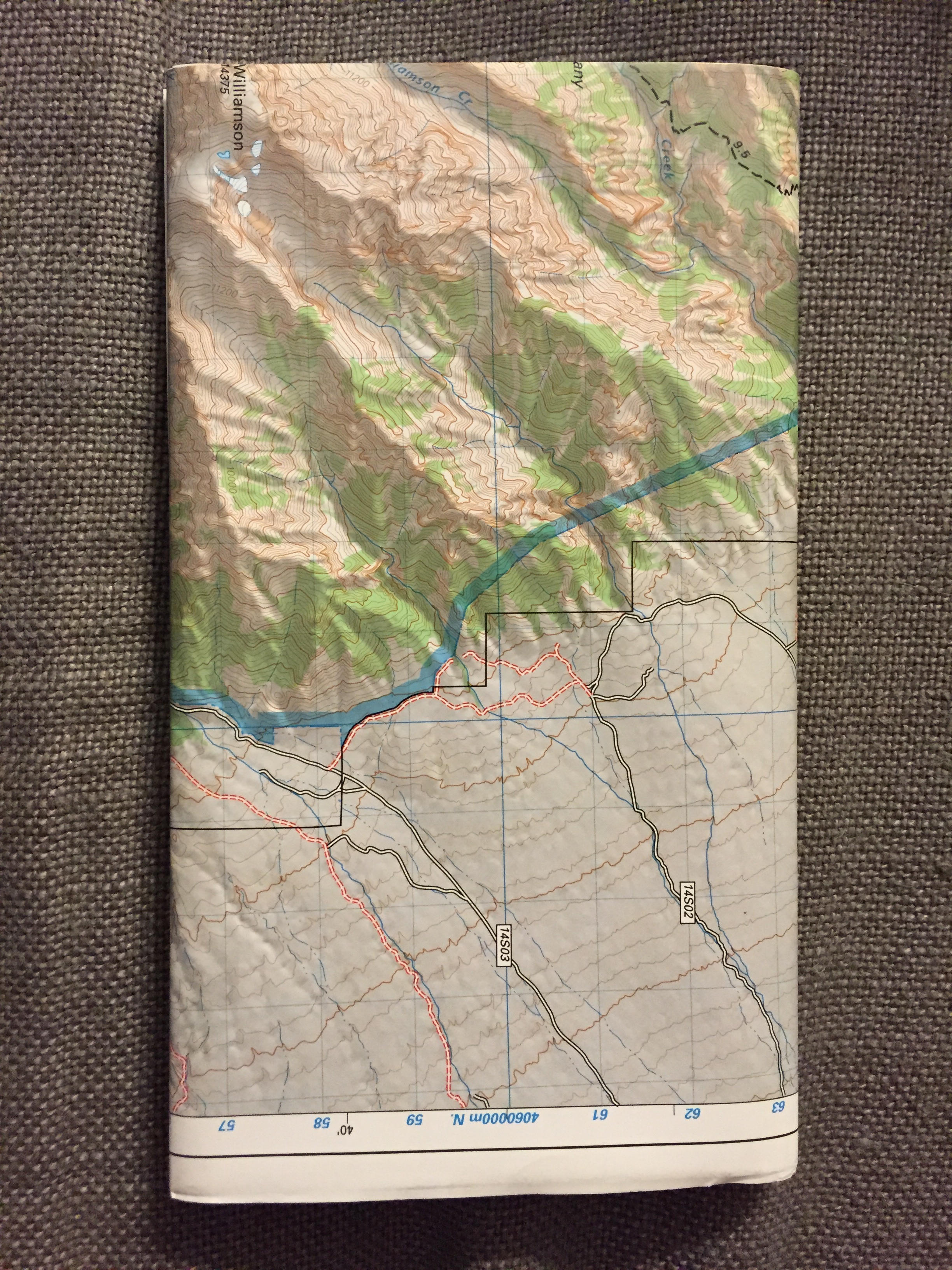
Let’s Go Hiking!
Posted: August 10, 2015 Filed under: the American West, the California Condition Leave a comment
That’s a Tom Harrison map of course: http://www.tomharrisonmaps.com/
(check out this great photo of Bear Heaven on Mr. David Stillman’s blog)
 But be careful, you don’t want to get partially consumed.
Reader Matt W. writes: “Bear Heaven is people hell!”
 Helytimes

#/media/File:Comanche.jpg)