More from Grant’s Memoirs
Posted: November 16, 2019 Filed under: war Leave a comment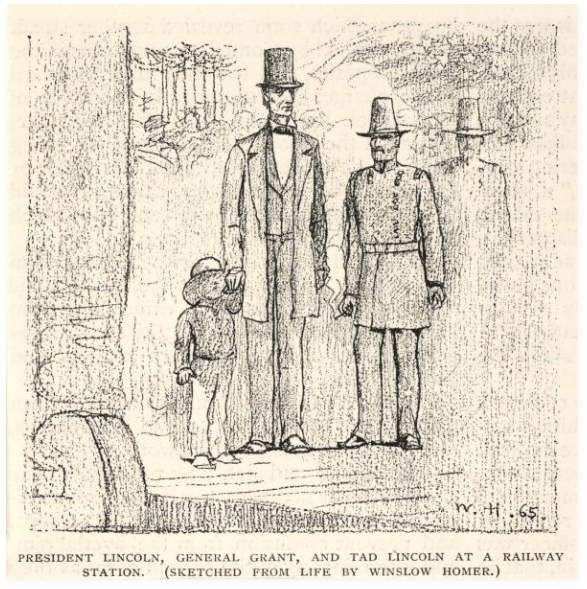
source. far as I know Grant and Lincoln were never photographed together
Any time Grant meets Lincoln it’s tremendous.
I explained to him that it was necessary to have a great number of troops to guard and hold the territory we had captures, and to prevent intrusions into the Northern States. These troops could perform that service just as well by advancing as by remaining still; and by advancing they would compel the enemy to keep detachments to hold them back, or else lay his own territory open to invasion. His answer was “Oh yes! I see that. As we say out West if a man can’t skin he must hold a leg while somebody else does.”
Later:
Mr. Lincoln, supposing I was asking for instructions, said, in reply to that part of Governor Smith’s letter which inquired whether he with a few friends would be permitted to leave the country unmolested, that his position was like that of a certain Irishman (giving the name) he knew in Springfield who was very popular with the people, a man of considerable promise, and very much liked. Unfortunately he had acquired the habit of drinking, and his friends could see the habit was growing on him. These friends determined to make an effort to save him, and to do this they drew up a pledge to abstain from all alcoholic drinks. They asked Pat to join them in signing the pledge, and he consented. He had been so long out of the habit of using plain water as a beverage that he resorted to soda-water a substitute. After a few days this began to grow distasteful to him. So holding the glass behind him, he said, “Doctor, couldn’t you drop a bit of brandy in that unbeknownst to myself?”
An interesting detail: after Spottsylvania and the Wilderness, Grant is convinced the Union has more artillery than could ever be brought into action at any given time. The extra artillery was serving only to clog the roads. The North had so many guns they couldn’t use them all – that was the situation in the Civil War.
Grant is forever on the move. He is either attacking or maneuvering to attack. Moving on the enemy, that is his goal. Putting the enemy where he wants him and then moving upon him. Investing his towns.
The role of Sheridan in taking the initiative in the Shenandoah Valley comes through in this book. (Sheridan, more than the equal of Stonewall Jackson? A question for the real military historians).
Grant’s regrets:
I have always regretted that the last assault at Cold Harbor was ever made. I might say the same thing of the assault of the 22nd of May, 1863, at Vicksburg.

Cold Harbor. Source.
I didn’t know that Grant, when president, attempted to buy what’s now the Dominican Republic with the idea of repatriating black Americans there.


The proposal (I read on Wikipedia) was stopped by Charles Sumner.

The memoirs don’t cover Grant’s presidency, so we don’t get much more about that. What would’ve happened if the plan had gone through, and there’d been a mass resettlement of African Americans to Santo Domingo? An alt-history collab for Junot Diaz and Colson Whitehead –> limited series on HBO starring Rihanna?
Safari
Posted: November 12, 2019 Filed under: Africa 1 Comment
Learned from Paul Theroux that safari in Swahili just means “journey.” When you drive to work in a way you’re on safari.
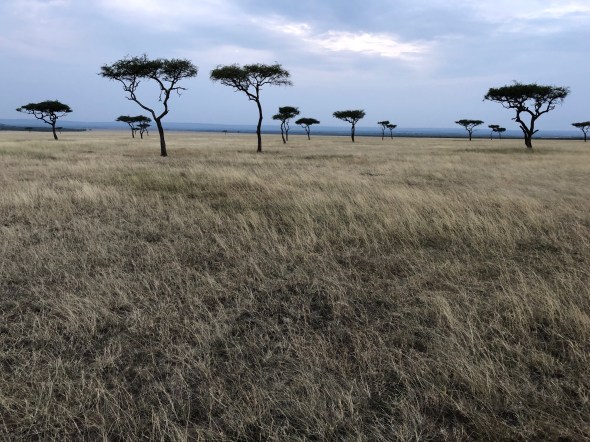
Learned from a guide that “mara” as in Masai Mara National Park means “spotted,” like spotted with thorn trees.
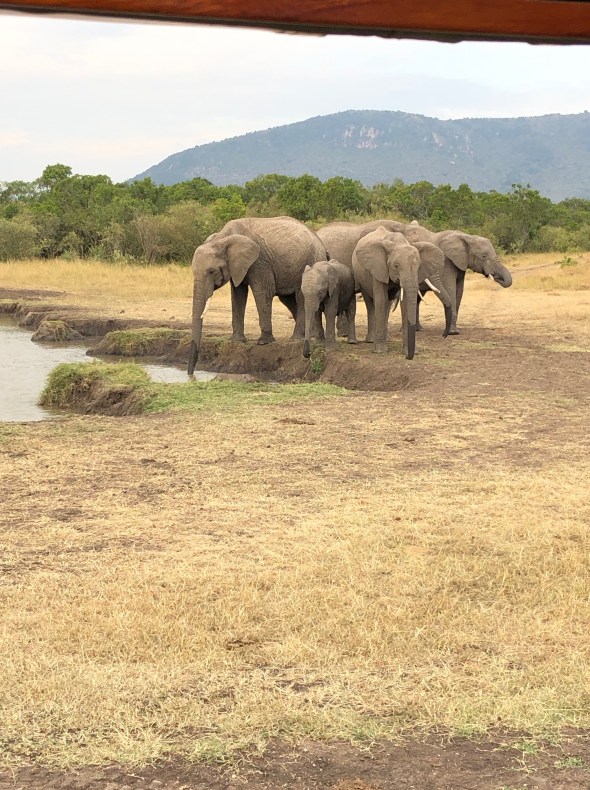
One thing we saw: a mother cheetah had killed an impala, minutes or so before. The mother cheetah crouched over the dead impala. Waiting. Scanning. Watching. She probably waited twenty minutes before she ripped into her breakfast. She’d expended a lot of energy, she was spent. And what if somebody else smelled the blood and came along to get in on it (and maybe you in the process)? I wondered if this pause before eating is at all connected to the idea of saying grace before meals. Primal need to have a pause and a lookaround before tucking in?
Then she chirped, and, eventually, found her six cubs and brought them over. You feel sad for the gazelle but to see the six cubs playing around and licking blood onto their faces is… cute?
Distant view of the lost city of Qattara
Posted: November 10, 2019 Filed under: adventures, architecture, the California Condition 2 Comments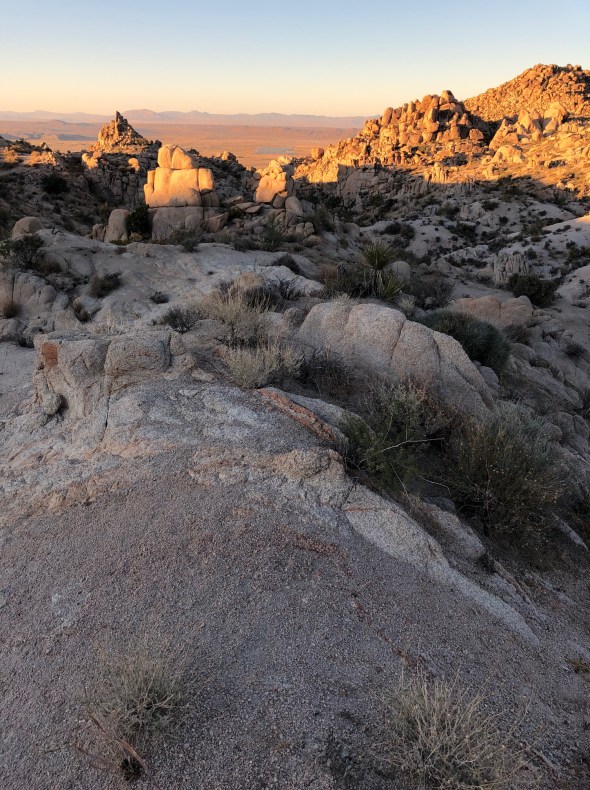
The inhabitants known for their bloodthirstiness would’ve killed me if I approached any further than the Unholy Gate.
Rules for Investment Success by Sir John Templeton
Posted: November 8, 2019 Filed under: business Leave a comment
Quality is a company strongly entrenched as the sales leader in a growing market. Quality is a company that’s the technological leader in a field that depends on technical innovation. Quality is a strong management team with a proven track record. Quality is a well-capitalized company that is among the first in a new market. Quality is a well-known trusted brand for a high-profit-margin consumer product.
The hunt for quality. That’s what’s cool about investing. Hidden quality.
It can’t be all Warren Buffett all the time. Sir John Templeton has been getting my attention.
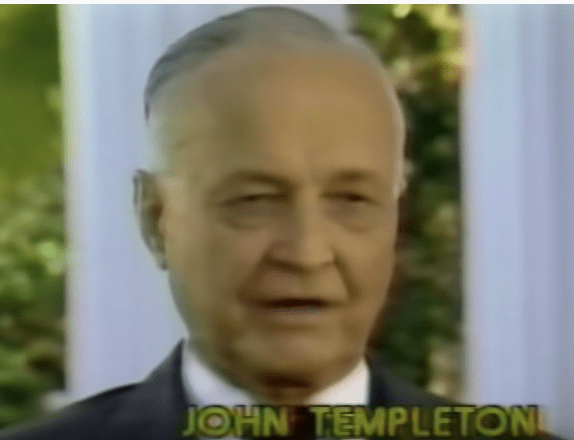
The hunt for points of maximum pessimism. Templeton worked above a grocery store in the Bahamas. His grand-niece keeping the flame. An interview from circa 1985. Later in life he devoted himself to spiritual searching.
Remember, in most cases, you are buying either earnings or assets.
The only reason to sell stocks now is to buy others, more attractive stocks. If you can’t find more attractive stocks, hold on to what you have.
Santa Anita, you had one job!
Posted: November 4, 2019 Filed under: horses, the California Condition Leave a comment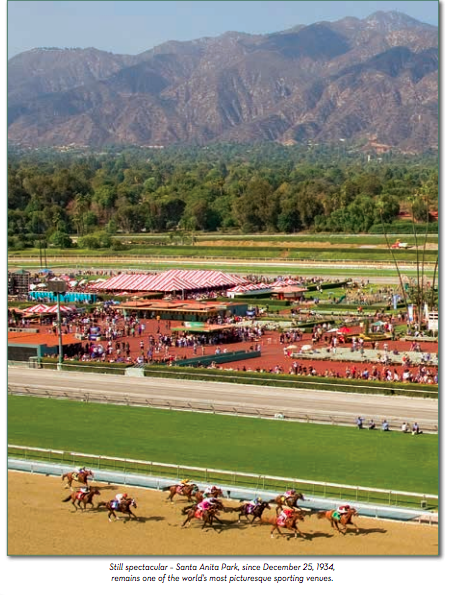
Santa Anita racetrack is a beautiful place. There’s history. Seabiscuit raced there, a statue honors him. It’s good to sit in the stands, look at the mountains, and drink a beer, watch the horses race. Read the little horse newspaper.
Santa Anita’s been having problems though. Horses keep dying there.
Since December 36 (!) horses have died.
On Saturday at Santa Anita they had the Breeders’ Cup, a nationally televised race.
Santa Anita! This is your big moment. All eyes on you. You’re on TV, time to shine.
Please.
Don’t let any horses die.

They had ONE job. And what happened?
A green screen was rushed onto the track to block Mongolian Groom from the view of 67,811 fans and a prime-time television audience. He was loaded onto an equine ambulance and taken to a hospital on the backstretch.
Cup officials said in a statement about two hours after the race that Mongolian Groom had been euthanized after suffering a serious fracture to his left hind leg.
Guys!
Couldn’t we pretend we were giving him tender care? euthanize him later?!
I’ll be sad if Santa Anita closes down. It’s like some enchanted time capsule of southern California. But, if you’re in the horse business, you can’t get me excited about horses and then keep killing them.

Start of the Juvenile Sprint by Jlvsclrk for Wiki
Around LA
Posted: November 3, 2019 Filed under: the California Condition Leave a comment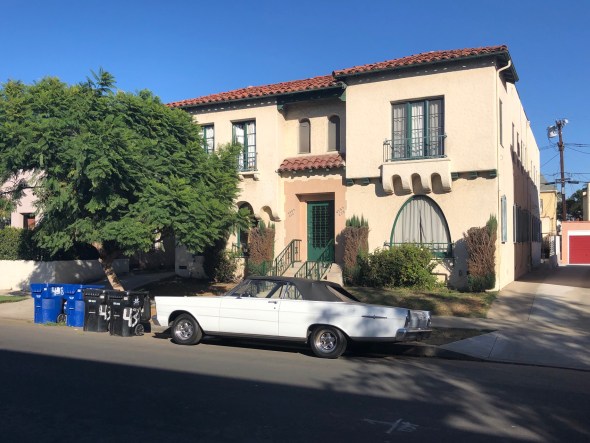
Just a small street scene. I like when cities look like themselves.

Grant’s Memoirs
Posted: November 3, 2019 Filed under: America, war Leave a comment
This picture of Grant at City Point, VA 1864 was taken by Egbert Guy Fowx
“Man proposes and God disposes.” There are but few important events in the affairs of men brought about by their own choice.
So Grant begins his memoirs. Grant’s voice is clear and unashamed and humble. The role of chance, fate, circumstance, God in determining the course of events, and the much smaller role played by character or our actions, is a key theme.
Grant never would’ve gotten to West Point if not for what happened to young Bartlett Bailey:
Finding before the January examination following that he could not pass, he resigned and went to a private school, and remained there until the following year when he was reappointed. Before the next examination he was dismissed. Dr. Bailey [his father] was a proud and sensitive man, and felt the failure of his son so keenly that he forbade his return home. There were no telegraphs in those days to disseminate news rapidly, no railroads west of the Alleghenies, and but few east; and above all, there were no reporters prying into other people’s private affairs. Consequently it did not become generally known that there was a vacancy at West Point from our district until I was appointed. I presume Mrs. Bailey confided to my mother the fact that Bartlett had been dismissed, and that the doctor had forbidden his son’s return home.
Grant later notes:
Major Bailey was the cadet who had preceded me at West Point. He was killed in West Virginia, in his first engagement.
A poignant family story between these lines.
Maybe it’s no surprise that Grant is an excellent, understated writer. Much of his job as a general was to communicate clear, succinct orders and directives under stressful conditions. Many written orders are included in the book. Compact expression of clear meaning must’ve been a key skill to a Civil War general. Probably a military commander in any era.
Then again I tried to read Sherman’s memoirs and can’t recommend them.

a thick book, as well. almost twice as long as Grant’s?
Grant didn’t really want to be a soldier.
Going to West Point would give me the opportunity of visiting the two great cities of the continent, Philadelphia and New York. This was enough.
Later he mentions:
a military life had no charms for me, and I had not the faintest idea of staying in the army even I should be graduated, which I did not expect.
Grant says at this time, he hoped to become a math professor.
The Mexican War breaks out. Grant doesn’t approve, but there he is. He rides from Corpus Christi to San Antonio without seeing a single person until he’s within thirty miles of San Antonio. He joins the expedition to Mexico City.
Considering in tranquility some movements during the Mexican War:
It has always seemed to me that this northern route to the City of Mexico would have been the better one to have taken. But my later experience has taught me two lessons: first, that things are seen plainer after the events have occurred; second, that the most confident critics are generally those who know the least about the matter criticised.
Occupying Mexico City he sees a bullfight:
The sight to me was sickening. I could not see how human beings could enjoy the sufferings of beasts, and often of men, as they seemed to do on these occasions.
Grant is sent to California:
Many of the real scenes in early California life exceed in strangeness and interest any of the mere products of the brain of the novelist. Those early days in California brought out character.
He leaves the army. But the Civil War is approaching:
The great bulk of the legal voters of the South were men who owned no slaves; their homes were generally in the hills and poor country; their facilities for educating their children, even up to the point of reading and writing, were very limited; their interest in the contest was very meagre… Under the old regime they were looked down upon by those who controlled all the affairs in the interest of slave owners, as poor white trash who were allowed the ballot so long as they cast it according to direction.
Grant, quickly, is elevated to command, and starts marching down the Tennessee River, taking Forts Henry and Donelson along the way. But his army is almost driven back into the river on the first day at Shiloh.
Shiloh, as you’ve probably heard, was not a good scene. Two big armies ran into each other and murdered each other for pretty much an entire day. The night after the first day, Grant tries to sleep under a tree in pouring rain:
Some time after midnight, growing restive under the storm and the continuous pain, I moved back to the log-house under the bank. This had been taken as a hospital, and all night wounded men were being brought in, their wounds dressed, a leg or an arm amputated as the case might require, and everything being done to save life or alleviate suffering. The sight was more unendurable than encountering the enemy’s fire, and I returned to my tree in the rain.
Yet, he’s confident:
So confident was I before firing had ceased on the 6th that the next day would bring victory to our arms if we could only take the initiative, that I visited each division commander in person before any reinforcements had reached the field. I directed them to throw out heavy lines of skirmishers in the morning as soon as they could see, and push them forward until they found the enemy… To Sherman I told the story of the assault at Fort Donelson, and said the same tactics would win at Shiloh.
After day two:
I saw an open field, in our possession on the second day, over which the Confederates had made repeated charges the day before, so covered with dead that it would have been possible to walk across the clearing, in any direction, stepping on dead bodies, without a foot touching the ground.
Jason Robards read the Grant parts in Ken Burns Civil War

Robards, from Wikipedia
On promotions:
Every one has his superstitions. One of mine is that in positions of a great responsibility every one should do his duty to the best of his ability where assigned by competent authority, without application or use of influence to change his position.
After Vicksburg fell, Grant was almost killed in New Orleans by a horse that was scared by a locomotive and fell on him. But he makes it out, though he’s on crutches for a bit. Imagine all the times when Grant could’ve been killed, and it was a spooked horse in occupied New Orleans that almost got him.
During the movements around Chattanooga, Grant pauses to consider:
There was no time during the rebellion when I did not think, and often say, that the South was more to be benefited by its defeat than the North. The latter had the people, the institutions, and the territory to make a great and prosperous nation. The former was burdened with an institution abhorrent to all civilized people not brought up under it, and one which degraded labor, kept it in ignorance, and enervated the governing class. With the outside world at war with this institution, they could not have extended their territory. The labor of the country was not skilled, nor allowed to become so. The whites could not toil without becoming degraded, and those who did were denominated “poor white trash.” The system of labor would have soon exhausted the soil and left the people poor. The non-slaveholders would have left the country, and the small slaveholder must have sold out to his more fortunate neighbor. Soon the slaves would have outnumbered the masters, and, not being in sympathy with them, would have risen in their might and exterminated them. The was was expensive to the South as well as to the North, both in blood and treasure, but it was worth all the cost.
That’s enough of Grant’s memoirs for now.
Santa Ana Winds
Posted: October 27, 2019 Filed under: the California Condition Leave a comment
“ There was a desert wind blowing that night. It was one of those hot dry Santa Anas that come down through the mountain passes and curl your hair and make your nerves jump and your skin itch. On nights like that every booze party ends in a fight. Meek little wives feel the edge of the carving knife and study their husbands’ necks. Anything can happen. You can even get a full glass of beer at a cocktail lounge. ” — Raymond Chandler, “Red Wind”
|
|
|
|
|
||
If you’re a reader of Helytimes you’ve probably come across these quotes about the dry, spooky winds that originate in the desert and blow into Los Angeles.
The definition of these winds in common use gets kind of loose. Any wind that’s blowing not the cooling, perfume air of the Pacifc, but the dry, harsh air off the desert, can get counted as a Santa Ana wind.
One of the oldest references to the Santa Ana winds appears to be in a January, 1943 issue of California Folklore Quarterly. Luckily we have that issue handy, and present it here for any interested California scholars.


Maybe next week we’ll look into The Vanishing Hitchhiker
Daily (?)
Posted: October 27, 2019 Filed under: bible Leave a comment
If you had a Catholic or any sort of Christian upbringing, you’ll know this one:
Our Father who art in heaven,
Hallowed be thy name.
Thy kingdom come.
Thy will be done
on earth as it is in heaven.
Give us this day our daily bread,
and forgive us our trespasses,
as we forgive those who trespass against us,
and lead us not into temptation,
but deliver us from evil.
The most famous prayer in the world? Maybe. But what about “daily” there? While reading a list of hapex legomenon,
a word that occurs only once within a context, either in the written record of an entire language, in the works of an author, or in a single text.
I learned that “daily” in this case is an ancient Greek hapex legomenon.
Epiousios, translated into English as ″daily″ in the Lord’s Prayer in Matthew 6:11 and Luke 11:3, occurs nowhere else in all of the known ancient Greek literature, and is thus a hapax legomenon in the strongest sense.

So, this word, that’s only used once, epiousios, what exactly did it mean? Wikipedia:
The difficulty in understanding epiousios goes at least as far back as AD 382… At that time, St. Jerome was commissioned by Pope Damasus I to renew and consolidate the various collections of biblical texts in the Vetus Latina (“Old Latin”) then in use by the Church. Jerome accomplished this by going back to the original Greek of the New Testament and translating it into Latin; his translation came to be known as the Vulgate. In the identical contexts of Matthew and Luke—that is, reporting the Lord’s Prayer—Jerome translated epiousios in two different ways: by morphological analysis as ‘supersubstantial’ (supersubstantialem) in Matthew 6:11, but retaining ‘daily’ (quotidianum) in Luke 11:3.
The modern Catholic Catechism holds that there are several ways of understanding epiousios, including the traditional ‘daily’, but most literally as ‘supersubstantial’ or ‘superessential’, based on its morphological components. Alternative theories are that—aside from the etymology of ousia, meaning ‘substance’—it may be derived from either of the verbs einai (εἶναι), meaning “to be”, or ienai (ἰέναι), meaning both “to come” and “to go”.
Other ideas:
Kenneth E. Bailey, a professor of theology and linguistics, proposed “give us today the bread that doesn’t run out” as the correct translation. The Syriac versions of the Bible were some of the first translations of the Gospels from the Greek into another language. Syriac is also close to Jesus’ own Aramaic, and the translators close in time and language to Jesus should thus have had considerable insight into his original meanings. In Syriac epiousios is translated as anemo, meaning lasting or perpetual.
Wrote to my friend BVZ who’s a pastor out in Oklahoma, he sent me some Biblical commentaries that suggest a connection with words that meant “ration.”
Today’s? Every day’s? Tomorrow’s? A day’s worth of? Earned? Special? Sacred? Eternal? Magic? Holy? Sustaining? Nutritious?
What did epiousios mean?
Maybe the prayer should go:
give us this day, our wonder bread.
Will the future be primitive?
Posted: October 20, 2019 Filed under: the California Condition Leave a comment Down in Manhattan Beach on a small mission, I stopped into Brothers Burritos, recommended as a Beach Cities lunch spot by Travis of El Segundo / Hood River. “You get two mini burritos.” Sold.
At Brothers, the Pacific just a few streets down, they have a rack of old issues of surfing mags, including Surfer’s Journal. This magazine has gripped me before, it’s really impressive, almost as much a journal of travel and philosophy as it is of waves.

In this issue was a piece by Jamie Brisick where he walks a stretch of Hawaii’s North Shore, “from Velzyland to Log Cabins,” a stretch he’s visited and lived in, on and off, for something like thirty-five years. He remembers legends, has encounters, studies the changes to the beach, shares memories.
This struck me:

Blacksmiths. Yvon Chouinard of Patagonia began as a blacksmith. How about Primitive Technologies guy?
Primitive technology is a hobby where you make things in the wild completely from scratch using no modern tools or materials. This is the strict rule. If you want a fire- use fire sticks, an axe- pick up a stone and shape it, a hut- build one from trees, mud, rocks etc. The challenge is seeing how far you can go without modern technology. If this hobby interests you then this blog might be what you are looking for.
Also It should be noted that I don’t live in the wild but just practice this as a hobby. I live in a modern house and eat modern food. I just like to see how people in ancient times built and made things. It is a good hobby that keeps you fit and doesn’t cost anything apart from time and effort.
from his website.
Out in the Mojave there are pockets of people into permaculture, imagining perhaps that the future may be primitive.
I’m not sure how primitive the future will be. Some skills and trades are ancient and seem to endure. The future may not be as futuristic as we once, collectively, seemed to dream. Maybe the primitive sense is just an adjustment of expectation. Does technology have to move forward all the time? The primitive future. Could there be a world where the past seems futuristic? The language of backwards and forwards almost suggests a direction History moves. But History also tells of times when life became more primitive, even for centuries. How dark were the Dark Ages is a good debate, too big for this space. Leave that out and there are still times where civilizations dissolve or collapse or just kinda retreat or fade out.
No matter how primitive the future gets, there’s something soothing about practicing ancient arts and crafts and trades. Simple, without being primitive — could that be a future to hope for?
Very satisfying burritos. I’ve since been to the Brothers in Hermosa Beach, which I also liked but just not quite as much.
The Manhattan Beach Public Library has got to be, real estate wise, one of the best public libraries in the nation. You can sit in a nice chair and stare at the ocean.

many things on the internet
Posted: October 19, 2019 Filed under: America Since 1945, art history Leave a commentremind me of this one:

from:
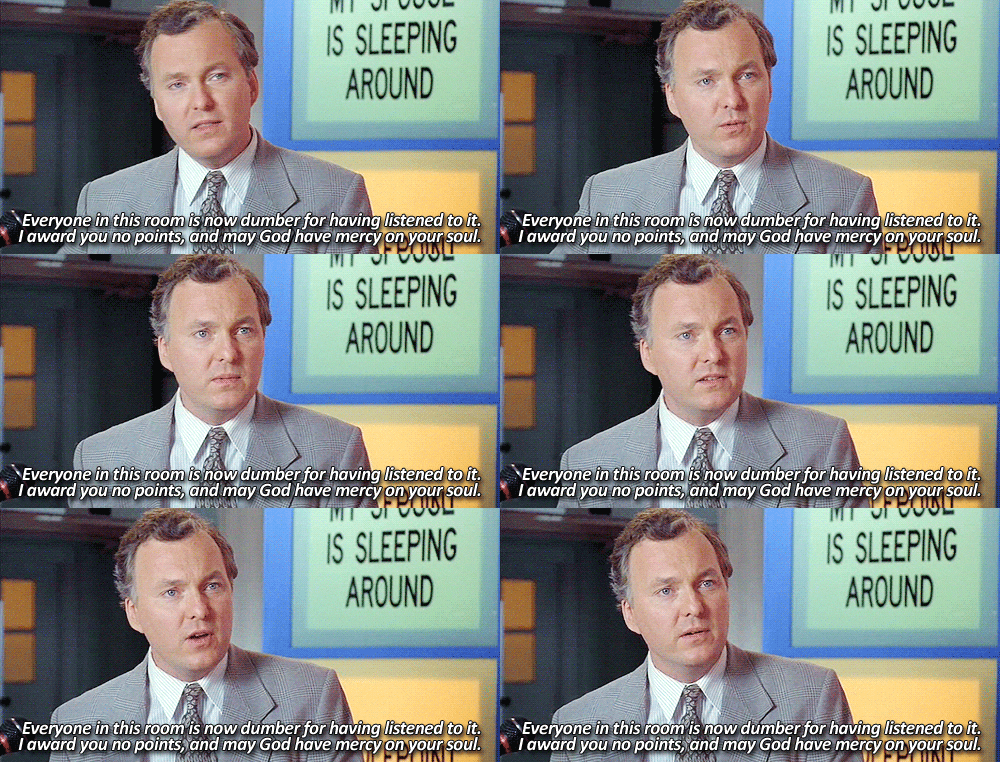
this scene from Newsradio
Posted: October 19, 2019 Filed under: comedy, TV Leave a comment
(for when YouTube removes the link, it is a scene where Matthew and Joe bet on whether the next song on the radio will be good or not. The song that comes up is “Wichita Lineman.”)
Some things I like about the scene: the idea that depending on the circumstances you could believe this was a good or bad song. Matthew trying to sell it. Also Matthew’s honesty.
This may have been the first time I heard this song?
Scrapbasket
Posted: October 16, 2019 Filed under: America Since 1945, photography Leave a commentSome scrap items found on my phone:
1)
I had to stop following Caroline Calloway on Instagram which is too bad, there’s a genius to sentences like this.
2) A view in Pittsburgh:

Pittsburgh is beautiful.
3) Rocks
4) I believe the source here is an interview with Years & Years singer Olly Alexander in Issue 11 of The Happy Reader, but can’t confirm, no longer have the issue. The phrase “Who is the hot boy? Who is the boy that will always bring the looks?” does not appear exactly in a Google search.

5) Seen in Hollywood:

6) Cat on a tray:

7) Portrait of the blogger as a boy:

Is it a crime if no one stops you?
Posted: October 15, 2019 Filed under: America Since 1945 Leave a comment
The worst crimes were dared by a few, willed by more and tolerated by all,
is a quote I’ve heard and seen attributed to Tacitus. I couldn’t find it in The Histories, just did a search. Maybe I missed it somehow, it might be in there. I did find a postcard from my sister.

You gotta be careful, a lot of these “classic quotes” were conjured up somewhere and never really checked, or in context they mean the opposite.
Set down to write here after becoming agitated and worked up watching Senator Ron Johnson two weeks ago on “Meet The Press.” Witness the sputtering nonsense.
Joshua Tree National Park has exploded in popularity: why?
Posted: October 11, 2019 Filed under: America Since 1945, joshua tree 2 Comments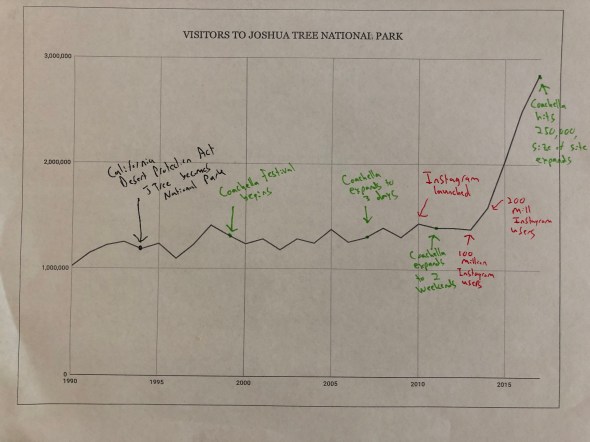
This chart was an attempt to test my thesis, that Instagram played a role in the dramatic rise in visits to Joshua Tree National Park.
I also incorporated a challenge to my thesis, offered by a colleague who suggested the answer might have something to do with the popular Coachella Valley Music and Arts Festival. Drivers to that festival from Los Angeles would have to pass signs for Joshua Tree NP and experience the intoxicating desert landscape.
What about the AirBNB factor?:
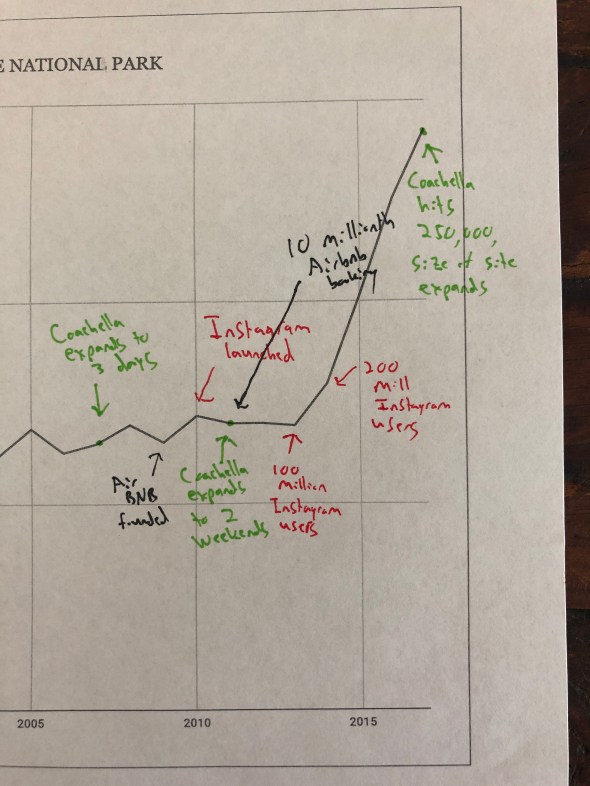
Was stunned to be reminded about how recently Instagram (2010) and AirBNB (2007) were founded. These companies changed the world very, very fast. We still haven’t had time to contemplate what these changes mean, both to communities and to human brains.
How does a fragile patch of desert ecosystem handle two million extra human visitors a year? You might think they’d increase the park’s budget. It appears the opposite is happening?
(Any time I look into a fact like this, so much appreciation for our nation’s journalists, looking into the files, tracking it all down.)
There’s rarely a single cause for things, but I feel confident in saying Instagram, or maybe more broadly, the instant sharing of powerful photographs on phones, played a role in the dramatic rise in popularity of Joshua Tree national park.
What might be other factors? Commercial photography and car commercial stuff may have boomed out in Joshua Tree and joshua tree-populated areas. I don’t know how you’d measure that data, but I feel it.

Credit to the wonderful movie Ingrid Goes West here, a movie about Joshua Tree and Instagram and California fantasy in general, which makes the same connection between the desert landscape and Instagram.
My studies suggest no burst in popularity connected to the U2 album “The Joshua Tree.”
Statues of Beverly Hills
Posted: October 10, 2019 Filed under: the California Condition Leave a comment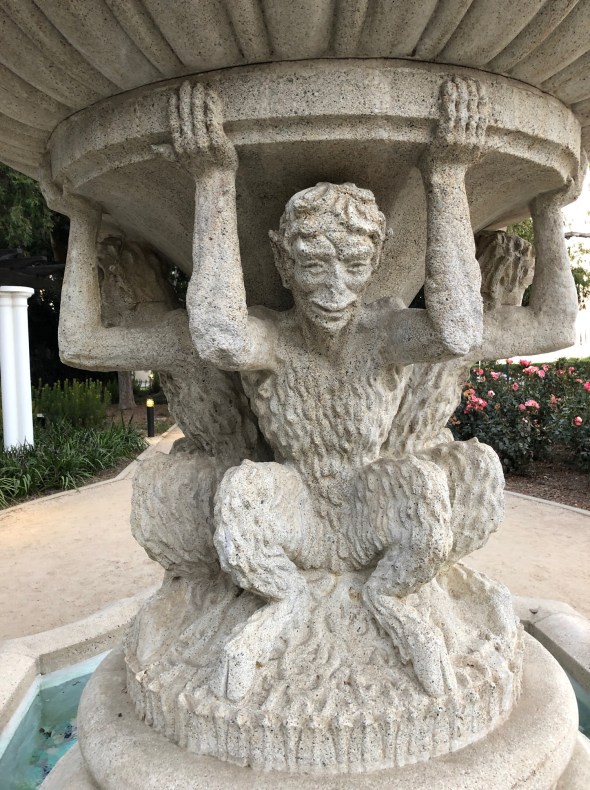
walked through the restored park area – “Beverly Gardens Park” – along Santa Monica Boulevard as it enters Beverly Hills.

This statue is called The Hunter and Hounds, by A. Jacourmat. The plaque tells me “This shell-torn statue stood guard above a subterranean chamber in which Signal Corps. 3rd Division American Army maintained headquarters communications during bombardment of Chateau Thierry Second Battle of the Marne.” Wow.

More info at publicartinla.com

Pond.
a true “lucky duck.” Here’s another look at this guy:

The Civil War in Arkansas
Posted: October 5, 2019 Filed under: history, war Leave a comment
source: photographer unknown
Traveling through Arkansas last spring, I tried to wrap my head around the Civil War as it played out there.

Like, what happened here? At some point did a Union army march through here?
In Arkansas in 1860, there were 435,450 total residents counted in the census.
Of these, 111,115 or about 20% were slaves.
There were 11,481 slaveowners in Arkansas.
And 144 free colored people.
Much of Arkansas at that time was wilderness. The big plantations were down in the Delta, the low bottom country in the south and east of that state, along the alluvial Mississippi floodlands, seen here on Raven’s excellent topographical map.
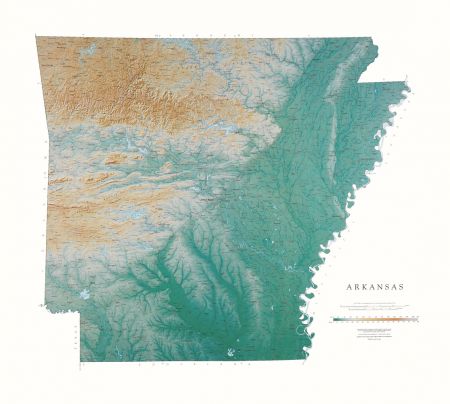
Here on the 1861 Coast Survey map of slave population, we can see where Arkansas slaves were:


Everyone needs a getaway once in a while. A getaway from the job, the house, the day-to-day routine and yes, even those that mean the most to us – our families.
reads the copy on this guide to touring the still-standing plantation houses of Arkansas. Presumably a getaway was not an option in 1860 for the 111,115 slaves.
In May, 1861, Arkansas seceded from the United States. At the secession convention, Isaac Murphy was one of the few no votes:
The convention voted to take Arkansas out of the Union, but Murphy and four other delegates opposed this step. The convention chair called on the five to switch their votes. All four of the other “nay” delegates changed their votes, but Murphy refused. Initially his position was popular in Huntsville, but as the war went on, Confederate sentiment increased.

About a year later, in spring, 1862, Union General Samuel Curtis marched in from Missouri, leading volunteer regiments from Missouri, Illinois, Ohio and Indiana (mostly). At the battle of Pea Ridge he drove back the Confederate forces sent to stop him.

Curtis kept on marching his army across Arkansas, following more or less the course of the White River.

As Curtis marched along, he picked up thousands of freed slaves.

Curtis was stifled in his effort to capture Little Rock by lack of supplies (his guys were pretty much living off the land) and by the forces raised by Confederate general Thomas Hindman.

Gregory J. W. Urwin summarizes:
Hindman’s General Orders Number 17 instructed “all citizens from this district” to organize themselves into ten-man companies under elected captains and start killing Yankees. An estimated 5,000 men responded to this summons by August 1862. They may not have been a decisive factor in Samuel Curtis’ failure to take Little Rock, but they aroused the ire of Union forces by picking off sentries and couriers, ambushing small patrols and foraging parties, and firing on gunboats and transports. Federal commanders announced that they would hold civilian responsible for any guerrilla activity occurring in their vicinity. When warnings failed to restrain the irregulars, details of Union soldiers and sailors began burning small hamlets or individual houses and barns. This retributive strategy caused many Arkansans to abandon their homes in the delta and north of the Arkansas River, but it did not suppress guerrilla depredations.
Curtis and his army (and irregular army of freed slaves) crossed the state, and reached Helena, on the Mississippi river. From there he could be resupplied by river since by now the Confederate river navy had been pretty much destroyed. Memphis had fallen, giving a clear path along the Mississippi north of Vicksburg.

As for Hindman, he got a fort named after him, at Arkansas Post, where the Arkansas River forks off and heads towards Little Rock. This was in important spot, and some Confederates from Texas held it until the Union Navy came up there in January, 1863, and blew it away.

Hindman was replaced by Theophilus Holmes

Jefferson Davis begged Holmes to bring his troops out to help relieve the tightening siege at Vicksburg, across the river in Mississippi. But Holmes had his own problems. Says Wikipedia (lifting from Walter Hilderman’s biography):
For the most part, the Confederate forces in this remote area were little more than a disorganized mob of militia scattered across all corners of the state. There were few weapons available and even fewer modern ones. The soldiers for the most part had no shoes, no uniforms, no munitions, no training, organization, or discipline, a situation worsened by the fact that many communities in Arkansas had no government above the village level. People did not pay taxes or have any written laws and strongly resisted any attempt to impose an outside government or military discipline on them. Soldiers in the Arkansas militia did not understand the organization of a proper army or obeying orders from above. Even worse, many of them were in poor physical condition and unable to handle the rigors of a lengthy military campaign. Holmes for his part believed that he could muster an army of about 15,000 men in Arkansas, but there would be almost no competent officers to lead it anyway. Further compounding his difficulties were multiple Union armies converging on the state from all sides. In this situation, Holmes wrote to Richmond that if by some miracle, he could organize the Arkansas militia into an army and get them across the Mississippi River, they would simply desert as soon as they got to the east bank.
On July 4, 1863, Vicksburg fell. On that day, a bit late, Holmes attacked the Union forces at Helena, Arkansas

present day Helena via Google
but they were blasted away both by Union troops in the city and massive gunboats in the river. A disastrous, pointless defeat, too late to do any good even if it hadn’t failed.
With the fall of Vicksburg (and the last ditch failure at Helena) the Union had control of the entire Mississippi River. Gen. Fredrick Steele was sent out across the river and into Arkansas:

colorized Steele photo lifted from Colorized Past
Steele and his army of Wisconsins, Illinoisians, and German immigrants arrived in Little Rock by September, 1863. The Confederate state capitol had been moved to Washington, Arkansas.
When spring began in 1864, Steele marched his army toward Washington, AR. (Here is an excellent map of how this went down). Steele had something like 7,000 soldiers. Steele was supposed to eventually meet up, in Shreveport, Louisiana, with General Nathaniel Banks and his 30,000 guys from the Department of the Gulf.

Traveling cross country in this hot and hostile part of the world was not easy. By the time Steele got to Camden, Arkansas, his guys didn’t have anything to eat, and word reached him that Banks’ army had been stopped anyway.
Steele had with him the 1st Kansas Colored Infantry, and he sent them out to collect some food. At Poison Spring, they were surrounded by the Confederate Second Indian Brigade or Choctaw Brigade.

I’ll let Confederate Colonel Tandy Walker tell the story:
I feared here that the train and its contents would prove a temptation too strong for these hungry, half-clothed Choctaws, but had no trouble in pressing them forward, for there was that in front and to the left more inviting to them than food or clothing—the blood of their despised enemy.
They set on the 1st Kansas Colored.
In all, the 1st Kansas lost nearly half of its numbers.
After this defeat, running out of food, with the planned meetup unlikely to come off, Steele decided to retreat back to Little Rock. When he got as far as Jenkins Ferry, in the pouring rain, he realized the Confederates were about to catch up to him. So he had his guys dig in. Steele’s troops killed some unknown number of the attacking Confederates.

source: JERRYE & ROY KLOTZ MD
What a mess that must’ve been. After the turnaround of the Camden expedition, the Union army stayed near their bases in the cities. Confederate marauders rode all over the place. Colonel Marcus LaRue Harrison led the Unionist 1st Arkansas Cavalry:
Harrison established a network of fortified “farm colonies,” populating them with the families of men who swore to serve in home guard companies. Anyone living within ten miles of a colony had to join it or was assumed to be a bushwhacker.
I agree with Naval Institute, interviewing Shelby Foote.
Naval History: It has always been frustrating that the Western rivers get hardly any play in Civil War History.
Foote: Well, the whole Western theater gets hardly any play. I sometimes think that the people in this country who know less about the Civil War than any other one group of people are Virginians. They may know a little more than South Dakotans, but that’s about all.
They think that the war was fought in Virginia, while various widespread skirmishes were going on out West. The opposite is closer to the truth
Looking for more info about Jenkins Ferry I found this picture on the Grants County Museum page, seems like the situation in that area has improved.

Most of the Confederate regiments raised in Arkansas served in the western theater. An exception was the 3rd Arkansas Infantry Regiment, sent to Lee’s Army of Northern Virginia.
When General Robert E. Lee surrendered at Appomattox Courthouse on April 9, 1865, only 144 men of the Third Arkansas remained out of the 1,353 mustered into it from the start of the war
Here is their battle flag.
After the failure of the Camden expedition, the Confederates had about 100 encampments in south Arkansas. Where do I get that number? From this incredible book:

This book is a digitized version of the maps Confederate engineer Richard M. Venable made in 1864. Venable and his guys were only able to reconnoiter the southern 29% of the state. I’m not sure whether that was because the northern portion was in Union hands and they couldn’t go there, or if that was just the resources they had, at a time when the Confederates in Arkansas were operating in the south, and might have to make moves further south or west.
The maps in this book are incredibly detailed, you can see, for example, which homesteads in Lafayette County had female heads of household, and which were the houses of widows.
Here’s a thorough review of the book. I was really impressed by it, it’s rare to find historic maps at this level of detail and readability, as the review notes, this was “obviously a labor of love.” How much need you have in your home for a detailed atlas of 1864 Arkansas is for you to determine, but for me it did make the past come alive. If you’re doing any traveling in the state of Arkansas and you’ve read this far in HelyTimes, consider investing in a copy. (hell I’ll loan you mine.)
When did the Civil War really end in Arkansas? In a special election in 1863, Isaac Murphy was elected governor:
remember me?
He presided until 1868. By 1874 there was close to an armed conflict over who would run Arkansas, and that was pretty much the end of Reconstruction in the state.
The following 35 governors of Arkansas, ruling for a total of 90 years, were all Democrats, until Republican Winthrop Rockefeller became governor in 1966 defeating James D. Johnson.
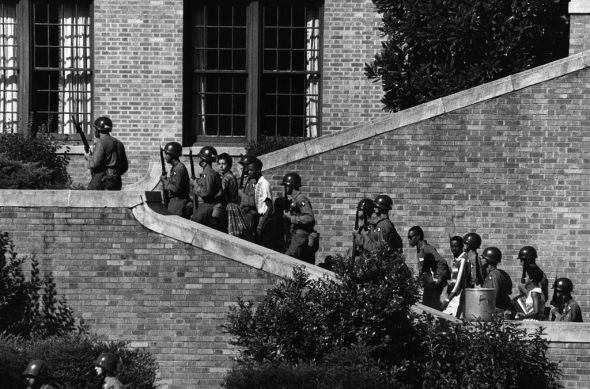
Maybe the Civil War ended in Arkansas when federal troops integrated Central High School in Little Rock in 1956-7.

Or maybe it ended with the election of Arkansas governor Bill Clinton.

When The World’s On Fire
Posted: October 1, 2019 Filed under: America Since 1945, music 3 Comments
enjoying Ken Burns Country Music (I guess, I wish it had a table of contents or something). This is the Carter Family song that’s been on my mind as I read the news!
Las Vegas, USA
Posted: September 30, 2019 Filed under: America Since 1945, desert Leave a comment
Made a brief visit recently. Whenever I’m in Las Vegas, I have a weird urge to become a degenerate gambler who hangs around the sports book. Writing things in the racing form with a little pencil, leaning back in one of those chairs at the little desks, crumped up napkins around. What is the attraction there? Maybe it’s all the screens covered with numbers and information. There’s got to be a pattern if I could just figure it out! Dissolving the self in the hunt for a tiny edge.
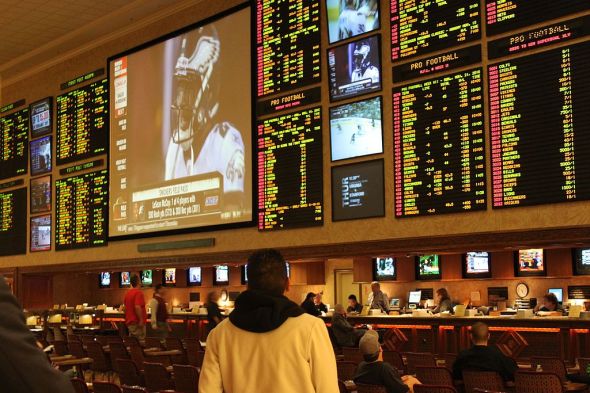
baishampayan ghose took this one for the Wikipedia page on “Sports Book”
There are a lot of famous restaurants in Las Vegas these days. One I’ve returned to is:
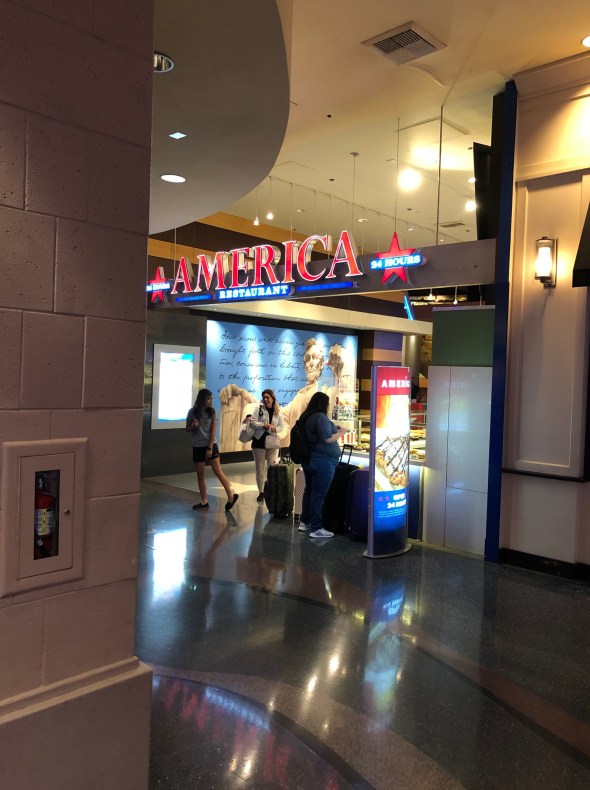
Inside New York, New York casino. They’re not kidding around here, it is straight-up America food:
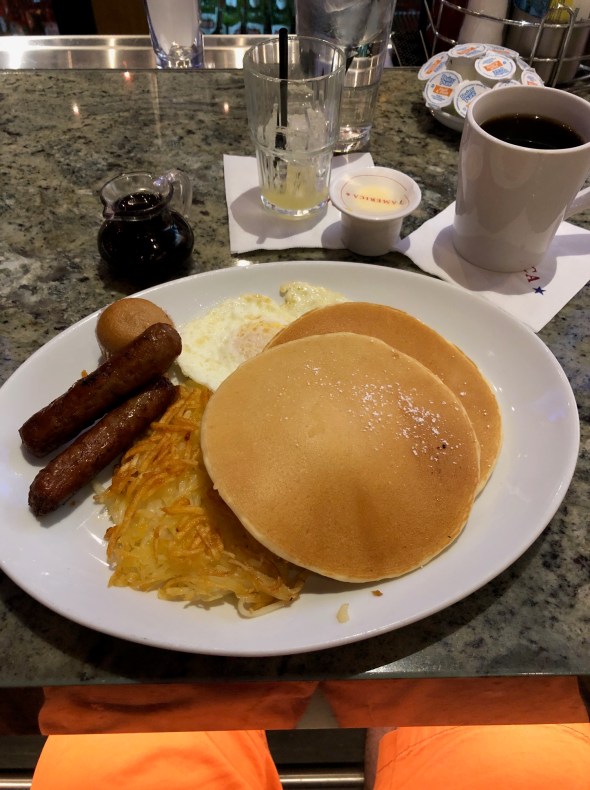
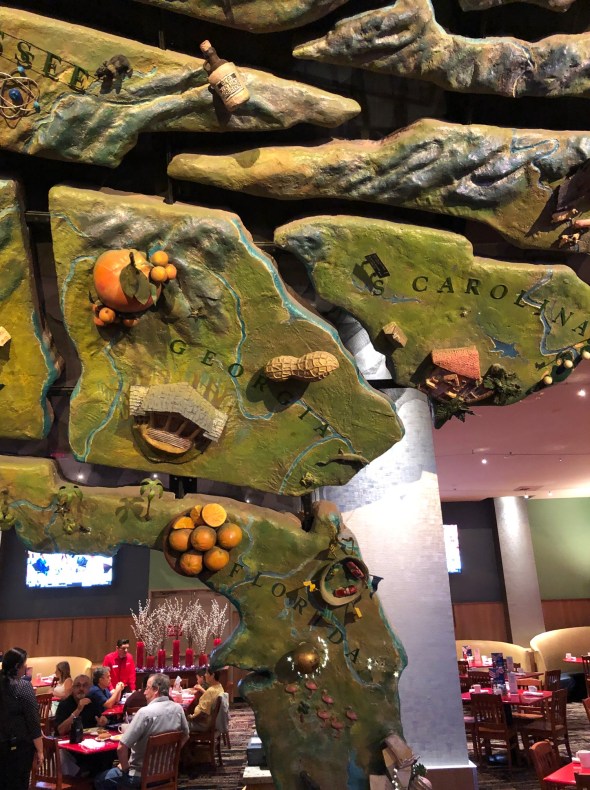
There are something like twenty beers on tap. You can admire a sculpture that models the United States:
Half the fun of flying to Las Vegas is having a look at the Mojave:
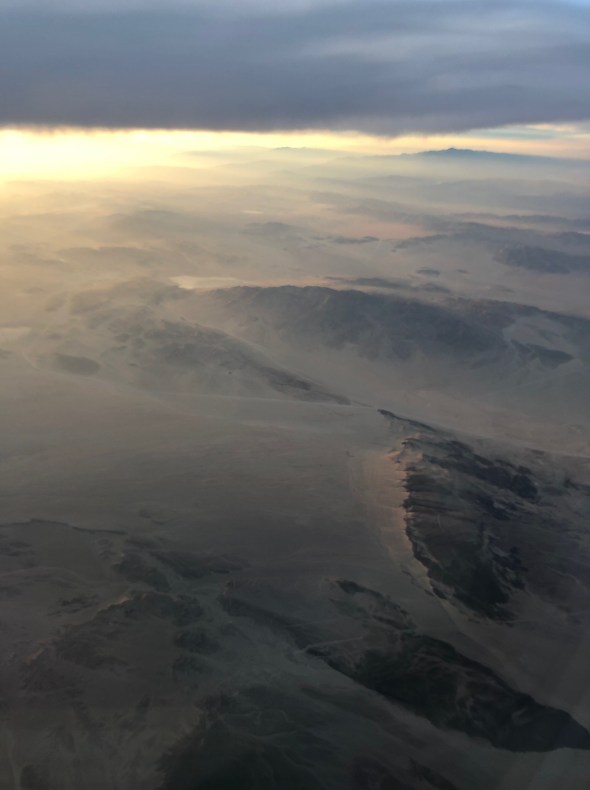
truly Mars level wastes. and I say that as a Mojave superfan!
Amsterdam
Posted: September 23, 2019 Filed under: Amsterdam, art history Leave a comment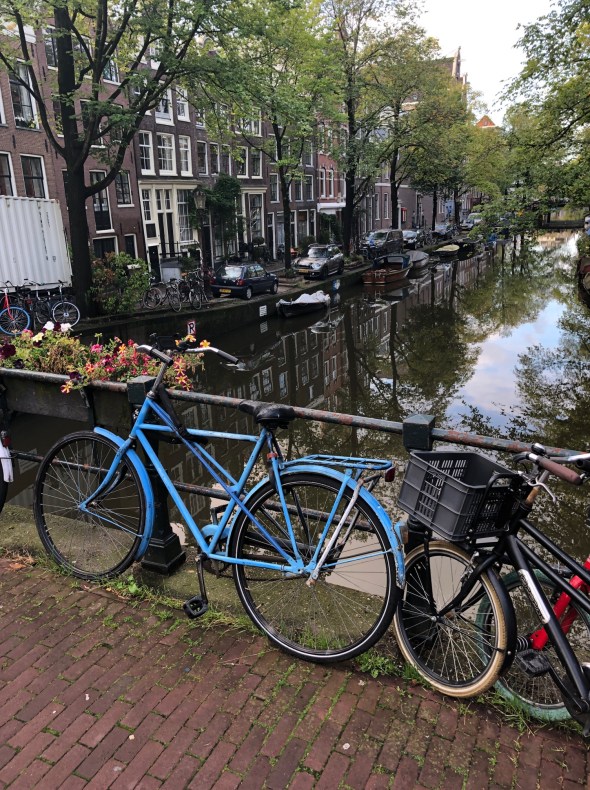
some cities are like a theme park of themselves.

Amsterdam: a water park? Blessed with an unusually bright day. You think of the history.

Took a reading on my altimeter:
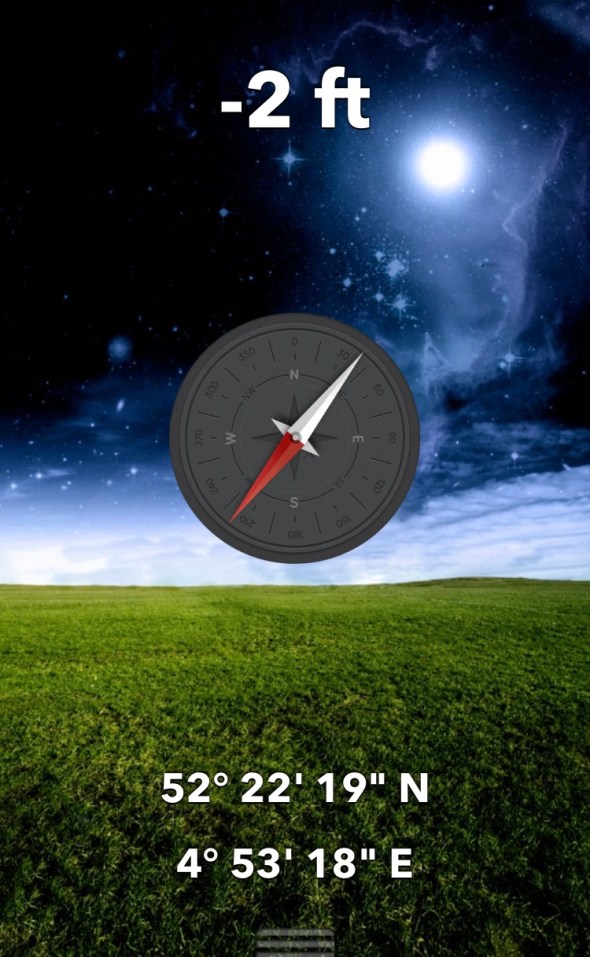
The Netherlands.
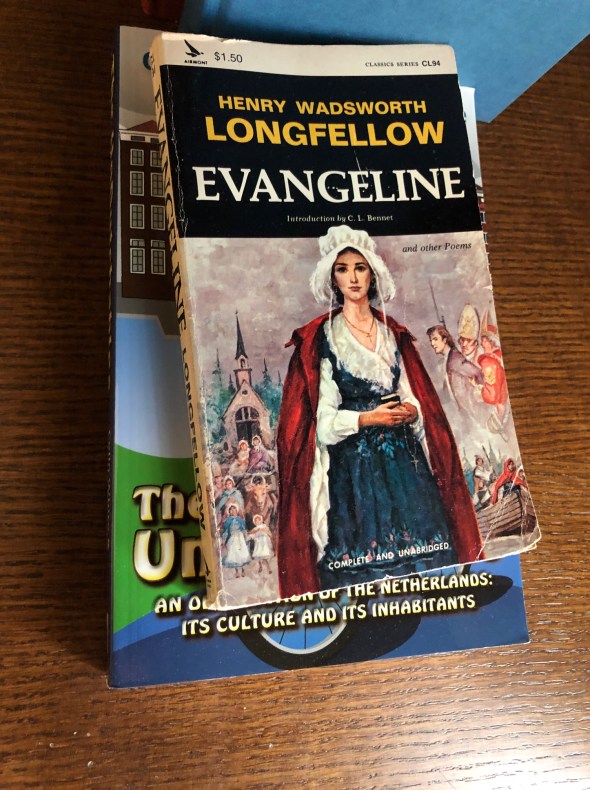
Books avail at hotel. At the Rijksmuseum they have Jan Willem Pieneman’s enormous painting of Waterloo.
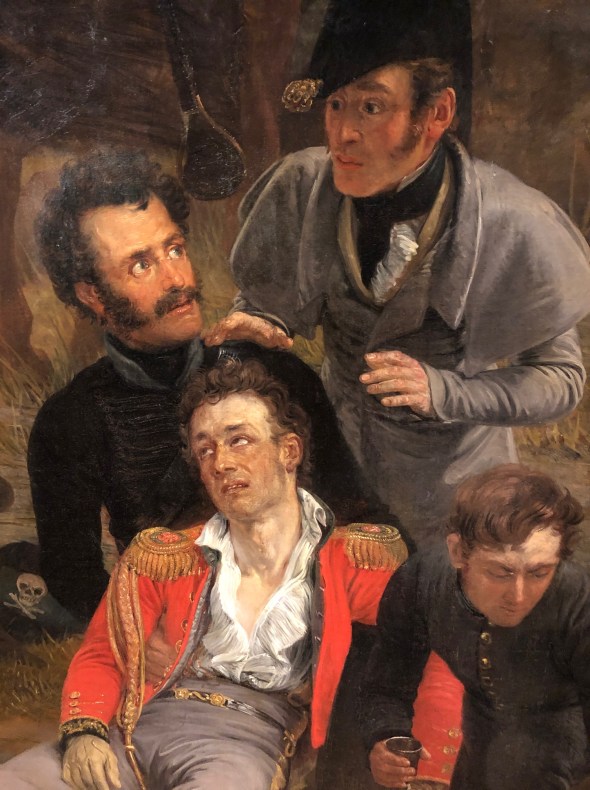
Detail.

 Helytimes


#/media/File:ChateauThierryTurningPointWorldWarCard.jpg)


