George HW Bush
Posted: December 5, 2018 Filed under: America Since 1945, politics, presidents Leave a comment
Thought of this photo today.
(what’s David Gergen doing there? sometimes I’ve been that guy).
All posts related to any Bush.
Anybody remember this one?
Posted: December 5, 2018 Filed under: America Since 1945, music Leave a comment
it’s possible attempts were made to record this song onto an audio cassette.
Best Email Subject Line of the Week
Posted: December 5, 2018 Filed under: America Since 1945 Leave a comment
Sympathy for the Devil
Posted: December 4, 2018 Filed under: religion, writing Leave a comment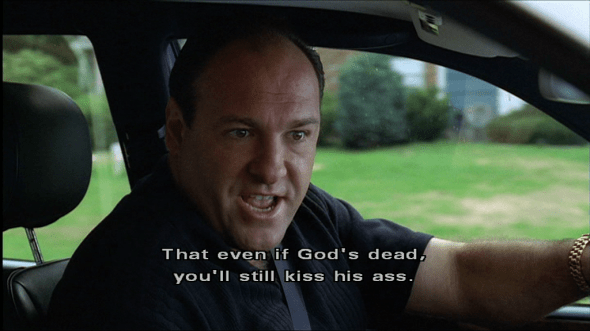
I was thinking about how a lot of movies and shows (a rewatch of The Sopranos is what made me thing of this) could be called Sympathy For The Devil.
Isn’t the premise of this show to take a murderer and crime boss and get you to sympathize with him?

The Riddle of Chaco Canyon
Posted: December 3, 2018 Filed under: America Since 1945, desert, native america Leave a comment
Sure, we’ve all heard of Chaco Canyon. It’s one of the 23 UNESCO World Heritage sites in the USA. But I tended to lump it in with Mesa Verde and the other cliff dwellings and move on.
Then an ad in High West (“for people who care about the West”) caught my eye. $25 for a year’s subscription to Archaeology Southwest, PLUS the Chaco archaeology report? Yes!
Once you get going on Chaco Canyon, it’s hard to stop.

Bob Adams at Wikipedia
What was it? Who built it? How? What happened? What were they up to? Why there?

Room 170 at source: this Gamblers House post
One of the most important conclusions that leaps out of this book is that most of the societies examined had attitudes toward nature that were fairly compatible with a responsible, sustainable relationship with the environment, but that nearly all of them ended up destroying their environment anyway, either because they lacked the scientific and technological knowledge to know how to act best or because they let their values change as they became wealthier and more powerful through exploitation of natural resources.
from this post.
Sometimes you start looking for something, more information, help, and you find exactly what you’re looking for. You find a guide who can give you exactly the information you’re looking for, in a digestible way.

That’s what I found when I found The Gambler’s House. A dense, rich blog about Chaco by a former Park Service seasonal guide, he / she seems to know this stuff at a deep level. Here are two of the closest I find to autobiography.

source: Gambler’s House
The author, who signs the name Teofilio, writes with clarity, patience, intelligence, respect for the reader, restrained but confident style, and a steady, calm voice, walking us through questions, debates, and controversies within the scholarship:
So if great houses weren’t pueblos, what were they? Here’s where contemporary archaeologists tend to break into two main camps. One sees them as elite residences, part of some sort of hierarchical system centered on the canyon or, alternatively, of a decentralized system of “peer-polities” with local elites who emulated the central canyon elites in the biggest great houses. In either case, note that the great houses are still presumed to have been primarily residential. The difference from the traditional view is quantitative, rather than qualitative. These researchers see the lack of evidence for residential use in most rooms, but they also see that there is still some evidence for residential use, and they emphasize that and interpret the other rooms as evidence of the power and wealth of the few people who lived in these huge buildings and were able to amass large food surpluses or trade goods (or whatever). The specific models vary, but the core thing about them is that they see the great houses as houses, not for the community as a whole (most people lived in the surrounding “small houses” both inside and outside of the canyon) but for a lucky few.
In this camp are Steve Lekson, Steve Plog, John Kantner, probably Ruth Van Dyke (although she doesn’t talk about the specific functions of great houses much), and others.
On the other side are those who see the difference between pueblos and great houses as qualitative. To these people, the great houses were not primarily residential in function, although they may have housed some people from time to time. Most of these researchers see the primary function of the sites as being “ritual” in some sense, although what that means is not always clearly specified. In many cases a focus on pilgrimage (based on questionable evidence) is posited. This group tends to make a big deal out of the astronomical alignments and large-scale planning evident in the layouts and positions of the great houses within their communities. They tend to see the few residents of the sites as caretakers, priests, or other individuals whose functions allowed them to reside in these buildings. Importantly, they don’t see these sites as equivalent to other residences in any meaningful way. They are instead public architecture, perhaps built by egalitarian communities as an act of religious devotion. Examples of monumental architecture built by such societies are known throughout the world (Stonehenge is a famous example), and this view fits with the traditional interpretation of modern Pueblo ethnography, which sees the Pueblos as peaceful, egalitarian, communal villagers. There is a long tradition of projecting this image back into the prehistoric past based on the obvious continuities in material culture, so while these scholars are in some ways breaking with tradition in not seeing great houses as residential, they are also staying true to tradition in other ways by interpreting them as a past manifestation of cultural tendencies still known in the descendant societies but expressed in different ways.
(from this post).

While many archaeologists have made valiant attempts to fit the rise of Chaco into models based on local and/or regional environmental conditions, they have been generally unsuccessful in finding a model that convincingly explains the astonishing florescence of the Chaco system in the eleventh and early twelfth centuries. This has inspired some other archaeologists more recently to try a different tack involving less environmental determinism and more historical contingency. This seems promising, but finding sufficient evidence for this sort of approach is difficult when it comes to prehistoric societies like Chaco. The various camps of archaeologists will likely continue to argue about the nature of Chaco for a long time, I think. Meanwhile, the mystery remains.

from the post “Plaster“
I doubt this mystery will ever be totally solved. There’s just too much information that is no longer available for various reasons. That’s not necessarily a problem, though. At this point the mysteries of Chaco are among its most noteworthy characteristics. Sometimes not knowing everything, and accepting that lack of knowledge, is useful in coming to terms with something as impressive, even overwhelming, as Chaco. One way to deal with it all is to stop trying to figure out every detail and to just observe. The experience that results from this approach may have nothing to do with the original intent of the builders of the great houses of Chaco, but then again it may have everything to do with that intent. There’s no way to be sure, and there likely never will be. But that’s okay. Sometimes mysteries are better left unsolved.

What of the Gambler legend for the origin of Chaco? Alexandria Witze at Archaeology Conservancy tells us:
Navajo oral histories tell of a Great Gambler who had a profound effect on Chaco Canyon, the Ancestral Puebloan capital located in what is now northwestern New Mexico. His name was Nááhwiilbiihi (“winner of people”) or Noqóilpi (“he who wins men at play”), and he travelled to Chaco from the south. Once there, he began gambling with the locals, engaging in games such as dice and footraces. He always won.
Faced with such a formidable opponent, the people of Chaco lost all their possessions at first. Then they gambled their spouses and children and, finally, themselves, into his debt. With a group of slaves now available to do his bidding, the Gambler ordered them to construct a series of great houses—the monumental architecture that fills Chaco Canyon today.

when I picture The Gambler
What was up with Chaco Canyon’s roads? They were thirty feet wide, perfectly straight, and seem to go… nowhere?
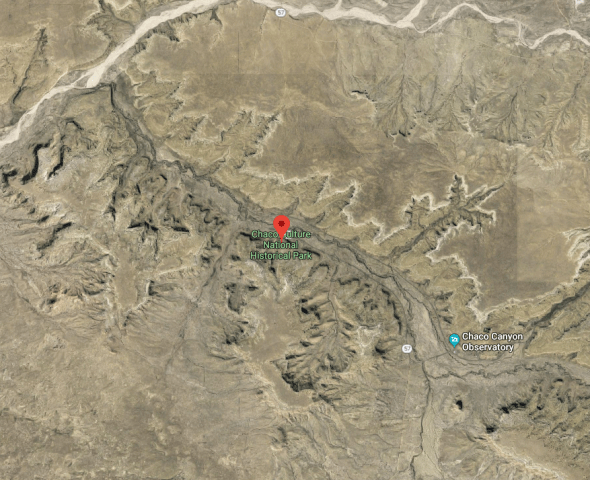
Once you’re into Chaco Canyon before you know it you’re into Hovenweep.

and where does Mesa Verde fit into this?
So what was the relationship between the two? The short answer is that no one knows.

source: rationalobserver for wikipedia
This is a great post with a possible Chaco theory:
Briefly, what I’m proposing is that the rise of Chaco as a regional center could have been due to it being the first place in the Southwest to develop detailed, precise knowledge of the movements of heavenly bodies (especially the sun and moon), which allowed Chacoan religious leaders to develop an elaborate ceremonial calendar with rituals that proved attractive enough to other groups in the region to give the canyon immense religious prestige. This would have drawn many people from the surrounding area to Chaco, either on short-term pilgrimages or permanently, which in turn would have given Chacoan political elites (who may or may not have been the same people as the religious leaders) the economic base to project political and/or military power throughout a large area, and cultural influence even further.
The “sexiest” post title:

Vivian Maier
Posted: December 2, 2018 Filed under: America Since 1945, art history, photography Leave a comment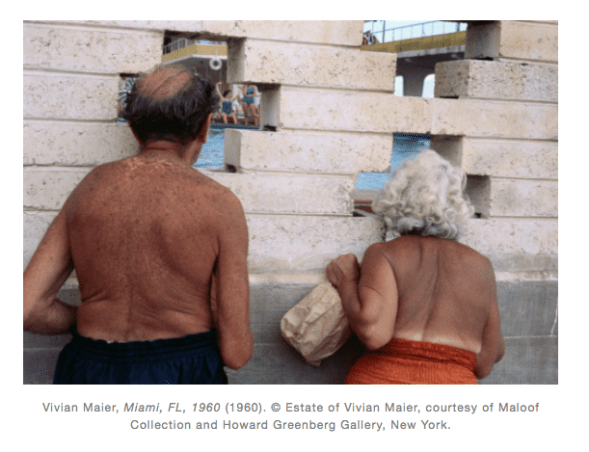
stole that straight from Artnet.
The tale of who owns Vivian Maier’s work is interesting. Through some twists, John Maloof, the Chicago real estate developer (?) who found and bought most of the physical photos at a storage auction, does not at present own the copyright:
Until those heirs are determined, the Cook County Administrator will continue to serve as the supervisor of the Maier Estate.


Cowen and Taleb (and Norm)
Posted: December 2, 2018 Filed under: jesus, writing, writing advice from other people Leave a commentIt’s like we understand that we’re not in here to eat mozzarella and go to Tuscany. We’re not in here to accumulate money. We’re in here mostly to sacrifice, to do something. The way you do it is by taking risks.
It’s taking risks for the sake of becoming more human. Like Christ. He took risks and he suffered. Of course, it was a bad outcome, but you don’t have to go that far. That was the idea.
More:
TALEB: Before 15, and I reread it many times. I’d say, before 15, I read Dostoyevsky and I read The Idiot. There’s a scene that maybe I was 14 when I read it. Prince Myshkin was giving this story. Actually, it was autobiographical for Dostoyevsky.
He said he was going to be put to death. As they woke him up and were taking him to the execution place, he decided to live the last few minutes of his life with intensity. He devoured life, it was so pleasurable, and promised himself, if he survives, to enjoy every minute of life the same way.
And he survived. In fact, it was a simulacrum of an execution, and Dostoyevsky . . . effectively that says the guy survived. The lesson was he no longer did that. It was about the preferences of the moment. He couldn’t carry on later. He forgot about the episode. That marked me from Dostoyevsky when I was a kid, and then became obsessed with Dostoyevsky.
More:
I discovered that I wanted to be a writer as a kid. I realized to have an edge as a writer, you can’t really know what people know. You’ve got to know a lot of stuff that they don’t know.
Also re: Jesus, how about Norm Macdonald on the topic:

Go Inside
Posted: December 1, 2018 Filed under: art history, the California Condition Leave a comment
They’re making progress on the dome/orb that will one day hold the Academy Museum (motto: Go Inside The Movies).
At neighboring LACMA the American Outliers exhibit is terrific.
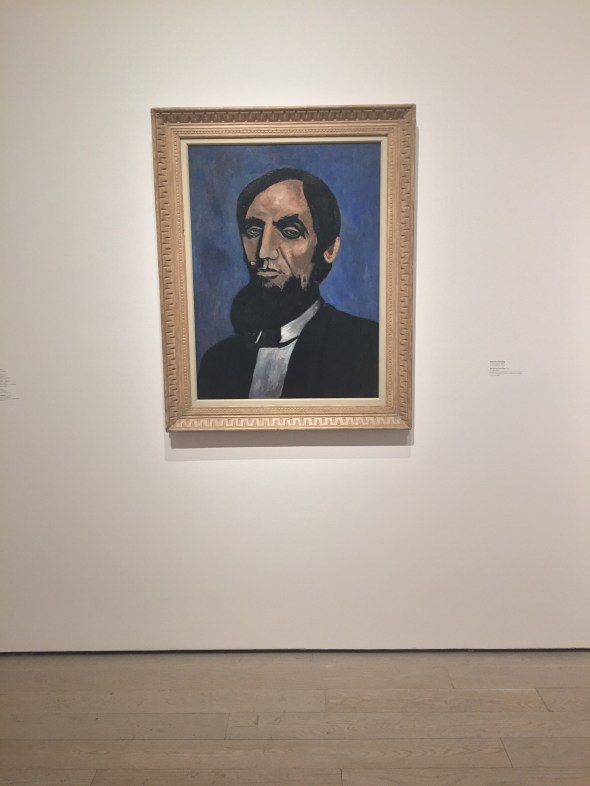
The Great Good Man by Marsden Hartley of Lewiston, Maine.
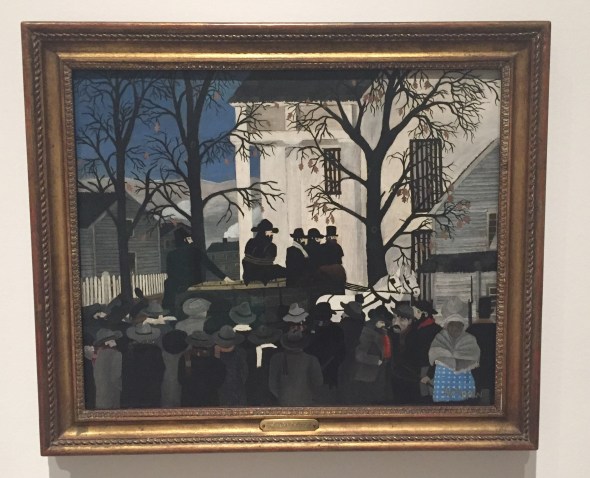
Struck by Horace Pippin’s John Brown Going To His Hanging:
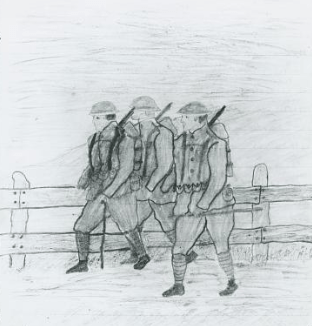
Pippin served in K Company, 3rd Battalion of the 369th infantry, the famous Harlem Hellfighters, in Europe during World War I, where he lost the use of his right arm after being shot by a sniper. He said of his combat experience:
I did not care what or where I went. I asked God to help me, and he did so. And that is the way I came through that terrible and Hellish place. For the whole entire battlefield was hell, so it was no place for any human being to be.
While in the trenches, Pippin kept an illustrated journal which gave an account of his military service.
How about this one, Miss Van Alen:

attributed to “The Ganesvoort Limner (possibly Pieter Vanderlyn).”
Generally untrained and itinerant, limners were a class of artists who helped shape the image of colonial Americans, securing the social status of their middle-class sitters in portraits that convey an air of refinement.
says The National Gallery.
Proposed motto for LACMA: Go Inside The Art.

Meanwhile in Australia
Posted: November 29, 2018 Filed under: Australia, politics Leave a comment
It started when Greens leader Richard Di Natale called Nationals Senator Barry O’Sullivan an “absolute pig”, after the Senator said there was a “bit of Nick Xenophon in” Ms Hanson-Young.
“He’s an absolute pig. He should be booted out. He’s a disgrace,” Mr Di Natale shouted across the chamber. “You grub.”
An emotional Senator Hanson-Young said Senator O’Sullivan and conservative independents Fraser Anning, Cory Bernardi and David Leyonhjelm were “cowards” who had spent months levelling slurs at her.
“You are not fit to be in this chamber. You are not fit to call yourselves men,” Senator Hanson-Young said.
She backed the Greens leader for calling out Senator O’Sullivan’s “reprehensible” remarks.
“That is what real men do. Real men don’t insult and threaten women,” Senator Hanson-Young said.
“You grub.”
Enjoy reading news stories about the goings-on in other English speaking countries, you usually have to fill in the gaps just enough to piece together what’s happening.
(thanks to our Sydney correspondent for the link and background)
TMI
Posted: November 29, 2018 Filed under: America Since 1945, brain, the ocean, WW2 Leave a comment
CIC of USS Spruance, 1975. USN-1162165.
But the most intriguing chapter is Hone’s study of a critical but largely unrecognized reorganization that transformed Navy operations beginning in late 1942. The problem was that commanders of warships were being cognitively overwhelmed by all the new information thrown at them in battle. In addition to traditional sightings and signaling, they were now receiving reports by radio from aircraft and from other ships, as well as from radar readings. The Navy’s answer was to design a new Combat Information Center on each ship. Through it, all that data could be continually funneled, sifted, integrated and passed to the captain and others on the vessel who might need it, like gunners. Such an improvement may seem mere common sense, but then many great innovations do seem obvious — in retrospect. Interestingly, Adm. Chester Nimitz told skippers what to do (establish the new centers) but not how to do it. This meant that different ships devised different approaches, which provided the basis for subsequent refinements.

CIC aboard an unknown destroyer escort during WWII, found here
Really interesting paragraph from Thomas Ricks, writing about this book:

which I will read when I have time, Trent Hone sounds serious!
Late 1942: is that the point in time where the age of information overload began? Sorting, digesting, processing the enormous amounts of information that flow our way, telling signal from noise, is that a/the prevailing cognitive problem of the post 1942 world?
Tom Ricks=boss.
Hovenweep
Posted: November 28, 2018 Filed under: America, desert, Indians, joshua tree, native america Leave a comment
What a name for a place.

between 1150-1350 these structures were built in, around, and above this canyon:

Gotta check that out sometime:

Was this era in the American Southwest something like roughly the same period, the early 12th century in Ireland:
To be glib, early medieval Ireland sounds like a somewhat crazed Wisconsin, in which every dairy farm is an armed at perpetual war with its neighbors, and every farmer claims he is a king.
Or was Hovenweep perhaps something more like a monastery?

Some Anasazi taking the Benedict Option?
Thought this was a good trip report from Hovenweep.
Got to Hovenweep trying to read about traditional architecture in the American desert regions. What kinds of buildings have people with few tools and tech built? What lasts?


This guy took on the challenge of building a pit house and kiva.
Easier than a kiva would be a false kiva:

John Fowler for wikipedia
Tyler Cowen’s Productivity
Posted: November 28, 2018 Filed under: books Leave a commentHere is Tyler Cowen’s list of the best non-fiction books of 2018.
I take eight where the Amazon link is easily clickable and find the page count, coming up with an average of 461 pages.
Let’s discount the two books written by colleagues and the one book TC wrote himself. That leaves us with 19 books, x 461 pages= 8,759 pages of books / 365 = TC is reading 24 pages of nonfiction on average every single day.
But remember, these are just the BEST books he’s picking. Let’s say for every one book he picks, there’s one he doesn’t. Call it 50 pages of nonfiction a day.
TC also picked eight fiction books, one of which is 1160 pages.
In addition to a busy travel schedule, college professor, prolific blogger, interviewer, husband, etc.
Impressed!
Flying cars
Posted: November 28, 2018 Filed under: America Since 1945 Leave a comment
Horst Faas, found here.
We have flying cars, they are called helicopters and they suck!
Are helicopters a net good or bad?
Surely many lives have been saved by medivacs and so on, but how much disturbance and disaster has been caused by these machines?
Have they gotten us into more trouble than they’ve gotten us out of?
Sure
Posted: November 28, 2018 Filed under: music Leave a comment
Thought this was fun. via Jia Tolentino’s twitter!
Messed up hoodie they’re selling in Germany
Posted: November 10, 2018 Filed under: Ireland, London Leave a comment
saw that when I went to read a Der Spiegel interview with Jeremy Corbyn:

More close than is comfortable to a kind of snobbish anti-Semitism is the most upper classy thing about Jeremy Corbyn, I wonder if it’s some kind of weird signal in the English language of codes.
I mean the ironic style that gives us our famously impenetrable sense of humour (which we will need now the rest of the world is laughing at us). The perfidious style that allows us to hide behind masks and has made England superb at producing brilliant actors for the West End but hopeless at producing practical politicians for Westminster. The teasing style of speaking in codes that benighted foreigners can never understand, however well they speak English. The cliquey style that treats England as a club, not a country, and allowed Jeremy Corbyn to say that Jews cannot “understand English irony”, however long their ancestors have lived here.
from this Guardian piece by Nick Cohen. More:
The deferential style that allowed one Etonian to lead the Remain campaign and another to lead the Leave campaign and for the English to not even see why that was wrong. The life’s-a-game-you-shouldn’t-take-too-seriously style that inspired Cameron to say he holds “no grudges” against Boris Johnson now the match is over and the covers back on the pitch. The gentleman amateur style that convinced Cameron he could treat a momentous decision like an Oxford essay crisis and charm the electorate into agreeing with him in a couple of weeks, as if voters were a sherry-soaked don who could be won round with a few clever asides. The effortlessly superior style that never makes the effort to ask what the hell the English have to feel superior about. The gutless, dilettantish and fatally flippant style that has dominated England for so long and failed it so completely. The time for its funeral has long passed.
The ancient and modern codes and secret languages of the British Isles are an inexhaustible subject.
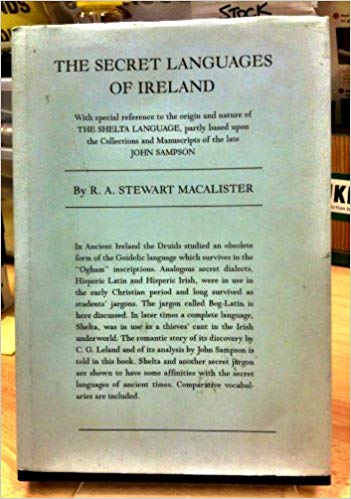
Feels in a way like Corbyn’s take on Brexit is “we must respect the voters’ stupidity.” If he sold this take out, and presented Labour as the un-Brexit, would that be good politically? If you’re over there sound off in the comments.
Unities across trades
Posted: November 8, 2018 Filed under: comedy Leave a comment
comedy and hog farming, from this article in Hobby Farm.

Happy Voters
Posted: November 6, 2018 Filed under: California Leave a comment
send in their pics after consulting the Helytimes Voter Guide.
The Helytimes California Voter Guide
Posted: October 31, 2018 Filed under: the California Condition Leave a comment
Really impressed with the LA Podcast well-argued voter guide. The LA Times has a thorough one. Read a few others, and here I present my picks for anyone who wants to vote a straight Helytimes ticket.
GOV: Gavin Newsom
not psyched about it. California should have a cool Governor.
LT. GOV: Ed Hernandez
SoS: Alex Padilla
CONTROLLER: Betty Yee
TREASURER: Fiona Ma
Not even sure why but I love Fiona Ma.

AG: Xavier Becerra
INS COMMISH: Ricardo Lara
State Board of Equalization 3rd: Tony Vazquez
Going on @ONLX rec here, they both sound bad. I admire the case for abstaining.
SENATE: Dianne Feinstein
There’s a fine case for Kevin De Leon, Feinstein voted for the Iraq War and stuff. But KDL took $5,000 from Cadiz Water Corp, which is trying to steal water from the Mojave National Preserve and sell it to Orange County. Then he helped kill AB 1000, which would’ve stopped this. To me, that’s just such a petty and direct corruption on an issue I care about. I’m sure he thought he could get away with it.
I guess I’m a one issue voter, which is letting bighorn sheep drink from Bonanza Spring.
Dianne Feinstein has her things but to my mind she’s also fairly heroic. I’d prefer a Senator not be a million years old, but then again the very word comes from the Latin meaning “old man.”
US House of Representatives: Adam Schiff
For your state reps I’d ask LA Podcast, I voted for my local Dems:
BEN ALLEN for Sen,
RICHARD BLOOM was my only option for Assembly.
Judges
Went with LA Podcast for Appeals Judges.
NO on Corrigan, yes on all the others for Appeals
For Judges I went:
SAUCEDA (LA Times says Coletta, they both sound good to me)
HUNTER (LA Times says Michel)
HANCOCK
RIBONS
Superintendant of Public Instruction: Tony Thurmond
Both Times and LA Podcast went Thurmond.
County Assessor: Prang
Sheriff: McDonnell
crazy contest with no good answer imo. LA Times and LA Podcast split.
State Propositions
Prop 1 – Bonds for Housing Assistance: YES
Prop 2 – Mental Illness Housing: YES
Prop 3 – Water Bonds: YES
this one’s a push, went with LA Podcast over LA Times
Prop 4 – Hospital Bonds: YES
Prop 5 – Property Tax Transfer: NO
Prop 6 – Gas and Vehicle Tax: NO
Prop 7 – Daylight Savings Time: YES
Prop 8 – Caps on Dialysis: NO
LA Podcast says don’t vote
Prop 10 – End Rent Control Restrictions: YES
Prop 11 – Ambulance Workers: NO
Prop 12 – Cage Free Animals: YES
LA County
Measure W (flood control): YES
LA City
Measure B (municipal bank): YES
sounds like a stupid measure but whatever
Measures E and EE: YES and YES
Sunday Scrapbasket
Posted: October 28, 2018 Filed under: America Since 1945, art history, baseball, sports, writing Leave a comment- Work by Ai Weiwei at Marciano Foundation:


- down the docks, San Pedro:

- Good illustration of Satan in the Wikipedia page for him:


from Strange Tales From A Chinese Studio (1740) by Pu Songling
- Looking into the history of the USA and Chile, found this.
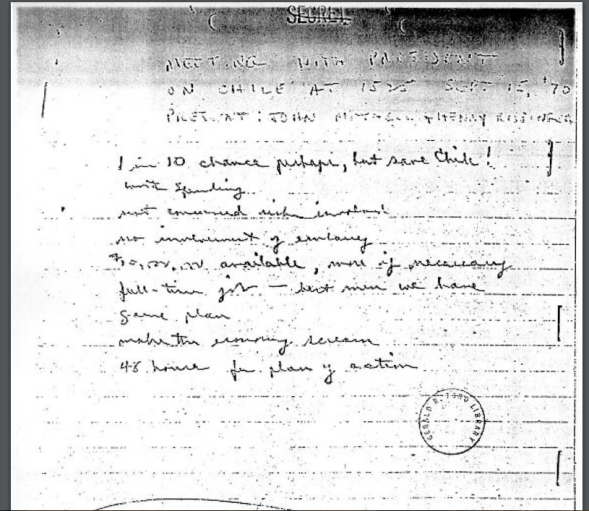 Declassified notes Richard Helms, CIA director, took at a September 15, 1970 meeting at the White House
game plan
make the economy scream
- This is a take I didn’t know I had until I saw it expressed:

of course. these rascals hired her and they knew who she was. it didn’t work for them like it did for Fox so they threw her under the bus, but they’re no more principled than she is.
- moving books around:


- happy fate to be in attendance at the longest World Series game ever played. Beginning:

End:
 Helytimes


