How much do you think this shitty painting by JFK sold for?
Posted: December 4, 2017 Filed under: art history Leave a comment
relevant to our discussion of George W. paintings.
You can find out the answer here at ArtNet in a piece by Sarah Cascone.
Mark Two
Posted: December 3, 2017 Filed under: Christianity, religion Leave a comment
Miniature 2427, “Archaic Mark,” turns out is actually a forgery?
“Why Mark?”, I asked. “Because it’s short“, he replied. I was willing to give anything a go, so I took the vicar’s advice and read it and the Gospel of Mark just swept me up.
So says Australian musician Nick Cave
in his intro to the Gospel of Mark, which I found on this Italian Nick Cave fan site.
The Gospel of Mark has to be one of the weirdest and most compelling books ever written. Nick Cave continues:
Scholars generally agree that Mark’s was the first of the four gospels to be written. Mark took from the mouths of teachers and prophets the jumble of events that comprised Christ’s life and fixed these events into some kind of biographical form. He did this with such breathless insistence, such compulsive narrative intensity, that one is reminded of a child recounting some amazing tale, piling fact upon fact, as if the whole worlddepended upon it – which , of course, to Mark it did. ‘Straightway’ and ‘immediately’ link one event to another, everyone ‘runs’, ‘shouts’, is ‘amazed’, inflaming Christ’s mission with a dazzling urgency. Mark’s Gospel is a clatter of bones, so raw, nervy and lean on information that the narrative aches with the melancholy of absence. Scenes of deep tragedy are treated with such a matter of factness and raw economy they become almost palpable in their unprotected sorrowfulness.
Couple things about the Gospel of Mark:
- there’s no Christmas. Jesus just turns up one day down by the river where John The Baptist is doing his thing.

- the oldest gospel. “Most scholars agree” is a term you come across again and again when you read into Bible stuff, especially New Testament stuff. Let’s acronym that as msa. As far as I can tell most scholars do agree on this one.

- the shortest gospel. 11,304 words. Very cool.
- simple language. Mark is written in Koine Greek which I can’t read. I’m told this was a simple version of Greek that people could use all over the Mediterranean. “Koine” just means “Common.” Mark wrote Common Greek.

I’m told Mark’s Greek is “rough”:

(from:

Now, “rough” sure but “unrehearsed”? Isn’t it likely Mark was writing down stories and quotes that had been transmitted orally, and thus were quite rehearsed?)
The version I’m reading is:

Here’s what J. B. says:

J. B. seems more confident than others that Mark = John Mark, but who cares?
It’s cool to imagine in the rubble of burned out Rome Mark starts going around saying “guys, I got some good news.”

“Who wants to read my book?”
Other scholars insist that Mark was written after 70 AD, because that’s when the Temple was destroyed after the Roman Siege of Jerusalem:

David Roberts’ lost painting of the siege of Jerusalem, source
which was a traumatic time. That chronology is the one Reza Aslan believes:

Me personally? I’m no expert but I think it’s possible someone like the writer of Mark might’ve been obsessed with the idea of the destruction of the Temple before it happened.
Maybe Mark saw things coming the way the Simpsons saw President Trump coming:
But let’s say Mark was written in 70. He’s writing about Jesus, who msa died around 33. So it’s like writing a book, today, about a guy who died in 1980.

John Lennon, say, or Colonel Sanders.

Mark isn’t writing a biography of Jesus though, he’s writing the “good news.” A good point by theologian Marcus Borg over at HuffPo:
-
Placing the Gospels after Paul makes it clear that as written documents they are not the source of early Christianity but its product. The Gospel — the good news — of and about Jesus existed before the Gospels. They are the products of early Christian communities several decades after Jesus’ historical life and tell us how those communities saw his significance in their historical context.
Here’s the craziest part about Mark imo. The last sentence of the original version, msa, is 16:8.
The women were shaking and confused. They went out and ran away from the tomb. They said nothing to anyone, because they were afraid.
What a freaky ending to your book!
Learned a lot about the Gospel origins from the PBS series From Jesus To Christ. Li’l snippet from this essay by Marilyn Matthews on their website:
What message did Mark intend to send to his audience? Scholars do not agree. Some argue that Mark deliberately constructs a bleak and frightening picture because that was the experience of the people for whom Mark composed his work. Elaine Pagels offers a different interpretation: “And the last words of the original gospel are ‘and they were terrified.’ It would be very bad news if it weren’t that underneath this rather dark story is an enormous hope . . . that this very promising story and its terrible anguished ending is nevertheless not the ending. That there’s a mystery in it, a divine mystery of God’s revelation that will happen yet. And I think it’s that sense of hope that is deeply appealing.”

This is Helytimes so next time we will have a look and see if we can find the oldest source of Mark.
Mark One
Posted: December 1, 2017 Filed under: Christianity, religion Leave a comment
1: 1] genealogy library YY YY YY yyyid [YY] Abraham [1: 2] Abraham [Heaven] nor did he [be] present in [his] [1: 3] take care of him and take him out of him they did not greet the embassy [1: 4] did not give birth and they have been in the midst of the sea
1: 5] Salvation shall not [be] of the rabbi did not recognize him from the p [o] y [to be] s een [1: 6] the dairy farm has been re-established it was the sausage of the sky. [1: 7] nor is it possible to do so ạμ does not enforce the [lacuna] you will be able to find [ gap [1:12] gap the man who gave birth to [n and he did not have the olive tree, [1:15] [Oliver] ḍε̣ [[in] η̣̣̣ [σ] ε̣ [ν] ο ελέξΑζζάρ ελέ [and] he did not do [the] knowledge of [ [1:16] and [he] is not [ [to] enforce the law of the [ ̣̣̣̣̣ []] ξ </s> </s> </s> </s> </s> </s> </s> </s> </s> </s> </s> </s> </s> </s> </s> </s> </s> [1:17] ̣̣̣̣̣̣̣̣̣̣ ̣̣̣̣̣̣̣̣̣̣̣̣̣̣̣̣̣̣ I have been born and I have been born [d] ạ [υ] ι̣δ̣ [ε] ω̣σ̣ τ̣η̣ [ς] (s) of [b] the weight of the toilet seat [to] of the YYYYyyyyyy [I] D [1:18] and YYYYY genera so that it can not be misinterpreted he shall have [his] name before the [e] found that this is the case of a gypsy [1:19] [ωσηφ̣̣̣̣̣̣̣̣̣̣̣̣̣] and [those] who do not desire it, compass [t] e [is] [1:20] [th] thou hast thou vnto him, []] [[]] [] [] [] [] that] [appears] [to] say [h] φ son] ḍ [da] ṃ [η] φ̣̣ β β β</s></s></s></s></s></s> [receive] [make] the [you] know [your] name the birth of [t] ns [estin] α̣ [son] [1: 21-23] the gap with [heat-treated methane]
Put some of Papyrus One through Google Translate and this is what I got.
Probably a li’l jumbled between the 2nd century Greek and the modern Greek.
Wiki tells me that what’s on Papyrus One is, in fact, Mark 1 1-9.
The beginning of the good news about Jesus the Messiah, the Son of God, as it is written in Isaiah the prophet:
“I will send my messenger ahead of you,
who will prepare your way”—
3 “a voice of one calling in the wilderness,
‘Prepare the way for the Lord,
make straight paths for him.’”4 And so John the Baptist appeared in the wilderness, preaching a baptism of repentance for the forgiveness of sins.
5 The whole Judean countryside and all the people of Jerusalem went out to him. Confessing their sins, they were baptized by him in the Jordan River.
6 John wore clothing made of camel’s hair, with a leather belt around his waist, and he ate locusts and wild honey.
7 And this was his message: “After me comes the one more powerful than I, the straps of whose sandals I am not worthy to stoop down and untie.
8 I baptize you with[e] water, but he will baptize you with the Holy Spirit.”
9 At that time Jesus came from Nazareth in Galilee and was baptized by John in the Jordan.
The papyrus skips over Mark 10:
10 Just as Jesus was coming up out of the water, he saw heaven being torn open and the Spirit descending on him like a dove.
Cool edit. The dove is a little much, too John Woo.
Then it continues:
11 And a voice came from heaven: “You are my Son, whom I love; with you I am well pleased.”
12 At once the Spirit sent him out into the wilderness,
13 and he was in the wilderness forty days, being tempted by Satan. He was with the wild animals, and angels attended him.
That from the New International version via Bible Gateway.

Grenfell and Hunt found Papyrus One at Oxyrhynchus in Egypt, along with a lot of other paperwork:
Administrative Documents assembled and transcribed from the Oxyrhynchus excavation so far include:
-
The contract of a wrestler agreeing to throw his next match for a fee.
-
Various and sundry ancient recipes for treating haemorrhoids, hangovers and cataracts.
-
Details of a corn dole mirroring a similar program in the Roman capital.
Plus some comedy scripts:
The classical author who has most benefited from the finds at Oxyrhynchus is the Athenian playwright Menander (342–291 BC), whose comedies were very popular in Hellenistic times and whose works are frequently found in papyrus fragments.

The Grouch at the Louvre by Wiki’s Rennet Stowe
Menander’s most popular character was a kind of proto Oscar the Grouch it sounds like.

Menander or literally me:

photo by Wiki’s Dave & Margie Hill of a relief of Menander choosing New Comedy masks.
Papyrus One is dated to the early 3rd century. Is Papyrus One the earliest fragment of Mark known to exist? We’ll take that up another time.
It’s interesting that there’s no birth of Jesus (“Christmas”) in Mark. Mark just jumps right in.
Here are the things Jesus says in Mark, Chapter One.
The time has come at last – the kingdom of God has arrived. You must change your hearts and minds and believe the good news.
Come and follow me, and I will teach you to catch men!
(to a demon) Hold your tongue and get out of him.
Then we will go somewhere else, to the neighboring towns, so that I may give my message there too – that is why I have come.
(to a leper) Of course I want to – be clean!
(also to a leper) Mind you say nothing at all to anybody. Go straight off and show yourself to the priest, and make the offerings for your cleansing which Moses prescribed as public proof of your recovery.
NEXT TIME:
Mark Two: what is the oldest version of Mark?
What An Unbranded Cow Has Cost
Posted: November 28, 2017 Filed under: art history Leave a comment
Shoutout to jrdfrnk on Instagram, whom I don’t know I don’t think, but whom put some closeups of this painting on his Instastory:

a different coloration in the Wikiart version?
reminding me to take more looks at Frederic Remington
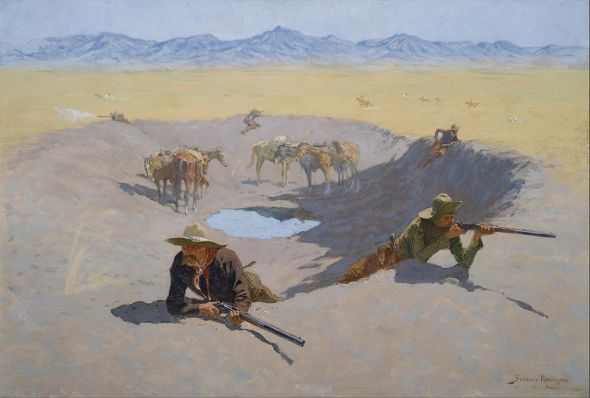
How cool was Frederic Remington?

The Scream Of Shrapnel on San Juan Hill:


The guy’s first sculpture was this:


April Ryan
Posted: November 22, 2017 Filed under: America Since 1945, presidents Leave a comment
Ice cold response to demeaning patronizing by Sarah Huckabee Sanders.
Ryan has been a member of the White House press corps for American Urban Radio Networks since January 1997 and has long been the only black female reporter among the White House correspondents.

‘Oumuamua
Posted: November 21, 2017 Filed under: Wonder Trail Leave a comment
This artist’s impression shows the first interstellar asteroid: `Oumuamua. This unique object was discovered on 19 October 2017 by the Pan-STARRS 1 telescope in Hawai`i. Subsequent observations from ESO’s Very Large Telescope in Chile and other observatories around the world show that it was travelling through space for millions of years before its chance encounter with our star system. `Oumuamua seems to be a dark red highly-elongated metallic or rocky object, about 400 metres long, and is unlike anything normally found in the Solar System. (source)
No known asteroid or comet from our solar system varies so widely in brightness, with such a large ratio between length and width. The most elongated objects we have seen to date are no more than three times longer than they are wide.
says NASA.
My theory? This is a bullet shot at Earth 300,000 years ago by a mysterious civilization that knew what we’d get up to.
An interstellar sniper shot.
Let’s hope 1) this is a one-off shot and 2) it’s gonna miss us.
How frustrating for this distant civilization if they put all their resources into one shot and it misses by a hair!
Here’s a documentary that compares two searches going on in Chile’s Atacama desert: the search for distant objects to the search for the remains of people murdered by the dictatorship.
Is it ok to have this calendar up in my office?
Posted: November 20, 2017 Filed under: America Since 1945, surfing, the California Condition Leave a comment
got it for free at Laguna Beach Surf and Sport.

Asked a female colleague her opinion, she didn’t care, but how much can we weigh that? here it is in some more context.

Another surf shop in Laguna is Thalia

Thalia as we all know is the muse of comedy

Thalia by Nattier
Here’s today’s surf report from Thalia via magicseaweed:

Uma’s example
Posted: November 16, 2017 Filed under: actors, buddhism, heroes Leave a comment
into Uma’s example of not speaking in anger and waiting to be ready to speak on stuff.
feel like Twitter Internet etc. has made everyone feel like they need to have a Take on everything instantly. I enjoy a good Take a much as anybody. But feel like I can’t remember the last time I heard someone say “I need to reflect on this before I comment.”
Remembering that Uma’s father is a scholar of Buddhism.

The Man From Onion Valley. source.
The Revolution eats its children
Posted: November 16, 2017 Filed under: art history 2 Comments
[Jaques Mallet du Pan] is known for coining the adage “like Saturn, the Revolution devours its children,” which originally appeared as “A l’exemple de Saturne, la révolution dévore ses enfants” in his widely circulated 1793 essay Considérations sur la nature de la Révolution de France, et sur les causes qui en prolongent la durée.
Goya’s painting above. Wikipedia tells me Goya had this painting in his dining room.
Rubens on same theme:

Don’t be a Søren
Posted: November 15, 2017 Filed under: how to live Leave a comment
Good lil bit in this Aeon article by Julian Baggini about Kierkegaard:

Will a painting by George W. Bush increase or decrease in value?
Posted: November 14, 2017 Filed under: art history, presidents 1 Comment
Vote by corresponding with Helytimes, please make only clear, considered arguments.
From The Hill, 2013 re a W. Christmas ornament for sale:
The former White House resident, 67, told Jay Leno in a Tuesday “Tonight Show” appearance that he takes weekly painting lessons, telling an instructor, “There’s a Rembrandt trapped in this body — your job is to find it.”
So hard to wrap your head around that someone (most presidents?) can be simultaneously a psychopath and a goofball.
Cultural revolution in the films of Zhang Yimou
Posted: November 14, 2017 Filed under: China, movies Leave a comment
At a time in my life when I had a lot of time and a physical DVD Netflix account I started watching the films of Zhang Yimou.
These movies are great. The plots are crazy, but compelling. There are other ways to tell stories besides the save the cat way.

(save the cat lol there’s a famine killing forty million people!)
A woman married to the brutal and infertile owner of a dye mill in rural China conceives a boy with her husband’s nephew but is forced to raise her son as her husband’s heir without revealing his parentage in this circular tragedy.
for example
Plus just trying to discern the basic premises the characters assume or the worldview of the movie assumes adds a whole other level
Been thinking about these movies in the context of a much, much, much more minor cultural revolution I perceive in the USA and especially Hollywood/the media, where people are like examining themselves and confessing to their political crimes.
Zhang was born in Xi’an, the capital of Shaanxi province. Zhang’s father, a dermatologist, had been an officer in the National Revolutionary Army under Chiang Kai-shek during the Chinese Civil War; an uncle, and an elder brother had followed the Nationalist forces to Taiwan after their 1949 defeat. As a result, Zhang faced difficulties in his early life.
During the Cultural Revolution of the 1960s and 1970s, Zhang left his school studies and went to work, first as a farm labourer for 3 years, and later at a cotton textile mill for 7 years in the city of Xianyang. During this time he took up painting and amateur still photography, selling his own blood to buy his first camera.[10]
Nice Try Hall Of Fame
Posted: November 13, 2017 Filed under: Hollywood Leave a comment
when Harvey Weinstein’s then-lawyer Lisa Bloom said he’s “an old dinosaur learning new ways”

Is it interesting?
Posted: November 13, 2017 Filed under: America Since 1945, politics Leave a comment
source
that William F. Buckley and Ayn Rand kind of look alike?

Hemingway Writing Advice
Posted: November 13, 2017 Filed under: Florida, Hemingway, writing, writing advice from other people 2 Comments
one of the descendants of Hemingway’s messed-up, inbred, extra-toe cats in Key West
In a 1935 Esquire piece, Hemingway, already playing the preening dickhead, gives some writing advice that I think is clear-eyed and well-expressed.

Writing room in Hem house in Key West
The setup is a young man has come to visit him in Key West, and Hemingway has given him the nickname Maestro because he played the violin.
MICE: How can a writer train himself?
Y.C.: Watch what happens today. If we get into a fish see exact it is that everyone does. If you get a kick out of it while he is jumping remember back until you see exactly what the action was that gave you that emotion. Whether it was the rising of the line from the water and the way it tightened like a fiddle string until drops started from it, or the way he smashed and threw water when he jumped. Remember what the noises were and what was said. Find what gave you the emotion, what the action was that gave you the excitement. Then write it down making it clear so the reader will see it too and have the same feeling you had. Thatʼs a five finger exercise. Mice: All right.
Y.C.: Then get in somebody elseʼs head for a change If I bawl you out try to figure out what Iʼm thinking about as well as how you feel about it. If Carlos curses Juan think what both their sides of it are. Donʼt just think who is right. As a man things are as they should or shouldnʼt be. As a man you know who is right and who is wrong. You have to make decisions and enforce them. As a writer you should not judge. You should understand.
Mice: All right.
Y.C.: Listen now. When people talk listen completely. Donʼt be thinking what youʼre going to say. Most people never listen. Nor do they observe. You should be able to go into a room and when you come out know everything that you saw there and not only that. If that room gave you any feeling you should know exactly what it was that gave you that feeling. Try that for practice. When youʼre in town stand outside the theatre and see how people differ in the way they get out of taxis or motor cars. There are a thousand ways to practice. And always think of other people.
Mice: Do you think I will be a writer?
Y.C.: How the hell should I know? Maybe youʼve got no talent. Maybe you canʼt feel for other people. Youʼve got some good stories if you can write them. Mice: How can I tell?
Y.C.: Write. If you work at it five years and you find youʼre no good you can just as well shoot yourself then as now.
Mice: I wouldnʼt shoot myself.
Y.C.: Come around then and Iʼll shoot you.
Mice: Thanks.
This article is behind a paywall at Esquire but I found it reprinted on the website of Diana Drake, who has story by credit on the film What Women Want.
The story of Profumo
Posted: November 12, 2017 Filed under: America Since 1945, heroes Leave a comment
Shortly after his resignation Profumo began to work as a volunteer cleaning toilets at Toynbee Hall, a charity based in the East End of London, and continued to work there for the rest of his life. Peter Hitchens has written that Profumo “vanished into London’s East End for 40 years, doing quiet good works”. Profumo “had to be persuaded to lay down his mop and lend a hand running the place”, eventually becoming Toynbee Hall’s chief fundraiser, and used his political skills and contacts to raise large sums of money. All this work was done as a volunteer, since Profumo was able to live on his inherited wealth. His wife, the actress Valerie Hobson, also devoted herself to charity until her death in 1998. In the eyes of most commentators, Profumo’s charity work redeemed his reputation. His friend, social reform campaigner Lord Longford said he “felt more admiration [for Profumo] than [for] all the men I’ve known in my lifetime”.
Profumo’s dedication and dignity won him enormous admiration from people in all walks of life. The author Peter Hennessy, a fellow trustee at a charitable foundation associated with Toynbee Hall, described him as “one of the nicest and most exemplary people I have met in public or political life; full of the old, decent Tory virtues”. Margaret Thatcher called him “one of our national heroes”. “Everybody here worships him”, a helper at Toynbee Hall was once quoted as saying. “We think he’s a bloody saint.”


The scum of the earth
Posted: November 10, 2017 Filed under: war Leave a comment
(c) English Heritage, The Wellington Collection, Apsley House; Supplied by The Public Catalogue Foundation
A French army is composed very differently from ours. The conscription calls out a share of every class — no matter whether your son or my son — all must march; but our friends — I may say it in this room — are the very scum of the earth. People talk of their enlisting from their fine military feeling — all stuff — no such thing. Some of our men enlist from having got bastard children — some for minor offences — many more for drink; but you can hardly conceive such a set brought together, and it really is wonderful that we should have made them the fine fellows they are.
Christopher Plummer played Wellington in the 1970 movie Waterloo, an expensive flop:
Final costs were over £12 million (GBP) (equivalent to about U.S. $38.3 million in 1970), making Waterloo one of the most expensive movies ever made, for its time. Had the movie been filmed in the West, costs might have been as much as three times this. Mosfilm contributed more than £4 million of the costs, nearly 17,000 soldiers of the Soviet Army, including a full brigade of Soviet cavalry, and a host of engineers and labourers to prepare the battlefield in the rolling farmland outside Uzhhorod, Ukraine (then part of the Soviet Union).
To recreate the battlefield authentically, the Soviets bulldozed away two hills, laid five miles of roads, transplanted 5,000 trees, sowed fields of rye, barley and wildflowers and reconstructed four historic buildings. To create the mud, more than six miles of underground irrigation piping was specially laid. Most of the battle scenes were filmed using five Panavision cameras simultaneously – from ground level, from 100-foot towers, from a helicopter, and from an overhead railway built right across the location.
Happened to tape the film onto a VHS off Boston’s TV 38 in my boyhood and thought it was pretty good.

is a very compelling book on the topic. Another great one by Howarth.

Wellington said a bunch of cool quotes:
As quoted in A History of Warfare (1968) by Bernard Montgomery, 1st Viscount Montgomery of Alamein: “Sir Winston Churchill once told me of a reply made by the Duke of Wellington, in his last years, when a friend asked him: “If you had your life over again, is there any way in which you could have done better?” The old Duke replied: “Yes, I should have given more praise.”
The phrase “scum of the earth” turns up in some translations of 1 Corinthians 4:13.
On this Veterans’ Day I like to remember unlikely veterans like Larry David:

He wrote a funny essay about his experience in the Army Reserve here. And:

He was drafted into the United States Army in 1970. He trained as a medic and was stationed in West Germany. After being honorably discharged he used the benefits of the G.I. Bill to enroll in the California Institute of the Arts, and received a BAdegree in drama from The Evergreen State College in 1975.
Thomas Ricks of course has a Veteran’s Day guest post worth reading.
Albums
Posted: November 10, 2017 Filed under: music, the California Condition Leave a commentThis album was recorded in Ireland:
from wiki:
Although the band liked the demo, it was difficult for them to record the song. Bassist Adam Clayton said, “At the time it sounded like a foreign language, whereas now we understand how it works”. The arrangement, with two time signature shifts and frequent chord changes, was rehearsed many times, but the group struggled to get a performance they liked. According to co-producer Daniel Lanois, “that was the science project song. I remember having this massive schoolhouse blackboard, as we call them. I was holding a pointer, like a college professor, walking the band through the chord changes like a fucking nerd. It was ridiculous.” Co-producer Brian Eno estimates that half of the album sessions were spent trying to record a suitable version of “Where the Streets Have No Name”. The band worked on a single take for weeks, but as Eno explained, that particular version had a lot of problems with it and the group continued trying to fix it up. Through all of their work, they had gradually replaced each instrument take until nothing remained from the original performance.
So much time had been spent on “screwdriver work” that Eno thought it would be best to start from scratch. His idea was to “stage an accident” and have the song’s tapes erased. He said that this was not to force abandonment of the song, but rather that it would be more effective to start again with a fresh performance. At one point, Eno had the tapes cued up and ready to be recorded over, but this erasure never took place; according to engineer Flood, fellow engineer Pat McCarthy returned to the control room and upon seeing Eno ready to erase the tapes, dropped the tray of tea he was carrying and physically restrained Eno.
This album was recored in Joshua Tree, CA:
Weighing the heart against a feather
Posted: November 8, 2017 Filed under: how to live Leave a comment

find the image of having your heart weighed against a feather after you die very powerful.
How do you do on the 42 Negative Confessions?:
The following are translations by E. A. Wallis Budge.
42 Negative Confessions (Papyrus of Ani)
From the Papyrus of Ani.
-
I have not committed sin.
-
I have not committed robbery with violence.
-
I have not stolen.
-
I have not slain men and women.
-
I have not stolen grain.
-
I have not purloined offerings.
-
I have not stolen the property of the gods.
-
I have not uttered lies.
-
I have not carried away food.
-
I have not uttered curses.
-
I have not committed adultery.
-
I have made none to weep.
-
I have not eaten the heart [i.e., I have not grieved uselessly, or felt remorse].
-
I have not attacked any man.
-
I am not a man of deceit.
-
I have not stolen cultivated land.
-
I have not been an eavesdropper.
-
I have slandered [no man].
-
I have not been angry without just cause.
-
I have not debauched the wife of any man.
-
I have not debauched the wife of [any] man. (repeats the previous affirmation but addressed to a different god).
-
I have not polluted myself.
-
I have terrorized none.
-
I have not transgressed [the Law].
-
I have not been wroth.
-
I have not shut my ears to the words of truth.
-
I have not blasphemed.
-
I am not a man of violence.
-
I am not a stirrer up of strife (or a disturber of the peace).
-
I have not acted (or judged) with undue haste.
-
I have not pried into matters.
-
I have not multiplied my words in speaking.
-
I have wronged none, I have done no evil.
-
I have not worked witchcraft against the King (or blasphemed against the King).
-
I have never stopped [the flow of] water.
-
I have never raised my voice (spoken arrogantly, or in anger).
-
I have not cursed (or blasphemed) God.
-
I have not acted with evil rage.
-
I have not stolen the bread of the gods.
-
I have not carried away the khenfu cakes from the spirits of the dead.
-
I have not snatched away the bread of the child, nor treated with contempt the god of my city.
-
I have not slain the cattle belonging to the god.
Definite no from me on 31. I’m always prying into matters! Something for me to work on.
I wonder how E. A. Wallis Budge himself would do on this quiz:

 Helytimes


.jpg)
