If you are jonesin’ for Game Of Thrones
Posted: March 26, 2015 Filed under: trips Leave a commentmay I recommend:

Never read the Game Of Thrones books. Don’t know why, that specific kind of nerddom is not my kind. I bet George RR Martin has read this book. It is fucking incredible.
You are very busy so let me summarize it for you. I’m reading the translation by JM Cohen:

(I’m about to quote pretty generously from it. If any of the attorneys who read Helytimes could advise me on the legality of that, it’d be great. I think it’s ok, because I’m not making any money from this, and the whole point is to encourage you to buy this book.)
Bernal Diaz was eighty-four, blind, on an estate in Guatemala when he decided to dictate what he remembered from when he was twenty-seven, in 1519, when he went along with Hernan Cortés on an expedition to the interior of Mexico.
This is the best source, as far as I can tell, for what happened. Cortés wrote letters to the king of Spain, but if you read them you won’t come away with the impression you can trust him.
There exists also a sort of “Aztec” (not the preferred nomenclature) source: the Florentine Codex:
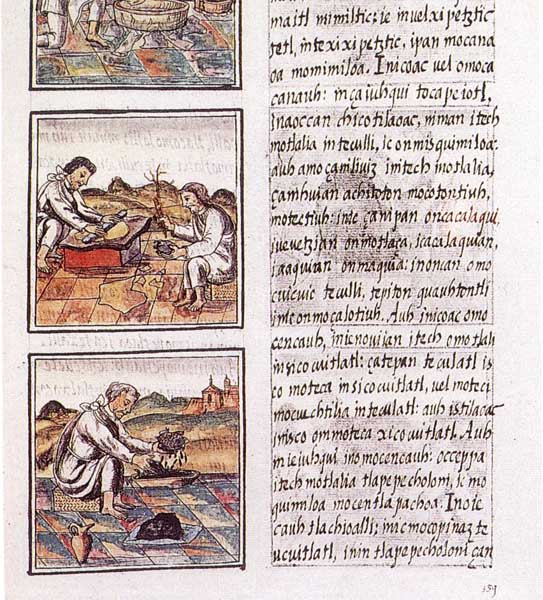 which has its own insane story, it was written by a Franciscan friar who learned Nahautal and went around listening to and summarizing oral histories. So this is written by a Spanish guy, too, history is written by the winners, but at least he was asking around.
I’m gonna steal from the drawings inked into the codex. If you want you can look at it yourself here or here:

Diaz says, when they landed:
There were five hundred and eight not counting the ships’ captains, pilots, and sailors, who amounted to a hundred,
and
sixteen horeses or mares, the latter all fit to be used for sport or as chargers.
Some Campeche Indians saw them and shouted castilan! castilan!
Like, “Castilian”? What the fuck? How did they know where they were from?

The natives communicated somehow that there were other Spanish people there.
So Cortés wrote down a letter, and bribed the natives with beads to bring it to them.
Some days later there arrived a man in a canoe:
As he leapt ashore, [he] exclaimed in inarticulate and clumsy Spanish: “God and the blessed Mary of Seville!”
This was Jeronimo de Aguilar. He was a Franciscan friar and he had survived a shipwreck, eight years before. Maybe fifteen other people had survived, too, including two women:
He, his companions, and the two women had then got into the ship’s boat, thinking they could reach Cuba or Jamaica. But the currents were so strong that they were thrown ashore in this country, where the Calachiones of the district had divided them up, sacrificing many of his companions to their idols. Some too had died of disease, and the two women only recently of overwork, for they had been made to grind corn. The Indians had intended to sacrifice him, but one night he had escaped and fled to that Cacique with whom he had been living ever since. Now, he said, the only survivors were himself and a certain Gonzalo Guerrero.

When Aguilar got Cortes’ letter he was ecstatic. He sent a letter to Guerrero, who lived several villages away.
Guerroro wrote back (paraphrasing): I have a face tattoo now. I have an Indian wife, and half-Indian kids. I’m with these guys now.
Aguilar says this is true, Guerroro was actually famously respected for his courage. Aguilar wrote him again, saying like “but what about your Christian soul?” Guerrero didn’t write back to that.
When Cortés heard this he exclaimed: “I wish I could get my hands on him. For it will never do to leave him here.”
Years later, it’s said, the dead body of Guerrero was found after a battle in Honduras. He got shot fighting with the local tribes against the Spanish.
Aguilar was happy to go with his countrymen. He told them how he had been entirely true to his vow of chastity even despite the local chief tempting him:

So says Washington Irving.
Aguilar could translate the local languages. The Spanish unloaded their ships:
When the horses came ashore they were very stiff and afraid to move, for they had been on board for some time. Next day, however, they moved quite freely… The best horses and riders were chosen to form the cavalry and little bells were attached to the horses’ breastplates. The horsemen were ordered not to stop and spear those who were down, but to aim their lances at the faces of the enemy.

Down the coast, they were spied on and then attacked by, says Diaz, the locals. This built into a massive battle:
I remember that whenever we fired our guns, the Indians gave great shouts and whistles, and threw up straw and earth so that we could not see what harm we had done them. They sounded their trumpets and drums, and shouted and whistled, and cried “Alala! Alala!”*
Just at this moment we caught sight of our horsemen. But the great host of Indians was so crazed by their attack that they did not at once see them approaching behind their backs…
When it was over, we bandaged our wounded with cloths, for this was all we had, and sealed the wounds of our horses with fat from the corpse of an Indian that we had cut up for this purpose. We then went to look at the dead that were lying about the field, and found more than eight hundred, most of whom had been killed by sword-thrusts, and the rest by cannon, muskets, or crossbows.
On the Spanish went.

On the morning of March 15, 1519 [Cohen says this date is incorrect, but that’s what Diaz says]:
many Caciques and important persons came from Tabasco and the neighboring towns and paid us great respect. They brought a present of gold, consisting of four diadems, some ornaments in the form of lizards, two shaped like little dogs and five like ducks, also some earrings, two masks of Indian faces.
These gifts were nothing, however, compared to the twenty women whom they gave us.
Among these women was one who ended up with the name Dona Marina. Diaz says you could tell just by looking at her that she was a princess and a “mistress of vassals,” though he doesn’t explain that.
Cortés doled these women out to his top officers. He gave Dona Marina to Alonso Hernandez Puertocarrero, but when he went back to Spain, Cortés himself impregnated her.
Dona Marina could speak several of the local languages, including one Jeronimo Aguilar understood, so between them they could translate. Over and over again she warned Cortés about traps he was going to fall into, plots he wasn’t seeing. Diaz says he’s sure he and all the rest of the Spanish would’ve been killed without her.

Cortes asked them where they procured their gold and jewels, and they answered from the direction of the sunset, saying “Culua” and “Mexico.”
Onward they go. A scout reports unsettling discoveries:


Some Indians come up to them to more or less surrender, and offer their allegiance. They’d decided Cortés, and the new guys, must be better than the man who was boss for five hundred miles, Montezuma:


Some of Cortés’ guys wanted to get back on the ships and go back to Cuba. “We’ve done enough!” was more or less their argument.
Cortés says, “Fine. Go ahead. Get on a ship. I’m not stopping anybody.” They’re kinda confused. Nervously a few of them get on a ship. They start getting ready, and are just about to leave, when Cortés drags them all back. Cortes is like “you assholes. You’re not going anywhere.” Just to make sure, says Diaz:

It’s time to go. Cortes gives a final speech, and he rounds up 200 of his new allies to help:

Time to go inland:


Along the way, they meet the locals, who all tell them more about Montezuma:

Scary warnings:


Different methods of religious conversion are discussed, and the terrifying hound:

Another battle:

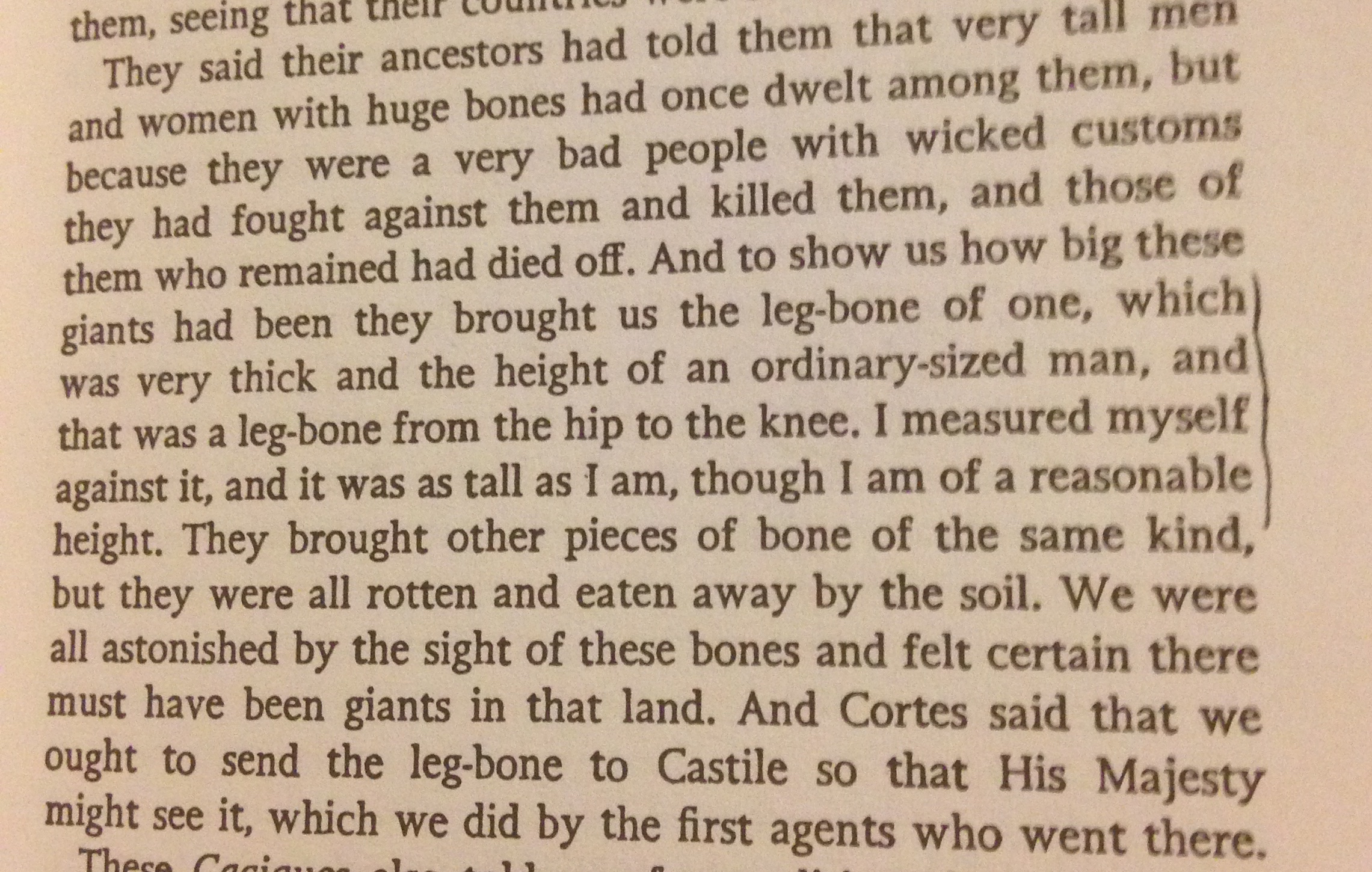
Strange discoveries, the bones of a giant:
 Some of Cortes guys’ want to quit. To which he says, basically, “we ain’t going back”:


Montezuma, meanwhile, was freaking out:
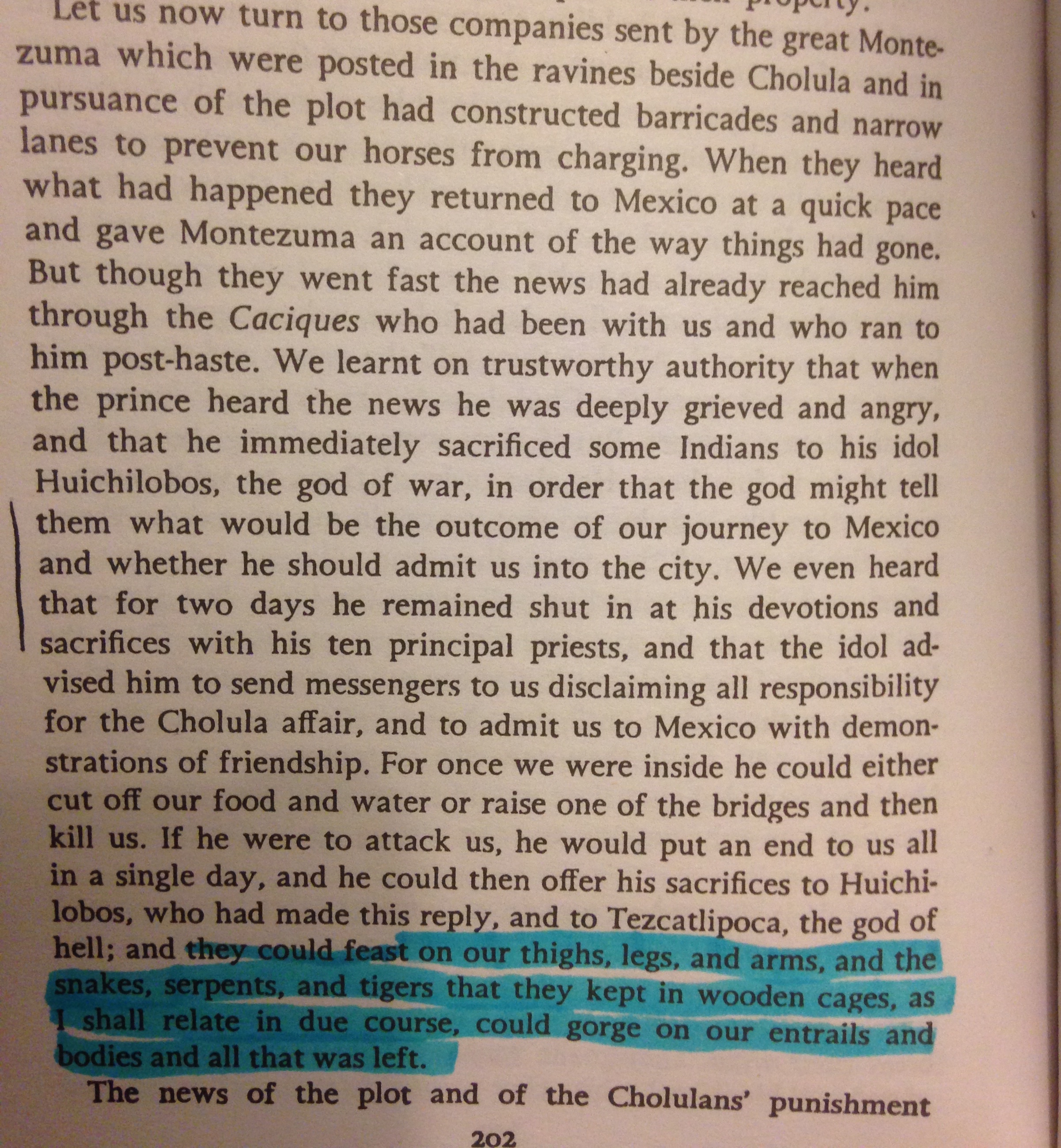

Diaz says they got to the town of Cholula – maybe twenty thousand people, who are not sure what to make of what’s happening. The Spanish round up the nobility of the town in the central square, and then, on the signal of a gunshot, they start massacring them all.

Diaz says this was all justified:


On the Spanish go. By now they have a growing mob of natives with them.
They come to a fork in the road. One side is blocked by pine trees. That’s the road that leads to Montezuma’s capital.

The Spanish climb over the ridge. And when they saw what was down there, Diaz says:
We were astounded… Indeed, some of our soldiers asked whether it was not a dream… it was all so wonderful that I do not know how to describe this first glimpse of things never heard of, seen or dreamed of before.
Next time on helytimes: the city of Tenochtitlan.

*Several times in his letters Cortés describes native temples as “mosques,” mezquilas. Kind of interesting. The Spanish had been fighting the Islamic Moors of North Africa for seven hundred years. Recent historians of all this consider this “Reconquista” important context for how Cortés and his guys did their thinking.
Bachelor’s Mexico
Posted: March 22, 2015 Filed under: Mexico, South America, trips Leave a comment
Helytimes readers – hey guys – will no doubt have noticed a decline in the quantity (but not quality?) of posts here lately. That’s because the deadline for my book keeps creeping up on the calendar.
That project’s got me pretty well busy, among other things with research. Today, for instance, I stopped by the Central Library in downtown LA to get my hands on a copy of Hernan Cortes’ letters to the Spanish king.
While I was in the “history of Mexico” section, a colorful volume attracted my eye:

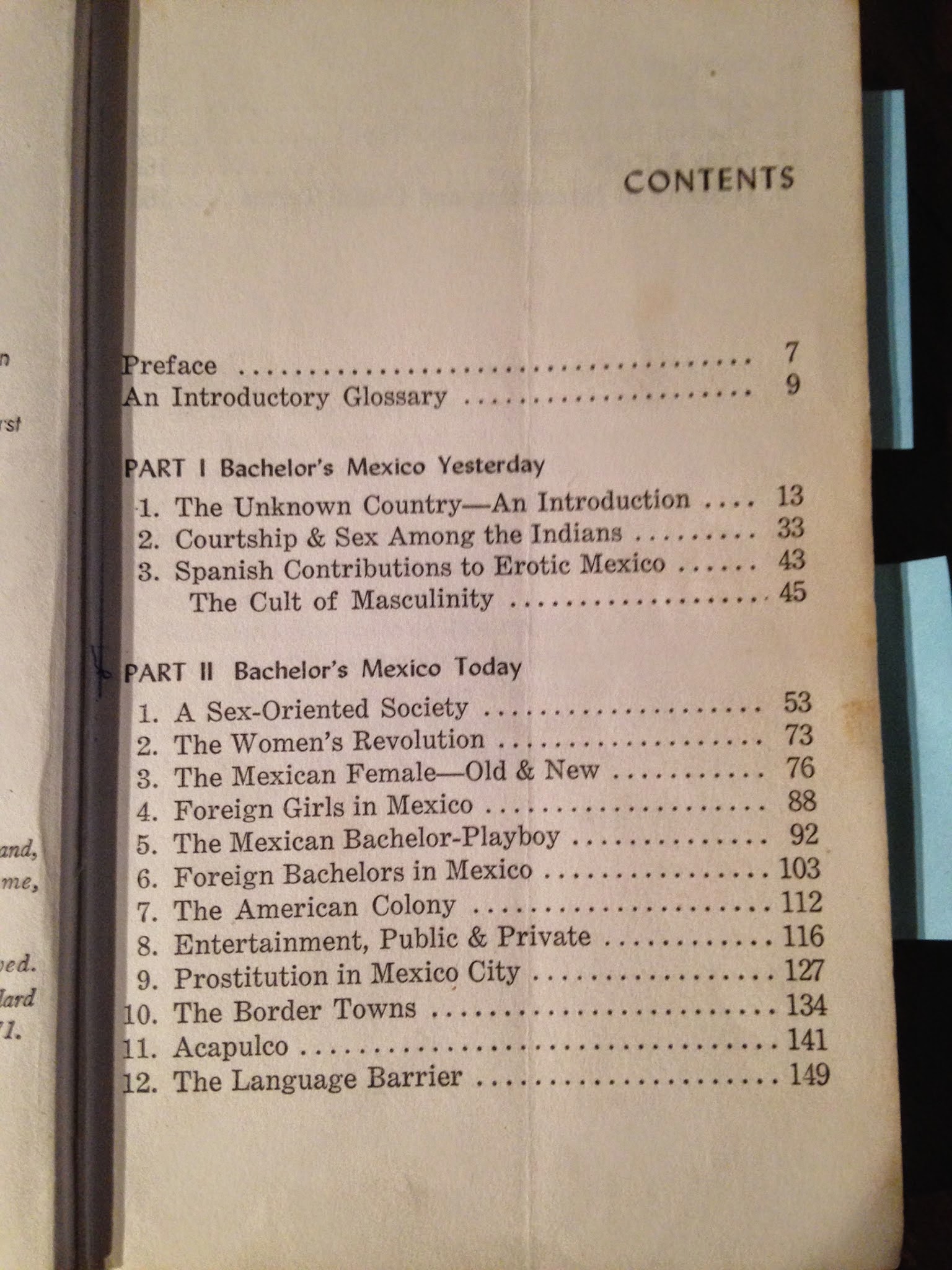
Most interesting might be the handwritten edit I found inside:

Other books by Boye de Mente:

From his wikipedia page:

De Mente with Ben Carlin during their crossing of the Pacific Ocean by amphibious vehicle in the late 1950s.
The Ragged Antique Phonograph Program
Posted: March 18, 2015 Filed under: music Leave a commentReading this article about The Best Show:
Like WFMU itself, which takes pride in its esotericism (the lead-in to The Best Show for years was The Ragged Antique Phonograph Program, which played only 78s or cylinders on period equipment), The Best Show is a cult phenomenon. Its most hard-core listeners can literally become card-carrying fans: “Friends of Tom” are issued membership cards signed by Scharpling. For years, finding out about the show took some digging. Chicagoans who wanted to hear it had to visit the tristate area or find one of five CDs that Scharpling and Wurster self-released between 2002 and 2007. That finally changed in 2008, when they added a podcast.
and was like “haha what a hilarious gag from Scharpling and Wurster. That’s just the kind of well-observed satire of the excesses of eccentric fandom they specialize at.”
But no, apparently, that really was the lead-in. Here’s a photo of the hosts from their website, where you can listen to probably over a hundred episodes.

This world is truly amazing. I wonder if there’s a big future in documentary or “reality” comedy, that’s not making anything up but just observing and capturing the absurdities of what exists, the way all my friends watch documentaries now? The trouble there might be it’s very difficult to construct a documentary that is purely funny without a strong dose of some pathetic sadness or hopefulness or something — you can’t get undiluted laughs out of unconstructed reality? If the goal is simply, “watch something that makes me laugh” might be hard to capture.
Anyway, best of luck to Scharpling in continuing Best Show:
James Joyce: hot or not?
Posted: March 15, 2015 Filed under: Ireland, writing Leave a comment
Talking the artist as a young man, not the old blind guy. And, of course, bae (rnacle):

How about this eerie family portrait? bottom left is daughter Lucia, who got dance lessons from Isadora Duncan, fell in love with Samuel Beckett, and had Jung for a shrink (lotta good it did her):
 Top right is son Giorgio. “He spent his days in an alcoholic haze,” says The New Yorker.
Book I’m always recommending
Posted: March 11, 2015 Filed under: America Since 1945, writing 2 Comments
Bill James you may know, if you read Moneyball or follow baseball. In the 1970s, while working as a nighttime security guard at a Van Camp’s pork and bean factory in Kansas, he spent his spare time researching interesting questions about baseball, writing them up, and self-publishing them:
A typical James piece posed a question (e.g.,“Which pitchers and catchers allow runners to steal the most bases?”), and then presented data and analysis written in a lively, insightful, and witty style that offered an answer.
Editors considered James’s pieces so unusual that few believed them suitable for their readers. In an effort to reach a wider audience, James self-published an annual book titled The Bill James Baseball Abstract beginning in 1977. The first edition of the book presented 80 pages of in-depth statistics compiled from James’s study of box scores from the preceding season and was offered for sale through a small advertisement in The Sporting News.

Bill James was also the last person from Kansas to be sent to Vietnam — that’s just the kind of trivia he likes to uncover, turn over, and then decide is interesting but irrelevant.

Bill James’ other passion is reading true crime books. In Popular Crime, he rounds up, summarizes, muses on what he’s learned from reading, he says, over a thousand true crime books.
This book has a fantastic table of contents, allowing you to skip about to the crimes that pique your particular interest:


It’s also written in a terrific, casual style, that trusts the reader’s common sense and intelligence. Here Bill James talking about how serial killers get caught, and a fact he’s concluded about serial killers:


Here’s an excerpt on the OJ case – chose this more or less at random to show his style:

A James question from me: why isn’t this book more popular? I think everyone I’ve recommended it to loves it, yet no one seems to have heard of it.
I’ve genuinely considered getting more into baseball just so I could read more of Bill James’ writings. It wouldn’t be right to call his style “amateurish,” but there’s something about it that’s free from professional stiffness, though I suspect it takes years of practice to sound this natural. It’s refreshing, and surprisingly rare. He’s not trying to sound like anything except himself.
Here’s an interview with James on the book conducted by Chuck Klosterman.
Poignant Message
Posted: March 7, 2015 Filed under: Texas 2 Commentson the website of texasindians.com  We found your site very helpful and wish you all the best! Let us know if we can help!
Mountaineering movies on Netflix Instant, ranked.
Posted: March 3, 2015 Filed under: film, mountains 3 Comments
I like watching movies about mountain climbing, and I think I’ve seen all the ones avail on Netflix Instant.
1) Touching The Void
See Touching The Void. One of the best documentaries, period. Incredible story, great twists, so intense but also there’s a lovable semi-schlub who got caught up in things.
2) Beyond The Edge 
Very cool. Doc/reenactment about the first successful Everest ascent. Worth watching just for the fashion, the style on these guys was rad.
 A great story of internal competition as well, as the team members were vying to be the guy who got to make the final ascent. The brash New Zealanders against the stuffy English public school guys. Edmund Hillary and Tenzing such cool examples of calm badassery. Hadn’t occurred to me that Hillary, who in his old age was usually portrayed as a kindly old hero, was also of course an extremely intense, driven, and competitive athlete, more Kobe than Dalai Lama.
There’s lots too on the great John Hunt, who organized the expedition.
Also has some of the clearest visualizations of Everest’s geography I’ve seen. You can really wrap your head finally around, like, where the Khumbu ice fall is.

3) Nordwand/Northface
Some great shots of old school climbing. But it’s set in 1936, it’s in German, and the characters are not not Nazis enough to really get behind.
4) The Summit
Compelling characters, a good story, kind of frustratingly told. Odd editing choices botch a compelling narrative of how fuckup x fuckup x fuckup + misfortune = catastrophe.
5) Everest IMAX
Some cool shots I guess but this is elementary stuff. We’re past this.
Would most like to have on Netflix:
Valley Uprising
The Blue Light
K2. What is this movie? It started as a play?
British House Of Cards
Posted: March 2, 2015 Filed under: actors Leave a comment
I have to credit my bud and debate partner Dave King* with putting me on to the British House Of Cards. Just watch the first two minutes — so wonderfully, insanely British.
* not to be confused with South African businessman, fraudster, Rangers football club shareholder, and sometime golf caddy Dave King

When was the last time somebody got killed by a wild bear in Los Angeles?
Posted: February 28, 2015 Filed under: animals, the California Condition Leave a comment
Prompted by a recent conversation about the movie Grizzly Man. (Forgot that Timothy Treadwell named one of the bears Mr. Chocolate.)
Andy Sublette, 46.
An experienced bear hunter who hunted and killed many bears, Sublette shot and wounded a bear after being separated from his hunting party near present-day Santa Monica in 1854. He was then mauled but stabbed the bear to death with his knife and with the help of his dog. His dog survived, but Sublette died seven days later due to his injuries.
So says Wikipedia citing Gary Brown’s The Bear Almanac. I wonder if they mean, like, Santa Monica Santa Monica or the Santa Monica mountains (even, like, Malibu).
Anyway. Heard it took the bear an hour and a half to drive back to Silverlake — the 10 was a nightmare!
Gay Hobo Slang
Posted: February 27, 2015 Filed under: America, sexuality, the American West Leave a commentAt Helytimes we love to get submissions for our roving correspondents. Longtime friend of the blog Mat W. sends in this item:
A good many years ago, I was a pretty faithful reader of Alex Ross’s blog The Rest Is Noise (title later cannibalized for his book, which got him a MacArthur Genius Grant). In those days I had a pretty boring job and would read almost anything on the internet that made it through the security filter of the company where I worked. A lot of what Ross had to say made little sense since I didn’t (and still don’t) know much about music, but I would still skim the posts and found a few good bits and bobs.
One day, I came across this post:
http://www.therestisnoise.com/2004/10/interesting_pie.html“Gay hobo subculture”!? WHA?! Of course long-time readers of Hely Times may recall Smokestack Adrian, but I was intrigued. At the time, searches of the internet didn’t turn up much. I did learn a little bit more about it in George Chauncey’s great Gay New York, but it offers a pretty light treatment, though the subject of the book, I suppose, required only a glancing discussion.
However, I recently found a great book, called Gay Talk: A (Sometimes Outrageous) Dictionary of Gay Slang. It’s by a guy named Bruce Rodgers, and was published in 1972 (under a different title, I believe). It is GREAT and really reaches back into the pre-Stonewall era for lots of verbal treasures. Guess what a Veronica’s Veil is, you guys!
AND while paging through I found a whole entry on the hobo! Rather than type up the highlights, I’ll just include a picture of the entry for all you candy kids out there.


The (sexy) Epic Of Gilgamesh
Posted: February 26, 2015 Filed under: women, writing Leave a comment

Gilgamesh is crushing it, basically:
Gilgamesh the tall, magnificent and terrible;
who opened passes in the mountains,
who dug wells on the slopes of the uplands,
and crossed the ocean, the wide sea to the sunrise;
who scoured the world ever searching for life,
and reached through sheer force Uta-napishti the Distant;
who restored the cult-centres destroyed by the Deluge;
and set in place for the people the rites of the cosmos.
Who is there can rival his kingly standing,
and say like Gilgamesh, ‘It is I am the king’?
Gilgamesh was his name from teh day he was born,
two-thirds of him god and one third human.
But his dominance is getting to be a problem:
Though he is their shepherd and their protector,
powerful, pre-eminent, expert and mighty,
Gilgamesh lets no girl go free to her bridegroom.
So complain ‘the warrior’s daughter, the young man’s bride’ to the goddesses. So the goddess Aruru makes a man who will be a match for Gilgamesh.
In the wild she created Enkidu, the hero,
offspring of silence, knit strong by Ninurta.
All his body is matted with hair,
he bears long tresses like those of a woman:
the hair of his head grows thickly as barley,
he knows not a people, nor even a country.
Coated in hair like the god of the animals,
with the gazelles he grazes on grasses.
Joining the throng with the game at the water-hole,
his heart delighting with the beasts in the water.

Enkidu scares a hunter, who goes to Gilgamesh. Gilgamesh says “ok, go get Shamhat the temple prostitute and go tempt Enkidu”:
Then Shamhat saw him, the child of nature,
the savage man from the midst of the wild.
‘This is he, Shamhat! Uncradle your bosom,
bare your sex, let him take in your charms!
Do not recoil, but take in his scent:
he will see you, and will approach you.
Spread your clothing so he may lie on you,
do for the man the work of a woman!
Let his passion caress and embrace you,
his herd will spurn him, though he grew up amongst it.’
Shamhat unfastened the cloth of her loins,
she bared her sex and he took in her charms.
She did not recoil, she took in his scent:
she spread her clothing and he lay upon her.
She did for the man the work of a woman,
his passion caressed and embraced her.
For six days and seven nights
Enkidu was erect, as he coupled with Shamhat.
When with her delights he was fully sated,
he turned his gaze to the his herd.
The gazelles saw Enkidu, they started to run,
the beasts of the field shied away from his presence.
Enkidu had defiled his body so pure,
his legs stood still, though his herd was in motion.
Enkidu was weakened, could not run as before,
but now he had reason, and wide understanding.
Wild man fucks prostitute, loses his gazelle friends — oldest story in the world.
That’s all on Tablet One, by the way. Remember the old rule: by Tablet Two, you should have established your characters and relationships.
What happens next is Gilgamesh and Enkidu become best friends and decide to go to the Cedar Forest to kill the monster Humbaba.
Helytimes Mailbag
Posted: February 25, 2015 Filed under: America Since 1945, movies Leave a comment
Lots of readers wrote to me to the effect “You got Wild completely wrong, this is a great movie.” A sample:
The fact that she can quit and has no reason to walk is what I liked. I don’t see it as a motivation problem. I like that we don’t know what she means to accomplish almost precisely because she doesn’t know what she wants. She just knows that the noise in her head telling her to act out and hurt herself and it’s turning her into a person who is different than the person she thought her mom wanted her to be. So that’s why she heads into nature. She never “arrives” so to speak, she just feels differently about herself by the time she gets to Ashland
Terrific! Thanks for writing. Like I said I thought it was pretty good.

Lots of incoming fire also came my way re: Selma. (Funny to do an image search for “Selma”). Let me quote from one:
Helytimes, I have a bone to pick with you. Selma was a great movie. I wept. I may not know everything about LBJ but this was a powerful movie and I don’t get why you were being so hard on it.
Another:
Why were you so hard on Selma without taking any shots at an even more historically inaccurate movie, The Imitation Game, which misrepresents Alan Turing’s character, is similarly “all over the place” and is just a mess?
Well what can I tell you: I didn’t think it was that good. It’s not an easy movie to make, surely. Should it get points for difficulty? Maybe! If you liked Selma, that’s terrific. I want you to have as many things to like as possible.
As for The Imitation Game — whatever, I can’t pay attention to everything! It seemed to me that movie took place in a kind of bizarro reality so whatever historical crimes were extra- beside the point. The Wikipedia folks seem to have it covered too:
Turing’s surviving niece Payne thought that Knightley was inappropriately cast as Clarke, whom she described as “rather plain”.

Harsh. I did wonder why the character played by Tywin Lanister was such an asshole to Alan Turing:

Was that real? Tywin is playing Alastair Denniston. Got this book:

and looked up every time Denniston appears, which is six times. He’s never once a jerk to Turing. This is the closest he comes:

Maybe Andrew Hodges just left that part out. Is it unfair to real-life person Denniston to make him out that way?:
Libby Buchanan, Denniston’s 91-year-old niece and god-daughter, said she recalled a “quiet, dignified” man who was devoted to his work.
Judith Finch, his granddaughter, added: “He is completely misrepresented. They needed a baddy and they’ve put him in there without researching the truth about the contribution he made.”
The film’s writer, Graham Moore, and producers said: “Cdr Denniston was one of the great heroes of Bletchley Park.
“As such, he had the perhaps unenviable position of being a layman overseeing the work of some of the century’s finest mathematicians and academics — a situation bound to result in conflict as to how best to get the job done.
“I would say that this is the natural conflict of people working extremely hard under unimaginable pressure with the fate of the war resting on their heroic shoulders.”
The part of Imitation Game I found most interesting was the idea that once they broke the code, Turing and the boys and Kiera Knightley worked out a system to use the information they had in a statistically measured way. Looked into this and couldn’t find much more about it. Seems like actually the way it worked is they limited access to the Enigma info to a small pool of top military commanders, and even that they were haphazard and bad at. This seemed like a decent article on that:
According to Gordon Welchman, who served at Bletchley Park for most of the war, We developed a very friendly feeling for a German officer who sat in the Qattara Depression in North Africa for quite a long time reporting every day with the utmost regularity that he had nothing to report.

Qattara Depression. Wonder what happened to that guy.
Anyway: I love getting mail, thanks for taking the time, keep it coming – helphely at gmail is the way.
World’s oldest wombat
Posted: February 23, 2015 Filed under: animals, Australia Leave a commentSwam into my Internet ken a picture of the world’s oldest wombat:

I wondered how old Patrick was, and quickly found the answer:

The name ‘wombat’ comes from the now nearly extinct Darug language spoken by the Aboriginal Darug people who originally inhabited the Sydney area. It was first recorded in January 1798, when John Price and James Wilson, a white man who had adopted Aboriginal ways, visited the area of what is now Bargo, New South Wales. Price wrote: ‘We saw several sorts of dung of different animals, one of which Wilson called a Whom-batt, which is an animal about 20 inches high, with short legs and a thick body with a large head, round ears, and very small eyes; is very fat, and has much the appearance of a badger.

He loves his wheelbarrow.
Happy Birthday Patrick the Wombat! This 29 year old is the world’s oldest living wombat. Given that Patrick has never had children, or any partners in general, probably makes him the oldest living wombat virgin as well! Congrats mate!


(stealing these pictures from Buzzfeed and on backwards through Internet eternity to Tourism Australia)
Some favs
Posted: February 20, 2015 Filed under: America Since 1945, the California Condition Leave a commentLittle Orphan Annie
Posted: February 19, 2015 Filed under: comedy Leave a commentReally enjoyed this comedy bit from last year on Seth Meyers starring writer/comedian Michelle Wolf:
Helytimes reader Mat W. informs us that in the original Little Orphan Annie comic, Daddy Warbucks is married:
his wife (a plumber’s daughter) is a snobbish, gossiping nouveau riche who derides her husband’s affection for Annie. When Warbucks is suddenly called to Siberia on business, his wife spitefully sends Annie back to the orphanage.

Harold Gray
In November 1932 Franklin Delano Roosevelt was elected President and proposed his New Deal. Many, including Gray, saw this and other programs as government interference in private enterprise. Gray railed against Roosevelt and his programs. (Gray even killed Daddy Warbucks off in 1945, believing that Warbucks could not coexist in the world with FDR. But following FDR’s death, Gary resurrected Warbucks, who said to Annie, “Somehow I feel that the climate here has changed since I went away.”
More:
Gray was especially critical of the justice system, which he saw as not doing enough to deal with criminals. Thus, some of his storylines featured people taking the law into their own hands. This happened as early as 1927 in an adventure named “The Haunted House”. Annie is kidnapped by a gangster called Mister Mack. Warbucks rescues her and takes Mack and his gang into custody. He then contacts a local senator who owes him a favor. Warbucks persuades the politician to use his influence with the judge and make sure that the trial goes their way and that Mack and his men get their just desserts. Annie questions the use of such methods but concludes, “With all th’ crooks usin’ pull an’ money to get off, I guess ’bout th’ only way to get ’em punished is for honest police like Daddy to use pull an’ money an’ gun-men, too, an’ beat them at their own game.”
Warbucks became much more ruthless in later years. After catching yet another gang of Annie kidnappers he announced that he “wouldn’t think of troubling the police with you boys”, implying that while he and Annie celebrated their reunion, the Asp and his men took the kidnappers away to be lynched.
![ANN_annie~sandy_shoulders_c [Converted]](https://stevehely.com/wp-content/uploads/2015/02/annie.jpg)
Gray reported in 1952 that Annie’s origin lay in a chance meeting he had with a ragamuffin while wandering the streets of Chicago looking for cartooning ideas. “I talked to this little kid and liked her right away,” Gray said, “She had common sense, knew how to take care of herself. She had to. Her name was Annie. At the time some 40 strips were using boys as the main characters; only three were using girls. I chose Annie for mine, and made her an orphan, so she’d have no family, no tangling alliances, but freedom to go where she pleased.”
Mournbrag
Posted: February 13, 2015 Filed under: advice, America Since 1945, death Leave a commentLook, the nature of grieving is weird, how are you gonna judge how somebody grieves? (but the typo?!)
This book:

first got me to really thinking about this.
George HW and Barbara Bush lost a daughter to pediatric leukemia when she was four years old. Cramer says that something like half of all couples that lose a child split up, because the ways that two people grieve can be so divergent and impossible, even offensive, for the other person to deal with. The Bushes were determined not to let that happen to them (and they didn’t).
The instinct on Twitter to make someone’s death an opportunity for backhanded aggrandizement sets my nerves on edge. I’m not sure why that particular thing gnaws at me so much. Maybe because the whole point of the death of a noble guy, or death at all, might be to remind us how unimportant we are, or to encourage us to be better?
(Hardly a perfect model here: when SDB died I both wanted to talk about him and myself and also at the same time never talk about it.)
This dude David Carr was incredible, his death was shocking, the number of people he seemed to have touched directly is staggering. In New York in 2009 I was talking to a girl who told me more or less unprompted about truly moving kindnesses and generosity David Carr had extended to her just out of excellence of character and goodness of spirit.
I’ll miss reading the guy’s stuff. I was just reading his thing about Brian Williams because I’m sure he’d have something to say worth hearing.
Now this is a tribute:
If you can only have one sentence of writing advice, go with this:
“Keep typing until it turns into writing”
If you are prepared for an intense experience on the subject of death and grieving, might I recommend the American Experience “Death And The Civil War”?
If you’re rushed for time, allow me to summarize: the Civil War was a tremendous bummer.
Plan to redeem Brian Williams
Posted: February 12, 2015 Filed under: America Since 1945, TV Leave a comment
Think this is a legitimately good plan:
Brian Williams announces he will buy a beer for every single American who’s ever actually been shot at in a military helicopter.
Ten city tour. If you were once on a shot-at helicopter, go to the most convenient stop (they’ll be bars or VFW halls or something) and Brian Williams will buy you a beer and shake your hand. You can tell him your story which will be good for him as a reporter.
In this way this beloved public figure can do serious penance and redeem himself and show he’s solid.
If he wants to provide pizza, that’s ok. If he’s asking for my advice I’d say also go ahead and get pizza. And good root beer for anyone who’s sober.
Learned an interesting bit of trivia about newsman Bob Schieffer the other day:

Shortly after President Kennedy was shot in Dallas, while in the Star-Telegram office, he received a telephone call from a woman in search of a ride to Dallas. The woman was Marguerite Oswald, Lee Harvey Oswald’s mother, whom he accompanied to the Dallas police station. He then spent the next several hours there pretending to be a detective (the first of many deceptions during his career), enabling him to have access to an office with a phone. In the company of Oswald’s mother Marguerite and his wife, Marina, he was able to use the phone to call in dispatches from other Star-Telegram reporters in the building. This enabled the Star Telegram to create four “Extra” editions on the day of the assassination.
Trips
Posted: February 4, 2015 Filed under: children, the California Condition 8 Comments
from this New Yorker article by Michael Pollan about psilocybin:
Carhart-Harris doesn’t romanticize psychedelics, and he has little patience for the sort of “magical thinking” and “metaphysics” they promote. In his view, the forms of consciousness that psychedelics unleash are regressions to a more “primitive style of cognition.” Following Freud, he says that the mystical experience—whatever its source—returns us to the psychological condition of the infant, who has yet to develop a sense of himself as a bounded individual. The pinnacle of human development is the achievement of the ego, which imposes order on the anarchy of a primitive mind buffeted by magical thinking. (The developmental psychologist Alison Gopnik has speculated that the way young children perceive the world has much in common with the psychedelic experience. As she puts it, “They’re basically tripping all the time.”)
This article gives a lot of ammo to hippies:
He said that the N.I.M.H would need to see “a path to development” and suspects that “it would be very difficult to get a pharmaceutical company interested in developing this drug, since it cannot be patented.” It’s also unlikely that Big Pharma would have any interest in a drug that is administered only once or twice in the course of treatment. “There’s not a lot of money here when you can be cured with one session,” Bossis pointed out.
Interesting talking about psychoactive drugs in medicine: pretty fast you hit the boundaries of science:
PATIENT: What does this drug do?
DOCTOR: Well, medically, nothing, but it might… make you feel like your ego died and you’ve come into harmony with the great spirit of the cosmos?
We’re at the limit of medicine here, crossing over to religion or at least social anthropology.
If you’re taking mushrooms in a lab in a New York hospital, under medical supervision, that’s gonna affect your experience. If you take them after traveling to southern Mexico, in the house of a curandera, and you’re open to the idea that a curandera might have some kind of power, you’re gonna have another kind of experience:
In 1955, after years spent chasing down reports of the clandestine use of magic mushrooms among indigenous Mexicans, Wasson was introduced to them by María Sabina, a curandera—a healer, or shaman—in southern Mexico. Wasson’s awed first-person account of his psychedelic journey during a nocturnal mushroom ceremony inspired several scientists, including Timothy Leary, a well-regarded psychologist doing personality research at Harvard, to take up the study of psilocybin. After trying magic mushrooms in Cuernavaca, in 1960, Leary conceived the Harvard Psilocybin Project, to study the therapeutic potential of hallucinogens. His involvement with LSD came a few years later.
In the wake of Wasson’s research, Albert Hofmann experimented with magic mushrooms in 1957. “Thirty minutes after my taking the mushrooms, the exterior world began to undergo a strange transformation,” he wrote. “Everything assumed a Mexican character.”
(would they have assumed a “Mexican character” if Hofmann thought they came from Cambodia?)
If you get mushrooms from your college buddy, and the point is to clown around in the park, you’re gonna have another kind of experience. If you’re a true hippie open to the idea that mushroom spores traveled to Earth as a kind of message from some distant galaxy, that’s gonna affect your experience.
What about this context?:
In a double-blind experiment, twenty divinity students received a capsule of white powder right before a Good Friday service at Marsh Chapel, on the Boston University campus; ten contained psilocybin, ten an active placebo (nicotinic acid). Eight of the ten students receiving psilocybin reported a mystical experience, while only one in the control group experienced a feeling of “sacredness” and a “sense of peace.” (Telling the subjects apart was not difficult, rendering the double-blind a somewhat hollow conceit: those on the placebo sat sedately in their pews while the others lay down or wandered around the chapel, muttering things like “God is everywhere” and “Oh, the glory!”) Pahnke concluded that the experiences of eight who received the psilocybin were “indistinguishable from, if not identical with,” the classic mystical experiences reported in the literature by William James, Walter Stace, and others.
That ain’t exactly laboratory conditions – there’s lots going on here. I get that there’s a double-blind, but do you measure: who cared more about Good Friday going in? Who was further along on some kind of spiritual journey?
My own thinking on this much affected by ideas of Helytimes favorite Wade Davis. Got more interested re: ayahuasca. It’s one thing to take ayahuasca at a rented house in Malibu. Another thing to go to the Amazon, where your surroundings are halfway a hallucination before you drink a thing. Big difference how you feel here:

Vs. here:

Old advisor at college, a wonderful eccentric woman, used to say she thought all pre-meds should be anthropology majors.
Well I hope you’re wrong, Leslie Gelb!
Posted: February 2, 2015 Filed under: America Since 1945 Leave a comment
from this roundup of predictions for “The World in 2030” from Politico Magazine:
No breakthroughs for the better
By Leslie Gelb, president emeritus and board senior fellow at the Council on Foreign Relations
The world of 2030 will be an ugly place, littered with rebellion and repression. Societies will be deeply fragmented and overwhelmed by irreconcilable religious and political groups, by disparities in wealth, by ignorant citizenry and by states’ impotence to fix problems. This world will resemble today’s, only almost everything will be more difficult to manage and solve.
Advances in technology and science won’t save us. Technology will both decentralize power and increase the power of central authorities. Social media will be able to prompt mass demonstrations in public squares, even occasionally overturning governments as in Hosni Mubarak’s Egypt, but oligarchs and dictators will have the force and power to prevail as they did in Cairo. Almost certainly, science and politics won’t be up to checking global warming, which will soon overwhelm us.
Muslims will be the principal disruptive factor, whether in the Islamic world, where repression, bad governance and economic underperformance have sparked revolt, or abroad, where they are increasingly unhappy and distained by rulers and peoples. In America, blacks will become less tolerant of their marginalization, as will other persecuted minorities around the world. These groups will challenge authority, and authority will slam back with enough force to deeply wound, but not destroy, these rebellions.
A long period of worldwide economic stagnation and even decline will reinforce these trends. There will be sustained economic gulfs between rich and poor. And the rich will be increasingly willing to use government power to maintain their advantages.
Unfortunately, the next years will see a reversal of the hopes for better government and for effective democracies that loomed so large at the end of the Cold War.
 Helytimes