The Idiot by Elif Batuman
Posted: March 7, 2017 Filed under: the California Condition, writing Leave a comment
Friends, this book is brilliant, hilarious and compelling. I recommend it without reservation.
My galley copy there is banged up because I ripped it in half so I could bring the unfinished half on a trip, and what a delightful companion it was.

Come see me discuss the book with Elif herself at the LA Public Library downtown:
Monday March 20th
7:15pm
Free but get a ticket
Here are some choice excerpts from The Idiot:
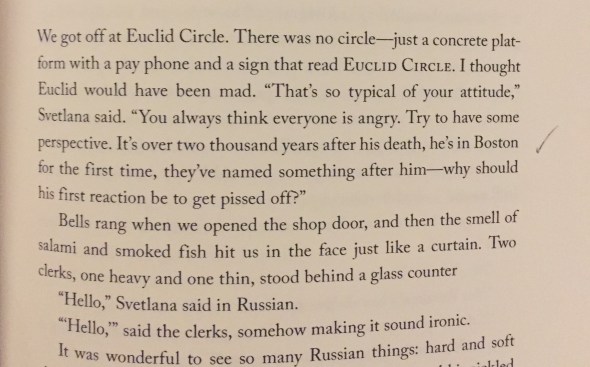

Patricia Lockwood highlighted one of my fav parts on Twitter:

Elif some years ago introduced me to the street cats of Istanbul: 
And showed me where to get corn: 
Now, I can return the favor in Los Angeles and YOU can join the fun:
MONDAY MARCH 20
7:15 PM
Mark Taper Auditorium – Central Library
The event is FREE but get a ticket.
Warren Buffett
Posted: March 4, 2017 Filed under: America Since 1945, business, writing Leave a comment
New Berkshire Hathaway letter is out. Free insight and humor for capitalism’s cheery uncle, a great read every year, even if I understand at most 1/12 of it.

Sunny American optimism:
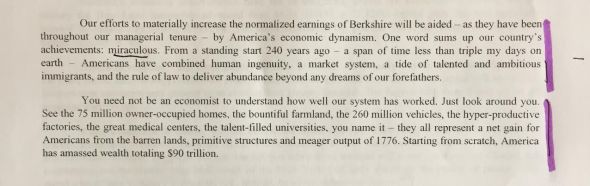
The infectious, enthusiastic amateur style of writing reminds me of Bill James:

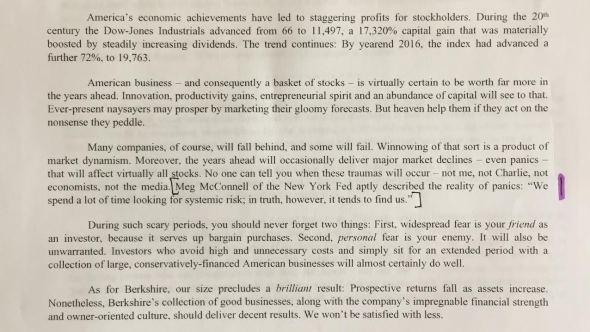
Some of the companies Berkshire owns:


9.3% of your Coke is Berkshire’s.
An unlikely hero:
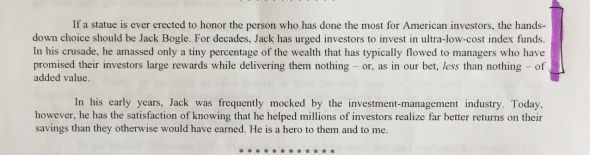
Jack Bogle founded Vanguard, and created a simple, low cost index fund for everyday investors.

found that at JL Collins impressive website.
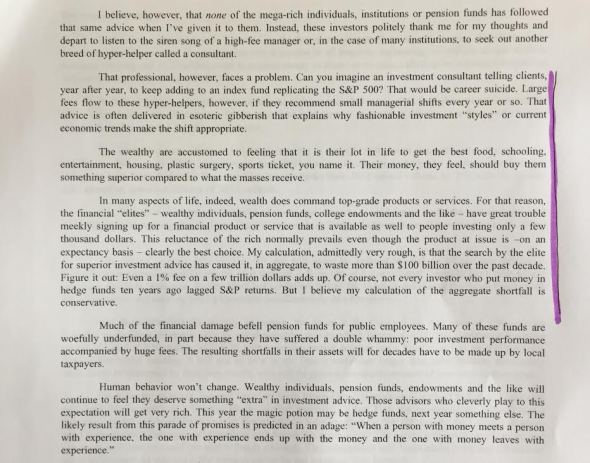
Buffett tells you, in simple terms, how to get rich:

Why people don’t do that:
On the other hand here’s the S&P 500 chart since 1980:

Doesn’t look like a washtubs moment to me.
Over at marketplace.org, Allan Sloan points out some of the things Buffett leaves out:
Allan Sloan: Two things are missing. One was how wonderful the management of Wells Fargo was, which he wrote the previous year. The second thing is he lavished praise on this company called 3G, what’s known as a private equity company, from Brazil, which manages a company called Kraft Heinz, which is Berkshire Hathaway’s biggest investment. And what it does is it goes around, it buys companies — now with the help of a lot of financing from Berkshire Hathaway — it fires zillions of people, the profits go up, and then after a while, it goes out and buys another company and does the same thing.
Buffett makes me think of Andrew Carnegie, a zillionaire of a hundred years ago who also had some kind of public conscience. If some percentage billionaires weren’t also lovable characters like Buffett, would capitalism collapse? Does his dad humor, like Carnegie’s library building, plug a dyke that holds back revolution?

At the Berkshire Hathaway shareholders conference, you can challenge table tennis champ Ariel Hsing:
Drudge
Posted: February 23, 2017 Filed under: writing Leave a comment
continues to be a guilty pleasure.
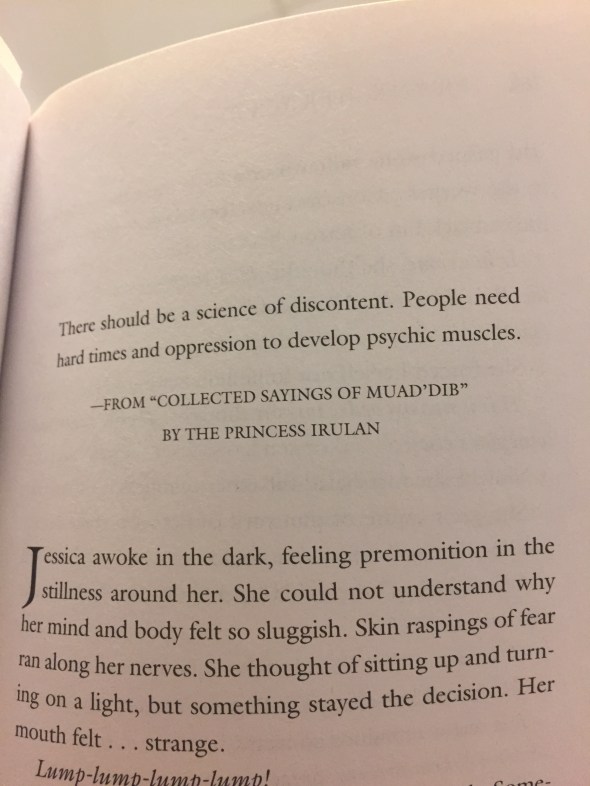
Dune
Posted: February 11, 2017 Filed under: the California Condition, writing Leave a comment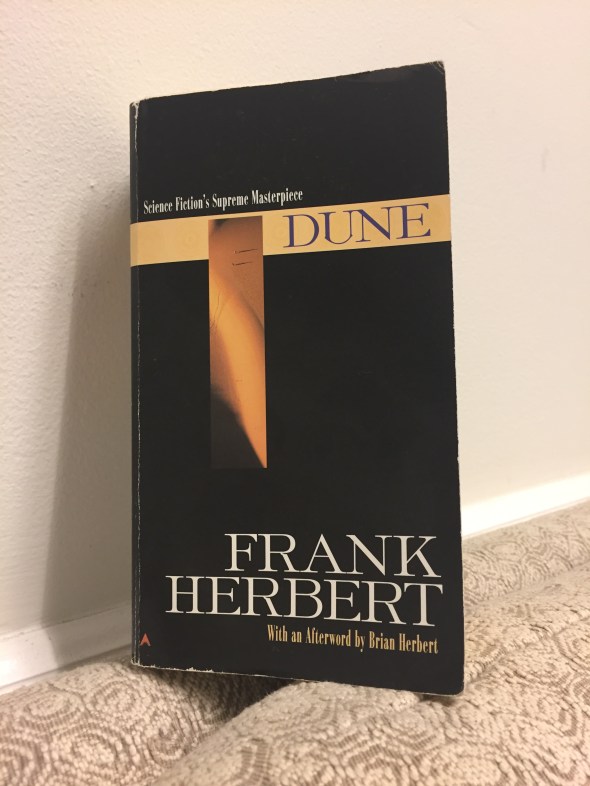
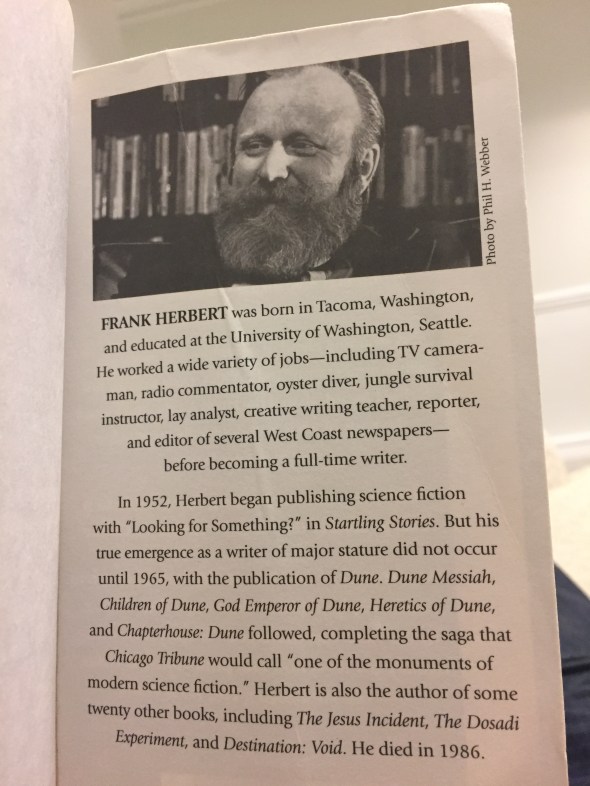
Let’s learn about Frank Herbert, author of Dune.
In WWII he was a Seebee:

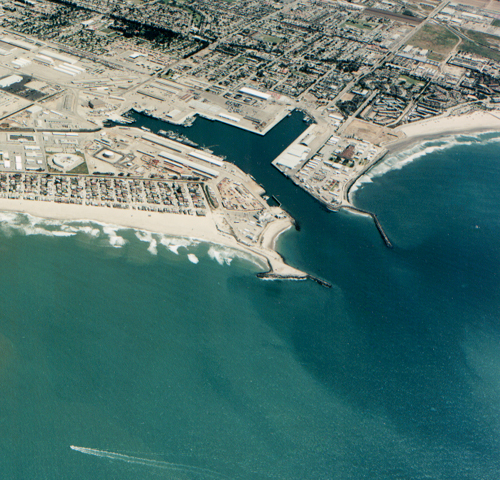
I think about the Seabees every time I drive up the Pacific Coast Highway and hit their base at Port Hueneme:
The idea for Dune came from dunes.
He later told Willis E. McNelly that the novel originated when he was supposed to do a magazine article on sand dunes in the Oregon Dunes near Florence, Oregon.

Source. Photo by Sam Beebe.
He became too involved and ended up with far more raw material than needed for an article. The article was never written, but instead planted the seed that led to Dune.

Source. Photo by Rebecca Kennison
Dune was first published by Chilton Company, known for its auto repair manuals:
Sterling E. Lanier, an editor of Chilton Book Company (known mainly for its auto-repair manuals) had read the Dune serials and offered a $7,500 advance plus future royalties for the rights to publish them as a hardcover book.
Great take on writing from a man who generated many books:
A man is a fool not to put everything he has, at any given moment, into what he is creating. You’re there now doing the thing on paper. You’re not killing the goose, you’re just producing an egg. So I don’t worry about inspiration, or anything like that. It’s a matter of just sitting down and working. I have never had the problem of a writing block. I’ve heard about it. I’ve felt reluctant to write on some days, for whole weeks, or sometimes even longer. I’d much rather go fishing, for example, or go sharpen pencils, or go swimming, or what not. But, later, coming back and reading what I have produced, I am unable to detect the difference between what came easily and when I had to sit down and say, “Well, now it’s writing time and now I’ll write.” There’s no difference on paper between the two.[15]
— Frank Herbert
PLOWBOY: So you think our country’s methods of instruction have a lot to do with the destruction of many family values?
HERBERT: Absolutely. By the time you have three or four generations of people who are taught not to trust their families and their families’ knowledge, individuals can really become separated from their roots. The effect is to make people feel like lost wanderers, or to cause them to think of themselves only in the role of their jobs, which is a complete misrepresentation of what it means to be alive.
Another lesson I learned in childhood is that what people do is just as important as—and maybe more so than—what they say. I had a marvelous object lesson in the difference between words and actions when I was in fourth grade. In those days I was bored to death by school, so I tended to cause a lot of trouble.
One day our teacher, a great big woman who wore eye-glasses that looked like the bottoms of pop bottles, caught me in the middle of a particularly heinous prank. She told me to stay after school and added, “I just don’t know what I’m going to do with you.”
Of course, I could imagine all kinds of horrible things she might do to me. Like the bastinado, or worse! But when school was over, she just made me sit and sit while she worked on papers. After what seemed like ages, she motioned me up to her desk, stared at me awhile—I could feel two holes being burned right through me—and then resumed her paperwork.
PLOWBOY: You must have been terrified.
HERBERT: Oh, I was. Finally, she put her pencil down and said, “I just don’t know what I’m going to do with you.” Well, it was all too much for me. I started to cry. She put her face right in front of mine then and said again!—”I just don’t know what I’m going to do with you.” And I said through my sobs, “Why are you mad at me?”
With that, she grabbed me by the shoulders, began shaking me roughly, and cried, “I’m not mad at you, I’m not mad at you!” Well, I now know that teachers get long lectures during their training on the importance of keeping their tempers with their students, so I had said exactly the wrong thing to this woman. I may not have understood that at the time, but I didn’t have a bit of trouble realizing that my teacher—who was repeatedly screaming, “I’m not mad at you!”—was nearly out of her mind with rage.
That incident drove home the lesson that what people say often doesn’t agree with what they actually do. And that discovery played a big part in the shaping my thinking and behavior.
from an interview with Pat Stone in a 1981 issue of Mother Earth news. Another gem:
I intend to add a solar collector over our swimming pool building to heat its water … and—for a time—I even raised chickens to provide manure for my methane experiments.
Herbert on government:
PLOWBOY: You feel that Kennedy was dangerous and Nixon was good for the country?
HERBERT: Yes, Nixon taught us one hell of a lesson, and I thank him for it. He made us distrust government leaders. We didn’t mistrust Kennedy the way we did Nixon, although we probably had just as good reason to do so. But Nixon’s downfall was due to the fact that he wasn’t charismatic. He had to be sold just like Wheaties, and people were disappointed when they opened the box.
I think it’s vital that men and women learn to mistrust all forms of powerful, centralized authority. Big government tends to create an enormous delay between the signals that come from the people and the response of the leaders. Put it this way: Suppose there were a delay time of five minutes between the moment you turned the steering wheel on your car and the time the front tires reacted. What would happen in such a case?
PLOWBOY: I guess I’d have to drive pretty slowly.
HERBERT: V-e-rrrrrrr-y slowly. Governments have the same slow-response effect. And the bigger the government, the more slowly it reacts. So to me, the best government is one that’s very responsive to the needs of its people. That is, the least, loosest, and most local government.
PLOWBOY: But you feel pretty sure humankind will be able to make the necessary changes?
HERBERT: I think they’ll be forced on us. Oh, we’ll make some mistakes. We’ll probably have a number of fanatic leaders and such to deal with in the years to come. I don’t see the future as being all sweetness and light, by any means. Learning from mistakes is a very slow process. It may take us 20,000 or 25,000 years to get to where, I feel, we have to go.
Herbert lived in Port Townsend, Washington for some time, not far from Cape Flattery. I find this picture on PT’s wikipedia page:
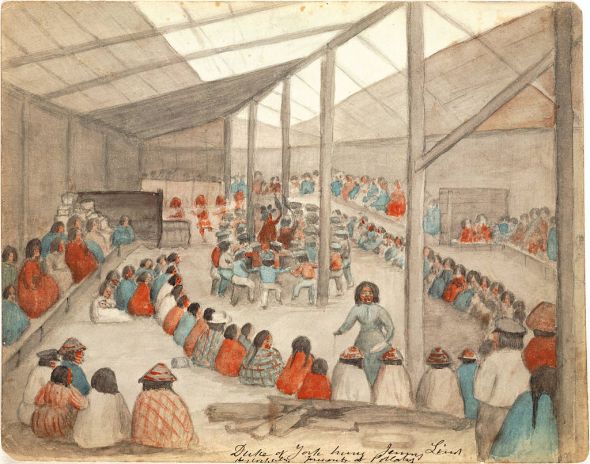
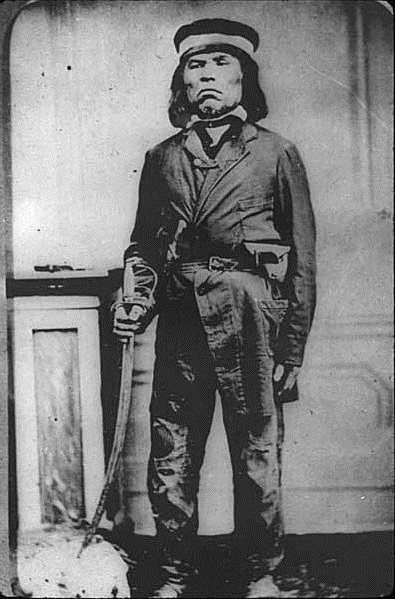

source, photo by Compdude123
Jodowarsky’s Dune is a must watch. Last I checked it was free on Netflix:
His sporting blood turned to horsepiss
Posted: February 7, 2017 Filed under: America, America Since 1945, Arkansas, books, writing Leave a comment
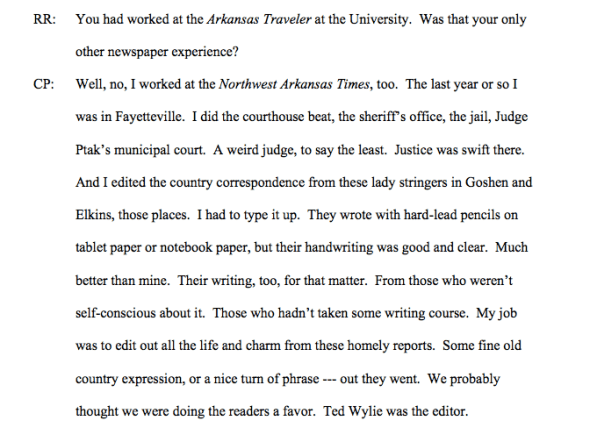
This interview with Charles Portis, on his days a young reporter, for an oral history project about the Arkansas Gazette newspaper is so wonderful.
Lady stringers:
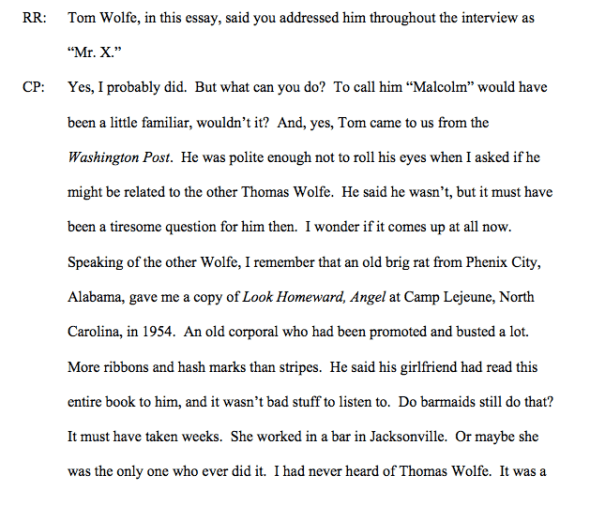
On Tom Wolfe and Malcolm X:
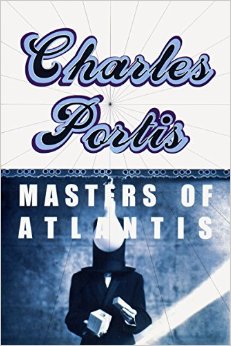
They made movies out of several Portis books:
is one and
is another.
What does Charles Portis make of all this I wonder?
Click on this link for an amazing picture of William Woodruff sailing up the Mississippi with his printing presses.
F Minus
Posted: December 8, 2016 Filed under: books, Boston, comedy, New England, writing Leave a commentI don’t like to give bad reviews to books on Helytimes. Why call limited attention to bad books? However I must condemn this book.

Let me admit that I didn’t read it.
I oppose it because:
1) I was not consulted on it and didn’t hear about it until it was published
2) I was not included in it
3) many geniuses were not included in it, and the selections don’t represent anything like a best of.
Impossible in an anthology to please everyone. But I suspect anyone familiar with the Lampoon will find the table of contents to be the funniest part.
(That’s the only part I read.)

4) No art?
The Lampoon is full of beautiful art that makes the words tolerable.

Example I happened to find here.
A mistake to print an all words anthology.
5) the whole point of the Lampoon is you can write and “publish” dumb bad practice material that no one will ever see.
On the other hand: I was lucky and was given issues of the Lampoon by my cousin when I was a senior in high school. That gift changed my life. So maybe this book will do that for someone.
Still, I must grade it an F minus and recommend that you not purchase it on Amazon or your local indie bookstore. For example The Harvard Book Store:

found on the website of Dr. Barbara Long
Here’s a funny review by one Helen Andrews of Sydney, Australia in the Weekly Standard. (Shoutout to Chris McKenna who I guess reads The Weekly Standard?)
I think you’ll get more value for your book dollar in:

available at Amazon or your local indie bookstore. You’ll enjoy it.
Irish language in Montserrat
Posted: December 7, 2016 Filed under: Ireland, islands, Wonder Trail, writing Leave a comment
found here
One thing leads to another and I’m reading about how there were black people on the Caribbean island of Montserrat who were said to speak Irish Gaelic:
Irish language in Montserrat
The Irish constituted the largest proportion of the white population from the founding of the colony in 1628. Many were indentured labourers; others were merchants or plantation owners. The geographer Thomas Jeffrey claimed in The West India Atlas (1780) that the majority of those on Montserrat were either Irish or of Irish descent, “so that the use of the Irish language is preserved on the island, even among the Negroes”.
African slaves and Irish colonists of all classes were in constant contact, with sexual relationships being common and a population of mixed descent appearing as a consequence. The Irish were also prominent in Caribbean commerce, with their merchants importing Irish goods such as beef, pork, butter and herring, and also importing slaves.
There is indirect evidence that the use of the Irish language continued in Montserrat until at least the middle of the nineteenth century. The Kilkenny diarist and Irish scholar Amhlaoibh Ó Súilleabháin noted in 1831 that he had heard that Irish was still spoken in Montserrat by both black and white inhabitants. A letter by W.F. Butler in The Atheneum (15 July 1905) quotes an account by a Cork civil servant, C. Cremen, of what he had heard from a retired sailor called John O’Donovan, a fluent Irish speaker:
- He frequently told me that in the year 1852, when mate of the brig Kaloolah, he went ashore on the island of Montserrat which was then out of the usual track of shipping. He said he was much surprised to hear the negroes actually talking Irish among themselves, and that he joined in the conversation…
There is no evidence for the survival of the Irish language in Montserrat into the twentieth century.
The wiki page for Amhlaoibh has several interesting quotes:
“February 3, 1828 …There is a lonely path near Uisce Dun and Móinteán na Cisi which is called the MassBoreen. The name comes from the time when the Catholic Church was persecuted in Ireland, and Mass had to be said in woods and on moors, on wattled places in bogs, and in caves. But as the proverb says, It is better to look forward with one eye than to look backwards with two…“
Amhlaoibh lived out in Callan, in Kilkenny:

Photo taken from “The Bridge”, Bridge St, Callan Co Kilkenny 2004 by Barry Somers
Nearby was born James Hoban, who designed The White House:

Elevation of the north side of the White House, by James Hoban, c. 1793. Progress drawing after having won the competition for architect of the White House. Collection of the Maryland Historical Society.
On a trip to DC once I brought along this book, which I recommend to any DC visitor:
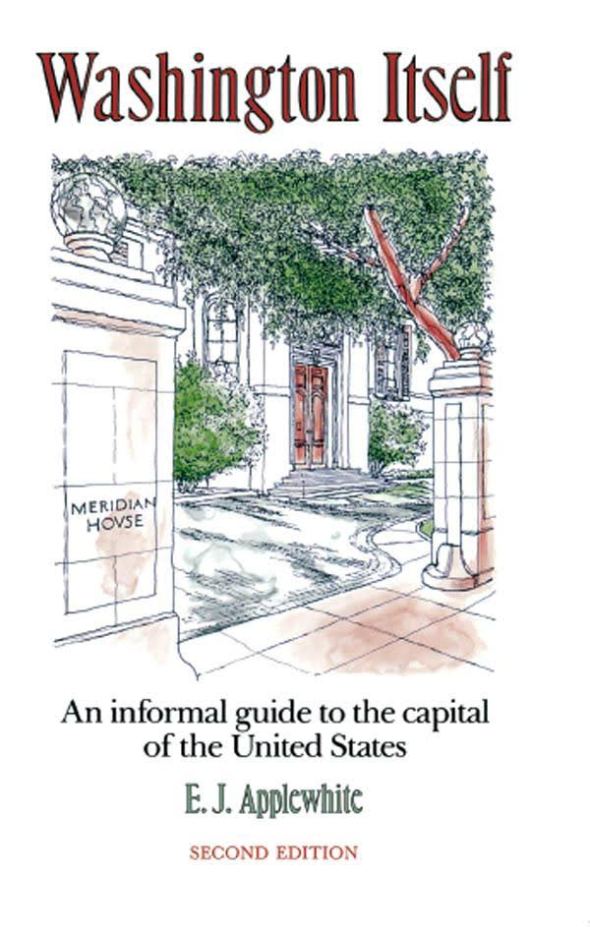
Applewhite might’ve been the first to put in my head the idea that the The White House is modeled on Irish country mansions:

The entire southern half of Montserrat got pretty messed up by volcanic eruptions and was abandoned in 1997:

The former capital, Plymouth
And is now an “exclusion zone”:

Montserrat’s national dish is Goat water, a thick goat meat stew served with crusty bread rolls.

found on the goat water facebook page

for more interesting oddities of Western Hemisphere geography and history, I recommend:

Available at Amazon or your local indie bookstore.
O Pioneers!
Posted: November 10, 2016 Filed under: America, history, nature, the American West, writing Leave a comment
Just finished reading:
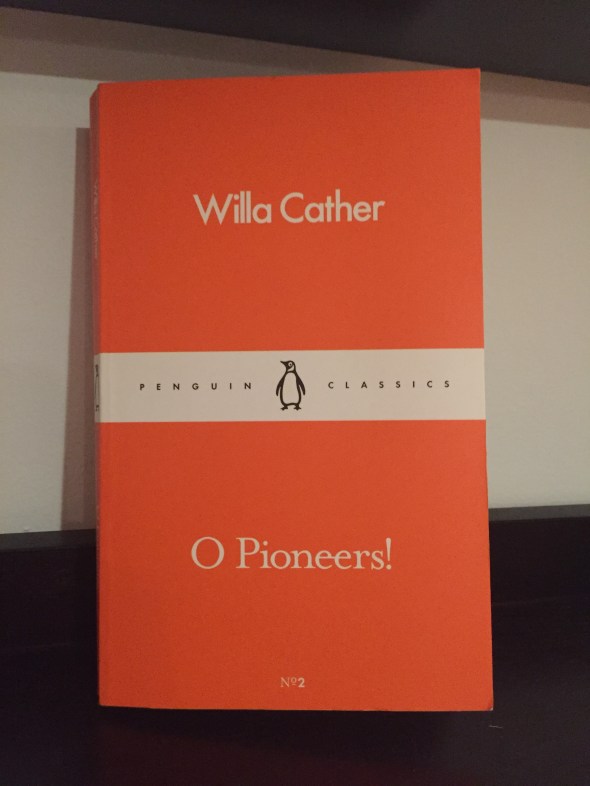
A strange thing to read, maybe. Here is the story of how I came to read it.
Some years ago, filming the finale of The Office on Dwight Schrute’s farm:

I looked around at the inland Malibu landscape and got to wondering if there could be a show about the pioneers: people who arrived on empty* land and built their lives there.

So as research I picked up the first book I thought of:
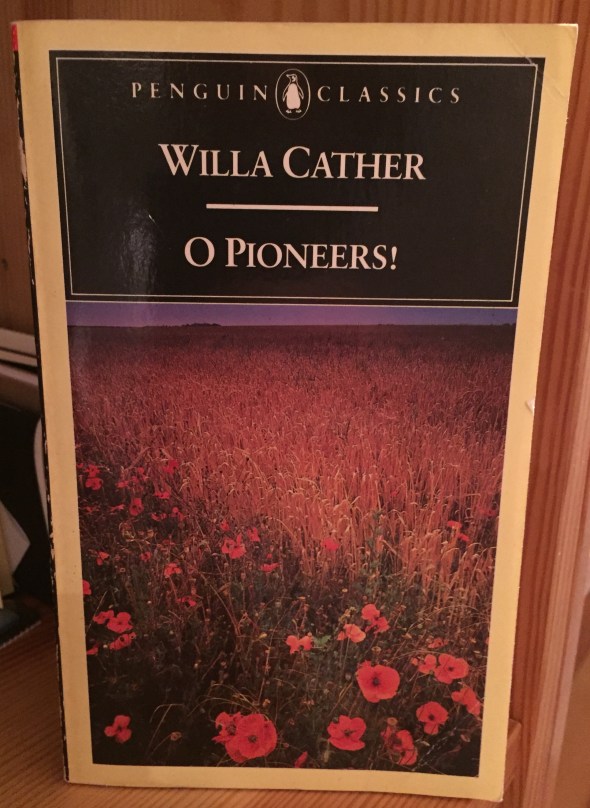
Didn’t finish it. Got distracted before I got off the third page, probably at first by my phone and then by my life.
A true Save The Cat
On the first page of O Pioneers!, there is a true Save The Cat situation.
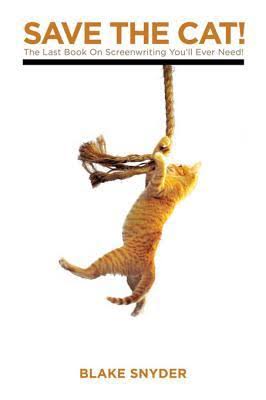
We’re in the middle of a blizzard, and Little Emil’s cat has gone up a telegraph pole, and he’s afraid it’ll freeze:

Reunited
Down in Australia in August, I saw the cool Penguin Classics edition:

and picked it up thinking, eh what the hell I should find out what happened to that cat.
Well, I found out, and I found out what happened to Emil and his sister Alexandra for the next forty years.
I believe an error was made in choosing this quote for the front page:
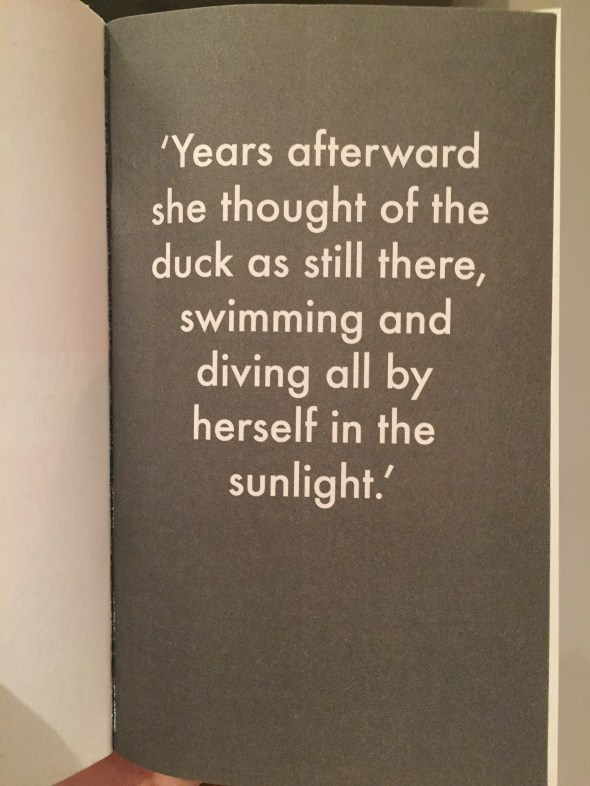
It isn’t the most interesting one from the book. I might’ve chosen this:
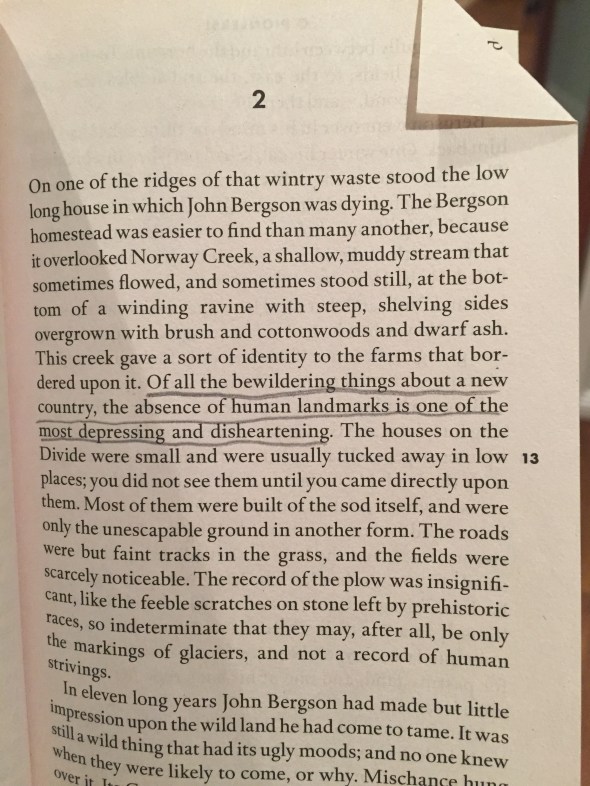
Or this:
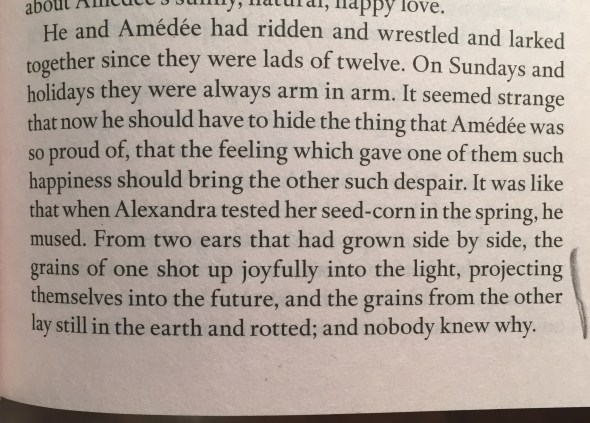
Or even, if we’re going re: ducks, this:
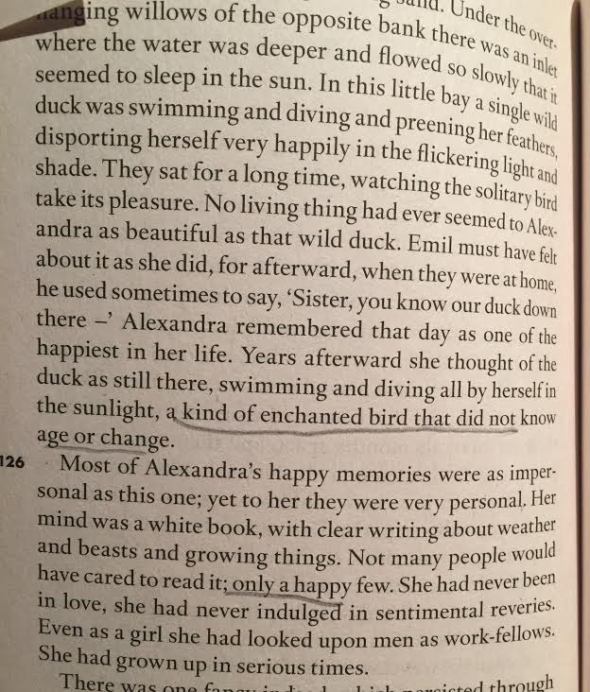
Or this:
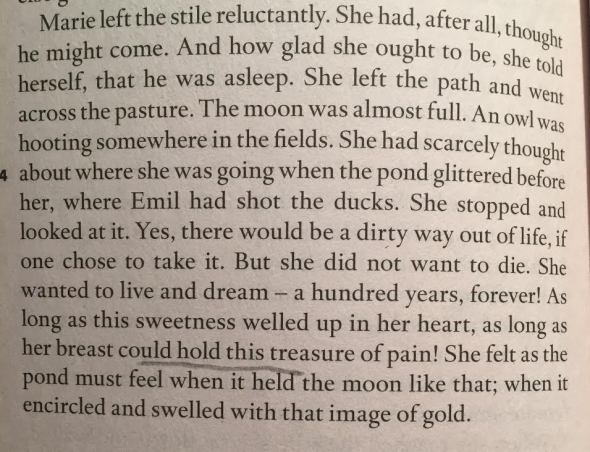
This quote made me think of the news:
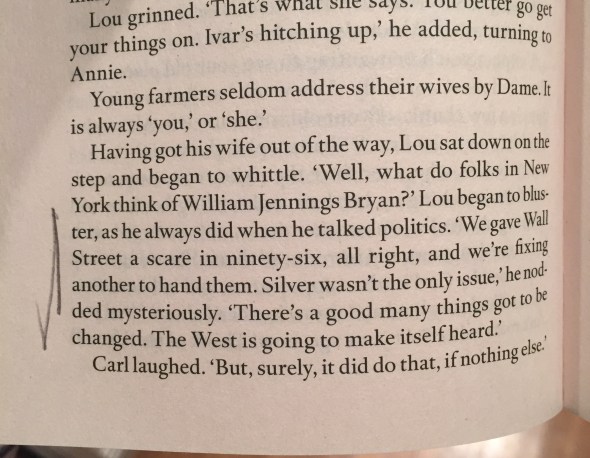
Also can’t say that the epigraph is especially sexy:
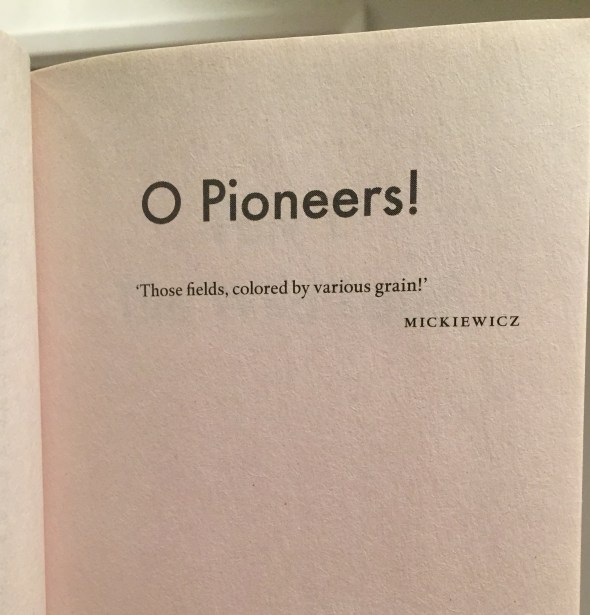
Perhaps it’s better in the original Polish.
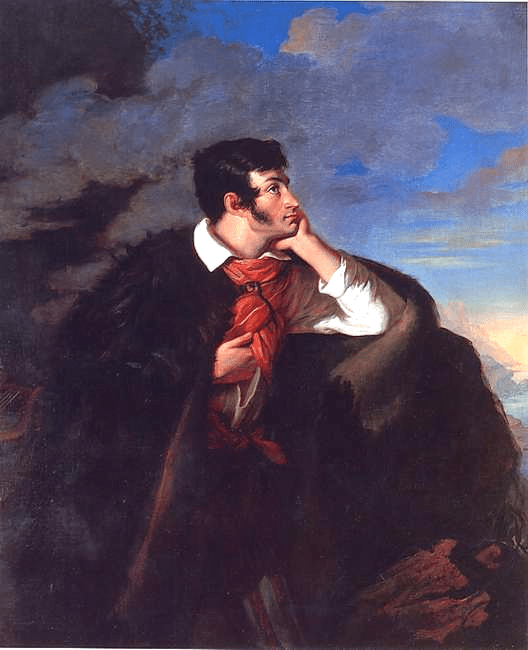
Mickiewicz is bae?
But still I pressed on, and in the end, I gotta give it up to O Pioneers!
The life of Willa Cather
Willa Cather must’ve been quite something. She was born in Gore, Virginia, but as a girl she was brought to Red Cloud, Nebraska:

where she made a real impression:

Was Willa Cather a lesbian?
Willa Cather shot out of Nebraska like a rocket.
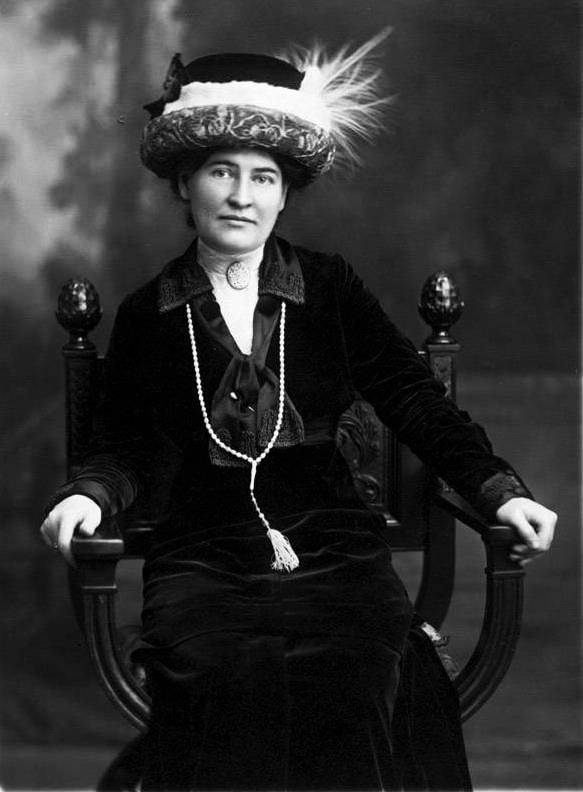
The closest relationships in her life were with women, and she lived with one Edith Lewis:
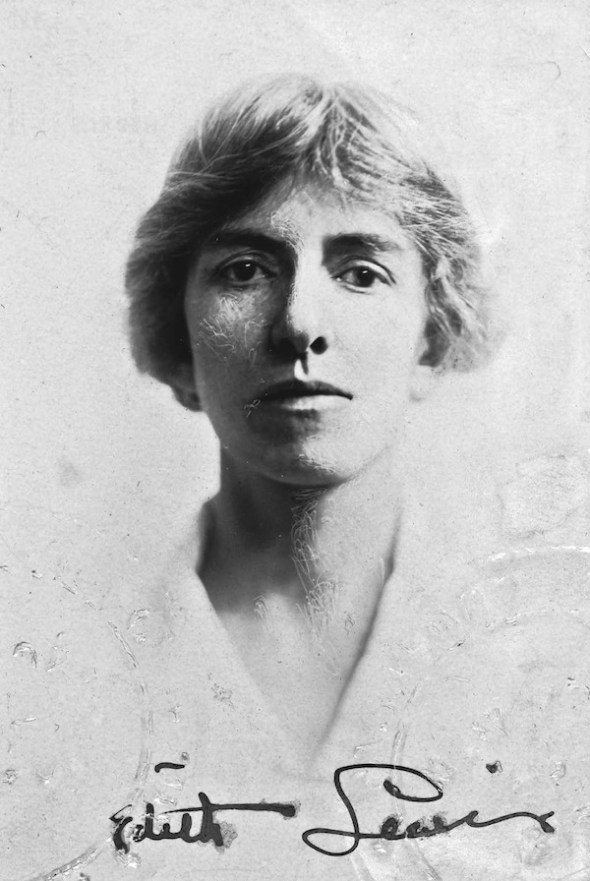
for close to thirty years. Some biographers hesitate to call her a lesbian, though, saying she never identified herself that way.
Willa Cather Memorial Prairie
Willa died in 1947. She has a memorial prairie named after her, it’s the number 2 thing to do in Red Cloud, NE after her house:

it’s cool to have your own prairie
Willa on writing
O Pioneers! still holds up. I found myself moved by it, and it’s short. Cather has a way of summing up loneliness, heartache, longing, compassion, in a few short lines.
I went ahead and got Willa’s collected essays on writing.
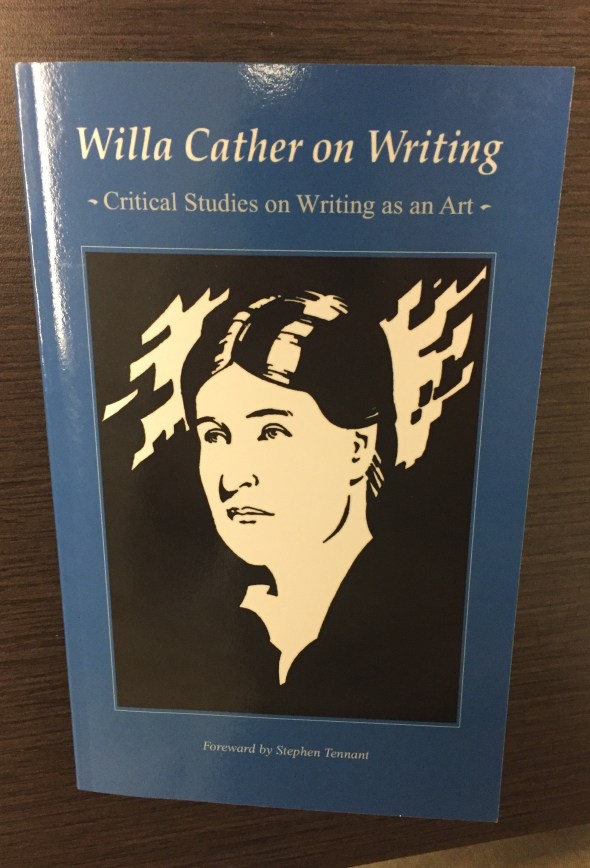
Here she tells how she came to write O Pioneers!, her second book: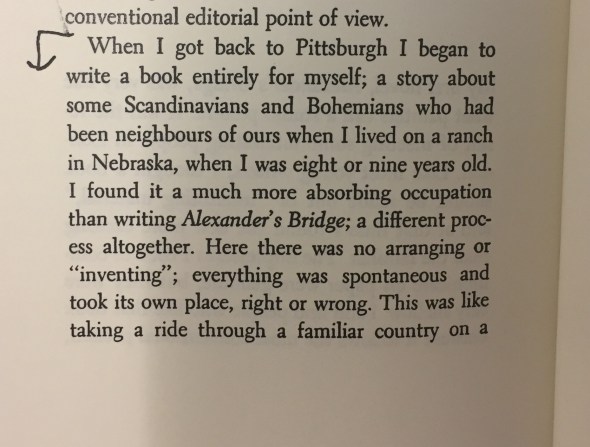
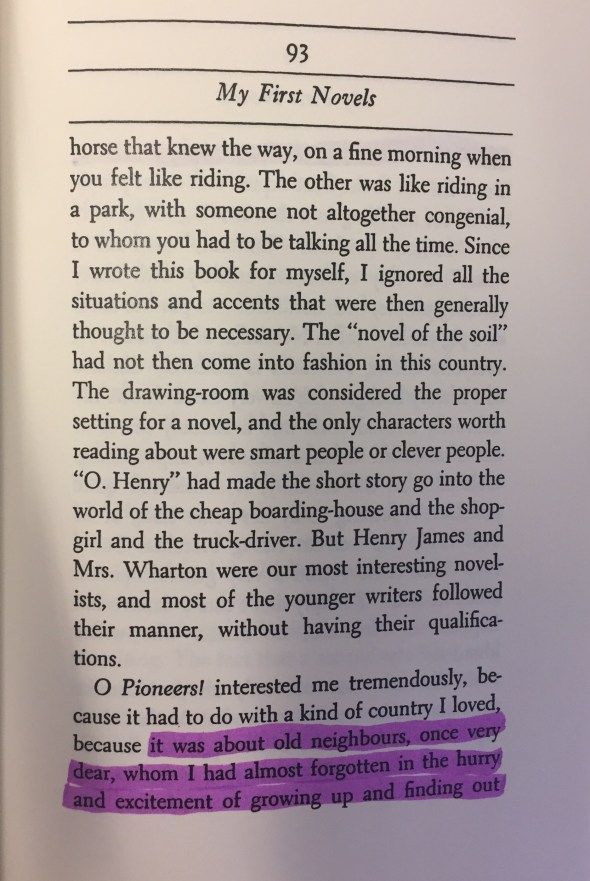
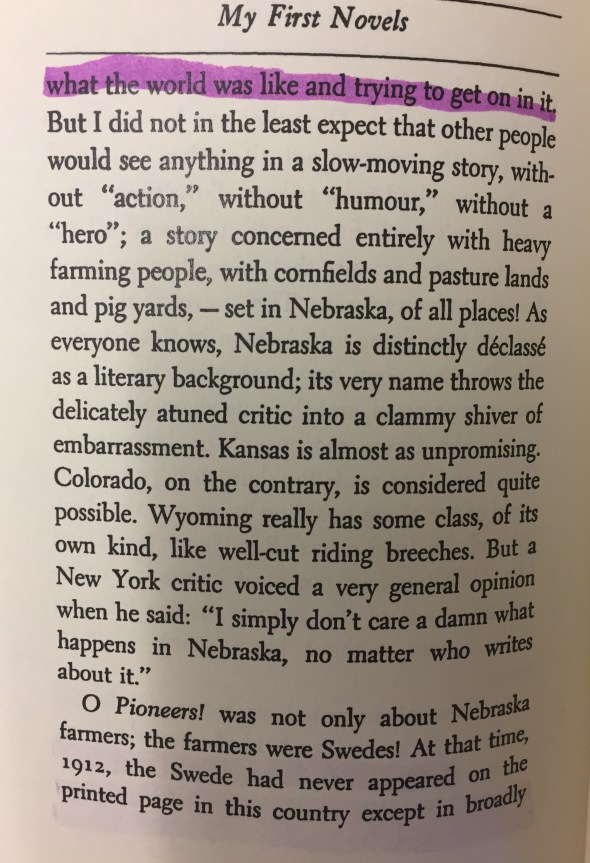
She wrote in some opposition to the detail-filled writing of Balzac:
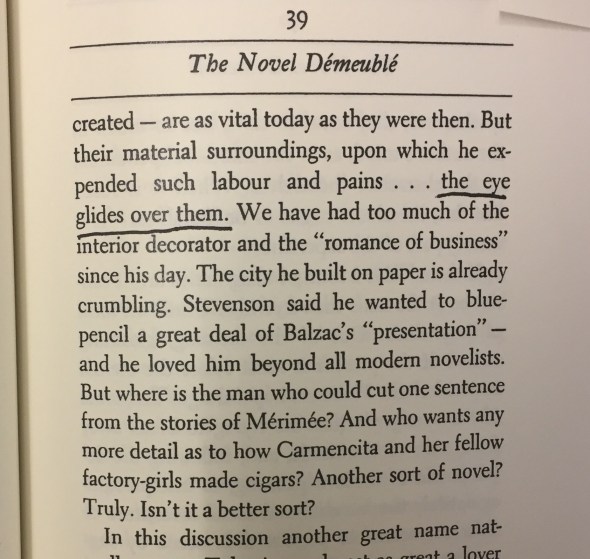
Interesting point here:
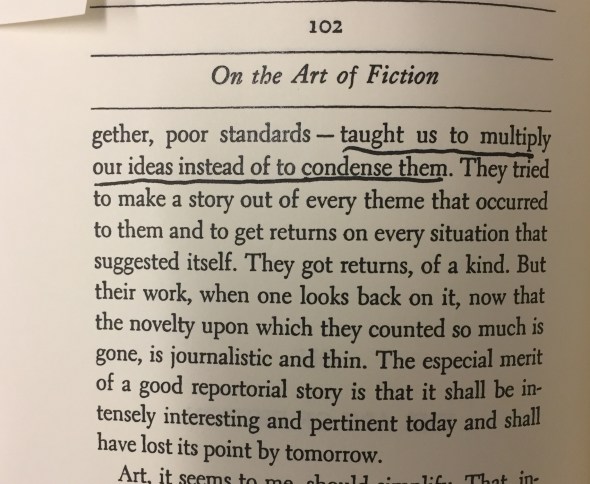
Red Cloud, Nebraska
Here’s a picture of downtown Red Cloud from Google Maps:

About as solid a Trump country as you will find:
As of 2000 the median income for a household in the city was $26,389, and the median income for a family was $34,038. Males had a median income of $26,364 versus $17,232 for females. The per capita income for the city was $14,772. About 8.4% of families and 13.3% of the population were below the poverty line, including 20.9% of those under age 18 and 10.1% of those age 65 or over.
Brave Companions
David McCullough has something moving to say about Red Cloud and Willa and her other famous book:
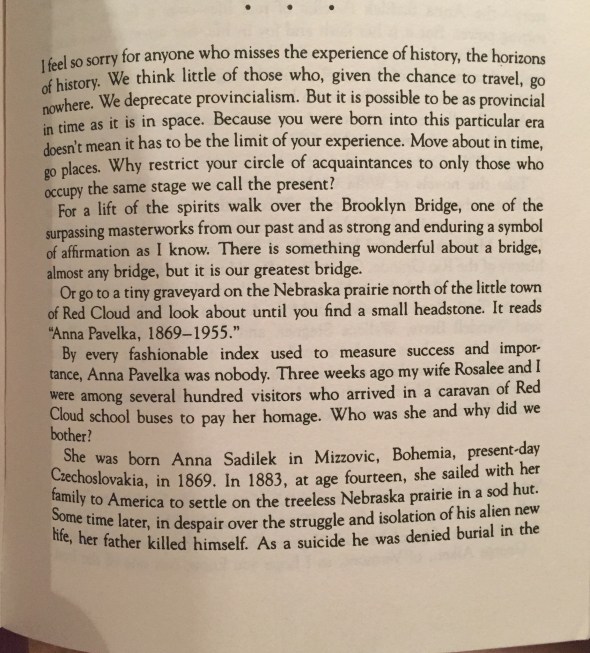
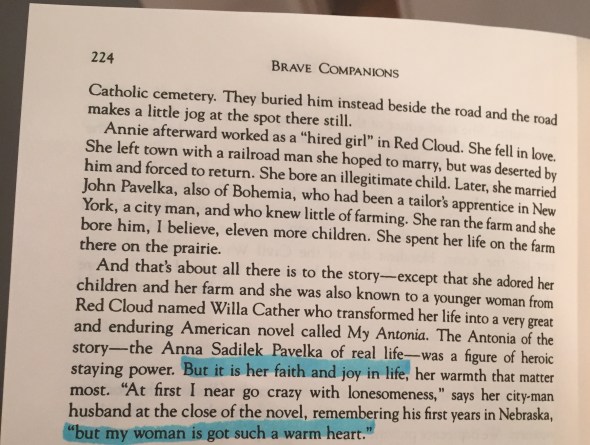
from:

I found O Pioneers! very moving and powerful, let me share with you why:
Warning: O Pioneers! spoiler
Skip this if you intend to read the book with suspense in mind.
But I doubt you will. I found this the most moving passage, and worth all the reading. Let me set it up for you:
Emil, he of the lost cat on page 2, grows up under the guidance of his older sister, Alexandra. She’s really the focus of our story. Carl, the local boy who saves the cat, is in love with her, but he can’t really take it out on the plains, so he goes off, and leaves her behind. She’s left to care for her brothers.
Emil, youngest brother, does great. He goes on to college at the University of Nebraska, while Alexandra stays to watch over the farm. All the while Emil’s been in love with a neighbor girl, Marie. She marries another man, though.
Still, Emil and Marie are in love. Eventually Marie’s husband, Frank Shabata, finds his wife and Emil together. In a crazed rage he murders Marie and Emil both.
Alexandra, alone at age forty, is heartbroken, left adrift at the death of her brother. But still, she feels sympathy for Frank Shabata, who’s been sent to prison in Lincoln for his crime.
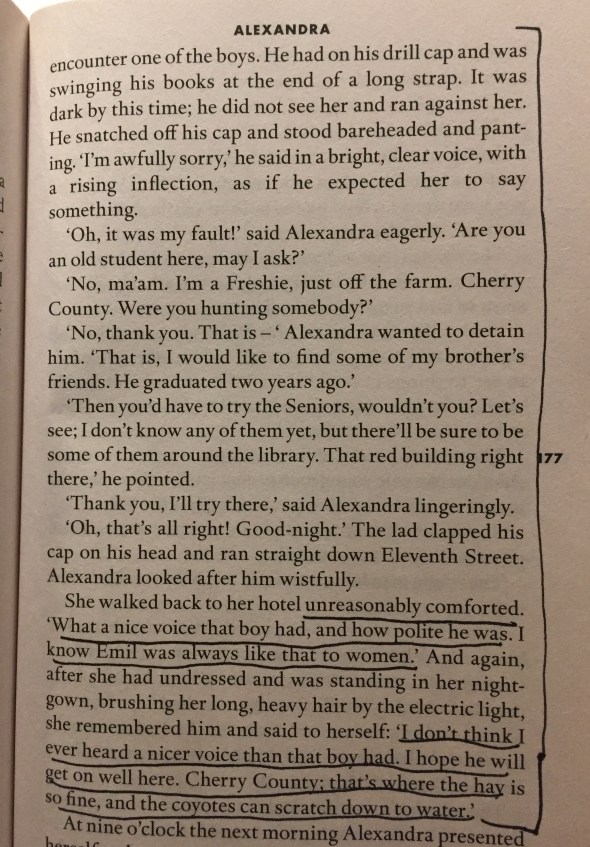
Alexandra, lost and in pain, decides to go visit Frank in prison. In afternoon/dusk, after arriving in Lincoln, she wanders the campus of the university, thinking of her murdered brother. Desperate for any kind of connection, she runs into a student:
Walt Whitman Reads: America
or
The Whitman Recording
The title of O Pioneers! comes from a poem by Walt Whitman.
Some years ago, a recording of Walt Whitman’s voice, said to have been recorded onto an Edison wax cylinder around 1889 or 1890, was rediscovered.
In these times when it seems maybe we lost our way, nationally, it made me feel good to hear this. Forty-six seconds long:
Big books
Posted: November 6, 2016 Filed under: Wonder Trail, writing Leave a comment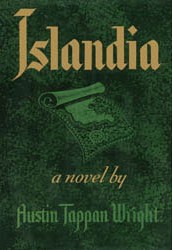
Pretty into two articles this week about enormous imaginative projects.
First up was this New Yorker thing by Charles Finch on Islandia:
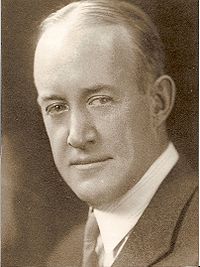
In 1931, a legal scholar named Austin Tappan Wright died in a car accident in Las Vegas, New Mexico, not far from Santa Fe. He was forty-eight. His father had been one of the preëminent academics of the previous century—“A History of All Nations from the Earliest Times,” for which he served as editor, runs to more than twenty volumes—and his mother, Mary Tappan Wright, was a famous novelist, a progenitor of what we now think of as the campus novel. Wright’s own career was more quietly successful. Before his death, he taught at Penn, Stanford, and Michigan, and published articles on maritime law, their scope profoundly, almost rebukingly more modest than that of his father’s work—“Supervening Impossibility of Performing Conditions in Admiralty,” for example, or “Private Carriers and the Harter Act.”
After his unexpected death, Wright’s wife and daughter had the task of going through his papers. They were unprepared for what they discovered there.
Cool story:
In an afterword to the novel, Wright’s daughter recalls that when her father spoke to his wife from a telephone booth, he would remove his hat. This small gesture explains “Islandia,” to me: Wright was part of that great age of anonymous managerial Harvard men who assumed their expected places in society while also maintaining the most intense imaginable internal worlds—Wallace Stevens, T. S. Eliot, Charles Ives if you expand the range to include Yale.
(Ugh, must we include Yale?)

A map of the Karain Semi-Continent based on Austin Tappan Wright’s 1942 Utopian novel Islandia. Created by Johnny Pez on 30 March 2006. from wiki.
Also wild was this New Yorker thing by Esther Yi about German writer Arno Schmidt and the effort to translate his 1300 page book:
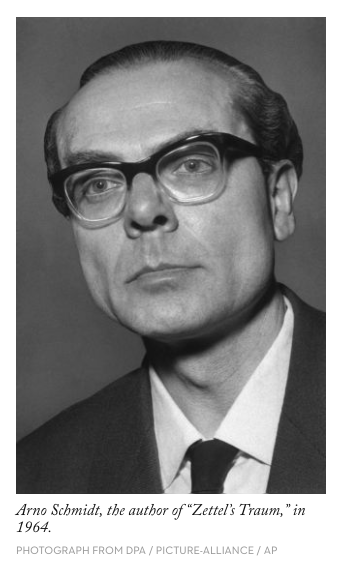
“Zettel’s Traum” is both Schmidt’s most famous book and his least read, and for the same reason:
because it’s thirteen hundred pages long?
it is dedicated almost entirely to applying a Freudian theory of language to the works of Poe. (This was familiar ground: Schmidt spent years translating Poe, in collaboration with Hans Wollschläger.) Dan argues that words are composed of units of sound, or “etyms,” that reveal an author or speaker’s unconscious thoughts. To say “whole” is to think “hole,” for instance. With his ear cocked to sexual harmonics, Dan finds in Poe an impotent man who is possessed by the erotic and, unable to express his sexuality in bed, resorts to voyeurism, notably of what people do on the toilet.
Huh.
“One could not tell if this was amazing, or if this was something for crazy people,” Susanne Fischer, the head of the Arno Schmidt Foundation, which manages the writer’s literary estate, told me.
There was a method to Schmidt’s madness:
Each night, at 2 a.m., he would begin writing in the upstairs room, from which even his cats were barred (not least because the one he called Conte Fosco, after a Wilkie Collins character, had urinated on his prized edition of James Fenimore Cooper). He compiled roughly a hundred and twenty thousand scraps of paper, or Zettel, in shallow wooden boxes, which he spread out on his desk. On each Zettel, there was written a bit of dialogue or sexual wordplay (“Im=pussy=bell’–!”) or a literary quote rerouted through his one-track mind (“the fleshy man=drake’s stem. / That shrieks, when torn at night”). After twenty-five thousand hours of knitting the pieces together, Schmidt handed the manuscript to his publisher in a large cardboard box tied with a curtain sash.
For a less hefty read might I recommend:

Available at Amazon or your local indie bookstore.
Fo
Posted: October 24, 2016 Filed under: comedy, Nobel, Uncategorized, writing Leave a comment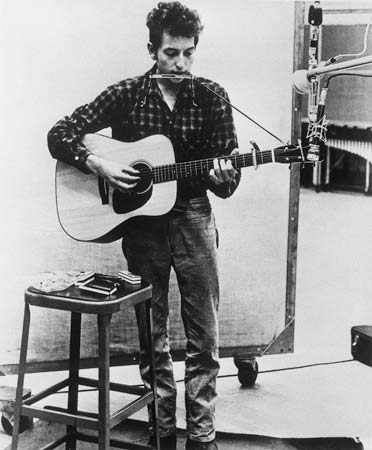
People are mad that Dylan won the Nobel Prize for Literature? Why? Because he does music, which is not the same as literature? What is the difference? More sounds? Instruments are allowed? Hmm.
Anyway, have heard no mention in the convo about the time a literal clown won the Nobel Prize.
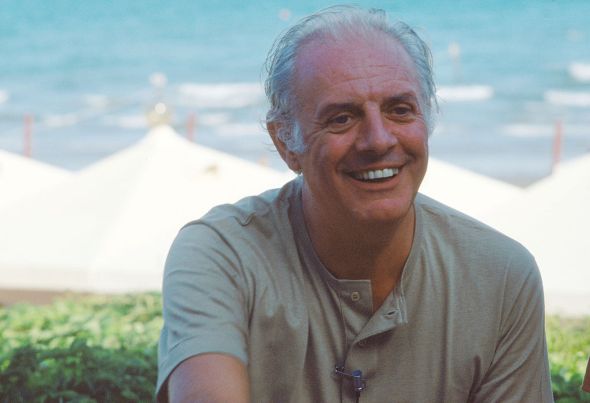
Gorupdebesanez – Own work Il drammaturgo e attore Dario Fo alla Mostra del cinema di Venezia
OK fine Dario Fo was a playwright but what he did was more than just write words down, right?
Mr. Fo attributed the State Department’s change of heart to the intervention of President Ronald Reagan, a former actor. It was, Mr. Fo said dryly, “the gesture of a colleague.”
Was reminded because heard he died. Dario Fo obituary.
Taking the high road
Posted: October 6, 2016 Filed under: America Since 1945, writing Leave a comment
The warps and folds of reality and meaning in this election are incredible.
When was the last time two New Yorkers ran against each other for president? Was it 1940?

Nazi Meth
Posted: September 27, 2016 Filed under: writing, WW2 Leave a commentIncredible article in the Guardian about Norman Ohler’s book Blitzed: Drugs in the Third Reich:

First, there were injections of animal hormones for this most notorious of vegetarians, and then a whole series of ever stronger medications until, at last, he began giving him a “wonder drug” called Eukodal, a designer opiate and close cousin of heroin whose chief characteristic was its potential to induce a euphoric state in the patient (today it is known as oxycodone). It wasn’t long before Hitler was receiving injections of Eukodal several times a day. Eventually he would combine it with twice daily doses of the high grade cocaine he had originally been prescribed for a problem with his ears, following an explosion in the Wolf’s Lair, his bunker on the eastern front.
More:
You think it [nazism] was orderly. But it was complete chaos. I suppose working on Blitzed has helped me understand that at least. Meth kept people in the system without their having to think about it.
(The point about Nazi Germany being in fact a bureaucratic shambles is well made by Lee Sandlin in “Losing The War.”)
Norman Ohler himself sounds deeply interesting:

The German writer Norman Ohler lives on the top floor of a 19th-century apartment building on the south bank of the river Spree in Kreuzberg, Berlin. Visiting him there is a vertiginous experience. For one thing, he works – and likes to entertain visitors – in what he calls his “writing tower”, a flimsy-seeming, glass-walled turret perched right on the very edge of the roof. (Look down, if you dare, and you will see his little boat moored far below.) For another, there is the fact that from this vantage point it is possible to discern two Berlins, one thrusting and breezy, the other spectral and grey.
SUNDAY TAKES!
Posted: September 18, 2016 Filed under: art history, Australia, marine biology, painting, pictures, presidents, writing Leave a commentHere are some takes and items for your Sunday enjoyment!
The coach on Netflix doc series Last Chance U:

The most compelling, complex character on “TV” right now
Sales:
In an old folder of articles I found this one, about Peter Thiel’s Zero To One
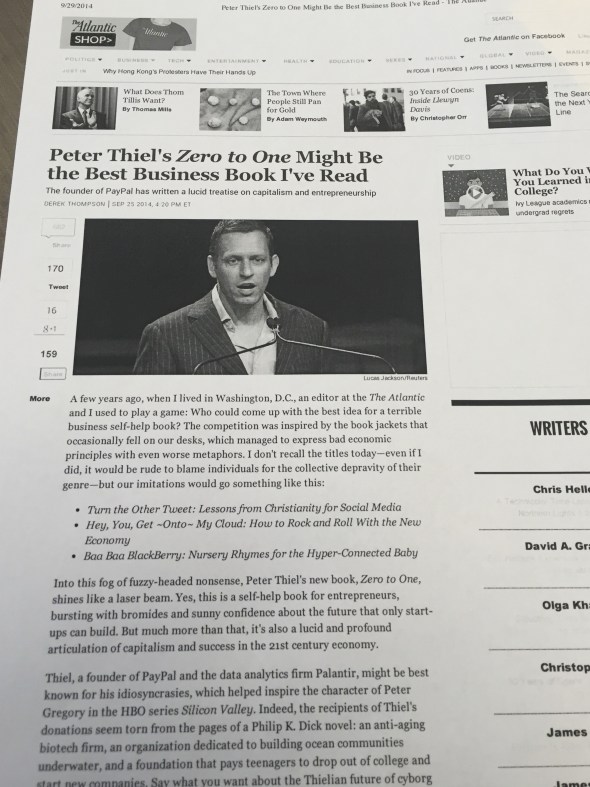
Thiel and his ideas are interesting to me. I’m open to the Vali/OwenE take that he might just be a kinda smart guy who got lucky and thinks he’s a genius. He definitely should not be on the Supreme Court.
I loved Zero To One, but Thiel’s support for Trump makes him seem like a much darker and more troubling figure than I felt he was when I was reading it.
Two interesting points in the article that had new meaning in light of Thiel being a Trump guy:

Is that something like what Trump did (old grouchy white men? white American nationalists? you’d think they’d be served by a lot of political competitors but maybe there was a hole in the market)? What about this?:

Unfortunately, Trump is good at sales and Hillary Clinton is kind of bad at sales.
Sometimes this campaign we get a reminder of how good at sales Bill Clinton is. Here is Bill talking about the Clinton Foundation. This clip is used by GOP and conservative sites as I guess kind of scummy because Clinton compares himself to Robin Hood:
Maybe comparing yourself to Robin Hood is a little much, but when I hear Bill explain the Clinton Foundation as asking for money from people who have a lot of it and giving it to people who don’t have any, it makes it sound a lot better.
Does anyone effectively refute the claim that almost 10 million more people in more than 70 countries have access to life-saving medicines through the Clinton Health Access Initiative?
Silence Of The Lambs

Not topical or relevant at all but for forever I’ve had in my phone a bunch of screenshots of this movie, one of the most gripping movies ever. Saw it on TV some months ago and was struck by how much of it is just a closeup of a person’s face. How unsettling/compelling!

Baltimore can be quite a fun town if you have the right guide
This guy:

This jumped out at me
In a not otherwise “sexy” article about English literary critic William Empson’s book The Face Of The Buddha:

William Empson:

Millennials
Enjoyed the caption on this one, from National Geographic’s Instagram:

Mediocrities

Thomas Frank, profiled in the Politico 50 list:

Frank went to University of Kansas, University of Virginia, and University of Chicago. Can he be trusted?
Doing some reading about AquAdvantage salmon, a genetically modified animal

- Am I ugly?
A growth hormone-regulating gene from a Pacific Chinook salmon, with a promoter from an ocean pout, was added to the Atlantic salmon’s 40,000 genes. This gene enables it to grow year-round instead of only during spring and summer. The purpose of the modifications is to increase the speed at which the fish grows without affecting its ultimate size or other qualities. The fish grows to market size in 16 to 18 months rather than three years.
Asked Anonymous Investor to take a look at the financials of the AquaBounty company.
I haven’t looked into the science, but if their salmon is all that they claim, AquaBounty should have a big pricing advantage. Because their fish grow so much faster than a normal salmon, they should be much cheaper to produce, and sell — undercutting their competitors.
This reminds of the tiny speculative biotech companies I invest in. There’s no money coming in, only money being burned. But you’re hoping someday for a big FDA approval that will open sluices of torrential cash. In this case, the FDA approval has come But the primary problem (they have a few) is that major buyers like Kroger and Target vowed not to carry the product. My guess is the company will eventually make inroads, just as Monsanto, Syngenta, etc, have in the past. But it might take a long time. Big money usually wins in the end. And the hippies, as always, will go whining back to their yurts.
AquaBounty is selling for around 64 million dollars. Not a bad price for a what looks like a pretty decent lottery ticket.
Not sure why AquaBounty only trades in London. The volume is extremely thin. This is a stock not on many people’s radar.
I do know that AquaBounty is controlled by Intrexon (the same company trying to battle Zika via their patented breed of mosquitos). They own over 50% of AquaBounty. Intrexon trades here under the ticker XON. It’s a 3 billion dollar company. (A year ago it was worth more than 6 billion). Intrexon does a lot of interesting Monsanto-type things, and the stock is sort of a darling of Wall Street. But lately doubt has crept into the story. Intrexon has been slow in providing evidence for many of it’s scientific claims. The company says they don’t want to divulge their trade secrets by releasing too much data. Skeptics speculate that they’re not disclosing much, because, they believe, much of the science probably doesn’t work.
Interesting. Here’s what Intrexon (NYSE: XON) has been up to:

“I couldn’t be more pleased with the birth of these adorable kittens,” noted Blake Russell, President of ViaGen Pets. “As the largest global provider of genetic preservation services for companion animals, we look forward to expanding the life-enriching connections that people form with their pets. Our goal is to bring this opportunity to all pet owners and their families.”
Sure. Anonymous Investor adds:
In the salmon world, AquAdvantage salmon are considered “ugly”. In a test 95% of salmon chose to mate with wild salmon over AquaBounty salmon.
Reginald
American Dad co-showrunner Brian Boyle has a very fine set of glasses with the AD characters on them.

One fan’s opinion? the show should do more with Reginald.

Reginald
The Flemish Giant
Somebody at work mentioned that the biggest kind of rabbit is called a Flemish giant.

Well worth the image search.
Boston accents:

A good, clear discussion of an often misunderstood issue from this classic
On the subject of Boston:

In Australia this kind of coconut frosted cake is known as Boston bun. Everyone was baffled when I told them I’d never heard of it.
A Boston bun is a large spiced bun with a thick layer of coconut icing, prevalent in Australia and New Zealand. Traditionally the bun contained sieved potato, and modern versions sometimes contain raisins. It is often served sliced, to accompany a cup of tea. The origin of the name is unknown.
In New Zealand they’re often called a Sally Lunn, especially in the North Island
Still reeling

from good times in Australia. A bizarro version of the United States, upside down and weirdly (to a USA observer) developed in all kinds of ways. For instance, Australia people talk about “the deep north” as like a joke on the way we talk about the “deep south.”
Important to remember that on the other side of the equator, you have to flip countries upside down to think about them. Their south is our north. If you think about that pointy part of Queensland as Florida, the Northern Territory as Texas, Tasmania as Newfoundland or Nova Scotia, Melbourne as Boston and Sydney as New York, you’re still way off but getting somewhere.

Ok but flip Australia upside down in your mind.
Huge thanks to the many people of New Zealand and Australia who helped me out. Puts me in mind of this week’s scripture, Matthew 25:35.
Bummed to miss
Had to come back to the USA before the Brisbane Writers’ Festival, so I missed Lionel Shriver of We Need To Talk About Kevin fame apparently light it up with a wild speech about cultural appropriation (attacking what seems to me to be a ridiculous straw man?)
I can’t find a photo of her wearing a sombrero, as she is alleged to have done. Did she really refer to herself as a “renowned iconoclast”?
Which Australian state library is the best?
I enjoy Melbourne’s State Library of Victoria so much:

photo by Wiki user Brian Jenkins
I mean how can you not admire that they have Ned Kelly’s armor on display?:

Some great illustrations on Ned’s wiki page:

“A strange apparition”: when Kelly appeared out of the mist-shrouded bush, clad in armour, bewildered policemen took him to be a ghost, a bunyip, and “Old Nick himself”.
a bunyip:

Let’s take a virtual look at Australia’s other state libraries:
Tasmania:

Hmm.
Would a better state library be a step towards helping Tasmania’s insane illiteracy rate?
New South Wales:


Impressive. Classic if slightly dull exterior, solid interior, I rate it a 9 (out of 11).
Queensland:


A big swing on the exterior, the interior kind of interesting but also kind of a like a weird mall. I’ll give it a 7.
Northern Territory:

No independent library building, it’s housed in the Parliament House which is kind of cool. DNQ for the rating system.
Western Australia:


Trash exterior, interior so weird as to be kind of interesting. 8.
The old version, once housed in Hackett Hall, appears to have been pretty cool:

South Australia:

Ok…

Aw yeah! 11/11.
Short Books
Australia/New Zealand publishing is so good at short books. I read a bunch of short books while traveling.

This one began as speech Flanagan gave, focusing on his disgust for the abuses, catastrophes, and inhumanity at Australia’s offshore detention centers for asylum seekers, but also about a general disappointment in political and cultural life:
Conformists par excellence, capable of only agreeing with power however or wherever it manifests itself, they are the ones least capable of dealing with the many new challenges we face precisely because those challenges demand the very qualities the new class lacks: courage, independence of thought and a belief in something larger than its own future.
The new class, understanding only self-interest, believing only in the possibilities of its own cynicism, committed to nothing more than its own perpetuation, seeks to ride the tiger by agreeing with all the tiger’s desires, believing it and not the tiger will endure, until the tiger decides it’s time to feed, as the mining corporations did with Kevin Rudd, as News Limited is now with Julia Gillard.
He goes on about the alternative:


If I may make a crude summary Flanagan’s argument could be he wishes Australia remembered Matthew 25:35 a little more.
Flanagan and I once shared a publisher, and I’m told his books are masterpieces, especially Narrow Road To The Deep North.
Also good, and more lighthearted if at times equally scorching:

Here’s a taste, where Pieper is digressing about a dog he adopted:
Took a page out of Vali’s book and wrote Mr. Pieper a short and simple fan letter complimenting him on his book. He wrote a gracious note back. Gotta do this more often.
I can’t write to the great New Zealand short story writer Katherine Mansfield because she’s dead:

If I could, I would compliment her on “The Garden Party.” This story starts out so boring and stodgy and Victorian I really thought I was in for it. But it pays off. Spoiler alert this is the last page:

What life was she couldn’t explain. No matter. He quite understood.
‘Isn’t it, darling?’ said Laurie.
Southbank

This scene, on Brisbane’s Southbank, really reminded me of this one, in Paris a hundredsome years ago:

Richard Bell

Impressed by this massive painting at the Milani Gallery in Brisbane by Australian indigenous artist Richard Bell.
(The price in Australian dollars is 55,000.)
Bell caused controversy in April 2011 after revealing that he selected the winner of the prestigious Sir John Sulman Prize through the toss of a coin.
Ngiao Marsh
Posted: September 1, 2016 Filed under: heroes, women, writing Leave a comment
In New Zealand I got invited to participate in the Great New Zealand Crime Debate, which was a blast. I was on a team with Christchurch lawyer Kathryn Dalziel and sociologist Jarrod Gilbert, who got badly beaten several times while writing this book:
My job it turned out was to roast the members of the other team, namely New Zealand broadcaster Paula Penfold (who was lovely and a good sport):

Anyway, afterwards they had the Ngiao Marsh Crime Awards. Who was Ngiao Marsh?

She was a New Zealand writer of detective stories, mostly starring Roderick Alleyn. Some of the covers of her books are great:


Says Wiki:
Marsh never married and had no children. She enjoyed close companionships with women, including her lifelong friend Sylvia Fox, but denied being lesbian, according to biographer Joanne Drayton. ‘I think Ngaio Marsh wanted the freedom of being who she was in a world, especially in a New Zealand that was still very conformist in its judgments of what constituted ‘decent jokers, good Sheilas, and ‘weirdos’’,’ Roy Vaughan wrote after meeting her on a P&O Liner.
It sounds like her mysteries, which revolve around poison on darts and that kind of thing, are exactly what Raymond Chandler was ranting against in his essay “The Simple Art Of Murder“:
This, the classic detective story, has learned nothing and forgotten nothing. It is the story you will find almost any week in the big shiny magazines, handsomely illustrated, and paying due deference to virginal love and the right kind of luxury goods. Perhaps the tempo has become a trifle faster, and the dialogue a little more glib. There are more frozen daiquiris and stingers ordered, and fewer glasses of crusty old port; more clothes by Vogue, and décors by the House Beautiful, more chic, but not more truth. We spend more time in Miami hotels and Cape Cod summer colonies and go not so often down by the old gray sundial in the Elizabethan garden. But fundamentally it is the same careful grouping of suspects, the same utterly incomprehensible trick of how somebody stabbed Mrs. Pottington Postlethwaite III with the solid platinum poignard just as she flatted on the top note of the Bell Song from Lakmé in the presence of fifteen ill-assorted guests; the same ingenue in fur-trimmed pajamas screaming in the night to make the company pop in and out of doors and ball up the timetable; the same moody silence next day as they sit around sipping Singapore slings and sneering at each other, while the flat-feet crawl to and fro under the Persian rugs, with their derby hats on.

Chandler calls for something a little harder edged:
The realist in murder writes of a world in which gangsters can rule nations and almost rule cities, in which hotels and apartment houses and celebrated restaurants are owned by men who made their money out of brothels, in which a screen star can be the fingerman for a mob, and the nice man down the hall is a boss of the numbers racket; a world where a judge with a cellar full of bootleg liquor can send a man to jail for having a pint in his pocket, where the mayor of your town may have condoned murder as an instrument of moneymaking, where no man can walk down a dark street in safety because law and order are things we talk about but refrain from practising; a world where you may witness a hold-up in broad daylight and see who did it, but you will fade quickly back into the crowd rather than tell anyone, because the hold-up men may have friends with long guns, or the police may not like your testimony, and in any case the shyster for the defense will be allowed to abuse and vilify you in open court, before a jury of selected morons, without any but the most perfunctory interference from a political judge.
It is not a very fragrant world, but it is the world you live in, and certain writers with tough minds and a cool spirit of detachment can make very interesting and even amusing patterns out of it. It is not funny that a man should be killed, but it is sometimes funny that he should be killed for so little, and that his death should be the coin of what we call civilization. All this still is not quite enough.
In everything that can be called art there is a quality of redemption. It may be pure tragedy, if it is high tragedy, and it may be pity and irony, and it may be the raucous laughter of the strong man. But down these mean streets a man must go who is not himself mean, who is neither tarnished nor afraid. The detective in this kind of story must be such a man. He is the hero, he is everything. He must be a complete man and a common man and yet an unusual man. He must be, to use a rather weathered phrase, a man of honor, by instinct, by inevitability, without thought of it, and certainly without saying it. He must be the best man in his world and a good enough man for any world. I do not care much about his private life; he is neither a eunuch nor a satyr; I think he might seduce a duchess and I am quite sure he would not spoil a virgin; if he is a man of honor in one thing, he is that in all things. He is a relatively poor man, or he would not be a detective at all. He is a common man or he could not go among common people. He has a sense of character, or he would not know his job. He will take no man’s money dishonestly and no man’s insolence without a due and dispassionate revenge. He is a lonely man and his pride is that you will treat him as a proud man or be very sorry you ever saw him. He talks as the man of his age talks, that is, with rude wit, a lively sense of the grotesque, a disgust for sham, and a contempt for pettiness. The story is his adventure in search of a hidden truth, and it would be no adventure if it did not happen to a man fit for adventure. He has a range of awareness that startles you, but it belongs to him by right, because it belongs to the world he lives in.
If there were enough like him, I think the world would be a very safe place to live in, and yet not too dull to be worth living in.
Wow. The world’s big enough for both kinds of mystery I guess.
This year’s award was won by Paul Cleave:

For his book Trust No One:

Richard Price
Posted: August 8, 2016 Filed under: writing Leave a commentInto The Night Of, reading this Richard Price interview in Paris Review online.

Damon Winter/The New York Times
Just the first question and answer:
INTERVIEWER
What started you writing?
RICHARD PRICE
Well, my grandfather wrote poetry. He came from Russia. He worked in a factory, but he had also worked in Yiddish theater on the Lower East Side of New York as a stagehand. He read all the great Russian novelists and he yearned to say something. He would sit in his living-room chair and make declarations in this heavy European accent like, When the black man finally realizes what was done to him in this country . . . I don’t wanna be here. Or, If the bride isn’t a virgin, at some point in the marriage there’s gonna be a fight, things will be said . . . and there’s gonna be no way to fix the words.
How about this?
INTERVIEWER
Do you want to keep writing both novels and screenplays?
PRICE
Every screenwriter loves to trash screenwriting. It’s like shooting fish in a barrel. They trash the calculatedness, the cynicism, the idiocy, the pandering. But if they’re really honest, they’ll also admit they love the action, the interaction. Depending on whom you’re working with, screenwriting is fun up to a point. And movies have such an impact on people. Thomas Kenealy once told me about a time he was with the guerrillas in Eritrea during the civil war in Ethiopia. They were sitting on the cusp of the desert under the moon. They all had their muskets; they were about to attack some place. Wanting to chill out before they mobilized, they watched The Color of Money on video. So every once in a while the hugeness of Hollywood gets to you—the number of people who see a movie compared to the number of people who read a book. So as a screenwriter you keep hoping against hope—just because they screwed me the last time doesn’t mean they’re going to screw me this time. Well, of course they will. They’re just going to screw you in a way you haven’t been screwed before.
The first draft is the most creative, the most like real writing because it’s just you and the story. The minute they get a hold of that first draft it ceases to be fun because it’s all about making everybody happy. Raymond Chandler said that the danger of Hollywood for a writer is that you learn to put everything you’ve got into your first draft and then you steel yourself not to care what happens because you know you’re going to be powerless after that. If you do that time and time again, the heart goes out of you.
Oh What A Slaughter and Sacagawea’s Nickname
Posted: July 11, 2016 Filed under: adventures, America, the American West, women, writing Leave a comment
Getting pretty close to having read all of Larry McMurtry’s nonfiction. LMcM has a rambling, conversational way in these books, I enjoy it. Here is some previous coverage about his book Hollywood, and his road trip book Roads, and the best one of all imo, Walter Benjamin at the Dairy Queen.
Oh What A Slaughter is definitely worth a read. A good quality of McMurtry and my all time favorite Evan S. Connell is that they really capture the weirdness of history.

How about this, as McMurtry describes the buildup to the Wounded Knee massacre?:


Wovoka / Jack Wilson
How can you not like a book that has this in it?
Sacagawea’s Nickname wasn’t as compelling to me.

It collects essays McMurtry wrote for the New York Review Of Books: a couple about Lewis & Clark, one about the great one-armed explorer/surveyor/ethnographer/proto-environmentalist John Wesley Powell:

But for title alone I was def gonna read it. Like every American kid I was taught about Sacagawea in school, whose name we were told was pronounced “Sack-a Jew-ee-uh.”

Imagine my shock years later when my friend Leila, who was schooled in Oregon and thus had some cred on the issue, told me her name was pronounced “Sack Ahj Way.” Well, sure. How could we know? Both Lewis and Clark, Clark especially, were crazy spellers, so their clues are confusing. From Wiki:
Clark used Sahkahgarwea, Sahcahgagwea, Sarcargahwea, and Sahcahgahweah, while Lewis used Sahcahgahwea, Sahcahgarweah, Sahcargarweah, and Sahcahgar Wea.
From McMurtry:

Anyway let me go ahead and give you a spoiler that Sar car Ja we a’s nickname was Janey.
England forever!
Posted: April 16, 2016 Filed under: everyone's a critic, Uncategorized, writing Leave a comment
From the Times Literary Supplement, this remarkable sentence in Geoffrey Wheatcroft’s review of Christopher Hitchens posthumous book of essays:
Born to a dyspeptic, reactionary naval officer and a mother whose Jewish origins Hitchens only discovered after her tragic suicide, he was educated at a modest public school and Oxford University, where he delightedly embarked on a double life – radical agitation by day, sybaritic lotus-eating by night – which set the tone for the years to come.
Jim Harrison
Posted: March 28, 2016 Filed under: America Since 1945, food, how to live, women, writing Leave a comment
Briefly shared a publisher, Grove/Atlantic, with Jim Harrison, which made me feel cool. Some gems in his New York Times obituary:
There was the eating. Mr. Harrison once faced down 144 oysters, just to see if he could finish them. (He could.)
“If you’ve known a lot of actresses and models,” he once confided with characteristic plain-spokenness to a rapt audience at a literary gathering, “you return to waitresses because at least they smell like food.”
Mr. Harrison had his detractors. With its boozing and brawling and bedding, his fiction was often called misogynistic. He did himself no favors with a 1983 Esquire essay in which he called his feminist critics “brie brains” and added, in gleeful self-parody, “Even now, far up in the wilderness in my cabin, where I just shot a lamprey passing upstream with my Magnum, I wouldn’t have the heart to turn down a platter of hot buttered cheerleaders.”
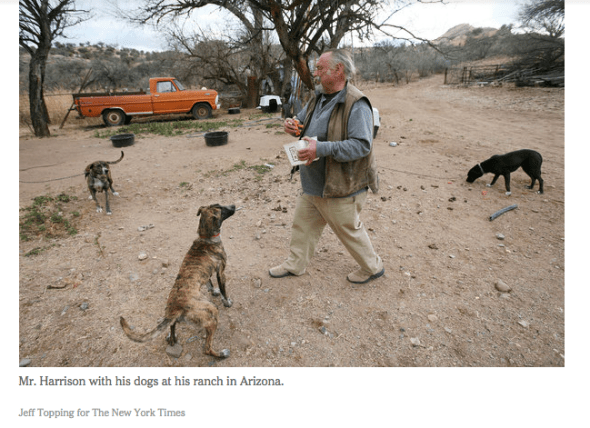
Would they like each other?
Posted: March 21, 2016 Filed under: heroes, war, writing Leave a comment
Before you say look at this fucking hipster re: Saki, remember that he was a lance sergeant in the Royal Fusiliers. Last words before he was killed by a sniper?:
Put that bloody cigarette out!
There is no grave for him, just the Thiepval monument, he is literally one of the missing of the Somme:

Shoutout to Stephen King’s 11/22/63

which sent me to Saki’s “The Open Window.”

King is such a boss. First line of his about the author:

 Helytimes


