Public Land, Part Two: What Happened with H. R. 621

We can’t all be experts on every outrage that’s going to come along.  At Helytimes we’ve taken on the issue of

Our Public Land

up in the national forest

up in the national forest

the land owned by the US government in the form of national parks, national forests, national monuments, and much more.’ The land we, the American People, own together, in other words.

Part One covered HJ Res 46, which proposes to ease up the rules for oil, gas, and mineral drilling and extraction in our national parkland.

Part Two: 

Victory on H. R. 621 and What We Can Learn From It

Meet Utah Congressman Jason Chaffetz

You may have heard of him, he was in the news this week catching hell at his town hall:

You may have seen some these videos on Twitter.

Chaffetz is an interesting character.

  • Born to a Jewish family in California
  • he was the placekicker on BYU’s football team.
  • Married a Mormon woman and converted to Mormonism.
  • Utah campaign manager for Michael Dukakis in 1988
  • at some point he became a Republican.  Possibly after meeting Ronald Reagan in 1990 (when, remember, Reagan had a decent degree of dementia)
  • Ran an aggressive Tea Party-style primary campaign in 2008 against a longtime Utah Republican, Chris Cannon, and knocked him out
  • An aggressive Benghazi investigator
  • Was all over the map on Trump: endorsing, unendorsing.  In the end he did vote for him
  • Has made it difficult for the residents of Washington DC to implement the legalization of marijuana they voted for

Here’s a funny article by Thomas Burr in the Salt Lake City Tribune about Chaffetz involving himself in DC local politics, and then getting payback where some DC politicians are like “fine Utah bitch you gonna tell us how to run our city then help us fix our potholes.”

Today though, we’re going to focus on a bill he introduced that comes up in the town hall.

H. R. 621: Story of a Victory

On Jan 24, Chaffetz introduced H. R. 621, which he titled “Disposal of Excess Federal Lands Act of 2017” which proposed to “dispose” – sell off – some land that is owned by you and me.

The Cosumnes River Preserve is home to California’s largest remaining valley oak riparian forest, and is one of the few protected wetland habitat areas in the state.

“The Cosumnes River Preserve is home to California’s largest remaining valley oak riparian forest, and is one of the few protected wetland habitat areas in the state.” Photo on BLM instagram by the legend, Bob Wick


Let’s back up.

Do the Republicans Want To Sell Off Our Land?

screen-shot-2017-01-22-at-9-53-07-pm

screen-shot-2017-01-24-at-6-51-29-pm

Is this true?  Will Trump / The GOP Sell Off Our Public Land?!

Joshua Tree

JTree by Helytimes

My take: they definitely tried to do so.  Given nearly complete power after the 2016 election, it was a top priority for several Republicans.

The rush to sell off public land has been beaten back, for now.

There’s a lot to learn from what went down about how to win against the Republican Party of Donald Trump.

Bias: Love for national lands

I love national lands.  I love national parks and national forests and national historic sites and national seashores.  I love national monuments and national battlefields.

hartwells

Minuteman National Historical Park

from Acadia National Parks Instagram

from Acadia National Park’s Instagram

crater

Crater Lake

The best of the United States is on display in a US Park Service uniform.

from the NPS instagram

from the NPS instagram

The National Parks are the gems.  Most federal land is not like this at all.

How much land does the federal government

– the US –

– us –

own?

The federal government owns a huge amount of land.  For instance, the federal government owns about 84% of the total land area of Nevada.

Here is federal land ownership in California:

screen-shot-2017-01-20-at-8-27-35-pm

The federal government owns 47% of California.

As you can see, this is a much different issue for some states than others.  Here is Utah:

screen-shot-2017-01-24-at-9-55-57-pm

The feds own 66.5% of Utah.

from Boston Kayaker

from Boston Kayaker

The feds own a mere .8% of Rhode Island, mainly coastal scrubland.

Getting all that from this great piece in the Deseret (UT) News by Jackie Hicken.

All told the federal government owns about 28% of the nation’s total surface, 2.27 billion acres.

Isn’t that crazy?

Here is a reasonable position:

The federal government shouldn’t own that much land.  It’s not in the Constitution as a job for the federal government to own a buncha land.

Here’s a sample of that take:

Now: I think Lars Larson may even have a point about cutting down forests.  Forestry is a science, I’m not well-informed enough to opine on it except to say I believe any forester will tell you burns are part of a life cycle of a forest.

But I disagree with Lars Larson on his first part.  Because when we say “the government owns this land,”  really we mean we own this land.  What could be more “the people’s land” than land we all own together?  “Give the people’s land back to the people?”  It already is ours!

You and me.  The taxpayers.  The voters.  The government is just us.


What Are The Kinds Of Our Lands?

Here are the percentages of our land, broken down by which agency manages them for us.  The  “Big Five”:

screen-shot-2017-02-11-at-2-15-40-am

Proud of this chart I made.

(getting my data from here, from 2013.  The pie would be slightly bigger if we included the Department of Energy, and there’s the Indian reservations, but that’s a whole other thing.)

As you can see, the National Park Service owns a mere 13% of US federal land.

National Park Service handles:

  • National Parks
  • National Monuments
  • National Preserves

Plus battlefields, historic sites, seashores, etc.  As I understand it, the only way to get rid of these would be to pass a bill through both houses of Congress and have the president sign it.  A cool power of the President is that he can create a National Monument out of any existing federal land.  Obama did this often.

The Forest Service under the Department of Agriculture handles:

our National Forests.

The US Fish and Wildlife Service handles:

our National Wildlife Refuges.  (Their slice of the pie gets way bigger if you count marine acres.)

There are National Wildernesses, administered by various different folks because they’re usually part of some other land.

There’s lots of land owned by the Department of Defense,

Air Force, Marine Corps, and Army bases and such.  The Navy owns a surprising amount of inland land here in California for dropping bombs on.

screen-shot-2017-02-11-at-2-19-34-am

And there is a bunch of leftover extra land, BLM land, managed by the Bureau of Land Management.

The BLM owns about 47% of the west and one-eighth of the land of the United States.

(Here’s a good Gizmodo article by Wes Siller about this same topic).

blm

The biggest chunk of public land is BLM land

On a trip to California in 2002 or so the Jeppson-Gamez brothers took me to some BLM land.  I learned you can shoot a gun and drive a Jeep and do whatever the fuck you want on BLM land.  What a great privilege as an American.

Here’s some BLM land in California:

from BLM's instagram

from BLM’s instagram

Here are some facts:

A lot of federal land is already used, mined, logged, grazed, and exploited now

There’s logging in national forests, and mining and grazing on BLM land.  The major operating principle for BLM land law is “multi use.”  Please correct me if I’m wrong, I’m no expert just an interested citizen, but I believe most BLM rules stem from the Federal Land Policy and Management Act of 1976.

The National Forest Service, National Park Service, and now, the Bureau of Land Management, are commissioned in FLPMA to allow a variety of uses on their land (of greater concern for the BLM, who is the least restrictive in terms of uses) while simultaneously trying to preserve the natural resources in them. This concept is best summarized by the term ‘multiple-use.’ ‘Multiple use’ is defined in the Act as “management of the public lands and their various resource values so that they are utilized in the combination that will best meet the present and future needs of the American people.”

Who should handle this junk land has a long, contentious history

Here is a readable summary of some history on the subject.  Who should own and manage land that looks like this?:

sagebrush

Should the states manage it?  In the Depression the states didn’t want it.

Fights over which of the multiple uses should be favored come up all the time.  The most newsworthy fight in recent years on this topic, the weird Oregon standoff originated with Nevada rancher Cliven Bundy’s dispute with the BLM over grazing his cattle on their lands:

the dispute started in 1993, when, in protest against changes to grazing rules, Bundy declined to renew his permit for cattle grazing on BLM-administered lands near Bunkerville, Nevada. According to the BLM, Bundy continued to graze his cattle on public lands without a permit. In 1998, Bundy was prohibited by the United States District Court for the District of Nevada from grazing his cattle on an area of land later called the Bunkerville Allotment.

Cliven Bundy refused to recognize federal ownership of the land, claiming it rightfully belonged to Nevada, which would maybe be chiller about letting him graze his cattle there.

Cliven, found on this CNN piece about him claiming he's not a racist

Cliven, found on this CNN piece: Cliven Bundy says he’s not racist

This being the USA, Cliven’s stand led to, a few years later, Bundy’s sons sitting around with guns at a remote bird refuge while Dad reflected on his views on “the Negro“:

they abort their young children, they put their young men in jail, because they never learned how to pick cotton. And I’ve often wondered, are they better off as slaves, picking cotton and having a family life and doing things, or are they better off under government subsidy?

fullsizerender-13

Where does the GOP Congress stand on federal land ownership?

All over the place, is the answer.

1) the Republican Party’s platform supports returning some federal land to the states.

See here for a Snopes breakdown of this.  Here’s the language on federal land transfer in the Republican Platform:

The federal government owns or controls over 640 million acres of land in the United States, most of which is in the West. These are public lands, and the public should have access to them for appropriate activities like hunting, fishing, and recreational shooting. Federal ownership or management of land also places an economic burden on counties and local communities in terms of lost revenue to pay for things such as schools, police, and emergency services. It is absurd to think that all that acreage must remain under the absentee ownership or management of official Washington. Congress shall immediately pass universal legislation providing for a timely and orderly mechanism requiring the federal government to convey certain federally controlled public lands to states. We call upon all national and state leaders and representatives to exert their utmost power and influence to urge the transfer of those lands, identified in the review process, to all willing states for the benefit of the states and the nation as a whole. The residents of state and local communities know best how to protect the land where they work and live. They practice boots-on- the-ground conservation in their states every day. We support amending the Antiquities Act of 1906 to establish Congress’ right to approve the designation of national monuments and to further require the approval of the state where a national monument is designated or a national park is proposed.

Key word there is “certain”?

I think it’s possible to be passionate about maintaining our treasured national land, and still think some federal land could be better managed by the states.

There’s a lot of wack stuff in the GOP platform, like this:

A Republican administration should streamline personnel procedures to expedite the firing of bad workers, tax cheats, and scammers.

Obviously they’re not worried about the Commander in Chief who won’t release his tax returns.  Maybe they will be similarly hypocritical about conveying federally controlled land to states.

Ah-Shi-Sie-Pah Wilderness Study Area in New Mexico

Ah-Shi-Sie-Pah Wilderness Study Area in New Mexico

2) the Republican Congress changed rules to allow the federal government to give up land while counting it as “budget neutral”

Meet Rep. Rob Bishop of Utah:

rob-bishop

A Republican Congressman.  He is apparently responsible for a change in House of Representatives rules.  Now, I don’t know anything about House budgeting rules. This article, from The Salt Lake City Tribune, written by Juliet Eilperin, seems fair and clear:

Under current Congressional Budget Office accounting rules, any transfer of federal land that generates revenue for the U.S. Treasury — whether through energy extraction, logging, grazing or other activities — has a cost. If lawmakers wanted to give land-generating receipts to a given state, local government or tribe, they would have to account for that loss in expected cash flow. If the federal government conveys land where there is no economic activity, such as wilderness, there is no estimated cost associated with it.

But House Natural Resources Committee Chairman [Rob] Bishop [Republican Congressman of Utah], who backs the idea of providing state and local officials with greater control over federal land, has authored language in the new rules package saying any such transfers “shall not be considered as providing new budget authority, decreasing revenues, increasing mandatory spending or increasing outlays.”

This was the same rules package that had the ethics loosening thing that got people to call their reps in an effective show of democratic displeasure.  Here is a much-tweeted Guardian article on the topic.

There’s lots about public land on Rob Bishop’s website. One issue that seems to bother Rob Bishop in particular is Wilderness Study Areas.  And I agree they represent the complex mess of interests when you deal with public land.

A Case Study: How A Wilderness Study Area Becomes A Wilderness

The Wilderness Study Areas are roadless sections of land that the BLM puts a hold on until Congress decides whether to designate them as wilderness or not.

Here’s my personal favorite:

fullsizerender-4

Here’s what Rob Bishop says:

For decades, unsettled land-use designations, such as wilderness study areas, have fueled distrust and acrimony. The uncertainty about the future of these lands created conflict amongst those favoring differing types of uses. The diverse uses of public lands have an important role in making Utah healthy, viable, and inviting. The future of the state depends on a responsible balance of both conservation and development.

There are 86 Wilderness Study Areas in Utah.  Myself, I think we should err on the side of keeping wildernesses — once they’re gone, they’ll never come back.

Once you’re a WSA, you either become a Wilderness, federally protected, or you get dropped and you can get chopped up and mineraled and whatnot like any old BLM land.  Or you get downgraded to Conservation Area, or some other designation.

The most recent Wilderness Study Area bill I can find in Congress was from last year, when some WSAs inside federal conservation areas were proposed to get dropped.  It’s been referred to committee.  Here’s an article about it, it sounds like a complicated issue.

You can see how this all gets pretty slow-moving and bureaucratic.

Maybe Rob Bishop has a point

The bottom line of what Rep. Bishop wants to do is made pretty clear on his website:

Congressman Bishop’s views on public land use differ from mine, why should I trust that this is a good faith effort to make new conservation areas?

Congressman Bishop is committed to conservation and economic development as part of the Public Lands Initiative. Throughout his career, Congressman Bishop has had a strong record of both conservation and development. The Cedar Mountain Wilderness area was created in 2006 after Congressman Bishop facilitated a locally-driven, collaborative process similar to the Public Lands Initiative. As a former high school teacher, Congressman Bishop also has pushed for increased energy production in Utah to help support and fund public education. Congressman Bishop is committed to elements of both conservation and development as part of any Public Lands Initiative legislative proposal.

How will the state of Utah benefit from this?

The state of Utah’s public education system will benefit from increased energy and mineral production. Public land users will benefit from the regulatory certainty that comes from congressionally designated lands. Local governments will benefit from revenue generated from multiple use of the land, including recreation, mineral development, and energy production. The outdoor recreation businesses will benefit from the improved certainty about land use and conservation. Future generations will benefit by having responsible policies that utilize the land in the most responsible and reasonable ways that make sense now and into the future.

Here’s more:

Proponents argue, however, that taking the federal government out of the picture will help the budget and offer economic benefits for the many communities located near federally-guarded land.

“In many cases, federal lands create a significant burden for the surrounding communities,” Molly Block, spokeswoman for the House Natural Resources Committee, said. “Allowing communities to actually manage and use these lands will generate not only state and local income tax, but also federal income tax revenues.”

That’s from this UPI article by Stephen Feller and Doug C. Ware.

Look, Rob Bishop’s there in Utah.  Maybe he knows best what should happen with this land.  In tough Western areas he could see roped off federal preserves with no clear purpose, and point out those could be jobs and money for his district, or even just better managed wilderness under local control.

BUT:

Why shouldn’t disposed-of land be marked as a loss to the federal revenue, when it is?  Isn’t this a form of the federal government lying to itself?  Lying to its citizens?  As an American taxpayer, I don’t see how this rather sneaky accounting change is at all good for me.

Plus what the hell?!  This land belongs to us, American citizens.  These guys want to sell away our inheritance?

High Desert News‘ Elizabeth Shongren puts it clearly:

Previously, when Congress wanted to transfer public lands managed by the Forest Service, Bureau of Land Management or other federal agency, the Congressional Budget Office, Congress’ research arm, calculated the cost to the U.S. Treasury by computing what revenues the lands provide over 10 years, such as grazing fees or oil and gas royalties. Under House rules, before a bill approving a transfer could be adopted, budget cuts would have to be made in other federal programs equal to the value of that land. The rules change eliminates that budgetary barrier to land transfer bills.

I’d have to explore this more, but I have a feeling the House somehow tied itself into knots on spending and budgetary rules to make various political points, and is trying to untangle this particular aspect so they can get rid of public land.

Can the government sell off our treasured national lands?

Yes, but it’s not that easy.

Let’s start with the BLM.  Can the BLM sell off their land?  From their website:

How are these lands selected for sale?

The law states that the BLM can select lands for sale if, through land use planning, they are found to meet one of three criteria: 1) they are scattered, isolated tracts, difficult or uneconomic to manage; 2) they were acquired for a specific purpose and are no longer needed for that purpose; or 3) disposal of the land will serve important public objectives, such as community expansion and economic development.

More:

The BLM does not offer much land for sale because of a congressional mandate in 1976 to generally retain these lands in public ownership. The BLM does, however, occasionally sell parcels of land where our land use planning finds disposal is appropriate.

Of the Big Five Agencies, only DoD and BLM lost land between 1990 and 2013 (again, source here).  In those years, the BLM went down by 24, 777, 190 acres.

Where did those acres go?

This decline in Alaska is largely the result of the disposal of BLM land, under law, to the State of Alaska, Alaska Natives, and Alaska Native Corporations.

Seems fine to me.  The Congressional Research Service goes on:

With regard to disposal, the NPS and FWS have virtually no authority to dispose of the lands they administer, and the FS disposal authorities are restricted.

Last big push to dispose of national lands failed.  It was HR 350: State National Forest Management Act of 2015, introduced by Rep. Don Young of Alaska.

don-young

Didn’t pass.


HR 621: Story of A Victory

Let’s return to Utah rep Jason Chaffetz:

jason-chaffetz

Which land did he try to sell away?

Great question.

It’s not immediately clear.  Chaffetz’s website links to a 1997 report of disposable lands.   Ryan Krogh at Men’s Journal identifies some of the choice land included in the 1997 report:

State: Wyoming

County: Sheridan

The Potential Land: 35,200 acres of BLM-managed land in the Powder River Basin, which is just east of the Bighorn Mountains, popular with hikers, campers, horseback riders, and hunters.

Here’s what’s going on on BLM land in the Powder River right now:

Powder River, from a BLM website

Powder River, from a BLM website

State: Wyoming

County: Park

The Potential Land: 27,300 acres surrounding the Shoshone River, a popular fly-fishing stream in northern Wyoming. Most of the BLM-managed land in Park County is downstream of the town of Cody, which sits between the Big Horn, Owl Creek, Bridger, and Absaroka mountain ranges. Tourism is the town’s primary industry.

State: Oregon

County: Harney

The Potential Land: 44,000 acres in a county that’s home to Steens Mountain, a 9,733-foot peak that’s popular with campers and hunters, and Malheur National Forest.

State: New Mexico

County: Catron

The Potential Land: 25,000 acres that contain “cultural resources,” meaning it’s probably home to pueblo ruins. The land is most likely a giant tract southwest of the town of Quemado, and some of the land abuts the Gila National Forest, home to the endangered Mexican gray wolf, the Gila trout, and some of the best elk hunting in the U.S.

State: Colorado

County: Montrose

The Potential Land: 2,105 acres that is home to endangered species and “historic/cultural resources.” The surrounding area contains the Gunnison Gorge, famous for its rafting and fly-fishing trips, and Uncompahgre National Forest, which is home to elk, mule deer, bighorn sheep, and mountain goat.

State: Nevada

County: Elko

The Potential Land: 208,900 acres that contains endangered species, historic resources, and is home to “wetlands/floodplain.” BLM-managed land makes up a giant percentage of land in Elko County, but exactly what land is up for consideration is unclear, or what the effects might be.

State: Arizona

County: Mohave

The Potential Land: 23,525 acres with mining claims and historic resources. A comment attached to the description notes that the land is “classified as habitat for the Desert Tortoise (a sensitive species).”

Now I heard about this, and I was pissed, because this land belongs to me.  And you.  And us.  Any time we wanna go there, it’s there.

And Jason Chaffetz tried to sell it off.  

Backcountry Backlash

Well this did not play.  Word spread via strong, aggressive groups like Backcountry Hunters & Anglers:

Google HR 621 and you fill find angry, mobilized publicity from groups like TheMeatEater.com, BowHunter.com, WiredToHunt (“Deer Hunting Strategies for the Next Generation”), and TexasBowhunter.com.

There were rallies in Helena, MT and Santa Fe, NM which BHA says drew a thousand people.

Chaffetz backed down by last night — six days after introducing the bill:

screen-shot-2017-02-02-at-1-30-09-pm


What can we learn from the defeat (for now) of HR 621?

  • Strong, organized, motivated, attentive citizens can win, easily, on issues that matter.
  • Play to a politician’s fears.  Jason Chaffetz got to Congress by primarying a guy in his own party.  He’s got to watch his back constantly.  His greatest fear has got to be somebody doing to him what he did to Chris Cannon, outrunning him on the right.
  • Push the pushable.  Chaffetz wasn’t moved by people who would never vote for him.  He was moved by hunters and fishermen,  people who probably would vote for him, as long as he doesn’t fuck them on something they care about.
  • Look at the focus on these groups: bow-hunters, meat-eating hunters.  They have clear interests, goals, and passions.  They follow their issues and inform each other.
  • Powerful allies.  Look at the sponsors for Backcountry Hunters and Anglers.  These are big corporations with big interests in keeping their customers happy and hunting and fishing.  Yeti coolers has a partnership with MeatEater.com.  What are rich companies that have interests that could align with yours?
  • Specific targets.  They learned something from all that bow-hunting.
  • See how fast and aggressively they responded to the slightest hint of a challenge and you can get an answer to the seemingly baffling question of why gun control bills get crushed so easily.  Strong, organized people are paying attention to the slightest threat to their gun rights and they do not let up.

The Trump hurricane has achieved an effect of constantly shifting focus.  When we compare what bow-hunters did to the stammering, confused, bafflement of the Hollywood libtards we follow on Twitter, and my own flabbergasted reactions, we realize we have much to learn from Texas bow-hunters on how to stay focused on a few issues that matter to us most.

The biggest lesson:

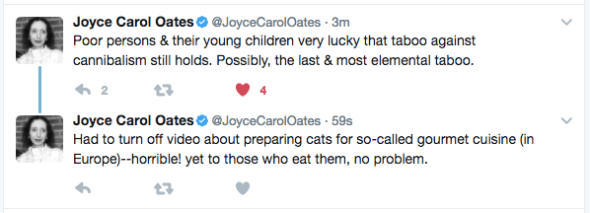
This issue brought together, on the same side, Joyce Carol Oates:

and these kind of guys:

screen-shot-2017-02-03-at-11-38-01-am

And the bros on the Texas Bowhunter forums.

They’re both passionate on the same side on this issue.

For me, the strongest takeaway is don’t insist on too much ideological purity.

Build coalitions on issues you care about.

That is the way to win in politics.

Plus who do you think Jason Chaffetz is most scared of?

screen-shot-2017-02-11-at-2-25-54-am

I’m guessing it’s this kinda guy? (seen here killing a huge deer with a bow and arrow).

screen-shot-2017-02-11-at-2-26-36-am

This guy and I may have different ideas about what to do with the land we share.

But we share an interest.  We can team up.

One of the most illuminating things I read about the election was “David Wong”‘s piece on Cracked.com about the rural vs. urban divide. Here I am very far from Powder River, WY.  The odds of me visiting it in the next ten years are small (but real).  But here I am allied with people who live near there and use it all the time.

Gotta Hear Both Sides

Look, it’s fair to say maybe we should sell off some public land.  The clearest expression I found of this ambiguity was put up by this poster on TexasBowhunter.com — I hope user 175gr7.62 won’t mind me quoting him, I think it’s a valid take (encourage you to read him in context):

I’m torn on it. The Constitutional side of me says the Fed should have never owned it anyway. The Constitution says the government can acquire and retain land necessary for carrying out its enumerated powers. This includes parcels for military bases, post offices and buildings to house federal employees undertaking enumerated functions. I don’t think anything the BLM or Forest Service does counts as anything enumerated. Several Supreme Court cases have said the govt can own it but I think that’s just case law.

The hunter in me said it could be bad if the Feds sell the land because it could be bought by a private citizen who can then prevent its use. That being said, if they sell it and I don’t have the money to buy it that’s my fault…I should have gotten a better education or made better investment decisions.

Tough call.

Reasonable people can disagree on how public land should be managed and who should managed it.

What bothers me, and what puts me on edge, is the sneakiness of what Bishop and Chaffetz appear to be doing.

And the misguided priorities.  This is the first thing they got to post-election.

Well, Chaffetz at least got called to the carpet for it.

A Passionate Plea

Here’s a full video of Jason Chaffetz’s town hall.  Listen to this guy at 11:39 say our free public lands are all he has.

Please write to us (helphely at gmail or in the comments) if we got something wrong or you have a strong take.  

These are complicated issues, I did my best and in good faith but it’s easy to make an error.  

In our Next Installment:

screen-shot-2017-01-30-at-10-51-17-am

Part Three:  Strange Allies.  

And why this:

ryan-zinke

is better than this:

cathy-mcmorris-rogers


Dune

img_0099

img_0101

Let’s learn about Frank Herbert, author of Dune.

img_0100

In WWII he was a Seebee:

720px-usn-seabees-insignia-svg

I think about the Seabees every time I drive up the Pacific Coast Highway and hit their base at Port Hueneme:

The idea for Dune came from dunes.

He later told Willis E. McNelly that the novel originated when he was supposed to do a magazine article on sand dunes in the Oregon Dunes near Florence, Oregon.

Source. Photo by Sam Beebe.

Source. Photo by Sam Beebe.

He became too involved and ended up with far more raw material than needed for an article. The article was never written, but instead planted the seed that led to Dune.

Source. Photo by Rebecca Kennison

Source. Photo by Rebecca Kennison

Dune was first published by Chilton Company, known for its auto repair manuals:

Sterling E. Lanier, an editor of Chilton Book Company (known mainly for its auto-repair manuals) had read the Dune serials and offered a $7,500 advance plus future royalties for the rights to publish them as a hardcover book.

Great take on writing from a man who generated many books:

A man is a fool not to put everything he has, at any given moment, into what he is creating. You’re there now doing the thing on paper. You’re not killing the goose, you’re just producing an egg. So I don’t worry about inspiration, or anything like that. It’s a matter of just sitting down and working. I have never had the problem of a writing block. I’ve heard about it. I’ve felt reluctant to write on some days, for whole weeks, or sometimes even longer. I’d much rather go fishing, for example, or go sharpen pencils, or go swimming, or what not. But, later, coming back and reading what I have produced, I am unable to detect the difference between what came easily and when I had to sit down and say, “Well, now it’s writing time and now I’ll write.” There’s no difference on paper between the two.[15]

— Frank Herbert
Lifted straight from Wikipedia. A vivid storyteller:

PLOWBOY: So you think our country’s methods of instruction have a lot to do with the destruction of many family values?

HERBERT: Absolutely. By the time you have three or four generations of people who are taught not to trust their families and their families’ knowledge, individuals can really become separated from their roots. The effect is to make people feel like lost wanderers, or to cause them to think of themselves only in the role of their jobs, which is a complete misrepresentation of what it means to be alive.

Another lesson I learned in childhood is that what people do is just as important as—and maybe more so than—what they say. I had a marvelous object lesson in the difference between words and actions when I was in fourth grade. In those days I was bored to death by school, so I tended to cause a lot of trouble.

One day our teacher, a great big woman who wore eye-glasses that looked like the bottoms of pop bottles, caught me in the middle of a particularly heinous prank. She told me to stay after school and added, “I just don’t know what I’m going to do with you.”

Of course, I could imagine all kinds of horrible things she might do to me. Like the bastinado, or worse! But when school was over, she just made me sit and sit while she worked on papers. After what seemed like ages, she motioned me up to her desk, stared at me awhile—I could feel two holes being burned right through me—and then resumed her paperwork.

PLOWBOY: You must have been terrified.

HERBERT: Oh, I was. Finally, she put her pencil down and said, “I just don’t know what I’m going to do with you.” Well, it was all too much for me. I started to cry. She put her face right in front of mine then and said again!—”I just don’t know what I’m going to do with you.” And I said through my sobs, “Why are you mad at me?”

With that, she grabbed me by the shoulders, began shaking me roughly, and cried, “I’m not mad at you, I’m not mad at you!” Well, I now know that teachers get long lectures during their training on the importance of keeping their tempers with their students, so I had said exactly the wrong thing to this woman. I may not have understood that at the time, but I didn’t have a bit of trouble realizing that my teacher—who was repeatedly screaming, “I’m not mad at you!”—was nearly out of her mind with rage.

That incident drove home the lesson that what people say often doesn’t agree with what they actually do. And that discovery played a big part in the shaping my thinking and behavior.

from an interview with Pat Stone in a 1981 issue of Mother Earth news.  Another gem:

I intend to add a solar collector over our swimming pool building to heat its water … and—for a time—I even raised chickens to provide manure for my methane experiments.

Herbert on government:

PLOWBOY: You feel that Kennedy was dangerous and Nixon was good for the country?

HERBERT: Yes, Nixon taught us one hell of a lesson, and I thank him for it. He made us distrust government leaders. We didn’t mistrust Kennedy the way we did Nixon, although we probably had just as good reason to do so. But Nixon’s downfall was due to the fact that he wasn’t charismatic. He had to be sold just like Wheaties, and people were disappointed when they opened the box.

I think it’s vital that men and women learn to mistrust all forms of powerful, centralized authority. Big government tends to create an enormous delay between the signals that come from the people and the response of the leaders. Put it this way: Suppose there were a delay time of five minutes between the moment you turned the steering wheel on your car and the time the front tires reacted. What would happen in such a case?

PLOWBOY: I guess I’d have to drive pretty slowly.

HERBERT: V-e-rrrrrrr-y slowly. Governments have the same slow-response effect. And the bigger the government, the more slowly it reacts. So to me, the best government is one that’s very responsive to the needs of its people. That is, the least, loosest, and most local government.

On the future:

PLOWBOY: But you feel pretty sure humankind will be able to make the necessary changes?

HERBERT: I think they’ll be forced on us. Oh, we’ll make some mistakes. We’ll probably have a number of fanatic leaders and such to deal with in the years to come. I don’t see the future as being all sweetness and light, by any means. Learning from mistakes is a very slow process. It may take us 20,000 or 25,000 years to get to where, I feel, we have to go.

Herbert lived in Port Townsend, Washington for some time, not far from Cape Flattery.  I find this picture on PT’s wikipedia page:

Depicted here is one of the wives of Cheech Ma Ham:

 He has a ferry named after him.
source, photo by Compdude123

source, photo by Compdude123

Jodowarsky’s Dune is a must watch.  Last I checked it was free on Netflix:


Cash Me Outside –> Whales

Late to the party on Cash Me Outside Girl.

I was walking by the Dr. Phil studio the other day, saw an audience lined up, and it dawned to me this must be the literal outside where she intended to be cashed.

fullsizerender-10

The mural is by Wyland, king of whale murals.  He has done one hundred.

The artist Wyland, who goes by only one name, paints a mural on Charlie Barracks, a former military barracks still in use on Midway. Midway Atoll National Wildlife Refuge, Papahānaumokuākea Marine National Monument January 2012 Photo: Pete Leary/USFWS

The artist Wyland, who goes by only one name, paints a mural on Charlie Barracks, a former military barracks still in use on Midway. Midway Atoll National Wildlife Refuge, Papahānaumokuākea Marine National Monument January 2012 Photo: Pete Leary/USFWS

Seeing this sight reminded me of the time I went to see The Hunger Games and walked past a long line of people waiting in the sun to be on Dancing With The Stars and I realized oh we are in The Hunger Games.


Huell can’t take it


Edelman learns Super Bowl has ended

seen on Inside The NFL on Showtime.


A real shot

Ryan then took questions. This was the first one: “The President made some new false statements yesterday, notably that there are major terrorist attacks that the media, essentially, isn’t covering. Are you getting concerned at all about his grasp of the truth?”

Ryan shrugged his shoulders.

[…finally he answers]

“Look,” he said. “I’m going to do my job. I’ll let you guys do yours with respect to how you report, or what you don’t report. The problem is we do have a war on terror in front of us. We do have isis trying to conduct terror attacks across the globe. This is a real serious problem. And what I am focussed on is doing our job and making sure our law-enforcement authorities, our military, have the tools to keep us safe.”

from this NYer piece by the great John Cassidy.

Paul Ryan has a real shot at going down in history as a pristine example of cynical soul-selling.

Are the Republicans really for:

  • the importance of virtue, morality, religious faith, stability, character and so on in the individual
  • sexual morality or what came to be termed “family values”
  • the importance of education to inculcate good character and to teach the fundamentals that have defined knowledge in the West for millennia
  • societal norms and public order
  • the centrality of initiative, enterprise, industry, and thrift to a sound economy and a healthy society
  • the soul-sapping effects of paternalistic Big Government and its cannibalization of civil society and religious institutions
  • a strong defense and prudent statesmanship in the international sphere

I didn’t pluck those out of thin air, those are exactly what Michael Anton, Bannon advisor, says conservatives should be for in this essay, The Flight 93 Election, his pre-election argument for DT.

Is DT making things better, stronger, or greater on any of those fronts?  How’s his prudent statesmanship?  What message does he send on virtue, morality, character, stability?  He’s rich (maybe) but does he demonstrate industry and thrift?  How’s he on education to inculcate good character and teach the fundamentals that have defined knowledge in the West for millennia?  “Family values?”

The Republican Party did this to us.  Reince Priebus, Trump chief of staff, is an old Wisconsin buddy of Paul Ryan.

The best case is Paul Ryan is trading all the other values for fighting “the soul-sapping effects of paternalistic Big Government and its cannibalization of civil society and religious institutions” but even he must know by now he’s fighting cannibalism by signing up with a bigger, worse cannibal.

Best case for Ryan is he makes it harder for people to pay for health care first.

Good luck!  Get ‘im, Scott Pelley!


His sporting blood turned to horsepiss

portis-eb-white

This interview with Charles Portis, on his days a young reporter, for an oral history project about the Arkansas Gazette newspaper is so wonderful.

Lady stringers:

lady-stringers

On Tom Wolfe and Malcolm X:

portis-on-tom-wolfe-andmalcom-x

They made movies out of several Portis books:

is one and

is another.

What does Charles Portis make of all this I wonder?

mofa

Click on this link for an amazing picture of William Woodruff sailing up the Mississippi with his printing presses.


We are better than this

User magicpiano on Wikipedia

User magicpiano on Wikipedia

NOTE: Per a conversation with a Catholic sister in New Hampshire who sometimes teaches Helytimes posts to her advanced English class, I’ve cleaned up some language here. 

The goal should be to raise the discourse.  

62,418,820 Americans voted for him.  All those people are not dumb jerks.

c5fd02cf-8ada-4829-9a84-04085f0f2f74


Many bad people in my experience end up with exactly the punishment they deserve

Many bad people in my experience end up with exactly the punishment they deserve

This is a mess and a shame.

Part of our job as citizens for the rest of our lives will be undoing this disgrace and bringing some honor back to this country.  USA has done much that’s staggeringly, tears to your eyes amazing and heroic and noble.

800px-john_w-_young_on_the_moon

photo of John Young by Charlie Duke

This work sucks, because I’m very lazy and have other things I’d rather do and preferred when my civic responsibility was minimal.


Counterpoint from Rabih Alameddine about whether we are better than this or not.  He tells a beautiful story at the end.


Buffett

img_0002

Warren Buffett’s advice always sounds simple, which isn’t the same as easy to follow.
fullsizerender-9

fullsizerender-8

Loved the doc about him on HBO.  The first scene is him advising high school kids to take care of their minds and bodies.  The second scene is him in the drive-through line at McDonald’s.


Coaches for Super Bowl LI

MORE ON public lands under Trump to come, but first we have to address a reader email:

beli-gif

Dear Helytimes,

Will you continue your tradition of discussing the Super Bowl coaches, in anticipation of Big Game LI?

So writes reader Abigail J. in Wellesley, Mass.

Thanks for writing Abigail!  Last year, we profiled the somewhat dim personalities of Ron Rivera and Gary Kubiak.

Photo Credit: Reginald RogersParaglide Carolina Panther head coach Ron Rivera, left, NFL Commissioner Roger Goodell and former Carolina Panthers player Mike Rucker sign autographs and photos for Soldiers at the 1st Brigade Combat Team dining facility Friday during their visit to the post.

Photo Credit: Reginald RogersParaglide Carolina Panther head coach Ron Rivera, left, NFL Commissioner Roger Goodell and former Carolina Panthers player Mike Rucker sign autographs and photos for Soldiers at the 1st Brigade Combat Team dining facility Friday during their visit to the post.

Rivera’s Panther’s may have controlled their APE but it wasn’t enough.

This year we have a return for Bill Belichick, whom we investigated to the edge of known facts before the epic XLIX game.  In that battle he squared off against Pete Carroll, the most compelling coaching figure in the NFL and subject of an in-depth Helytimes profile.

This year comes Dan Quinn.

quinn

He won a Super Bowl under Pete Carroll in 2014, and seems more Carroll than Belichick for sure.  Here’s an article about him from the AJC by Jeff Schultz.  Bumper stickers are a theme:

Quinnisms: Iron sharpens iron. Do right longer. Do what we do. It’s about the ball. It’s about the process (Former coach Mike Smith left that one behind.)

Quinn also has had a dozen T-shirts or hats with punchy thoughts made up during the season, the latest being, “Ready to Ride, Dog.” The week of the first playoff win over Seattle, players wore shirts reading: “Arrive violently.” Those words were referenced by Neal after the game.

Don’t have much more to add.  In light of Belichick’s Trump support perhaps this a revealing moment, from Inside the NFL:

We’ll see what happens in Houston.

At the moment, who can fail to find NBA coaches more compelling?:


Confident prediction about the world

screen-shot-2017-02-01-at-5-53-01-pm

It will get weirder.  NY Times piece about the President’s doctor:bornstein-nyt


Oil Wells in National Parks

This is part one of our series on Our Public Land Under President DT and the GOP

yosemite-big

I took the pictures that aren’t credited to someone else.

We can’t all be experts on every outrage that’s going to come along. After the November Calamity we had a meeting here at Helytimes and decided our beat would be Our Public Land.

up in the national forest

up in the national forest

The land owned by the US government in the form of national parks, national forests, national monuments, and much more.

crater

This land is special to us, our heritage, we owe it to our children to leave it to them undestroyed, un-shat upon.

Federal land ownership is a complex issue.  Our Spotlight team has been deep-diving on the topic.  Many aspects deserve some careful exploration.

source: USGS

Map of federally owned land.  Source: USGS

For example, maybe the federal government should return some Bureau of Land Management land to the state of Utah.

And who will follow Jonathan Jarvis as head of the NPS?

There are even areas where conservationists can find common cause with President Trump.  Even use the issue to drive a wedge between him and the GOP congress.

We’ll be discussing that in Part 2 and 3.  First up is the most disgusting matter of:

HJ Res 46

A sneaky little bill:

screen-shot-2017-01-31-at-11-04-16-pm

Introduced by this man:

Arizona’s Paul Gosar.  Noted for boycotting the Pope’s visit to Congress and then milking it for fundraising purposes, among other low deeds.  The Washington Post has a somewhat less flattering photo of him:

screen-shot-2017-02-01-at-3-37-21-pm

Now listen, to his credit, Gosar was the Arizona Dental Association’s Dentist of the Year in 2001, which is cool.  Credit where it’s due.

However with his hopefully limited time in Washington, he’s spending some of it loosening rules for oil and gas drilling in National Park Service land.

This is a complicated issue.  Here’s the Washington Post’s Daryl Fears on the subject:

But his latest move came as a surprise to many. Gosar submitted a resolution Monday that threatens to repeal the National Park Service’s authority to manage private drilling for oil, gas and minerals at 40 national parks, according to the National Parks Conservation Association. Under what are known as the 9B rules, the Park Service, which controls the surface of natural parks, can decline drilling rights to parties that own resources beneath the surface if it determines that the operation would be an environmental threat.

There already are some drilling concessions in national parkland.  Here’s some info from Curbed:

The so-called “split-estate” situation involves land acquired by the federal government for national parks where private owners maintain their rights to potentially lucrative minerals underground…

Some key split-estate parks include Everglades National Park in Florida, the Grand Teton National Park in Wyoming, the Flight 93 Memorial in Pennsylvania, and the Grand Canyon National Recreation Area.

It’s also important to note that due to this particularly quirky legal status, there are a dozen national parks that currently have oil and gas operations—including Big Cypress National Park in Florida, with 20 active wells, and Lake Meredith Recreation Area in Texas, with 174 active wells.

Back to Mr. Fears at the Post:

Gosar called claims that he’s trying to open the parks to more drilling “utterly false.” His resolution “simply seeks to block a midnight Obama [administration] regulation implemented in November” that he said targets the livelihoods of existing drilling operations in national parks.

The lawmaker was referring to an update to the 9B rules drafted by the Park Service a week before Trump was elected in November. At that time, then-Park Service Director Jonathan Jarvis bemoaned that 60 percent of drilling operations allowed in parks were exempt from the regulations.

Jarvis also said a cap on financial assurance that went toward cleaning up any mess caused by drilling operations, $200,000, was inadequate to cover the true cost to restore the land. Finally, the Park Service had no authority to require compensation when operations strayed outside the boundaries of where they were limited to operating.

The park service eliminated the exemptions, removed the cap on financial assurance and authorized compensation to taxpayers when operations went outside their boundaries.

Hey Coastal Elite, what the hell do you know about Arizona’s need for more drilling?

A fair question.  Federal bureaucracies can be annoying as hell.  What if you owned mineral rights in an area that then became a national preserve?  Maybe Paul Gosar DDS knows more about this than you.

Well, interestingly, none of the drilling in national parklands appears to be in Arizona at all.

So, my guess is Rep. Gosar anticipates some expansion of drilling.

If you want to get the facts as Rep. Paul Gosar, DDS sees them, you can do so here.  You will find language like this:

Private property rights are a bedrock principle of America. However, the Park Service’s midnight oil and gas regulation jeopardizes significant investments made by job creators, states and private companies. The federal government has no right to impose job-killing regulations for private and state-owned oil and natural gas wells not owned by the federal government, especially when these wells are already subject to existing environmental regulations.

He further quotes an objection filed by the state of Utah:

The proposed 180 day timeframe for oil and gas permits is completely unacceptable. The proposed change to Section 9.104 would lengthen the timeframe for the NPS to reach a final decision on a future oil and gas permit application, from 60 days to 180 days, plus allowances for an extension if the NPS determines that it needs more time. Six months for a permit decision by the NPS is an exorbitant length of time that creates unnecessary delays in industry operations.

The National Park Service’s side of the story

How much oil, gas and mineral extraction should there be in the national parks and national preserves?  Me, I’m ok with zero.  Since there’s some already, I’m with former National Park Service Director Jonathan Jarvis:

jon_jarvis_older_2009

Here’s what Jarvis had to say back in November 2016 when the rule adjustments were made:

Oil and gas drilling is rare on NPS land and is limited to areas where a private or state landowner controls mineral rights. Drilling only happens in 12 of the 413 national parks.

“We have a fundamental responsibility to conserve park resources and the values for which these parks are created for the enjoyment of future generations,” NPS Director Jonathan Jarvis said in a statement.

“The changes we made to this rule bring more than 300 previously exempt oil and gas operations in parks under NPS regulations,” he said. “The rule clarifies the process for oil and gas development in the small group of parks where current operations exist, and for parks that may have to manage oil and gas operations in the future.”

The rule had not been updated in 37 years.

The update brings 319 wells under NPS regulations, removes a cap on financial bonding requirements for drillers and strengthens enforcement powers.


Let’s hear a strong take from the National Parks Conservation Association:

House Moves to Encourage Drilling in National Parks

screen-shot-2017-01-31-at-11-13-37-pm

Well, let’s be reasonable here, the NPCA is putting a slightly hyperbolic spin on the situation.

The National Park Conservation Association is one of the “extremist groups” referred to on Congressman Gosar’s Twitter:

screen-shot-2017-02-01-at-3-49-43-pm

(Why did this knucklehead quote and share their negative tweet about him?)

I think, though, that even Rep. Paul Gosar, DDS, would have a hard time calling The Coalition to Protect The National Parks an extremist group.

screen-shot-2017-02-01-at-4-42-19-pm

These are all former Park Service employees.  Here is their quite reasoned take on the changes to the rules that Gosar wants to undo:

  • NPS has documented 26 instances of surface contamination and water quality degradation from spills, storm water runoff, erosion, and sedimentation;

  • Forty-seven cases of oil and ground water contamination have been found from existing drilling mud pits, poorly constructed wells, pump jack leaks, operations and maintenance spills, and tank battery leaks;

  • Many sites cause air quality degradation from dust, natural gas flaring, hydrogen sulfide gas, and emissions from production operations and vehicles, and NPS inspections have documented 14 instances of notable odors emanating from the wellhead;

  • Increased human presence and noise from seismic operations, blasting, construction, drilling and production operations effect wildlife behavior, breeding, and habitat utilization, and negatively impact the visitor experience;

  • Adverse effects on sensitive and endangered species. NPS site inspections have documented 15 sites with sensitive species or habitat;

  • Disturbance to archeological and cultural resources from blasting associated with seismic exploration and road/site preparation, maintenance activities, or by spills; and

  • Visitor safety hazards from equipment, pressurized vessels and lines, presence of hydrogen sulfide gas, and leaking oil and gas that can create explosion and fire hazards. Through site inspections the NPS has documented 62 instances of visitor safety hazards.

Another critical improvement is the NPS proposal to eliminate the current bonding (financial assurances) limit of $200,000 per operator per unit. Currently, in the case of an inadequate bond amount, the only NPS recourse is a civil suit to recover additional reclamation costs – a difficult, costly, and time consuming process. In cases where the operator is insolvent or can’t be located the cost of well plugging and site reclamation fall on the NPS and American taxpayers.


from the NPS instagram

from the NPS instagram

Our national parklands are terrific.  Any effort to mess with them must be met immediately and aggressively.  Why Congressman Gosar is so passionate about making oil, gas and mineral exploitation easier in these lands is no doubt an intriguing story.

What to do

  • Call Paul Gosar and tell him he may be a fine dentist but he’s a seemingly pisspoor steward of our national treasures.  Here’s a possible script:

Hi, I’m calling because I’m an American citizen, and I’m disappointed with HJ Resolution 46, introduced by the Congressman.  

[they’ll ask you where you’re from — no doubt many Helytimes Readers live in Arizona’s Fourth Congressional District.  But if you don’t, just mention that you’re an American citizen and a frequent visitor to our national parkland, so this affects you too.]

It’s a disgrace to weaken protections for these treasured national landscapes.  And a strange way for the Congressman to spend his time.  I’ll be paying attention to this issue, and I’ll be paying attention to the Congressman’s next election.  Thank you, and goodbye.

(202) 225-2315

to call him in Washington.

(928) 445-1683

in Prescott, AZ

screen-shot-2017-01-30-at-12-13-09-pm

  • Donate to the Coalition to Protect the National Parks — a gentler, less aggressive, more experienced squad.
  • If your own Congressman is on the House Committee On Natural Resources, give them a call.  Tell them you’ll be keeping an eye on HJ Res 46.
  • Let me know if I got something wrong!  If you are an expert on the 9B rules!  If you are an independent petroleum driller!  If you are Rep. Paul Gosar and you feel slandered!
  • That’s it, you’re done!

You know damn well we wouldn’t ask you to do anything we hadn’t done ourselves.  

In our next installment:

H. R. 621: Bowhunters and Joyce Carol Oates vs the land-sellers!

Cuyahoga Valley National Park has 96 wells in it

Cuyahoga Valley National Park has 96 wells in it, photo from the Cuyahoga Valley NPS website


Cosmopolitan

screen-shot-2017-01-31-at-11-26-44-am

“In America and Europe, working people are reasserting their right to control their own destinies,” Bannon wrote. “Jeff Sessions has been at the forefront of this movement for years, developing populist nation-state policies that are supported by the vast and overwhelming majority of Americans, but are poorly understood by cosmopolitan elites in the media that live in a handful of our larger cities.”

source: The Washington Post.  Bannon wrote this in an email to The Washington Post, he is trolling the Washington Post.  Maybe best reaction to a troll is ignore it, but the classic schoolyard retort “takes one to know one” might be valid here.

Bannon: a Georgetown and Harvard Business School graduate turned Goldman Sachs banker and Hollywood producer.

In the late 1980s, he and some Goldman colleagues broke off and formed their own investment bank, Bannon & Co., housed in an office on Canon Drive in Beverly Hills, California.

Trump: a Wharton graduate television host from New York City


Shoddy

screen-shot-2017-01-31-at-11-18-12-am

from Whitehouse.gov, a shoddy website

  1. badly made or done
  2. lacking moral principle; sorid

poor-quality

inferior

second-rate

cheap

trashy

careless

sloppily-made

worthless

prone to falling apart, disintegrating

valueless

unworthy

inadequate


Arabic


arabic

The challenge:arabic-1

How to react:
arabic-2


Bloggers = B Players?

thank-you-for-being-late

Working my noggin on this quote from Justin Peters’ review of Thomas Friedman’s book over at Slate:

A very perceptive barfly once explained it to me like this. In the corporate world, you’ve got A players, B players, and C players stacked top to bottom like a pyramid. There’s this documentary called Jiro Dreams of Sushi, about a perfectionist Japanese sushi chef. When an A player sees that movie, the barfly explained, she will come to work the next day determined to work harder and smarter than ever before. A B player will spend the next day raving about the movie to anyone who’ll listen; maybe she’ll write a review for her blog. A C player sees Jiro Dreams of Sushi and comes to work the next day inspired to order Japanese food for lunch.

Tom Friedman is a B player interpreting A players for the benefit of C players, and there are lots of C players, and maybe it’s that simple. But both B players and C players habitually miss the point—and, in the end, so does Thank You for Being Late

Let’s consider this:

  • this sentence occurs in a review on what is essentially a blog, so is Justin Peters self-identifying as a B player?
  • quoting a “very perceptive barfly” is a very Thomas Friedmany kind of thing to do.  Is that the joke/point Justin Peters is making?
  • are we really calling Thomas Friedman a B player?  The dude is the dominant NY Times columnist, consistently crushing it with bestselling books.

The bloggers I enjoy are all A players, I would say.

Sensitive to the fact that the word “blog” has come to connote “loserish.”  Have been struck by the fact that Stephen Miller and Steve Bannon, who are today writing the President’s executive orders, are, essentially, bloggers.

Breitbart News Daily Stephen K. Bannon interviews Stephen Miller for SiriusXM Broadcasts' New Hampshire Primary Coverage Live From Iconic Red Arrow Diner on Feb. 8 in Manchester, New Hampshire. | Getty

Breitbart News Daily Stephen K. Bannon interviews Stephen Miller for SiriusXM Broadcasts’ New Hampshire Primary Coverage Live From Iconic Red Arrow Diner on Feb. 8 in Manchester, New Hampshire. | Getty.  Source.

Consider this Politico profile of Stephen Miller by Julia Ioffe.  At Duke:

But mostly he used the column as a lightning rod, a way to court angry reaction and put himself at the center of major campus controversies. He wrote that interacting with the population outside the campus was overrated. “Durham isn’t a petting zoo,” he chided. “The residents won’t get lonely or irritable if we don’t play with them.” He was a strong supporter of the war in Iraq and called Ted Kennedy a “traitor” for criticizing American use of torture.

Miller invited another media figure, David Horowitz, to Duke, and that led him to Jeff Sessions:

The name he made for himself in fighting the university establishment, through his column and in inviting Horowitz to speak, would later reap benefits. It was Horowitz who, in 2009, would recommend Miller to his old friend, Jeff Sessions.

President DT himself would not be president if his Twitter micro-blog were not so stimulating and provocative. The Trump movement comes out of provocative media networks.  How on Earth is the left losing that battle?

Wonder if — hear me out — an effective force for anti-Trumpism and resistance could be mini-networks, newspapers, arguments, alternatives, ideas, forums for strong takes.  Reach people and really change their minds, is the idea.

Write to me, lemme know what you think!


Snapshot of Tim Ferriss’s twitter

screen-shot-2017-01-25-at-7-12-56-pm

If you seem like a parody of yourself, you’re doing something right.

Cool shoutout to Great Debates in Tools Of Titans — we gotta get this dude on the podcast.


Rain

screen-shot-2017-01-24-at-8-32-23-am

Fascinating story over at the LA Times, turns out the answer is it rained a lot.

(Damn, between here and Twitter I am just being a snarky lil bitch lately.  I blame Trump of course.  But I gotta watch myself, work on uplifting rather than degrading discourse)

All this rain in SoCal is a good reminder of what a huge problem flooding is here.  Somewhere in an old book I remember a scholar huffily declaring that LA is not in fact a desert, it’s an “arid floodplain.”  The devastating flood of 1938 killed something like 115 people.

los_angeles_river_-_flood_of_1938_aerial_view_above_victory_blvd_spcol20

Los Angeles River – flood of 1938 aerial view above Victory Blvd. Los Angeles River. View upstream from above Victory Blvd. showing breaches in paved levees in and below a sharp curve in channel alignment. River mile 32.0. This image is from the Report on Engineering Aspects, Flood of March 1938 by the U.S. Engineer Office in Los Angeles and compiled in August 1938.

Flood prevention is why the LA River is all concretey:

My eyes were opened to a lot of this by Wrenshall’s cousin DJ Waldie:

holy-land-waldie who was Deputy City Manager of Lakewood in addition to being a thoughtful and insightful writer:

waldie_d-_j-_portrait_2012

I should drive out to Silver Lake and see if there’s water:

source. Photo by Wilson

source. Photo by wiki user Wilson44691 whose contributions are astounding

screen-shot-2017-01-24-at-8-45-16-am


McConaughey Story

Study of McConaughey is always rewarding.  The best part of the above video is the first few seconds :12-:36


It’s unfortunate that used copies of I Amaze Myself!, McConaughey’s mother’s autobiography, are unreasonably priced.  I’m interested in more stories like this.

screen-shot-2017-01-23-at-11-36-51-am


“The messenger of this incredible movement”

Muhammad leads Abraham, Moses and Jesus in prayer. from medieval Persian manuscript Source: ''The Middle Ages. An Illustrated History'' by Barbara Hanawalt (Oxford University Press, 1998)

Muhammad leads Abraham, Moses and Jesus in prayer. from medieval Persian manuscript Source: ”The Middle Ages. An Illustrated History” by Barbara Hanawalt (Oxford University Press, 1998). Source

is that

a) how Muhammad is described in the Quran

or

b) how Sean Spicer describes President Donald Trump?