What?
Posted: December 11, 2014 Filed under: America Since 1945 Leave a comment Not well informed on the torture report, so thanks to Andrew Sullivan for calling my attention to this NYT piece:
For all the publicity the Bush administration gave Mr. Padilla, the committee revealed that the government never took his dirty bomb plot seriously. It was based on a satirical Internet article titled “How to Make an H-Bomb,” and the plot involved swinging a bucket full of uranium over one’s head for 45 minutes. One internal C.I.A. email declared that such a plot would most likely kill Mr. Padilla but “would definitely not result in a nuclear explosive device.” Another called Mr. Padilla “a petty criminal” and described the dirty bomb plot as “lore.”
Easy to forget who you’re supposed to be rooting for as you read this thing. The goofy gang that can’t shoot straight or the fiendish torturers who’re hiding the pathetic results of their evil in a tedious bureaucratic report?
Possible to do this and still be an idiot.
Posted: December 10, 2014 Filed under: America Since 1945 Leave a commentFrom Dana Milibank in The Washington Post:
[TNR owner Chris] Hughes is no idiot (he reads Balzac in French)
Yo Monkeytrial!
Posted: December 10, 2014 Filed under: America Since 1945 Leave a comment
This post is in response to my East Coast buddy Monkeytrial, who says:
We haven’t been to the moon in 42 years, and the richest 1 percent of humans own half the world’s assets.
…
I’d like to read a discussion of the psychological implications of growing up in a time of dramatic technological progress (my parents’ generation) versus consumer-focused incrementalism (my own). If any of my zero readers know and could link, much appreciated.
Hmm! Let’s think about the idea that technological progress has slowed from a rapid rate 1940-1970 to a stagnation now.
Is this true?
What does it mean?
I don’t have exactly what Monkeytrial is looking for. But through the glory of the Internet, we can converse via blog.
Some uncooked ideas inspired by him. First, a rec:
Check out Peter Thiel.

If not exactly this, he is obsessed with similar problems. He talks about ’em in his book which I recommend, thought-provoking to the max. Dude is thinking interesting thoughts at a rapid rate:

Even more on Monkeytrial’s theme is this essay, from National Review (I know, I know):
When tracked against the admittedly lofty hopes of the 1950s and 1960s, technological progress has fallen short in many domains. Consider the most literal instance of non-acceleration: We are no longer moving faster. The centuries-long acceleration of travel speeds — from ever-faster sailing ships in the 16th through 18th centuries, to the advent of ever-faster railroads in the 19th century, and ever-faster cars and airplanes in the 20th century — reversed with the decommissioning of the Concorde in 2003, to say nothing of the nightmarish delays caused by strikingly low-tech post-9/11 airport-security systems. Today’s advocates of space jets, lunar vacations, and the manned exploration of the solar system appear to hail from another planet. A faded 1964 Popular Science cover story — “Who’ll Fly You at 2,000 m.p.h.?” — barely recalls the dreams of a bygone age.
Another roundup of Thiel pessimism. This one seems to really nag at him:
The Empire State Building was built in 15 months in 1932. It’s taken 12 years and counting to rebuild the World Trade Center.
(Well, was that an engineering problem, or a political one? I don’t know a ton about New York City politics in the ’30s, but from what I understand, between former governor Al Smith as president of Empire State Inc., FDR as governor, Jimmy Walker as mayor, and James Farley supplying the building materials there was more or less a semi-benevolent mafia running the city.)

Maybe: we work in levels, like an orbiting electron?
Like, maybe we humans make big jumps, and then plateau for awhile? Nothing happened in Europe between 5oo and 1300 AD (let’s say) and then there was the Renaissance. Maybe what DFW’s characters speculate about tennis applies?:
“‘He’s talking about developing the concept of tennis mastery,’ Chu tells the other three. They’re on the floor indian-style, Wayne standing with his back against the door, rotating his head to stretch the neck. ‘His point is that progress towards genuine Show-caliber mastery is slow, frustrating. Humbling. A question of less talent than temperament.’
‘Is this right Mr. Wayne?’
Chu says ‘…that because you proceed toward mastery through a series of plateaus, so there’s like radical improvement up to a certain plateau and then what looks like a stall, on the plateau, with the only way to get off one of the plateaus and climb up to the next one up ahead is with a whole lot of frustrating mindless repetitive practice and patience and hanging in there.’
‘Plateaux,’ Wayne says, looking at the celing and pushing the back of his head isometrically against the door. ‘With an X. Plateaux.’
Maybe: we got scared by the speed of what we were doing.
Nukes, etc.
This caused us to pull back on investment/energy in areas like nuclear engineering where there may have been big if scary advances to make?
Maybe: we were really just plucking low hanging fruit.
The Tyler Cowen theory, that there was a lot of low-hanging economic fruit, esp. in the resource rich United States, and we ate it all up and now it’s gone.
Maybe: globalization happened in one big boom.
Like, it was a closer to a one-time event than an enduring process, and it already happened, between say 1960 and 1989, as China opened, containerization blasted international shipping forward. The revolution is over, we already got the major results in the form of Wal-Mart and so on, now it’s just a matter of economic water shifting across the world until all the glasses (countries) are level, and that’s gonna look like reverse progress from here in the US.
Maybe: it only looks bad here in the US.
Sure, it seems like technological progress has stalled out since 1970~ here in the US, but it sure as hell doesn’t look like that in China, India, dunno parts of Africa, where changes from 1970-now are as rapid as 1945-1970 in the US?
Maybe: tech “progress” isn’t necessarily good.
Maybe the jarring nature of it, the disorienting and alienating effects, level out the material gains? Maybe we’re feeling some kind of technological hangover and we’re all kinda cooling it?
What about social/cultural progress?
Food. I’m eating better every year. The food a person in Los Angeles or New York can access is insanely better than it was in 1970 in terms of variety and quality. Here’s literally the first pic I found when I googled “Food 1970:”
 Sex. Sexual freedom is insane now.
Art. There’s pretty much no limit on what you can do artwise in the Western World – a guy inflated a buttplug in the middle of Paris and the President of France stuck up for him.
Drugs, alternative lifestyles, dressing weird – it’s becoming pretty much a field day. Whether that’s “good” or “bad” is another puzzle but we are “progressing” very rapidly in a direction.
In less ambiguous ways, there’s been massive social progress. We’re getting more inclusive. Here’s a clearly stated example Aisha happened to put on This. today: Shonda Rhimes putting racial/gender/representational progress in sharp terms she receives the Sherry Lansing Award:
Look around this room. It’s filled with women of all colors in Hollywood who are executives and heads of studios and VPs and show creators and directors. There are a lot of women in Hollywood in this room who have the game-changing ability to say yes or no to something.
15 years ago, that would not have been as true. There’d have been maybe a few women in Hollywood who could say yes or no. And a lot of D girls and assistants who were gritting their teeth and working really hard. And for someone like me, if I was very very VERY lucky, there’d have been maybe one small show. One small shot. And that shot would not have involved a leading actress of color, any three dimensional LGBT characters, any women characters with high powered jobs AND families, and no more than two characters of color in any scene at one time — because that only happened in sitcoms.
30 years ago, I’d think maybe there’d be a thousand secretaries fending off their handsy bosses back at the office and about two women in Hollywood in this room. And if I were here, I would serving those two women breakfast.
50 years ago, if women wanted to gather in a room, well it had better be about babies or charity work. And the brown women were in one room over there and the white women were in a room over here.
What if: technological progress – the speed of it, especially – itself aggravated the wealth inequality.
Twitter was created eight years ago. It’s now worth roughly $24 billion. Have people ever, in the history of the world, gotten that rich that fast?
Also: the last period of insane technological progress culminated in a horrifying cataclysm.

from this great website: http://madefromhistory.com/world-war-one/painting/
World War I, where all those terrific machines were turned to gassing and machine-gunning each other. Then, when they were done with that, they ramped up to the next one: twice as cataclysmic (but on the other hand, very fertile for creating more technological progress).

So, maybe we should just count our stars we’re lucky we dodged that and closed out a tech boom peacefully.
And: Why should we expect things to be linear?
Maybe this Thiel idea that technological progress has “stalled” is like the weird thinking of an Asberger’s robot, human history is chaotic and works in undiagnosable, epileptic fits and starts that can’t be rationally charted.
Did the rapidity of change make us (sanely enough) feel more unsettled about predicting the future?
Maybe that itself acted as some kind of check on technological progress? The optimism of a 1960s Popular Mechanics cover

feels dated today.
Anyway, I guess my point is: check out Monkeytrial.
reblog from bookbinderlocal455
Posted: December 7, 2014 Filed under: advice, Texas, writing 3 Commentsgotta remember this re: consuming internet.
stirs something within you
i think about this constantly in marfa, where there is a non-stop stream of performance and art, which sometimes rob one of time to pursue his/her own work. via pitchfork:
“One of the problems of our modern world is that there’s a lot of things to work through, but, at some point, everybody should take a pause from that and make something, so that it’s not just all one-way traffic. Human beings aren’t meant to be solely consumers—eventually, something has to come out. Otherwise, I don’t really see what the point of all that consumption is. The idea behind watching things and listening to things is that it stirs something within you, and hopefully that will stimulate you to then create your own thing.”
Photos from the Shackleton expedition
Posted: December 5, 2014 Filed under: adventures Leave a comment

Man. These are all pretty great. HT Jon Lee Anderson’s Twitter feed.
That is, apparently, Hubert Hudson. From here, I hope John F. Mann doesn’t mind:
|
Two Videos
Posted: December 3, 2014 Filed under: America Since 1945, the California Condition Leave a commentI always enjoy when friends and houseguests put me on to interesting videos. INSURANCE as these are old.
Ice Cube celebrates the Eames:
And a remix:
Amazing murals
Posted: December 2, 2014 Filed under: the California Condition Leave a commentMy dad, who deserves to be on the cover of Fantastic Man magazine, sends me a link to this Boston Globe story about WPA projects of the ’30s that live on, like this Ross Moffett mural in a Somerville, MA post office:

MATTHEW J. LEE/GLOBE STAFF
My dad’s fav is Coit Tower, in San Francisco, done by a ton of folks:

This map, from The Living New Deal, is awesome.
Me, I’m a murals guy, so that’s what I’m looking at. Orange Pickers, in the Fullerton CA post office by Paul Julian, is the sexiest one I can find:

The Oceanside post office has a good one by the wonderfully named Elise Seeds, here’s a detail:

Man, the coastal post offices of SoCal are truly blessed. In San Pedro, Fletcher Martin depicted “Mail Transportation”:

Down at Dana Middle School in San Pedro is “The Life And Travels Of Richard Henry Dana” by Adrien Machefort:

Let’s leave California for a moment and observe The Two Rivers in the Rome, GA post office by Peter Blume:

Alaskan Landscape in the (old) federal courthouse in Anchorage, AK by Arthur Kerrick:

Point Loma, at Balboa Park, San Diego, CA by Charles Reiffel:

How about the Lost Continents of Atlantis and Mu, at the Aquatic Park bathhouse in San Francisco, by Hilaire Hiler?:

Or Origin And Development of the Name Of California, by Lucile Lloyd?:

Here is the freakin’ motherlode, really: SDSU has a Flickr of the murals in California.
Let it all just drop.
Posted: December 1, 2014 Filed under: America Since 1945 Leave a comment

(can’t find the credit for this photo – the Sept. 25, 2008 meeting)
Incredible ideas in the Chris Rock interview from New York magazine:
When you mentioned Bush, I thought you were going to say something else, which is that he had this “good versus evil” manner of speaking — the Western sheriff who’s come to lay down the law. Obama’s been faulted for not showing anger in public, and for not speaking in simple, declarative Bushisms. Of course, the moment he does do that, he’s accused of being an angry black man.
There’s an advantage that Bush had that Obama doesn’t have. People thinking you’re dumb is an advantage. Obama started as a genius. It’s like,What? I’ve got to keep doing that? That’s hard to do! So it’s not that Obama’s disappointing. It’s just his best album might have been his first album.
What has Obama done wrong?
When Obama first got elected, he should have let it all just drop.
Let what drop?
Just let the country flatline. Let the auto industry die. Don’t bail anybody out. In sports, that’s what any new GM does. They make sure that the catastrophe is on the old management and then they clean up. They don’t try to save old management’s mistakes.
That’s clever. You let it all go to hell.
Let it all go to hell knowing good and well this is on them. That way you can implement. You hire your own coach. You get your own players. He could have got way more done. You know, we’ve all been on planes that had tremendous turbulence, but we forget all about it. Now, if you live through a plane crash, you’ll never forget that. Maybe Obama should have let the plane crash. You get credit for bringing somebody back from the dead. You don’t really get credit for helping a sick person by administering antibiotics.
How about this?
We still have some white people taking the Sarah Palin line about blacks and immigrants alike. They want to “take back the country” — and we know from whom. I find it depressing. The increments of change seem to be so much tinier than we wanted to believe when the Civil Rights Act passed 50 years ago, or when Obama was elected in 2008.
Yeah. The stuff you’re talking about is pockets though. There’s always going to be people that don’t know that the war’s over. I’m more optimistic than you, but maybe it’s because I live the way I do. I just have a great life, so it’s easier for me to say things are great. But not even me. My brothers drive trucks and stock shelves. They live in a much better world than my father did. My mother tells stories of growing up in Andrews, South Carolina, and the black people had to go to the vet to get their teeth pulled out. And you still had to go to the back door, because if the white people knew the vet had used his instruments on black people, they wouldn’t take their pets to the vet. This is not some person I read about. This is my mother.
Or this?:
Tim Cook, the CEO of Apple, just came out as gay.
Which I think is actually bigger than the football player. Because the average person in that locker room is in his 20s. And it’s just not a big deal to be around a gay guy — if you’re in your 20s. Whereas Tim Cook is around these corporate guys. That is the epitome of a boys’ club. That is sexist, racist — the least inclusive group of people you’re ever going to find. Men who have no problem being called owners. Who actually wants to be called an owner, even if you owned a football team? Just the title owner is just so nasty and disgusting.
It does have a kind of antebellum ring.
So Tim Cook came out to those guys. He’s in that club. My God.
Holy fucking shit (?)
Posted: November 26, 2014 Filed under: writing Leave a commentThey discovered a first folio of Shakespeare in a library in France.

Denis Charlet/Agence France-Presse — Getty Images
Is this like a big deal?
“This is huge,” said Eric Rasmussen, an American Shakespeare expert who traveled to France over the weekend to authenticate the volume.
Wow. How huge?
Mr. Rasmussen pointed out the name “Neville,” inscribed on the folio’s first surviving page — a possible indication, he said, that the book was brought to St.-Omer in the 1650s by Edward Scarisbrick, a member of a prominent English Catholic family who went by that alias and attended the Jesuit college, founded when Catholics were banned from England’s universities.
OK…
The St.-Omer folio, Mr. Rasmussen said, also contains handwritten notes that may illuminate how the plays were performed in Shakespeare’s time.
Like… Hamlet has a happy ending now?
In one scene in “Henry IV,” the word “hostess” is changed to “host” and “wench” to “fellow” — possibly reflecting an early performance where a female character was turned into a male. “I’ve never seen this kind of gender switch in a Shakespeare folio,” Mr. Rasmussen said.
I’m very happy for Mr. Rasmussen, and wish him happy hunting. But if you ask me, the better story is of the hunt for the things, not the things:
Today, first folios are tracked like rare black rhinoceroses, right down to their disappearances. One is known to have burned in the Great Chicago Fire of 1871; another went down with the S.S. Arctic off Newfoundland in 1854.
New ones come to light every decade or so, Mr. Rasmussen said, most recently in the library of a London woman who died without a will. “It was a mess, with a bunch of second-folio bits mixed in,” Mr. Rasmussen said.
The disgust in his voice.
The quest for a word for “female masturbation” in Swedish
Posted: November 24, 2014 Filed under: Sweden Leave a comment
- TREMENDOUS respect for sex educator Kristina Ljungros agreeing to be the photo on this story. (Photo: RFSU)
There is no Swedish word for specifically female masturbation. (Is there an English word for it? What world language is richest in words for this practice I wonder?) Anyway now there’s a contest to come up with one:
The idea for the contest emerged after a member of RFSU – a national not-for-profit organization which aims to promote an “open, positive view of sex and relationship issues” – brought up the absence of a specific word for female masturbation in the Swedish language at a bi-annual meeting of the group in 2013.
“Rather than sit around amongst ourselves talking about it, we thought we would launch a nationwide competition,” Kristina Ljungros, a spokeswoman for the association told The Local.

Two girls discuss their entry into the contest along the Munkbroloden in Gamla Stan, Stockholm (photo by SC/Helytimes)
(ht the great Tyler Cowen):
“Klittra”, “pulla” and “selfa” are among the suggestions…

- And what does he think?

Why it’s crucial:
“But the absence of one commonly used word for female masturbation suggests that we still don’t have gender equality here in Sweden,” [sex education group spokeswoman Kristina Ljungros] added.
“Hopefully this is another step towards that”.
Wholeheartedly agree, and support this cause. I even have some nominees:
- purså
- murledunk
- burlisnuff
- klaam
- snurtlinattan
- självberöring
- nerelek
- hemligskratt
- fittabråkade
- kvinnlig glädje
- “kröna lucia”
Readers, I beg you to email helphely at gmail with further suggestions.

- What would Lotta på Bråkmakargatan make of all this? (photo courtesy the Lisa Larsson collection at the Wrenshall Archives Of Theatrical Posters)

My Swedish is so bad, I don’t even know the Swedish word for male masturbation. But I know who does:

Filip and Fredrik. Highly recommend their podcast. Their English is fascinating, articulate and technically flawless yet wonderfully strange. They’re also so intelligent and funny they must be at the far end of some kind of spectrum.
But boys, if you’re reading, you MUST update your wikipedia photo. I use this one instead:

What is going ON in DC?
Posted: November 22, 2014 Filed under: America Since 1945, politics Leave a commentI gotta say, I agree with Peggy Noonan that this article in the New York Times, “Reid Is Unapologetic as Aide Steps on Toes, even the President’s,” is upsetting. Here is Ms. Noonan’s summary of its contents:
Assuming the article is factually correct, and it certainly appears to be well reported, the president of the United States phoned the majority leader of the U.S. Senate during a legislative crisis to complain that one of the senator’s staffers is a leaker. Unbeknown to the president, the staffer was listening in on the call and broke in to rebut the president’s accusation.

Credit Stephen Crowley/The New York Times
That’s the staffer there, David Krone.
(What should we make of Harry Reid’s portrait of Twain there? There’s no way Reid is so dumb it didn’t occur to him what Twain would think of that, and him. Is choosing that portrait a sage bit of humor and humility? Or a cheap show at sage humor and humility? Plus bloody bloody Andrew Jackson? anyway there’s no time to sort all that out.)
Says the Times:
For some on Capitol Hill, Mr. Krone is a manipulative megalomaniac. For others, he is a hero who has the financial independence to speak his mind. The one thing that everyone agrees on is that he is different.
(Krone is rich I guess from being a cable TV executive as a young man?). I’m not liking this dude’s tone as presented in the article:
“I don’t remember anything about that,” Mr. Reid said in his chandeliered office on Nov. 13, a few hours after being re-elected leader of the Senate Democrats. “Do you?” he asked, turning to Mr. Krone, who was seated beside him in the “leader’s chair.”
“Umm,” Mr. Krone, who is rarely at a loss for words, said through a frozen smile. A few minutes later, Mr. Krone, dressed impeccably in a bespoke suit, walked a reporter out of the office, and, referring to the president’s call, jocularly exclaimed, “I can’t believe that you know that story!”
Krone’s wife is Alyssa Mastromonaco, former Deputy Chief Of Staff for Operations at the White House:

photo of AM I found on Italian wikipedia.
One day, congressional leaders went to the White House to meet with the president. As they entered, Secret Service agents decided to screen staff members, who usually roll right onto the grounds with their bosses. According to a person familiar with the day’s events, Mr. Krone, incredulous, began shouting. He then called Ms. Mastromonaco, then his fiancée and the administration’s deputy chief of staff for operations, who arrived and apologized. (Mr. Krone said he did not recall the incident and suggested that he might have been misunderstood. “I have a sarcastic sense of humor,” he said.)
Adding to the tumult as the staff members and congressional leaders waited in the White House lobby, Mr. Boehner approached Mr. Reid and, upset by Mr. Reid’s attacks on him on the Senate floor, told him to “go [expletive] yourself.” Mr. Reid replied that he read only what Mr. Krone put in his speeches.
“He says, ‘Blame David,’ ” Mr. Krone recalled, chuckling. “And I was, like, ‘Don’t look at me!’ ”
There’s more weirdness. Apparently the President and First Lady threw a party in honor of Mr. Krone and Miss Mastromonaco’s upcoming wedding, and Krone didn’t go:
Even as his relationship with the administration deteriorated, Mr. Krone set a wedding date with Ms. Mastromonaco for last November. As the big day approached, Mr. Krone’s good friend George E. Norcross III, the Democratic political boss of South Jersey, suggested a golf outing at his Palm Beach, Fla., home before the nuptials. Mr. Krone said his fiancée endorsed the idea, but a week before the trip said, “Don’t get mad, but they are throwing a party for us.” The “they” in question was Mr. Obama and the first lady, Michelle Obama, but Mr. Krone kept his engagement with Mr. Norcross instead. “I’m exactly where I wanted,” he recalled thinking during the Florida trip.
At the White House engagement party, the president spoke of Ms. Mastromonaco’s indispensability and referred to her as a “little sister.” Michelle Obama declared her to be like “part of my family.” The absent groom later admired a photo of the cake served at the party, describing it as “like taller than me.”

(Pete Souza/The White House)
Mastromonaco now works at VICE. Reid, talking about Krone:
Mr. Reid fought back tears as he recalled the time he visited his wife, who had been injured in a car accident, and saw Mr. Krone at her hospital bedside. “David is someone I can say, and it doesn’t affect my manhood at all,” Mr. Reid said, “I love David Krone.”
This Times article has some unusually casual phrasing. For example:
It is hard to imagine now, but Mr. Krone used to have a good relationship with the White House. Smart and insanely hard-working, Mr. Krone, with his direct manner and total empowerment by Mr. Reid, proved a valuable ally in the administration’s early policy lifts.
Anyway: Peggy Noonan is disgusted with all this. She goes on to invoke The West Wing, on which she briefly worked:
The second thing the Horowitz story made me think of is this. I have remarked, and I think others have also, on the broad, deep impact of the television drama “The West Wing.” It spawned a generation of Washington-based television dramas. (Interestingly, they have become increasingly dark.) It also inspired a generation of young people to go to Washington and work in politics. I always thought the show gave young people a sense of the excitement of work, of being a professional and of being part of something that could make things better.
But it also gave them a sense of how things are done in Washington. And here the show’s impact was not entirely beneficial, because people do not—should not—relate to each other in Washington as they do on TV. “The West Wing” was a television show—it was show business—and it had to conform to the rules of drama and entertainment, building tension and inventing situations that wouldn’t really happen in real life.
Once when I briefly worked on the show, there was a scene in which the press secretary confronts the president and tells him off about some issue. Then she turned her back and walked out. I wrote a note to the creator, Aaron Sorkin, and said, Aaron, press secretaries don’t upbraid presidents in this way, and they don’t punctuate their point by turning their backs and storming out. I cannot remember his reply, but it was probably along the lines of, “In TV they do!”
“The West Wing” was so groundbreaking, and had in so many ways such a benign impact. But I wonder if it didn’t give an entire generation the impression that how you do it on a TV drama is how you do it in real life.
And so the president calls the senator and the aide listens in and cuts the president off. And things in Washington are more like a novel than life, but a cheap novel, and more like a TV show than life, but a poor and increasingly dark one.
Over at Gawker they love to call Peggy Noonan things like “doddering” and “an 800 year-old broken record” and “lunatic.” That is not helpful. It only reveals Gawker to be dummies who think they’re smarter than they are, Peggy Noonan is 10x more skillful at writing than anyone at Gawker.
She’s so good at writing/rhetoric/storytelling that she can slick you by assumptions that might not hold up. Here, in this same blog post, she tells the story of hearing of Monica Lewinsky:
At this point I said, “Whoa. Whoa.” Because my instinct was that it wasn’t true, presidents don’t do things like that, this sounds more like a novel than life. Maybe the girl is just someone with an extremely odd and active fantasy life.
But my friends believed the story, and I could tell that they felt a little sorry for me that I didn’t get it.
Which I didn’t. Because no president would act like that. It took days and weeks for me to fully absorb it. And then I got mad, because the people involved in the scandal were acting as vandals and tearing down things it took centuries to build.
My only personal experience of the White House was of two men, Ronald Reagan and George H.W. Bush, for whom such behavior would have been impossible.
If you work for American presidents who are good men, you will inevitably carry forward in your head the assumption that American presidents will be good men. Your expectations will be toward high personal standards and normality. If you started out working for leaders who are not good men, on the other hand, you can go forward with a cynicism and suspicion that are perhaps more appropriate to your era.
Well sure maybe they weren’t getting bjers but Reagan almost certainly was demented and both of them either didn’t know or lied about knowing how military officers in their White House were selling weapons to Islamist revolutionaries and using the money to fund right-wing murderers in Central America.
Maybe that’s worse?
That thing about tearing down things it took centuries to build, tho. I’m with her on that.
Thinking as I go here but: it’s cool and hip and really important sometimes to be “disruptive.”
But: perhaps in my dottage I’m becoming a grumpy old crank, but:
There’s also wisdom in a lower-c “conservative” respect and protective instinct for “things” it took centuries and great sacrifice to build. Things that preserve important, maybe even eternal values. Things like the American Presidency, which has a dignity earned for it by brilliant, inspired men, starting with George Washington, and yeah he owned slaves and that is extremely fucked as even he seems to have known but his greatness is undeniable because he was, seemingly at all times, thinking of something bigger than himself, offering his life to a larger vision that extends all the way to us and beyond.
Among the people that followed George Washington, John Adams, and Thomas Jefferson in that office there was not one who wasn’t deeply weird and full of puzzle and contradiction. There was at least one wicked criminal who deserved to be dumped in an open sewage canal. But taken together they built up and left behind a legacy, a “thing” of brilliance and endurance and dignity and honor and pride that benefits us, protects us, improves and broadens and enriches our lives. That deserves some kind of deep reverence.
Not worshipful reverence, not fanatical reverence. Even Reid knows he’s supposed to remember Twain too. Maybe reverence is the wrong word even. Maybe what it should inspire is humility.
That’s what’s missing here. A guy who interrupts the President and then brags about it to The New York Times isn’t being humble. He’s being an asshole.
Conversations With Kennedy
Posted: November 21, 2014 Filed under: America Since 1945, Kennedy-Nixon Leave a comment Ben Bradlee, then a reporter for Newsweek, and John Kennedy, senator and then president, were good pals. Their wives, Toni and Jackie, were pals as well. This book is full of incredible detail. The night of the 1960 West Virginia primary, Kennedy and Bradlee go to a DC movie theater and see a porn:
This wasn’t the hard-core porn of the seventies, just a nasty little thing called Private Property, starring one Katie Manx as a horny housewife who kept getting raped and seduced by hoodlums. We wondered aloud if the movie was on the Catholic index of forbidden films (it was) and whether or not there were any votes in it either way for Kennedy in allegedly anti-Catholic West Virginia if it were known that he was in attendance. Kennedy’s concentration was absolute zero, as he left every twenty minutes to call Bobby in West Virginia. Each time he returned, he’d whisper “Nothing definite yet,” slouch back into his seat and flick his teeth with the fingernail of the middle finger on his right hand, until he left to call again.
[regrettably a newer actress, “Catie Minx,” makes further research here come to a circuitous end.]
How much did JFK drink?
Normally he sipped at a scotch and water without ice, rarely finishing two before dinner, sipped at a glass of wine during dinner, rarely had a drink after dinner, and he almost never had a drink in the middle of the day.

says an impressed Bradlee. From a footnote:
Kennedy was justly proud of the uncanny ability of the White House telephone operators to find anyone, anywhere, at any time of the day or night. Once, he dared Tony and Jackie and me to come up with a name of someone the operators couldn’t find. Jackie suggested Truman Capote, because he had an unlisted telephone number. Kennedy picked up the telephone and said only “Yes, this is the president. Would you please get me Truman Capote?” – no other identification. Thirty minutes later, Capote was on the line… not from his own unlisted number in Brooklyn Heights, but at the home of a friend in Palm Springs, Calif., who also had an unlisted number.
A recurring theme:
Philosophically, Kennedy worried out loud about the widening gap between the people who can discuss the complicated issues of today with intelligence and knowledge, and those he later referred to as “the conservative community.” It is a theme that fascinates him, and one to which he returns time and time again: a kind of Dialogue of the Deaf, growing and disturbing, between the comparative handful of people truly knowledgeable about the increasingly complex issues our our society, and the great majority who just don’t understand these issues and hide their lack of understanding behind old cliches. (He made an important speech on this subject at Yale University. It was never far from his thoughts.)
How much did JFK swear?:
Jackie’s question, “What is a Charlie-Uncle-Nan-Tare, for heaven’s sake?” [re: reporter Dick Wilson] went unanswered. (Kennedy’s earthy language was a direct result of his experience in the service, as it was for so many men of his generation, whose first serious job was war. Often it had direct Navy roots, as above when he used the signalman’s alphabet. He used “prick” and “fuck” and “nuts” and “bastard” and “son of a bitch” with an ease and comfort that belied his upbringing, and somehow it never seemed offensive, or at least it never seemed offensive to me.)

May 29, 1963, the President’s birthday party, a cruise on the yacht Sequoia down the Potomac:
Kennedy has not gotten the word that the “twist” is passe; any time the band played any other music for more than a few minutes, he passed the word along for more Chubby Checkers [sic]. he was also passing the word all night to the Sequoia’s captain. Apparently through an abundance of caution in case he wasn’t having a good time, Kennedy had ordered the skipper of the Sequoia to bring her back to the dock at 10:30 PM, only to be ordered back out “to sea” – which meant four or five miles down the Potomac. This happened no less than four times. Four times we moored and four times we unmoored. The weather was dreadful most of the evening, as one thunderstorm chased us up and down the river all night, and everyone was more or less drenched. Teddy was the wettest, and on top of everything mysteriously lost one leg of his trousers some time during the night.
September 12, 1963, Kennedy in Newport:
The president arrived thirteen minutes late, timidly carrying a felt hat. I had never seen him wear a hat, but he told us “I’ve got to carry one for a while… they tell me I’m killing the industry.”

November 23, 1963:
The sledgehammer news that President Kennedy had been shot came to me while I was browsing through Brentano’s bookstore on my lunch hour.
Six months earlier, over dinner at the White House:
It’s so hard to answer the question, “What’s he like?” about anyone interesting, with all the contradictions in all of us. “That’s what makes journalism so fascinating,” the president commented, “and biography so interesting… the struggle to answer that single question, “What’s he like?”
Hot Cross Buns
Posted: November 20, 2014 Filed under: music 1 CommentFinding a leftover roll in my house reminded me of the sad, funny sound of elementary students playing “Hot Cross Buns” on their recorders. I went looking for it on YouTube:
This video has 11,221 views.
Is it OK to love Serial?
Posted: November 20, 2014 Filed under: America Since 1945 Leave a comment
Last week I was driving around the Pacific Northwest.

To pass the time I listened to seven episodes of Serial, the podcast where Sarah Koenig and her team investigate a murder that occurred in 1999 in Baltimore County.

It’s incredibly well-done storytelling. Compelling, entertaining, and now wildly popular. Serial is fun.
But is it ok?
As with all things there’s a backlash. I read this attack, which comes at Sarah for “white privilege,” and it didn’t ring valid at all to me (but then again I ate white privilege mixed in with my chocolate chip pancakes every Saturday morning as a kid).
I can’t get involved in whether this is really Hae’s brother, so let’s forget about that too.
What I’d say makes me a little queasy is the tone. Is it ok to have a great, fun listen as the kids play Nancy Drew about a teenage girl who was strangled and left in the park?
All across American media we turn murders into entertainment. Is this one any worse?
How many murders are depicted on TV in America in a year? A thousand?
I truly dunno. But Serial did make me think of this long, deeply sad article by Eric Schlosser, author of the incredible Fast Food Nation, which is about what happens to the family of a person who gets murdered.
If you like Serial, I give my highest recommendation to Popular Crime: Reflections On The Celebration Of Violence by Bill James. Maybe my favorite book read in the last five years.

Anyway, I was glad to have Serial as I drove around.

Where does LA tap water come from?
Posted: November 19, 2014 Filed under: the California Condition Leave a comment
Where does LA’s water come from?
Although the exact percentages can change dramatically from one year to the next, generally L.A. gets about half of its water from Northern California and the Colorado River, 10 percent from local groundwater sources, and a third from the Owens Valley
says this helpful post on KCRW’s blog. (Only adds up to 93%, which is worrisome.)

The Owens Valley looks like this:

photo taken at great risk of injury/snakebite by helytimes
That’s the Owens River, and it feeds into Owens Lake. If Owens Lake sounds nice to you, terrific, apparently it was, once. There are accounts of clear water, and great ducks that swam there, ducks exploded in yellow fat when shot. Here’s what Owens Lake looks like now:

Photograph taken on 5 April 2009 by Charles W. Hull and posted on DVInfo.
Here’s another picture of beautiful Owens Lake:

Here it is on my Raven Map of California:

It’s crazy how far away it is from LA:

How did LA get this water?:
Eager to find water for the growing metropolis, Los Angeles had agents pose as farmers and ranchers to buy water and land rights in the valley.
People in the Owens Valley are still pissed about this water thievery. Here is my bud in front of an LA DWP sign sternly claiming this watery spot some 196 miles from downtown LA:

If you can’t read the graffiti it says “Fuck LA and the horse it rode in on.”
But, progress. That quote comes from this LA Times article I happened to pick up.

LA has sucked the Owens Lake so dry that the big problem there now is dust. The old way they used to suppress the dust, was, weirdly, flooding. Now they’re switching to a new method:
It involves using tractors to turn moist lake bed clay into furrows and basketball-sized clods of dirt. The clods will bottle up the dust for years before breaking down, at which point the process will be repeated.
This is way better, apparently:
The new process, which starts in December, is expected to save nearly 3 billion gallons of water its first year, rising to nearly 10 billion gallons three years later. Most of that water will be put back into the aqueduct.
So, good on LA Mayor Eric Garcetti. But the real hero here seems to be Ted Schade, the Great Basin Unified Air Pollution Control District enforcement officer:
City officials singled out Schade for praise Friday. Garcetti described him as “a truly great environmentalist.”
The comments marked a reversal by a city that just a few years ago made him the target of a barrage of DWP lawsuits, including one accusing him of issuing unreasonable and unlawful orders. The city asked to have him barred from presiding over decisions affecting the city.
Ron Nichols, DWP general manager at the time, said in a statement then that “our water consumer will no longer be victimized by an unaccountable regulator.”
Schade was abandoned by many Owens Valley community leaders and environmental activists who feared that standing up in his defense would risk retribution from DWP.
That federal court lawsuit was dismissed a year later.
This week, Schade, 57, stood on a berm in a portion of the dry lake recently tilled to test the effectiveness of the new dust suppression method.
“I’ve been at war with the DWP for 24 years, two months and 15 days,” he said. “The fighting is over, and the path forward is clear. So, I’m resigning in December. My job here is done.”
Ted Schade, enforcement officer for the agency in charge of Owens Valley’s air quality, is a longtime nemesis of the DWP. But L.A. Mayor Eric Garcetti, in announcing the new agreement, praised him as “a truly great environmentalist.” (Don Kelsen / Los Angeles Times)
Cool dude, sounds like.
Owens Lake isn’t even the biggest massive dried up lake in California. That honor (?) belongs to Tulare Lake.

from an 1871 Southern Pacific railroad map in the Historical Atlas Of California.
Tulare Lake was the largest freshwater lake west of the Mississippi River and the second largest freshwater lake entirely in the United States, based upon surface area. The lake dried up after its tributary rivers were diverted for agricultural irrigation and municipal water uses.
That’s way up in the tule country. And don’t even get me started on the Salton Sea, which I guess is the reverse of a shrinking lake.
Here’s another pic from the Owens Valley:

Let’s hope they have snow like that again.
spaghetti [reblog]
Posted: November 17, 2014 Filed under: Uncategorized Leave a commentreblog from Bookbinderlocal455.com:
from the essential guide to hysterectomy:
Without a doubt, the most common question about anatomy involves the mystery of the empty space. Women are really concerned about what’s going to happen to the void left by the uterus. Picture this. If you have a bowl of spaghetti with a large meatball in the middle and a few smaller meatballs on the side, and then someone removes the large meatball, the space the meatball formerly occupied is replaced by the spaghetti. No one would know that the meatball was ever there.
Koalas and shirtfronting
Posted: November 16, 2014 Filed under: Australia Leave a comment
If you don’t follow Australia as closely as we do here at Helytimes, you may have missed a good scandal.
Thirty-eight Australians were killed when Malaysia Airlines 17 was shot down over the Ukraine in July. In anticipation of encounters with Vladimir Putin in Beijing and then Australia for the G20 summit, Australia’s prime minister Tony Abbott said (on a pretty bland TV interview it appears, hard to find the all important context) he would “shirtfront” Putin:
“I am going to shirtfront Mr Putin – you bet I am – I am going to be saying to Mr Putin Australians were murdered, they were murdered by Russian backed rebels,” Abbott said.
Urban Dictionary tells us shirtfront is:
A brutal shoulder charge in Australian rules football (AFL) where a player instead of tackling an opponent, bumps them forcefully in the chest. Often leads to heavy concussions due to incidental contact to the head.
Australian English is a barroom language. It is not a language for a woman.

AFP Photo / Andrew Taylo
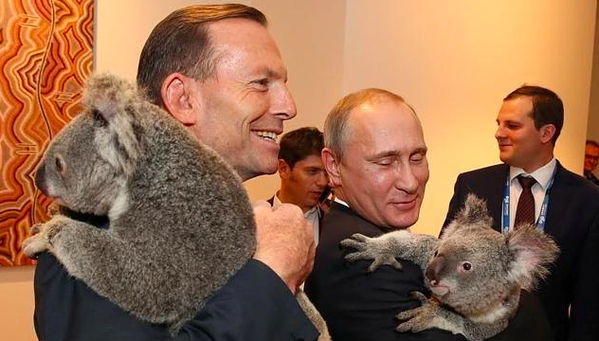
can’t find the photographer, I found it here: http://rt.com/news/205855-g20-abbott-putin-koala/
There’s even a sub-scandal about a sarcastic news segment that aired about the shirtfronting (you can watch it here – I think it’s been inaccurately described as a “skit”). The perpetrators have been sentenced to Australia’s cruelest punishment:
The ABC is being urged to have a “long, hard think” about a skit it aired mocking the Prime Minister’s threat to shirtfront the Russian President over the MH17 tragedy with Julie Bishop warning it had the potential to devastate the families of the victims.
(Australia you know I love you baby)
Maybe you guys both need to chill?
Posted: November 12, 2014 Filed under: America Since 1945 Leave a comment
Reading Nathan Heller on Stephen Pinker:
American language digests everything, in all directions. (Few other tongues would let you seize a bottle of whisky with chutzpah, drink it with louche abandon, and get down with the party.) And it’s given rise to special innovations. Consider the extra grammatical “aspects” of African-American English, the “be” aspects conveying habitual states, which add descriptive precision and nuance. (Eddie Murphy: “Elvis was forty-two years old, remember, right before he croaked?… His butt be sticking out.”) Problems arise only when vernaculars don’t intersect—when, say, the West Coast twentysomething asks her Bostonian boss to bring “hella” doughnuts to the meeting.
I don’t understand that Eddie Murphy joke. What would happen if you ask edyour Boston boss for hella doughnuts? If he’s cool he’d probably think it was funny . But, even if you’re on the West Coast you probably shouldn’t ask your boss to bring hella doughnuts to a meeting. (If you’re from the West Coast wouldn’t you call them donuts anyway?)
If you’re gonna take a run at Steven Pinker you better come correct.
Just learn how to diagram sentences and then relax, I say.
Crazy detail from this Washington Post story
Posted: November 5, 2014 Filed under: America Since 1945 Leave a commentCREDIT: REUTERS/ERIC THAYER
Minutes after landing at Reagan National Airport one day early this year, many GOP Senate hopefuls found themselves besieged at baggage claim by people with cameras yelling questions at them about abortion and rape.
This was no impromptu news conference but rather Republican staffers in disguise, trying to shock the candidates into realizing the intensity of what lay before them.
Cute, they’re role-playing!
The names of these organizations:
Party honchos tapped former Romney campaign manager Matt Rhoades and star operatives Joe Pounder and Tim Miller to start America Rising, a group dedicated to digging up damaging information on Democrats.
Vote All You Want
Posted: November 4, 2014 Filed under: America Since 1945, politics Leave a comment

If you live in LA County, here are some endorsements based on a very casual roundup from smart people. I have not looked into all this myself but this may be slightly better than voting at random:
Sheila Kuehl for supervisor.
No on 46.
Yes to all judicial reappointments
Dayan Mathai for judge.
1) Interested by this article in The Boston Globe entitled “Vote All You Want. The Secret Government Won’t Change.”
IDEAS: What evidence exists for saying America has a double government?
GLENNON:I was curious why a president such as Barack Obama would embrace the very same national security and counterterrorism policies that he campaigned eloquently against. Why would that president continue those same policies in case after case after case? I initially wrote it based on my own experience and personal knowledge and conversations with dozens of individuals in the military, law enforcement, and intelligence agencies of our government, as well as, of course, officeholders on Capitol Hill and in the courts. And the documented evidence in the book is substantial—there are 800 footnotes in the book.
IDEAS: Why would policy makers hand over the national-security keys to unelected officials?
GLENNON: It hasn’t been a conscious decision….Members of Congress are generalists and need to defer to experts within the national security realm, as elsewhere. They are particularly concerned about being caught out on a limb having made a wrong judgment about national security and tend, therefore, to defer to experts, who tend to exaggerate threats. The courts similarly tend to defer to the expertise of the network that defines national security policy.
The presidency itself is not a top-down institution, as many people in the public believe, headed by a president who gives orders and causes the bureaucracy to click its heels and salute. National security policy actually bubbles up from within the bureaucracy. Many of the more controversial policies, from the mining of Nicaragua’s harbors to the NSA surveillance program, originated within the bureaucracy. John Kerry was not exaggerating when he said that some of those programs are “on autopilot.”
No surprise here to readers of The Wise Men.
2)
Enjoyed reading this Michael Kelly profile of David Gergen from 1993.
A speech-department staff member culled dozens of anecdotes about Nixon from intimates and aides in a lengthy report, with each anecdote indexed according to the character trait it was meant to advertise: Repartee, Courage, Kindness, Strength in Adversity. What is most painfully obvious about these undertakings is how little the anecdotalists had to work with. Exemplifying the President’s talent for Repartee was an account of Nixon silencing a New York businessman who had upbraided him over the Vietnam War by telling the man not to “give me any crap.” Illustrating the President’s Strength in Adversity was a bald little story of how the young Congressman Nixon, falling on an icy sidewalk, still managed to keep his 2-year-old daughter, Tricia, safe in his arms.
In this perfectionist and paranoid atmosphere, Gergen learned the bones of his craft.
He learned the importance of saying the same thing, over and over and over: “Nixon taught us about the art of repetition. He used to tell me, ‘About the time you are writing a line that you have written it so often that you want to throw up, that is the first time the American people will hear it.’ ”
He learned about the gimmicks of phrasing calculated to catch the public ear: “Haldeman used to say that the vast majority of words that issue under a President’s name are just eminently forgettable. What you need to focus on is what’s the line that is going to have a little grab to it.”
He learned the theory of controlled access. If you gave the press only a smidgen of Presidential sight and sound on a given day, reporters would be forced to make their stories out of that smidgen: “Nixon used to go into the press room with a statement that was only 100 words long because he did not want them editing him. He knew if he gave them more than 100 words, they’d pick and choose what to use.”
He learned the endless discipline required to protect the image, which was as evanescent as morning mist: “It went into everything — the speeches, the talking points, the appearances. Haldeman had a rule on appearances: if you wanted to put in a scheduling request for anything the President was going to do in public, your request had to fulfill what we called H.P.L. — Headline, Picture, Lede. You had to say, in writing, what the headline out of the event was going to be, what the lede was going to be and what the picture was going to be.”
And this:
Then, on Jan. 21, 1980, Bush unexpectedly won the Iowa Republican caucus and became the instant front-runner. “The very next day, Gergen called up Baker and said, miracle of miracles, he had managed to clear his schedule and would be able to take the job after all,” Keene says. “When Baker said the job was filled, Gergen came in as a volunteer speech writer.” In the month between the Iowa caucus and the New Hampshire primary, when Bush was the leading Republican candidate, Gergen, according to Keene, “was very visible.”
But on Feb. 26, Bush lost the New Hampshire primary to a resurgent Ronald Reagan. “And Gergen just disappeared completely, I mean right away,” recalls Peter Teeley, Bush’s press secretary at the time. “We never heard from him again until he turned up with Reagan at the Republican convention.”
Even the Reaganites, who benefited from Gergen’s leap, were appalled by the speed of it. “He came to us as soon as it began to seem Bush was going to lose, definitely before Bush pulled out, and quite frankly this made us very suspicious of him,” recalls a former Reagan campaign official. “I mean, there’s jumping ship and there’s jumping ship. This guy was elbowing the women and children aside to get overboard.”
Gergen strongly denies that he showed any undue haste in switching allegiances. “It is not true that I disappeared in the campaign,” he says. “I continued to advise Bush much in the same way I had up to the point he was nominated Vice President.”
Let me note here (as I have elsewhere) that I took a class with David Gergen at the K School. I found him to be a serious but approachable and warm dude, always engaged and present. He did have a habit of ostentatiously taking notes during any guest speaker’s talk, but I took that to be a form of politeness.
I recall him telling a story – it’s possible I read this somewhere but I think I heard him say it – that he had a meeting with Nixon when he was (I believe) leaving law school and about to go into the Navy. Nixon advised him to serve as a regular old line officer on a ship, and not to use his law degree to get into a headquarters job.
 Helytimes
