Microsociology
Posted: July 12, 2016 Filed under: actors, America Since 1945, how to live, sexuality, war Leave a commentHow many interesting things are in sociologist Randall Collins’ latest post (which is maybe the text of a speech or something?) Let me excerpt some for us. I have highlighted some nuggets:

I will add a parallel that is perhaps surprising. Those who know Loic Wacquant would not expect to find silent harmony. Nevertheless, Wacquant’s study of a boxing gym finds a similar pattern: there is little that boxers do in the gym that they could not do at home alone, except sparring; but in the gym they perform exercises like skipping, hitting the bags, strengthening stomach muscles, all in 3-minute segments to the ring of the bell that governs rounds in the ring. When everyone in the gym is in the same rhythm, they are animated by a collective feeling; they become boxers dedicated to their craft, not so much through minds but as an embodied project.
A large proportion of violent confrontations of all kinds– street fights, riots, etc.– quickly abort; and most persons in those situations act like Marshall’s soldiers– they let a small minority of the group do all the violence. Now that we have photos and videos of violent situations, we see that at the moment of action the expression on the faces of the most violent participants is fear. Our folk belief is that anger is the emotion of violence, but anger appears mostly before any violence happens, and in controlled situations where individuals bluster at a distant enemy. I have called thisconfrontational tension/fear; it is the confrontation itself that generates the tension, more than fear of what will happen to oneself. Confrontational tension is debilitating; phenomenologically we know (mainly from police debriefings after shootings) that it produces perceptual distortions; physiologically it generates racing heart beat, an adrenaline rush which at high levels results in loss of bodily control.
This explains another, as yet little recognized pattern: when violence actually happens, it is usually incompetent. Most of the times people fire a gun at a human target, they miss; their shots go wide, they hit the wrong person, sometimes a bystander, sometimes friendly fire on their own side. This is a product of the situation, the confrontation. We know this because the accuracy of soldiers and police on firing ranges is much higher than when firing at a human target. We can pin this down further; inhibition in live firing declines with greater distance; artillery troops are more reliable than infantry with small arms, so are fighter and bomber crews and navy crews; it is not the statistical chances of being killed or injured by the enemy that makes close-range fighters incompetent. At the other end of the spectrum, very close face-to-face confrontation makes firing even more inaccurate; shootings at a distance of less than 2 meters are extremely inaccurate. Is this paradoxical? It is facing the other person at a normal distance for social interaction that is so difficult. Seeing the other person’s face, and being seen by him or her seeing your seeing,is what creates the most tension. Snipers with telescopic lenses can be extremely accurate, even when they see their target’s face; what they do not see is the target looking back; there is no mutual attention, no intersubjectivity. Mafia hit men strike unexpectedly and preferably from behind, relying on deception and normal appearances so that there is no face confrontation. This is also why executioners used to wear hoods; and why persons wearing face masks commit more violence than those with bare faces.
NOTE THE POLICY IMPLICATION: The fashion in recent years among elite police units to wear balaclava-style face masks during their raids should be eliminated.

How does violence sometimes succeed in doing damage? The key is asymmetrical confrontation tension. One side will win if they can get their victim in the zone of high arousal and high incompetence, while keeping their own arousal down to a zone of greater bodily control. Violence is not so much physical as emotional struggle; whoever achieves emotional domination, can then impose physical domination. That is why most real fights look very nasty; one sides beats up on an opponent at the time they are incapable of resisting. At the extreme, this happens in the big victories of military combat, where the troops on one side become paralyzed in the zone of 200 heartbeats per minute, massacred by victors in the 140 heartbeat range. This kind of asymmetry is especially dangerous, when the dominant side is also in the middle ranges of arousal; at 160 BPM or so, they are acting with only semi-conscious bodily control. Adrenaline is the flight-or-fight hormone; when the opponent signals weakness, shows fear, paralysis, or turns their back, this can turn into what I have called a forward panic, and the French officer Ardant du Picq called “flight to the front.” Here the attackers rush forward towards an unresisting enemy, firing uncontrollably. It has the pattern of hot rush, piling on, and overkill. Most outrageous incidents of police violence against unarmed or unresisting targets are forward panics, now publicized in our era of bullet counts and ubiquitous videos.

Another pathway is where the fight is surrounded by an audience; people who gather to watch, especially in festive crowds looking for entertainment; historical photos of crowds watching duels; and of course the commercial/ sporting version of staged fights. This configuration produces the longest and most competent fights; confrontational tension is lowered because the fighters are concerned for their performance in the eyes of the crowd, while focusing on their opponent has an element of tacit coordination since they are a situational elite jointly performing for the audience. Even the loser in a heroic staged fight gets social support. We could test this by comparing emotional micro-behavior in a boxing match or a baseball game without any spectators.
(among the photos that come up if you Google “crowd watching a duel”:

Title: Crowd reflected in water while watching Sarazen and Ouimet duel at Weston Country Club

Beardsley vs Salazar in the 1982 Boston Marathon
Finally, there are a set of techniques for carrying out violence without face confrontation. Striking at a distance: the modern military pathway. Becoming immersed in technical details of one’s weapons rather than on the human confrontation. And a currently popular technique: the clandestine attack such as a suicide bombing, which eliminates confrontational tension because it avoids showing any confrontation until the very moment the bomb is exploded. Traditional assassinations, and the modern mafia version, also rely on the cool-headedness that comes from pretending there is no confrontation, hiding in Goffmanian normal appearances until the moment to strike.
All this sounds rather grisly, but nevertheless confrontational theory of violence has an optimistic side. First, there is good news: most threatening confrontations do not result in violence. (This is shown also in Robert Emerson’s new book on quarrels among roommates and neighbours.) We missed this because, until recently, most evidence about violence came from sampling on the dependent variable. There is a deep interactional reason why face-to-face violence is hard, not easy. Most of the time both sides stay symmetrical. Both get angry and bluster in the same way. These confrontations abort, since they can’t get around the barrier of confrontational tension. Empirically, on our micro-evidence, this zero pathway is the most common. Either the quarrel ends in mutual gestures of contempt; or the fight quickly ends when opponents discover their mutual incompetence. Curtis Jackson-Jacobs’ video analysis shows fist-fighters moving away from each other after missing with a few out-of-rhythm punches. If no emotional domination happens, they soon sense it.
More:
Anne Nassauer, assembling videos and other evidence from many angles on demonstrations, finds the turning points at which a demo goes violent or stays peaceful. And she shows that these are situational turning points, irrespective of ideologies, avowed intent of demonstrators or policing methods. Stefan Klusemann, using video evidence, shows that ethnic massacres are triggered off in situations of emotional domination and emotional passivity; that is, local conditions, apart from whatever orders are given by remote authorities. Another pioneering turning-point study is David Sorge’s analysis of the phone recording of a school shooter exchanging shots with the police, who nevertheless is calmed down by an office clerk; she starts out terrified but eventually shifts into an us-together mood that ends in a peaceful surrender. Meredith Rossner shows that restorative justice conferences succeed or fail according to the processes of interaction rituals; and that emotionally successful RJ conferences result in conversion experiences that last for several years, at least. Counter-intuitively, she finds that RJ conferences are especially likely be successful when they concerns not minor offenses but serious violence; the intensity of the ritual depends on the intensity of emotions it evokes.

High authorities are hard to study with micro methods, since organizational high rank is shielded behind very strong Goffmanian frontstages. David Gibson, however, analyzing audio tapes of Kennedy’s crisis group in the Cuban Missile Crisis of 1962, penetrated the micro-reality of power in a situation in which all the rationally expectable scenarios led toward nuclear war. Neither JFK nor anyone else emerges as a charismatic or even a decisive leader. The group eventually muddled their way through sending signals that postponed a decision to use force, by tacitly ignoring scenarios that were too troubling to deal with. This fits the pattern that conversation analysts call the preference for agreement over disagreement, at whatever cost to rationality and consistency.
How about how social interactions affect job interviews?:
We have a long way to go to generalize these leads into a picture of how high authority really operates. Does it operate the same way in business corporations? The management literature tells us how executives have implemented well thought-out programs; but our information comes chiefly from retrospective interviews that collapse time and omit the situational process itself. Lauren Rivera cracks the veneer of elite Wall Street firms and finds that hiring decisions are made by a sense of emotional resonance between interviewer and interviewee, the solidarity of successful interaction rituals. Our best evidence of the micro details of this process comes from another arena, where Dan McFarland and colleagues analyze recorded data on speed dating, and find that conversational micro-rhythms determine who felt they “clicked” with whom.
OK what about sex?
I will end this scattered survey with some research that falls into the rubric of Weberian status groups, i.e. social rankings by lifestyle. David Grazian has produced a sequence of books,Blue Chicago and On the Make, that deal with night life. This could be considered a follow-up to Goffman’s analysis of what constitutes “fun in games” as well as “where the action is.” For Grazian, night-life is a performance of one’s “nocturnal self,” characterized by role-distance from one’s mundane day-time identity. By a combination of his own interviewing behind the scenes and collective ethnographies of students describing their evening on the town, from pre-party preparation to post-party story-telling, Grazian shows how the boys and the girls, acting as separate teams, play at sexual flirtation which for the most part is vastly over-hyped in its real results. It is the buzz of collective effervescence that some of these teams generate that is the real attraction of night life. And this may be an appropriate place to wind up. Freud, perhaps the original micro-sociologist, theorized that sexual drive is the underlying mover behind the scenes. Grazian, looking at how those scenes are enacted, finds libido as socially constructed performance. As is almost everything else.

In conclusion. Will interaction ritual, or for that matter micro-sociology as we know it, become outdated in the high-tech future? This isn’t futuristic any more, since we have been living in the era of widely dispersed information technology for at least 30 years, and we are used to its pace and direction of change. A key point for interaction ritual is that bodily co-presence is one of its ingredients. Is face contact needed? Rich Ling analyzed the everyday use of mobile phones and found that the same persons who spoke by phone a lot also met personally a lot. Cell phones do not substitute for bodily co-presence, but facilitate it. Among the most frequent back-and-forth, reciprocated connections are people coordinating where they are. Ling concluded that solidarity rituals were possible over the phone, but that they were weaker than face-to-face rituals; one was a teaser for the other.
…
Conceivably future electronic devices might wire up each other’s genitals, but what happens would likely depend on the micro-sociological theory of sex (chapter 6 in Interaction Ritual Chains): the strongest sexual attraction is not pleasure in one’s genitals per se, but getting the other person’s body to respond in mutually entraining erotic rhythms: getting turned on by getting the other person turned on. If you don’t believe me, try theorizing the attractions of performing oral sex. This is an historically increasing practice, and one of the things that drives the solidarity of homosexual movements. Gay movements are built around effervescent scenes, not around social media.
I will try theorizing the attractions of performing oral sex, Professor!
I recommend Collins’ book written with Maren McConnell, Napoleon Never Slept: How Great Leaders Leverage Social Energy, which I bought and read though I do wish there was a print edition.
Previous coverage about Collins’ work. Shoutout to Brent Forrester, who I think put me on to him.
Oh What A Slaughter and Sacagawea’s Nickname
Posted: July 11, 2016 Filed under: adventures, America, the American West, women, writing Leave a comment
Getting pretty close to having read all of Larry McMurtry’s nonfiction. LMcM has a rambling, conversational way in these books, I enjoy it. Here is some previous coverage about his book Hollywood, and his road trip book Roads, and the best one of all imo, Walter Benjamin at the Dairy Queen.
Oh What A Slaughter is definitely worth a read. A good quality of McMurtry and my all time favorite Evan S. Connell is that they really capture the weirdness of history.

How about this, as McMurtry describes the buildup to the Wounded Knee massacre?:


Wovoka / Jack Wilson
How can you not like a book that has this in it?
Sacagawea’s Nickname wasn’t as compelling to me.

It collects essays McMurtry wrote for the New York Review Of Books: a couple about Lewis & Clark, one about the great one-armed explorer/surveyor/ethnographer/proto-environmentalist John Wesley Powell:

But for title alone I was def gonna read it. Like every American kid I was taught about Sacagawea in school, whose name we were told was pronounced “Sack-a Jew-ee-uh.”

Imagine my shock years later when my friend Leila, who was schooled in Oregon and thus had some cred on the issue, told me her name was pronounced “Sack Ahj Way.” Well, sure. How could we know? Both Lewis and Clark, Clark especially, were crazy spellers, so their clues are confusing. From Wiki:
Clark used Sahkahgarwea, Sahcahgagwea, Sarcargahwea, and Sahcahgahweah, while Lewis used Sahcahgahwea, Sahcahgarweah, Sahcargarweah, and Sahcahgar Wea.
From McMurtry:

Anyway let me go ahead and give you a spoiler that Sar car Ja we a’s nickname was Janey.
Picture from the wikipedia page for Maine Coon
Posted: June 29, 2016 Filed under: cats, New England Leave a comment
(was trying to learn about native cat and dog type creatures of North America)
Michael Herr
Posted: June 24, 2016 Filed under: America Since 1945, heroes, war Leave a comment

If you read Dispatches and you weren’t obsessed with learning everything you possibly could about Michael Herr, we are different!
Read it AGAIN just recently after reading Mary Karr yank out its gears and examine them in her:

Also recommended.
Just a sample of Dispatches:


What about?:
In my search for info on Herr I read this 1990 profile for the LA Times by Paul Ciotti:
Friends of friends invited him to dinner. Strangers wanted to meet him. Once, Herr recalls, he got a phone call from a guy who said he was standing in a phone booth in Nebraska in the middle of the night. “I could hear the wind blowing. He hadn’t read the book.” The caller said, “Time magazine says this. What does this mean?” Herr reversed the question: “What do you think it means?” “Oh, ho! Now that you’re rich and famous you don’t want to talk to people like me.”
:
One inspiration was Ernest Hemingway. “When I was a kid, I was obsessed with him and made some pathetic teen-age attempts to imitate him in my life. And I reinvented myself as this outdoorsman, hard-drinking and everything with it. I dare say that influence put my foot on the trail to Vietnam. Which is why that book is about acting out fantasy as much as anything.
“I had always wanted to go to war. I wanted to write a book. It was something I had to do. The networks kept referring to this as a TV war, which I didn’t believe it was. I sent a proposal to Harold Hayes. I was to write a monthly column, but once I got over there I realized this was not the way to approach the story. I wired Hayes. He said, ‘You do what you want to do. Have fun. Be careful.’ “
What do we make of this?:
What sets Herr’s book apart is the authoritative sense he conveys of the terror, ennui and ecstasy of what it felt like to be there. In a chapter about the siege of Khe Sanh, he offers a long series of conversations between two friends, a huge, gentle black Marine named Day Tripper and a little naive white Marine named Mayhew. The exchanges ring so true that one wonders, simply on a journalistic level, how he ever managed to record them.
He smiles. “They are totally fictional characters.”
They are ?
“Oh, yeah. A lot of ‘Dispatches’ is fictional. I’ve said this a lot of times. I have told people over the years that there are fictional aspects to ‘Dispatches,’ and they look betrayed. They look heartbroken, as if it isn’t true anymore. I never thought of ‘Dispatches’ as journalism. In France they published it as a novel.”
But, Herr says, “I always carried a notebook. I had this idea–I remember endlessly writing down dialogues. It was all I was really there to do. Very few lines were literally invented. A lot of lines are put into mouths of composite characters. Sometimes I tell a story as if I was present when I wasn’t, (which wasn’t difficult)–I was so immersed in that talk, so full of it and so steeped in it. A lot of the journalistic stuff I got wrong.”
My hunt for more Herr led me to this Dutch (?) documentary, First Kill, interviews with vets interspersed with film of contemporary Vietnam. Herr is interviewd first at minute 27:40 or so.
The story he tells starting around 40:20. Jeez.
I forget where I learned that Herr was living in upstate New York or sumplace, practicing a rigorous Buddhism. My trail on him brought me to this book:


What to make of this Buddhist-type idea:


On the lighter side: there’s great stuff too in Michael Herr’s book about Kubrick:


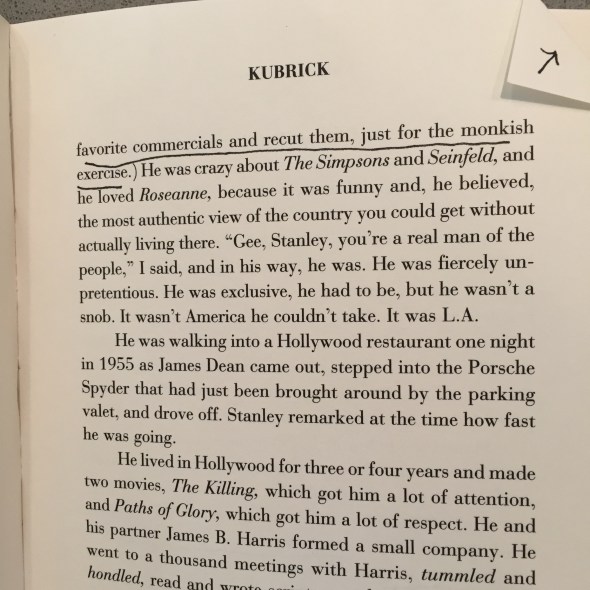
He’d tape his favorite commercials and recut them, just for the monkish exercise.
RIP.

Hamatsa emerging from the woods – Koskimo
Posted: June 23, 2016 Filed under: art history, photography, pictures Leave a comment
good photo from the Edward S. Curtis archives / Library of Congress.
_of_the_Duwamish,_1896.jpg)
Princess Angeline (Duwamish)
Great lost works of art
Posted: June 22, 2016 Filed under: boxing, painting, personal history Leave a comment

Let me add to Wikipedia’s list a work by my former roommate Sean Denis Boyland, acryllic (?) on photograph (?), that I’ve crudely approximated above. Begun and completed in the East Village of Manhattan, or perhaps Chelsea, Massachusetts, possibly in the summer of 2003, the artist bought an enlarged framed photo on the street and painted on it. The key was the elegance of the brushstroke which I just can’t replicate here.
Anyone who has further remembrance of this work is encouraged to contact Helytimes.
Re: lost artwork, always taken some perverse pleasure that I saw one of the most famous missing paintings ever, Rembrandt’s Storm on The Sea Of Galilee, before it was stolen from Boston’s Gardner Museum in 1990.

Discussion question: how much does it matter that the original painting is missing when there are extremely good photographs of it?
Three good losties from Wiki’s gallery: Van G’s Scheveningen beach in stormy weather, stolen 2003:

and Cezanne’s View of Auvers-sur-Oise, stolen from the Ashmolean during a fireworks show on New Years’ Eve 1999:

As the thieves ignored other works in the same room, and the stolen Cézanne has not been offered for sale, it is speculated that this was a case of an artwork stolen to order.
And how about Flinck, Landscape with an Obelisk?

Tragedy/comedy/absurdity in southern Mexico
Posted: June 20, 2016 Filed under: Wonder Trail Leave a comment
Reading about the teachers’ protests in Oaxaca I find this photo/caption combo which in a way tells the whole story.
Best lists from The List App
Posted: June 19, 2016 Filed under: assorted Leave a comment
And I like my friends’ app, li.st

Here are the best lists I’ve made on this app:
Is this a survey or the chant of a cult?
Posted: June 17, 2016 Filed under: baseball, Boston, New England Leave a comment
At Fenway Park for Jason Varitek bobblehead day, I stopped to fill out a two page survey. Here’s the bottom of page 2:

The whole survey had a bit of a hypnotism vibe:

If you’re an official card-carrying member of Red Sox Nation ($14 a year) you can watch batting practice from on top of the Green Monster:

Fenway is just so wonderful. From the wall of former Red Sox logos, one of the more unsuccessful efforts:

Orioles outfield coach Wayne Kirby kept giving emphatic instructions that, as far as I could tell, were heard by nobody:
The Red Sox encourage you to follow “the time-honored tradition of keeping score.” A very Zen activity, recommended. I developed my method during my Roxbury Latin playing career, when I was judged more valuable for my tactical/strategic and historical mind than for my hitting/fielding abilities.

Doesn’t that just tell the whole story. A tough night for Boston but any night at Fenway is a good time.

I feel grateful to the Boston Red Sox.
I feel thankful for the Boston Red Sox.
I feel a sense of gratitude towards the Boston Red Sox.

(contact me if you wish to purchase a Varitek bobblehead, $6000 obo)
New book out today!
Posted: June 14, 2016 Filed under: Wonder Trail Leave a comment
Get some! More about the book here, Hank the Cat reviews it here, handy reviewers’ guide, order on Amazon here, from your local indie bookstore here! And hey: lemme know what you think. The book’s intended to illuminate and entertain and I hope it does so for YOU.
If you’re in LA, come see me at Book Soup, in conversation with Little Esther, on Monday June 20 at 7pm.
Went to check on results of the Harvard-Yale boat race
Posted: June 13, 2016 Filed under: New England, sports Leave a comment
an inauspicious day for the Crimson.
Hydrogen bomb photos
Posted: June 13, 2016 Filed under: America Since 1945 Leave a comment

ca. 1951 – 1962, Nevada, USA — Mushroom Cloud From Nuclear Test — Image by © CORBIS


Between the show’s first and second seasons, the writers waited in the lobby of Andreessen’s office, where photographs of hydrogen-bomb blasts hang on the walls. (“They’re a good way to make sure people are awake,” Andreessen’s spokesperson told me.) Then the writers were ushered into a conference room, where, for more than an hour, they sat around a blond-wood conference table while Andreessen pitched them jokes. “They weren’t terrible, either,” one of the writers told me. “I have eight dense pages of notes from that meeting. I have never heard a man speak as fast as Marc Andreessen.” None of his jokes appeared on the show in their original form, but a concept he explained—the downside of accepting too much free money from investors—became a scene in season two. In the TV version, the venture capitalist is a young woman, and the conversation begins with her interrupting Richard while he’s in the bathroom.
(from this New Yorker thing by Andrew Marantz about Silicon Valley.)

.jpg)

Tough to find original sources for some of these photos, click through for the ends of my trails. More.
School vacations and diplomacy
Posted: June 12, 2016 Filed under: Cuba Leave a comment
Stephen Crowley/ NY Times
But the driving force, according to sources at both State and the Vice President’s office, was that the president and first lady very much wanted a family trip, and the March 20-23 dates coincided with spring break at Sidwell Friends School for daughters Malia, who’s been studying Spanish, and Sasha
How much world diplomacy comes down to school vacations? from this interesting article in Politico about Obama’s trip to Cuba.
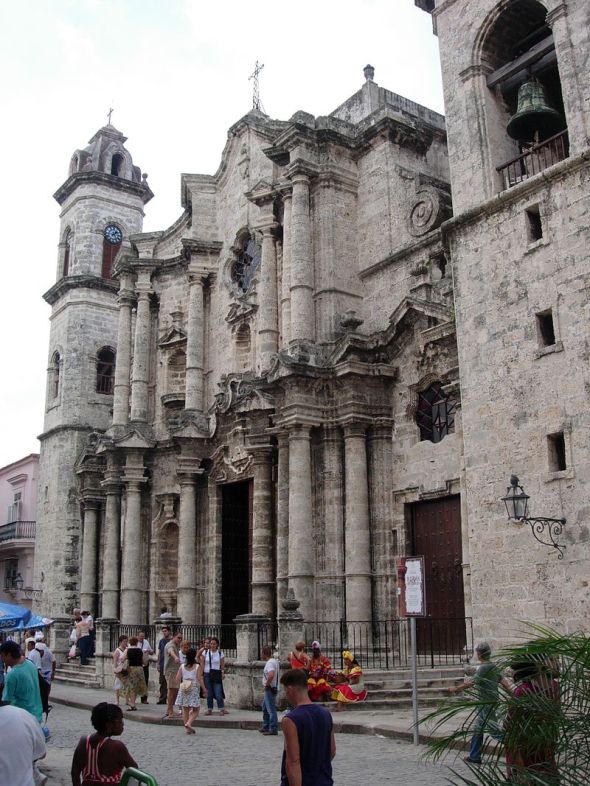
The Obama family made the requisite tourist stops, including the city’s grand Cathedral, built in 1777 from blocks of coral; they took a walking tour led by Havana’s remarkable official historian, Eusebio Leal. Despite failing health and being in considerable pain, Leal gamely guided the Obamas through historic Havana in and around the Plaza de Armas.
The buzz of la bola en la calle—Cuban street gossip—was that the visit had prompted previously unimaginable upgrades to parts of the capital. Every building that the Obama entourage passed had been repainted, and every road his limousine traversed had been repaved. Some streets were still being paved and re-striped just hours before his arrival. “Come visit us,” cried out residents of neglected, pot-holed barrios in what became a weeklong running joke, “y llevar el asfalto!” — “and bring the asphalt!”

Eusebio Leal
from an interesting profile of Leal in the Washington Post:
Eusebio Leal, a diminutive, silver-haired man in a dark suit, sips sweet Cuban coffee in an elegant salon of the Cuban Interests Section mansion on 16th Street NW and recalls the day they began calling him crazy in Havana.
The year was 1967, in a country not known for rewarding dissent, and Leal, then 25, was relatively new on the job as a city preservationist. He was leading a project to skin the asphalt off a historic street, revealing the original wooden surface, and he had a special load of vintage wood to restore the centuries-old grandeur. But government officials told him the street would have to be paved over immediately so it could be used for an important diplomatic visit.
The next morning, crews came to do the work — and Leal lay in front of the trucks to save the street.
“The mayor had to come to persuade me,” Leal recalls in his deep voice, through an official interpreter. “I didn’t get up until he guaranteed that we could complete our work. He kept his word. It was a very tense moment. Then they started saying I was a madman — but in that kind of aspect in which being a madman is a good thing.”
(Is Havana Cathedral the largest building made of coral in the world?) As for this picture:

AP photo
As the conference streamed live, Cubans watched a flustered Raul lose his cool, then abruptly end the news conference and march over to Obama to raise his arm in a victory salute. A bemused Obama was having none of it, and let his arm dangle. “Oh my god,” said a former Cuban diplomat. “It made Raul look weak. No one here has ever seen anything like that.”
Be like Beyers!
Posted: June 11, 2016 Filed under: Wonder Trail Leave a comment
Come see me interview Mary Roach on Friday, June 17 or come see me be interviewed about WONDER TRAIL at Book Soup in LA on Monday, June 20.
Bro you’re called the SECRET service
Posted: June 6, 2016 Filed under: America Since 1945 Leave a comment
At the fights
Posted: June 6, 2016 Filed under: the California Condition Leave a comment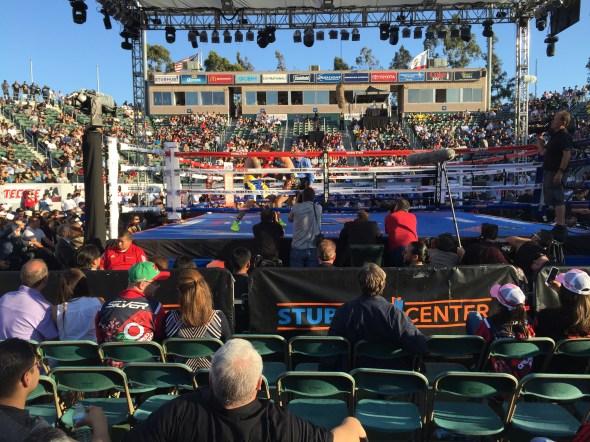
In an entertaining ten round middleweight slugfest, Gabriel Rosado edged out a wildly unpopular unanimous decision victory over Antonio Gutierrez (21-2-1, 9 KOs). Gutierrez dropped Rosado hard in the fourth round with a solid one-two combo and was the more aggressive fighter, often chasing a back-peddling or sidestepping Rosado. It was a slugfest, throughout, and a very evenly matched fight. Gutierrez is the hard luck loser while Rosado builds off his recent victory over Joshua Clottey. Judges scored the bout 95-94, 96-93 and 95-94, all in favor of Rosado.
D*-Day
Posted: June 5, 2016 Filed under: history, war, WW2 Leave a comment * the D is for Dave!
Happy birthday, tomorrow, June 6, to Dave King (the Great Debates co-host, not the Bad Plus drummer)

Dave King the drummer photographed by Wiki user Steve Bowbrick
A promise made in Host Chat is a promise kept so here is a selection of D-Day readings for Davis.

scene from the Bayeux Tapestry

New Yorker’s July 15, 1944 parody of the Bayeux Tapestry
The single best thing to read about D-Day
is online and free. It is S. L. A. Marshall writing for The Atlantic in November, 1950.

During World War II, Marshall became an official Army combat historian, and came to know many of the war’s best-known Allied commanders, including George S. Patton and Omar N. Bradley. He conducted hundreds of interviews of both enlisted men and officers regarding their combat experiences, and was an early proponent of oral history techniques. In particular, Marshall favored the group interview, where he would gather surviving members of a frontline unit together and debrief them on their combat experiences of a day or two before.

The article is called “First Wave On Omaha Beach” here is an excerpt:
Even among some of the lightly wounded who jumped into shallow water the hits prove fatal. Knocked down by a bullet in the arm or weakened by fear and shock, they are unable to rise again and are drowned by the onrushing tide. Other wounded men drag themselves ashore and, on finding the sands, lie quiet from total exhaustion, only to be overtaken and killed by the water. A few move safely through the bullet swarm to the beach, then find that they cannot hold there. They return to the water to use it for body cover. Faces turned upward, so that their nostrils are out of water, they creep toward the land at the same rate as the tide. That is how most of the survivors make it. The less rugged or less clever seek the cover of enemy obstacles moored along the upper half of the beach and are knocked off by machine-gun fire.
Within seven minutes after the ramps drop, Able Company is inert and leaderless. At Boat No. 2, Lieutenant Tidrick takes a bullet through the throat as he jumps from the ramp into the water. He staggers onto the sand and flops down ten feet from Private First Class Leo J. Nash. Nash sees the blood spurting and hears the strangled words gasped by Tidrick: “Advance with the wire cutters!” It’s futile; Nash has no cutters. To give the order, Tidrick has raised himself up on his hands and made himself a target for an instant. Nash, burrowing into the sand, sees machine gun bullets rip Tidrick from crown to pelvis. From the cliff above, the German gunners are shooting into the survivors as from a roof top.
Captain Taylor N. Fellers and Lieutenant Benjamin R. Kearfoot never make it. They had loaded with a section of thirty men in Boat No. 6 (Landing Craft, Assault, No. 1015). But exactly what happened to this boat and its human cargo was never to be known. No one saw the craft go down. How each man aboard it met death remains unreported. Half of the drowned bodies were later found along the beach. It is supposed that the others were claimed by the sea.
After the war, Marshall would write Men Against Fire:

which claimed that only about 25% of American combat soldiers actually fired their guns at the enemy:
Marshall’s work on infantry combat effectiveness in World War II, titled Men Against Fire, is his best-known and most controversial work. In the book, Marshall claimed that of the World War II U.S. troops in actual combat, 75% never fired at the enemy for the purpose of killing, even though they were engaged in combat and under direct threat. Marshall argued that the Army should devote significant training resources to increasing the percentage of soldiers willing to engage the enemy with direct fire.
Marshall has been harshly criticized:

General Marshall said soldiers who did not fire were motivated by fear, a desire to minimize risk and a willingness, as in civilian life, to let a minority of other people carry the load.
In his 1989 memoir, About Face, Hackworth described his initial elation at an assignment with a man he idolized, and how that elation turned to disillusion after seeing Marshall’s character and methods first hand. Hackworth described Marshall as a “voyeur warrior,” for whom “the truth never got in the way of a good story” and went so far as to say, “Veterans of many of the actions he ‘documented’ in his books have complained bitterly over the years of his inaccuracy or blatant bias”.
Omaha Beach was the worst of it, but experiences on D-Day were vastly different.

stolen from the Daily Mail: http://www.dailymail.co.uk/news/article-2336753/Back-beaches-final-time-D-Day-heroes-return-Normandy-mark-69th-anniversary-landings.html
Twenty-one miles away on Juno Beach the Canadian Ninth Division landed with their bikes:
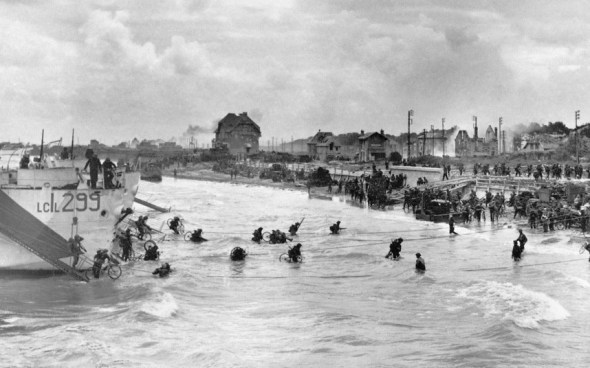
Picture: STF/AFP/Getty Images
Leave it to Canadians to bring their bikes. (900 Canadians died in a botched semi-practice D-Day in 1942).
Best Single Book To Read About D-Day
Looking around I can’t find my copy of Normandy Revisited by AJ Liebling:

Image by © Bettmann/CORBIS found here
Liebling, a vivacious fatso who had spent a lot of time in Normandy pre-war, describes going through with the Army and eating at spots he remembered from before. Definitely a different kind of war corresponding.
This book

was wildly popular for a reason: it’s thrilling, readable, and full of epic American hero stories.
Maybe starting with Andrew J. Higgins of Nebraska and Mobile, Alabama:

who developed shallow-draft boats for logging in the bayou (or for bootlegging?) and then took on the job of making similar boats for amphibious landings:

Higgins Industries
Anthony Beevor has a blunter take. Major takeaway from his book:

was that the Allies came up way short of their goals on D-Day. Unsurprisingly, many of those who got off the beaches in one piece considered their work done for the day. They were literally in Calvados,
 it was pretty easy to find bottles of highly alcoholic apple brandy, and a lot of survivors got hammered at first opportunity.

Who can blame them? But the failure to achieve the ambitious goals had costs. Caen was the biggest city around:

British and Canadian troops had intended to capture the town on D-Day. However they were held up north of the city until 9 July, when an intense bombing campaign during Operation Charnwood destroyed 70% of the city and killed 2,000 French civilians.
From this Washington Post review of Beevor, some excerpts:
US Army medical services had to deal with 30,000 cases of combat exhaustion in Normandy,” and:
“Nothing . . . seemed to reduce the flow of cases where men under artillery fire would go ‘wide-eyed and jittery’, or ‘start running around in circles and crying’, or ‘curl up into little balls’, or even wander out in a trance in an open field and start picking flowers as the shells exploded. Others cracked under the strain of patrols, suddenly crying, ‘We’re going to get killed! We’re going to get killed!’ Young officers had to try to deal with ‘men suddenly whimpering, cringing, refusing to get up or get out of a foxhole and go forward under fire’. While some soldiers resorted to self-inflicted wounds, a smaller, unknown number committed suicide.”
But the single best book to read about D-Day I would say is The Boys’ Crusade by Paul Fussell:

Amazon reviewer Bill Marsano sums it up nicely:
It’s probably all that “good war” and “greatest generation” stuff that drove Fussell to write this book; he doesn’t have much truck with gooey backward glances, and that will probably make some readers mad. Well, you don’t come to Fussell–author of, among other things, “Thank God for the Atom Bomb, and Other Essays”–for good times. You come to Fussell for the hard stuff.
And here it is his contention that behind and beneath all that “greatest generation” nonsense was the Boys’ Crusade–that last year of the war in Europe when too many things went wrong too often. The generals who’d convinced themselves that this war would not be a war of attrition–i.e., human slaughter–like the last one found they’d guessed wrong. Casualties were horrifyingly high and so huge numbers of children–kids 17-19 years–old were flung into combat. And they were, with the help of the generals, ill-trained, ill-clothed and ill-equipped.
They were also faceless ciphers. As Fussell points out, the US Army’s policy was to break up training units by sending individual replacements up to the line piecemeal–one at a time–so they often arrived as strangers among strangers, often addressed merely as “Soldier” because no one knew their names. The result was too many instances of cowardice–both under fire and behind the lines–too many self-inflicted wounds to escape combat. Too many disgraces of every kind because the Army’s system, Fussell says, destroyed the most important factor in the fighting morale of the “poor bloody infantry”–the shame and fear of turning chicken in front of your comrades. Many of these boys–and Fussell is properly insistent on the word boys–funked because they had no comradeship to value.
This is not in the least a personal journal. Fussell was serriously wounded as a young second lieutenant; he was also decorated. But he wisely leaves himself out of this narrative. There’s no special pleading here, no showing of the wounds on Crispin’s Day. Instead this is a passionate but straightforward report on what that last year was like for the poor bloody infantry–those foot soldiers, those dogfaces, those 14 percent of the troops who took more than 70 percent of the casualties.
And yet there were those who stood the gaff, who survived “carnage up to and including bodies literally torn to pieces, of intestines hung on trees like Christ,mas festoons,” and managed not to dishonor themselves. They weren’t heroes, Fussell says, just men who earned the Combat Infantryman’s Badge, which was the only honor they respected. In a brief but moving passage, he explains why: It said they’d been there, been through it, and toughed it out.
Horrible as it is I found this book refreshing when I first read it, because it felt like somebody was telling me the unvarnished truth, which is that even for the good guys this was a series of catastrophes, fuckups, and massacres.
All Fussell’s books are good. This one in particular I was obsessed with:

and I talk about it in The Wonder Trail: True Stories From Los Angeles To The End Of The World, out June 14:
Those photos are by Robert Capa, who lost all but 11 of the 106 or so photos he risked his life shooting when the guy developing them was in such a hurry he fudged up the negatives.
Let’s give the last word to Fussell:
One wartime moment not at all vile occurred on June 5, 1944, when Dwight Eisenhower, entirely alone and for the moment disjunct from his publicity apparatus, changed the passive voice to active in the penciled statement he wrote out to have ready when the invasion was repulsed, his troops torn apart for nothing, his planes ripped and smashed to no end, his warships sunk, his reputation blasted: “Our landings in the Cherbourg-Havre area have failed to gain a satisfactory foothold and I have withdrawn the troops.” Originally he wrote, “the troops have been withdrawn,” as if by some distant, anonymous agency instead of by an identifiable man making all-but-impossible decisions. Having ventured this bold revision, and secure in his painful acceptance of full personal accountability, he was able to proceed unevasively with “My decision to attack at this time and place was based on the best information available.” Then, after the conventional “credit,” distributed equally to “the troops, the air, and the navy,” came Eisenhower’s noble acceptance of total personal responsibility: “If any blame or fault attaches to the attempt, it is mine alone.” As Mailer says, you use the word shit so that you can use the word noble,and you refuse to ignore the stupidity and barbarism and ignobility and poltroonery and filth of the real war so thatit is mine alone can flash out, a bright signal in a dark time.

Happy Birthday Dave!

Raise prices?
Posted: June 3, 2016 Filed under: advice Leave a comment
photo by Joe Pugliese for The New Yorker, click through for source.
Tim Ferriss: If you could have one billboard, anywhere with anything on it, what would you put on it? If you wanted to convey a short message to as many people as possible.
Marc Andreessen: I’ve got one, I’ve actually thought about hiring a skywriter to do this one. Right in the heart of San Francisco would be a billboard with just two words on it: Raise Prices.
TF: Raise prices?
MA: Yes. The number one thing – just the theme and we see it everywhere – the number one theme with our companies have when they get really struggling is they are not charging enough for their product. It has become absolutely conventional wisdom in Silicon Valley that the way to succeed is to price your product as low as possible under the theory that if it’s low-priced everybody can buy it and that’s how you get the volume. And we just see over and over and over again people failing with that because they get in the problem we call too hungry to eat. They don’t charge enough for their product to be able to afford the sales and marketing required to actually get anybody to buy it. And so they can’t afford to hire the sales rep to go sell the product. They can’t afford to buy the TV commercial, whatever it is. They cannot afford to go acquire the customers.
TF: Too hungry to eat.
MA: Too hungry to eat. And then they sit there and they don’t sell anything and then they get nervous and then they cut their prices.
TF: And then it’s a race to the bottom.
MA: It just makes the problem worse. And so, probably the single number one thing we try to get our companies to do is raise prices. By the way, it’s like, “Is your product any good if people won’t pay more for it?”
from here. ReformedBroker warms that up with:
Good advice is worth multiples of what a client pays for it. Mediocre advice is not worth a little less, it’s worth nothing because it won’t be adhered to.
LATTJO alert
Posted: June 3, 2016 Filed under: Sweden Leave a comment
(thanks to our IKEA correspondent)
 Helytimes
