Hydrogen bomb photos
Posted: June 13, 2016 Filed under: America Since 1945 Leave a comment

ca. 1951 – 1962, Nevada, USA — Mushroom Cloud From Nuclear Test — Image by © CORBIS


Between the show’s first and second seasons, the writers waited in the lobby of Andreessen’s office, where photographs of hydrogen-bomb blasts hang on the walls. (“They’re a good way to make sure people are awake,” Andreessen’s spokesperson told me.) Then the writers were ushered into a conference room, where, for more than an hour, they sat around a blond-wood conference table while Andreessen pitched them jokes. “They weren’t terrible, either,” one of the writers told me. “I have eight dense pages of notes from that meeting. I have never heard a man speak as fast as Marc Andreessen.” None of his jokes appeared on the show in their original form, but a concept he explained—the downside of accepting too much free money from investors—became a scene in season two. In the TV version, the venture capitalist is a young woman, and the conversation begins with her interrupting Richard while he’s in the bathroom.
(from this New Yorker thing by Andrew Marantz about Silicon Valley.)

.jpg)

Tough to find original sources for some of these photos, click through for the ends of my trails. More.
School vacations and diplomacy
Posted: June 12, 2016 Filed under: Cuba Leave a comment
Stephen Crowley/ NY Times
But the driving force, according to sources at both State and the Vice President’s office, was that the president and first lady very much wanted a family trip, and the March 20-23 dates coincided with spring break at Sidwell Friends School for daughters Malia, who’s been studying Spanish, and Sasha
How much world diplomacy comes down to school vacations? from this interesting article in Politico about Obama’s trip to Cuba.
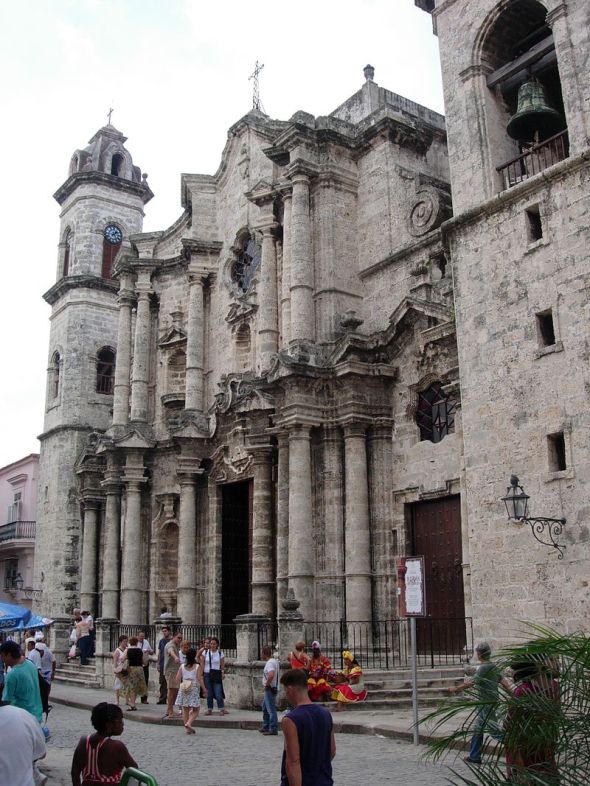
The Obama family made the requisite tourist stops, including the city’s grand Cathedral, built in 1777 from blocks of coral; they took a walking tour led by Havana’s remarkable official historian, Eusebio Leal. Despite failing health and being in considerable pain, Leal gamely guided the Obamas through historic Havana in and around the Plaza de Armas.
The buzz of la bola en la calle—Cuban street gossip—was that the visit had prompted previously unimaginable upgrades to parts of the capital. Every building that the Obama entourage passed had been repainted, and every road his limousine traversed had been repaved. Some streets were still being paved and re-striped just hours before his arrival. “Come visit us,” cried out residents of neglected, pot-holed barrios in what became a weeklong running joke, “y llevar el asfalto!” — “and bring the asphalt!”

Eusebio Leal
from an interesting profile of Leal in the Washington Post:
Eusebio Leal, a diminutive, silver-haired man in a dark suit, sips sweet Cuban coffee in an elegant salon of the Cuban Interests Section mansion on 16th Street NW and recalls the day they began calling him crazy in Havana.
The year was 1967, in a country not known for rewarding dissent, and Leal, then 25, was relatively new on the job as a city preservationist. He was leading a project to skin the asphalt off a historic street, revealing the original wooden surface, and he had a special load of vintage wood to restore the centuries-old grandeur. But government officials told him the street would have to be paved over immediately so it could be used for an important diplomatic visit.
The next morning, crews came to do the work — and Leal lay in front of the trucks to save the street.
“The mayor had to come to persuade me,” Leal recalls in his deep voice, through an official interpreter. “I didn’t get up until he guaranteed that we could complete our work. He kept his word. It was a very tense moment. Then they started saying I was a madman — but in that kind of aspect in which being a madman is a good thing.”
(Is Havana Cathedral the largest building made of coral in the world?) As for this picture:

AP photo
As the conference streamed live, Cubans watched a flustered Raul lose his cool, then abruptly end the news conference and march over to Obama to raise his arm in a victory salute. A bemused Obama was having none of it, and let his arm dangle. “Oh my god,” said a former Cuban diplomat. “It made Raul look weak. No one here has ever seen anything like that.”
Be like Beyers!
Posted: June 11, 2016 Filed under: Wonder Trail Leave a comment
Come see me interview Mary Roach on Friday, June 17 or come see me be interviewed about WONDER TRAIL at Book Soup in LA on Monday, June 20.
Bro you’re called the SECRET service
Posted: June 6, 2016 Filed under: America Since 1945 Leave a comment
At the fights
Posted: June 6, 2016 Filed under: the California Condition Leave a comment
In an entertaining ten round middleweight slugfest, Gabriel Rosado edged out a wildly unpopular unanimous decision victory over Antonio Gutierrez (21-2-1, 9 KOs). Gutierrez dropped Rosado hard in the fourth round with a solid one-two combo and was the more aggressive fighter, often chasing a back-peddling or sidestepping Rosado. It was a slugfest, throughout, and a very evenly matched fight. Gutierrez is the hard luck loser while Rosado builds off his recent victory over Joshua Clottey. Judges scored the bout 95-94, 96-93 and 95-94, all in favor of Rosado.
D*-Day
Posted: June 5, 2016 Filed under: history, war, WW2 Leave a comment * the D is for Dave!
Happy birthday, tomorrow, June 6, to Dave King (the Great Debates co-host, not the Bad Plus drummer)

Dave King the drummer photographed by Wiki user Steve Bowbrick
A promise made in Host Chat is a promise kept so here is a selection of D-Day readings for Davis.

scene from the Bayeux Tapestry

New Yorker’s July 15, 1944 parody of the Bayeux Tapestry
The single best thing to read about D-Day
is online and free. It is S. L. A. Marshall writing for The Atlantic in November, 1950.

During World War II, Marshall became an official Army combat historian, and came to know many of the war’s best-known Allied commanders, including George S. Patton and Omar N. Bradley. He conducted hundreds of interviews of both enlisted men and officers regarding their combat experiences, and was an early proponent of oral history techniques. In particular, Marshall favored the group interview, where he would gather surviving members of a frontline unit together and debrief them on their combat experiences of a day or two before.

The article is called “First Wave On Omaha Beach” here is an excerpt:
Even among some of the lightly wounded who jumped into shallow water the hits prove fatal. Knocked down by a bullet in the arm or weakened by fear and shock, they are unable to rise again and are drowned by the onrushing tide. Other wounded men drag themselves ashore and, on finding the sands, lie quiet from total exhaustion, only to be overtaken and killed by the water. A few move safely through the bullet swarm to the beach, then find that they cannot hold there. They return to the water to use it for body cover. Faces turned upward, so that their nostrils are out of water, they creep toward the land at the same rate as the tide. That is how most of the survivors make it. The less rugged or less clever seek the cover of enemy obstacles moored along the upper half of the beach and are knocked off by machine-gun fire.
Within seven minutes after the ramps drop, Able Company is inert and leaderless. At Boat No. 2, Lieutenant Tidrick takes a bullet through the throat as he jumps from the ramp into the water. He staggers onto the sand and flops down ten feet from Private First Class Leo J. Nash. Nash sees the blood spurting and hears the strangled words gasped by Tidrick: “Advance with the wire cutters!” It’s futile; Nash has no cutters. To give the order, Tidrick has raised himself up on his hands and made himself a target for an instant. Nash, burrowing into the sand, sees machine gun bullets rip Tidrick from crown to pelvis. From the cliff above, the German gunners are shooting into the survivors as from a roof top.
Captain Taylor N. Fellers and Lieutenant Benjamin R. Kearfoot never make it. They had loaded with a section of thirty men in Boat No. 6 (Landing Craft, Assault, No. 1015). But exactly what happened to this boat and its human cargo was never to be known. No one saw the craft go down. How each man aboard it met death remains unreported. Half of the drowned bodies were later found along the beach. It is supposed that the others were claimed by the sea.
After the war, Marshall would write Men Against Fire:

which claimed that only about 25% of American combat soldiers actually fired their guns at the enemy:
Marshall’s work on infantry combat effectiveness in World War II, titled Men Against Fire, is his best-known and most controversial work. In the book, Marshall claimed that of the World War II U.S. troops in actual combat, 75% never fired at the enemy for the purpose of killing, even though they were engaged in combat and under direct threat. Marshall argued that the Army should devote significant training resources to increasing the percentage of soldiers willing to engage the enemy with direct fire.
Marshall has been harshly criticized:

General Marshall said soldiers who did not fire were motivated by fear, a desire to minimize risk and a willingness, as in civilian life, to let a minority of other people carry the load.
In his 1989 memoir, About Face, Hackworth described his initial elation at an assignment with a man he idolized, and how that elation turned to disillusion after seeing Marshall’s character and methods first hand. Hackworth described Marshall as a “voyeur warrior,” for whom “the truth never got in the way of a good story” and went so far as to say, “Veterans of many of the actions he ‘documented’ in his books have complained bitterly over the years of his inaccuracy or blatant bias”.
Omaha Beach was the worst of it, but experiences on D-Day were vastly different.

stolen from the Daily Mail: http://www.dailymail.co.uk/news/article-2336753/Back-beaches-final-time-D-Day-heroes-return-Normandy-mark-69th-anniversary-landings.html
Twenty-one miles away on Juno Beach the Canadian Ninth Division landed with their bikes:
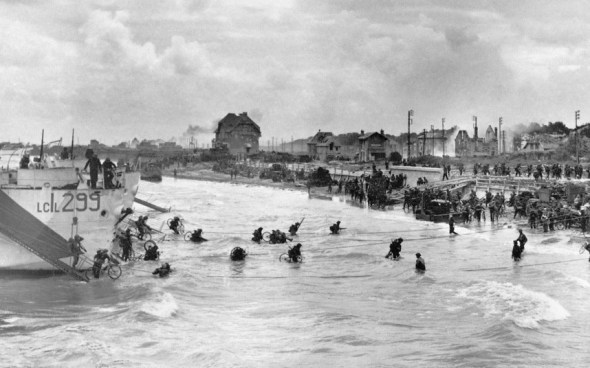
Picture: STF/AFP/Getty Images
Leave it to Canadians to bring their bikes. (900 Canadians died in a botched semi-practice D-Day in 1942).
Best Single Book To Read About D-Day
Looking around I can’t find my copy of Normandy Revisited by AJ Liebling:

Image by © Bettmann/CORBIS found here
Liebling, a vivacious fatso who had spent a lot of time in Normandy pre-war, describes going through with the Army and eating at spots he remembered from before. Definitely a different kind of war corresponding.
This book

was wildly popular for a reason: it’s thrilling, readable, and full of epic American hero stories.
Maybe starting with Andrew J. Higgins of Nebraska and Mobile, Alabama:

who developed shallow-draft boats for logging in the bayou (or for bootlegging?) and then took on the job of making similar boats for amphibious landings:

Higgins Industries
Anthony Beevor has a blunter take. Major takeaway from his book:

was that the Allies came up way short of their goals on D-Day. Unsurprisingly, many of those who got off the beaches in one piece considered their work done for the day. They were literally in Calvados,
 it was pretty easy to find bottles of highly alcoholic apple brandy, and a lot of survivors got hammered at first opportunity.

Who can blame them? But the failure to achieve the ambitious goals had costs. Caen was the biggest city around:

British and Canadian troops had intended to capture the town on D-Day. However they were held up north of the city until 9 July, when an intense bombing campaign during Operation Charnwood destroyed 70% of the city and killed 2,000 French civilians.
From this Washington Post review of Beevor, some excerpts:
US Army medical services had to deal with 30,000 cases of combat exhaustion in Normandy,” and:
“Nothing . . . seemed to reduce the flow of cases where men under artillery fire would go ‘wide-eyed and jittery’, or ‘start running around in circles and crying’, or ‘curl up into little balls’, or even wander out in a trance in an open field and start picking flowers as the shells exploded. Others cracked under the strain of patrols, suddenly crying, ‘We’re going to get killed! We’re going to get killed!’ Young officers had to try to deal with ‘men suddenly whimpering, cringing, refusing to get up or get out of a foxhole and go forward under fire’. While some soldiers resorted to self-inflicted wounds, a smaller, unknown number committed suicide.”
But the single best book to read about D-Day I would say is The Boys’ Crusade by Paul Fussell:

Amazon reviewer Bill Marsano sums it up nicely:
It’s probably all that “good war” and “greatest generation” stuff that drove Fussell to write this book; he doesn’t have much truck with gooey backward glances, and that will probably make some readers mad. Well, you don’t come to Fussell–author of, among other things, “Thank God for the Atom Bomb, and Other Essays”–for good times. You come to Fussell for the hard stuff.
And here it is his contention that behind and beneath all that “greatest generation” nonsense was the Boys’ Crusade–that last year of the war in Europe when too many things went wrong too often. The generals who’d convinced themselves that this war would not be a war of attrition–i.e., human slaughter–like the last one found they’d guessed wrong. Casualties were horrifyingly high and so huge numbers of children–kids 17-19 years–old were flung into combat. And they were, with the help of the generals, ill-trained, ill-clothed and ill-equipped.
They were also faceless ciphers. As Fussell points out, the US Army’s policy was to break up training units by sending individual replacements up to the line piecemeal–one at a time–so they often arrived as strangers among strangers, often addressed merely as “Soldier” because no one knew their names. The result was too many instances of cowardice–both under fire and behind the lines–too many self-inflicted wounds to escape combat. Too many disgraces of every kind because the Army’s system, Fussell says, destroyed the most important factor in the fighting morale of the “poor bloody infantry”–the shame and fear of turning chicken in front of your comrades. Many of these boys–and Fussell is properly insistent on the word boys–funked because they had no comradeship to value.
This is not in the least a personal journal. Fussell was serriously wounded as a young second lieutenant; he was also decorated. But he wisely leaves himself out of this narrative. There’s no special pleading here, no showing of the wounds on Crispin’s Day. Instead this is a passionate but straightforward report on what that last year was like for the poor bloody infantry–those foot soldiers, those dogfaces, those 14 percent of the troops who took more than 70 percent of the casualties.
And yet there were those who stood the gaff, who survived “carnage up to and including bodies literally torn to pieces, of intestines hung on trees like Christ,mas festoons,” and managed not to dishonor themselves. They weren’t heroes, Fussell says, just men who earned the Combat Infantryman’s Badge, which was the only honor they respected. In a brief but moving passage, he explains why: It said they’d been there, been through it, and toughed it out.
Horrible as it is I found this book refreshing when I first read it, because it felt like somebody was telling me the unvarnished truth, which is that even for the good guys this was a series of catastrophes, fuckups, and massacres.
All Fussell’s books are good. This one in particular I was obsessed with:

and I talk about it in The Wonder Trail: True Stories From Los Angeles To The End Of The World, out June 14:
Those photos are by Robert Capa, who lost all but 11 of the 106 or so photos he risked his life shooting when the guy developing them was in such a hurry he fudged up the negatives.
Let’s give the last word to Fussell:
One wartime moment not at all vile occurred on June 5, 1944, when Dwight Eisenhower, entirely alone and for the moment disjunct from his publicity apparatus, changed the passive voice to active in the penciled statement he wrote out to have ready when the invasion was repulsed, his troops torn apart for nothing, his planes ripped and smashed to no end, his warships sunk, his reputation blasted: “Our landings in the Cherbourg-Havre area have failed to gain a satisfactory foothold and I have withdrawn the troops.” Originally he wrote, “the troops have been withdrawn,” as if by some distant, anonymous agency instead of by an identifiable man making all-but-impossible decisions. Having ventured this bold revision, and secure in his painful acceptance of full personal accountability, he was able to proceed unevasively with “My decision to attack at this time and place was based on the best information available.” Then, after the conventional “credit,” distributed equally to “the troops, the air, and the navy,” came Eisenhower’s noble acceptance of total personal responsibility: “If any blame or fault attaches to the attempt, it is mine alone.” As Mailer says, you use the word shit so that you can use the word noble,and you refuse to ignore the stupidity and barbarism and ignobility and poltroonery and filth of the real war so thatit is mine alone can flash out, a bright signal in a dark time.

Happy Birthday Dave!

Raise prices?
Posted: June 3, 2016 Filed under: advice Leave a comment
photo by Joe Pugliese for The New Yorker, click through for source.
Tim Ferriss: If you could have one billboard, anywhere with anything on it, what would you put on it? If you wanted to convey a short message to as many people as possible.
Marc Andreessen: I’ve got one, I’ve actually thought about hiring a skywriter to do this one. Right in the heart of San Francisco would be a billboard with just two words on it: Raise Prices.
TF: Raise prices?
MA: Yes. The number one thing – just the theme and we see it everywhere – the number one theme with our companies have when they get really struggling is they are not charging enough for their product. It has become absolutely conventional wisdom in Silicon Valley that the way to succeed is to price your product as low as possible under the theory that if it’s low-priced everybody can buy it and that’s how you get the volume. And we just see over and over and over again people failing with that because they get in the problem we call too hungry to eat. They don’t charge enough for their product to be able to afford the sales and marketing required to actually get anybody to buy it. And so they can’t afford to hire the sales rep to go sell the product. They can’t afford to buy the TV commercial, whatever it is. They cannot afford to go acquire the customers.
TF: Too hungry to eat.
MA: Too hungry to eat. And then they sit there and they don’t sell anything and then they get nervous and then they cut their prices.
TF: And then it’s a race to the bottom.
MA: It just makes the problem worse. And so, probably the single number one thing we try to get our companies to do is raise prices. By the way, it’s like, “Is your product any good if people won’t pay more for it?”
from here. ReformedBroker warms that up with:
Good advice is worth multiples of what a client pays for it. Mediocre advice is not worth a little less, it’s worth nothing because it won’t be adhered to.
LATTJO alert
Posted: June 3, 2016 Filed under: Sweden Leave a comment
(thanks to our IKEA correspondent)
Trivia: who is the second-longest tenured baseball announcer?
Posted: June 2, 2016 Filed under: baseball, the California Condition Leave a comment
Bryce Duffy/Corbis Outline from http://www.aarp.org/politics-society/history/info-2016/vin-scully-voice-of-the-dodgers.html
First place is Vin Scully of the LA Dodgers.

As a Boston transplant who doesn’t care about the Dodgers, it took me a long time to join the Cult of Scully. The tales of his greatness and my own listens didn’t rank him above Red Sox announcer Sean McDonough, in my opinion.

But I’ve come around. Some milestones on my journey: Karina Longworth citing Vin as an influence (along with Elvira! and two others I forget) in this Longform interview.

Co-worker Joe talking up Scully, in particular his 1965 Sandy Koufax perfect game call.
Vin Scully has been in the Baseball Hall of Fame since 1982.
Really enjoyed this SB Nation profile of Scully by Cee Angi. So much goodness:
Scully’s work is researched, but never rehearsed. There are all those index cards, but none of them are filled with grandiose soliloquies; his fear is that such preparation would cheapen the moment and cause him to say something disingenuous. “I never do that,” Scully said in a recent interview on New York’s WFAN radio. Referring to his call of Hank Aaron’s record-breaking 715th home run in 1974. “I really concentrate on the moment… I’m afraid that if I tried to prepare, I’d be so eager to get my marvelous words out onto the air [that] I might do it prematurely and be wrong.”
Check it out at the source, great photos as well.
How about Giants announcer John Miller doing Vin Scully in Japanese?
Anyway, the second-longest tenured MLB announcer is ALSO at the Dodgers!

It is Jaime Jarrín, who’s been doing the Spanish language broadcasts for 54 years.
When the Dodgers moved to Los Angeles in 1958, KWKW, where Jarrin was the news and sports director, picked up the Spanish language rights for the games. The original broadcast team included Rene Cardenas, Miguel Alonso and Rodolfo Hoyos Jr. and they were joined by Jarrin in 1959. For the first six years, they did not travel with the team but would recreate the games on radio while listening to the English-language broadcast in a studio. In 1973, after 14 years with the Dodgers, Jarrín became the club’s number-one Spanish-language broadcaster.
Portrait Of The Artist As A Young Man
Posted: June 1, 2016 Filed under: photography Leave a comment
found by the Bookbinder.
What the hell were the Mama’s and the Papa’s up to?
Posted: May 30, 2016 Filed under: Uncategorized Leave a comment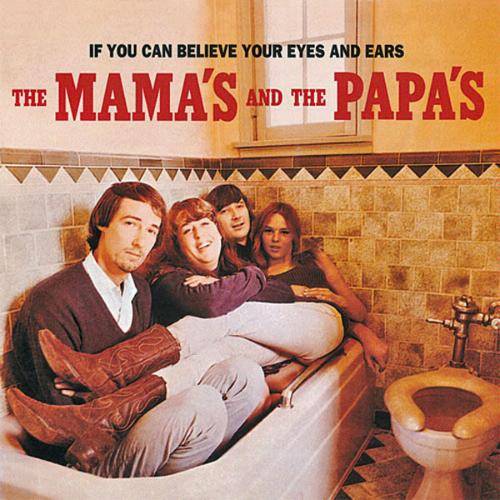
Great Debates Live — NYC — Behind the Scenes
Posted: May 28, 2016 Filed under: actors, New York Leave a comment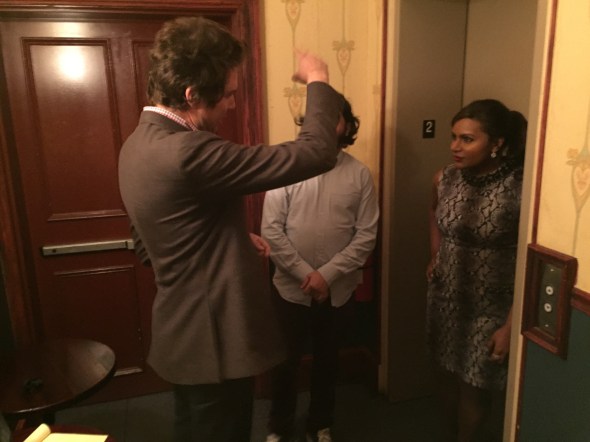
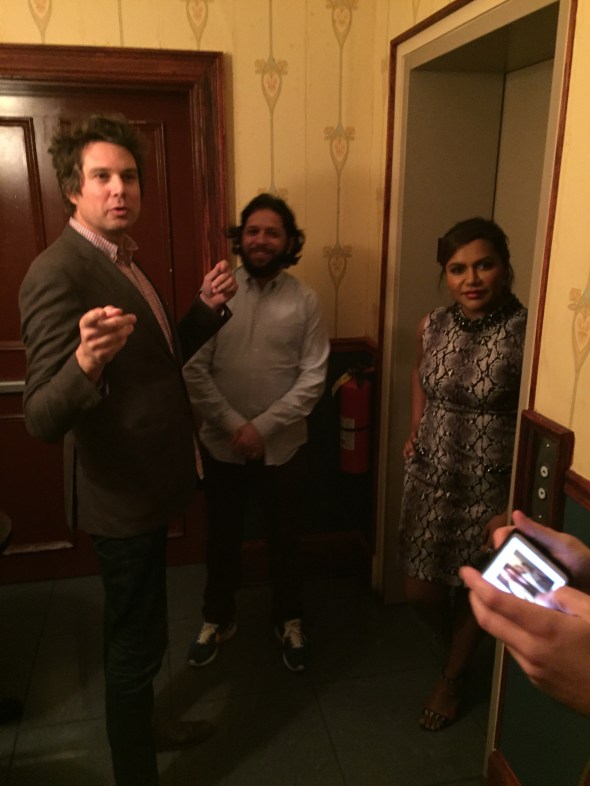
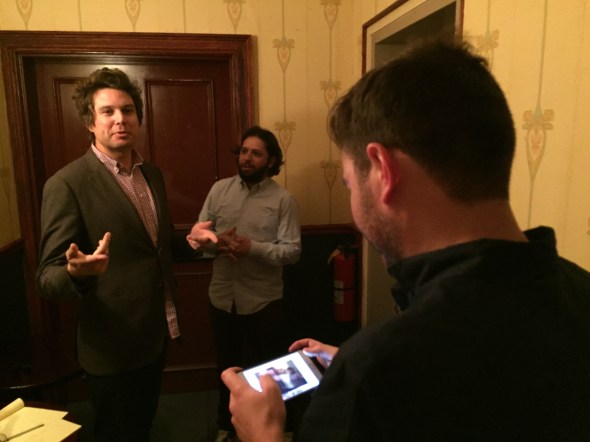
Thanks to The Slipper Room for helping us out. You can listen to the episode here or catch it on iTunes, Stitcher, wherever you get your podcasts.
Architecture of Downtown Los Angeles
Posted: May 27, 2016 Filed under: architecture, the California Condition Leave a commentAnnual tradition: a day of architectural touring with Craig D.

The restaurant Otium, with the Broad Museum to the right and some building to the left.
Craigs’s house is beautiful.
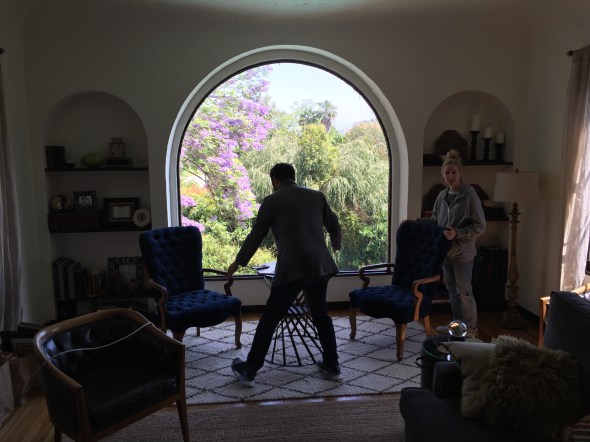
Craig helping wife Abby
First stop: LA’s Cathedral.

The cathedral was designed by the Pritzker Prize-winning Spanish architect Rafael Moneo. Using elements of postmodern architecture, the church and the Cathedral Center feature a series of acute and obtuse angles while avoiding right angles.

Rafael Moneo
Cardinal Roger Mahony’s decision to rebuild the Los Angeles Cathedral in such elaborate and postmodern architecture has drawn great criticism. Many argued that a church of that size and expense was unnecessary, overly-elaborate and money could have been better spent on social programs. Many felt that either St. Vincent Church on West Adams Boulevard or St. Basil Church on South Kingsley Drive could easily perform the functions required of a cathedral with minimal additional cost. Our Lady of the Angels Cathedral was also criticized for its departure from historical California Mission-style architecture and aesthetics.
Had been reading this book:
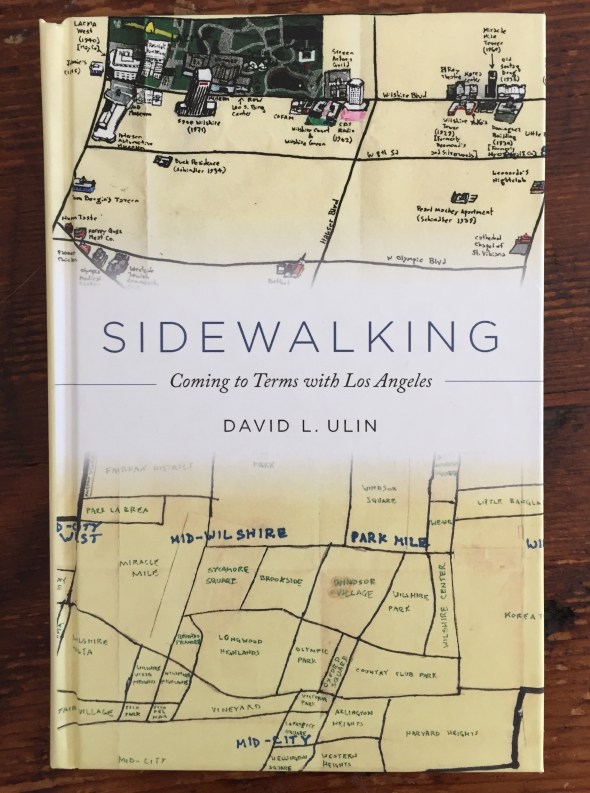
which talks a lot about why LA feels so odd to the pedestrian, and the ways LA’s public buildings have of shutting off the street:
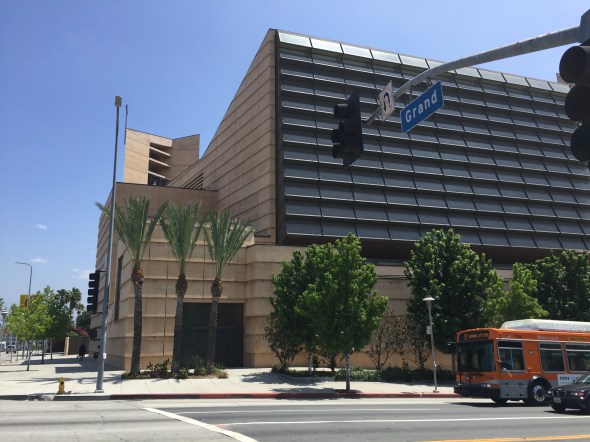
I’ll say:

LA’s cathedral, finished in 2002, seemed a bit ’90s to me:
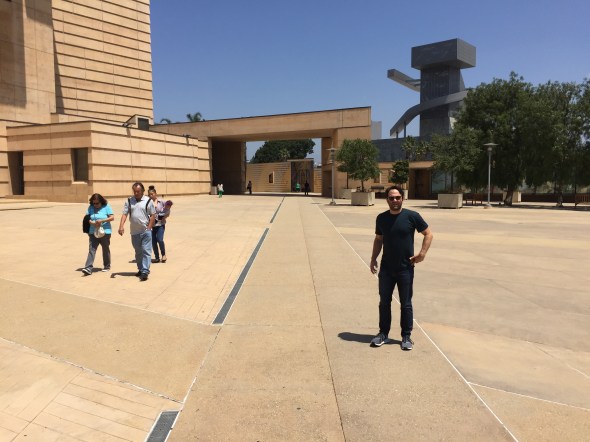
That’s the Grand Arts School / Ramon C. Cortines School of Visual and Performing Arts behind Craig.
 Disaster waiting to happen at the mausoleum?
Quick tour through Grand Central Market:
 A walk past the retired Angels’ Flight:
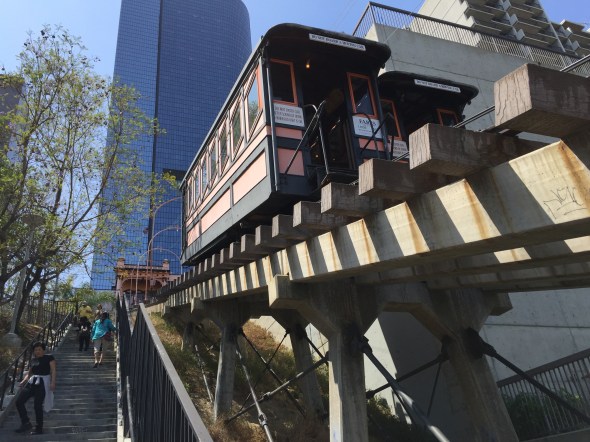
On February 1, 2001, Angels Flight had a serious accident that killed a passenger, Leon Praport (age 83), and injured seven others, including Praport’s wife, Lola. The accident occurred when car Sinai, approaching the upper station, reversed direction and accelerated downhill in an uncontrolled fashion to strike car Olivet near the lower terminus.
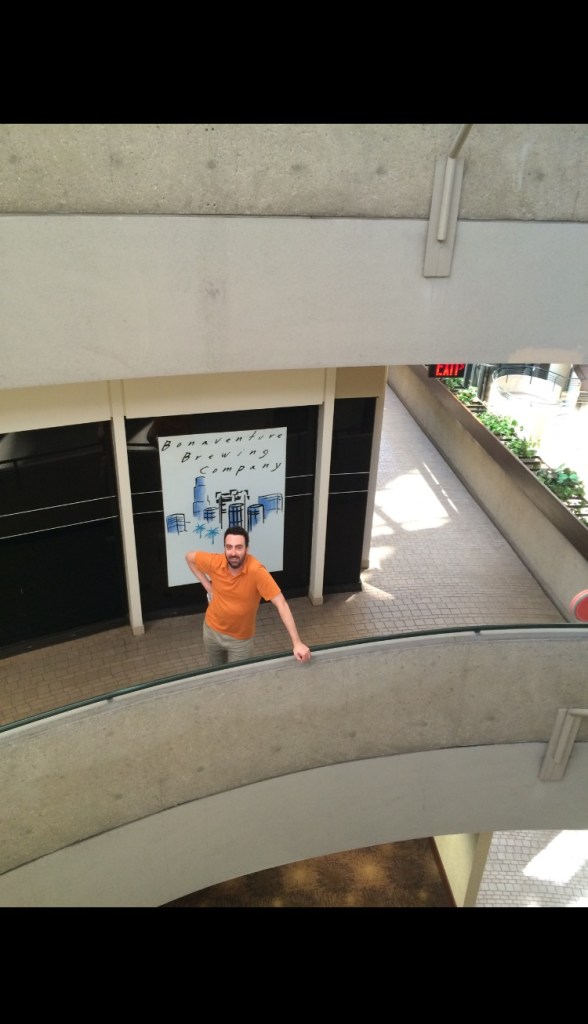
On to the truly bizarre angles of the Bonaventure Hotel designed by John C. Portman, Jr.
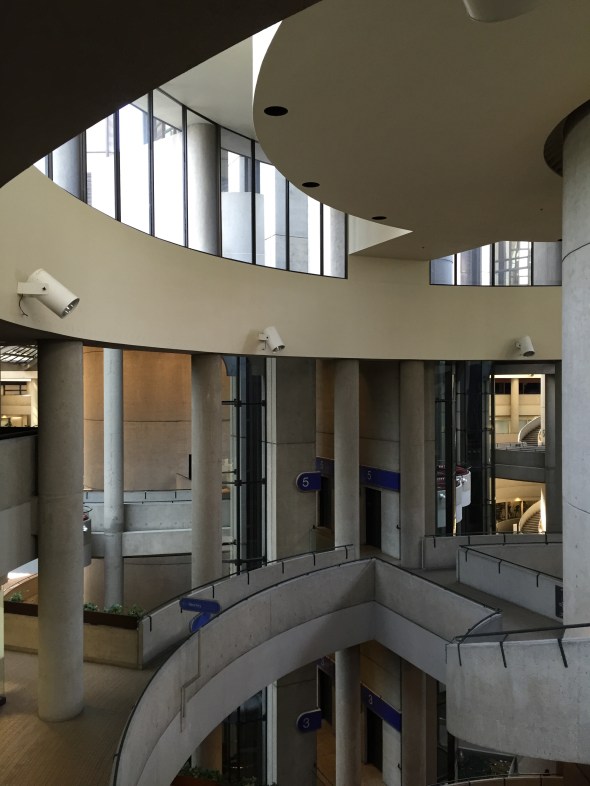 I mean what is going on here?:
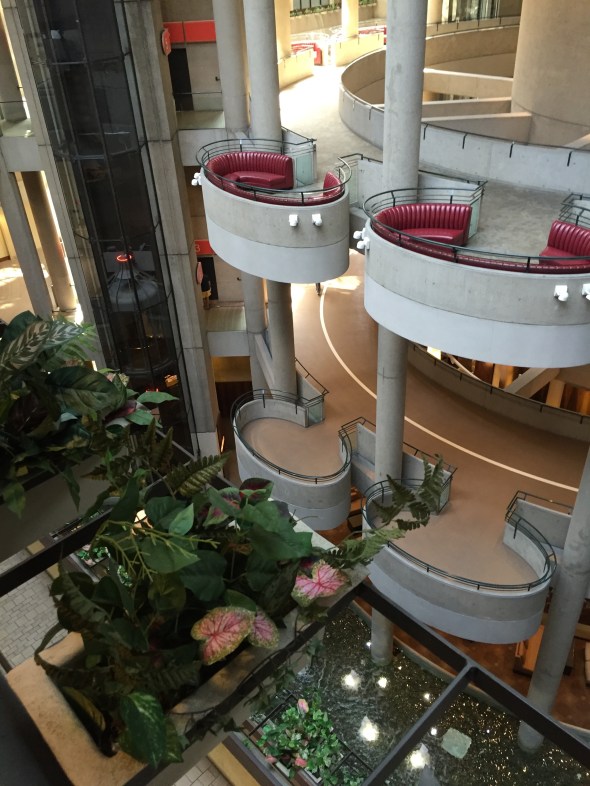
In his book Postmodern Geographies: The Reassertion of Space in Critical Social Theory (1989), Edward Soja describes the hotel as
a concentrated representation of the restructured spatiality of the late capitalist city: fragmented and fragmenting, homogeneous and homogenizing, divertingly packaged yet curiously incomprehensible, seemingly open in presenting itself to view but constantly pressing to enclose, to compartmentalize, to circumscribe, to incarcerate. Everything imaginable appears to be available in this micro-urb but real places are difficult to find, its spaces confuse an effective cognitive mapping, its pastiche of superficial reflections bewilder co-ordination and encourage submission instead. Entry by land is forbidding to those who carelessly walk but entrance is nevertheless encouraged at many different levels. Once inside, however, it becomes daunting to get out again without bureaucratic assistance. In so many ways, its architecture recapitulates and reflects the sprawling manufactured spaces of Los Angeles
You said it, pal.
Wonder Trail reviewers’ guide
Posted: May 26, 2016 Filed under: books, Wonder Trail Leave a comment
The main character of my last book had some rough things to say about book reviewers. That was part of the joke. Me? I’ve always rooted for book reviewers. They have a tough job. Newspapers shrinking, etc. I am on the book reviewers side. This site is largely amateur book reviewing. It’s easy (and cheap) to write a bad review. Hard to write a good one.
Let me make things as easy as possible for anyone reviewing of my book.
If you’ve been assigned the job, or if you want to pitch it and take it on freelance (her0), let me help you with this handy reviewers’ kit to The Wonder Trail:

If you’re brave enough to volunteer? At your local publication? God bless. (Happy to answer your interview questions, write me.)
Print that helpful guide out. Download it. All those phrases are free to use.
Start each paragraph on one and you’ll be done in no time!
* this one from actual human reader Margot B. who I don’t know but who very kindly wrote in after winning a copy in the Great Debates Newsletter contest.
Thanks, and good luck!
No Jumper
Posted: May 24, 2016 Filed under: broadcasting Leave a comment
Great Debates visited brother podcast No Jumper. Adam: excellent interviewer, such a professional, warm host. Do I love this photo? I might:

Couple points I did want to make:
- if you’re new to our format let me stress that sometimes in our debates we give voice to arguments we don’t believe. I don’t really think the Earth is a flat coin
- completely choked on now-rappers, sorry. Straight-up blanked! Would’ve annihilated if I’d mentioned Nicki Minaj, Kendrick or Kanye. “Debaters’ Remorse” as we say
- also why am I bringing up Drudge Report trash?! needless.
We’re always trying to improve. What a fun time.
Live Great Debates ep coming soon! All the behind-the-scenes action will be in Great Debates News, subscribe for once a week fun.
Nestle
Posted: May 19, 2016 Filed under: business, the California Condition, water Leave a comment
In the Swabian dialect, “Nestle” is a small bird’s nest.
So says the Wiki for Henri Nestle. I was reading about Nestle because I was trying to learn who owns the spring sources for the major bottled waters in the United States.
Here are our popular waters, by sales in billions of $$:

Dasani and Aquafina are literally just purified municipal tap water with salt added:
Dasani uses tap water from local municipal water supplies, filters it using the process of reverse osmosis, and adds trace amounts of minerals, including magnesium sulfate (Epsom salt), potassium chloride and table salt (sodium chloride).
Nestle Pure Life as I understand it comes from springs in Canada:
Nestlé’s Aberfoyle Springs plant currently bottles two different waters: the on-site Aberfoyle spring water, and spring water tankered in from Cedar Valley Spring in Erin, Ontario. In addition, spring water is botted on-site in Hope, British Columbia. In the United States, Nestlé Pure Life is a purified (filtered) water.
Next is Poland Spring, owned by Nestle. Vitaminwater I don’t care about.

and:
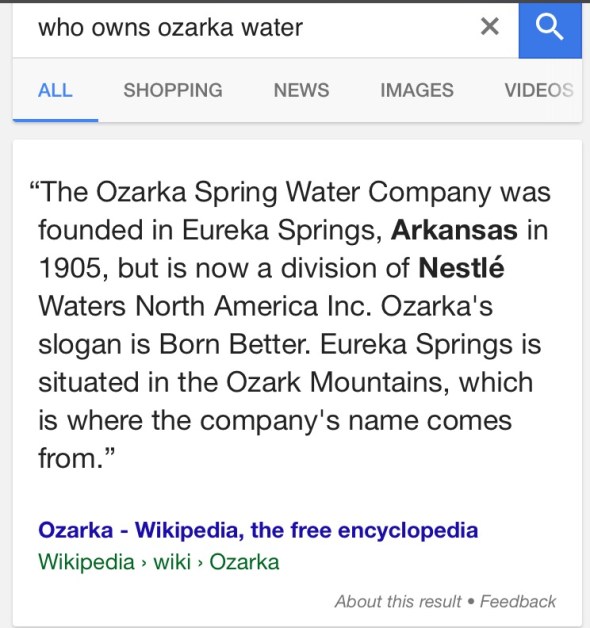
Fiji water is owned by David Brooks’ buddies:
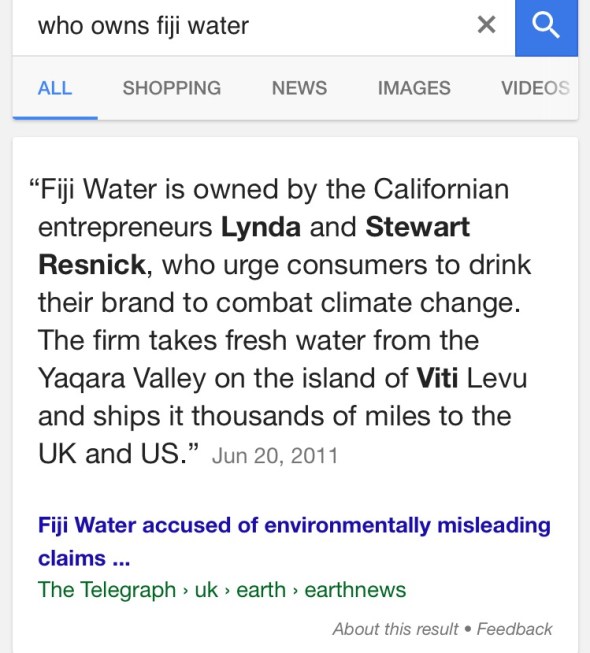
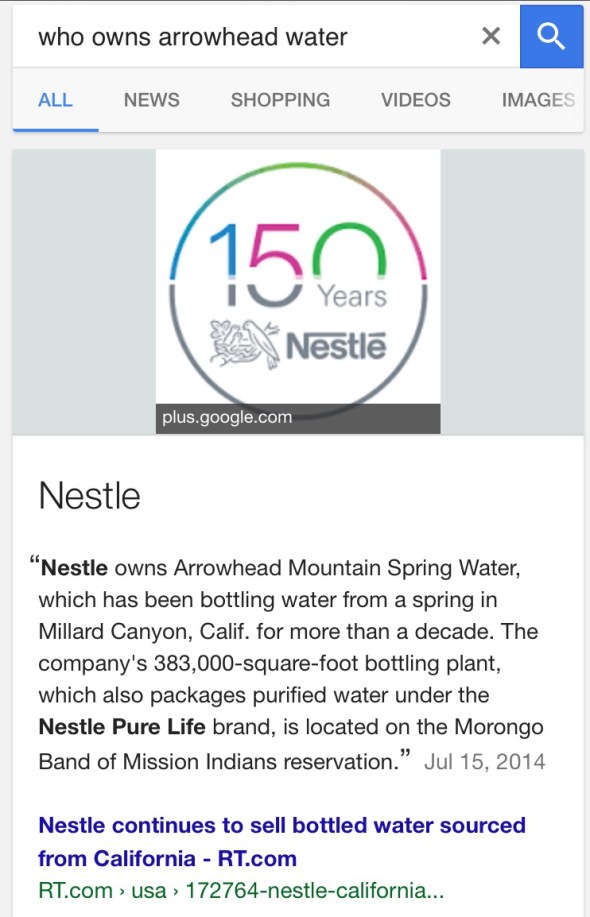
How about local SoCal water sources, like Arrowhead?:

Nestle again!
Here’s an interesting one: Crystal Geyser, the source of which is up on the 395, in bleak country near the Owens Lake, source of LA tap water:

The owner there is:

We had to check in with Anonymous Investor on that one:
I never heard of Otsuka before, but just browsed through their 2015 annual report.
Lots of interesting stuff here. Most of their business (67%) is pharmaceuticals. And the lion’s share of that came from Abilify. When Abilify went generic in 2015, their earnings dropped off a cliff, although they still managed to stay profitable.Crystal Geyser is a tiny sliver of their business. It’s part of their “consumer products” segment. An honor it shares with “Bon Curry,” a line of instant curries–
http://www.amazon.com/Bon-Curry-Gold-180g-pieces/dp/B00BXW9SAM
–and a Gatorade knockoff called “Match”.
http://www.amazon.com/Otsuka-Foods-MATCH-1-5LPETX8-pieces/dp/B010S5VRNK
All together, the consumer products division comprises only 2.8% of the company’s total sales.
So if you buy the stock, what you are getting is mostly the drug business.
Anyway. If you wish to own fresh springs, the way to do it seems to be to buy Nestle stock, as Joshua Kennon enthusiastically advises. Nestle also owns Perrier, whose slim cans I’m getting into.
You should never buy a stock though without looking at a picture of the company’s CEO. What do we think of Paul Bulcke?
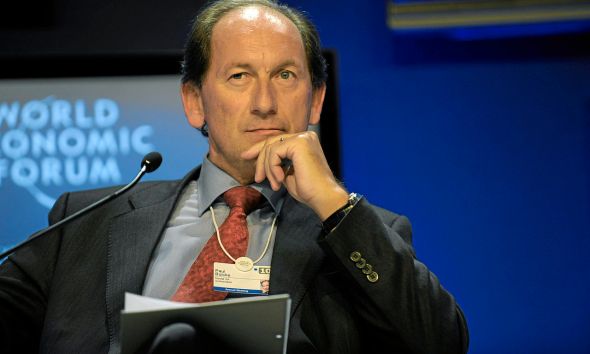
On August 30, 2012, Bulcke claimed that water is not a human right and should be privatized. He was quoted as saying “”If something isn’t given a value, people tend to waste it. Water is our most useful resource, but those using it often don’t even cover the costs of its infrastructure. Fresh water is being massively overused at nature’s expense, but it seems only a global crisis will make us realise the importance of the issue. What is environmentally unsustainable today will become socially unsustainable in the future,
(hmm, that quote is sourced on wiki to this article:
but I don’t see it).
File this under our ongoing interest in “sources.”
A month away from WONDER TRAIL release
Posted: May 17, 2016 Filed under: Wonder Trail Leave a comment
On June 14, my new book The Wonder Trail: True Stories From Los Angeles To The End Of The World, comes out.
You can pre-order the book here on Amazon or here from your favorite independent bookstore(s?!). Independent bookstores were very supportive of my last book, I owe them bigtime. Also who doesn’t love an independent bookstore?
Possible I’m beating the drum on my own book a little too hard. Book promotion can feel very weird. By the time the book comes out, you’re exhausted of it, it’s the last thing you want to talk about.
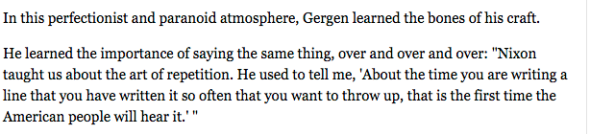
But there’s probably something this lesson about marketing told by David Gergen in this 1993 Michael Kelly profile:
Anyway, I hope the book is cool and fun and entertaining, a perfect summer read that proves surprisingly informative.
It’s not too early to mark Monday, June 20 on your calendar, I’ll be at Book Soup in Los Angeles.
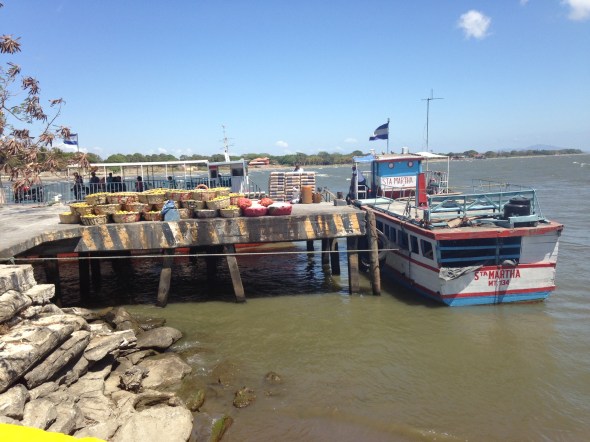
Today I sent to Helytimes Superfan subscribers some excerpts of the book, about Nicaragua. If you’d like to receive it too, just send me an email to helphely at gmail.com
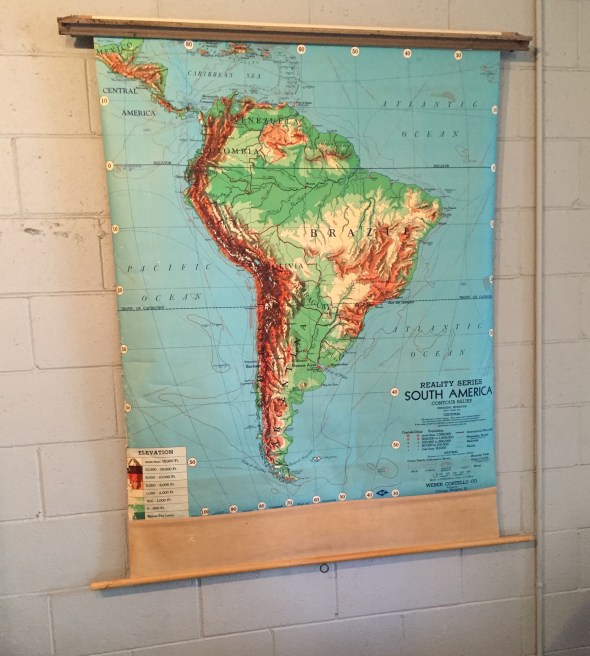
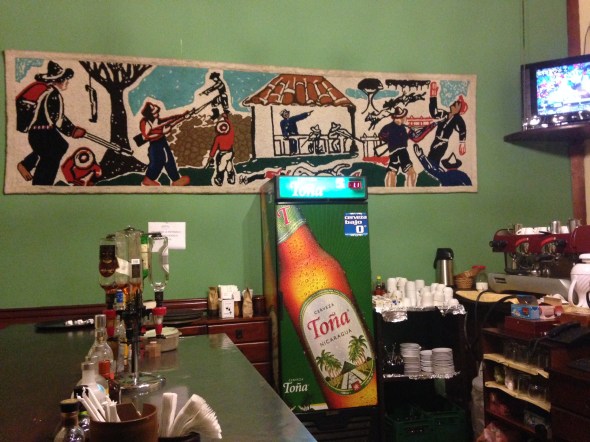
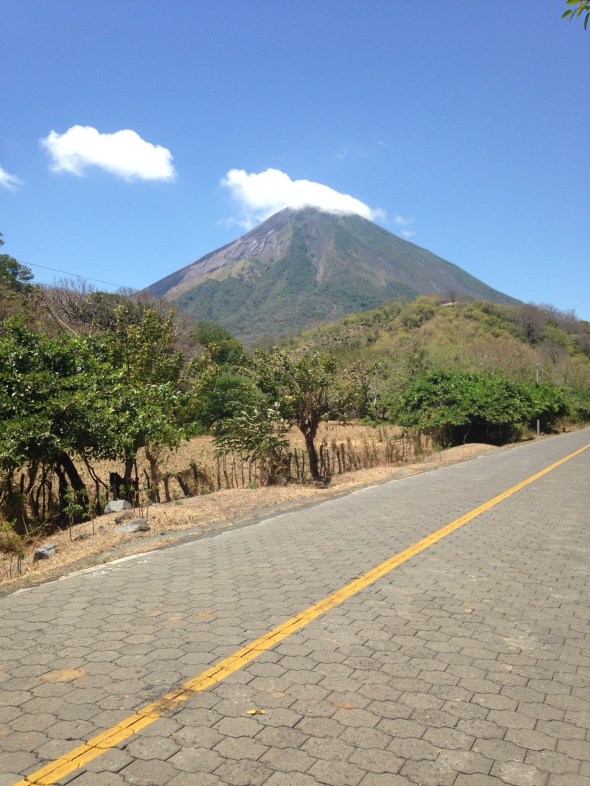
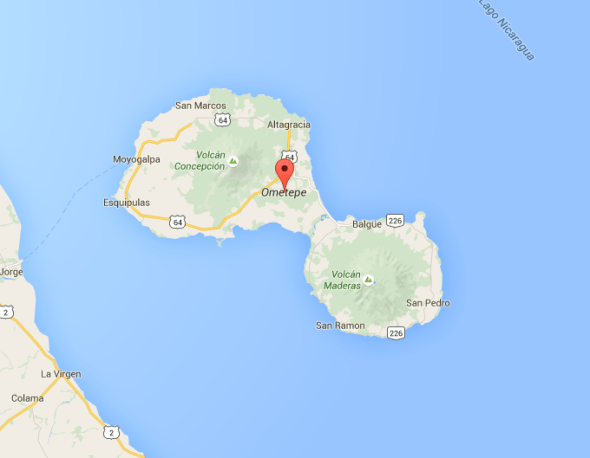
These are all pictures of Nicaragua I took on my travels, here is the Ojo de Agua on the island of Ometeppe:

And a local Coke / wheelbarrow store:
Song of the Sunday: Bobbie Gentry covering James Taylor
Posted: May 15, 2016 Filed under: music Leave a comment
Off We Go
Posted: May 15, 2016 Filed under: America Since 1945, explorers, heroes, history, people, the California Condition Leave a comment
Captain Ted W. Lawson of the Ruptured Duck
Watching Trumbo –> reading about 30 Seconds Over Tokyo
Before I knew it I was looking at the US Air Force’s photo archive specifically photos tagged “history.”

Several of the mission’s 16 B-25B bombers are lined up on the deck of the USS Hornet (CV-8). In the foreground is tail No. 40-2261, which was mission plane No. 7, piloted by 2nd Lt. Ted W. Lawson. The next plane is tail No. 40-2242, mission plane No. 8, piloted by Capt. Edward J. York. Both aircraft attacked targets in the Tokyo area. Lt. Lawson later wrote the book “Thirty Seconds over Tokyo.”
Note searchlight at left. (U.S. Navy photo)
Aviation history has never been a passion of mine but let’s just browse some of the highlights. Pearl Harbor:

A report entitled “7 December 1941: The Air Force Story” compiled by the Pacific Air Forces Office of History obtained this photo of Wheeler Air Field taken by a Japanese Empire pilot to record the battle damage to the U.S. Air Forces Dec. 7, 1941.
Homeward bound:

Newly freed prisoners of war celebrate as their C-141A aircraft lifts off from Hanoi, North Vietnam, on Feb. 12, 1973, during Operation Homecoming. The mission included 54 C-141 flights between Feb. 12 and April 4, 1973, returning 591 POWs to American soil. (U.S. Air Force photo)
Captain Mary T. Klinker:

Capt. Klinker was 27-years-old when she died April 4, 1975 when the first aircraft supporting Operation Babylife crashed. Klinker was the last nurse and the only member of the Air Force Nurse Corps to be killed in Vietnam. Capt. Mary T. Klinker was posthumously awarded the Airman’s Medal for Heroism and the Meritorious Service Medal.
Father and son:

Staff Sgt. Shaun Meadows shares a laugh with his son after completing his jump June 14, 2010. Sergeant Meadows is assigned to the 22nd Special Tactics Squadron at Joint Base Lewis-McChord, Wash. (U.S. Air Force photo/Airman Leah Young)
Fire retardant:

Approximately 3,000 gallons of fire retardant is deployed Oct. 25 over the Poomacha fire in North San Diego County, Calif. The C-130 Hercules and crew are assigned to the 302nd Airlift Wing from Peterson Air Force Base, Colo. The aircraft launched from Channel Islands Air National Guard Station, Calif. (U.S. Air Force photo/Tech. Sgt. Roy A. Santana)
Water:

On June 21, 1921, U.S. Army Air Service pilots bombed the captured German battleship Ostfriesland to demonstrate the effectiveness of aerial bombing on warships. At the time, the ship was one of the world’s largest war vessels.
An explosion 95 years ago:

An MB-2 hits its target, the obsolete battleship USS Alabama during tests. On Sep. 27, 1921, still operating with Mitchell’s provisional air brigade, the group’s MB-2 aircraft bombed and sank the ex-U.S. Navy battleship Alabama (BB-08) in Tangier Bay, Chesapeake Bay, Md.
Basic:

Basic cadets from the first Air Force Academy class line up for physical training here, the temporary location for the academy while permanent facilities were being constructed in Colorado Springs. (U.S. Air Force photo)
The Starlifter:

1970’s — MARCH 1978 — 3/4 front view of a C-141 Starlifter assigned to the 710th Military Airlift Squadron (AFRES), 60th Military Airlift Wing, in flight over the San Francisco Bay en route to Travis AFB, CA. (Photo by Ken Hackman)
How about Betty Gillies?:

Mrs. Betty Gillies was the first woman pilot to be “flight checked” and accepted by the Women’s Auxiliary Ferring Squadron. Mrs. Gillies 33 years of age, has been flying since 1928 and received her commercial license in 1930. She has logged in excess of 1400 hours flying time and is qualified to fly single and multi-engined aircraft. Mrs. Gillies is a member of the Aviation Country Club of Hicksville L.I. and is a charter member of ’99, an international club of women flyers formed by Amelia Earhardt in 1929. (U.S. Air Force photo)
Cool. Here is My Girl, 1945.

1940’s — A North American P-51 takes off from Iwo Jima, in the Bonin Islands. From this hard-won base our fighters escorted the B-29s on bombing missions to Japan, and also attacked the Empire on their own. (U.S. Air Force photo)
Goddard:

EARLY YEARS — Robert H. Goddard besides 1926 liquid- fueled rocket. The rocket is on top, receiving its fuel by two lines from the tank at the bottom. Goddard’s rockets made little impression upon government officials at the time. (U.S. Air Force photo)
That must be in New England someplace, believe it is near Auburn, MA:

Look, I’m not saying these Air Force photos are any Record Group 80: Series: General Photographic File of the Navy, 1939-1945, the Air Force wasn’t around yet. But some of them are great. I mean:
Dr. John Paul Stapp, the fastest man on Earth:

1950’s — Dr. John Paul Stapp was not only the “fastest human on earth;” he was the quickest to stop. In 1954, America’s original Rocketman attained a then-world record land speed of 632 mph, going from a standstill to a speed faster than a .45 bullet in five seconds on an especially-designed rocket sled, and then screeched to a dead stop in 1.4 seconds, sustaining more than 40g’s of thrust, all in the interest of safety.
The Hop A Long to the Rescue:

1950’s — An UH-19B Chickasaw at the Air Force Museum. Courtesy photo.
Can’t help but think of:

Connecting:

1960s — U.S. Air Force Sgt. Suzann K. Harry, of Wildwood, N.J., operates a switchboard in the underground command post at Strategic Air Command headquarters, Offutt Air Force Base, Neb., in 1967. (U.S. Air Force photo)
Found
Posted: May 14, 2016 Filed under: the California Condition Leave a commenton a bookshelf
can’t remember origin story
 Helytimes