The price of pigs
Posted: April 7, 2013 Filed under: history Leave a comment
A Cambridge tutor had once informed Judt that the true historian knows the price of pigs at the time and place he is studying, and Judt could claim to have known just that, the price of pigs at market in the Var département over several decades.
from this TLS article. This photo, from wikipedia’s article on “pigs,” is captioned “Swedish performer with piglet. Early 20th century.”
The Barbarians (Max Ernst, 1937)
Posted: April 2, 2013 Filed under: art, painting, pictures Leave a comment
A recent Artwork of the Day at the Met.
Steven Soderbergh
Posted: March 18, 2013 Filed under: film, Uncategorized 2 Comments
I look at Hurricane Katrina, and I think if four days before landfall you gave a movie studio autonomy and a 100th of the billions the government spent on that disaster, and told them, “Lock this place down and get everyone taken care of,” we wouldn’t be using that disaster as an example of whatnot to do. A big movie involves clothing, feeding, and moving thousands of people around the world on a tight schedule. Problems are solved creatively and efficiently within a budget, or your ass is out of work. So when I look at what’s going on in the government, the gridlock, I think, Wow, that’s a really inefficient way to run a railroad. The government can’t solve problems because the two parties are so wedded to their opposing ideas that they can’t move. The very idea that someone from Congress can’t take something from the other side because they’ll be punished by their own party? That’s stupid. If I were running for office, I would be poaching ideas from everywhere. That’s how art works. You steal from everything. I must remember to tweet that I’m in fact not running for office.
(I can’t agree that the entertainment biz is a model of efficiency)
On the few occasions where I’ve talked to film students, one of the things I stress, in addition to learning your craft, is how you behave as a person. For the most part, our lives are about telling stories. So I ask them, “What are the stories you want people to tell about you?” Because at a certain point, your ability to get a job could turn on the stories people tell about you. The reason [then–Universal Pictures chief] Casey Silver put me up for [1998’s] Out of Sight after I’d had five flops in a row was because he liked me personally. He also knew I was a responsible filmmaker, and if I got that job, the next time he’d see me was when we screened the movie. If I’m an asshole, then I don’t get that job. Character counts. That’s a long way of saying, “If you can be known as someone who can attract talent, that’s a big plus.”
I was watching one of those iconoclast shows on the Sundance Channel. Jamie Oliver said Paul Smith had told him something he hadn’t understood until very recently: “I’d rather be No. 2 forever than No. 1 for a while.” Just make stuff and don’t agonize over it. Stop worrying about being No. 1. I see a lot of people getting paralyzed by the response to their work, the imagined result. It’s like playing a Jedi mind trick on yourself, and Smith is right. That’s the way I’ve always approached films, the way I approach everything. Just make ’em.
RFK
Posted: March 13, 2013 Filed under: America, history, politics Leave a comment
“[Robert] Kennedy did not just play furiously. He was furious,” spoiling, off the field as well as on, for a fight – often for senseless fights. One took place in a Cambridge bar where Bobby, celebrating his birthday with a group of friends, including the football captain, Ken O’Donnell, was picking up everyone’s bar tab. Another Harvard student, John Magnuson, happened to be already celebrating his birthday there, and his friends began singing “Happy Birthday” to him. Infuriated over what he apparently regarded as an intrusion into his celebration, Bob walked up behind Magnuson and hit him over the head with a beer bottle, sending him to the hospital for stitches.
– from Robert Caro, The Years Of Lyndon Johnson: The Passage of Power
Cinderella and Interrogation Technique
Posted: March 13, 2013 Filed under: America Leave a comment
This is one of five mosaics depicting the story of Cinderella, which can be found inside Cinderella’s Castle at Disney World.

These mosaics were supervised by one of the world’s great mosaicists, Hanns Scharff.

Before moving the US and becoming a mosaicist, Hanns Scharff was considered the best interrogator in the German Luftwaffe.
Scharff was opposed to physically abusing prisoners to obtain information. Learning on the job, Scharff instead relied upon the Luftwaffe’s approved list of techniques, which mostly involved making the interrogator seem as if he is his prisoner’s greatest advocate while in captivity.
Scharff described various experiences with new POWs, outlining the procedure most of his fellow interrogators were instructed to use. Initially, the POW’s fear and sense of disorientation, combined with isolation while not in interrogation, were exploited to gain as much initial biographical information as possible. A prisoner was frequently warned that unless he could produce information beyond name, rank, and serial number, such as the name of his unit and airbase, the Luftwaffe would have no choice but to assume he was a spy and turn him over to theGestapo for questioning…
After a prisoner’s fear had been allayed, Scharff continued to act as a good friend, including sharing jokes, homemade food items, and occasionally alcoholic beverages. Scharff was fluent in English and knowledgeable about British customs and some American ones, which helped him to gain the trust and friendship of many of his prisoners. Some high profile prisoners were treated to outings to German airfields (one POW was even allowed to take a German aircraft for a trial run), tea with German fighter aces, swimming pool excursions, and luncheons, among other things.
Scharff was best known for taking his prisoners on strolls through the nearby woods, first having them swear an oath of honor that they would not attempt to escape during their walk. Scharff chose not to use these nature walks as a time to directly ask his prisoners obvious military-related questions, but instead relied on the POWs’ desire to speak to anyone outside of isolated captivity about informal, generalized topics.
Scharff began by asking a prisoner a question he already knew the answer to, informing the prisoner that he already knew everything about him, but his superiors had given instruction that the prisoner himself had to say it. Scharff continued asking questions that he would then provide the answers for, each time hoping to convince his captive that there was nothing he did not already know. When Scharff eventually got to the piece of information he did not have, prisoners would frequently give the answer, assuming Scharff already had it in his files anyway, often saying so as they provided the information. Scharff made a point of keeping the Luftwaffe’s lack of knowledge a strict secret so as to exploit the same tactic further in later conversations.
In 1948 Scharff lectured at the Pentagon on interrogation techniques.
The Crabfish
Posted: March 9, 2013 Filed under: the ocean Leave a comment
The Crabfish is a ribaldhumorousfolk song of the Englishoral tradition. It dates back to the seventeenth century, appearing in Bishop Percy’s Folio Manuscript as a song named “The Sea Crabb” based on an earlier tale.
Lyrics, dating to 1620 apparently, are found here:
“Fisherman, fisherman, standing by the sea,
Have you a crabfish that you can sell to me?”
By the wayside i-diddle-dee-di-doh.“Yes sir, yes sir, that indeed I do.
I’ve got a crabfish that I can sell to you.”
By the wayside etc.Well, I took him on home and I thought he’d like a swim,
So I filled up the thunderjug and I threw the bastard in.Late that night I thought I’d have a fit
When my old lady got up to take a shit.“Husband, husband,” she cried out to me,
“The devil’s in the thunderjug and he’s got hold of me!”“Children, children, bring the looking glass.
Come and see the crabfish that bit your mother’s ass.”“Children, children, did you hear the grunt?
Come and see the crabfish that bit your mother’s cunt.”That’s the end of my song and I don’t give a fuck.
There’s a lemon up my asshole and you can have a suck.
The ’70s
Posted: March 1, 2013 Filed under: America, photography Leave a comment
Do not miss these rad photos from the 1970s, from an EPA project to document “America’s Environmental Problems and Achievements,” found at the consistently terrific Big Picture.


Tule Fog
Posted: February 27, 2013 Filed under: the California Condition 24 Comments
Tule fog is a thick ground fog that settles in the San Joaquin Valley and Sacramento Valley areas of California’s Great Central Valley. Tule fog forms during the winter and early spring (California’s rainy season) after the first significant rainfall. The official time frame for tule fog to form is from November 1 to March 31. This phenomenon is named after the tule grass wetlands (tulares) of the Central Valley.
Tule fog near Bakersfield, from wiki, which reports:
Motor vehicle accidents caused by the tule fog are the leading cause of weather-related casualties in California.
The word, by the way, is pronounced “tooly,” not “tool” as I long believed.
First observed by this author while he searched for the site of the Mussel Slough gunfight.
photo source: Wikipedia? Gone now.
Hanagami Danjo fights a giant salamander
Posted: February 25, 2013 Filed under: painting, pictures 1 Comment
Musashi
Posted: February 22, 2013 Filed under: heroes, painting, religion 4 Comments
Musashi having his fortune told
All Helytimes readers are familiar with Miyamoto Musashi’s work on strategy in Book Of Five Rings, but some may need to brush up on the Dokkodo, “The Path of Aloneness.”
-
Accept everything just the way it is.
-
Do not seek pleasure for its own sake.
-
Do not, under any circumstances, depend on a partial feeling.
-
Think lightly of yourself and deeply of the world.
-
Be detached from desire your whole life long.
-
Do not regret what you have done.
-
Never be jealous.
-
Never let yourself be saddened by a separation.
-
Resentment and complaint are appropriate neither for oneself nor others.
-
Do not let yourself be guided by the feeling of lust or love.
-
In all things have no preferences.
-
Be indifferent to where you live.
-
Do not pursue the taste of good food.
-
Do not hold on to possessions you no longer need.
-
Do not act following customary beliefs.
-
Do not collect weapons or practice with weapons beyond what is useful.
-
Do not fear death.
-
Do not seek to possess either goods or fiefs for your old age.
-
Respect Buddha and the gods without counting on their help.
-
You may abandon your own body but you must preserve your honour.
-
Never stray from the way.

self-portrait
Cats Suggested as the fifty-three stations of the Tokaido, by Utagawa Kuniyoshi (1797-1862)
Posted: February 20, 2013 Filed under: painting Leave a comment

Obama
Posted: February 18, 2013 Filed under: America, Boston, Chicago, heroes, New England, politics, the California Condition, writing Leave a comment
James Fallows calls my attention to this article, from Chicago Magazine in 2007, about then-Senatorial candidate Obama’s Democratic convention speech.
The best bits, for the busy executive:
Obama composed the first draft in longhand on a yellow legal pad, mostly in Springfield, where the state senate was in overtime over a budget impasse. Wary of missing important votes, Obama stayed close to the Capitol, which wasn’t exactly conducive to writing. “There were times that he would go into the men’s room at the Capitol because he wanted some quiet,” says Axelrod. Once, state senator Jeff Schoenberg walked into the men’s lounge and found Obama sitting on a stool along the marble countertop near the sinks, reworking the speech. “It was a classic Lifemagazine moment,” says Schoenberg, who snapped a picture of Obama with his cell-phone camera.
(Photo not included, regrettably.) Kerry’s folks made Obama take out a line:
After the rehearsal ended, Obama was furious. “That fucker is trying to steal a line from my speech,” he griped to Axelrod in the car on the way back to their hotel, according to another campaign aide who was there but asked to remain anonymous. Axelrod says he does not recollect exactly what Obama said to him. “He was unhappy about it, yeah,” he says, but adds that Obama soon cooled down. “Ultimately, his feeling was: They had given him this great opportunity; who was he to quibble over one line?”
And:
On Tuesday, the day of his speech, Obama was up before 6 a.m. He gobbled down a vegetable omelet en route to the FleetCenter for back-to-back-to-back live interviews with the network morning shows. Next, he rushed off to speak at the Illinois delegation breakfast and then to a rally sponsored by the League of Conservation Voters. Afterwards, he returned to the arena for another hour of TV interviews. There was barely time for lunch, a turkey sandwich that he ate in the SUV while being interviewed by a group of reporters.
Always, always tell me what everyone ate.

(both photos from Chicago Magazine, uncredited. Michelle’s skeptical face in that first photo!)
Dick Cheney Road Trip
Posted: February 15, 2013 Filed under: America Leave a comment
[David Petraeus’] real mistake, I think, was going directly from four-star command to the directorship of the CIA. Rather, he should have taken some time out and reoriented himself. So the real lesson, I think, is that the time of retirement from high position is a vulnerable moment.
I didn’t think much of Dick Cheney as a vice president, but I think he was a good defense secretary. I remember being told that when he left that job, he got in a car and drove across the country alone.
“A picture of Musashi engaged in fantastic combat”
Posted: February 13, 2013 Filed under: adventures, animals, heroes, painting, pictures Leave a comment
That’s wikipedia’s caption for this picture by Utagawa Kuniyoshi (1798-1861)
Hemingway
Posted: February 11, 2013 Filed under: Hemingway, writing Leave a comment
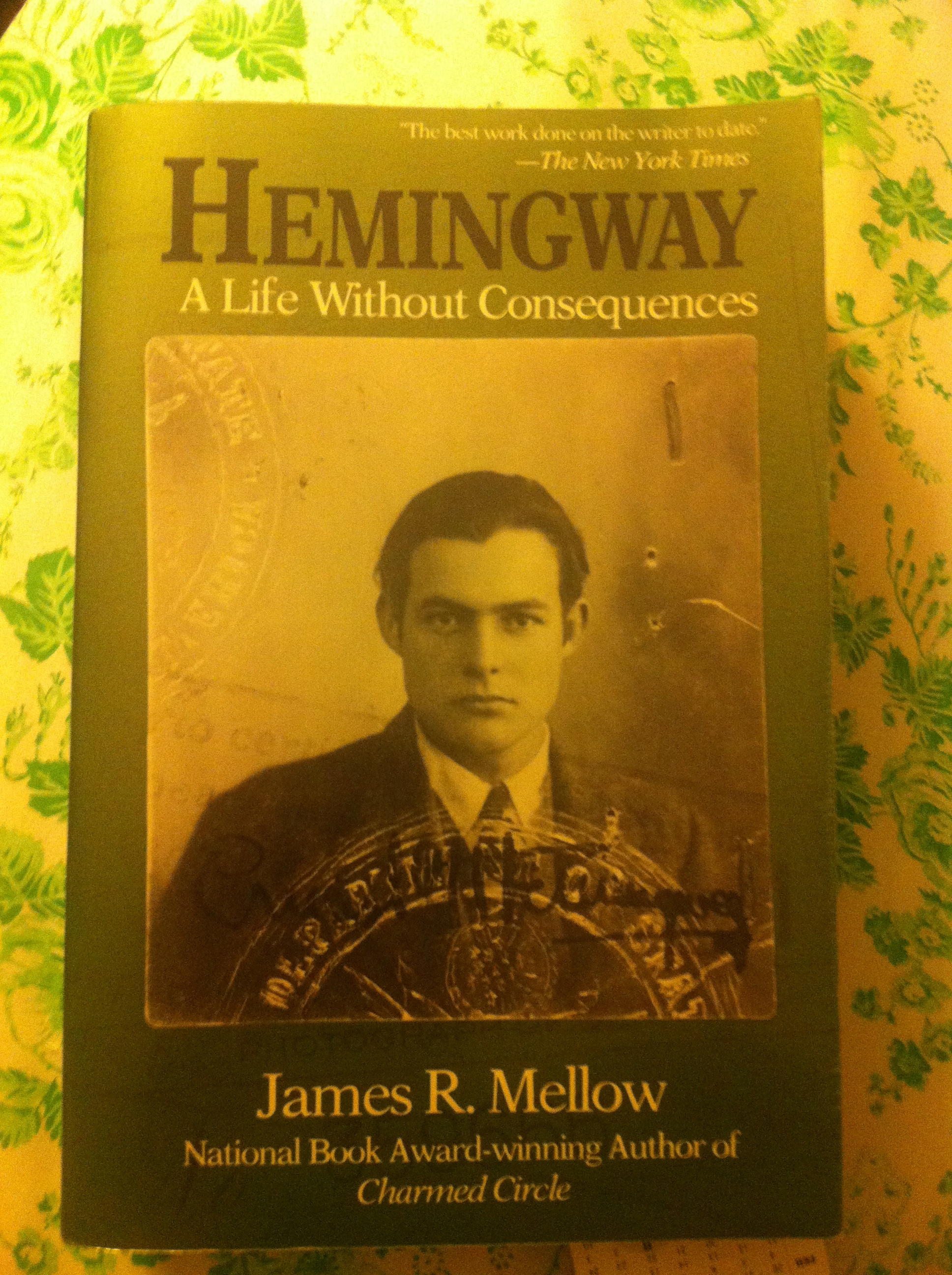
Dinner with James and Nora Joyce:

A troubled fourth marriage:

Pannonica de Koenigswarter
Posted: February 6, 2013 Filed under: music Leave a comment
was a British-born jazz patroness and writer. She was a leading patron of bebop music. She was a scion of the prominent Rothschild international financial dynasty.
Her friend Thelonious Monk reported that she was named after a species of butterfly her father had discovered, although her great-niece has found that the source of the name is a rare kind of moth.
The name “Pannonica” (nicknamed “Nica”) derives from Eastern Europe’s Pannonian plain.

The Tomb of Askia
Posted: February 4, 2013 Filed under: UNESCO Leave a commentIn Gao, Mali, there’s a UNESCO World Heritage site.

[Askia Muhammed] brought back with him [from his pilgrimage] the materials to make his tomb; all of the mud and wood came from Mecca. The caravan is said to have consisted of “thousands of camels.” It was structured as a house, with several rooms and passageways and was sealed when Askia Mohammed died.
For now watching the video of bewildered tourists at the Tomb of Askia here will be instead of visiting it.
Orange Butter
Posted: February 2, 2013 Filed under: food, New York Leave a comment
from Edward Robb Ellis’ The Epic Of New York City
A delicacy of the day was orange butter, made according to this recipe: “Take new cream two gallons, beat it up to a thicknesse, then add half a pint of orange-flower-water, and as much red wine, and so being become the thicknesse of butter it has both the colour and smell of butter.” Drunkenness was common.
Johnny
Posted: January 31, 2013 Filed under: America, music 1 Comment
In June 1965, his truck caught fire due to an overheated wheel bearing, triggering a forest fire that burnt several hundred acres in Los Padres National Forest in California. When the judge asked Cash why he did it, Cash said, “I didn’t do it, my truck did, and it’s dead, so you can’t question it.” The fire destroyed 508 acres (206 ha), burning the foliage off three mountains and killing 49 of the refuge’s 53 endangered condors. Cash was unrepentant: “I don’t care about your damn yellow buzzards.” The federal government sued him and was awarded $125,172 ($923127 in 2013 dollars). Cash eventually settled the case and paid $82,001. He said he was the only person ever sued by the government for starting a forest fire.
Cat
Posted: January 28, 2013 Filed under: cats, UNESCO Leave a comment
The other day I got mad at my cat for doing something undesirable. Then later I was like, “what am I doing being mad at a cat? She has no idea what human rules are. She is a less than one year old furry mushball. She is completely alone in the universe, with a brain incapable of processing even the simplest language. How would she possibly know what’s good or bad in a house? To her a flushing toilet is a marvel as wondrous as the Tomb Of Jahangir at Shahdara Bagh.”


