Travel Tips From Bill and Tony
Posted: January 8, 2016 Filed under: America Since 1945, politics, presidents, travel 1 Comment
Bonn
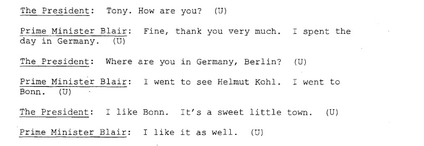
Fascinated with these recently released transcripts of convos between Tony Blair and Bill Clinton.
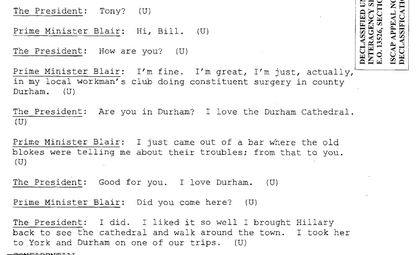

There’s not a ton of chitchat, aside from some travel discussion.
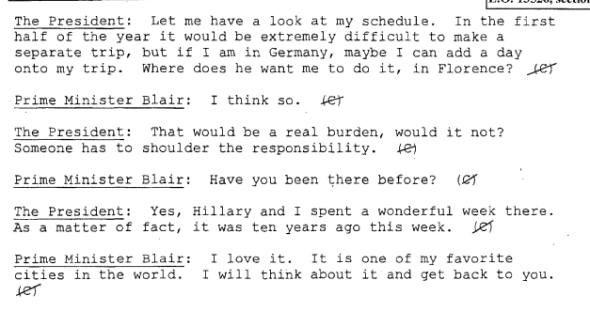
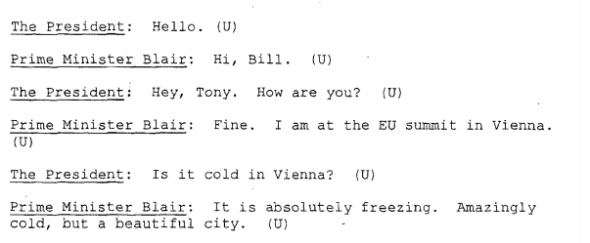
Tony also likes Vienna:

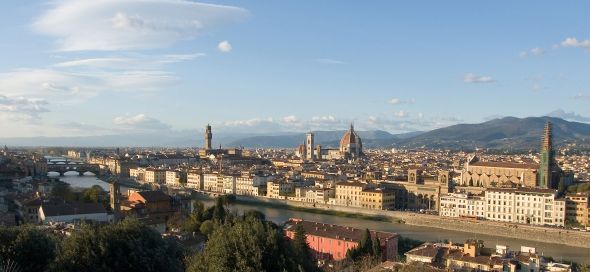
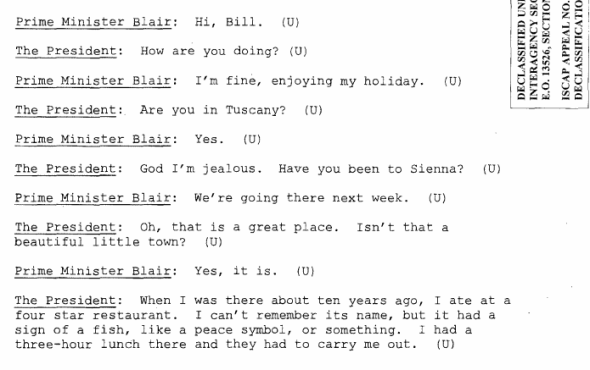
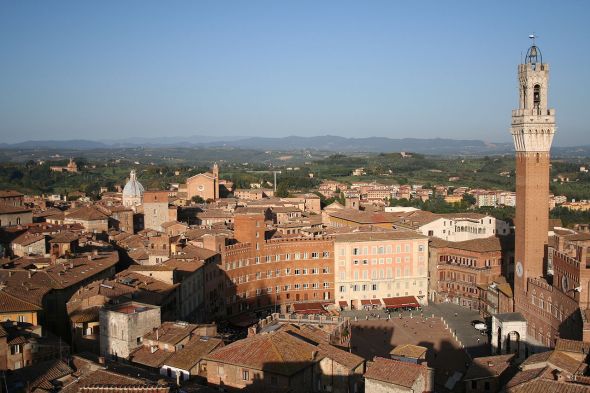
Bill likes Siena:
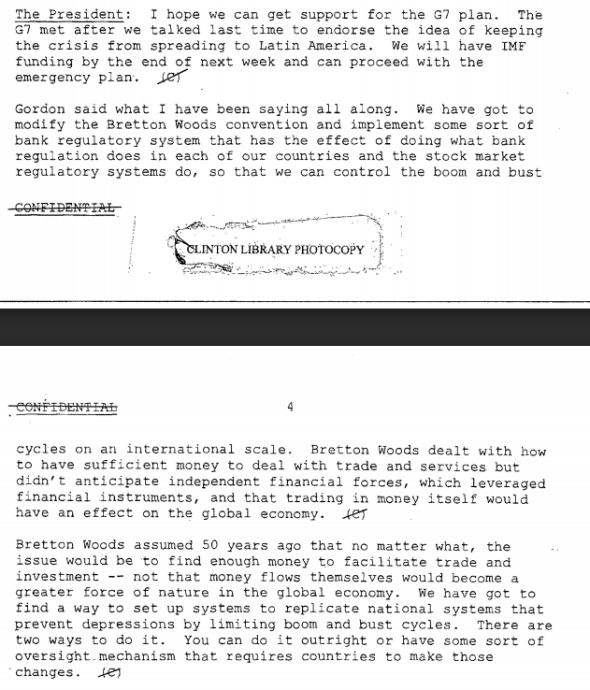
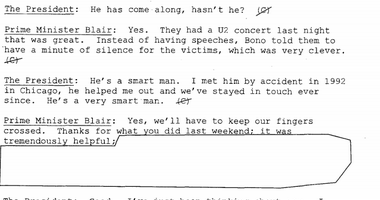
Billiam does most of the talking. One takeaway is how insanely expansive and versatile BC’s mind is as he pivots from topic to another:
He thinks highly of Bono:
The only other cultural figures I found mentioned are Spielberg and Tom Hanks:

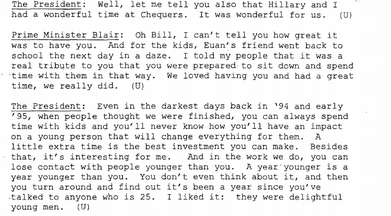
Bill reminds Tony Blair of the importance of taking time for young people:
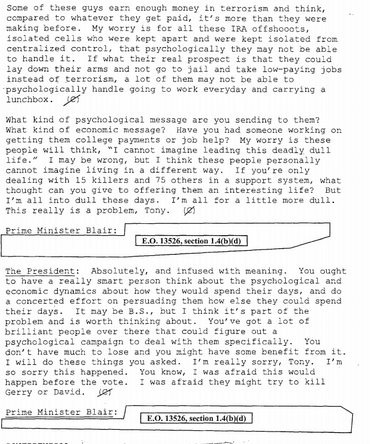
Talking about IRA splinter groups, Bill Clinton raises a problem that’s still all too relevant:
Bill sums up Central America:

But as they mention often, they’re not on a secure line. Who knows what they say there?!
San Francisco
Posted: January 7, 2016 Filed under: America Since 1945, assorted, California, San Francisco, the American West, the California Condition, the ocean Leave a comment
Right before Christmas had a chance to visit San Francisco — always great!
In San Francisco you can really feel like you’re halfway in the ocean. 
Finding myself with an idle hour I went to go check out Diego Rivera’s mural Allegory of California over at the City Club in the former Pacific Stock Exchange building. The City Club was all done up for a Christmas party.
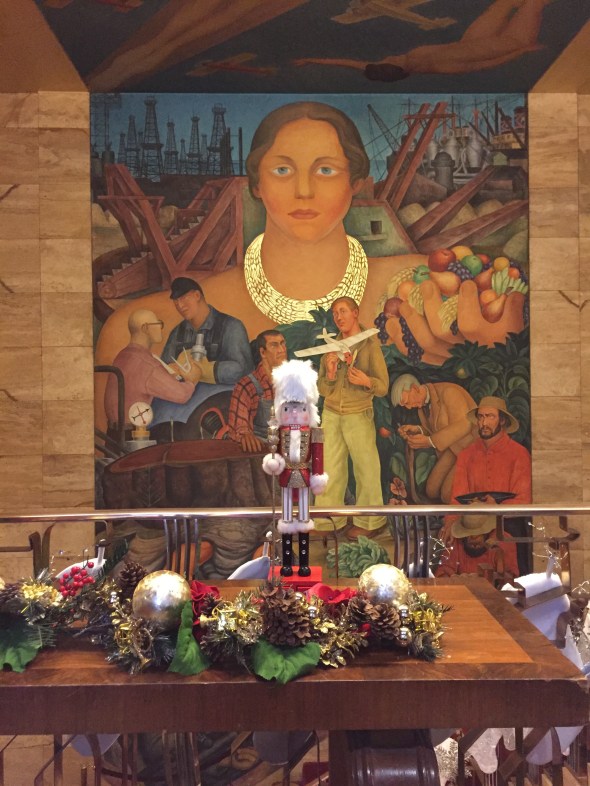
Pictures of the mural often leave out the amazing ceiling part:

Rivera painted this one in 1931, He modeled the lady on tennis champ Helen Wills Moody, who was at that time one of California’s most famous daughters:

She was a painter herself:
Wills was an artist by avocation. She received a degree in fine arts along with a Phi Beta Kappa key from the University of California, and painted throughout her life. She was delighted to be chosen as the model for Diego Rivera’s two-story mural “The Riches of California,” commissioned for $2,500 in 1930. Wills and the first of her two husbands, the financier Frederick Moody, invited Rivera and his wife, the painter Frieda Kahlo, to a celebratory tea after the mural’s unveiling at the former San Francisco Stock Exchange.
For Wills, who confessed to suffering the intangible pangs of “a restless heart,” tennis and painting were the best antidotes for melancholy. She maintained an artist’s studio at her residences in San Francisco and later in Carmel, once sold 40 paintings for $100 each and illustrated her own articles for The Saturday Evening Post.
Here’s one of her own drawings:
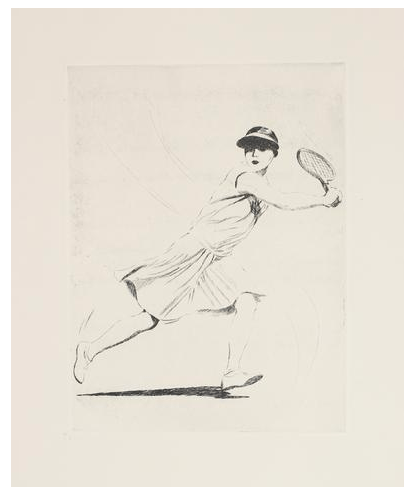 Lifting that one from San Francisco’s Lost Art Salon. Reader Schoboats calls our attention to a good detail from Wills Moody’s NY Times obit:
Perhaps Wills’s most infamous match, and certainly the one she extolled as the focal point of her playing career, was her only meeting with Lenglen, the queen of the continent, in a much ballyhooed showdown at Cannes in 1926. Lenglen was 26 and tactically superior; Wills was 20 and physically stronger. Lenglen won the raucous encounter, 6-3, 8-6.
There was a prizefight atmosphere, with tickets scalped at a then-shocking rate of $50 each, and an international gallery of spectators that included King Gustaf, a group of stowaway French schoolboys in a eucalyptus tree at one end of the court and Wills’s future husband, Frederick Moody, who introduced himself to her after the match. Wills was fond of noting that although she lost the match, she not only gained perspective on necessary changes to her game, which tended to be without nuance and relied on battering her opponents into submission with repetitious forehand ground strokes, but also gained a husband.
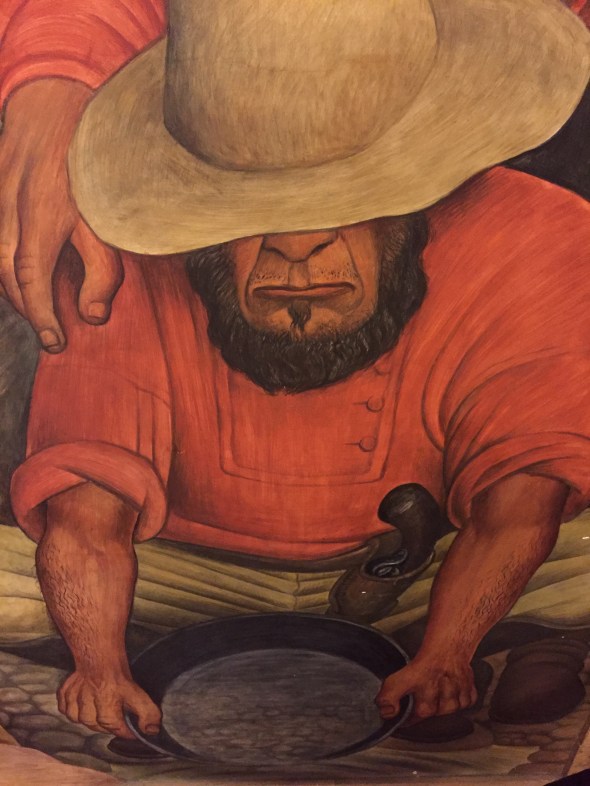
Maybe next time I’m up there I will get to see Making Of A Fresco:

Movie Roundup!
Posted: January 1, 2016 Filed under: actors, America Since 1945, film, movies Leave a comment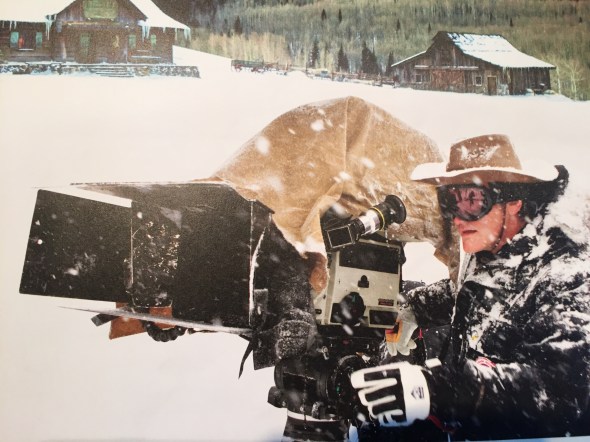
Before we begin: We need to redefine “spoiler.”
Any news about what happens in a TV show or movie shouldn’t count as a “spoiler.” Saying Walter White meets a guy named Tuco is not a “spoiler.” It is perhaps unwelcome information, but you know what, you’ll survive. A true “spoiler” is something that would truly spoil the experience of watching the thing. That is a very high standard. Even then, you’ll friggin’ survive. I watched both the movie The Crying Game and a recent famous episode of Game Of Thronesknowing the “spoilers,” and found both to still be very compelling. Maybe my enjoyment was diminished 15%, but I mean come on.
Also I believe you don’t really remember stuff you hear about shows you aren’t watching, so most “spoilers” pass by like harmless gusts of wind.
A passionate Mindy Kaling take I am on board with: it is unmanly to whine about spoilers. Take your spoilers like a man. As a society we’ve become much too weak on this.
These write ups contain no true spoilers, but they assume you’ve seen the movie, so skip as you will.
A word about criticism, too: anyone criticizing anything should begin by saying “it’s really hard and brave to make any work of art. I have never made a movie. Making a movie is a crazy accomplishment. The credit belongs to the man in the arena. It’s a lot easier to sit here and criticize.” BUT: it’s also a good way to get yourself thinking about what you care about in movies and why, so it’s worth doing. Plus it’s fun!
Now I don’t know anything about shots and cinematography and all that film stuff. I do know a little about acting, mainly that it is way harder than it looks and that to make it look effortless is amazing. I do know a little about telling stories.
What I think about with movies is usually the stories so that is where I will focus my attention.
Let’s have some fun with movies!
THE MARTIAN
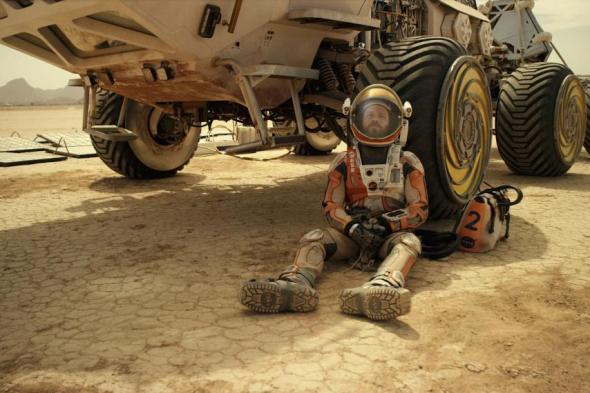
stealing this movie photo from Newsweek
What the fuck went wrong with this movie? I saw the trailer for it and was moved to near-tears, like “YES! Goddamn it, let’s go rescue The Martian! He will never stop fighting to survive!”
But then in the movie, it’s like who cares. Does the Martian have anyone on Earth who cares about him? Does he have a family? A wife? A mom? A cute kid? Go for it! Tug on my heartstrings! Is a class of schoolchildren watching him?
It felt like The Martian was like deliberately choosing not to do that, out of some kind of integrity or something. As I understand it, the book The Martian was written by an engineer and has none of that bullshit, it’s just hard-ass science. Which, I guess is cool but c’mon. You got Matt Damon there! Give me a reason to care whether he lives or dies!
Also, the Martian has that awesome speech in the trailer about fighting to survive when the shit goes down. In the movie, that speech is plopped down as literally a classroom lecture after the Martian is safe and sound and the movie is essentially over. Who gives a shit anymore?
Ridley Scott is amazing. He made Alien which is as perfect a movie as has ever been made.
He also made Kingdom Of Heaven. I remember vouching for that movie to friends, being like “hey Ridley Scott made a movie about the Crusades. It’s gotta be at least worth seeing!” I believe I was still making this argument to myself, having failed to convince my friends, when I saw that movie alone. It taught me the lesson that a truly great director with near-infinite resources is still left with a piece of shit if the story doesn’t make sense. Kingdom Of Heaven twisted itself into story knots trying to make Orlando Bloom friends with the Muslim guy. Hey man, if you’re gonna make a movie about the Crusades, either do it or don’t. And maybe don’t, because the Crusades were fucked up and I don’t want Orlando Bloom getting involved.
I thought The Counselor was very cool. I think a flaw with the Counselor, which is not really Cameron Diaz’s fault, is that Cameron Diaz is supposed to play a character who is like the pure distillation of female evil. And, that can’t happen because I like Cameron Diaz even when she’s telling me “the slaughter to come will be beyond our imagining.” Maybe that was the idea?
Anyway back to The Martian:
Science-wise: was the solution Donald Glover proposes in The Martian anything? I mean, I don’t know a ton about space travel but I thought the most basic idea is that you’re slingshotting with gravity, how had they not thought of that at NASA?
Worth reading Ridley Scott’s quotes page on IMDb. Two good ones:
I’m a yarnteller. My job is to engage you as much as I can and as often as I can. I love the process and still continue to adore the process, actually. I don’t get attached to anything. I’m like a good antique dealer. I’m prepared to sell my most valuable table.
Never let yourself be seen in public unless they pay for it.
It might be crazy but I did leave The Martian hungry for potatoes.
The writer Caleb Crain has a neat blog, and at this time of year he puts up a bunch of stray matter under the heading NOTES. I printed it out to read at Tatsu, and his take on The Martian was so interesting I ripped it out to save:
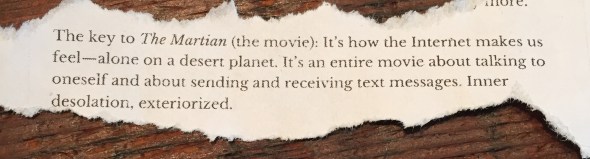
(I will also use the word “suthering” now!)
A+ acting I thought by Matt Damon.
Great Debates Topic: Matt Damon is as good at what he does as Tom Brady is at what he does.
BROOKLYN
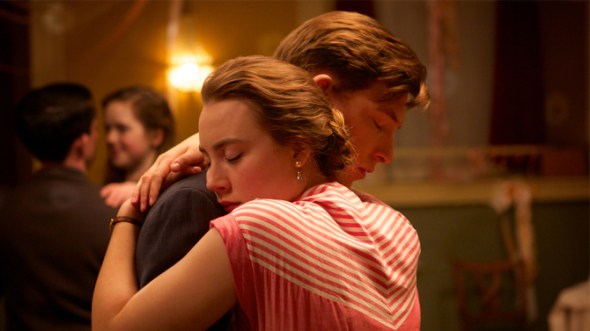
photo from Variety. If they can use it can I? I’m not even charging money
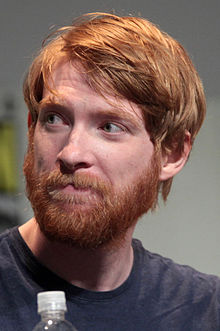
This movie was excellent, very well-made. It dig bug me a bit though why Saoirse got married — like, why include that at that point in the plot? If she’s already married, she doesn’t really have much of a choice in Ireland, does she? At least it’s a lot messier. If she’s married, she’s kind of jerking poor Domhnall Gleeson around, no?
Anyway good film. Why didn’t we get the screener on this one? A rare miss in a bonanza year of screeners.
Kudos to this movie for not shying away from the physical ugliness of the Irish people.
A+ acting by Saoirse and Domhnall.
JOY
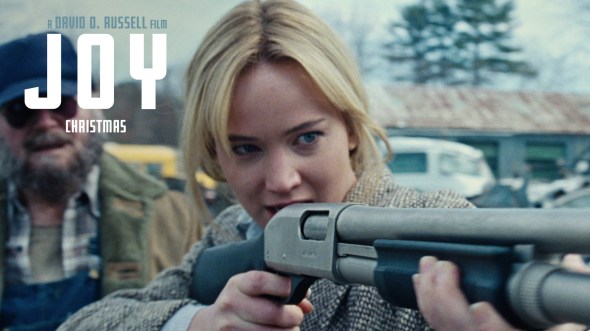
Into it! Any movie that can get your emotions up around a scene of a woman vouching for her self-invented mop is terrific. Great job.
A+ acting by Jennifer Lawrence. Does it seem like I’m grading on a curve? Well, maybe we’re just blessed with good actors. B+ to Bradley Cooper. A+ to Isabella Rosselini.
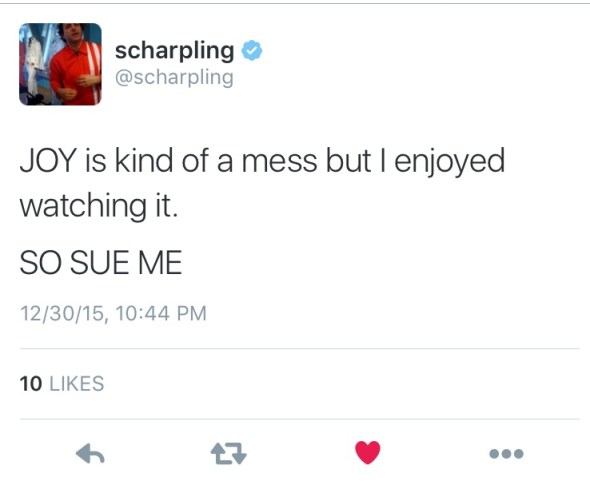
Sympathized with this take from the great Tom Scharpling:
ANOMALISA
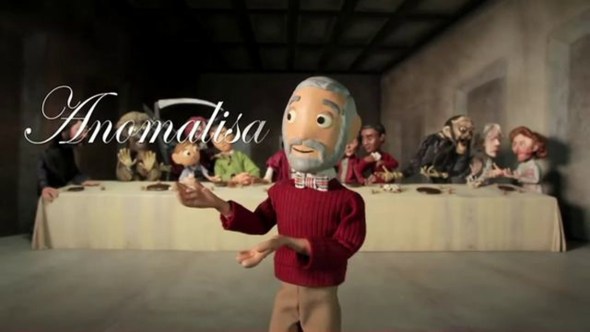
Ugh, am I really gonna have to see this? I guess so. Man, I love Charlie Kaufman but it just seems like a bit much to ask me to drag myself to the Arclight to watch some puppets mourn over how the cost of consciousness is despair or whatever.
Ugh, it’s probably great, haven’t seen it, is a thought I had a lot in 2015.
Everyone should read this BAFTA speech by Charlie Kaufman.
THE REVENANT
LOVED! A triumph! Any movie that tries to really depict the earthy details of some fucked-up primitive period in American history I am INTO! Previous title holder in this category was The New World.
Drudge was not being crazy to hype the bear rape element of this movie. That scene was definitely shot to at least suggest/hint at rape, don’t be cute Alejandro Iñárritu, you knew damn well what you were doing.
Thanks to Cherry for demanding I see this, really might’ve missed it, it seemed like too much snow for me.
Michael Punke, who wrote the book on which The Revenant is “based in part on” (why say that? felt a bit petty) sounds like my kinda guy:
When he was a teenager, he also spent at least three summers working at the Fort Laramie National Historic Site as a “living history interpreter.”
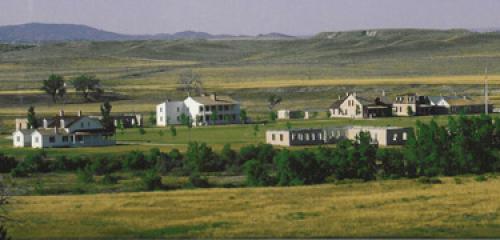
nationalparks.org
(Should we have seen Fort Laramie’s Three-Mile Hog Ranch in the movie?:
The ranch was described by U.S. Army Lieutenant John Gregory Bourke:[3]
… tenanted by as hardened and depraved set of witches as could be found on the face of the globe. It [was] a rum mill of the worst kind [with] half a dozen Cyprians, virgins whose lamps were always burning brightly in expectancy of the coming of the bridegroom, and who lured to destruction the soldiers of the garrison. In all my experience I have never seen a lower, more beastly set of people of both sexes.
Um, try the parking lot at Whole Foods Bourke!
(Bourke is fascinating, he could read Irish, Greek Latin and speak Apache. His field notes, Evan Connell tell us, fill eight feet of shelf space. More on him in the next Helytimes Premium.))
And now Michael Punke is the US Ambassador to the World Trade Organization in Geneva? What a dope dude!
Punke allegedly came up with the idea to write the novel while on an airplane, after reading a couple of lines in a history book about real-life frontier fur trapper Hugh Glass. Punke was also working at the law firm of Mayer Brown at the time when he started the book (1997), so he would go to the office as early as 5:00 AM in the morning before anyone else got there to write pages for roughly three hours, and then do his job for eight to ten hours. The book took a total of four years to complete and according to his brother Tim, Punke actually caught pneumonia at least four times during the writing process.
You KNOW I clicked the wiki for Hugh Glass spoilers!!:
Glass was thereafter referred to as “the revenant,” from the 19th century French verb revenant, meaning someone who returns from a long absence, or a person or thing reborn.[citation needed]
After recovering, Glass set out again to find Fitzgerald and Bridger, motivated either by murderous revenge or the desire to get his weapons back. He eventually traveled to Fort Henry on the Yellowstone River, but found it deserted; a note indicated that Andrew Henry and company had relocated to a new camp at the mouth of the Bighorn River. Arriving there, Glass found Bridger but apparently forgave him because of his youth, and then re-enlisted with Ashley’s company.
Man Tom Hardy is fucking crushing it this year.

from reelfilmchatter.net uncredited
A+ to him. A+ to Leo as well, although who had the harder job?
Hypothetical: If Leonardo DiCaprio’s sole goal in doing The Revenant was to try to win an Oscar (and I don’t think it was but play along) was pairing himself was Tom Hardy:
a) brave: compete/push yourself with the best to raise your game
b) sensible: not brave, just be with the best and make a good movie and maybe you’ll get lucky
c) an accident: he didn’t consider that element
d) a huge miscalculation: Tom Hardy blew him away?
e) neither, DiCaprio knows the Oscars are a fucked up contest where your work at enacting yourself as a movie star over years matters far more than what you did in the one movie
It wasn’t c.
Hardy made his big screen debut in Black Hawk Down, a great one by Ridley. Now, that movie had a simple, clear story: heroes vs. savages. What’s that? Problematic take? Oh well we moved on.
Says Hardy to The Guardian a few years ago:
So what drives Tom Hardy? “I want everyone to love me.”
And has he got what he wanted? “You get to the point where you can’t please everyone. I don’t want constructive criticism, I want adulation,” he beams. “That’s immature but it’s totally there. King Baby.”
Tom Hardy is truly King Baby.
FURIOUS 7
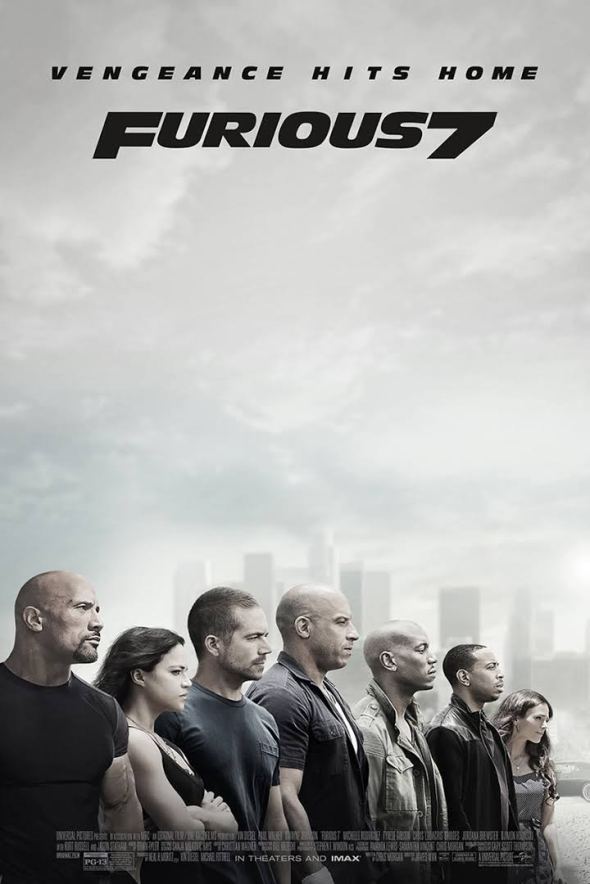
What a great movie to wrap Christmas presents to or to enjoy even if you don’t really speak English. These guys are doing what they’re doing and they’re great at it. I’m not sure what Vin Diesel does is “acting,” but he’s terrific at it. I don’t like how Tyrese was made to be a bit of a coward and a fool.
In one of the earlier movies, do they show Michelle Rodriguez/Vin Diesel wedding? Let me know, I would like to go back and watch that! Seriously if that happens in one of the movies and you know about that please email helphely@gmail.com
It’s good to see Ronda Rousey in movies because it demonstrates how hard acting is. Ronda Rousey, who is brave/confident/calm/controlled/disciplined/tight/skillful enough to fight another person in a cage, is noticeably bad at it.
JURASSIC WORLD

from business insider, credit Chuck Zlotnick, Universal Pictures, hope this ok Chuck/Universal!
Had a good time, seemed fun enough to me! Admittedly I was watching while helping build the White House out of LEGOs.

Could Chris Pratt’s character in the movie be the same guy he was in Zero Dark Thirty, further down the road? He was in the Navy in both movies.
I can see an argument that the migration from Laura Dern’s character in the old JP to Bryce Dallas Howard’s in this one illustrates a troubling backslide for feminism.
STAR WARS: THE FORCE AWAKENS
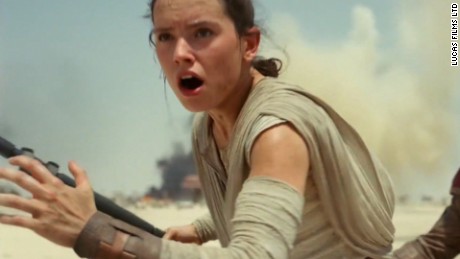
Sure whatever.
A+ job by Daisy Ridley. From her far too brief wikipedia:
Her great-uncle was actor and playwright Arnold Ridley, who played Private Godfrey in Dad’s Army.
Huh! Is that… good?
A Brief Digression
While watching Star Wars I was reminded of a delightful episode from my young adulthood.
As a young apprentice writer in Los Angeles, I heard about a book published in the UK called The Seven Basic Plots. The book was said to be over seven hundred pages long and was the life’s work of one Christopher Booker. “My God,” I thought. “This man Booker’s cracked the code! If I can get my hands on this book writing will never be hard again!” So I sent away for it. It arrived, no small book either:
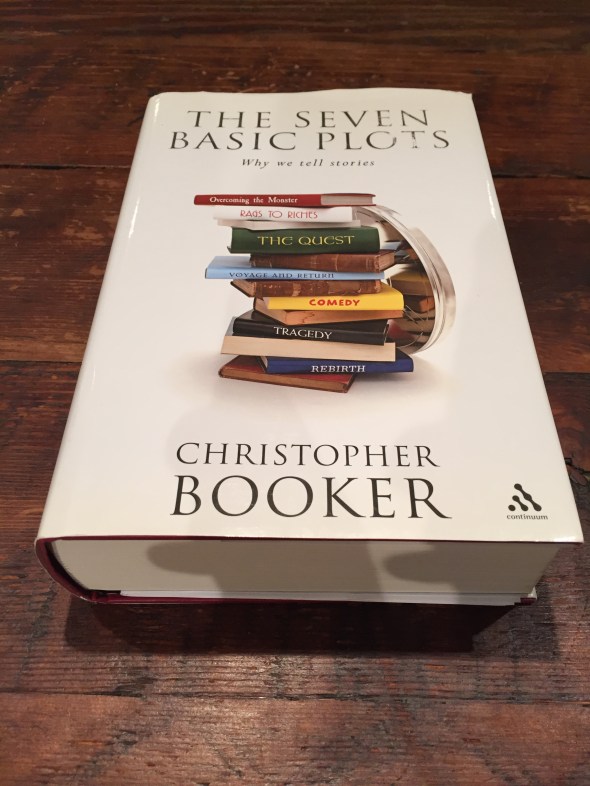
Maybe it should’ve told me all I needed to know that one of the seven plots is “comedy” but it didn’t. With pencil and highlighter in hand, I set to my studies to learn Booker’s wisdom. It started out well enough, but then I got to page 42.
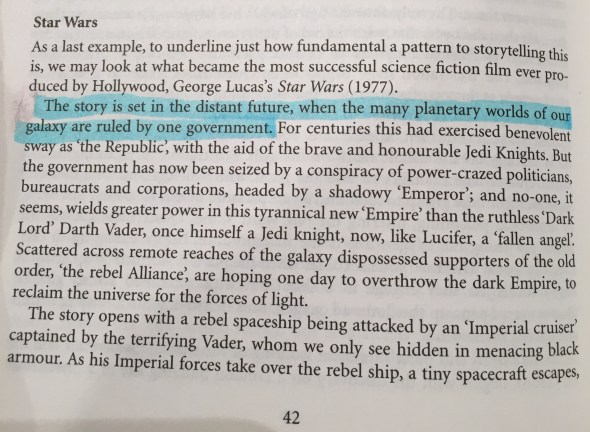
“Oh dear,” I thought. Just to be safe I double-checked the very first words of the very first shot of the film Star Wars:
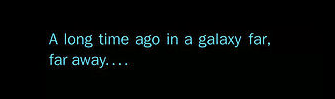
Uh-oh. Maybe this guy Booker wasn’t paying all that much attention to all these stories?
I wrote to Booker’s publisher, hoping they could fix this error, and they were actually kinda snooty about it!
Anyway. Anybody can get something wrong but it is funny to get something that wrong.
MAD MAX
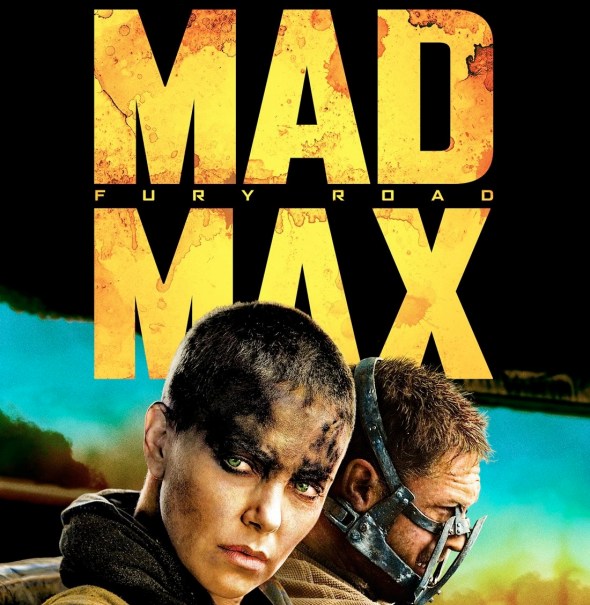
Don’t forget that Mad Max: Fury Road came out this year. What a movie. The main guy starts out the movie hanging upside down being used as a blood bag. Now that is putting your hero in trouble.
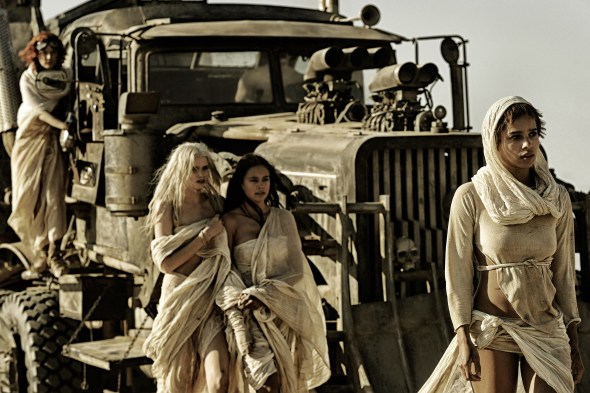
MAD MAX: FURY ROAD – 2015 FILM STILL –
Photo Credit: Jasin Boland © 2015 WV FILMS IV LLC AND RATPAC-DUNE ENTERTAINMENT LLC – U.S., CANADA, BAHAMAS & BERMUDA © 2015 VILLAGE ROADSHOW FILMS (BVI) LIMITED – ALL OTHER TERRITORIES – Stealing this photo from Coral Gables Art Cinema’s website.
CAROL
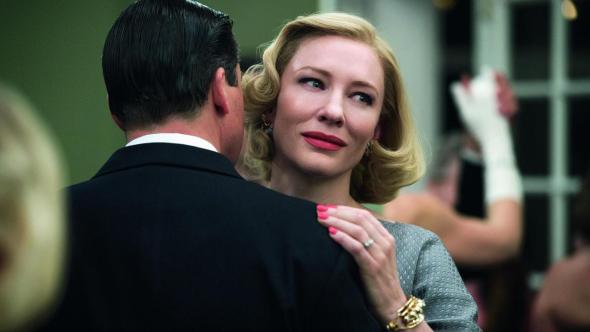
lifted from the UK Telegraph, credit “Festival de Cannes”
I thought at some point, a desire to watch this movie would arise in me. But it never did! I bet it’s great, I hope someday I watch it.
Cate Blanchett is one of the actresses whose face can be made to look most like a bunraku puppet:

from an article about a bunraku show at Princeton. Those guys know how to party.
Haynes knows puppets and human simulacra:
In 1987, while an MFA student at Bard College, Haynes made a short, Superstar: The Karen Carpenter Story, which chronicles the life of American pop singer Karen Carpenter, using Barbie dolls as actors.
THE HATEFUL EIGHT
Damn. This guy is making stuff on such a crazy level it’s lucky just to be alive at the same time as he is.
If you’re a movie critic, how are you even supposed to write about this movie? Just for starters, Quentin Tarantino definitely knows more about movies than you and if you say anything at all, you better be damn sure he wasn’t doing exactly what you’re accusing him of doing exactly on purpose.
I have listened to lots of interviews with this dude. The one on Bret Easton Ellis’ podcast is very in depth. Think what you will of BEE, he has a strong take. (thanks to BJN for the rec).
Listening to interviews with him, hearing about the insane typos in his screenplays, his play-it-backwards-just-for-fun level of total genius not just comprehension but ability to execute in his movies makes me wonder if QT isn’t something like the version of Mozart in Amadeus:
Is there anything this guy thinks of that he can’t make appear on the screen more or less as it popped out of his insane swirling noggin?
Think of the twists and turns and levels for the actors to play in this movie! The stuff for Jennifer Jason Leigh alone!
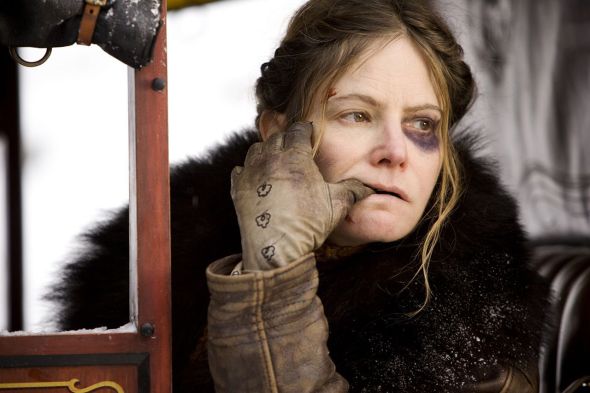
clipped from: http://www.theverge.com/2015/12/21/10632304/the-hateful-eight-movie-review-quentin-tarantino
Imagine QT walking Jennifer Jason Leigh through this character. (Ugh, spoilers warning): “Ok, so, you’re going to be a murderous racist, you’re going to scream the n-word in Samuel L. Jackson’s face, you’re gonna get hit in the face five or six times, your face will be coated in blood and vomit for much of the film, you will play a heartbreakingly beautiful song, but that will be while taunting a man you know is about to die, you will cross and double cross and be a schemer beyond measure and a siren and a charmer and sister and and in the end you will hung and will die twitching, sound good?”
Incredible job by her. All the actors were awesome. A+ to everybody.
How about that Walton Goggins? Are you kidding me? There’s a guy named Walton Goggins? (Imagine the casting department for Justified:
“Uh, who should we get to play Boyd Crawther?”
“Um, Walton Goggins?”
“Wow sounds perfect, but can he do the accent? Where is he from?”
“Alabama, then Lithia Springs, Georgia?”)
Check out Walton Goggins’ blog where he posts photos from his travels and musings:

if Walton Goggins is half as good at blogging as he is at acting ain’t nobody gonna need Helytimes.
Did anybody else think Michael Madsen looks like kind of a roughed-up future version of Andy Jones?
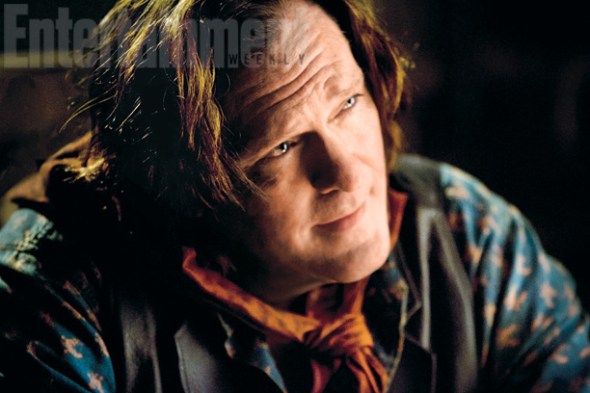
I saw The Hateful Eight twice. First at a WGA screening a couple weeks ago with Medina. We loved it.
Then I ended up seeing it again, at 8:30 in the morning the other day at the Arclight. (I woke up too early because my bod was on East Coast time so I thought hell I guess I’ll go see Hateful Eight again.)
There was much that was illuminated on a second viewing. Here’s a spoiler for you: the 8:30am 70mm showing of Hateful Eight is full of weirdos. Nor what I would call a “ton” of ladies. One guy had brought a girl, but if it was a date it was not a success.
At the intermission a very old man in a Warner Bros. jacket walked to the bathroom muttering to himself “enough dialogue for ten movies!”
You said it pal.
The men’s room at the intermission for this movie, which comes right after Mr. Jackson’s speech about his dingus, is quite an interesting scene.
Got to thinking during this movie about Martin McDonagh’s plays, like The Lieutenant of Inishmore, which ends with the stage covered in blood:
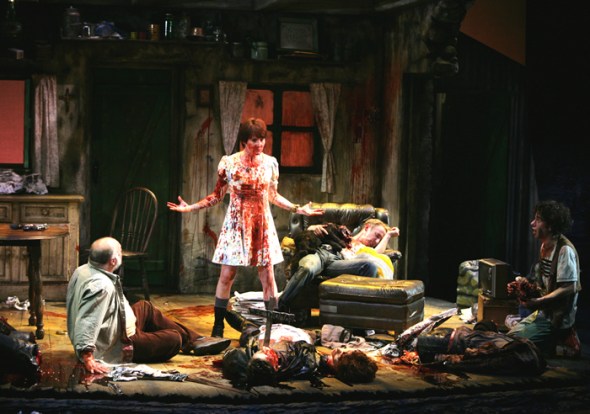
from the website of Keira Keeley, production photographer: http://www.keirakeeley.com/photo15.html, she credits The Repertory Theater of St. Louis, I hope they don’t mind.
No doubt McDonagh learned a lot from Tarantino, and had the idea to push the stage to its limit of blood. Now you can watch Tarantino himself try the same trick. Spoiler he is good at it and there is a lot of blood on the stage.
There is much to be said for this point raised by comedian Todd Levin:
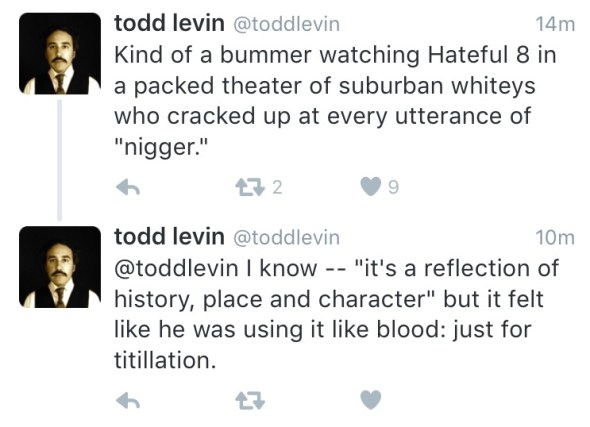
In my own theater no one was comfortable enjoying the use of that word, the laughter was half distress-call.
I feel like QT gave away the skeleton key to his whole deal on Fresh Air last year:
GROSS: So here’s something I was wondering, I know there’s so much like, you know, African-American popular culture that you really love. And I was wondering when you were growing up if you grew up in an integrated neighborhood, if you went to an integrated school, if you had African-American friends or if your contact with black people was largely through popular culture.
TARANTINO: No, no. I went to a mostly black school. You know, it wasn’t all-black because I was there, but it was mostly black.
(LAUGHTER)
TARANTINO: And the different points of my life I was raised by black people, raised in black homes – between my mom’s best friend that I lived a lot of times with her and her family and just the kind of United Nations aspect that my mom’s house was in the early ’70s, right at the explosion of black culture. So black culture is my culture growing up.
GROSS: Your mother had a United Nations kind of home?
TARANTINO: Yeah. Well, it was almost like a sitcom, actually the way we lived in the ’70s because she was in her 20s, she was hot, all right, she was a hot white girl. Her best friend was named Jackie. She was a hot black girl. And her other best friend was Lillian and she was a hot Mexican girl. And they lived in this like swinging singles apartment with me.
(LAUGHTER)
GROSS: What impact did that have on you?
TARANTINO: Yeah, well, it was just yeah, it was just, you know, it was the ’70s so it was, you know, I lived with these three hip ladies all going out on dates all the time and dating football players and basketball players and, you know, my mother…
GROSS: Professionals ones or…
TARANTINO: Yeah. Yeah. My mom dated Wilt Chamberlain. She’s one of the thousand.
GROSS: No.
(LAUGHTER)
GROSS: Did that – this is getting too personal, but did that affect your sense of sexuality when you were growing up?
TARANTINO: In what way?
GROSS: Well, because most people can’t imagine their – so many people can’t imagine their parents having sex. And when you’re growing up with like your mother and two other women who are obviously engaging, you know, it makes you think of your own…
TARANTINO: Oh yeah. No, it was…
GROSS: Yeah.
TARANTINO: You know, she was a woman. She was a, you know, she was living the life. She was having a good time and everything, you know? She was taking care of me, too, so everything was fine. It was hip. It was just cool. You know the boyfriends would come over and they’d take me out. They’d take me blacksploitation movies trying to, you know, get me to like them.
And buy me footballs and stuff. And we’d go to, like, cool, you know, my mama and her friends would take me to cool bars and stuff where they’d be playing cool live rhythm and blues music. And I’d be drinking whatchamacallit, Shirley Temples, I think. I called them James Bond because, yeah, I didn’t like the name Shirley Temple.
(LAUGHTER)
TARANTINO: I drank Shirley Temples and, you know, eat Mexican food or whatever. While, like some, you know, Jimmy Soul and a cool band would be playing in some lava lounge-y kind of a ’70s cocktail lounge. It was really cool. It made me grow up in a real big way. When I would hang around with kids I’d think they were really childish. I always used to hang around with, like, really groovy adults.
GROSS: Well, I feel like I know you just a little bit better now.
(LAUGHTER)
TARANTINO: Yeah. No, no. You know, Saturday – every time Saturday would roll around, it would become 1 o’clock, everyone in the house (technical difficulties)
(When they come back Terry asks about the New Beverly)
Man, if in my childhood cool black dudes would have sex with my mom and then take me to bars? I would remain quite fascinated with cool black dudes and their sexuality and language and behavior and values.
Two discussion questions about Hateful Eight:
Stories have values. To tell a story you and the audience must share some basic ideas about what’s a good and bad way to act, and a good and bad outcome. For instance, you couldn’t follow The Revenant if you didn’t understand that it’s not great to leave a guy for dead.
So, all stories have morality. The story can be pretty easy-to-agree with principles: surviving is better than dying, say or it is right to seek justice for others or love is good. (Greg Daniels was really good at talking about this, I learned a lot from thinking about things he said.)
What are we gonna do with the morality of a movie like Hateful Eight, where all the characters are, as stated clearly, hateful? What does it mean to get me to root for… their twisted revenge or whatever?Where the only thing in the movie there is to root for, really, is the gleeful shock of seeing chaos and calamity? Where nothing positive emerges at the end except our boyish delight in the total chaos of it all and our shrieking delight in the wicked talents of the filmmaker who made us enjoy at horrible words and deeds?
After ingesting hours of interviews with him, I feel like 1) I like QT and think he is not a bad guy and 2) whenever QT is challenged on something, he demonstrates that while he may not agree, he has certainly thought about the issue as deeply and usually much more deeply than the interviewer.
Like: you can’t charge him with a crime he hasn’t already put himself on trial and acquitted himself for. I’m sure that’s the case here, too.
But is it disappointing to see the talent this guy has and then watch him use it to tell a story that’s just about hateful people destroying each other? Can’t we ask of this guy, “give us a bit more joy than watching a mean bastard get hung?” Is it wrong to ask for some kind of positive energy to come from the movie experience?
I guess that energy comes from the staggering craft of the movie, the “fun” of its outrageousness, but… you gotta know in a movie where they’re screaming nigger at each other like they really mean it plus beating the shit out of a woman and being as cruel as possible, the energy of enjoyment is not gonna be all enriching clean fun.
Is telling an audience a completely unredeemed story like this a tiny bit wrong, wicked? dark magic? Or, is what’s troubling about it part of the point?!
Maybe you could ask the same thing about Moby-Dick and The Counselor and Blood Meridian — at least this movie has cool songs.
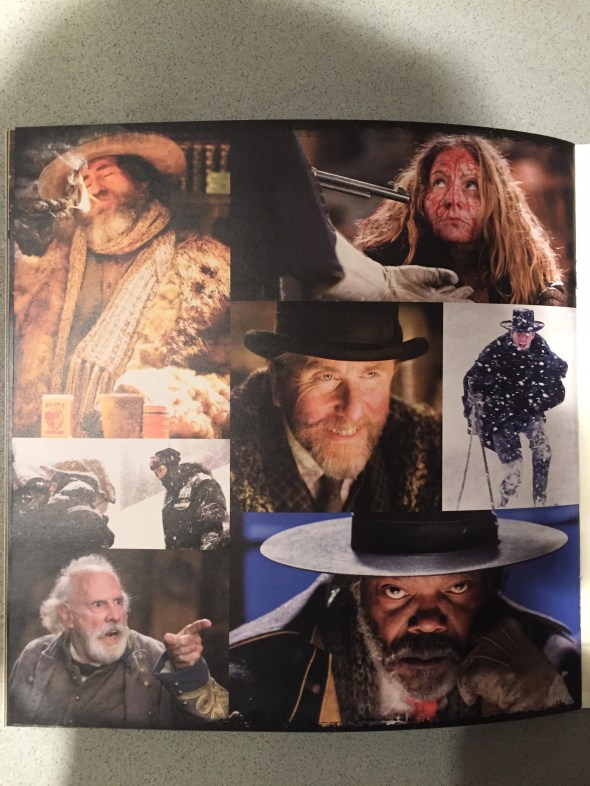
from the printed program you get when you see Hateful Eight in 70mm
Second question: is the way the music swells and the camera rises at the end when we hear the “Lincoln letter” joke meant to be a cruel joke about our civic pieties? the idea that somehow Lincoln is an inspiring figure, whose words suggests progress and enlightenment can be the shared future for the races that share this country, is kinda turned on its head and suggested as a con and a trick? Is the final idea of this movie like “a Lincoln letter — HA! what a buncha saps we all are, when all there is is death and hate and blood and ruin?”
Even knowing it’s fake we’re semi-moved by it, is that the joke? How much we (even Walton Goggins’ Hateful Sheriff) crave it?
I dunno!
OK this has been Movie Roundup! Thanks to all of you for reading. And thanks to these great movies for entertaining me! I really like movies.
See you at the Oscars!
Pie
Posted: December 25, 2015 Filed under: America Since 1945, food Leave a comment

Lemon meringue pie from daringgourmet.com
from writer and Obama pal Marilynne Robinson in the Paris Review Interviews Vol. 4:
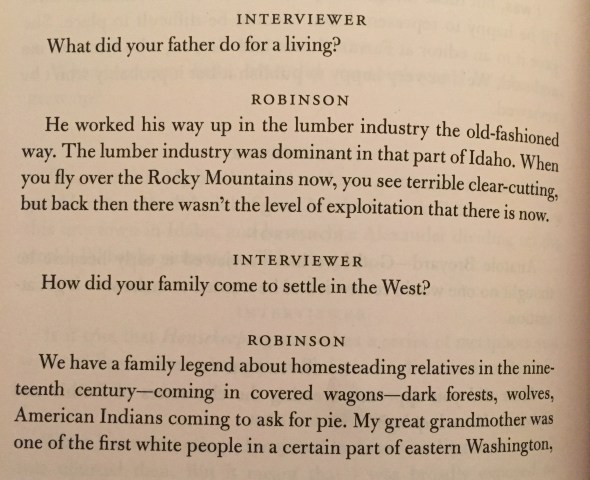
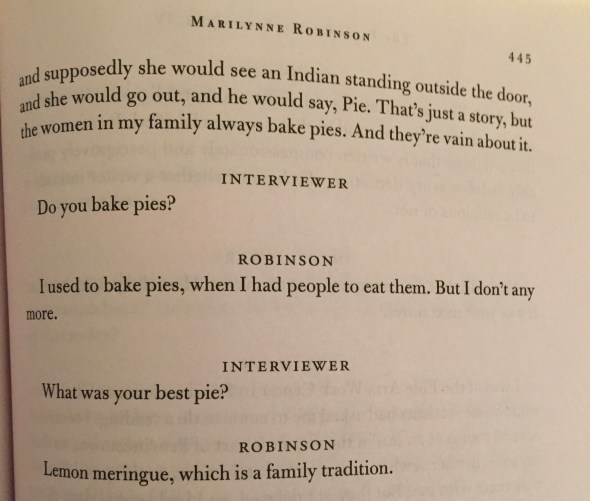
Merry Christmas, everybody! Remember to let your kids smoke a cigarette!
Special Snowflakes
Posted: December 23, 2015 Filed under: America Since 1945, music, science Leave a comment
Wandering into a hipster-type boutique in the East Village to buy a present for an Evil Santa/White Elephant type thing during a brief stop in NYC, I heard this song playing:
I really liked this album when it first came out, still do I guess. From the wiki page for the album:
In an interview with Rolling Stone Magazine, Pecknold admitted that his girlfriend of five years found the stress this album placed on their relationship too much, and ended things. Upon hearing the completed album, she realized that Pecknold’s efforts were worth it, and they tried to work it out. The couple has since split up.
Also:
Added to this, he stated they wanted to record very quickly, saying he wanted to do the “vocal takes in one go, so even if there are fuck-ups, I want them to be on there. I want there to be guitar mistakes. I want there to be not totally flawless vocals. I want to record it and have that kind of cohesive sound. Van Morrison’s Astral Weeks, to me, is the best-sounding album because it sounds like there were only six hours in the universe for that album to be recorded in. So I want it to have that feeling.
(Remember now that after reading this for the first time when the album first came out, I went back and gave a good hard listen to Astral Weeks, which I found totally boring even though I’m obsessed with the Van Morrison song “And it Stoned Me”:
Morrison, in 1985, related the song to a quasi-mystical experience he had as a child:
I suppose I was about twelve years old. We used to go to a place called Ballystockart to fish. We stopped in the village on the way up to this place and I went to this little stone house, and there was an old man there with dark weather-beaten skin, and we asked him if he had any water. He gave us some water which he said he’d got from the stream. We drank some and everything seemed to stop for me. Time stood still. For five minutes everything was really quiet and I was in this ‘other dimension’. That’s what the song is about.)
Anyway, we’re talking about snowflakes. Here are the opening lyrics of the song Helplessness Blues:
I was raised up believing I was somehow unique
Like a snowflake distinct among snowflakes, unique in each way you can see
And now after some thinking, I’d say I’d rather be
A functioning cog in some great machinery serving something beyond meBut I don’t, I don’t know what that will be
I’ll get back to you someday soon you will see
So now I am older than my mother and father
when they had their daughter
now what does that say about me

A snowflake, from the wikipedia page “snowflake,” which I am free to use and remix provided I attribute the photographer, Dakota Lynch.
On campuses so saturated with progressivism that they celebrate diversity in everything but thought, every day is a snow day: There are perishable snowflakes everywhere. The institutions have brought this on themselves. So, regarding the campuses’ current agonies, schadenfreude is not a guilty pleasure, it is obligatory.
I notice lately that some members of your generation are being called, derisively, Snowflakes. Are you really a frail, special and delicate little thing that might melt when the heat is on?

Snow and ice: how are they different?
In 1988, Nancy Knight was documenting snowflakes for the National Center for Atmospheric Research and found two identical snowflakes of the hollow column type.
Nancy’s colleagues recall her spirited approach to hunting for hail and other items of interest. “Some of my most hilarious memories of Nancy on field campaigns were driving,” says Karyn Sawyer, the former director of UCP/JOSS. “We’d be rocketing along a dirt road somewhere, and she’d insist that we stop because she had spotted an interesting bird.”

Nancy Knight w/hail
New Paintings For Barry
Posted: December 8, 2015 Filed under: America Since 1945, art history, painting Leave a comment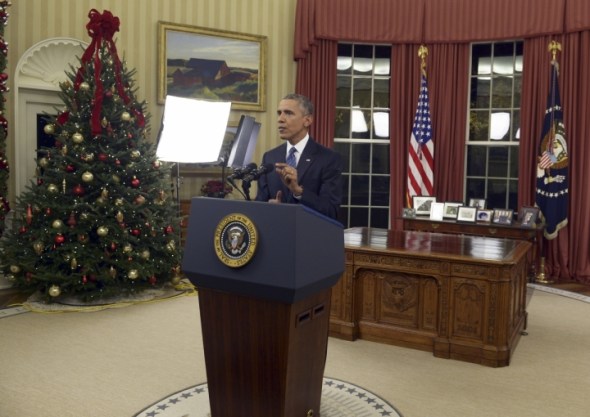
Reuters pool photo
Why did Obama talk in this weird way, and not sitting at the desk? I dunno, but it looks like he got some new paintings for the Oval Office to replace Childe Hassam. I learn they are Josephine Hopper’s, on loan from the Whitney:
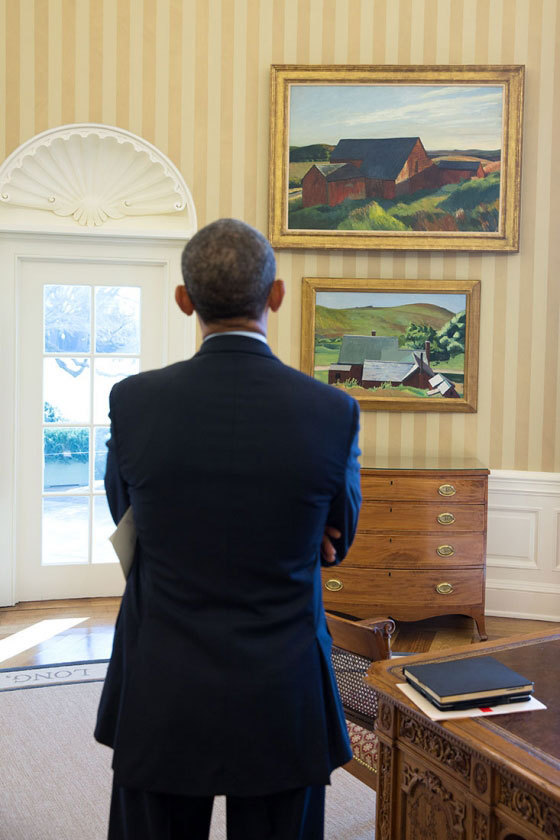
Official White House Photo by Chuck Kennedy
Says Whitney curator Dana Miller:
How did you feel when you saw the works installed on the Oval Office wall? Does their new context change the way they read?
There was something pretty wonderful about the way the light was streaming into the Oval Office the day we hung the works, in that it mimicked the lighting in Cobb’s Barn. With Hopper it is so much about the quality of light, and I think the early morning light at that moment echoed what we were seeing in the painting and I remember remarking upon that to Barbi Spieler, Head Registrar for the Permanent Collection, who was there as well. For obvious reasons we don’t often see Hopper paintings in natural light at the Museum.
When I saw the official White House photograph taken by Chuck Kennedy of The President standing in front of the two paintings, I thought it looked like a Hopper composition. Hopper’s urban scenes are often of a solitary figure caught in quiet contemplation, and that’s what the photograph captured. The light in the office and the sense of stillness are very Hopper-esque; the sun even seems to be coming into the office at the precise angle of the sun in the painting. And the back of The President recalls the back of the figure in Hopper’s most famous painting, Nighthawks. I’m guessing Chuck Kennedy knew exactly what he was doing. And of course, it was deeply gratifying to see an image of President Obama so intently focused on the paintings.
The paintings are of Cobb’s Barn in South Truro, Mass. — Cape Cod. Both Hoppers were like obsessed with Cobb’s Barn, here is Edward:

Far as I can tell Cobb’s Barn isn’t there anymore. Bit of a bummer, maybe they should put up a plaque or something.
Josephine Hopper:
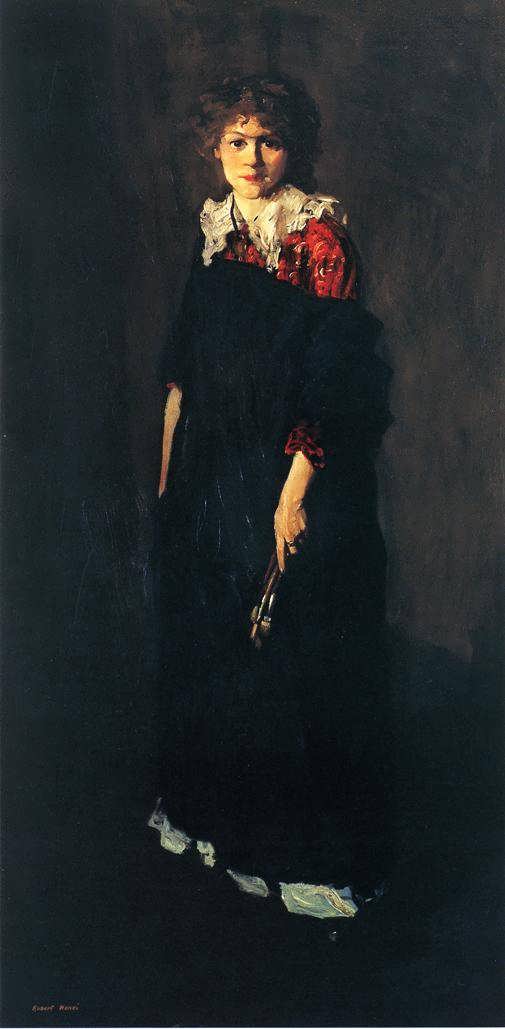
That’s her painted by Robert Henri, who loved to paint babes:
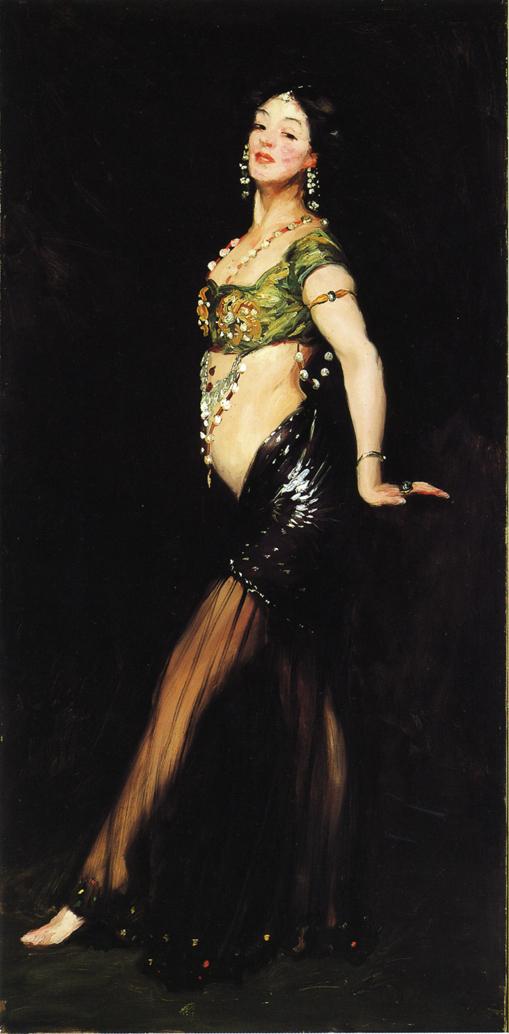
Henri was, by this point, at the heart of the group who argued for the depiction of urban life at its toughest and most exuberant. Conservative tastes were necessarily affronted. About Henri’s Salome of 1909, critic Hughes observed: “Her long legs thrust out with strutting sexual arrogance and glint through the over-brushed back veil. It has far more oomph than hundreds of virginal, genteel muses, painted by American academics. He has given it urgency with slashing brush marks and strong tonal contrasts. He’s learned from Winslow Homer, from Édouard Manet, and from the vulgarity of Frans Hals”.
More Helytimes coverage about the Hoppers.
Now, what painting is in the Oval Office may seem meaningless but I gotta tell ya: I like living a country where the President is expected to have some taste and make some choices about putting some cool art on the wall.
Presidents have different art on the wall, but it means something to them. George W. Bush made a real point of having a bust of Churchill in there. Obama allegedly returned it, right? Ted Cruz definitely tells the whole truth about that?
New president, new art. We can all find American art we like, that’s a great thing about us. You can bet in the Reagan days they made choices about the art:
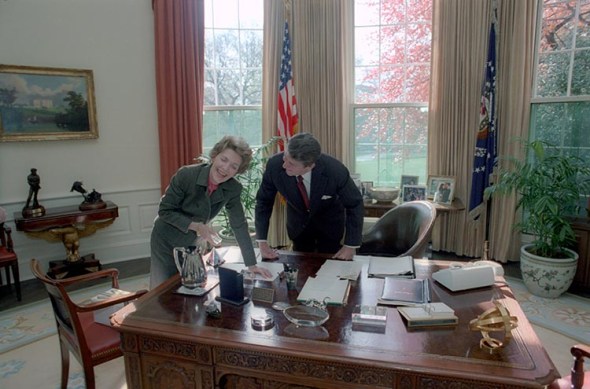
Looks like Reagan has The President’s House up there.

From the “Artwork” section of the Wiki page on Oval Office:
Most presidents have hung a portrait of George Washington – usually the Rembrandt Peale”Porthole” portrait or the Charles Willson Peale three-quarter-length portrait – over the mantel at the north end of the room. A portrait of Andrew Jackson by Thomas Sully hung in Lyndon Johnson’s office, and in Ronald Reagan’s, George H. W. Bush’s and Bill Clinton’s. A portrait of Abraham Lincoln by George Henry Story hung in George W. Bush’s office, and continues in Barack Obama’s. Three landscapes/cityscapes by minor artists – The City of Washington from Beyond the Navy Yard by George Cooke, Eastport and Passamaquoddy Bay by Victor de Grailly, and The President’s House, a copy after William Henry Bartlett – have adorned the walls in multiple administrations. The Avenue in the Rain by Childe Hassam and Statue of Liberty by Norman Rockwell flanked the Resolute Desk in Bill Clinton’s office, and do the same in Barack Obama’s.
What a slam! “minor artists”. The friggin’ President looks at your painting every day and you’re still minor. These art world guys are tough on each other, I tell ya.
Anyway.
Reader reaction is encouraging me in a White House kick. Be sure to weigh in to Helytimes if you know any facts about Oval Office art. Somebody out there knows what Bartlett had up.
The White House Pool
Posted: December 3, 2015 Filed under: America Since 1945, Kennedy-Nixon 2 Comments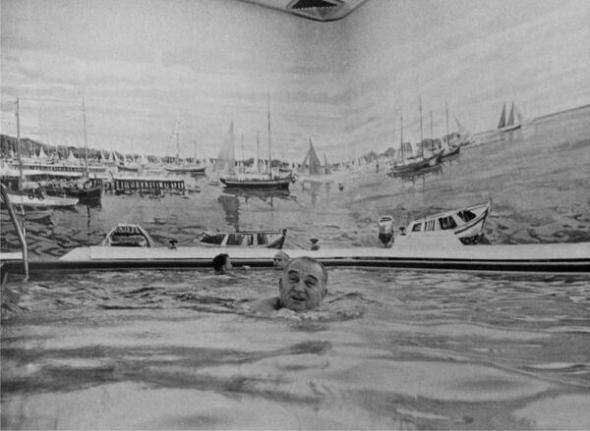
LBJ in the White House pool, from Michael Beschloss Twitter/NARA: https://twitter.com/beschlossdc/status/411277928991707136
There used to be an indoor swimming pool in the West Wing of the White House. From the White House Museum website:
As the men and women of New York opened copies of the New York Daily News on March 14, 1933, they learned of a campaign to raise money for building the president a swimming pool at the White House. The effort was a way to honor President Franklin Roosevelt, a New York native who suffered from the crippling disease, poliomyelitis. The President often swam at therapy pools at his Hyde Park home in New York or at a center in Warm Springs, Georgia.
The campaign was a success, and the workmen gathered around the pool on June 2, 1933 to listen to President Roosevelt, who spoke from his wheelchair and thanked them for their work. The pool was built inside the west gallery between the White House and the West Wing in place of the old laundry rooms, which were moved to the basement of the mansion. Arched ceilings and high rows of half-mooned windows surrounded the rectangular pool. French doors opened into the Rose Garden. The president’s pool was a modern-day showcase of technology, featuring underwater lighting, sterilizers and the latest gadgets. For several years, he used it multiple times a day. Harry Truman swam in it frequently—with his glasses on.
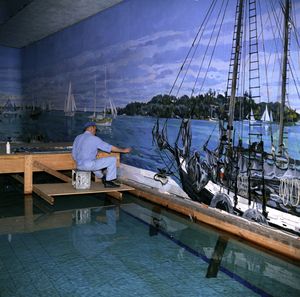
When his son was in the White House, Joe Kennedy paid French artist Bernard Lamotte to paint a mural of sailing scenes and the harbor of Christiansted, St. Croix, US Virgin Islands:
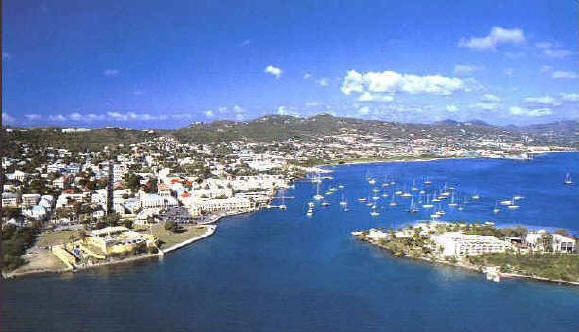
Christiansted, from Wiki
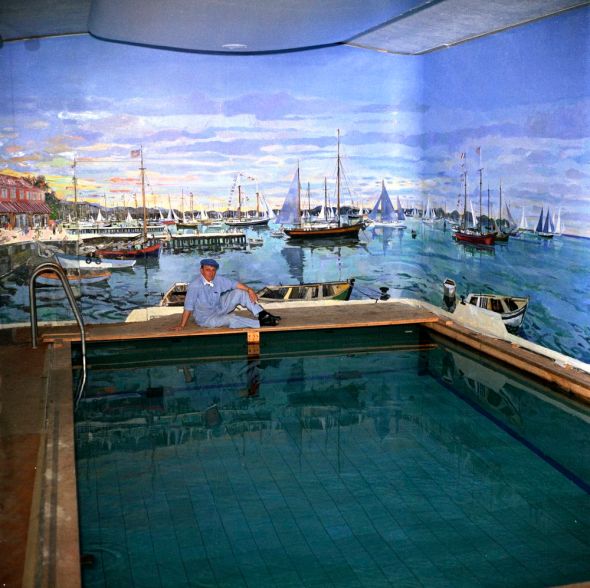
From the JFK Library. http://www.jfklibrary.org/Asset-Viewer/Archives/JFKWHP-1962-06-04-B.aspx
I cannot find a picture of JFK in the pool.
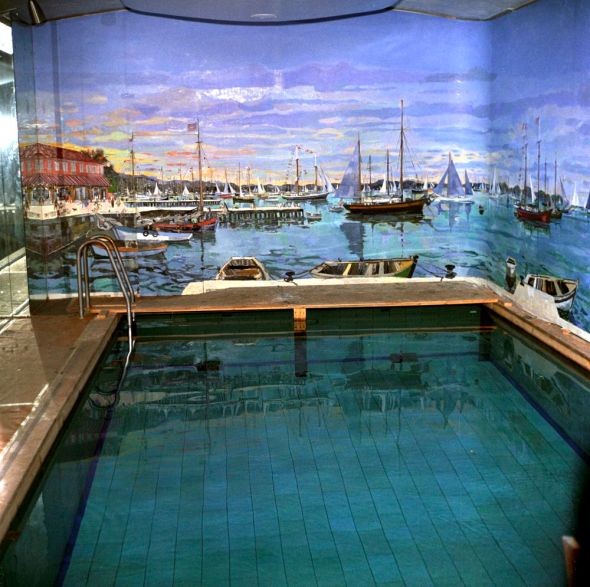
Here’s what the White House Museum says about the pool in the Kennedy years:
John Kennedy sometimes held swimming races with Cabinet members. He liked the pool so much that he made a habit of stopping by at noon, stripping down for a swim, and padding back to his bedroom for lunch and a nap in nothing but a robe. He did the same at the end of the day, dressing again for dinner. As a result, Chief Usher JB West observed, “John F Kennedy wore three separate suits of clothes every day of his White House life.”
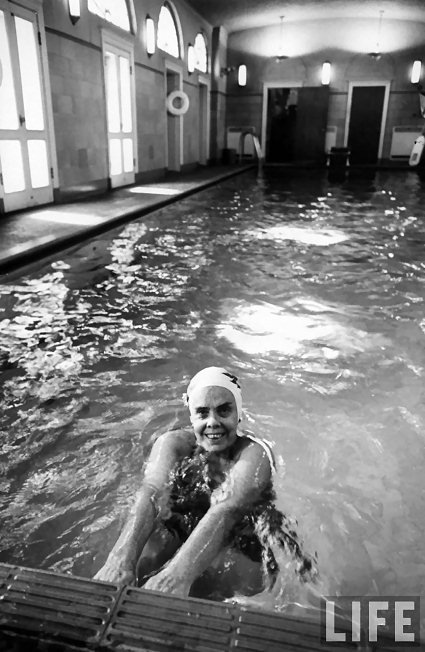
I believe this was pre-mural?
Here is JFK’s sometime doctor Janet Travell in the pool.
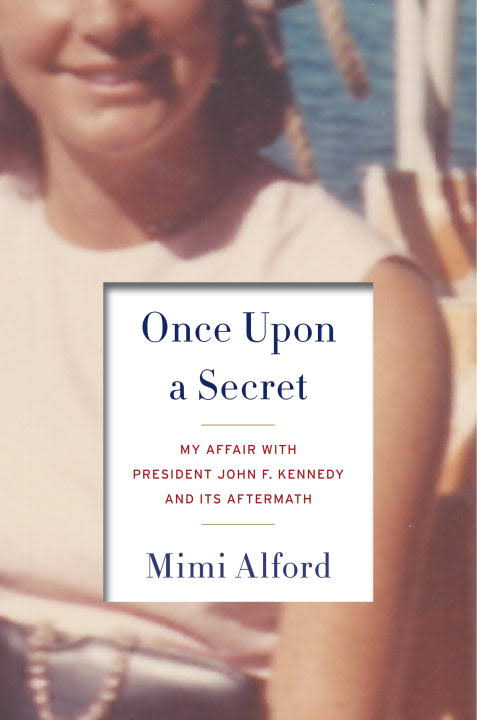
In her book Once Upon a Secret, Mimi Alford describes the pool as like the center of JFK’s sexual life. Frequent poolers, in her memory, were two staffers, one from the President’s Secretary’s office and one from the Press Secretary’s office, with the nicknames Fiddle and Faddle:
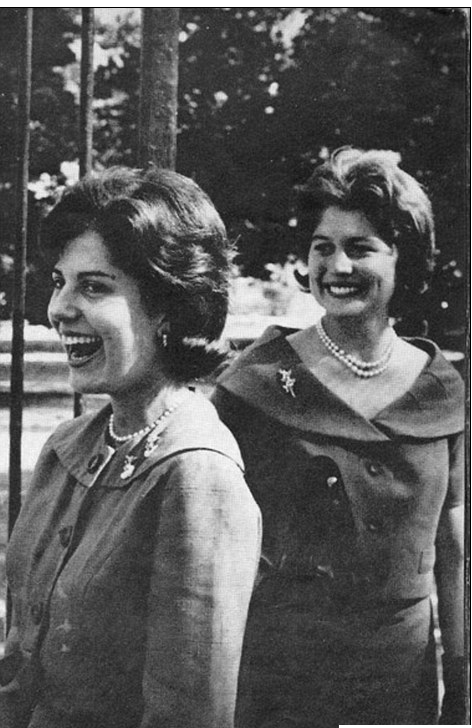
Can’t really sort out the origin of this photo. The Daily Mail cites it as being from “Wikipedia”
A lot of stories about JFK get thrown around as true without a lot of investigating into the source. Who can say now what was happening in the pool? Caitlin Flanagan reviewed Alford’s book here, her takes are always engaging:
The overheated White House swimming pool, painted in a lurid Caribbean theme (its renovation a kinky father-son gift from Joe to Jack), was, according to a number of respected sources (among them Seymour Hersh and three on-the-record Secret Service agents), the locus of endless lunchtime sex parties. Two young secretaries named Priscilla Wear and Jill Cowen—the now infamous Fiddle and Faddle—often left their desks to splash and skinny-dip with Jack, returning to their desks with wet hair so they could go on with their important work of autographing his photographs and wondering how to type. They, like Mimi, were regularly packed along on official trips, apparently so that the president could always get laid if there was any trouble scaring up local talent. Although neither has ever commented on their relationship with Kennedy, their joint interview for the JFK oral-history project is astonishing for the number of trips they casually allude to having taken with him; they were the sex-doll Zeligs of JFK’s foreign diplomacy, their eager faces just out of frame in Berlin, Rome, Ireland, Costa Rica, Mexico, and Nassau, to say nothing of their extensive domestic work in places like Palm Beach and Hyannis Port.
It’s impossible to think Jackie had no idea that any of this was taking place. Once while giving a Paris Match reporter a tour of the White House, she passed by Fiddle’s desk and remarked—acidly, and in French—“This is the girl who supposedly is sleeping with my husband.”
Say what you will about Nixon, he wasn’t frolicking with secretaries in the pool:
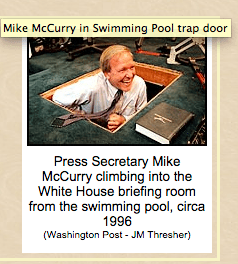
President Richard Nixon arranged for the construction of a press briefing room above the old pool to accommodate the growing demand for television news.
The old mural is now in the Kennedy Museum & Library in Boston:

The single best picture I can find of the pool shows astronaut Edward White throwing his daughter into it:
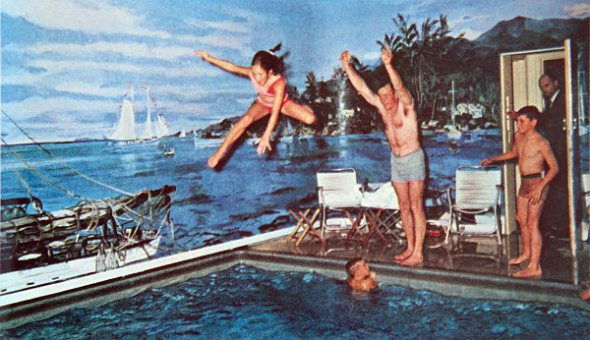
It’s from an old National Geographic. Seven years later White died in the Apollo 1 fire:

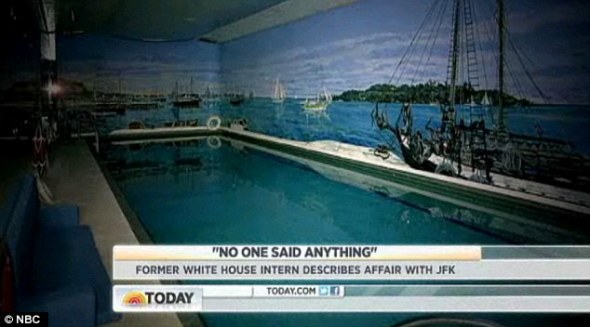
There is still an outdoor pool at the White House.

Posted: November 24, 2015 Filed under: America Since 1945 Leave a comment
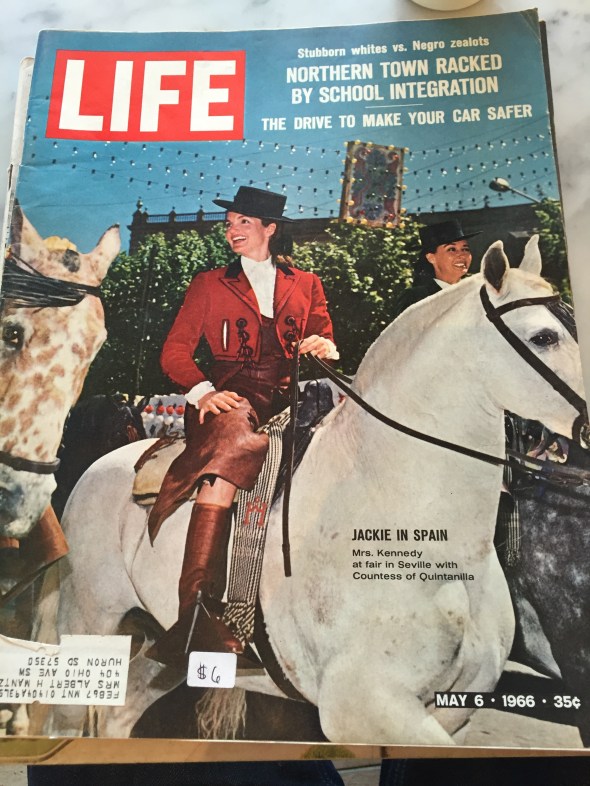
Flipping through an old Life magazine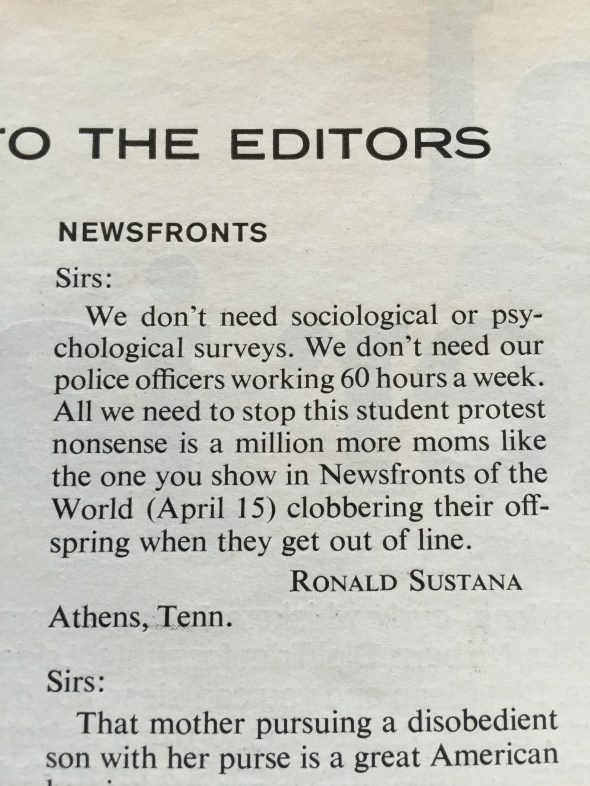
Elizabeth Hodges of Bratenahl writes in:
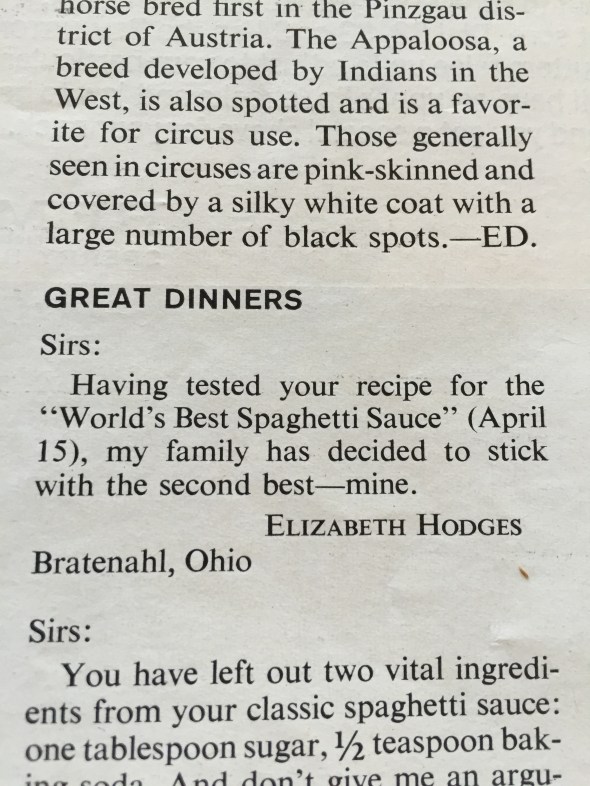
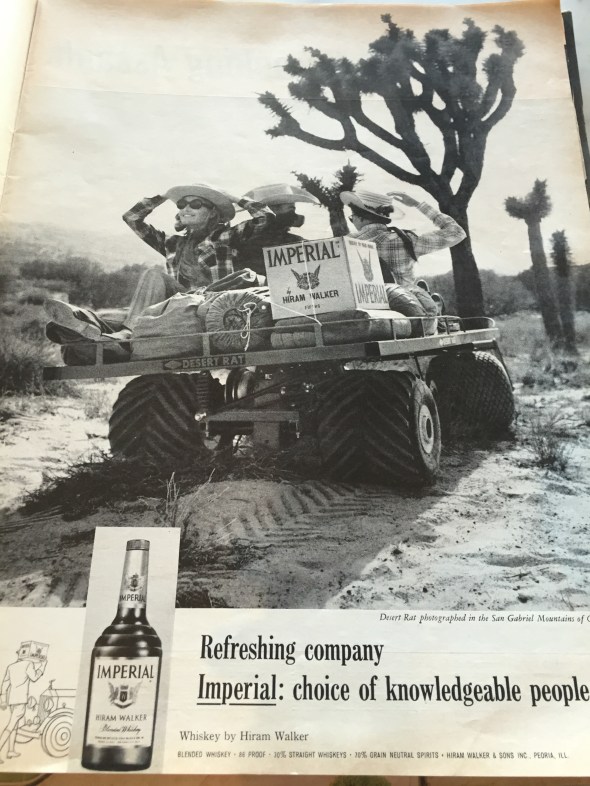
J Tree squad goals:
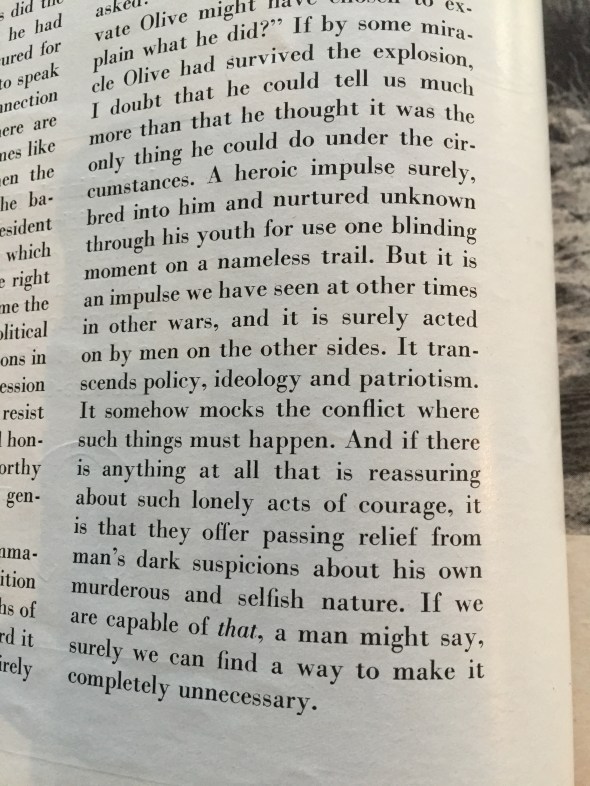
Rufus Wainwright’s grandfather writing something really affecting about the presentation of a Congressional Medal of Honor, posthumously, to Milton Olive III who threw himself on a grenade to save his comrades:
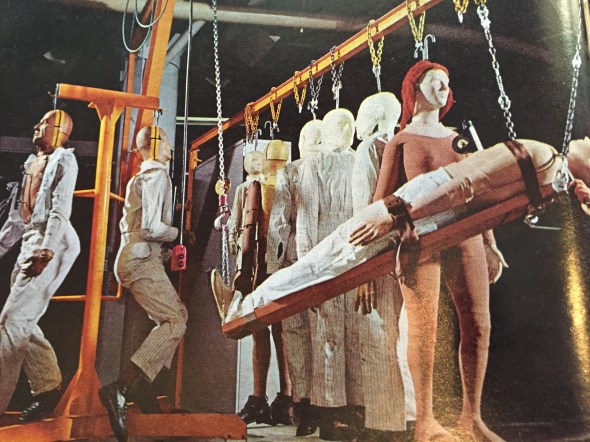
From a special about crash test dummies:
What kind of man uses Vaseline Hair Tonic?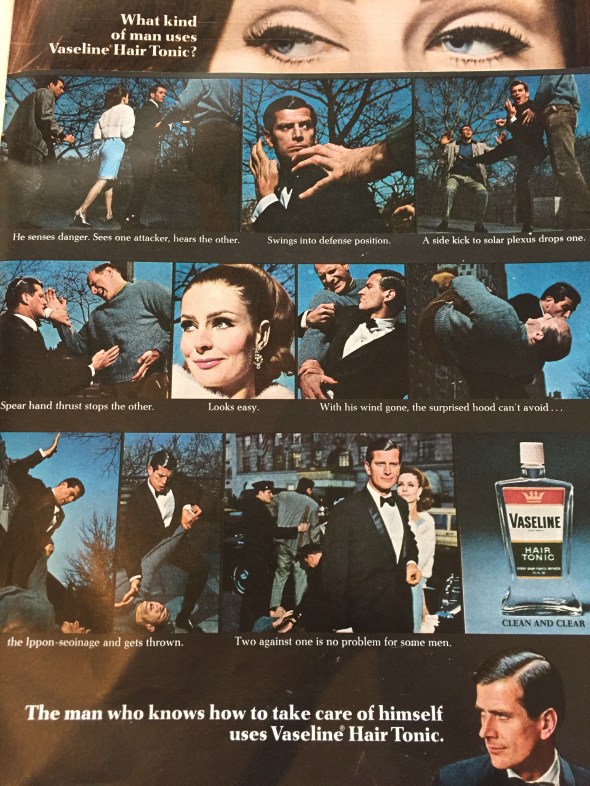
Tang!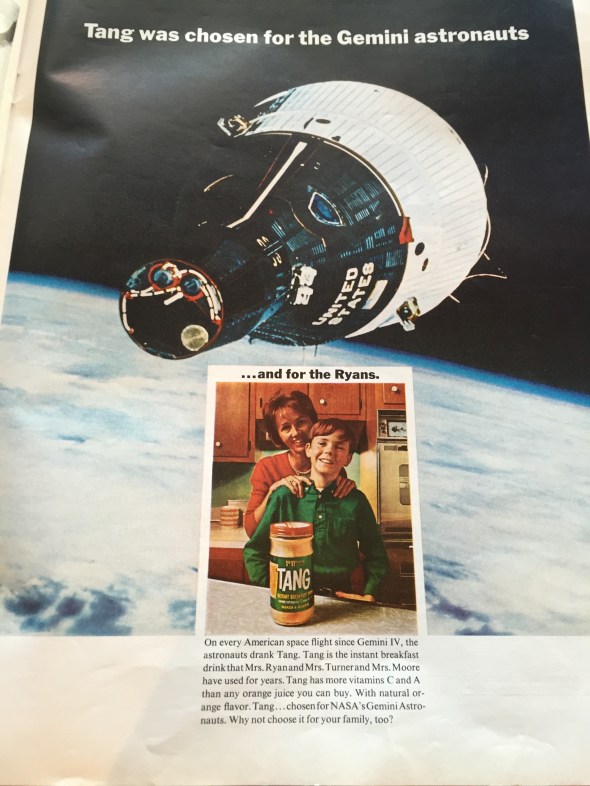
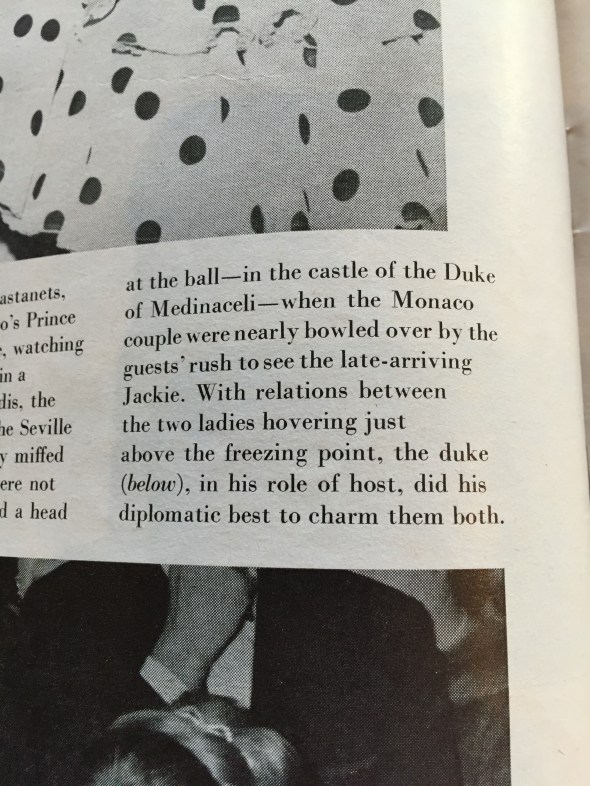
Jackie’s trip to Spain was not without frost-ups: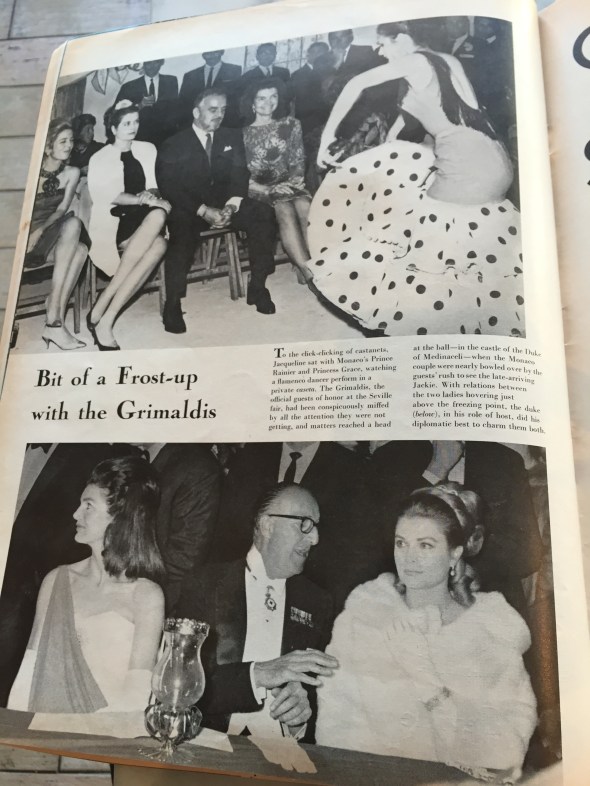

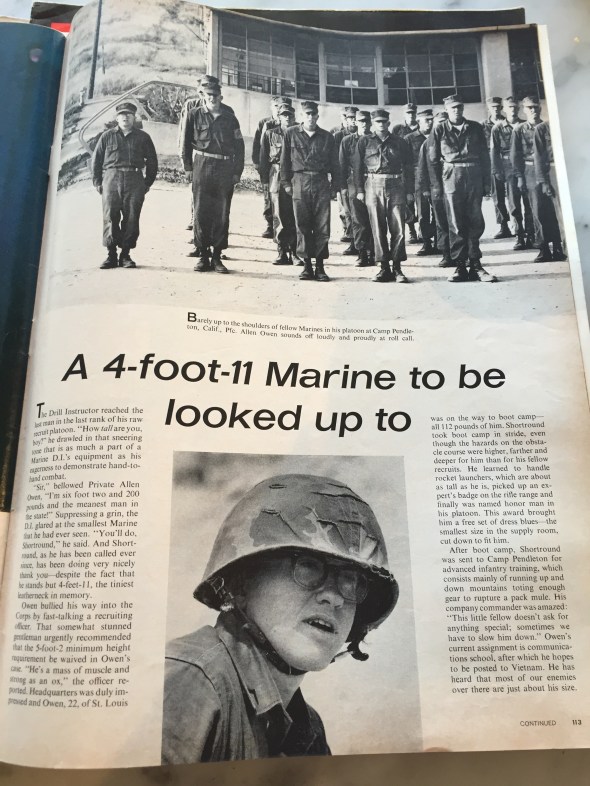
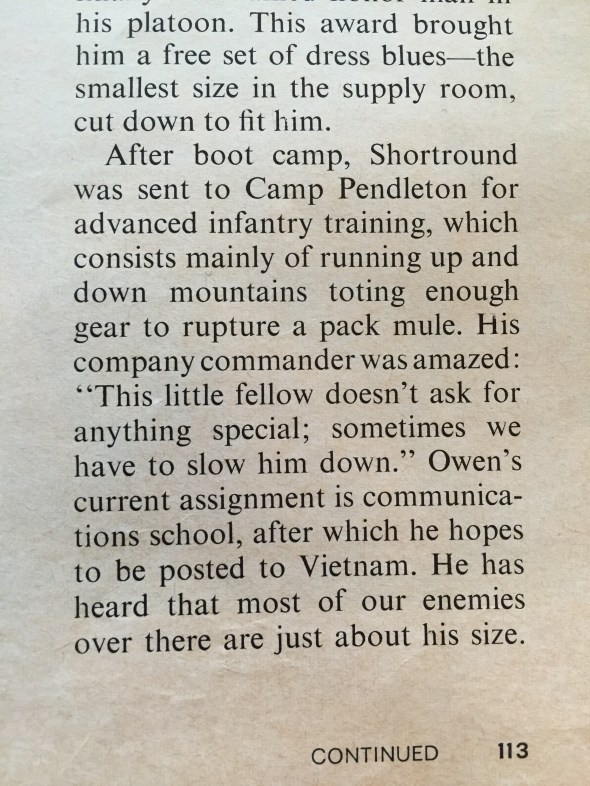

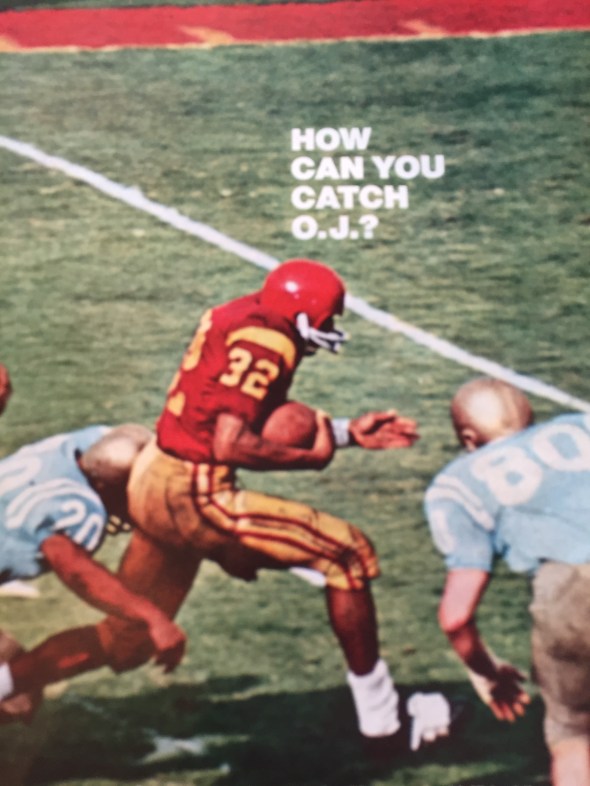
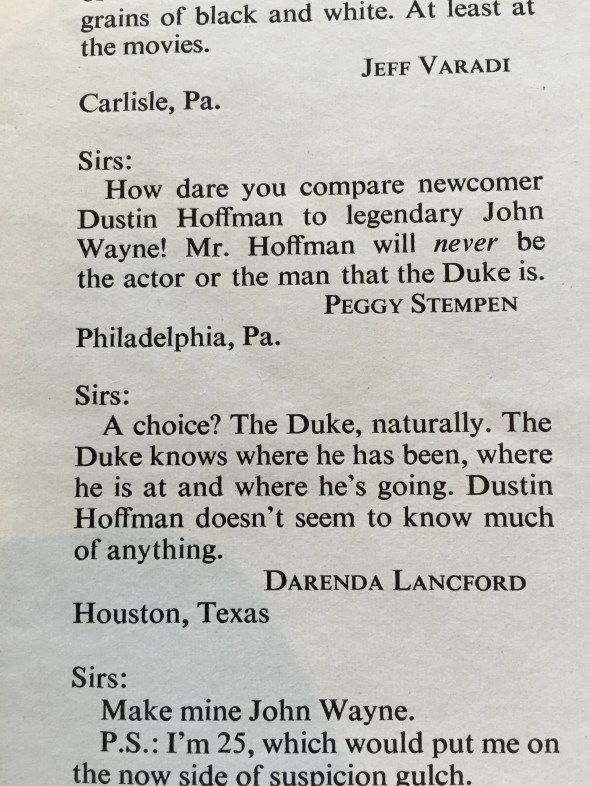
Wait, can’t you tell a TON about it from this?
Posted: November 17, 2015 Filed under: America Since 1945 Leave a comment
from The New Yorker. Like, you definitely at least get the vibe.

Tends to be amusing for English speakers
Posted: October 27, 2015 Filed under: America Since 1945, comedy Leave a comment
Enjoyed reading this article from Vanity Fair. The jist of the article is that Ermahgerd Girl was intentionally making comedy when she took this picture. Does that change the funniness of this?
According to Ari Spool, a New York–based reporter and self-described meme scientist for Know Your Meme, rhotacized speech—that is, speech in which the “R” sound is somehow disfigured—tends to be amusing for English speakers.
But it’s not just about the imagined voice. “[It’s] also the absurdity, rhythm, and timbre of the words,” Spool said. “We call this type of voice-heavy meme writing ‘interior monologue captioning,’ and it’s a common ingredient in a successful image.”

People who look kind of alike
Posted: October 26, 2015 Filed under: America Since 1945 Leave a comment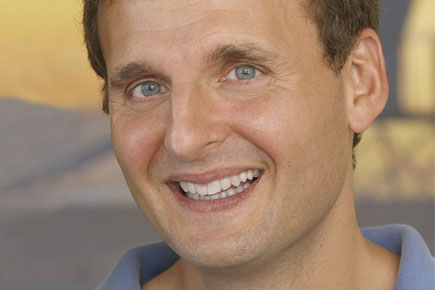
Phil Rosenthal and
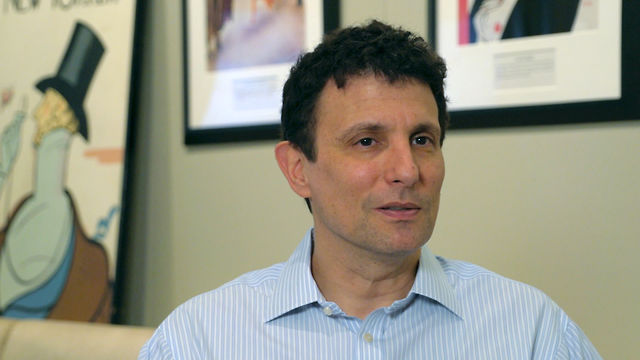
David Remnick
Moon
Posted: October 13, 2015 Filed under: America Since 1945, photography, pictures, science Leave a comment Went through NASA’s new Flickr of the Apollo missions looking for good ones I hadn’t seen before.
Some very great shades of blue.

Camping!


Mexico!
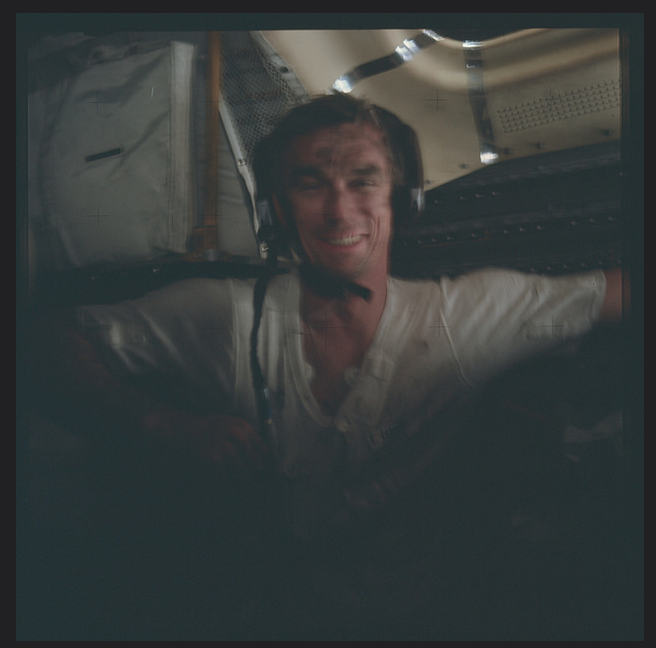
 Earf
Earf
 NASA’s foil game is so on point
 Goodbye spaceman!

Making movies


 Wish traffic in LA were like this.
The word “spa” in Massachusetts
Posted: October 2, 2015 Filed under: America Since 1945, Boston, New England Leave a comment
Massachusetts local dialect is all over the Web these days*. This is a favorite topic of mine.

A discussion of placemats caused my sister to send the above photo, and sent me looking into the Massachusetts use of the word “spa.”
Best (first) source I found was (of course?) at Village 14, “Newton’s Virtual Village”:

The word spa comes to us from Spa, Belgium:

The greatest Belgian in fiction? Some people say its Poirot but I say it’s Remy from “Young Indiana Jones Chronicles.”

For Massachusetts dialect, let me give a shoutout to David Hackett Fischer’s Albion’s Seed: Four British Folkways In America.

This guy is a boss. He tells us that what we think of as the “Boston accent” might have its origin in the dialect of East Anglia:
Also he suggests how Scots-Irish people brought us pig-ribs and fighting and gun-love.

- see previous Helytimes coverage of the ocean sunfish here
Wolfe on Status
Posted: September 29, 2015 Filed under: America Since 1945, heroes Leave a comment
Reading this Jefferson Lecture from 2006, delivered by Tom Wolfe:
Within the ranks of the rich, including the “owners of the means of production,” there inevitably developed an inner circle known as Society. Such groups always believed themselves to be graced with “status honor,” as Weber called it. Status honor existed quite apart from such gross matters as raw wealth and power. Family background, education, manners, dress, cultivation, style of life–these, the ineffable things, were what granted you your exalted place in Society.
Military officer corps are rife with inner circles aloof from the official and all-too-political hierarchy of generals, admirals, and the rest. I went to work on a book called The Right Stuff thinking it would be a story of space exploration. In no time at all, I happened upon something far more fascinating. The astronauts were but part of an invisible, and deadly, competitive pyramid within an inner circle of American military fighter pilots and test pilots, and they were by no means at the apex. I characterized this pyramid as a ziggurat, because it consisted of innumerable and ever more deadly steps a fighter pilot had to climb to reach the top. The competition demanded an uncritical willingness to face danger, to face death, not once but daily, if required, not only in combat but also in the routine performance of his duties–without ever showing fear–in behalf of a noble cause, the protection of his nation. There were more ways to die in a routine takeoff of a supersonic jet fighter of the F-series than most mortals could possibly imagine. At the time, a Navy pilot flying for twenty years, an average career span, stood a 23 percent chance of dying in an accident and a 56 percent chance of having to eject at some point, which meant being shot out of the plane like a human rocket by a charge of dynamite under his seat, smashing into what was known as the “wall” of air outside, which could tear the flesh off your face, and descending by parachute. The figures did not include death or ejection in combat, since they were not considered accidental. According to Korean War lore, a Navy fighter pilot began shouting out over the combat radio network, “I’ve got a Mig at zero! A Mig at zero! I’ve got a Mig at zero!” A Mig at zero meant a Soviet supersonic fighter plane was squarely on his tail and could blow him out of the sky at any moment. Another voice, according to legend, broke in and said, “Shut up and die like an aviator.” Such “chatter,” such useless talk on the radio during combat, was forbidden. The term “aviator” was the final, exquisite touch of status sensitivity. Navy pilots always called themselves aviators. Marine and Air Force fliers were merely pilots. The reward for reaching the top of the ziggurat was not money, not power, not even military rank. The reward was status honor, the reputation of being a warrior with ultimate skill and courage–a word, by the way, strictly taboo among the pilots themselves. The same notion of status honor motivates virtually every police and fire fighting force in the world.
Badass.

source: https://veneremurcernui.wordpress.com/2014/07/10/flightline-friday-returns-f-84h-thunderscreech/
In the related interview, Wolfe gets going on fashion:
Cole: Why is fashion important? What does it tell us?
Wolfe: Every man and every woman is equally fixated on fashion. Men who would bridle at that suggestion are usually men who want to fit in in whatever milieu they want to be in. They do not want to stand out in any way, shape, or form. That’s just as true in the stands at the stock car races as it might be at Sullivan and Cromwell, the law firm.
Somebody like myself, perhaps, stands out on purpose with just minor variations on the conventional. My suits are conventionally cut. They just happen to be white. The same with shoes, everything else.
I feel it’s to a writer’s advantage, since he sells a mass-produced product called a book, to catch attention any way he can. This is not shared by my fellow writers, you understand. But you’ll notice how few writers are willing to appear on the back of a book with a necktie on. That’s a bohemian fashion that’s supposed to show one way or another you’re thumbing your nose at convention. Then it becomes a convention itself. If I saw one more writer with an open shirt, the wind blowing through his hair, I was going to stop buying books. They’ve calmed down a little bit, but still the tie is anathema.
Ironically, if you read a book such as The Intellectuals on the Road to Class Power, about the arts in Czechoslovakia under a Communist regime, the writers in the Writers’ Union were dressed like businessmen. They were on top. If you were in the Writers’ Union, your books were published automatically, even if no one read them. And I’ve just been reading Huizinga’s The Autumn of the Middle Ages.
Cole: That’s a very great book, I think.
Wolfe: The attention to status detail and dress is absolutely fascinating. I forget the French nobleman who was found guilty of a capital crime, who insisted on arriving in his full regalia–an ermine-trimmed coat and the works–for his beheading. He just wasn’t going to show up looking like a common, vulgar victim. I liked that.
To this day, I think it hasn’t changed. It’s just more covert now. Style is always a window into what a person thinks of his place in the world or what he wants his place to be in the world.
Balzac often would start off chapters with a description of a room and the types of furniture. He might point out that the curtains on the windows were not really damask. They were half cotton. He would give you a whole picture of the inhabitants just through his status details.
And Saint-Beuve, who I guess was the leading French critic of the day, said, if this man Balzac is so obsessed with furniture, why doesn’t he own a shop and spare us these tedious novels. [Laughter]
Tissot, who has become my favorite painter the more of his work that I see, is a great example of that. For a long time, Tissot was written off as a sort of fashionista. He was in love with the look of women’s clothes. But I think now he’s being perceived as a great painter.
Cole: He’s a much more nuanced painter, I think, than people give him credit for.
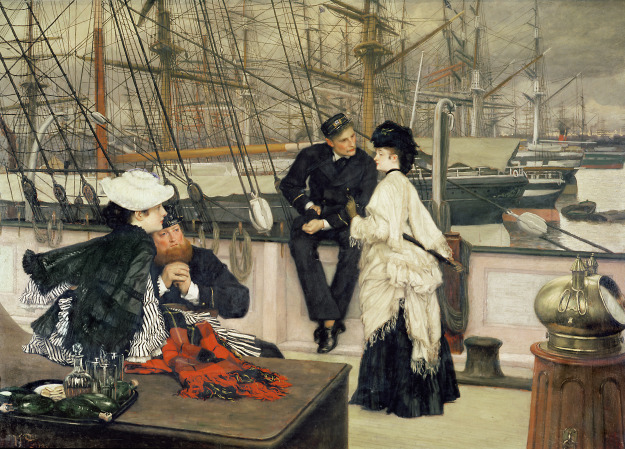
The Captain and the Mate, 1873 (oil on canvas) by Tissot.
Later the interview turns to architecture, and Wolfe gives a shout to Edward Durell Stone’s US Embassy in New Delhi:

What’s going on in this photo?
Posted: September 24, 2015 Filed under: America Since 1945, politics Leave a comment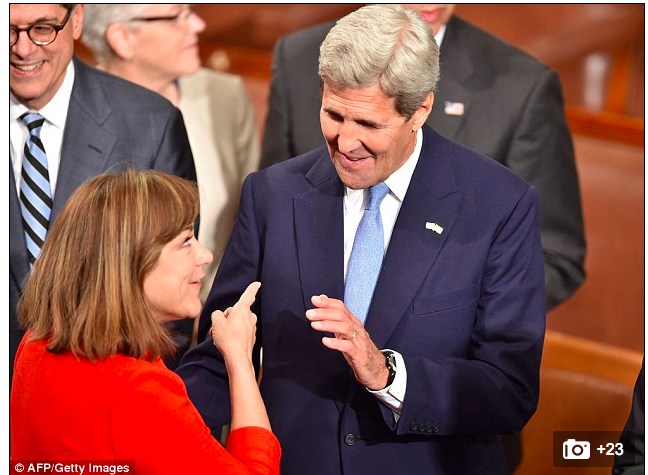
found it on a Pope roundup
An unhappy story with no winners
Posted: September 21, 2015 Filed under: America Since 1945 Leave a comment
Blog I Endorse
Posted: September 21, 2015 Filed under: America Since 1945, animals, art history, film, the California Condition Leave a comment

He turned to animated television commercials, most notably the Raid commercials of the 1960s and 1970s (in which cartoon insects, confronted by the bug killer, screamed “RAID!” and died flamboyantly) and Frito-Lay’s controversial mascot, the Frito Bandito.
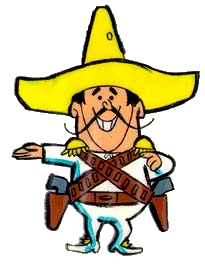
Frito Bandito

Office Life!
Posted: September 17, 2015 Filed under: America Since 1945 Leave a comment
From the wikipedia page for “office” — The Division of Classification and Cataloging, National Archives, 1937.
Embracing office life today. Two episodes from lunch:
- Kathy singing “What is lunch?” to the tune of “What is love?”
- A guy in the elevator asking aloud, “is it Friday yet?” I laughed way too hard. Then he said “it is in Australia!”
Entrepreneurs in Italy
Posted: September 16, 2015 Filed under: America Since 1945, Italy Leave a comment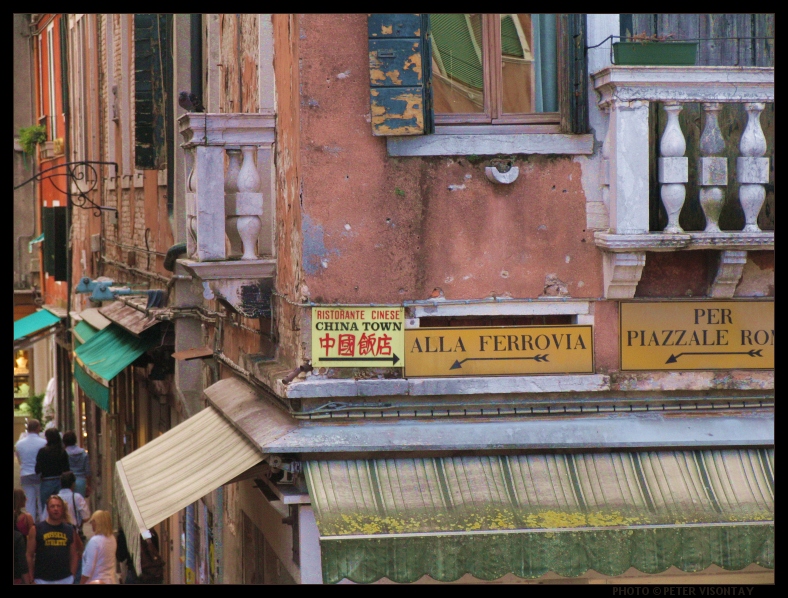
Photo of a Chinese restaurant in Venice by Peter Vistonay found here: http://www.earth-photography.com/Countries/Italy/Italy_Venice_Misc_Signs.html
from this convo between Tyler Cowen and Italian economist Luigi Zingales:
COWEN: Here’s an article from Quartz. Let me read you the headline. Maybe you saw it from a few months ago. “The most common surnames of new entrepreneurs in Italy are Hu, Chen, and Singh.” If you look at Milan, you have to go through 20 names, and at number 20 is the Italian name Colombo for the most common or most frequent names of entrepreneurs.
Is this sustainable culturally, or is this Italy’s future, in essence, to be economically colonized the way parts of Southeast Asia have been by Chinese, Indians, Sikhs, whoever it may be. Maybe Germans.
ZINGALES: One friend of mine was saying that the demise of the Italian firm family structure is the demise of the Italian family. In essence, when you used to have seven kids, one out of seven in the family was smart. You could find him. You could transfer the business within the family with a little bit of meritocracy and selection.
When you’re down to one or two kids, the chance that one is an idiot is pretty large. The result is that you can’t really transfer the business within the family. The biggest problem of Italy is actually fertility, in my view, because we don’t have enough kids. If you don’t have enough kids, you don’t have enough people to transfer. You don’t have enough young people to be dynamic.
Here’s more from Luigi, predicting the coming of Trump and comparing him to Italy’s Berlusconi:
Trump and Berlusconi are remarkably alike. They are both billionaire businessmen who claim that the government should be run like a business. They are both gifted salesmen, able to appeal to the emotions of their fellow citizens. They are both obsessed with their looks, with their hair (or what remains of it), and with sexy women. Their gross manners make them popular, perhaps because people think that if these guys could become billionaires, anyone could. Most important is that both Trump and Berlusconi made their initial fortunes in real estate, an industry where connections and corruption often matter as much as, or more than, talent and hard work. Indeed, while both pretend to stand for free markets, what they really believe in is what most of us would label crony capitalism.
Berlusconi’s policies have been devastating to Italy. He has been prime minister for eight of the last ten years, during which time the Italian per-capita GDP has dropped 4 percent, the debt-to-GDP ratio has increased from 109 percent to 120 percent, and taxes have increased from 41.2 percent to 43.4 percent. Italy’s score in the Heritage Foundation’s Index of Economic Freedom has dropped from 63 to 60.3, and in the World Economic Forum Index of Competitiveness from 4.9 to 4.37. Berlusconi’s tenure has also been devastating for free-market ideas, which now are identified with corruption.
How can such a pro-business prime minister wreak havoc on the economy and on the idea of free markets? Because “pro-business” doesn’t necessarily mean “pro-market.” While the two agendas sometimes coincide—as in the case of protecting property rights—they’re often at odds. Market competition threatens established firms, which often use their political muscle to restrict new entries into their industry, strengthening their positions but putting customers at a disadvantage. A pro-market strategy, by contrast, aims to encourage the best business conditions for everyone. That’s in fact the opposite of what a real-estate tycoon wants: to keep competitors out and enhance the value of his own properties. By capturing (or more precisely, purchasing) the free-market flag in the same way one might acquire a business brand, Berlusconi likely has destroyed the appeal of the free-market ideal in Italy for a generation.
Reality can be hacky!
Posted: September 9, 2015 Filed under: America, America Since 1945 Leave a comment
Reading this Jeffrey Goldberg article about Angola prison.
If you tried to come up with a name for a Louisiana prison warden, and you came up with Burl Cain, you would chide yourself for being a little “on the nose.”

