A rough moment on CBS News Super Tuesday broadcast
Posted: March 4, 2016 Filed under: America Since 1945, politics Leave a commentBrother, I’ve been there.

Not to be missed
Posted: February 28, 2016 Filed under: America Since 1945, Kennedy-Nixon, politics Leave a comment
This take from the Dick Nixon Twitter feed is so great.
New Berkshire Hathaway annual letter
Posted: February 27, 2016 Filed under: America Since 1945, business Leave a comment
New Berkshire Hathaway annual letter is out. I love to read this thing every year. If Warren Buffett weren’t busy running a 362 billion dollar company he would be a very talented business writer.
He’s funny, compelling, a calm and sunny optimist, and thoughtful about dimensions beyond the monetary, one of the great American characters alive. Here are some highlights if you are too busy to read:
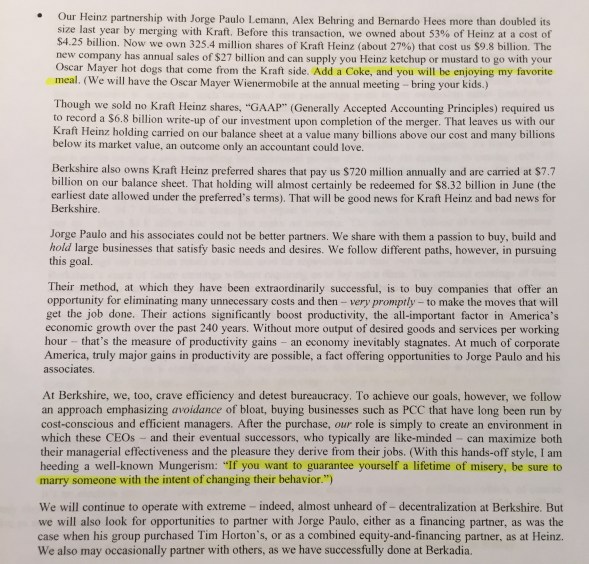

Some common sense social policy:

About rail cars:


A brief history of auto insurance in the United States:

Advice:
A non-apology for GEICO advertising:
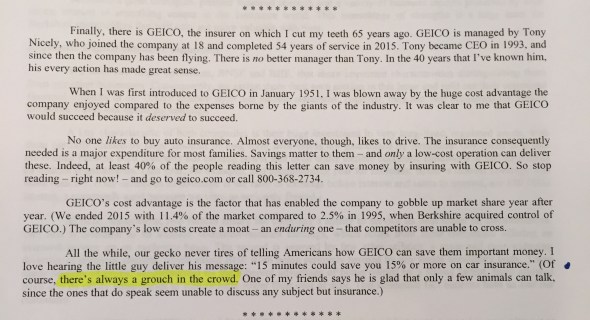
Discussion of the realities of economic change on people’s lives:
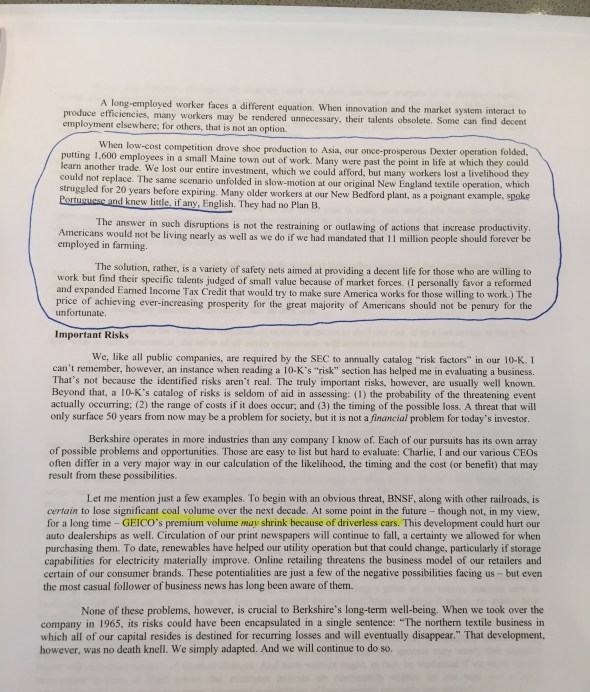
Here is the scariest part, a warning about cyber, biological, nuclear or chemical attack on the USA:

Damn I hope I have the time to make it to the annual meeting:
If I make it to Omaha I would like to challenge Ariel Hsing at table tennis:
We’re not gonna be the dummies anymore, folks
Posted: February 26, 2016 Filed under: America Since 1945, politics Leave a commentAt the beginning you hear the response part of the call and response to “Who’s gonna built that wall?” “MEXICO!” Then:
Here a protestor (you can see him in the aisle to Trump’s right, holding a sign that says “VETERANS TO MR. TRUMP END HATE SPEECH AGAINST MUSLIMS” and he leaves peacefully:
and this is right after a protestor was led out by police:
The aftermath:

How To Debate Donald Trump
They think we’re kidding too, don’t they folks? We’re not kidding. We’re not kidding.
-Donald J. Trump
That’s more or less exactly what I wondered. Is this guy kidding? Are the people who are voting for him kidding? I wanted to go to a rally and see what this was all about. A pal is a reporter on the campaign and encouraged me to see it for myself, saying, basically, you won’t believe it.
Best chance to do it from the West Coast would be in Las Vegas, on Monday before the Nevada primary. Poking around on the Trump website I saw a form to apply for media credentials. So I did that. All they asked really is what outlet I worked for — Great Debates News.
The rest of this post will be going out shortly to Helytimes Premium and Great Debates News subscribers. Subscribe to Great Debates News here. Subscribe to Helytimes Premium by emailing me.
Helytimes Premium subscribers: sorry for the typo, can you imagine my embarrassment? Sentence should read: “admiring what Ann Friedman and Ryan Holiday were doing with their newsletters.”
When did JFK’s soul go to Heaven?
Posted: February 24, 2016 Filed under: America Since 1945, Kennedy-Nixon 1 Comment
Doing some research for a Kennedy-related project, came across this interview with Father Oscar Huber, Dallas priest who ended up giving JFK last rites:

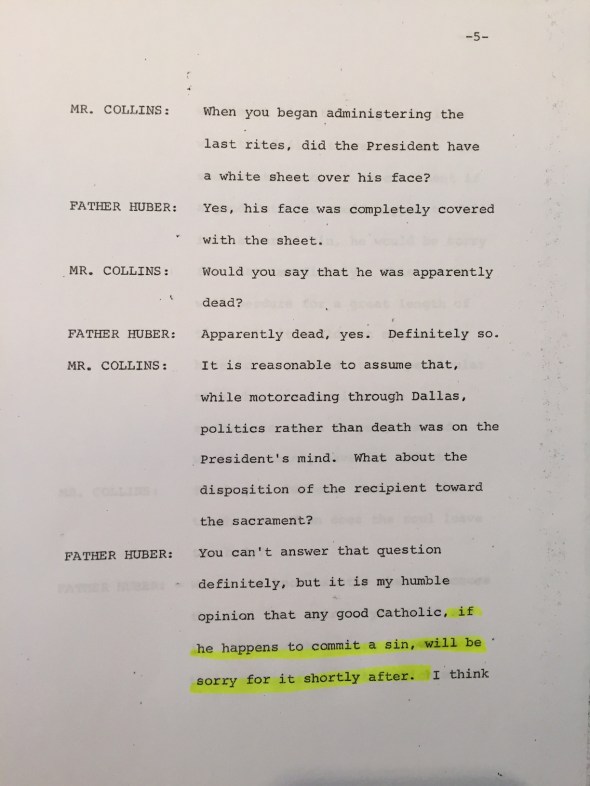

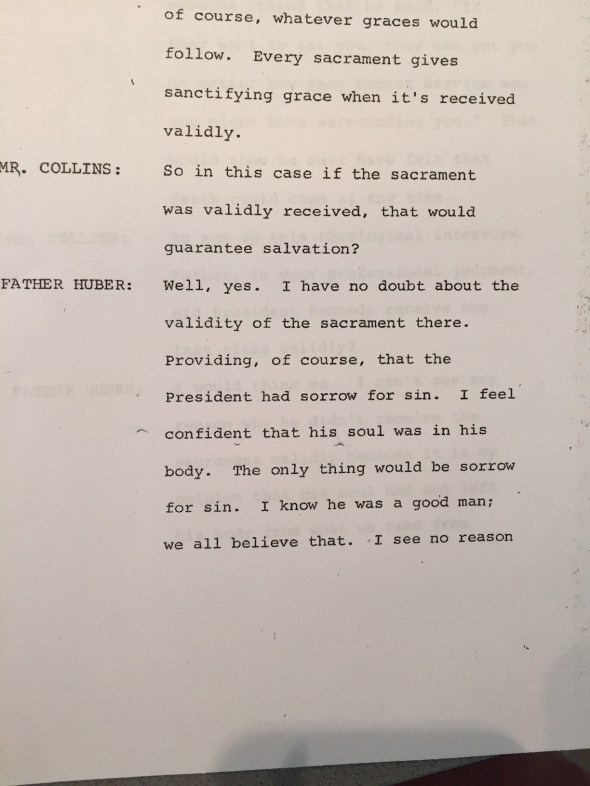
Sounds like he was all good!

Father Huber pic from The Catholic Spirit: http://thecatholicspirit.com/commentary/this-catholic-life/remembering-president-kennedy-50-years-later-vincentian-pastor-administered-last-rites-presidents-assassination/
I’ve spent hours and hours combing the JFK Oral Histories at the Kennedy Library website, and the best thing I’ve found is this one, from Massachusetts Democratic operative and Harvard prof Samuel Beer, interviewed long after the fact. Here he’s talking about Adlai Stevenson and Kennedy’s lady game:


Adlai
Should you buy Twitter? Plus: Advice to Jack Dorsey
Posted: February 14, 2016 Filed under: America Since 1945, business 1 Comment
I’ve noticed that writing about investing is very popular on the Internet so I’m gonna try it.
This post is about Twitter (TWTR). At the moment: the stock is priced at 15.88, I don’t own it.
Twitter is one of my favorite products in the world. If I’m being real, I probably spend minimum an hour a day looking at Twitter.
Lots of people hate it — my Great Debates colleague Dan Medina, for instance, claims to find it unusable. Yet there he is:

and he’s fascinated by it.
How can you not be? Here are entertainers, comedians, athletes, famous people of all kinds, plus millions of strong-opinioned randos, bots, sex bots, ordinary citizens, kids, organizations, Vine people, all gabbing away at some fantastically weird party / school assembly gone mad.
On the one hand maybe Twitter is a negative in my life, because I read fewer books. On the other hand, while I’ve been putting off reading William Gibson’s books, I’ve been enjoying his Twitter feed:

Little Esther tells me Twitter is for losers, but her feed is hilarious:

Twitter is a fiendishly perfect invention for distracting comedians because so many of them
- Crave instant feedback/laughs
- Are desperate for connection
- Are bored
- Are traveling / waiting around for something
- Are video game addicts
If anything, the biggest problem I have a user of Twitter is how much stuff there is I want to look at, and how to sift it out from all the garbage.
I’ve solved that problem more or less to my satisfaction by making private lists. The second biggest problem might be the jarring combos of information:

but maybe that’s a feature, not a bug.
For all this entertainment, hours and hours of it, Twitter charges me…
NOTHING?! Zero dollars?
That is ridiculous.
I mean, I guess sometimes I have to look at ads. But I gotta tell ya, these ads don’t tend to get in the way. Often they are wack enough to be part of the fun:
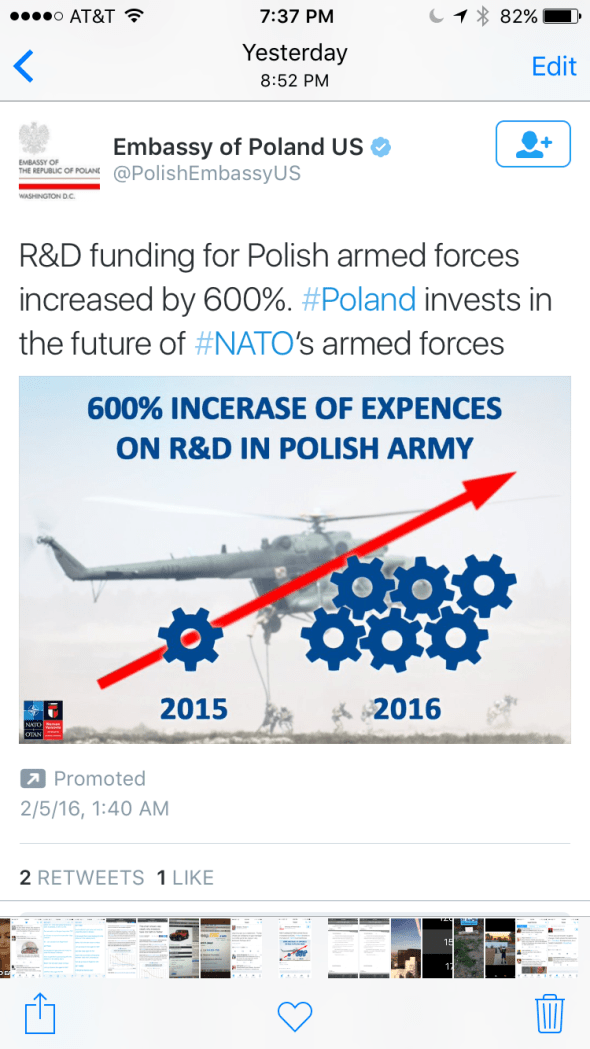
(What? The Embassy of Poland wants to brag to me, specifically, about its military expenditures?)
What kind of wonderful company is this, that gives me entertainment, information and amusement for free?!

Should I get in on?
When a product becomes a part of your life, you have to ask yourself if maybe you should go ahead and own part of the company by buying shares in it.

SHOULD YOU INVEST IN TWITTER (TWTR)?
What I know about investing is cobbled together from skimming and half-reading investment books, blogs and articles (and Twitter) plus mistakes plus talking to people.
First, big believer in the Peter Lynch method.

Peter Lynch of Fidelity Investments.(Story/Paulson)
Peter Lynch was a wealthy Bostonian of my youth who got his start caddying for the president of Fidelity Investments, became an intern there, and rose up to manage Fidelity’s Magellan fund:
From 1977 until 1990, the Magellan fund averaged a 29.2% return and as of 2003 had the best 20-year return of any mutual fund ever.
and also wrote some bestselling investment guides:

which I haven’t read. But which Wikipedia helpfully summarizes:
His most famous investment principle is simply, “Invest in what you know,” popularizing the economic concept of “local knowledge“. Since most people tend to become expert in certain fields, applying this basic “invest in what you know” principle helps individual investors find good undervalued stocks.
Lynch uses this principle as a starting point for investors. He has also often said that the individual investor is more capable of making money from stocks than a fund manager, because they are able to spot good investments in their day-to-day lives before Wall Street. Throughout his two classic investment primers, he has outlined many of the investments he found when not in his office – he found them when he was out with his family, driving around or making a purchase at the mall. Lynch believes the individual investor is able to do this, too.
OK, great.
I would say I’m not an expert but I’m pretty serious about:
- comedy
Twitter is a great way to get comedy in quick, easy form. Every comedian I know is on Twitter.


- written entertainment
Not every writer is on Twitter but a lot of them are, and there’s neat writing on Twitter every day.

- news/information/infotainment.
from this I’ve had my biggest insight of all: journalists are obsessed with Twitter. They give better, faster, more interesting news directly to their Twitter feeds.

Plus, the news makers and influencers are themselves talking directly to the Twitter user:

and
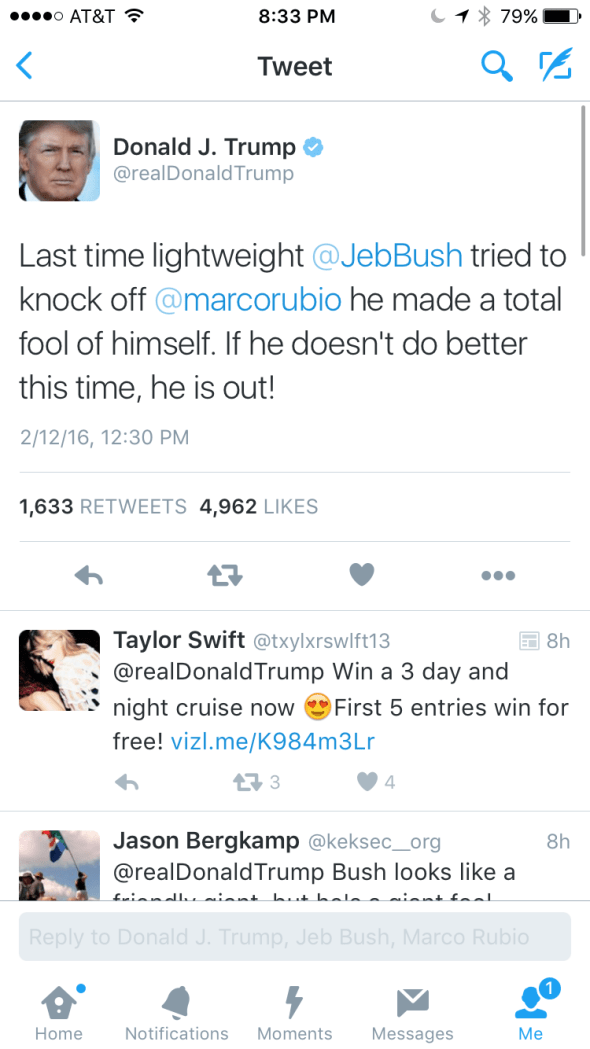
That’s how I identified Twitter as a possible opportunity. Now let’s run it through a rigorous Lynchian checklist.
Do you use it yourself?
Yes, so much so that I have to impose rules on myself that I then break.
Do people you know use it?
Oh God they’re obsessed.
Does it seem like a good product?
Well, I dunno. For instance I have no idea how or if they make money.
That brings us to the next level.
Buffet analysis.

Everybody knows billionaire investor and Omaha cheapskate Warren Buffett, he is one of the great American characters.
You might also know his partner and former WWII Army Air Corps meteorologist Charlie Munger:

A good intro to some of Munger’s ideas can be found here on the blog of Tren Griffin, who rounds up a lot of wisdom.
Buffett and Munger’s insights are many and not easy to summarize, but a crudely simplified version in three quotes might be:
1:
Buy into a company because you want to own it, not because you want the stock to go up.
2:
I never attempt to make money on the stock market. I buy on the assumption that they could close the market the next day and not reopen it for five years.
(that quote I can’t 100% track down to the source but it appears legit).
and 3:
Never invest in a business you cannot understand.
Buffett is a value investor. He asks, is the business valuable? For instance, a railroad.

Only a few companies control all the railroad track in North America:

and they’re not building more. People continue to ship things on railroad. Warren Buffett decided that he understood railroads I guess, because he bought one.
Presumably before he did that, though, he ran BNSF through the third level of investment analysis, which is the level of numbers.
This is the level that is so boring. You almost can’t believe it.
Try, for instance, to read the wikipedia page on valuation (finance) and if your eyeballs don’t turn to mush maybe investment banking is for you.
For me, I can only handle the very basics. There’s P/E (price of the stock to earnings), for instance. Should be simple enough:
Theoretically, a stock’s P/E tells us how much investors are willing to pay per dollar of earnings. For this reason it’s also called the “multiple” of a stock. In other words, a P/E ratio of 20 suggests that investors in the stock are willing to pay $20 for every $1 of earnings that the company generates. However, this is a far too simplistic way of viewing the P/E because it fails to take into account the company’s growth prospects.
So says investopedia. Ugh, everything is always far too simplistic with these guys.
Let’s take it down to basics.

Hmmmmmm.
OK, I can do this.
EBITDA is earnings before interest, taxes, depreciation, and amortization. A measure, right, of how much money the company is making.
Twitter’s is negative two hundred and eight million dollars.
Coca-Cola, by comparison, is $124 million.
Amazon’s is $7.8 billion.
Netflix’s is $368.1 million.
Chipotle’s is $908 million.
How about profit margin, that seems simple.
Coca-Cola: 2.7%
Amazon: .56%
Netflix: 1.81%
Chipotle: 10.57%
Twitter: -27.99%
OK, so let us answer the key question:
- How much money is Twitter making?
Negative a lot?
- How is that possible?
Well, I took to the Internet. Here are some things I learned:
- Twitter makes huge amounts of revenue, but not a profit.
From this week’s earnings call, we learned that Twitter’s revenue in the fourth quarter totaled $710 million, up 48 percent year-over-year.
Most of that money ($641 million) comes from ad sales, with the rest ($69 million?) coming I guess from data sales. Although apparently Twitter has somehow screwed up selling that up — last year it made $147 million from data sales before they shut off their data “fire hose.”
I ran all this by my colleague Anonymous Investor. Here’s what he has to say:
Let’s say you owned a pizza shop. In 2015 you sell a million dollars worth of pizza (or said another way, you made a million dollars in revenue). At first glance, that might seem good. But if your food, labor and rent costs add up 1.3 million, you would have ended up losing money for the year. (a $300,000 loss for 2015).
Likewise, Twitter sold 2 billion dollars worth of stuff (mostly advertising sales). But they spent around 2.5 billion dollars doing it. I haven’t dug deep into it, but lots of their costs seem like wasteful spending — such as 778 million on research and development, which seems ridiculous for a company that’s basically not much more than a slightly-advanced message board.
Seems the company could be profitable if google or someone else bought it. They could slash costs and make some profit off that revenue.
- Twitter wastes lots of money.
How much does it cost to run Twitter? I honestly have no idea, but the brilliant thing about the business is that the users are doing the hard work of generating the content. All Twitter should have to do is run the servers and so on, right?
In looking into it, I found that Twitter spends an insane amount of money on research and development. This is from a 2013 Fortune article:
According to its IPO document, in the third quarter of the year, Twitter shelled out nearly $90 million on R&D. That was equal to more than half, 52%, of the company’s revenue in the same period. It is Twitter’s largest cost, nearly 50% more than it spent on marketing. And it’s far more than most of its rivals spend. Facebook, for instance, spent just 14% of its revenue on R&D in the the quarter right before it went public. It has since ramped up that spending to 26%. But Facebook FB 0.10% makes money, unlike Twitter.
Google spends just 15% of revenue on R&D. And Google is working on a self-driving car, high-tech glasses and, maybe, space elevators.
There is no sign that Twitter is working on anything that cool. Twitter actually gives very little detail about what it spends its R&D budget on in the offering documents for its IPO. It says that R&D expenses are to “improve our products and services.” And it doesn’t appear that Twitter is building some kind of high-tech lab or supercomputer. In fact, the bulk of Twitter’s R&D expenses go toward personnel-related expenses. And a good portion of that expense, about a quarter, was the cost of handing out stock options.
Twitter doesn’t say how many employees work in its R&D groups. The company has a total of 2,300 employees. That would be $104,000 per employee if all of its employees were in R&D, which they are not.
That sounds crazy. And it seems like the problem has not been solved. Take a look at this:

Again, I am no expert, the whole point of writing this is to educate myself, but Twitter is spending $800 million dollars on research & development?! WTF? To research and develop what?!
Your job is to bring me this shit as simply as possible:

And you don’t even do a good job of that!
Much of that money, apparently, is stock distribution.
- Twitter’s employee stock distribution system is screwy.
So I learn from this Quora post. I don’t entirely understand this. Neither do the folks at Vox I guess, who proclaim:
At the same time, depending on how you count Twitter employees’ stock options, the company is either still continuing to lose money or only modestly profitable.
That murkiness definitely makes me uneasy.
Is this an accounting anomaly that’s falsely inflating how much money Twitter is spending?
Or is Twitter like giving away too much of itself to its employees?
- Twitter is not gaining users
That seems to be what’s making “Wall Street” so mad, since when they bought into it at its IPO with a valuation of $30 billion dollars they were assuming it would be the next Facebook or whatever. Not happening.

As far as I can tell at least some significant percentage of Twitter users are bots anyway. If some of your users are artificial sex picture machines, and you’re still losing users?
- Twitter has untapped revenue potential?
So says this bullish article:
According to Twitter, there are 500 million people who consume Twitter that don’t actively use Twitter, or have accounts. These people see tweets on websites, mobile apps, in articles, or in Google search among other places. After much debate, and criticism about how Twitter can convert those users to the platform, Dorsey made the decision to begin showing promoted tweets to its logged out userbase of 500 million, rather than wasting money trying to convert those consumers to users.
I don’t really understand this. Does it mean you’re gonna get users back to Twitter? Doubt it. We’ll watch the test case of our colleague Dan Medina, but in my experience people don’t come back to social media apps they left.
- This guy has a terrible idea. Or is it genius?
To let everybody pay to push up their Tweets. Users eat it.
The title of his article is:
How Twitter could be 10X bigger, 100X more profitable, and 1000X more awesome
and I have to say this is a case of what we might call Bro Exaggeration.
- What about the exact opposite?
Twitter pays you if your tweets get 2,500 RTS. Celebrities excluded, can only win a few times, scams will have to be dodged etc., but: essentially Twitter becomes a joke casino where anyone can play. Americans love casinos. Casino owners do not go broke but they sometimes get murdered I guess.
OK so those are the things I know
Can I pass any of Buffett’s tests?
Do I want to own Twitter as a business, not just as a stock?
Not if it costs ten billion dollars, no, which is market cap as of this writing.
If the stock market shut down for five years tomorrow, would Twitter emerge well?
Ehhhhhh…. yes I think so but not worth ten billion dollars or its five year equivalent.
Do you understand the business?
Not really. It is a simple mobile entertainment company where the content is generated for free but somehow it costs TWO billion dollars a year to run it? Where all the ads are like garbage and increasingly young people tell me it is for losers?
I don’t understand that.
I kind of do understand it like the world’s news feed and it’s free. Something like an AP wire that anyone can post on, that (mostly) sorts itself out but has as it’s biggest problem filtering, a problem it has to solve fast or it will be replaced like MySpace by something nimbler and cooler that doesn’t cost two billion dollars to run.
It all comes down to the final piece of the Hely Investment Method: look at a photo of the CEO.

Does he look like he knows what he’s doing? Would you trust this man with your money?
Hrmm. I dunno. How can you tell with these tech guys?
Maybe Jack Dorsey will:
- figure out innovations that draw new users to Twitter without antagonizing the existing users
- find deep new trenches of revenue
- cut operating expenses
and Twitter will be an amazingly valuable company. OR, maybe he will
- appear or come close enough to doing that so the stock price goes way up.
Very possible.
Another possibility is
- they go too far and drive off the users they do have.
Jack Dorsey, knowing he has to do something, uses his neuro-atypical brain to change interfaces in ways that actual humans hate. No new users join, Wall Street freaks out. The company stock plummets. Maybe some giant buys it out of perverse experimentation or nostalgia or valuation of scrap parts at some lower level.
One thing I can almost guarantee:
- Twitter will not grow in new user gain numbers
New people are not lining up to join Twitter. Everyone in the world has had a chance to try it out.
What I would suggest to Jack Dorsey?:
- DON’T DO ANYTHING.
Some huge number of people are insane devotees of your site as is.
Let them keep entertaining and informing themselves with it.
Change nothing. You won’t gain any new users, but you won’t lose any either. In the meantime, you can figure out how to sort out operating expenses and improve advertising.
Wall Street investment banks overvalued the company because they were in a hysteria about tech and had no idea how to value a company that had nothing but enormous user growth, so they overvalued it. Now the user growth has stopped and they are panicking. But it’s fine. Maybe Twitter isn’t worth $10 billion / $15 a share, but it is worth something.
At this price I would suggest do not buy Twitter. Marc Cuban agrees with me, here’s what he said to CNBC on Feb. 11 (funny how their transcripts are in all caps):
WAPNER: THAT LEADS ME TO MY LAST QUESTION. SINCE WERE TALKING TECH AND SO-CALLED FALLING KNIVES, WHEN YOU LOOK AT A TWITTER, WHAT DO YOU SEE IF YOU ARE PART OF AN INVESTMENT GROUP OR IF YOU WERE A CEO OF ANY NUMBER OF TECH COMPANIES OUT THERE, WOULD YOU LOOK AT THIS PROPERTY AS AN ASSET YOU WANTED TO HAVE?
CUBAN: YEAH, YOU KNOW, A LITTLE BIT LOWER I CERTAINLY WOULD. I THINK NOW IT IS AT THE QUESTION POINT WITH THE $10 BILLION MARKET CAP, BUT $6 BILLION MARKET CAP WITH $2 BILLION IN CASH, I WOULD BE A HUGE BUYER OF THE STOCK.
If you believe him, and I guess I do, somebody will buy Twitter soon.
So, there’s some stock price point at which that news will come out, and then the stock will go up some (probably). So if you want to gamble on that exact moment you can make money.
Seems like a sucker’s game to me, but if you love gambling it’s probably fun. Says Anonymous Investor:
Despite the fact that the company can’t make any profit, the stock is still selling for a high price. It’s selling for 5 times its revenue. That’s higher than average. The high valuation means that investors have the belief that in the future some of those revenues can be converted into profit. And other investors might have the belief that twitter could be bought out by another company for a market cap north of 10 billion dollars (or to be more accurate: north of around 8 billion, since Twitter holds about 2 billion in net cash).It’s all a matter of opinion. To me, both assumptions have a pretty high risk of not happening. So in order for me personally to buy Twitter, I’d need to be compensated for that risk with a lower price.
Did you know Jack Dorsey has a whole other company he’s CEO of?
Wait what? You’re telling me he’s working at most half time on fixing Twitter?
Yes he’s also busy being CEO of Square, the credit card payment company that might be hugely profitable or might be about to collapse?
Haha this guy. How does he explain that?
He says it’s easy with his “theme day” system:
The way I found that works for me is I theme my days. On Monday, at both companies, I focus on management and running the company…Tuesday is focused on product. Wednesday is focused on marketing and communications and growth. Thursday is focused on developers and partnerships. Friday is focused on the company and the culture and recruiting. Saturday I take off, I hike. Sunday is reflection, feedback, strategy, and getting ready for the week.
HAHA amazing. This guy.
Bama
Posted: February 8, 2016 Filed under: America Since 1945, Louisiana, music, Texas Leave a comment
Did not know this is like a DC semi-slur/term for dummy? via NY Mag via cuz.
By the time Costa got fired for using it, ’Bama had been around for quite some time, and its meaning and use had changed. Most likely, the word was first used to put down recent arrivals to D.C.’s black neighborhoods from southern states—especially Alabama, says cultural anthropologist and long time Smithsonian staffer John Franklin. “It’s had currency over several generations,” Franklin says. It was a way of calling someone a black hick: “There was some disdain for people who didn’t live in the city and weren’t sophisticated.” The word had particular weight during the Great Migration, when many African Americans left the rural South for northern cities. Then, the point was to differentiate the newer arrivals from the longtime Washingtonians—who worried that the countrified Southerners flooding the District would reflect badly on the whole community. It was, essentially, the way D.C.’s black residents called one of their own a redneck. (Around the same time, German Jews who had already been in the U.S. for a few decades coined their own slang term to put down their less sophisticated Russian and Polish cousins—and thus, “kike” was born, only becoming a generalized ethnic slur afterwards.)
Eventually, ’Bama lost most of the geographic connotations it once had, and melted into just another piece of regional slang. Even white kids like Costa learned what it meant, picking it up by osmosis from the culture around them. Costa says his own definition of ’Bama is that it refers to a person who is “stupid.” He spent most of his life in the Baltimore-Washington area, and says he and his friends grew up using “the B-word” all the time.
Twerps vs. Bullies
Posted: February 8, 2016 Filed under: America Since 1945 Leave a comment
Really crazy how schoolyard this is:

Have become strangely absorbed with rooting for Jeb to stand up to his bully.
Control Your APE
Posted: February 3, 2016 Filed under: America Since 1945, sports Leave a commentReader Kayla in Colorado writes,
Enjoyed your take on Bill Belichick and Pete Carroll last year. Would love your read on this year’s Super Bowl vis a vis coaches (Kubiak vs. Rivera)
Thanks for writing Kayla! As should be noted, I don’t know much about football but I’m interested in coaches and coaching philosophies. So let’s take a look at Super Bowl Fifty: The Coaches.
In this year’s Super Bowl L, we have Ron Rivera of the Carolina Panthers:
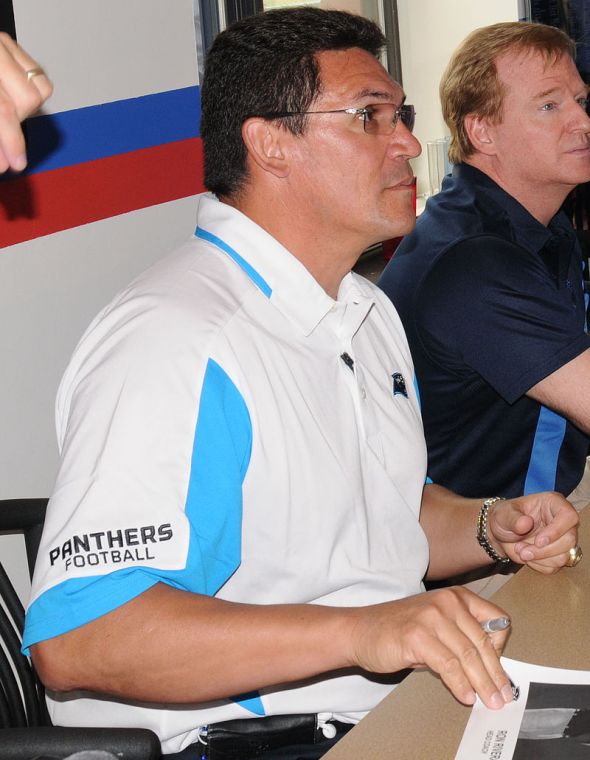
Photo Credit: Reginald RogersParaglide Carolina Panther head coach Ron Rivera, left, NFL Commissioner Roger Goodell and former Carolina Panthers player Mike Rucker sign autographs and photos for Soldiers at the 1st Brigade Combat Team dining facility Friday during their visit to the post.
against the Broncos’ Gary Kubiak:

DENVER, CO – AUGUST 29: Denver Broncos head coach Gary Kubiak wasn’t happy when the team had to call a timeout on defense in the second quarter of the preseason game against the Arizona Cardinals at Sports Authority Field at Mile High on Thursday, September 3, 2015. (Photo by Steve Nehf/The Denver Post)
Neither of them has written a book, nor have their personal philosophies been as parsed and examined as those of Belichick and Carroll. Still, from what we have available let’s take a look.
Ron Rivera was born on Fort Ord, right here in California, and he went to Seaside High in Monterey.


Fort Ord
His dad was a Puerto Rican born Army officer and his mom is Mexican. He’s not the first Hispanic head coach in the Super Bowl, though – that honor goes to Tom Flores of the Raiders:

Every week during team meetings, the 56-year-old Rivera chooses one pivotal play from the previous week’s game and plays the Spanish broadcast version for his players. Most don’t have a clue what the broadcasters are screaming about, but they holler in delight upon hearing the call.
So says this article in Citizen-Times. Everyone seems to agree Rivera is a decent, focused dude.
“On one side I’m getting a strong and deep sense of family, tradition and culture,” he says. “On the other side I’m getting this discipline and pride that you get growing up and living on Army bases.”
He won a Super Bowl himself with the ’85 Bears, a game I myself watched with disappointment during, if I remember right, a snowstorm.
He could’ve been in the famous “Super Bowl Shuffle” video but missed his chance:
Rivera could have been a part of the video, and gone down in music video (and YouTube) history, but he chose to sleep in instead.“Half the team showed up for it,” Rivera said. “Half stayed home and slept because it was a Monday night game. We didn’t get home until 4:30-5 o’clock in the morning.”
Pulling up his weekly presentations to the team, Rivera showed me how every one of them starts with a slide that says “Control Your A.P.E – Attitude, Preparation, Effort.” This emphasis on self-empowerment and responsibility has created a team culture of positive attitude, intense preparation and maximum effort.
On to Denver:
Gary Kubiak:

Photo by Eric Lars Bakke, AP
That’s the perspective behind this article, “Gary Kubiak and the Tao Of the Backup Quarterback” by Footbyballs over on SI’s The Cauldron.
As a backup Kubiak was on the sidelines for three Super Bowl losses. (He also won three as an assistant coach for the Broncos and 49ers). Elway as GM/EVP of the Broncos is still Kubiak’s boss.
Says Footyballs:
I don’t think it’s a stretch to say that Gary Kubiak is a Broncos’ franchise cornerstone. He played out his quarterback career. He did his job, stayed ready, and waited. Now, it’s his team to lead. The Broncos are doing just fine with the professional backup in charge, uneven seas and all. Maybe he’ll have a third career, as a writer, in which he gathers all his accumulated wisdom into a book of sorts. He could call it “Precepts of the Tao of the Backup Quarterback.”
I would definitely read that.
The more dynamic coach on the Broncos might be defensive coordinator Wade Phillips, himself a former head coach

and the son of NFL coach Bum Phillips:

can’t find source
whose Quotes section on his wiki page is worth a look:
- (20 years after playing Pittsburgh six times in two seasons) “Don’t take long to spend all the time you want in Pittsburgh.”[7]
- (referring to Miami Dolphins coach Don Shula) “He can take his’n and beat your’n and take your’n and beat his’n.”[8] He also said the same line about Bear Bryant.[9]
- (referring to Houston Oilers quarterback Warren Moon) “That boy could throw a football through a car wash and not get it wet.”
- (when asked about Oilers RB Earl Campbell’s inability to finish a one-mile run in training camp) “When it’s first and a mile, I won’t give it to him.”
- (when asked by Bob Costas why he took his wife on all of the Oilers’ road trips) “Because she’s too ugly to kiss goodbye.”[10]
Here’s a little trivia coworker Zack calls to my attention: who did both Ron Rivera and Gary Kubiak replace when they took over their current job?
Answer?:

John Fox
All things considered, this doesn’t seem like nearly the coaching duel of last year.
I give the psychological edge here to Rivera, and predict based on my patented Coaching Analysis System the Panthers will defeat the Broncos (and cover the six point spread).
As you can see here, my system has me at 1/3 total, but 1/1 on Super Bowls.
Kareem Abdul-Jabbar talks to Tyler Cowen
Posted: February 2, 2016 Filed under: America Since 1945, sports, the California Condition Leave a comment
Great interview. Kareem talks about how his love of Sherlock Holmes made him a better basketball player:

 About that action scene above:


Boyd, Trump and OODA Loops
Posted: January 28, 2016 Filed under: America Since 1945 Leave a comment
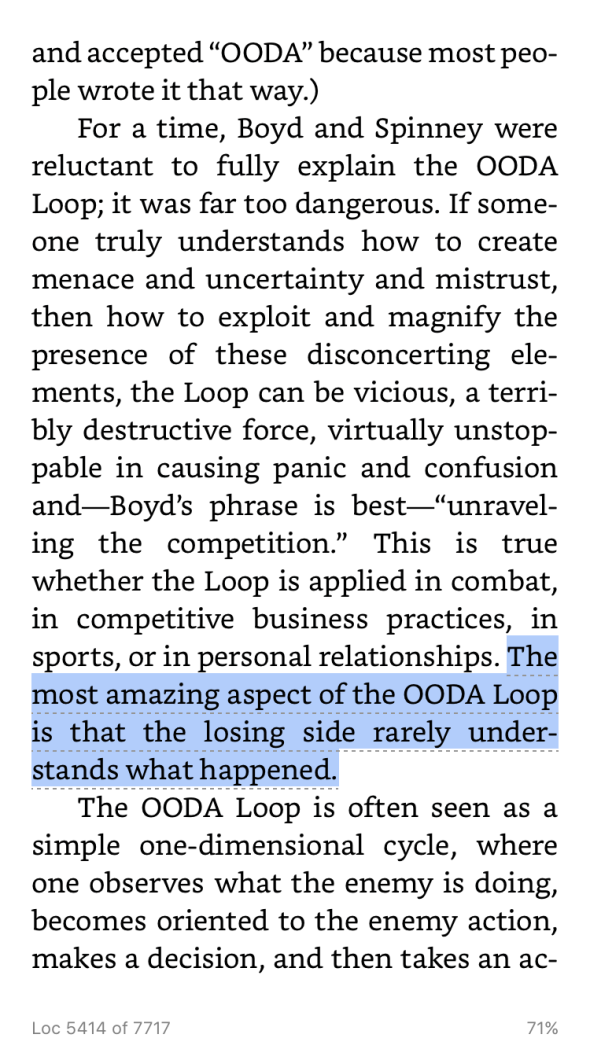
This very long article and this shorter one both talk about Donald Trump in light of the theories of fighter pilot/Air Force Colonel John Boyd, and specifically his idea about the OODA Loop.
OODA stands for:
Observe
Orient
Decide
Act
Boyd says, whoever cycles through this loop faster wins the dogfight (or battle, orbusiness competition, or whatever).
It’s more complicated than that: see, for example, this version of Boyd’s own chart to describe his ideas:
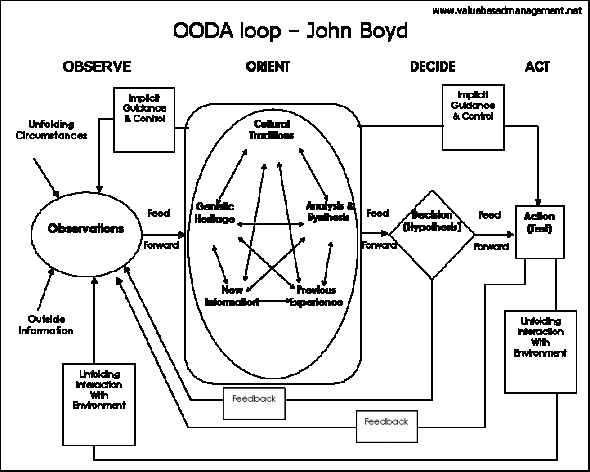
For one thing, the goal isn’t just to get through your cycle faster. It’s to screw up the other guy’s ability to get through his cycle.
In the longer version above about Trump, Dan McLaughlin makes the point that Trump, mainly via Twitter, is constantly messing with Bush and now Cruz’s abilities to observe, orient, decide and act. Before they’ve even oriented he’s changing the whole landscape with some new outrageous thing like declaring he’s not gonna show up to the debate or whatever.
These guys, with their lumbering organizations of consultants and campaign managers, and their political limitations, just can’t orient, decide, or act with the speed and freedom Trump can.
Boyd is a fascinating dude. I read once that he lived on basically a cot with no furniture because he decided the only ways to be truly free were either to be very wealthy or to have no material needs, and since he wasn’t gonna be wealthy he went full Spartan.
Seeing these articles convinced me it was finally time to pick up this book:
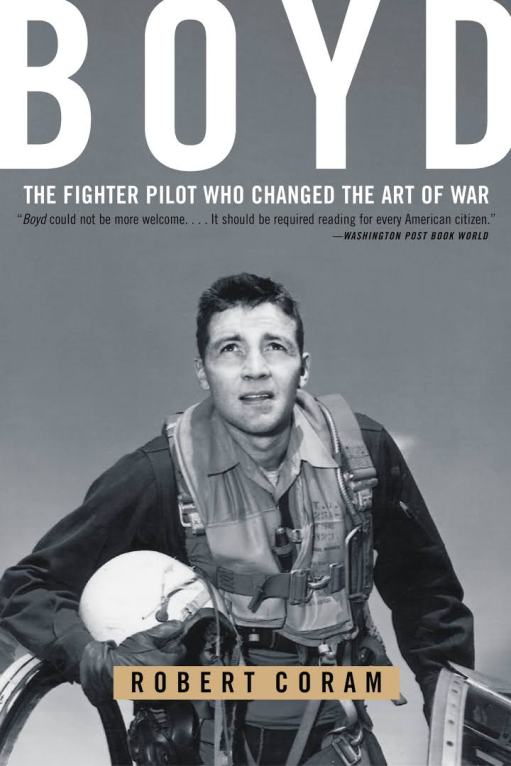
This book is fascinating, hats off to Robert Coram. Let me tell you a bit about Boyd:
- Boyd was considered the best fighter pilot of generation. He could supposedly defeat anybody in forty seconds. He was not humble about it either.
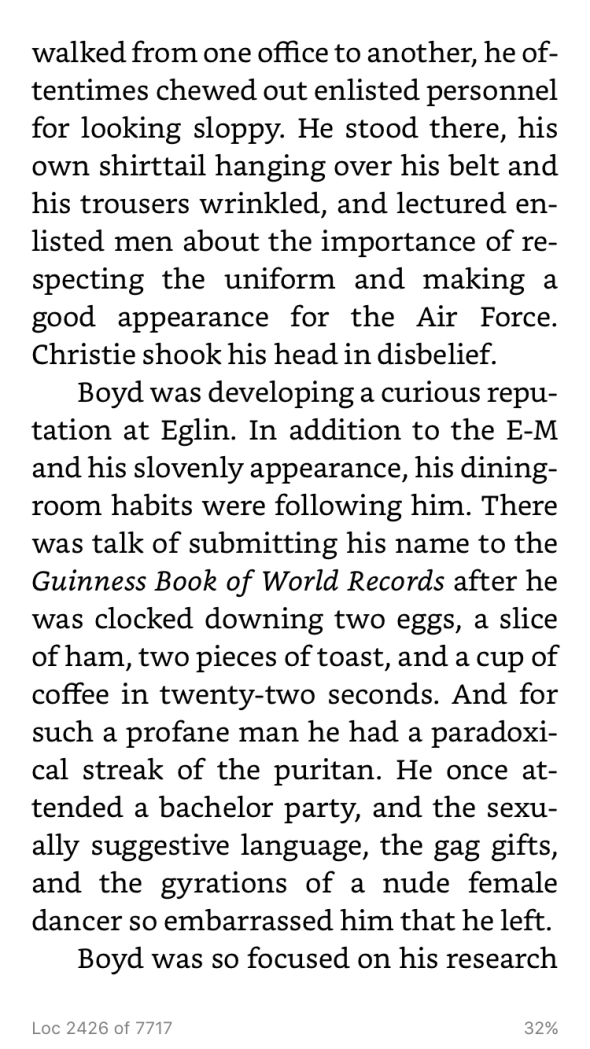
- He had an insane appetite:
- Although Boyd fought in the Korean War, he never shot down a MiG. This was considered kind of a knock on him by other fighter pilots who had shot down MiGs. But then again, everyone seems to agree Boyd was still the most badass or at least equally badass pilot around.
- He proved this during his time at the Air Force Weapons School at Nellis Air Force Base outside of Vegas. In Boyd’s heyday pilots looking to test their stuff would meet over “the green spot,” a rare patch of green in the Nevada desert, and practice dogfighting. Corum says the green spot could easily be found by any pilot. I went looking for a picture “green spot Nellis AFB” on Google, and in a development that would no doubt be distressing to Boyd found only medical marijuana stores. Maybe it was something like this?:

- Boyd was not really one for going along with the chain of command:
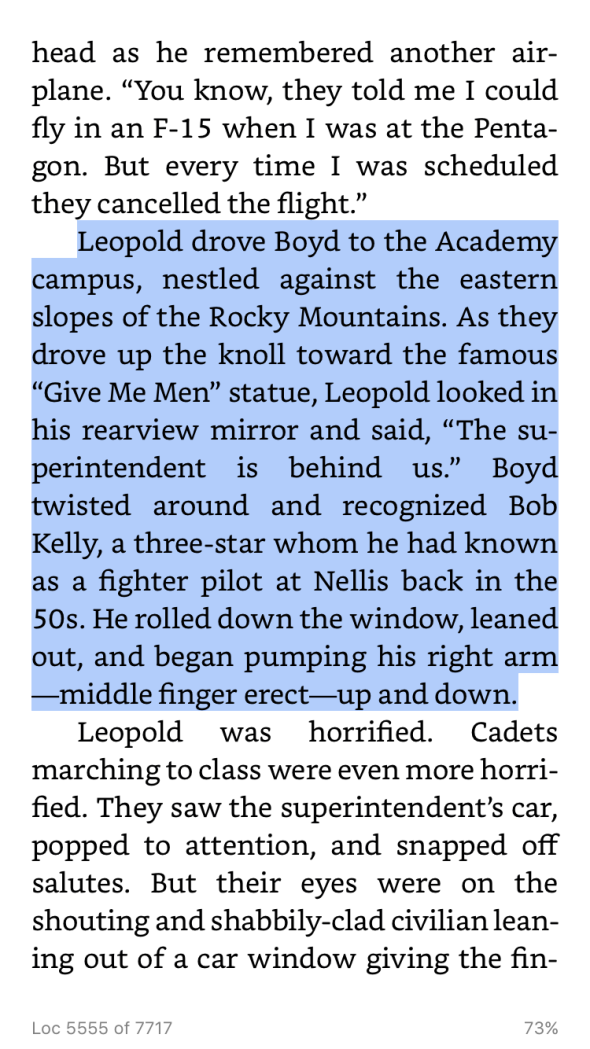
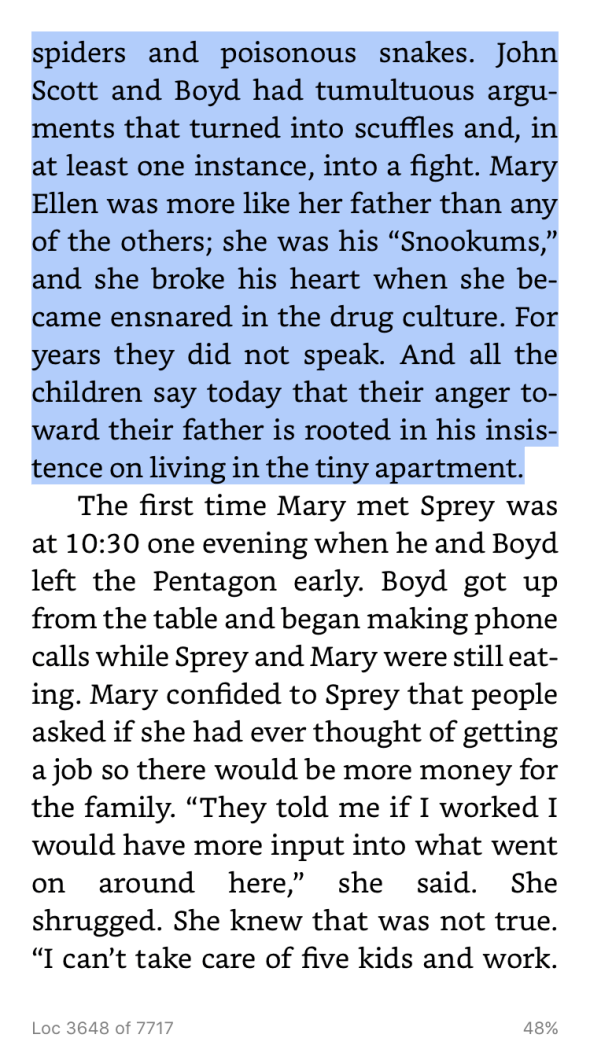
- Boyd did indeed believe in living in super Spartan fashion. This was not always easy on his wife and five children, nor on his youngest son’s collection of dangerous spiders and snakes:
- Boyd became obsessed with designing planes that would give the pilot the most possible options . He spent huge amounts of his own time developing Energy Maneuverability charts for various airplanes.
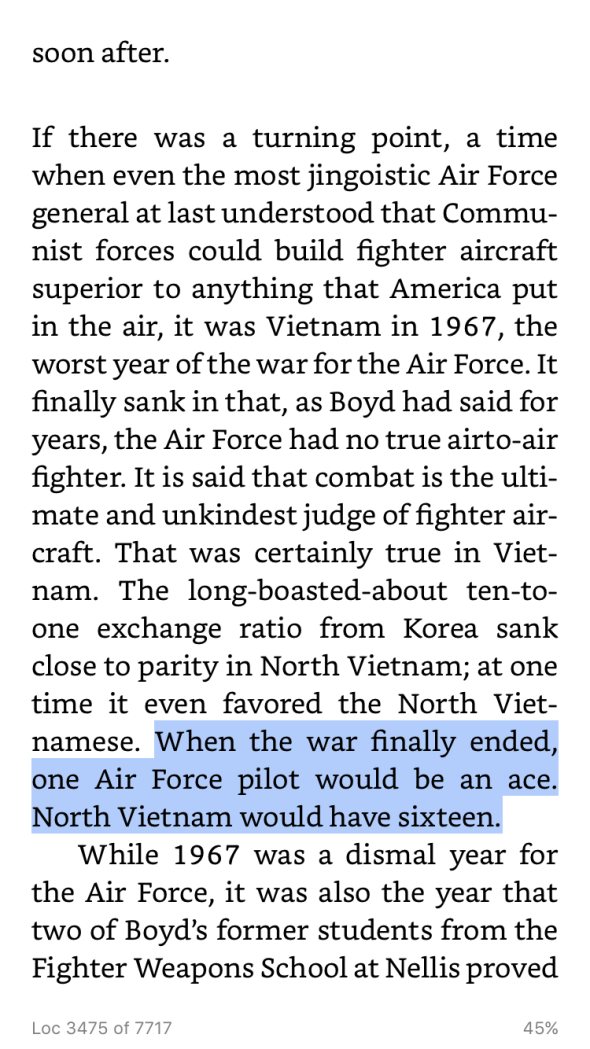
- He was infuriated and frustrated by the bureaucratic stupidities he discovered in the Air Force as he fought for what he believed to be superior airplane design. Reading Coram’s book, you can’t help but agree with Boyd and get outraged right along with him. For example, I did not have any idea that in the Vietnam War US planes were often found to be inferior to North Vietnamese planes:
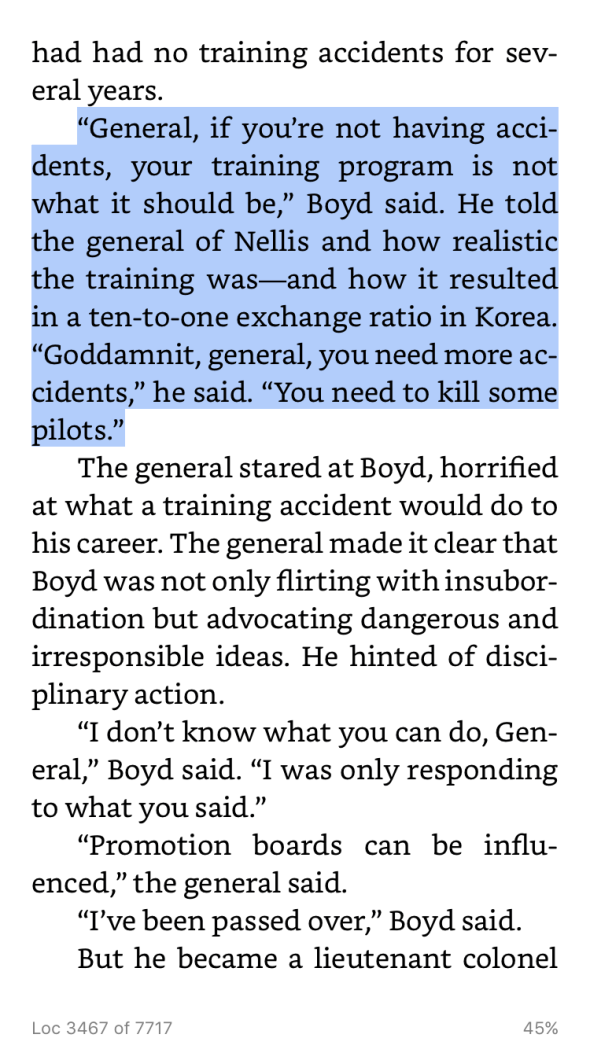
- Boyd also had strong opinions about pilot training:
- There were a group of admirers/pupils/younger officers around Boyd called his Acolytes. He would regularly call them at 2am and talk about Clausewitz and so on:
- Sometimes Boyd could be weird: “When Boyd talked to someone at a party, he gave them 100 percet of his attention. He did not look over the person’s shoulder to see who else was in the room. But there were times at a party when Boyd might sit down and sleep for an hour or so.”
- and:
Dick Cheney was impressed with Boyd, and says of him that Boyd “clearly was a factor in my thinking” about strategy in the first Gulf War.
On YouTube, you can see Boyd give the “Patterns Of Conflict” presentation that became famous in the military. It’s hard to look at this and see this guy as the amazing badass he must’ve been. Perhaps it was more compelling in person or the guy was no longer at the height of his presenting powers:
Maybe he just wasn’t made for YouTube.
There’s lots of bros obsessed with Boyd online, and he definitely seems like a real hero, a kind of American samurai. All the Boyd acolytes talk about a speech Boyd would give about whether you want to “be somebody or do something”:
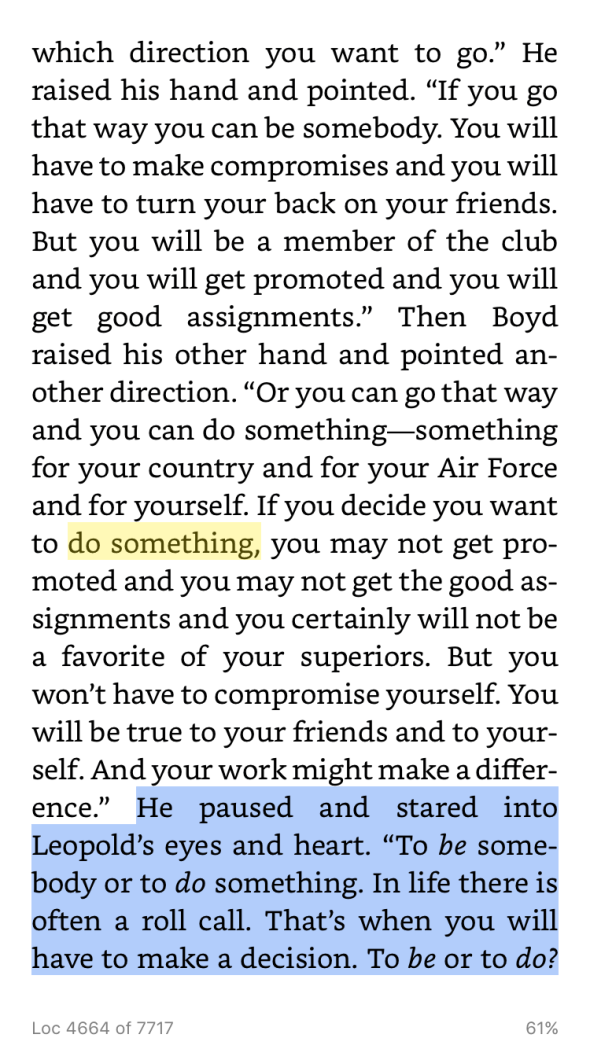
Something for all our candidates to think about!
Here’s another bit of advice for Trump’s opponents, especially:
If you enjoy Helytimes, you should write to helphely@gmail.com and ask to subscribe to Helytimes Premium — bonus content right to your inbox no more than once a month.
The Deaths Of Great Inventors
Posted: January 25, 2016 Filed under: America Since 1945, science Leave a comment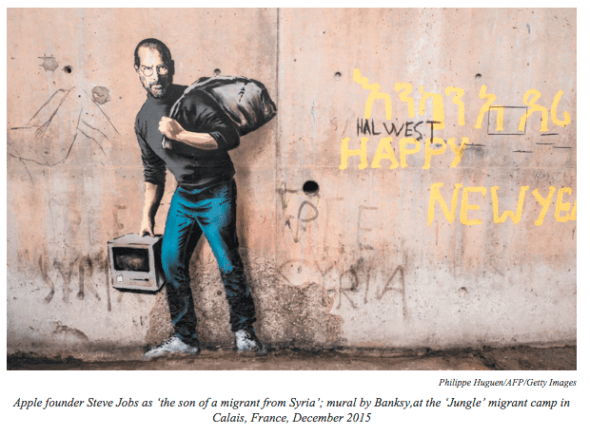
In this NYRB wrapup on the movies about Steve Jobs, Sue Halpern gets to talking about public expressions of grief at Jobs’ death:
Yet if the making of popular consumer goods was driving this outpouring of grief, then why hadn’t it happened before? Why didn’t people sob in the streets when George Eastman or Thomas Edison or Alexander Graham Bell died—especially since these men, unlike Steve Jobs, actually invented the cameras, electric lights, and telephones that became the ubiquitous and essential artifacts of modern life?
“Awww hell no!” I giddily squealed, aflame with the joy-fire of Internet Outrage. I was good and hot because I knew I had this Sue Halpern in my crosshairs. I’d just been reading, in Paul Johnson’s Birth Of The Modern, about the death of steamboat inventor Robert Fulton.

Says Johnson:
By then Fulton was dead, of a neglected cold which became pneumonia. The day of his funeral, the legislature went into mourning, and the New York shops shut — they respected inventors in those days.

stud.
Johnson’s doing the reverse version of Sue Halpern: “they knew how to act in the old days” vs. “we’ve gotten so weird” but it’s the same conservative (right?) point: things used to be better, more appropriate, whatever. It’s a point that I love getting mad about, because a quick inspection of the messy, insane past will usually prove it wrong.
“Ugh, Sue Halpern,” I thought, warm in smugness, “Don’t be such a presentist. There’s nothing new under the sun, babe. The style might be different, but they made a big show about the deaths of inventors (or maker/producer/facilitator whatever Jobs was) in the past, too. Did you not know that at the conclusion of Alexander Graham Bell’s funeral they suspended phone service in all of North America in mourning?! Did you not take two minutes to see if there’s footage on YouTube of people crowding the streets for Edison’s funeral?”
“Hell,” I thought, “when Edison died they preserved his last breath in a tube!”
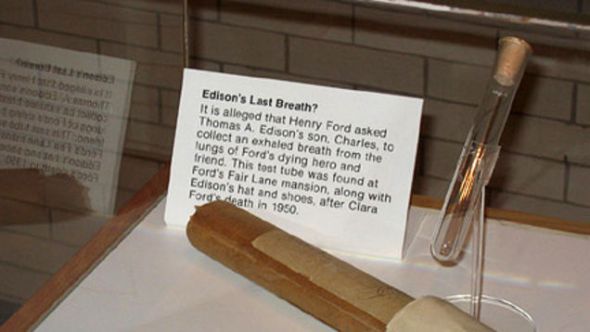
Imagine my disappointment then when I got to work and discovered the NYRB had already dealt with this in a footnote:
When Bell died, every phone exchange in the United States was shut down for a moment of silence. When Edison died, President Hoover turned off the White House lights for a minute and encouraged others to do so as well.
Darn it, ruined a real satisfying chance for an “ACTUALLY.” But I’m glad the whole thing happened because it got me reading about the death of George Eastman, founder of Kodak. Here’s how he went out:
On March 14, 1932, Eastman invited some friends to witness a change of his will. After some joking and warm conversation, he asked them to leave so that he could write a note. Moments later, he shot himself once in the heart with an automatic pistol. The note found by the household staff read simply: “To my friends, My work is done–, Why wait?” When his casket was carried out of the Eastman House, the accompanying music was *Marche Romaine*.
That’s from this site related to the PBS American Experience about Eastman. They go on:
If there is one thing that can be said about Eastman, it is that he was a rational man. Throughout his life, he sounded the same themes again and again — adventure, happiness and control, and the greatest of these was control. The early death of his father and his family’s subsequent poverty stamped him with an insatiable need for stability, which he found in bachelorhood and a financial empire and held close ever after. As far as he was concerned, there was no world beyond the one he could dominate. Even when he punctuated his labors with travel, his drive for order went with him in his compulsion to plan out every last detail of his itinerary. In this light, Eastman’s career can be seen as act of self-sacrifice. With one of his cameras in hand, it became possible to capture an instant of abandon, even happiness, and so we came to possess, as part of our human heritage, images of people smiling on adventures large and small. Of course, Eastman was often caught in camera in far-off locations as well, but in the end one fact is inescapable: one must look long and hard to find a picture of George Eastman smiling. In harnessing his impulses, he gave the world an experience that he never permitted himself.
Sure enough:

About Halpern’s original point tho: maybe there’s something to public expressions about Jobs’ death that have to do with what people use Apple products for: music, photos, videos, social media, personal expressions of themselves.
If we’re talking about the emotional meaning of Jobs, couldn’t we see him as the guy who did the most to take cold computers and turn them into facilitators of human connection and self-expression machines? Isn’t that what all Apple ads end up being about, from the 1984 ad to the Think Different ones to this?:
In doing that, wasn’t Jobs not just a tech pioneer but a part of a social revolution? Who more than Jobs made it as easy to be the star of your own movie and the spectator of everyone else’s? Is that why we care about him?
And is caring about Jobs wildly exaggerated anyway except among Silicon Valley bros? Nobody really saw the movie.
Why wear clothes?
Posted: January 23, 2016 Filed under: America Since 1945 Leave a comment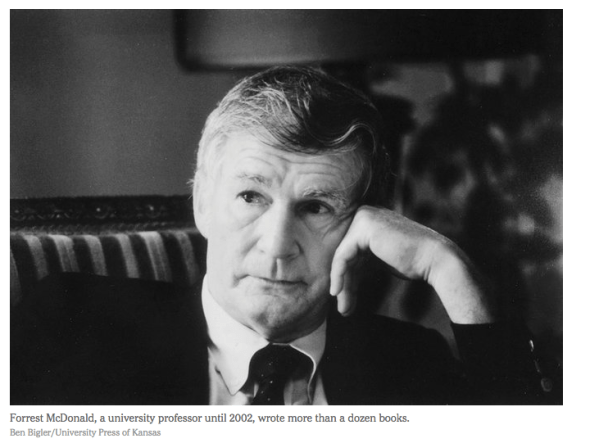
From this NYT obit of constitutional scholar Forest McDonald:
Interviewed by Brian Lamb on C-Span’s “Booknotes” in 1994, Dr. McDonald revealed that he typically wrote in longhand on a yellow legal pad and in the nude. (“We’ve got wonderful isolation,” he said, “and it’s warm most of the year in Alabama, and why wear clothes?”)
Experimental film
Posted: January 20, 2016 Filed under: America, America Since 1945, film Leave a comment
I made a one minute experimental film of Trump watching Sarah Palin talk.
What.
Posted: January 17, 2016 Filed under: America Since 1945, food, New York Leave a comment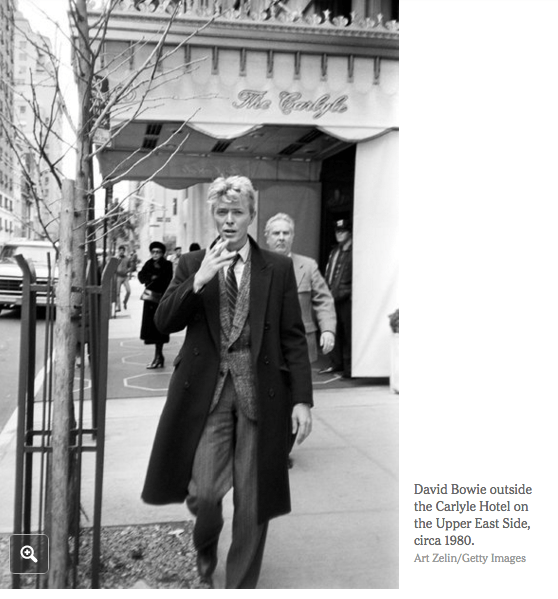
Can’t front like I was the world’s biggest David Bowie fan in life, but reading about him after his death I’m getting more and more into the guy! From The New York Times:
After he became Ziggy Stardust, and a huge star, Mr. Bowie found refuge at the West 20th Street apartment of his publicist, Cherry Vanilla. In her memoir, “Lick Me,” she recounts how he would do brain-sizzling amounts of cocaine and drink milk for nourishment (no solid food in those years), and they’d rap about “power, symbols, communication, music, the occult, Aleister Crowley and Merlin the Magician.”
Says Cherry Vanilla:
David liked my apartment on 20th Street, and he also liked Norman Fisher’s coke, something for which he’d recently acquired an insatiable appetite and for which I had, of course, hooked him up. And since my days were winding down at Mainman, I guess David felt comfortable getting high with me and opening up about anything and everything that was on his mind. He spent many an evening, often an all-nighter, sitting in one of my canary-yellow enameled wicker chairs, doing lines, drinking milk (he never ate at all during this period), and telling me one crazy story after another — Defries and Adolf Hitler were buddies . . . Lou Reed was the devil . . .he himself was from another planet and was being held prisoner on earth — going on and on about power, symbols, communication, music, the occult, Aleister Crowley, and Merlin the Magician. I never did any of David’s coke (and, what’s more, he never offered). I just sat there, smoked my pot, sipped my Café Bustelo, and got totally into his rap. This was probably the period when I was most in love with him.
Sometimes David would busy himself with my record collection — Duke Ellington’s Live at Newport and the Ohio Players’ Skin Tightamong his favorite LPs. And occasionally he and I would have sex in my mirrored, mosquito-netted, dycro-lit, pink-satin bedroom, taking everything a bit further than we had that first time in Boston, and utilizing the many new sex toys I’d since acquired. One time, after I’d arranged for him to shop privately at the new Yves Saint Laurent boutique on Madison Avenue and get the most fabulous black wool overcoat, he came up the five flights of stairs to my apartment, and fucked me without ever taking off the coat and then left immediately to hang out with Mick Jagger. Bowie liked my bedroom so much, he even brought Claudia Lennear and Jean Millington (the other sister from Fanny) there for sex on occasion. I didn’t participate, but I got off on how much he appreciated the setting.
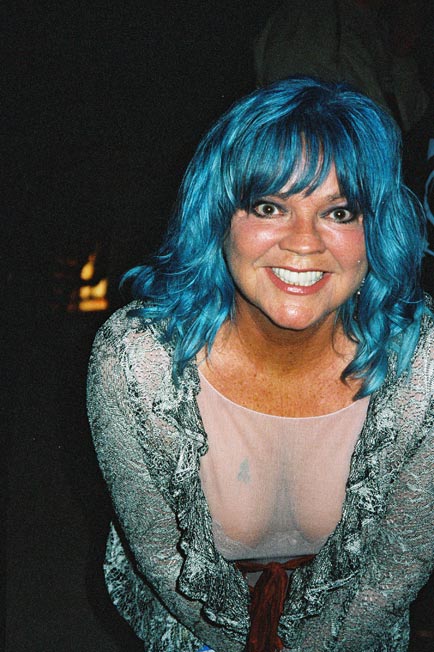
photo from Cherry Vanilla’s website attributed to Arlene Pachasa
The Dilbertito
Posted: January 17, 2016 Filed under: America Since 1945, food, the California Condition Leave a comment
Dilbert creator Scott Adams has many interesting ideas. Reader Mike Yank put me on to his analysis of Trump:
The $10 billion estimate Trump uses for his own net worth is also an “anchor” in your mind. That’s another classic negotiation/persuasion method. I remember the $10 billion estimate because it is big and round and a bit outrageous. And he keeps repeating it because repetition is persuasion too.
I don’t remember the smaller estimates of Trump’s wealth that critics provided. But I certainly remember the $10 billion estimate from Trump himself. Thanks to this disparity in my memory, my mind automatically floats toward Trump’s anchor of $10 billion being my reality. That is classic persuasion. And I would be amazed if any of this is an accident. Remember, Trump literally wrote the book on this stuff.
Over the holidays I read Scott Adams’ book:
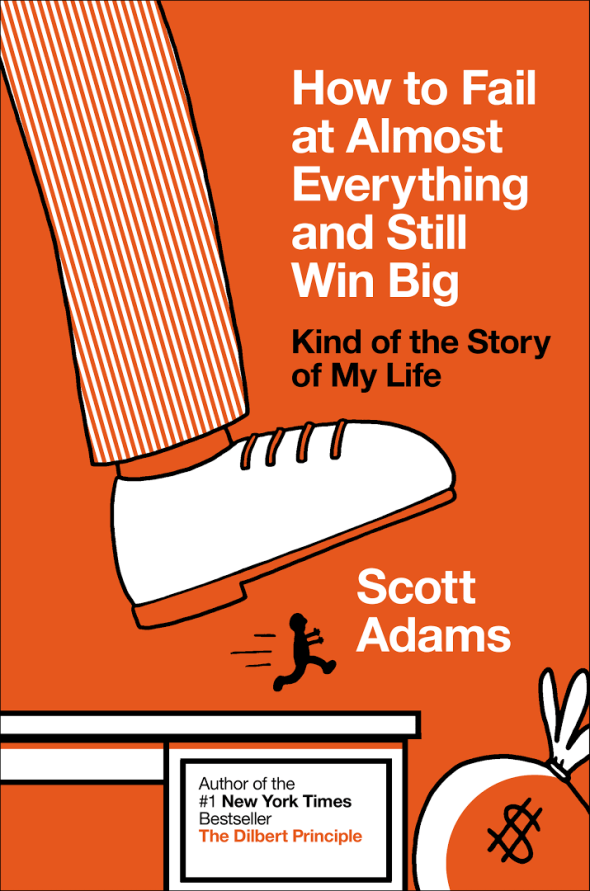
which was full of interesting stuff as well as plenty of boring stuff. Scott Adams practical, experienced-based ideas on what you should eat, for instance: he talks about how he has found that white starches and potatoes (my two favorite foods) are nothing but energy saps. Adams also suggests you drink as much coffee as you want. He also makes a good case for “systems instead of goals.”
On Friday at work I got into an argument because I brought up Scott Adams, and a female co-worker was like “that crazy misogynist”? And indeed Scott Adams has written some stuff that could justifiably make steam come out of ears:
Women have made an issue of the fact that men talk over women in meetings. In my experience, that’s true. But for full context, I interrupt anyone who talks too long without adding enough value. If most of my victims turn out to be women, I am still assumed to be the problem in this situation, not the talkers. The alternative interpretation of the situation – that women are more verbal than men – is never discussed as a contributing factor to interruptions. Can you imagine a situation where – on average – the people who talk the most do NOT get interrupted the most? I don’t know if the amount of talking each person does is related to the amount of interrupting they experience, or if there is a gender difference to it, but it seems like a reasonable hypothesis. My point is that men are assumed guilty in this country. We don’t even explore their alibis. (And watch the reaction to even bringing up the topic.)
It’s an ongoing issue in his writings.
I can’t and don’t want to defend everything Scott Adams has written, but I tried to make the case that maybe Scott Adams isn’t a misogynist, he’s a nerdy weirdo who’s working out ideas and we should cut him some slack. I read all kinds of weird thinkers, it’s healthy. I follow The Federalist on Twitter — they like Ted Cruz over there, but sometimes they make some interesting argument I’ve never thought about before. You can read The Federalist and Mother Jones and subscribe to Ann Friedman’s newsletter and go see the Entourage movie.
Somebody somewhere on Twitter directed me to this piece by Ryan Holiday:
Any publicist will tell you this. A scandal is awful while you’re in it, almost unbearably awful as the headlines from bigger and bigger outlets pour in. But as time passes, whatever those headlines said begins to blur, the pointed words lose their potency and the residue that’s left, that residue is raw fame. And fame is a precious resource that most people, companies, and causes will never have but always seek.
And while people have always been willing to debase themselves to get famous, this mindset has metastasized through our more important institutions—from journalism to government.
The Gawker’s of this world publish the most vicious and shameful story of 2015, and as long as their writers can successfully pretend they didn’t do anything wrong, they can get right back on their high horse and blog like it never happened. A Donald Trump can make serious—even alarming—progress towards the nation’s highest office so long as he refuses to laugh at the joke of it all.
One can imagine these folks surfing a large and monstrous wave of attention. It looks dangerous and indeed it is, but they know—having been on or watched others on such waves before—that if they can just ride it out they’ll emerge intact, ever the more famous for it, since so few have.
Anyway this all a long way of getting to the interesting trivia that in the late ’90s Scott Adams used his Dilbert money to try and launch an all-in-one superfood product called the Dilberito:
First announced in The Dilbert Future and introduced in 1999[1] the Dilberito came in flavors of Mexican, Indian, Barbecue, and Garlic& Herb and was sold through some health food stores.
Said Fortune in 2001:
Adams’s invention, the Dilberito, is sober and utilitarian. It’s a tortilla-wrapped comestible consisting of vegetables, rice, beans, and seasonings that contains all of the 23 vitamins and minerals that nutritionists say are essential.
The product was not a success.
All Roads
Posted: January 15, 2016 Filed under: America Since 1945, heroes, music, the California Condition, war Leave a comment
Happening to watch half of Jarhead on TV (Saarsgaard so good! *) leads to reading screenwriter William Broyles Jr.’s Wiki page, which leads to reading his essay “Why Men Love War”:
A lieutenant colonel I knew, a true intellectual, was put in charge of civil affairs, the work we did helping the Vietnamese grow rice and otherwise improve their lives. He was a sensitive man who kept a journal and seemed far better equipped for winning hearts and minds than for combat command. But he got one, and I remember flying out to visit his fire base the night after it had been attacked by an NVA sapper unit. Most of the combat troops I had been out on an operation, so this colonel mustered a motley crew of clerks and cooks and drove the sappers off, chasing them across tile rice paddies and killing dozens of these elite enemy troops by the light of flares. That morning, as they were surveying what they had done and loading the dead NVA–all naked and covered with grease and mud so they could penetrate the barbed wire–on mechanical mules like so much garbage, there was a look of beatific contentment on tile colonel’s face that I had not seen except in charismatic churches. It was the look of a person transported into ecstasy.
And I–what did I do, confronted with this beastly scene? I smiled back. ‘as filled with bliss as he was. That was another of the times I stood on the edge of my humanity, looked into the pit, and loved what I saw there. I had surrendered to an aesthetic that was divorced from that crucial quality of empathy that lets us feel the sufferings of others. And I saw a terrible beauty there. War is not simply the spirit of ugliness, although it is certainly that, the devil’s work. But to give the devil his due,it is also an affair of great and seductive beauty.
Which leads me to decide to finally read Chris Hedges’ book War Is A Force That Gives Us Meaning:
Chris Hedges was a graduate student in divinity at Harvard before he went to war. He spent fifteen years as a war correspondent for the Dallas Morning News, theChristian Science Monitor, and the New York Times, reporting on conflicts in El Salvador, Bosnia, Kosovo, and Iraq.
While on Amazon their robot recommends to me Ernst Jünger’s Storm Of Steel —

that’s a pass for now, but I will check out Ernst’s Wiki page:
Throughout the war, Jünger kept a diary, which would become the basis of his 1920 Storm of Steel. He spent his free time reading the works of Nietzsche, Schopenhauer, Ariosto andKubin, besides entomological journals he was sent from home. During 1917, he was collecting beetles in the trenches and while on patrol, 149 specimens between 2 January and 27 July, which he listed under the title of Fauna coleopterologica douchyensis (“Coleopterological fauna of the Douchy region”).

a leatherhead beetle in Death Valley illustrates the wiki page on coleopterology
which leads me to the wiki page for Wandervogel:
Wandervogel is the name adopted by a popular movement of German youth groups from 1896 onward. The name can be translated as rambling, hiking, or wandering bird (differing in meaning from “Zugvogel” or migratory bird) and the ethos is to shake off the restrictions of society and get back to nature and freedom.
which leads us both to the Japanese pastime of sawanobori, which looks semi-fun:

a bit silly but in the best way
and to History Of The Hippie Movement, subsection “Nature Boys Of Southern California” and thus to Nat King Cole’s song Nature Boy:
which has maybe the longest wiki page of any of these, culminating in
The song was a central theme in Luhrmann’s Moulin Rouge! “Nature Boy” was initially arranged as a techno song with singer David Bowie’s vocals, before being sent to the group Massive Attack, whose remix was used in the film’s closing credits. Bowie described the rendition as “slinky and mysterious”, adding that Robert ‘3D’ Del Naja from the group had “put together a riveting piece of work,” and that Bowie was “totally pleased with the end result.”
And just like that we’re back to Bowie.
*Saarsgaard on Catholicism:
In an interview with the New York Times, Sarsgaard stated that he followed Catholicism, saying: “I like the death-cult aspect of Catholicism. Every religion is interested in death, but Catholicism takes it to a particularly high level. […] Seriously, in Catholicism, you’re supposed to love your enemy. That really impressed me as a kid, and it has helped me as an actor. […] The way that I view the characters I play is part of my religious upbringing. To abandon curiosity in all personalities, good or bad, is to give up hope in humanity.”
RIP Red
Posted: January 14, 2016 Filed under: America Since 1945, music, the California Condition Leave a comment
It’s not just Bowie — this week music also lost Red Simpson, writer/performer of the above song (discussed briefly in this book).
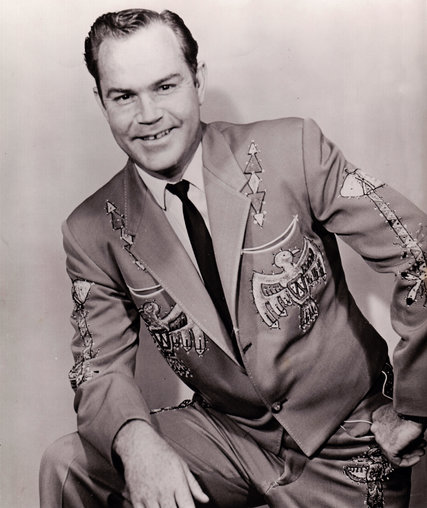
From his NY Times’ obituary I learn that he performed regularly at Trout’s:

pic from this interesting blog: https://wayfarenotes.wordpress.com/ “Stories of Music Towns you Haven’t heard of yet”
Joseph Cecil Simpson was born on March 6, 1934, in Higley, Ariz., the youngest of 13 children, and grew up in Bakersfield, where he learned to play guitar as a child. His red hair earned him his nickname.
He enlisted in the Navy during the Korean War and served on the hospital ship Repose, where he played with a shipboard group, the Repose Ramblers.

Speaking of Simpsons, I can’t hear about a ship like this without thinking of the Simpsons’ landing on the USS Walter Mondale:
but the Repose had a dramatic history:
Arriving on 3 January 1966, she was permanently deployed to Southeast Asia and earned the nickname “Angel of the Orient.” Operating mainly in the I Corps area, she treated over 9,000 battle casualties and 24,000 inpatients while deployed. Notably, USS Repose was on station during the 1967 USS Forrestal fire that killed 134 sailors and injured 161.

the Forrestal fire. Future Senator John McCain’s plane was destroyed in the fire — one of many exciting events in his not-boring life.
According to Wiki Red’s last release was “Hey Bin Laden” but I cannot find that tune on YouTube.
I wonder if Red liked Bowie.
REMINDER: if you enjoy Helytimes, subscribe to Helytimes Newsletter by emailing helphely@gmail.com. No more than one email a month, with bonus content and fun!
Travel Tips From Bill and Tony
Posted: January 8, 2016 Filed under: America Since 1945, politics, presidents, travel 1 Comment
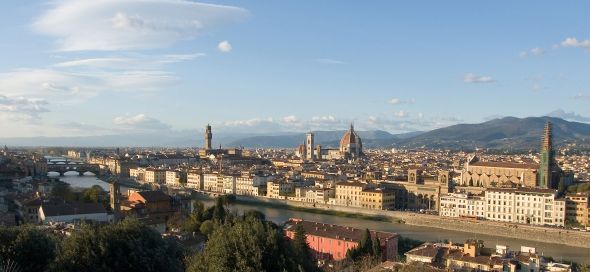
Bonn
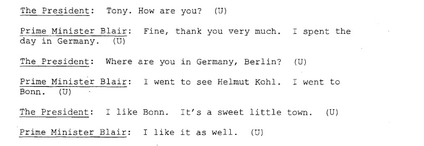
Fascinated with these recently released transcripts of convos between Tony Blair and Bill Clinton.
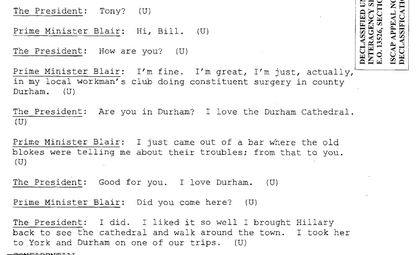

There’s not a ton of chitchat, aside from some travel discussion.
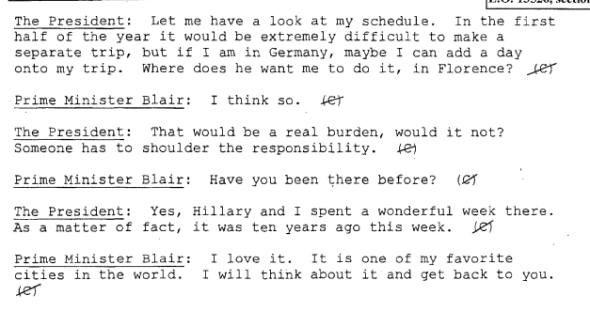
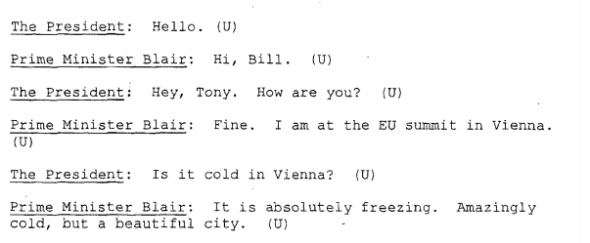
Tony also likes Vienna:

Bill likes Siena:
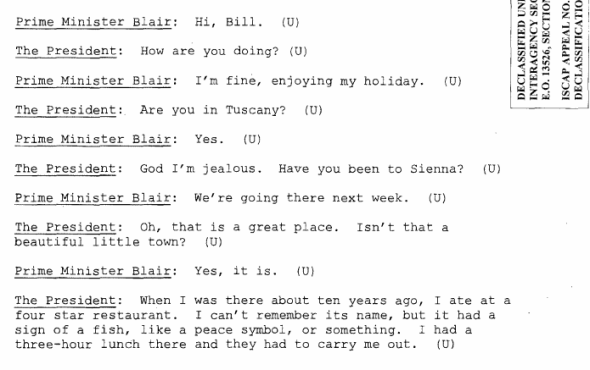
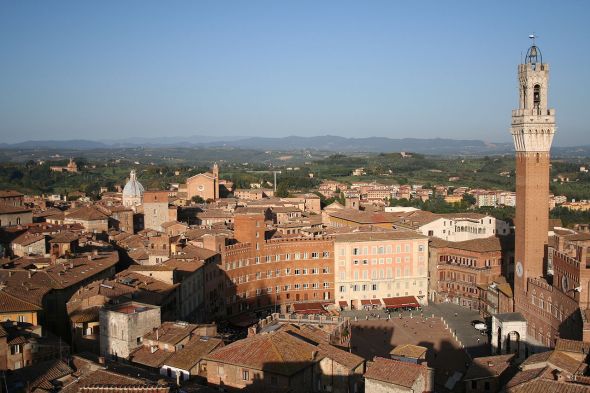
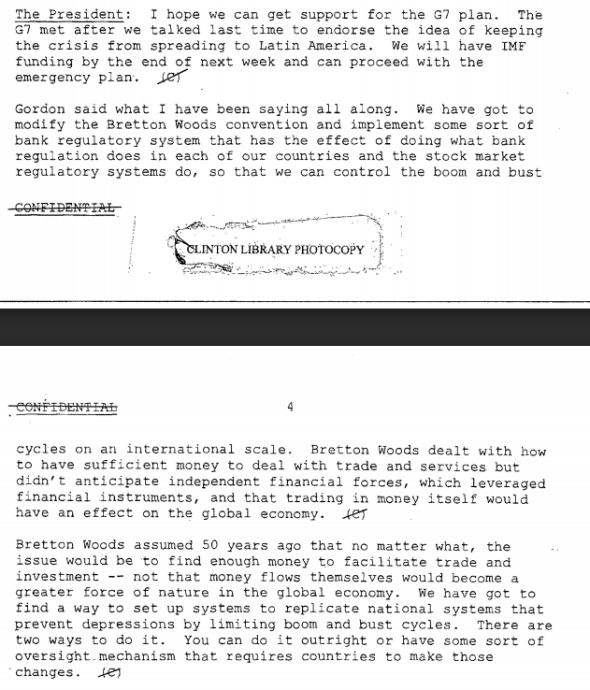
Billiam does most of the talking. One takeaway is how insanely expansive and versatile BC’s mind is as he pivots from topic to another:
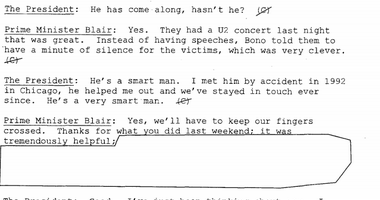
He thinks highly of Bono:
The only other cultural figures I found mentioned are Spielberg and Tom Hanks:

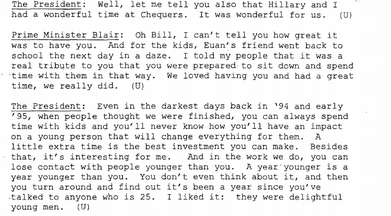
Bill reminds Tony Blair of the importance of taking time for young people:
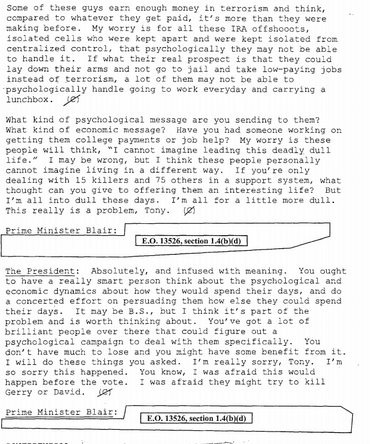
Talking about IRA splinter groups, Bill Clinton raises a problem that’s still all too relevant:
Bill sums up Central America:

But as they mention often, they’re not on a secure line. Who knows what they say there?!

