Charlie Rose Memories
Posted: December 11, 2019 Filed under: America Since 1945, writing Leave a comment
 There was a period when I was working on a novel, not working a steady job, and I figured, “I should make sure I at least hear an hour of human conversation a day.” That was the time in my life when I watched the most Charlie Rose.
The Charlie Rose Show website used to be elegantly organized. It’s still good, but there was a neat way it used to be indexed, there was section called like “writers on writing” I appreciated.
Charlie Rose has now been banished for his crimes which sound bad enough. Sometimes in the wake of what’s (perhaps unfortunately) called “the MeToo movement” I hear like “well what about due process?!” or arguments along those lines. But shouldn’t our public media gatekeeper/narrative shapers be not just merely not sex pests, but in fact above reproach? Couldn’t we have higher standards for our public broadcasters?
This got me riled about about Brett Kavanaugh as well — like, can’t we find someone for the Supreme Court who can’t be credibly accused of anything? I believe it is possible!
Anyway. Here are some memories of moments on Charlie Rose that stuck in my craw:
- The Franzen/DFW/Mark Leyner “Future of Fiction” episode
- When John Grisham was on, and Charlie asked him “what advice would you give to an aspiring writer?” Grisham said, “figure out where you’re going to get your paycheck from.”
- Charlie needling David McCullough about selling the rights to John Adams to Tom Hanks. McCullough was going on about how Hanks came to him with the book all marked up and noted, and how THAT was what convinced him. Charlie: “But surely some money changed hands, David.”
- Charlie would often say to a guest, who was just back from Iraq or whatever, “take me there.” (In fact, I think Charlie himself even called attention to this technique.
- Charlie referencing his “girlfriend”
- In a Remembering John Updike episode, David Remnick (or maybe Updike’s editor, or both) noting that Updike wanted to “get it all down.” Like, all of life, his every thought. Is this a good instinct?
- Charlie saying “c’mon, Toby” to Tobias Scheeman’s bullshit justification about why he had sex with a Papua New Guinean tribesman in Keep The River On Your Right
Plans are worthless, but planning is everything
Posted: May 14, 2019 Filed under: America Since 1945, war, writing, WW2 Leave a comment
During a speech in November 1957 Eisenhower employed the saying again. He told an anecdote about the maps used during U.S. military training. Maps of the Alsace-Lorraine area of Europe were used during instruction before World War I, but educational reformers decided that the location was not relevant to American forces. So the maps were switched to a new location within the U.S. for planning exercises. A few years later the military was deployed and fighting in the Alsace-Lorraine: 2
I tell this story to illustrate the truth of the statement I heard long ago in the Army: Plans are worthless, but planning is everything. There is a very great distinction because when you are planning for an emergency you must start with this one thing: the very definition of “emergency” is that it is unexpected, therefore it is not going to happen the way you are planning.
so says Quote Investigator. Eisenhower’s speech can be found here. Nixon picked up the quote in

I remember learning at the Nixon library about Nixon’s writing routine when he wrote this book in a house in Apple Valley, CA:
He used a Dictaphone or wrote longhand, working in seclusion, according to Esquire Magazine.
For breakfast, he ate a bowl of Grape Nuts and drank a can of orange juice. He wrote until noon, then paused for a ham sandwich.
Believe I first heard Eisenhower’s quote from Jeff Melvoin at a WGA showrunner training like mini-camp. I’ve found it profound.
One time a female Uber driver told me the secret to winning over women is “plan ahead.”
A brief skim of Eisenhower images on NARA.GOV leads us to this gem

General Eisenhower’s dog, Telek, poses for photographers on top of desk. [65-658]
Busy
Posted: April 10, 2019 Filed under: America Since 1945, writing Leave a comment
Noticed something about myself, but maybe it’s true for you, too. I am most productive when I am a certain level of “busy.”
When I have absolutely nothing to do, like zero, I rarely get anything done.
There’s a level of overwhelmedment where I am also useless.
But at just the right level of medium busy, my machinery hums and I get a lot done.
Surely there’s meaning in this!
(Image found by doing a search on NARA.gov for “busy.”
Original Caption: Older Citizens, Retired Persons and Those Unable to Care for Themselves Physically Are Cared for in Two Community Centers. This Man Lives at the Highland Manor Retirement Home, Keeping Busy with “Old Country” Crafts. New Ulm Is a County Seat Trading Center of 13,000 in a Farming Area of South Central Minnesota. It Was Founded in 1854 by a German Immigrant Land Company That Encouraged Its Kinsmen to Emigrate From Europe.
U.S. National Archives’ Local Identifier: 412-DA-15875
Photographer: Schulke, Flip, 1930-2008
Subjects:
New Ulm (Brown county, Minnesota, United States) inhabited place
Environmental Protection Agency
Project DOCUMERICA
Persistent URL: arcweb.archives.gov/arc/action/ExternalIdSearch?id=558325
)
Paul Beatty’s Literature From Los Angeles Class
Posted: April 4, 2019 Filed under: the California Condition, writing Leave a commentOV: You teach an MFA class at Columbia called Literature from Los Angeles. Why didyou decide to do that?
PB: Why? I guess my reason is twofold. I stole the idea from a friend of mine who actually taught a class like that. She’s always complaining, “These kids never have any setting!” So I wanted to talk about setting and what setting means, not just in terms of place but what the notions of setting are. So it’s partly that. And partly a way of getting the students to read stuff they haven’t read before. So we read Chester Himes, we read Michael Jaime-Becerra; we read Wanda Coleman, we read Karen Tei Yamashita; we readBret Easton Ellis, we read Bukowski. We read a ton of stuff.
I’d like to take the class Paul Beatty lays out in this LitHub interview. Sent me to learn about Chester Himes.

Mike Davis in City of Quartz: Excavating the Future of Los Angeles, describing the prevalence of racism in Hollywood in the 1940s and ’50s, cites Himes’ brief career as a screenwriter for Warner Brothers, terminated when Jack L. Warner heard about him and said: “I don’t want no niggers on this lot.”[4] Himes later wrote in his autobiography:
Up to the age of thirty-one I had been hurt emotionally, spiritually and physically as much as thirty-one years can bear. I had lived in the South, I had fallen down an elevator shaft, I had been kicked out of college, I had served seven and one half years in prison, I had survived the humiliating last five years of Depression in Cleveland; and still I was entire, complete, functional; my mind was sharp, my reflexes were good, and I was not bitter. But under the mental corrosion of race prejudice in Los Angeles I became bitter and saturated with hate.
Suttree
Posted: March 27, 2019 Filed under: America Since 1945, books, cormac, writing Leave a comment
Moving stuff around in my house I found the handwritten list of words I had to look up from Suttree, by Cormac McCarthy, and their definitions.


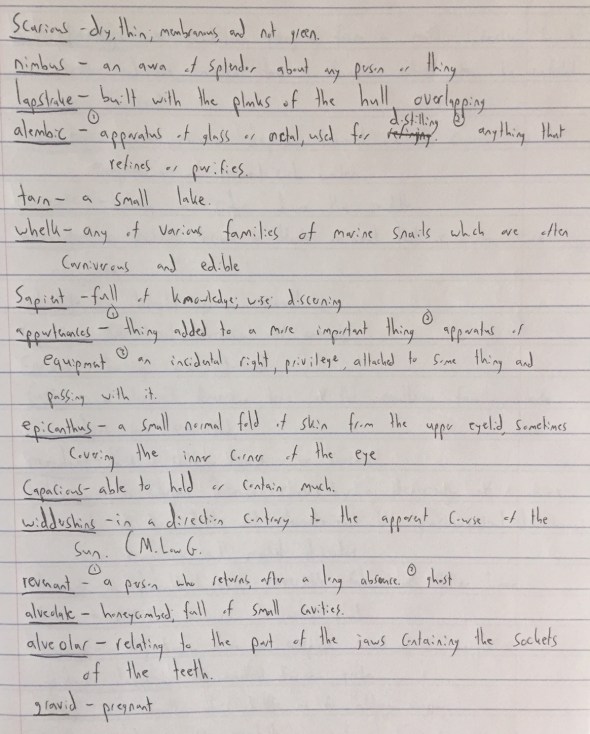

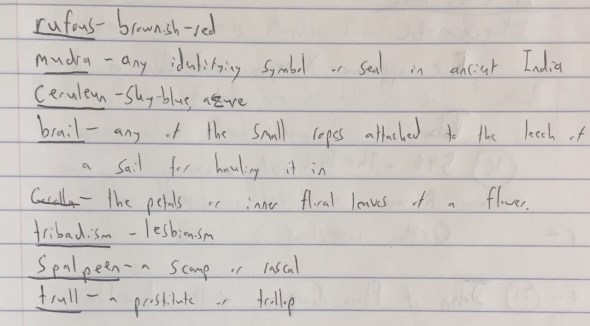
Trull: a prostitute or a trollop.
Tellurian: an inhabitant of Earth.
Feels like I used to have a lot more spare time.
Suttree is set along the river in Knoxville, TN.

If you think Suttree might be for you, try the first sentence:
Dear friend now in the dusty clockless hours of the town when the streets lie black and steaming in the wake of the watertrucks and now when the drunk and the homeless have washed up in the lee of walls in alleys or abandoned lots and cats go forth highshouldered and lean in the grim perimeters about, now in these sootblacked brick or cobbled corridors where lightwire shadows make a gothic harp of cellar doors no soul shall walk save you.

John Wayne
Posted: February 20, 2019 Filed under: America Since 1945, writing 1 Comment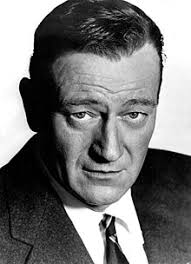
some recent Twitter stir about John Wayne’s unwoke Playboy interview from the ’70s got me looking up a phrase that stuck in my craw since I read it. It’s Charles Portis, author of True Grit, telling his impression of seeing Wayne on a movie set.
What impressions do you have of John Wayne from the film?
“Wayne was a bigger man than I expected. He was actually bigger than his image on screen, both in stature and presence. One icy morning, very early, before sunrise, we were all having breakfast in a motel…. A tourist came over to speak. Wayne rose to greet her. He stood there, not fidgeting and just hearing her out, but actively listening, and chatting with her in an easy way, as his fried eggs congealed on the plate. I took this to be no more than his nature. A gentleman at four o’clock on a cold morning is indeed a gentleman.”
Found that here on the Fort Smith National Historic Site website.
On Tactics by B. A. Friedman
Posted: February 15, 2019 Filed under: America Since 1945, war, writing Leave a comment This book is an excellent size and weight. Small, portable, yet solid. It’s published by the Naval Institute Press, they who took a chance on an unknown insurance man named Tom Clancy who’d written a thriller called The Hunt For Red October.
Amazon suggested this book to me as I was browsing translations of Sun Tzu. Military history has interested me since I was a boy, maybe because 1) the stakes are so high and 2) the stories are so vivid. Metaphors and similes drawn from famous war events are powerful and stark. Consider for example Friedman’s description of the Battle of the Bulge:
… Although the Germans had caught the Allies at their culminating point, the Germans reached their own far too early. Newly created infantry units were filled with hastily trained and inexperienced conscripts. These green units could not effectively hold the territory gained by the leading panzer units. On 22 December the fog cleared and Allied air units hammered the German formations from the skies. Despite the prestaged fuel reserves, panzer units still ran out of fuel, just when they needed it to escape the Allied aerial counterattack.
Buried in there is a tactical lesson, and also an intense story about some poor children getting blown up right before Christmas.
The author was a second lieutenant in the Marine Corps. If I understand right, might make this book the equivalent of a book called like Writing A Hit TV Show by a staff writer. But Friedman seems like he’s gone deep on the knowledge, and there’s a quote from Gen. Anthony Zinni on the back. Good enough for me.
Alexander The Great would not be in the least bit perplexed by the enemy that we face right now in Iraq, and our leaders going into this fight do their troops a disservice by not studying — studying, vice just reading – the men who have gone before us. We have been fighting on this planet for 5,000 years and we should take advantage of their experience.
So goes a quote from James Mattis that opens this book. Friedman cites the example of Cortes in 1520 CE, referring to written accounts of Alexander’s battle at Gaugamela eighteen hundred years before to design his tactics against the Mexica/Aztec.
What is strategy? What is tactics? Where do they divide? Friedman summarizes Clausewitz:
Clausewitz divided warfare into tactics, actual combat between opposed military forces, and strategy, the latter being the overarching plan for using tactical engagements to achieve the ends as set forth by policy… The strategy acts as a bridge between the tactical actors (military forces) and the desired political end state of the entity those forces serve.
Much of this book is summaries of Clausewitz, really and Sun Tzu as well. How could it not be?
What I thought I remembered most of all from Clausewitz is the concept of Fingerspitzengefühl, fingertips-feel, a sensing of what’s going on, and where. But I don’t have my copy of Vom Kriege at hand, and searching for fingerspitzengefühl it seems possible the term may be of later origin. Maybe it was discussed in the introduction.
Clausewitz is very concerned with will, the imposing of one’s will on the enemy, breaking the will of the enemy. Given the time and place where Clausewitz was coming from, 1800s what’s now-Germany, I can’t help but think this idea of will was connected to other philosophers like Kant who were pondering the meanings and dimensions of will around then.
Friedman picks up on the idea of will, or what he refers to as moral cohesion. He digs in on the idea of destroying the enemy’s moral cohesion.
Clausewitz defined the destruction of an enemy as “they must be put in such a condition that they can no longer carry on the fight” (emphasis added). This does not mean that the enemy force must be totally destroyed. Indeed, he went on to say, “when we speak of destroying the enemy’s forces we must emphasize that nothing obliges us to limit this idea to physical forces: the moral element must be considered. In other words, breaking the moral cohesion of the opposing force is destruction of that force as an effective unit and the true goal of tactics.
In a whole chapter on moral cohesion, Friedman quotes Marine Major Earl “Pete” Ellis speaking of how important it was to marines fighting insurgents in the Philippines to believe that the United States was acting from “purely altruistic motives.” Jim Storr’s The Human Face of War is quoted as well: “In general, defeat occurs when the enemy believes he is beaten… Defeat is a psychological state.”
Friedman brings out Clausewitz’s concept of “the center of gravity,” too, and points out, in a thought-provoking way that it’s not totally clear what Clausewitz meant or understood by “gravity,” and what Clausewitz understood about physics. Clausewitz died in 1831 — have we even figured out gravity now? Clausewitz noted that the center of gravity could be a capital city, an ally, the shared interests of an alliance, particular leaders, or popular opinion. The North Vietnamese correctly located the center of gravity of the US in the Vietnam War as American political will. They destroyed our moral cohesion.
Friedman is tough on the U.S war in Iraq, which he says is “a glaring example of tactics, strategy, and policy in disarray.” We need to maintain our sense of moral cohesion. It’s slipping away from us.
We get some Boyd, too, a favorite here at HelyTimes. As a bottom line lesson on tactics, this is pretty clear and cool:
Boyd says if you move and decide faster than your enemy, you will win.
Friedman concludes by pointing out that tactics are subordinate to strategy.
The tactician employs tactics that will best serve the strategy, but he must also know when a flawed strategy cannot be achieved with reasonable tactics. Duty might still demand that he try to accomplish the mission, but he will need to inform the strategist that his aims are improbable.
Taking on a big concept like tactics and attempting to codify and create a short, comprehensible theory or unified system is a nobel mission. I found On Tactics profitable to read and full of stimulating ideas and examples.
Lying politicians
Posted: February 12, 2019 Filed under: America Since 1945, writing Leave a comment
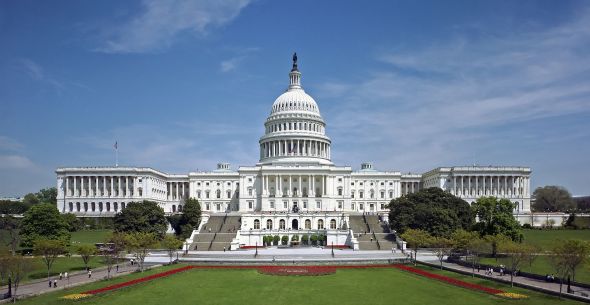
Sometimes, for instance watching Trump talk about the wall, I wonder how much of politics is just people enjoying and wallowing in different kinds of lies. Reminds me of this passage from Mark Helprin’s novel A Winter’s Tale. A mayoral election is going on in New York:
He never talked about garbage, electricity, or police. He only talked about winter, horses and the countryside. He spoke almost hypnotically about love, loyalty, and esthetics … He promised them love affairs and sleigh races, cross-country skiing on the main thoroughfares, and the transfixing blizzards that howled outside and made the heart dance.
They thought, or so it was generally stated at the time, that if they were going to be lied to, they might as well pick the liar who did it best.
Looking for this quote in my old files I found F. Scott Fitzgerald, in The Beautiful and the Damned, talking about Congress:
he tried to imagine himself in Congress rooting around in the litter of that incredible pigsty with the narrow and porcine brows he saw pictured sometimes in the rotogravure sections of the Sunday newspapers, those glorified proletarians babbling blandly to the nation the ideas of high school seniors! Little men with copy-book ambitions who by mediocrity had thought to emerge from mediocrity into the lustreless and unromantic heaven of a government by the people – and the best, the dozen shrewd men at the top, egotistic and cynical, were content to lead this choir of white ties and wire collar-buttons in a discordant and amazing hymn, compounded of a vague confusion between wealth as a reward of virtue and wealth as a proof of vice, and continued cheers for God, the Constitution, and the Rocky Mountains!
Proust’s coffee
Posted: February 10, 2019 Filed under: books, coffee, comedy, writing Leave a comment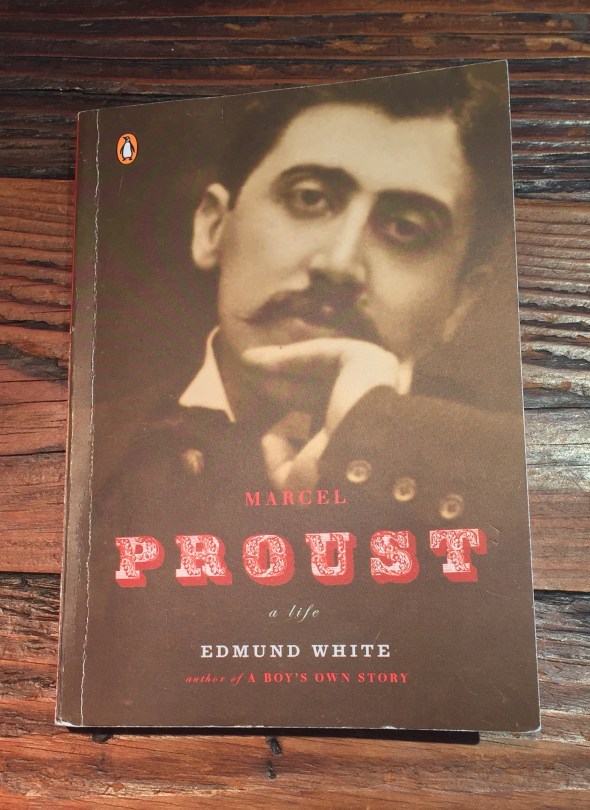
Although fifteen years later [Marcel Proust] would recall his year as a soldier with total delight, as “a paradise,” at the time he complained bitterly and his mother had to write him consoling, babying letters, telling him to think of the twelve months as twelve chocolate squares.
Imagine the guys in the barracks finding your letters from your mom telling you to think about your year as twelve chocolate squares.
In his short biography of Custer, Larry McMurtry mentions a few other short biographies he judges fine, including with a characteristic lack of false modesty his own biography of Crazy Horse, and this Edmund White biography of Proust.
So, I got it and read it. Wonderful act of compression. Thoughtful, succinct, at times funny, human, gentle, this book is a great guide to the man and artist, what his work meant and what he was after.
Thought this was wild:
In 1911 Proust became a subscriber to Théàtrophone, a service that held a telephone receiver up at a concert, which allowed people to stay at home and hear live music on their receivers.
The few hundred pages of Remembrance of Things Past I was supposed to read in college (“Proust, Joyce and Modernism”: a class I chose to take!) were tough going for me. Proust won’t be hurried. This guy didn’t even get a job until he was in his thirties. This was an unpaid job, as a librarian, and eventually he got fired for being out sick too much. Proust is not interested in going at anyone’s pace except the languid pace of a man lying in bed, leisurely following the meandering paths of his own memory.
Proust always claimed that he had a bad memory and that, besides, a carefully reconstructed recollection, prompted by photos or shared reminiscences, was invariably colorless, Only an involuntary memory, triggered by a taste or smell or other sensation, could erase the passage of time and restore a past experience in its first, full effulgence.
Proust’s world was pretentious and can seem ridiculous. Proust himself was a great mimic, reducing people to fits of laughter with his impressions. He loved collecting anecdotes and gossip, grilling waiters for details (Proust was an extravagant tipper.) White says that Georg D. Painter’s Marcel Proust: A Biography, the one-volume edition, is
so amusing that it could be used as a source for a stand-up comic.
I’ll be looking into this claim.
How about Proust’s maid, Céleste?
Céleste’s great anxiety was Proust’s morning (or afternoon) coffee. It had to be ready the moment he rang for it, but the preparation took at least half an hour, since he liked the water to be dripped, drop by drop, through the grounds in order to produce the thickest, strongest possible “essence” of coffee. Nor could he bear for it to be reheated…
This is after Céleste had been standing up for hours listening to Proust recount gossip he’d collected on “rare midnight sorties,” Proust waiting til midnight to go out because he was so afraid of dust. Well, White tells us we read Proust because he knows that
only the gnarled knowledge that suffering brings us is of any real use.
Maybe Céleste pondered that while she remade the coffee.
Leaving the house was a challenge for Proust, but near the end of his life he made an outing to see Vermeer’s View of Delft:
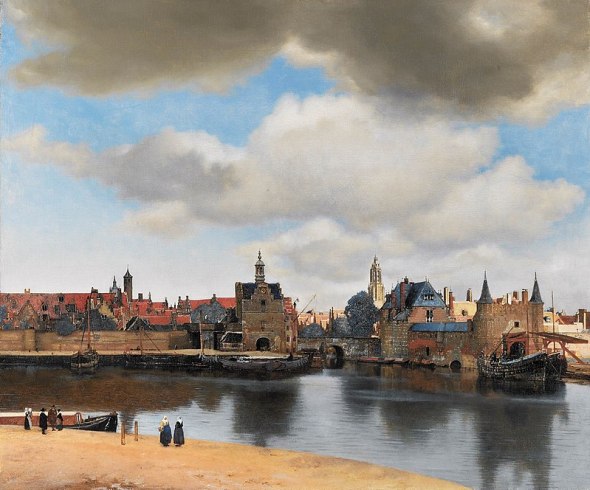
On the night before he died Proust dictated a last sentence: “There is a Chinese patience in Vermeer’s craft.”
White tells us. Man Ray took a picture of Proust right after the author died, you can see it here if you’re so inclined. I’m told by the Met that Cocteau wrote of the scene:
Those who have seen this profile of calm, of order, of plenitude, will never forget the spectacle of an unbelievable recording device come to a stop, becoming an art object: a masterpiece of repose next to a heap of notebooks where our friend’s genius continues to live on like the wristwatch of a dead soldier.
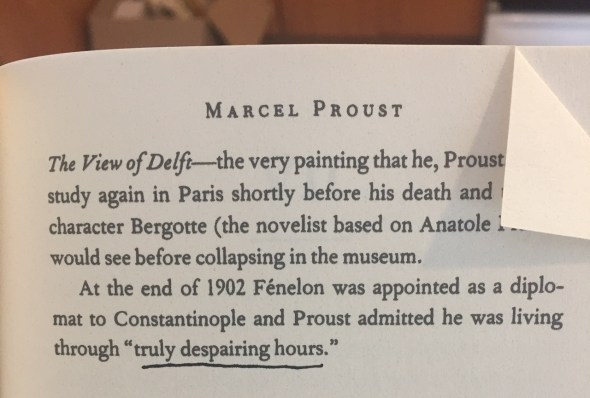
True despair hours:
The Evolution of Pace In Popular Movies
Posted: December 29, 2018 Filed under: film, movies, screenwriting, writing, writing advice from other people Leave a comment
Abstract
Movies have changed dramatically over the last 100 years. Several of these changes in popular English-language filmmaking practice are reflected in patterns of film style as distributed over the length of movies. In particular, arrangements of shot durations, motion, and luminance have altered and come to reflect aspects of the narrative form. Narrative form, on the other hand, appears to have been relatively unchanged over that time and is often characterized as having four more or less equal duration parts, sometimes called acts – setup, complication, development, and climax. The altered patterns in film style found here affect a movie’s pace: increasing shot durations and decreasing motion in the setup, darkening across the complication and development followed by brightening across the climax, decreasing shot durations and increasing motion during the first part of the climax followed by increasing shot durations and decreasing motion at the end of the climax. Decreasing shot durations mean more cuts; more cuts mean potentially more saccades that drive attention; more motion also captures attention; and brighter and darker images are associated with positive and negative emotions. Coupled with narrative form, all of these may serve to increase the engagement of the movie viewer.
Keywords: Attention, Emotion, Evolution, Film style, Movies, Narrative, Pace, Popular culture
Over at Cognitive Research: Principles and Implications, James E. Cutting has an interesting paper about how popular movies have changed over time in terms of shot duration, motion, luminance, and cuts.
One thing that hasn’t really changed though: a three or four act structure.
In many cases, and particularly in movies, story form can be shown to have three or four parts, often called acts (Bordwell, 2006; Field, 2005; Thompson, 1999). The term act is borrowed from theater, but it does not imply a break in the action. Instead, it is a convenient unit whose size is between the whole film and the scene in which certain story functions occur. Because there is not much difference between the three- and four-act conceptions except that the latter has the former’s middle act broken in half (which many three-act theorists acknowledge; Field, 2005), I will focus on the four-act version.
The first act is the setup, and this is the portion of the story where listeners, readers, or viewers are introduced to the protagonist and other main characters, to their goals, and to the setting in which the story will take place. The second act is the complication, where the protagonists’ original plans and goals are derailed and need to be reworked, often with the help or hindrance of other characters. The third is the development, where the narrative typically broadens and may divide into different threads led by different characters. Finally, there is the climax, where the protagonist confronts obstacles to achieve the new goal, or the old goal by a different route. Two other small regions are optional bookend-like structures and are nested within the last and the first acts. At the end of the climax, there is often an epilogue, where the diegetic (movie world) order is restored and loose ends from subplots are resolved. In addition, I have suggested that at the beginning of the setup there is often a prologue devoted to a more superficial introduction of the setting and the protagonist but before her goals are introduced (Cutting, 2016).
Interesting way to think about film structure. Why are movies told like this?
Perhaps most convincing in this domain is the work by Labov and Waletzky (1967), who showed that spontaneous life stories elicited from inner-city individuals without formal education tend to have four parts: an orientation section (where the setting and the protagonist are introduced), a complication section (where an inciting incident launches the beginning of the action), an evaluation section (which is generally focused on a result), and a resolution (where an outcome resolves the complication). The resolution is sometimes followed by a coda, much like the epilogue in Thompson’s analysis. In sum, although I wouldn’t claim that four-part narratives are universal to all story genres, they are certainly widespread and long-standing
Cutting goes on:
That form entails at least three, but usually four, acts of roughly equal length. Why equal length? The reason is unclear, but Bordwell (2008, p. 104) suggested this might be a carryover from the development of feature films with four reels. Early projectionists had to rewind each reel before showing the next. Perhaps filmmakers quickly learned that, to keep audiences engaged, they had to organize plot structure so that last-seen events on one reel were sufficiently engrossing to sustain interest until the next reel began.
David Bordwell:

source: Wasily on Wiki
I love reading stuff like this, in the hopes of improving my craft at storytelling, but as Cutting notes:
Filmmaking is a craft. As a craft, its required skills are not easily penetrated in a conscious manner.
In the end you gotta learn by feel. We can feel when a story is right, or when it’s not right. I reckon you can learn more about movie story, and storytelling in general, by telling your story to somebody aloud and noticing when you “lose” them than you can by reading all of Brodwell. Anyone who’s pitched anything can probably remember moments when you knew you had them, or spontaneously edited because you could feel you were losing them.
Still, it’s fun to break apart human cognition and I look forward to more articles from Cognitive Science and am grateful they are free!
Another paper cited in this article is “You’re a good structure, Charlie Brown: the distribution of narrative categories in comic strips” by N Cohn.

Thanks to Larry G. for putting me on to this one.
Sympathy for the Devil
Posted: December 4, 2018 Filed under: religion, writing Leave a comment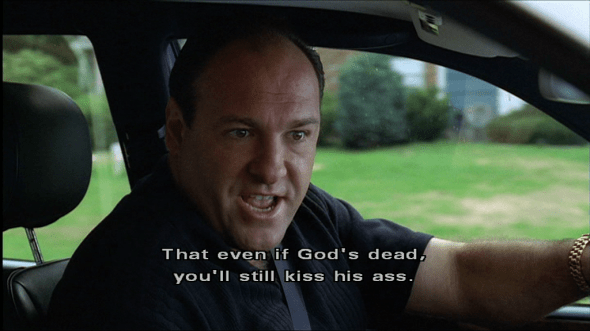
I was thinking about how a lot of movies and shows (a rewatch of The Sopranos is what made me thing of this) could be called Sympathy For The Devil.
Isn’t the premise of this show to take a murderer and crime boss and get you to sympathize with him?
Cowen and Taleb (and Norm)
Posted: December 2, 2018 Filed under: jesus, writing, writing advice from other people Leave a commentIt’s like we understand that we’re not in here to eat mozzarella and go to Tuscany. We’re not in here to accumulate money. We’re in here mostly to sacrifice, to do something. The way you do it is by taking risks.
It’s taking risks for the sake of becoming more human. Like Christ. He took risks and he suffered. Of course, it was a bad outcome, but you don’t have to go that far. That was the idea.
More:
TALEB: Before 15, and I reread it many times. I’d say, before 15, I read Dostoyevsky and I read The Idiot. There’s a scene that maybe I was 14 when I read it. Prince Myshkin was giving this story. Actually, it was autobiographical for Dostoyevsky.
He said he was going to be put to death. As they woke him up and were taking him to the execution place, he decided to live the last few minutes of his life with intensity. He devoured life, it was so pleasurable, and promised himself, if he survives, to enjoy every minute of life the same way.
And he survived. In fact, it was a simulacrum of an execution, and Dostoyevsky . . . effectively that says the guy survived. The lesson was he no longer did that. It was about the preferences of the moment. He couldn’t carry on later. He forgot about the episode. That marked me from Dostoyevsky when I was a kid, and then became obsessed with Dostoyevsky.
More:
I discovered that I wanted to be a writer as a kid. I realized to have an edge as a writer, you can’t really know what people know. You’ve got to know a lot of stuff that they don’t know.
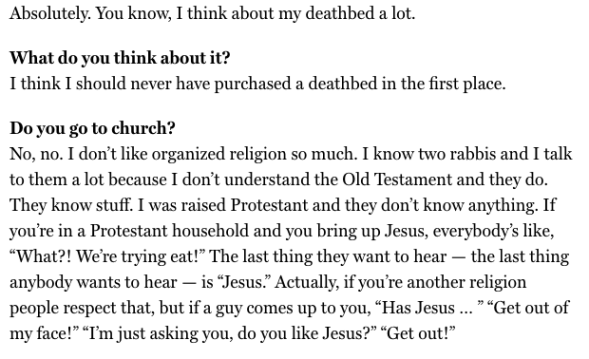
Also re: Jesus, how about Norm Macdonald on the topic:
Sunday Scrapbasket
Posted: October 28, 2018 Filed under: America Since 1945, art history, baseball, sports, writing Leave a comment- Work by Ai Weiwei at Marciano Foundation:


- down the docks, San Pedro:

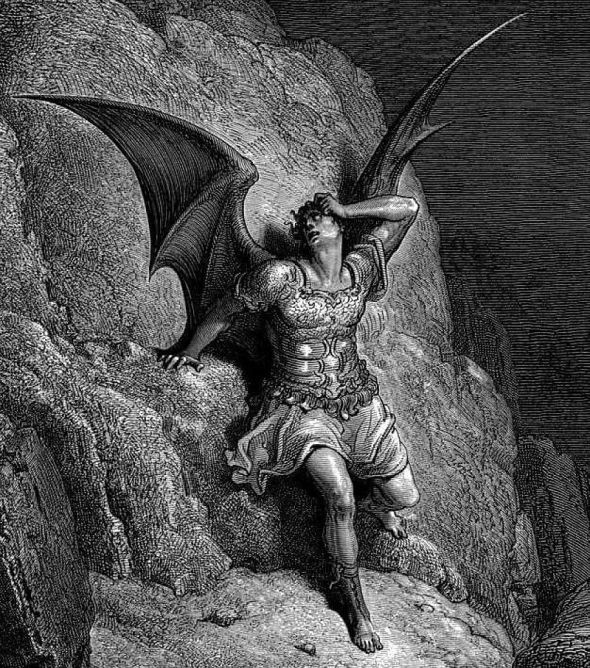
- Good illustration of Satan in the Wikipedia page for him:


from Strange Tales From A Chinese Studio (1740) by Pu Songling
- Looking into the history of the USA and Chile, found this.
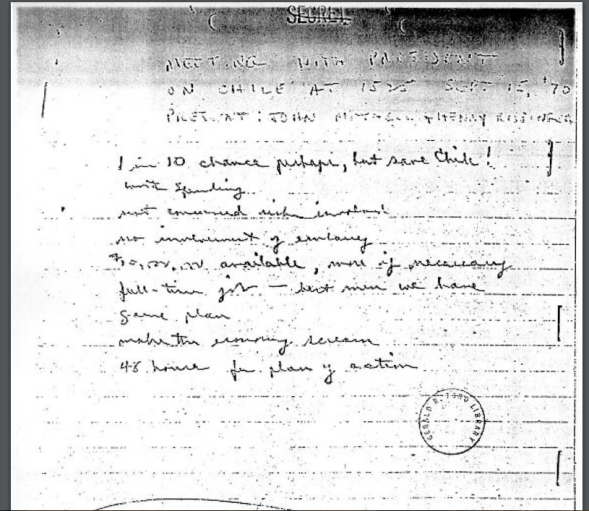 Declassified notes Richard Helms, CIA director, took at a September 15, 1970 meeting at the White House
game plan
make the economy scream
- This is a take I didn’t know I had until I saw it expressed:

of course. these rascals hired her and they knew who she was. it didn’t work for them like it did for Fox so they threw her under the bus, but they’re no more principled than she is.
- moving books around:


- happy fate to be in attendance at the longest World Series game ever played. Beginning:

End:
Ron Hansen
Posted: October 21, 2018 Filed under: Christianity, religion, writing Leave a comment
found in my notes some quotes from an interview with novelist Ron Hansen:
You may pray to God for guidance about some decision in your life, and God might say, ‘Look inside yourself and see what you want. It’s not necessary for you to be a priest. It’s not necessary for you to be married. It’s whatever you decide.’ In essence, God says, ‘Surprise me.’ We’re co-creators in a lot of ways, and what God relishes most about us is our creative freedom.
How about this:
For me, each Mass has a plot. It’s a kind of murder mystery. There is for me within the liturgy a sense of the importance of this celebration-this reenactment of the conspiracy and murder and resurrection of an innocent man. Here’s a man who on the eve of his betrayal celebrates dinner with his friends. Then he’s led away and whipped and has all these terrible things happen to him. But at the end the story we find out it’s a comedy, because it has such a wonderful, happy ending. And we get to share in it, in this mystery of the redemption.
love the idea of Mass as murder mystery slash comedy.
The opening of Ron Hansen’s The Assassination of Jesse James By The Coward Robert Ford:
He was growing into middle age and was living then in a bungalow on Woodland Avenue. Green weeds split the porch steps, a wasp nest clung to an attic gable, a rope swing looped down from a dying elm tree and the ground below it was scuffed soft as flour. Jesse installed himself in a rocking chair and smoked a cigar down in the evening as his wife wiped her pink hands on a cotton apron and reported happily on their two children. Whenever he walked about the house, he carried serval newspapers – the Sedalia Daily Democrat, the St. Joseph Gazette, and the Kansas City Times – with a foot-long .44 caliber pistol tucked into a fold. He stuffed flat pencils into his pockets. He played by flipping peanuts to squirrels. He braided yellow dandelions into his wife’s yellow hair. He practiced out-of-the-body travel, precognition, sorcery. He sucked raw egg yolks out of their shells and ate grass when sick, like a dog. He would flop open the limp Holy Bible that had belonged to his father, the late Reverend Robert S. James, and would contemplate whichever verses he chanced upon, getting privileged messages from each. The pages were scribbled over with penciled comments and interpretations; the cover was cool to his cheek as a shovel. He scoured for nightcrawlers after earth-battering rains and flipped them into manure pails until he could chop them into writhing sections and sprinkle them over his garden patch. He recorded sales and trends at the stock exchange but squandered much of his capital on madcap speculation. He conjectured about foreign relations, justified himself with indignant letters, derided Eastern financiers, seeded tobacco shops and saloons with preposterous gossip about the kitchens of Persia, the Queen of England, the marriage rites of the Latter Day Saints. He was a faulty judge of character, a prevaricator, a child at heart. He went everywhere unrecognized and lunched with Kansas City shopkeepers and merchants, calling himself a cattleman or commodities investor, someone rich and leisured who had the common touch.
What was up with Will Shakespeare?
Posted: September 23, 2018 Filed under: shakespeare, writing Leave a comment
It’s 1588. You walk into a play-house. A guy walks out on stage and says:
O for a Muse of fire, that would ascend the brightest heaven of invention, a kingdom for a stage, princes to act and monarchs to behold the swelling scene!
Then should the warlike Harry, like himself, assume the port of Mars; and at his heels, leash’d in like hounds, should famine, sword and fire crouch for employment.
But pardon, and gentles all, the flat unraised spirits that have dared on this unworthy scaffold to bring forth so great an object: can this cockpit hold the vasty fields of France?
or may we cram within this wooden O the very casques that did affright the air at Agincourt?
O, pardon! since a crooked figure may attest in little place a million; and let us, ciphers to this great accompt, on your imaginary forces work.
That’s how Henry V opens.
That ref to the wooden O is (as I understand the only time) we hear about the Globe Theater from Shakespeare himself’s mouth or pen or whatever. Got to thinking about it in London in May.

Shakes is so good. That “o for a muse of fire” is so good. Like a Jimi Hendrix moment:

A dude who’s gone so far in his art that he’s got nothing left to do but scream at Heaven to let him ascend.

One time Yang saw this at my house and said, “is Shakespeare good?” Solid question. To answer it I suggested we watch:
which, I think is pretty good. Yang pointed out that in this version, the music does do a lot of the work.
By the time Shakespeare wrote Henry V he’d already done Romeo & Juliet, Richard III, A Midsummer Night’s Dream, Merchant of Venice, Henry IV Part 1, Henry IV Part 2, Much Ado About Nothing, and thirteen other plays.
That’s if you believe the story.

The “Chandos Portrait” at the National Gallery in London.
There was a def a real guy Shakespeare, a real person who was born and died. In his own lifetime this Will Shakespeare was famous for writing plays. Pirate editions of plays with Shakespeare’s name on them would be sold like scripts of The Godfather on the streets of New York.
Far as I can see, Will Shakespeare gave no evidence of giving a shit about the text/publishing of his plays. Didn’t appear to care. The fact we are reading them now would’ve probably shocked him or else he also wouldn’t have cared about that. What he cared about was like getting a coat of arms.

Is this headline correct? I dunno, I think he wasn’t exactly a nobody in Stratford.
There’s much bureaucratic evidence that Will Shakespeare existed. Probably at least sometimes he was a semi-gangster.
He was around brothels and bars. The last hot young playwright got stabbed to death in a bar.
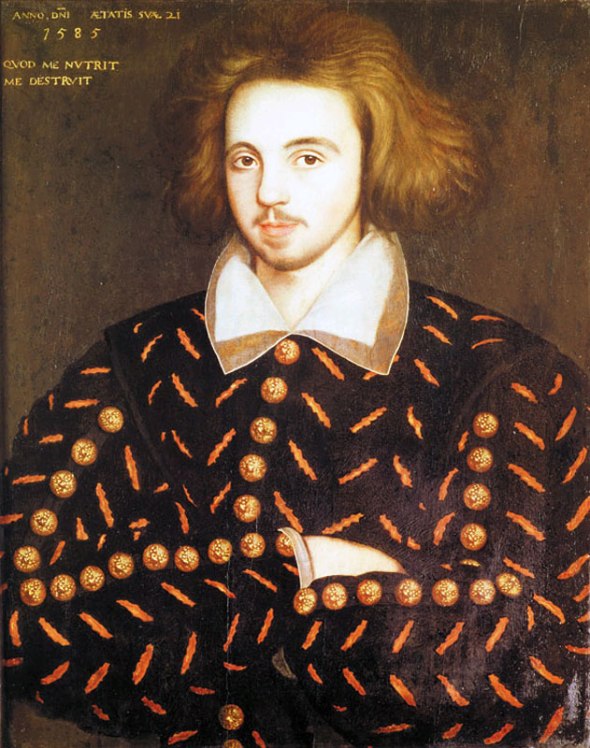
from Wiki
Read this book recently:

I agree with some of the points in this New Criterion hammering of it. There’s a lotta coulda woulda shoulda. But then again if there wasn’t the book would be like five pages long.
Did Shakespeare really write all those plays?
The evidence suggests to me that yeah, real guy Will Shakespeare wrote at least most of them.
Top piece of evidence: in Shakespeare’s lifetime, real guy Shakespeare was known for writing these plays. His name was on ’em.

Well, some of ’em.
I don’t see Shakespeare’s name in the “bad quarto” of Henry V.
The scholars tell me that’s fine. Consider the folios! Put together by Shakespeare’s friends after his death! Henry V is in there, perhaps typeset from the “foul papers” of Shakespeare himself in fact! It counts.
OK whatever.
Second best piece of evidence: Shakespeare’s fellow writers were jealous of him.
Catty remarks from the time are recorded.
He also turns up in a contemporary diary getting off a pretty good joke about boning a groupie.
Third best evidence: there’s a “voice” to the Shakespeare plays. You can feel if if you read a bunch of the best plays. I admit I haven’t read all of ’em. But I’ve read maybe a third, and I’ve read some Christopher Marlowe plays and some Ben Johnson plays, and you can tell a difference. The plays marked Shakespeare are better. In fact half the time that’s how they decide whether to include one or not.
That’s the weakest evidence, who knows what kinda bias my brain is bringing to the table when they’re presented as Shakespeare plays. Some computer/AI type analysis of word usage and so on suggests maybe he didn’t write the Henry VI ones but those suck anyway I’m told.
I think you have to admit Shakespeare wrote some of Shakespeare’s plays, right?
Not everyone agrees:
Rylance thinks now that William Shakespeare was most likely a front for a small band of writers, perhaps headed by Francis Bacon, which included, among others, Lady Mary Sidney. He argues that in the seventeenth century it wouldn’t have been appropriate for persons of rank to write for the public theatre; therefore they would need to do so anonymously. “If you even suggest that Shakespeare would have had to be at court, it’s heretical,” van Kampen said. “It’s a metaphor, and it’s about Englishness.”
(from this New Yorker profile by Cynthia Zanin).
The idea that Shakespeare was really Francis Bacon feels to me like someone five hundred years from now claiming
perhaps Barack Obama wrote Dave Chappelle’s routines and Kendrick Lamar’s raps.
or maybe
it’s possible Hillary Clinton wrote Shonda Rhimes’ shows.

“I want to be Shakespeare,” he told us. “You should all want to be Shakespeare, too.”
That’s Denis Johnson. I think that quote got me back into Shakespeare.
Shakespeare scholars are not usually people who are in the habit of cranking out scripts on tight deadlines or have necessarily been around showbiz.
The experience of seeing how scripts get writ makes me wonder if Shakespeare was a showrunner. If we should think of him like Aaron Sorkin or Shonda or Ryan Murphy. Both himself a wildly talented craftsman but also a quality controller supervising and directing other writers.

Shakespeare is a happy hunting ground for minds that have lost their balance
Joyce has Stephen say in Ulysses.
Ian Buruma
Posted: September 20, 2018 Filed under: writing 2 Comments
Ian Buruma is a great writer. I’ve learned so much from his books, his writings on Japan were super illuminating to me, and Year Zero is a powerful work by a great mind.
That piece in NYRB by the Canadian radio guy who used to punch women in the head and choke them by surprise and be a monster to co-workers was not acceptable or valuable or at all necessary.
 Source
Didn’t Jon Ronson write a whole book about this?
One of the great talents of Ian Buruma (in my experience as a reader) is opening his eyes, comprehending and informing himself and then sharing ideas about the currents of culture. I hope he keeps doing that.
Writing Course from Stephen J. Cannell
Posted: September 14, 2018 Filed under: TV, writing, writing advice from other people 2 Comments
Our friends over at Monkey Trial put this one up. Led us to the Stephen J. Cannell website, where there’s a short but thorough and helpful writing course available for free. Adding it to my category Writing Advice From Other People.
The Gambler (2014)
Posted: September 12, 2018 Filed under: business, film, money, movies, screenwriting, shakespeare, writing 1 Comment
Saw this clip on some retweet of this fellow’s Twitter.
I was struck by
- the bluntness and concision of the advice
- the fact that the advice contains a very specific investment strategy down to what funds you should be in (80% VTSAX, 20% VBTLX)
- the compelling performance of an actor I’d never seen opposite Wahlberg (although I’d say it drops off at “that’s your base, get me?”)
It appeared this was from the 2014 film The Gambler

The film is interesting. Mark Wahlberg plays a compulsive gambler and English professor. There are some extended scenes of Wahlberg lecturing his college undergrads on Shakespeare, Camus, and his own self-absorbed theories of literature, failure, and life. The character is obnoxious, self-pitying, logorrheic and somewhat unlikeable as a hero. Nevertheless his most attractive student falls in love with him. William Monahan, who won an Oscar for The Departed, wrote the screenplay. The film itself is a remake of 1974 movie directed by James Toback, in which James Caan plays the Mark Wahlberg role.
Here’s the interesting thing. Watching the 2016 version, I realized the speech I’d seen on Twitter that first caught my attention is different. The actor’s different — in the movie I watched it’s John Goodman.
What happened here? Had they recast the actor or something? The twitterer who put it up is from South Africa, did they release a different version of the movie there?
Did some investigating and found the version I saw was made by this guy, JL Collins, a financial blogger.
Here’s a roundup of his nine basic points for financial independence.
He did a pretty good job as an actor I think! I believe the scene in the movie would be strengthened from the specificity of his advice. And the line about every stiff from the factory stiff to the CEO is working to make you richer is cool, maybe an improvement on the script as filmed. I’ll have to get this guy’s book.
It would make a good commercial for Vanguard.

VTSAX vs S&P 500:

Readers, what does the one to one comparison of JL Collins and John Goodman teach us about acting?
The Moviegoer
Posted: September 9, 2018 Filed under: America Since 1945, Louisiana, writing 2 Comments
Took this one off my shelf the other day. Think I was supposed to read it in college but never finished it. The plot didn’t propel me along, but there’s some magic to it for sure. A relaxed New Orleans kind of existentialism. 
What’s the narrator looking for? Even he doesn’t know. 
He sees a young man reading on the bus, and types him:

Good old Walker Percy:

At one point the narrator sees William Holden on the street:
Ah, William Holden. Already we need you again. Already the fabric is wearing thin without you.

What is a story? What is narrative?
Posted: August 19, 2018 Filed under: writing, writing advice from other people 1 Comment
“Good story” means something worth telling that the world wants to hear. Finding this is your lonely task. It begins with talent… But the love of a good story, of terrific characters and a world driven by your passion, courage, and creative gifts is still not enough. Your goal must be a good story well told.
says McKee.
What is a story? What makes something a story? It’s a question of personal and professional interest here at Helytimes. The dictionary gives me this for narrative:
a spoken or written account of connected events; a story.
boldface mine.

The human brain is wired to look for patterns and connections. Humans think in stories and seem to prefer a story, even a troubling story, to random or unrelated events. This can trick us as well as bring us wisdom and pleasure.
Nicholas Nassem Taleb discusses this in The Black Swan:


Narrative is a way to compress and store information.
From some investing site or Twitter or something, I came across this paper:

“Cracking the enigma of asset bubbles with narratives,” by Preston Teeter and Jörgen Sandberg in Strategic Organization. You can download a PDF for free.
Teeter and Sandberg suggest that “mathematical deductivist models and tightly controlled, reductionist experiments” only get you so far in understanding asset bubbles. What really drives a bubble is the narrative that infects and influences investors.
Clearly, under such circumstances, individuals are not making rational, cool-headed decisions based upon careful and cautious fundamental analysis, nor are their decisions isolated from the communities in which they live or the institutions that govern their lives. As such, only by incorporating the role of narratives into our research efforts and theoretical constructs will we be able to make substantial progress toward better understanding, predicting, and preventing asset bubbles.
Cool! But, of course, we need a definition of narrative:
But first, in order to develop a more structured view of how bubbles form, we also need a means of identifying the structural features of the narratives that emerge before, during, and after asset bubbles. The most widely used method of evaluating the structural characteristics of a narrative is that based on Formalist theories (see Fiol, 1989; Hartz and Steger, 2010; Pentland, 1999; Propp, 1958). From a structural point of view, a narrative contains three essential elements: a “narrative subject,” which is in search of or destined for a certain object; a “destinator” or source of the subject’s ideology; and a set of “enabling and impeding forces.” As an example of how to operationalize these elements, consider the following excerpt from another Greenspan (1988) speech:
More adequate capital, risk-based capital, and increased securities powers for bank holding companies would provide a solid beginning for our efforts to ensure financial stability. (p. 11)
OK great. Let’s get to the source here. Fiol, Hartz and Steger, and Pentland are all articles about “narrative” in business settings. Propp is the source here. Propp is this man:

Vladimir Propp, a Soviet analyst of folktales, and his book is this:

I’ve now examined this book, and find it mostly incomprehensible:

Propp’s 31 functions (summarized here on Wikipedia) are pretty interesting. How a Soviet theorist would feel about his work on Russian folktales being used by Australian economists to assess asset bubbles in capitalist markets is a fun question. Maybe he’d be horrified, maybe he’d be delighted. Perhaps he’d file it under Function 6:
TRICKERY: The villain attempts to deceive the victim to acquire something valuable. They press further, aiming to con the protagonists and earn their trust. Sometimes the villain make little or no deception and instead ransoms one valuable thing for another.
There’s some connection here to Dan Harmon’s story circles.

But when it comes to the definition of what makes a story go, I like the blunter version, expressed by David Mamet in this legendary memo to the writers of The Unit::
QUESTION:WHAT IS DRAMA? DRAMA, AGAIN, IS THE QUEST OF THE HERO TO OVERCOME THOSE THINGS WHICH PREVENT HIM FROM ACHIEVING A SPECIFIC, *ACUTE* GOAL.
SO: WE, THE WRITERS, MUST ASK OURSELVES *OF EVERY SCENE* THESE THREE QUESTIONS.
1) WHO WANTS WHAT?
2) WHAT HAPPENS IF HER DON’T GET IT?
3) WHY NOW?
Cracking the enigma of narrative is a fun project.
ps don’t talk to me about Aristotle unless you’ve REALLY read The Poetics.
 Helytimes


