Melfax
Posted: June 24, 2017 Filed under: the California Condition Leave a comment

The street art scene in my neighborhood is fantastic.




Beyond Meat Bolognese
Posted: June 23, 2017 Filed under: food Leave a comment
Used some Beyond Meat to make a bolognese. I used more or less this recipe from attorney and new mom Michelle.

Shoutout to Filip H. for teaching me the secret to sauces is using this particular brand of crushed San Marzanos.

As you can see I still used 4 oz. of pancetta – baby steps, right?

Used one package of “beefy” flavor and one package of “fiesty” flavor Beyond Meat.

Gotta say it was pretty darn good.
Starting to become a believer in Beyond Meat.

Houellebecq
Posted: June 22, 2017 Filed under: writing Leave a comment
found here
from the Paris Review interview with Michel Houllebecq
INTERVIEWER
You have a bit of a scientific background. After high school, you studied agronomy. What is agronomy?
HOUELLEBECQ
It’s everything having to do with the production of food. The one little project I did was a vegetation map of Corsica whose purpose was to find places where you could put sheep. I had read in the school brochure that studying agronomy can lead to all sorts of careers, but it turns out that was ridiculous. Most people still end up in some form of agriculture, with a few amusing exceptions. Two of my classmates became priests, for example.
INTERVIEWER
Did you enjoy your studies?
HOUELLEBECQ
Very much. In fact, I almost became a researcher. It’s one of the most autobiographical things in The Elementary Particles. My job would have been to find mathematical models that could be applied to the fish populations in Lake Nantua in the Rhône-Alpes region. But strangely, I turned it down, which was stupid, actually, because finding work afterward was impossible.
INTERVIEWER
In the end you went to work as a computer programmer. Did you have previous experience?
HOUELLEBECQ
I knew nothing about it. But this was back when there was a huge need for programming and no schools to speak of. So it was easy to get into. But I loathed it immediately.
INTERVIEWER
So what made you write your first novel, Whatever, about a computer programmer and his sexually frustrated friend?
HOUELLEBECQ
I hadn’t seen any novel make the statement that entering the workforce was like entering the grave. That from then on, nothing happens and you have to pretend to be interested in your work. And, furthermore, that some people have a sex life and others don’t just because some are more attractive than others. I wanted to acknowledge that if people don’t have a sex life, it’s not for some moral reason, it’s just because they’re ugly. Once you’ve said it, it sounds obvious, but I wanted to say it.
Talking about his novel The Possibility of An Island:
INTERVIEWER
Why did you make your main character a comedian?
HOUELLEBECQ
The character came from two things. First of all, I went to a resort in Turkey and there was one of those talent shows produced by the guests. There was this girl—she must have been fifteen—who was doing Céline Dion and clearly for her, this was very, very important. I said to myself, Man, this girl is really going for it. And it’s funny because the next day, she was sitting alone at the breakfast table and I thought, Already the solitude of the star! I sensed that something like that can decide an entire life. So the comedian has a similar experience. He discovers all of sudden that he can make whole crowds laugh and it changes his life. The second thing was that I knew a woman who was editor in chief of a magazine and she was always inviting me to these hip events with Karl Lagerfeld, for example. I wanted to have someone who was part of that world.
On Anglo-Saxons (apparently including the Irish) and Americans:
INTERVIEWER
And what do you think of this Anglo-Saxon world?
HOUELLEBECQ
You can tell that this is the world that invented capitalism. There are private companies competing to deliver the mail, to collect the garbage. The financial section of the newspaper is much thicker than it is in French papers.
The other thing I’ve noticed is that men and women are more separate. When you go into a restaurant, for example, you often see women eating out together. The French from that point of view are very Latin. A single-sex dinner would be considered boring. In a hotel in Ireland, I saw a group of men talking golf at the breakfast table. They left and were replaced by a group of women who were discussing something else. It’s as if they’re separate species who meet occasionally for reproduction. There was a line I really liked in a novel by Coetzee. One of the characters suspects that the only thing that really interests his lesbian daughter in life is prickly-pear jam. Lesbianism is a pretext. She and her partner don’t have sex anymore, they dedicate themselves to decoration and cooking.
Maybe there’s some potential truth there about women who, in the end, have always been more interested in jam and curtains.
INTERVIEWER
And men? What do you think interests them?
HOUELLEBECQ
Little asses. I like Coetzee. He says things brutally, too.
INTERVIEWER
You’ve said that you possibly had an American side to you. What is your evidence for this?
HOUELLEBECQ
I have very little proof. There’s the fact that if I lived in an American context, I think I would have chosen a Lexus, which is the best quality for the price. And more obscurely, I have a dog that I know is very popular in the United States, a Welsh Corgi. One thing I don’t share is this American obsession with large breasts. That, I must admit, leaves me cold. But a two-car garage? I want one. A fridge with one of those ice-maker things? I want one too. What appeals to them appeals to me.

The Paris Review website has given me an awful lot.
Wanted to listen to the original record of Sgt. Pepper’s
Posted: June 20, 2017 Filed under: music Leave a comment

I knew my man Jeff was the guy to talk to. Pictured: Jeff’s stereo.
Island Fighting
Posted: June 18, 2017 Filed under: America Since 1945, WW2 Leave a comment
Picked up the Island Fighting volume of the Time Life World War II series and found this incredible picture:
Couldn’t find a name of a photographer.
Mysterious Notes
Posted: June 17, 2017 Filed under: America Since 1945, mysteries Leave a comment
I’ve come into possession of someone’s mysterious notes on a printed out copy of Alan Weisman’s book The World Without Us. Reason to suspect the note-taker is a Helytimes reader.
If they belong to you, claim them, otherwise I intend to auction them to the highest bidder. God only knows what these insights could be worth.
Beyond Meat
Posted: June 14, 2017 Filed under: America Since 1945, food Leave a comment
Grilled some Beyond Meat burgers yesterday (over a combo of mesquite briquettes and mesquite chips). As a noted burger enthusiast I declare this: pretty darn good.
File this under: Long June news you can use.

A Strange Tale From East of the River
Posted: June 8, 2017 Filed under: Japan Leave a commentMy favorite book title of the year.

A lonely man meets a mysterious woman in a strange neighborhood of Tokyo. Nagai – a proto Murakami?

From now on I will insist that it be noted in all foreign translations of my work that my English is somewhat eccentric.
Seidensticker, ever precise.
Helytimes Classic: D*-Day
Posted: June 6, 2017 Filed under: America Since 1945 Leave a commentReprinting this beloved post from a year ago:
 * the D is for Dave!
Happy birthday, tomorrow, June 6, to Dave King (the Great Debates co-host, not the Bad Plus drummer)
A promise made in Host Chat is a promise kept so here is a selection of D-Day readings for Davis.

scene from the Bayeux Tapestry

New Yorker’s July 15, 1944 parody of the Bayeux Tapestry
The single best thing to read about D-Day
is online and free. It is S. L. A. Marshall writing for The Atlantic in November, 1950.

During World War II, Marshall became an official Army combat historian, and came to know many of the war’s best-known Allied commanders, including George S. Patton and Omar N. Bradley. He conducted hundreds of interviews of both enlisted men and officers regarding their combat experiences, and was an early proponent of oral history techniques. In particular, Marshall favored the group interview, where he would gather surviving members of a frontline unit together and debrief them on their combat experiences of a day or two before.

The article is called “First Wave On Omaha Beach” here is an excerpt:
Even among some of the lightly wounded who jumped into shallow water the hits prove fatal. Knocked down by a bullet in the arm or weakened by fear and shock, they are unable to rise again and are drowned by the onrushing tide. Other wounded men drag themselves ashore and, on finding the sands, lie quiet from total exhaustion, only to be overtaken and killed by the water. A few move safely through the bullet swarm to the beach, then find that they cannot hold there. They return to the water to use it for body cover. Faces turned upward, so that their nostrils are out of water, they creep toward the land at the same rate as the tide. That is how most of the survivors make it. The less rugged or less clever seek the cover of enemy obstacles moored along the upper half of the beach and are knocked off by machine-gun fire.
Within seven minutes after the ramps drop, Able Company is inert and leaderless. At Boat No. 2, Lieutenant Tidrick takes a bullet through the throat as he jumps from the ramp into the water. He staggers onto the sand and flops down ten feet from Private First Class Leo J. Nash. Nash sees the blood spurting and hears the strangled words gasped by Tidrick: “Advance with the wire cutters!” It’s futile; Nash has no cutters. To give the order, Tidrick has raised himself up on his hands and made himself a target for an instant. Nash, burrowing into the sand, sees machine gun bullets rip Tidrick from crown to pelvis. From the cliff above, the German gunners are shooting into the survivors as from a roof top.
Captain Taylor N. Fellers and Lieutenant Benjamin R. Kearfoot never make it. They had loaded with a section of thirty men in Boat No. 6 (Landing Craft, Assault, No. 1015). But exactly what happened to this boat and its human cargo was never to be known. No one saw the craft go down. How each man aboard it met death remains unreported. Half of the drowned bodies were later found along the beach. It is supposed that the others were claimed by the sea.
After the war, Marshall would write Men Against Fire:

which claimed that only about 25% of American combat soldiers actually fired their guns at the enemy:
Marshall’s work on infantry combat effectiveness in World War II, titled Men Against Fire, is his best-known and most controversial work. In the book, Marshall claimed that of the World War II U.S. troops in actual combat, 75% never fired at the enemy for the purpose of killing, even though they were engaged in combat and under direct threat. Marshall argued that the Army should devote significant training resources to increasing the percentage of soldiers willing to engage the enemy with direct fire.
Marshall has been harshly criticized:

General Marshall said soldiers who did not fire were motivated by fear, a desire to minimize risk and a willingness, as in civilian life, to let a minority of other people carry the load.
In his 1989 memoir, About Face, Hackworth described his initial elation at an assignment with a man he idolized, and how that elation turned to disillusion after seeing Marshall’s character and methods first hand. Hackworth described Marshall as a “voyeur warrior,” for whom “the truth never got in the way of a good story” and went so far as to say, “Veterans of many of the actions he ‘documented’ in his books have complained bitterly over the years of his inaccuracy or blatant bias”.
Omaha Beach was the worst of it, but experiences on D-Day were vastly different.

stolen from the Daily Mail: http://www.dailymail.co.uk/news/article-2336753/Back-beaches-final-time-D-Day-heroes-return-Normandy-mark-69th-anniversary-landings.html
Twenty-one miles away on Juno Beach the Canadian Ninth Division landed with their bikes:
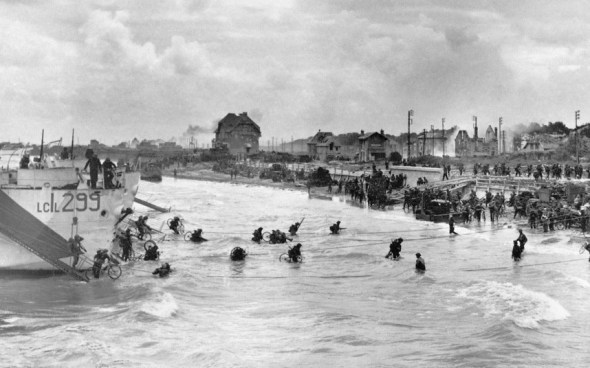
Picture: STF/AFP/Getty Images
Leave it to Canadians to bring their bikes. (900 Canadians died in a botched semi-practice D-Day in 1942).
Best Single Book To Read About D-Day
Looking around I can’t find my copy of Normandy Revisited by AJ Liebling:

Image by © Bettmann/CORBIS found here
Liebling, a vivacious fatso who had spent a lot of time in Normandy pre-war, describes going through with the Army and eating at spots he remembered from before. Definitely a different kind of war corresponding.
This book

was wildly popular for a reason: it’s thrilling, readable, and full of epic American hero stories.
Maybe starting with Andrew J. Higgins of Nebraska and Mobile, Alabama:

who developed shallow-draft boats for logging in the bayou (or for bootlegging?) and then took on the job of making similar boats for amphibious landings:

Higgins Industries
Anthony Beevor has a blunter take. Major takeaway from his book:

was that the Allies came up way short of their goals on D-Day. Unsurprisingly, many of those who got off the beaches in one piece considered their work done for the day. They were literally in Calvados,
 it was pretty easy to find bottles of highly alcoholic apple brandy, and a lot of survivors got hammered at first opportunity.

Who can blame them? But the failure to achieve the ambitious goals had costs. Caen was the biggest city around:

British and Canadian troops had intended to capture the town on D-Day. However they were held up north of the city until 9 July, when an intense bombing campaign during Operation Charnwood destroyed 70% of the city and killed 2,000 French civilians.
From this Washington Post review of Beevor, some excerpts:
US Army medical services had to deal with 30,000 cases of combat exhaustion in Normandy,” and:
“Nothing . . . seemed to reduce the flow of cases where men under artillery fire would go ‘wide-eyed and jittery’, or ‘start running around in circles and crying’, or ‘curl up into little balls’, or even wander out in a trance in an open field and start picking flowers as the shells exploded. Others cracked under the strain of patrols, suddenly crying, ‘We’re going to get killed! We’re going to get killed!’ Young officers had to try to deal with ‘men suddenly whimpering, cringing, refusing to get up or get out of a foxhole and go forward under fire’. While some soldiers resorted to self-inflicted wounds, a smaller, unknown number committed suicide.”
But the single best book to read about D-Day I would say is The Boys’ Crusade by Paul Fussell:

Amazon reviewer Bill Marsano sums it up nicely:
It’s probably all that “good war” and “greatest generation” stuff that drove Fussell to write this book; he doesn’t have much truck with gooey backward glances, and that will probably make some readers mad. Well, you don’t come to Fussell–author of, among other things, “Thank God for the Atom Bomb, and Other Essays”–for good times. You come to Fussell for the hard stuff.
And here it is his contention that behind and beneath all that “greatest generation” nonsense was the Boys’ Crusade–that last year of the war in Europe when too many things went wrong too often. The generals who’d convinced themselves that this war would not be a war of attrition–i.e., human slaughter–like the last one found they’d guessed wrong. Casualties were horrifyingly high and so huge numbers of children–kids 17-19 years–old were flung into combat. And they were, with the help of the generals, ill-trained, ill-clothed and ill-equipped.
They were also faceless ciphers. As Fussell points out, the US Army’s policy was to break up training units by sending individual replacements up to the line piecemeal–one at a time–so they often arrived as strangers among strangers, often addressed merely as “Soldier” because no one knew their names. The result was too many instances of cowardice–both under fire and behind the lines–too many self-inflicted wounds to escape combat. Too many disgraces of every kind because the Army’s system, Fussell says, destroyed the most important factor in the fighting morale of the “poor bloody infantry”–the shame and fear of turning chicken in front of your comrades. Many of these boys–and Fussell is properly insistent on the word boys–funked because they had no comradeship to value.
This is not in the least a personal journal. Fussell was serriously wounded as a young second lieutenant; he was also decorated. But he wisely leaves himself out of this narrative. There’s no special pleading here, no showing of the wounds on Crispin’s Day. Instead this is a passionate but straightforward report on what that last year was like for the poor bloody infantry–those foot soldiers, those dogfaces, those 14 percent of the troops who took more than 70 percent of the casualties.
And yet there were those who stood the gaff, who survived “carnage up to and including bodies literally torn to pieces, of intestines hung on trees like Christ,mas festoons,” and managed not to dishonor themselves. They weren’t heroes, Fussell says, just men who earned the Combat Infantryman’s Badge, which was the only honor they respected. In a brief but moving passage, he explains why: It said they’d been there, been through it, and toughed it out.
Horrible as it is I found this book refreshing when I first read it, because it felt like somebody was telling me the unvarnished truth, which is that even for the good guys this was a series of catastrophes, fuckups, and massacres.
All Fussell’s books are good. This one in particular I was obsessed with:

and I talk about it in The Wonder Trail: True Stories From Los Angeles To The End Of The World, out June 14:
Those photos are by Robert Capa, who lost all but 11 of the 106 or so photos he risked his life shooting when the guy developing them was in such a hurry he fudged up the negatives.
Let’s give the last word to Fussell:
One wartime moment not at all vile occurred on June 5, 1944, when Dwight Eisenhower, entirely alone and for the moment disjunct from his publicity apparatus, changed the passive voice to active in the penciled statement he wrote out to have ready when the invasion was repulsed, his troops torn apart for nothing, his planes ripped and smashed to no end, his warships sunk, his reputation blasted: “Our landings in the Cherbourg-Havre area have failed to gain a satisfactory foothold and I have withdrawn the troops.” Originally he wrote, “the troops have been withdrawn,” as if by some distant, anonymous agency instead of by an identifiable man making all-but-impossible decisions. Having ventured this bold revision, and secure in his painful acceptance of full personal accountability, he was able to proceed unevasively with “My decision to attack at this time and place was based on the best information available.” Then, after the conventional “credit,” distributed equally to “the troops, the air, and the navy,” came Eisenhower’s noble acceptance of total personal responsibility: “If any blame or fault attaches to the attempt, it is mine alone.” As Mailer says, you use the word shit so that you can use the word noble,and you refuse to ignore the stupidity and barbarism and ignobility and poltroonery and filth of the real war so thatit is mine alone can flash out, a bright signal in a dark time.

Happy Birthday Dave!

Planet Earth 2
Posted: June 6, 2017 Filed under: animals Leave a comment
Important to remember some things such as nature documentaries are better than ever!
Seal of Acceptance
Posted: June 5, 2017 Filed under: fashion Leave a comment
shopping for shoes today. I see this on one of them:

Would love to attend this banquet.
Astronomers
Posted: June 5, 2017 Filed under: space Leave a comment
I follow a bunch of astronomers on Twitter. One of them got a new ergonomic chair today and she’s so happy about it!
Sappho
Posted: June 4, 2017 Filed under: women, writing Leave a comment
cool book.


I find Mary Barnard’s photo on the Oregonencyclopedia:

Her literary career took her from a childhood in the Oregon backwoods, where she often traveled with her timber-wholesaler father, to Reed College in Portland, where she was introduced to the classics and to the modern poetic revolution by Lloyd Reynolds.

MOA
Posted: June 4, 2017 Filed under: Canada Leave a comment





Very cool place: MOA – Museum of Anthropology, on the campus of University of British Columbia in Vancouver.
Bag Balm
Posted: June 4, 2017 Filed under: animals, Canada Leave a comment
My feet were kinda messed up (from walking?). Mentioned this to my friend Hana. She knows how to bring forth bounty from the Earth, I knew she would have some wondrous cure. She thought about it and came back with this medicine they use for messed up cow udders.

Gotta say it seems like a miracle product. 
If you are cool buy some of Hana’s blankets and yarn:

Best mayor name
Posted: June 1, 2017 Filed under: Canada Leave a comment
It’s got to go to Victoria, British Columbia’s Lisa Helps.

Mayor Lisa Helps has a very cool city she’s entrusted with. 
a constituent
Design of Big Wheel Burger by our buds at Caste Projects

More about Victoria can be found in A Trip To Canada.
Denis Johnson, Walt Whitman
Posted: May 29, 2017 Filed under: America Since 1945, heroes, writing Leave a comment
We’ve been thinking a lot about the glow of some of your poems, the visionary language seeping through parts of Angels, and the electric way in which the border between Fuckhead’s consciousness and the outside world is always being dissolved throughout Jesus’ Son. Could you talk a bit more about Whitman’s influence in your poetry and prose?
I’m not sure I could trace the lines of his influence on my language, particularly, or the way his work affects the strategies in my work, or anything like that. His expansive spirit, his generosity, his eagerness to love – those are the things that influence me, not just as a writer, but as a person. His introduction to LEAVES OF GRASS I take as a sort of personal manifesto, especially the passage:
This is what you shall do: Love the earth and sun and the animals, despise riches, give alms to every one that asks, stand up for the stupid and crazy, devote your income and labor to others, hate tyrants, argue not concerning God, have patience and indulgence toward the people, take off your hat to nothing known or unknown or to any man or number of men, go freely with powerful uneducated persons and with the young and with the mothers of families, read these leaves in the open air every season of every year of your life, re-examine all you have been told at school or church or in any book, dismiss whatever insults your own soul, and your very flesh shall be a great poem and have the richest fluency not only in its words but in the silent lines of its lips and face and between the lashes of your eyes and in every motion and joint of your body. . . .
found in this interview with Denis Johnson. Oddly or presciently or synchronistically enough I’d been looking for Denis Johnson materials as I did ever so often. How did this guy know this stuff? was what I was looking for as usual.
 so good!

May I please recommend to you you have actor Will Patton read you the audiobook of:

I loved the experience so much I got into the full unabridged 23+ hours of:

Will Patton is such a gifted, subtle performer of audiobooks.

from a profile in AudioFile
Let’s give the last word to DJ:
I love McDonald’s double cheeseburgers and I don’t care if they’re made of pink slime and ammonia, I eat them all the time because they’re delicious.

Today’s I Ching
Posted: May 25, 2017 Filed under: China, mysticism, religion 1 Comment
In some translations springtime is rendered as Long June
from:

the only book I’ll ever need?!
if I want to learn more about China I can pick up this month’s Westways:

Lol did somebody pitch Westways “how about a story about China?”
WESTWAYS EDITOR: what angle?
PITCHER: Everything from cities to cuisine! All the facets!
EDITOR: All?!
PITCHER: Well, many facets.
EDITOR: Is there enough there?
PITCHER: I think so. Did you know it is a 5,000 year old civilization?
EDITOR: Wow! OK let’s also have a piece on Iceland and car racing for amateurs and I think we’re good!
Morrissey / Noonan
Posted: May 23, 2017 Filed under: America Since 1945, politics Leave a comment
Compare what Morrissey said on Facebook (via Vulture) to this Peggy Noonan piece from February:
There are the protected and the unprotected. The protected make public policy. The unprotected live in it. The unprotected are starting to push back, powerfully.
The protected are the accomplished, the secure, the successful—those who have power or access to it. They are protected from much of the roughness of the world. More to the point, they are protected from the world they have created. Again, they make public policy and have for some time.
Anne R. Dick
Posted: May 22, 2017 Filed under: America Since 1945, writing Leave a comment
Obit worth reading in the NY Times:
Bored with science fiction and unable to interest publishers in his mainstream novels, Dick quit writing to help his new wife in her jewelry business. He liked that even less, and so he pretended to work on a new novel. To make it look realistic, he said in a 1976 interview with Science Fiction Review, he had to start typing.
What emerged was “The Man in the High Castle.” It was dedicated, cryptically and not altogether favorably, to his wife, “without whose silence this book would never have been written.” (In the 1970s, Dick changed the dedication, dropping Anne Dick entirely.)
Ms. Dick said she saw only the pilot of the Amazon series, finding the Nazis a little too threatening.
If you are interested in hearing some ideas that flutter between profound and totally bonkers might I suggest:


How paranoia is natural:

How about this?:

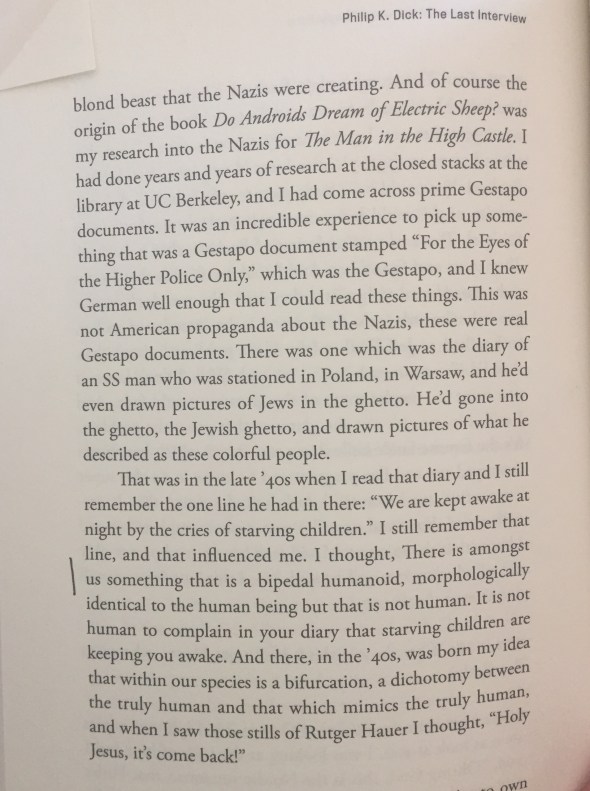
Just a guy with a fragile mind hanging out reading Gestapo documents in German up at UC Berkeley:

In Sweden there’s a fashion brand called Filippa K and I thought it would be funny for someone to do a mashup Filippa K Dick.

But who has the time.
 Helytimes