Lippincott’s Pronouncing Gazeteer of the World
Posted: July 25, 2017 Filed under: the California Condition Leave a comment
from

a book no home should be without
Root ecosystem, Lauren Elizabeth!
Posted: July 25, 2017 Filed under: the California Condition Leave a comment
Ansel in Playboy
Posted: July 20, 2017 Filed under: art history, photography, the American West, the California Condition Leave a comment
I’ll explain it this way: Both William Henry Jackson and Edward Weston photographed the American West extensively. But in my opinion, only Weston’s photographs qualify as art. Jackson, for all his devotion to the subject, was recording the scene. Weston, on the other hand, was actually creating something new. In his work, subject is of secondary importance to the total photograph. Similarly, while the landscapes that I have photographed in Yosemite are recognized by most people and, of course, the subject is an important part of the pictures, they are not “realistic.” Instead, they are an imprint of my visualization. All of my pictures are optically very accurate–I use pretty good lenses–but they are quite unrealistic in terms of values. A more realistic simple snapshot captures the image but misses everything else. I want a picture to reflect not only the forms but what I had seen and felt at the moment of exposure.
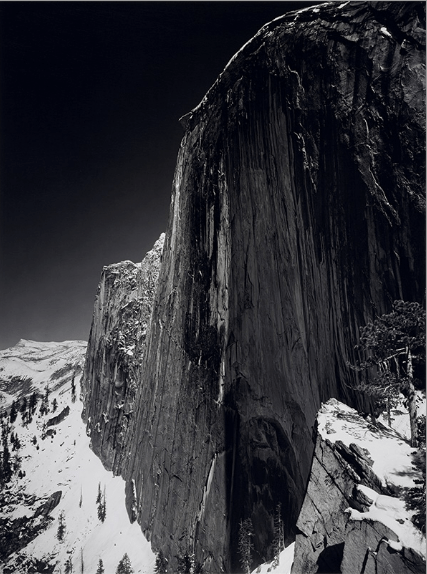
Playboy: Give us an example.Adams: My Moonrise, Hernandez, New Mexico has the emotion and the feeling that the experience of seeing the actual moonrise created in me, but it is not at all realistic. Merely clicking the camera and making a simple print from the negative would have created a wholly different–and ordinary–photograph. People have asked me why the sky is so dark, thinking exactly in terms of the literal. But the dark sky is how it felt.

When photographer Alfred Stieglitz was asked by some skeptic, rather scornfully, “How do you make a creative photograph?” he answered, “I go out into the world with my camera and come across something that excites me emotionally, spiritually or aesthetically. I see the image in my mind’s eye. I make the photograph and print it as the equivalent of what I saw and felt.” That describes it well. What he called seeing in the mind’s eye, I call visualization. In my mind’s eye, I am visualizing how a particular revelation of sight and feeling will appear on a print. If I am looking at you, I can continue to see you as a person, but I am also in the habit of shifting from that consciously dimensional presence to a photograph, relating you in your surroundings to an image in my mind. If what I see in my mind excites me, there is a good chance it will make a good photograph. It is an intuitive sense and also an ability that comes from a lot of practice. Some people never can get it.

Playboy: When did you know you could accomplish it?Adams: I had my first visualization while photographing Half Dome in Yosemite in 1927. It was a remarkable experience. After a long day with my camera, I had only two photographic plates left. I found myself staring at Half Dome, facing the monolith, seeing and feeling things that only the photograph itself can tell you. I took the first exposure and, somehow, I knew it was inadequate. It did not capture what I was feeling. It was not going to reflect the tremendous experience. Then, to use Stieglitz’ expression, I saw in my mind’s eye what the picture should look like and I realized how I must get it. I put on a red filter and figured out the exposure correctly, and I succeeded! When I made the prints, it proved my concept was correct. The first exposure came out just all right. It was a good photograph, but it in no way had the spirit and excitement I had felt. The second was Monolith, the Face of Half Dome, which speaks for itself.
More:
They were the ones Weston called the fuzzy-wuzzies. They would go out into the street and find some old bum with a matted beard, and they’d get a tablet of Braille and make the old man put his fingers on the Braille. They would place him in an old chair, looking up through a cloud of cigarette smoke that was illuminated by a spotlight. The title would be Mine Eyes Have Seen the Glory. That must have been done a thousand times. There were also slimy nudes.

I am an Ansel Democrat:
Playboy: You said that earlier. We assumed you were speaking rhetorically. Weren’t you?Adams: Definitely not. We are on a disaster course. A revolution may happen first; and, of course, that may be a disaster anyway. I don’t say it would be a Soviet revolution, but it could very well result in a different order of society. It could be a socialist setup that might work for a while. We don’t know. The point is, I think there may be a revolution if there is not greater equality given to all citizens. We have consistently considered the employer, especially the large corporations, as the most valuable part of the American society. We have consistently overlooked the enormous importance of the farmer, the technician, the educator, the artist, the laborer. I’m not calling for a revolution; I’m calling for greater equality to all citizens. If that doesn’t happen, something will.You see, I believe in a Federalism under which you would pay your taxes to a properly elected and conducted central Government that would, in turn, provide essential services–which would include medical care and other essentials–to the population. I do think there is a basic obligation for everyone to make his maximum contribution to society, but we talk about opportunity for everyone, and the fact is that it is perfectly obvious that equal opportunity does not exist. It’s about time we woke to that fact and clarified the whole social-political structure. Or we’ll be awakened.Remember, ten percent unemployment, no matter how high that is, is an average. There are places and segments of the population with much higher unemployment. People will not continue to tolerate those conditions. What we need is a new set of political commandments that call to attention some of the basic provisions of the Constitution that are often overlooked by our contemporary leaders. There are inalienable rights that are supposed to be guaranteed. It is absolutely criminal that our Government has consistently supported rightist governments that deny citizens’ rights while being paranoid about any liberal concept, which is the concept upon which our country was founded. But, remember, it took a revolution here.

And finally, his martini recipe:
Playboy: While we’re on the subject, that is some strong martini we’ve sampled. Will you share your recipe with us?Adams: The martini I am drinking now is simply diluted–that way, I can have several. But the ones you’re sipping come from a Hotel Sonesta bartender in Cambridge. You take a good-sized glass and fill it with fine vermouth. Then you marinate some big lemon peels in there for days. As the vermouth evaporates or is used up, replenish it. All you need is a glass, ice, vodka and a lemon peel. Rub the lemon peel around the rim of the glass, drop it in, and you have a very dry martini.

Luckie
Posted: July 17, 2017 Filed under: desert, the California Condition Leave a comment
If you’re like me you saw this and wondered who Luckie Park is named after
I didn’t have to look far:

“This Luckie Reilly may be a relation,” I thought. Sure enough:

It’s this Dr. Luckie that the park is named after. Here’s some good info about him in the Morongo Basin Historical Society’s newsletter:
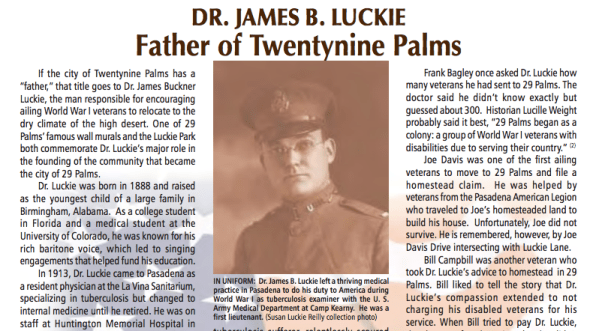
There’s a mural of him:

That’s from Google Earth. Better picture at Action 29 Palms – The Mural People.
I wonder if this James Luckie was the son or grandson of James Buckner Luckie, who was a doctor with the Army of East Tennessee in the Civil War, and performed one of the first ever triple amputations. More info and (warning) a photo on this German language (?) wikipedia page.
Luckie Reilly sounds great. From a 2006 article about her, “10 Things To Know About Luckie Reilly,” in the Hi-Desert Star in 2006:
10. Susan continues to weigh in on local land-use issues, sometimes speaking her mind at City Council meetings and through letters to the editor. “I’ve been an activist for years,’ she says. “I’ve opposed power plants, polluting industries and waste dumps in the desert. You can’t just sit back and watch things go to heck!”

Melfax
Posted: June 24, 2017 Filed under: the California Condition Leave a comment

The street art scene in my neighborhood is fantastic.




Meanwhile, out in the desert
Posted: April 26, 2017 Filed under: the California Condition Leave a comment
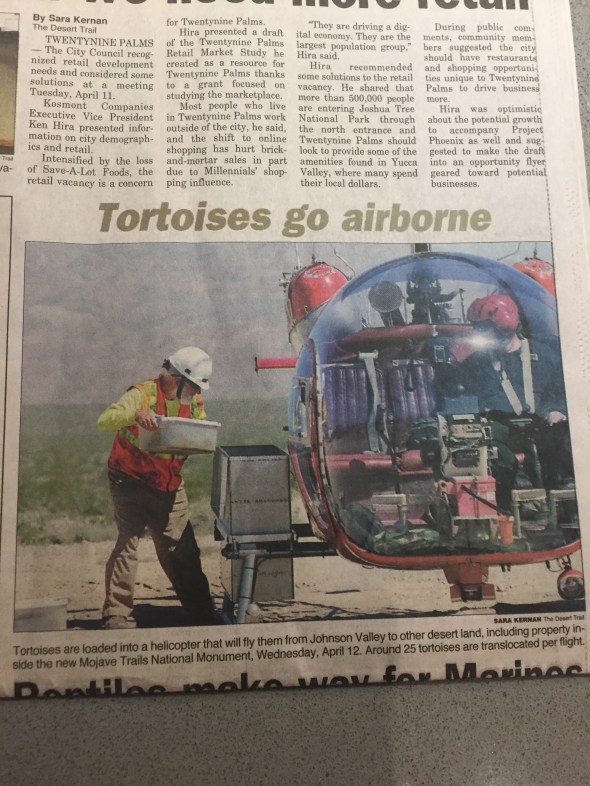
The top story in both the Hi-Desert Star and The Desert Trail is the removal of 1,100 desert tortoises from the Marine Corps base to safer lands.


Was Defense Secretary Mattis personally briefed on the operation?

It may seem silly but the story made me feel good.
find happy homes guys.

All I Gotta Do Is Act Naturally
Posted: April 24, 2017 Filed under: actors, the California Condition Leave a comment
When I first got to California a real curiosity was Bakersfield and the Bakersfield Sound.

from wiki’s article on the Kern River Oilfield. Photo by Antantrus
What the hell was going on up there in Bakersfield? There were four Basque restaurants in town.

Buck Owens was the king of the Bakersfield sound, he had the Crystal Palace. He died before I got to see him. From Wiki:
The Los Angeles Times interviewed longtime Owens spokesman (and Buckaroos keyboard player) Jim Shaw, who said Owens “had come to the club early and had a chicken fried steak dinner and bragged that it’s his favorite meal.”
bragged?
Afterward, Owens told band members that he wasn’t feeling well and was going to skip that night’s performance. Shaw said a group of fans introduced themselves while Owens was preparing to drive home; when they told him that they had traveled from Oregon to hear him perform, Owens changed his mind and took the stage anyway.
Shaw recalled Owens telling the audience, “If somebody’s come all that way, I’m gonna do the show and give it my best shot. I might groan and squeak, but I’ll see what I can do.” Shaw added, “So, he had his favorite meal, played a show and died in his sleep. We thought, that’s not too bad.”
The alpha song of the Bakersfield sound has to be Act Naturally. The Beatles had Ringo sing it:
I’ve probably listened to the Buck Owens version between 50 and 100 times. It continues to reveal itself. How about the the paradox of acting naturally.
Only very very good actors are capable of truly acting naturally.

Otani Oniji II as Yakko Edobei in the Play “Koinyabo Somewake Tazuna”
Saraku, Toshusai (worked 1794-1795)
Polychrome woodblock print with mica ground
h. 15 in. w. 9-7/8 in.
from the Met.
Did Otani Onjii act naturally?
Whole acting schools are devoted to teaching people how to act naturally.

Why do people have so much trouble acting naturally?

If you’re in Bakersfield get an ice cream sundae at Dewar’s.

Will and Ariel Durant
Posted: April 22, 2017 Filed under: heroes, history, the California Condition Leave a comment
One of the local branches of the LA Public Library, the one on Sunset across from Wendy’s, is named after Will and Ariel Durant.
David Brooks grows wistful as he considers the Will and Ariel Durant project:
Between 1935 and 1975, Will and Ariel Durant published a series of volumes that together were known as “The Story of Civilization.” They basically told human history (mostly Western history) as an accumulation of great ideas and innovations, from the Egyptians, through Athens, Magna Carta, the Age of Faith, the Renaissance and the Declaration of the Rights of Man. The series was phenomenally successful, selling over two million copies.
I’ve taken a look at the first volume of the series,

and was astounded, amused, and delighted by what I found there. Here’s an example.

When Will met Ariel Durant, her name was Ida, she was fourteen, and she was his student.
She was 15 at her marriage on Oct. 31, 1913, and came to the ceremony with her roller skates slung over her shoulder. Her husband was just about to turn 28. He called her Ariel, after the the imp in Shakespeare’s ”The Tempest,” and she later had her name legally changed.
(from Will’s NYT obituary). In Our Oriental Civilization, Will makes the case for himself:

It’s pretty funny that we named the library after a pair of lovers whose romance would get the man arrested today.
On the other hand, that’s the kind of paradox of historical and civilizational change that Will Durant took so much joy in teaching about.

More from the NYT:
Dr. Durant consistently took a generally optimistic view of civilization, despite a growing belief that ”the world situation is all fouled up.”
”Civilization is a stream with banks,” he said in his precise voice. ”The stream is sometimes filled with blood from people killing, stealing, shouting and doing the things historians usually record, while on the banks, unnoticed, people build homes, make love, raise children, sing songs, write poetry and even whittle statues.
”The story of civilization is the story of what happened on the banks. Historians are pessimists because they ignore the banks for the river.”
Will and Ariel, from Wikipedia:

TAKE: vote yes on WGA strike authorization
Posted: April 18, 2017 Filed under: America Since 1945, the California Condition Leave a comment
The Writers’ Guild is weird. For one thing, some of the members are owners or bosses. Writers who become showrunners and share in the profits of a show can have an owner’s interest. Another: writers have agents who negotiate for them.
Some writers make lots and lots of money. Others are unemployed, or at least unemployed as writers. It’s not really a union, it’s a guild, like a medieval guild, an association of craftspeople who work a certain trade.

Why is Staalmesters translated as “Syndics”? Rembrandt’s Syndics of the Drapers’ Guild. The Sampling Officials sounds cooler.
Or maybe something like London’s livery companies?:

A writers union going on strike can seem silly when you picture a union like this:

and a strike like this:

I find this on the Post-Bulletin: Steve Martell, Charles Brown, and an unidentified third man stand on the picket line on the morning of August 17, 1985, outside the Hormel Foods plant in Austin, Minnesota. Did Trump steal that style of hat consciously?
and writers like this:

But, if you’re in the Writers Guild, and you’re a Helytimes reader, I think you should vote yes on the strike authorization.
If you’re not in the Writers’ Guild, here are the facts, as I misremember them:
- TV writers are making less and less money but working the same amount of time. As shows have smaller orders of episodes, ten instead of twenty-two, writers are still working the same amount of days, but since many of us get paid per episode, we’re getting paid less for the same or more amount of days working.
- The studios are making enormous profits.*
- The studios sort of owe it to us to maintain our healthcare and pension plans, due to deals that were made over the years, and they’re saying they’re not going to do that.
Like all workers, we’re getting squeezed as much as possible by companies whose mandate is to be as profitable as possible for shareholders.
Workers can and should use every tool they can to fight for as much as they can. Our guild’s leaders are negotiating and have asked us to vote to authorize a strike, so they can bargain as effectively as possible.

Gunawan Kartapranata provided Wikipedia’s photo for the article on Bargaining
That’s pretty much my take. I hope it doesn’t happen. It will be very painful and hurt a lot of people. It shuts down production, which means grips, PAs, electricians, etc. are all out of work too. And actors, lots of whom have really struggled to get a shot and are going to continue to struggle.
I think the studios should just give us what we asked for. Disney is one of the studios we’re negotiating with. They have a market cap of $178 billion. I appreciate that Bob Iger has his strategic challenges with ESPN and so on but it seems wise and reasonable to me to say “fine let’s give the creators of our highly profitable content their not ridiculous demands and continue generating money from some of the world’s most popular entertainment, TV shows and movies.”

During the last strike my dad sent me his book of AFL-CIO songs
If we do go on strike, I think we shouldn’t picket. That was unhelpful. There should be some human shows of solidarity, but daily picketing got to be a weird ritual, some kind of bizarre martyrdom that in the end made us look more ridiculous. I am proud to say I feel like I did my duty, but I preferred my days answering the phones at Strike Headquarters to making small talk with Tom Bergeron while I held a sign outside CBS. Although that was fun too.

We discussed Rap Around. Source.
A dissenting opinion from a writer with always interesting takes:
The idea of a WGA strike in these times, when freedom of expression is a far more fundamental issue than small differences between comparatively large amounts of money, is stunningly tone deaf and offensive.
That’s on a moral level.
On a strategic level, strikes are only effective when one side has both desperation and leverage. The WGA has neither.
I voted for the WGA strike in 2008. I regret it. The tangible benefits to the lives of working writers have never been explained in any relevant or understandable terms. The tangible losses to writers’ lives were painfully clear.
This is a bad idea masquerading as the right thing to do. On every level, it is not.
The issues at stake in the last strike were complex. I thought it was important for writers to get some kind of residual for streaming content. Whether it was necessary or well-executed, I’m not informed enough to answer. There was a layer of silliness to it for sure.
I do feel some energy like “one strike is fine, but two in this short a time is awful much.”
I kind of get that? But: the WGA is sort of the first union down the chain. We’re on the frontier here, that’s why we keep having to fight.
So, that’s my take.
* I saw the number $51 billion thrown around. I have no idea where that came from. Does it include, for instance, Disney’s theme park division? It’s hard to assess how much profit the studios are making. The AMPTP represents over 350 companies. I’m sure some of them are doing terribly!
But, here are some numbers for the bigger companies, from a 2015 Forbes magazine rundown by Natalie Robehmed:
Once the theatrical run of a film is over, studios make money from home video, video on demand, and through syndicating hit TV shows, as 21st Century Fox was able to do with Modern Family. Rupert Murdoch’s 21st Century Fox clocked the second highest profit of the publicly traded studios, earning $1.5 billion in 2014. It measured revenue of $10.3 billion, largely from betting big on books that turned into box office hits hits such as Gone Girl and The Fault in Our Stars.
Undeterred by the failed Comcast/Time Warner merger, NBCUniversal outdid itself and recorded its most profitable year ever. The studio notched $711 million in profit on $5 billion in revenue – the second best ratio in Hollywood.
Warner Bros.’ films grossed a collective $4 billion in 2014, but the studio pocketed $1.2 billion in profit from $12.5 billion in revenue. This was up 23% on 2013’s tally. The studio weathered its fair share of flops: Transcendence, Blended and Winter’s Tale all failed to perform. Its pockets were fattened by the last Hobbit movie, plus popcorn cruncher The Lego Movie which has a sequel in the works. The studio is also expanding its $5 billion television business internationally, paying $267 million for production company Eyeworks which operates in 15 countries
etc. There is poor baby Paramount:
The title of least profitable studio goes to the Viacom-owned Paramount. Despite an increase in its films’ performance at the international box office, the filmed entertainment division tallied just $219 million on revenues of $3.7 billion. This was a decrease from 2013, when profit surged thanks to selling distribution rights for Marvel movies to Disney.


Hit me up if you disagree, find factual errors, want to express a contrary view!
Joshua Tree from the air
Posted: April 15, 2017 Filed under: the California Condition Leave a comment
from Google Earth. A little closer to the ground:

Campfire cooking
Posted: April 7, 2017 Filed under: food, the California Condition Leave a comment

Something Biblical about roasting lamb chops right on the fire. A true al pastor. Plus it seemed to honor(?) the local fauna:

Of course you need a charcuterie plate.

Working on taking campfire cooking to the next level. HT various campmates for the photos and ideas.

Some notes:
- Foil packeted onions and peppers came out pretty well. More elaborate foil pack meals have been a bust for me. I tried some stew meat / potatoes sitch once, pointless. Keep it simple.
- Wrapping a potato in foil and putting it in the ashes is such a crapshoot. You have to leave it in there for a good hour I believe.
- You always want the cheapest hot dog buns you can find.
- Enjoyed reading these camping experts’ recipes from kayakcritic.net and would like to try Cristina Lash’s cast iron apple cinnamon oatmeal.

Man vs. nature. A tie, in this case.
At Hungry Cat
Posted: April 1, 2017 Filed under: the California Condition Leave a comment
© Andrew Stuart source
Ran into a bartender I’ve seen there before who greeted me by saying “Have you seen Logan yet?”
On KUSC
Posted: March 16, 2017 Filed under: music, the California Condition Leave a comment
our local classical radio station, the DJ just said (I’m paraphrasing)
if you like the classical music you’re hearing, roll down your windows and share it with your neighbors!
then he said, mild as all hell,
just a suggestion.
KUSC’s website.

Mirga! I swear I won’t forget
Ottensamer ist clarinet bae.
Clarinetist Andreas Ottensamer’s third solo album is dedicated to the Mannheim School: an 18th-century melting pot of musical revolutionary experimentation.

George Bellows
Posted: March 14, 2017 Filed under: art history, New York, the California Condition Leave a comment

The Idiot by Elif Batuman
Posted: March 7, 2017 Filed under: the California Condition, writing Leave a comment
Friends, this book is brilliant, hilarious and compelling. I recommend it without reservation.
My galley copy there is banged up because I ripped it in half so I could bring the unfinished half on a trip, and what a delightful companion it was.

Come see me discuss the book with Elif herself at the LA Public Library downtown:
Monday March 20th
7:15pm
Free but get a ticket
Here are some choice excerpts from The Idiot:
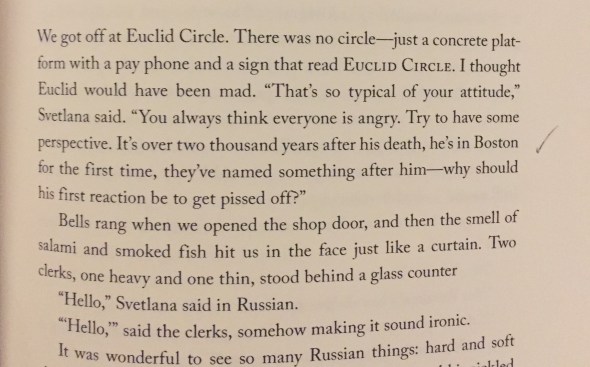

Patricia Lockwood highlighted one of my fav parts on Twitter:

Elif some years ago introduced me to the street cats of Istanbul: 
And showed me where to get corn: 
Now, I can return the favor in Los Angeles and YOU can join the fun:
MONDAY MARCH 20
7:15 PM
Mark Taper Auditorium – Central Library
The event is FREE but get a ticket.
LA after rain
Posted: March 6, 2017 Filed under: the California Condition Leave a comment
Looks cool
Oscars Conspiracy Theory
Posted: March 2, 2017 Filed under: film, the California Condition Leave a comment
Let me be clear I don’t really believe this conspiracy. But I DID think of it.
If Moonlight had won, award would’ve gone to Adele Romanski, Dede Gardner, and Jeremy Kleiner, the producers. That’s who would’ve accepted and given the speech. White producers winning for a movie directed by a black man about black characters would’ve been a terrible look for an Academy terrified by its own dismal record on representation and diversity. So, the Academy deliberately staged a mixup. This had the added benefit of helping the Oscars’ other big problem, people tuning out of the telecast, by making wild unpredictable surprises a part of the experience — “you gotta watch to the very end to see what happens!”
Again, I don’t believe this theory, there’s no evidence for it and significant evidence against it. Still sharing it.
Speak Out!
Posted: March 2, 2017 Filed under: America Since 1945, the California Condition Leave a comment
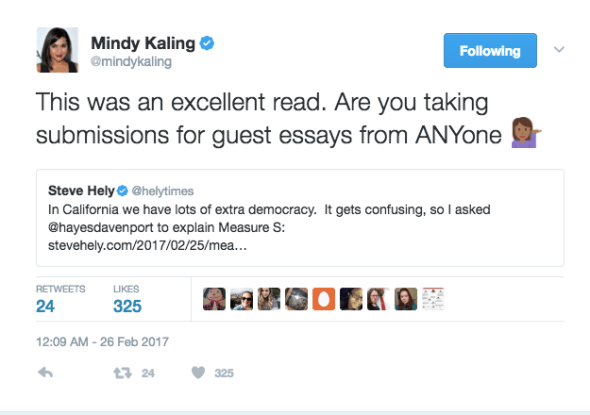
WILD response to Hayes’ post on Measure S and California’s ballot cranks. Very cool.
Yes!
Source: the WPA
Do you have an issue you’re passionate about?
Make your voice heard! We have an easy format for posting, and welcome strong takes on California conditions.
Find us.
Which one of you jokesters
Posted: March 1, 2017 Filed under: America, America Since 1945, Middle East, politics, presidents, the California Condition Leave a comment
Ordered me two copies of The Complacent Class by Tyler Cowen?
Very funny.
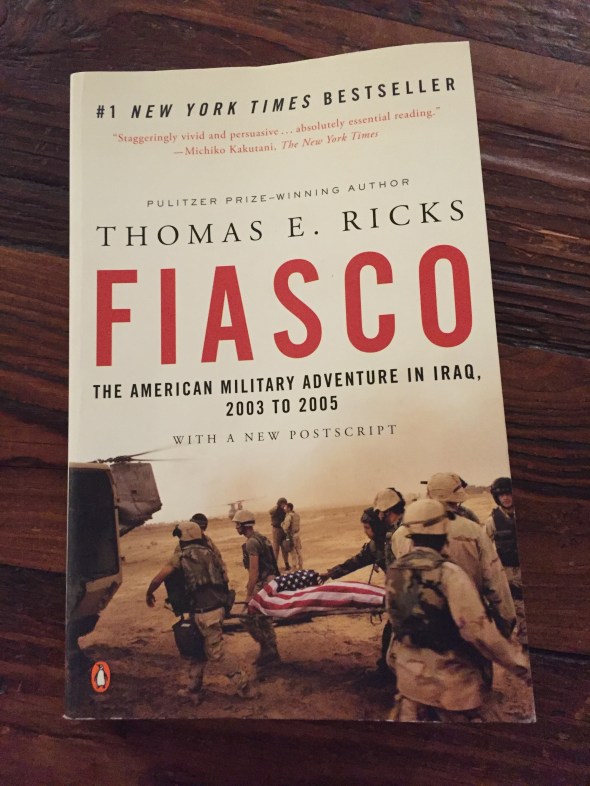
Mission accomplished, it’s next up after I finish Tom Ricks:
More California Ballot Cranks
Posted: February 28, 2017 Filed under: politics, presidents, the California Condition Leave a commentHayes D. is back with a look at some legendary ballot cranks of California history:

I took a sick pleasure in writing about Measure S and Michael Weinstein the other day. Thanks to Steve for asking me to do that.
While I was at it, I dug into some of the other rich, angry men who took advantage of the California ballot system: guys like Weinstein who spent a ton of money and made pretty extreme changes to the law without ever actually being elected to office.
Here are two!
HOWARD JARVIS
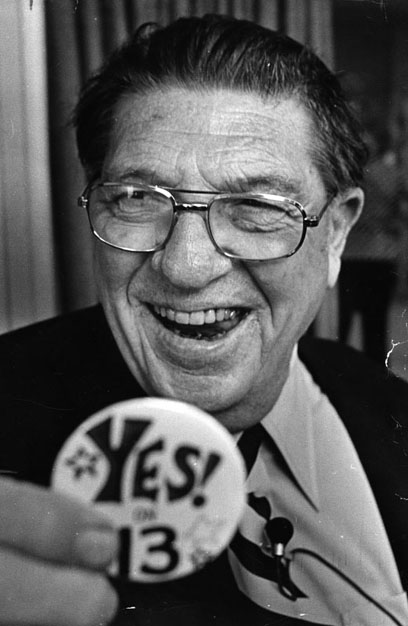
Jarvis was a millionaire from LA who got rich making airplane parts and garbage disposals and other stuff. Your classic 1950’s generic “businessman.” What separated him from his peers was how much he hated taxes.
So after he retired in 1962, he ran for office a few times on an anti-tax platform. Lost every time. Then he discovered the ballot initiative route, and in 1979 he wrote up Proposition 13: a rule that the property tax could only be about 1% of the appraised value of the property, and it couldn’t go up unless the property was sold.
With the help of the base he built from his other campaigns, he and his wife gathered 1.5 million signatures to get it on the ballot. Then Jarvis went on a barnstorming tour of California and riled everybody up so good that the measure passed with 65 percent of the vote.
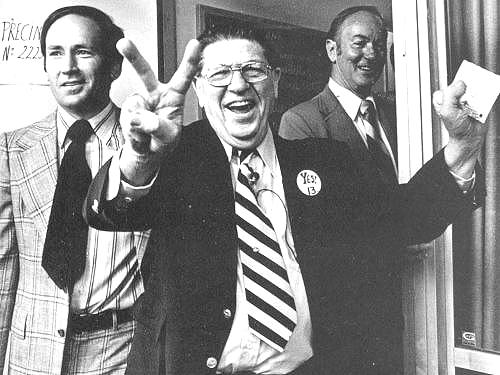
“When I have three, four, five thousand people, I really pour it on,” he said in his gravelly voice. “Like a goddamn Baptist preacher. I tell ’em how government is clobbering them. I rev ’em up. I talk about basic human rights.”Jarvis was quick to admit that playing on the public’s fears was one of the trump cards that made Proposition 13 a big winner.
When he got excited, Jarvis would puff harder on his pipe, and this created a lot of excess “tobacco juice.” During one unfriendly interview with a reporter, Jarvis got agitated and started puffing hard. At one point, sitting behind his big, false desk with no drawers, Jarvis leaned forward and spit some of the excess tobacco juice into a waste can. Jerry Carroll, on the other side of the desk without benefit of a full view, wrote in a 1994 San Francisco Chronicle story that at one point in an interview Jarvis, “jerked opened a drawer in his desk, spit into it and slammed it shut.”

FARYON: Well let’s go back to prior 1978, back in the day when schools needed money. More money to hire students, to pay for classrooms, supplies, and so on. They basically looked to the local taxpayer for money in the form of property taxes. And in fact, they set their budgets, went to the county assessor, the property tax rate was set, and then they collected enough money. As much money as they needed. After 1978, what happened was we couldn’t do that anymore. It was a statewide cap. One percent – that’s all the money that you got. So as a result, before 1978, before Prop 13, statewide the schools had a $9 billion budget. After Prop 13 they lost $3 billion – a third of that – overnight.
***
Here’s a look at California’s per-pupil spending for the past four decades in comparison to other states. The last time California was at the top of the heap was 1965, when it ranked 5th. In 1978 – the year Prop 13 passed –California was 14th out of 50. The next year, the state fell to 22nd place. In 1988, California fell below the national average for the first time and never recovered. The state now ranks 43rd.
Ron Unz

Ron Unz with 80 dollars. Source
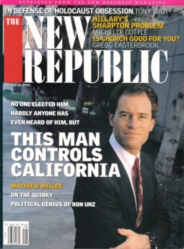
When Ron Unz’s mother, a politically active left-wing schoolteacher from Los Angeles, was in her mid-20s, she met an older professor from the Midwest on a flight to Israel. He seemed odd, eccentric even, but clearly brilliant, too, and Esther-Laio Avrutin decided, after he‘d visited her several times when she’d returned to L.A., that she would a have a child with him. When Esther-Laio wrote to her lover to let him know about her pregnancy, the letter was opened by the professor‘s wife — the existence of this wife came as startling news to Esther-Laio — and that ended any possibility that, her sister says, they would be married.
The results show that while students in English immersion programs perform better in the short term, over the long term students in classrooms taught in two languages not only catch up to their English immersion counterparts, but they eventually surpass them, both academically and linguistically.
So: no, not really. Forcing kids who didn’t speak English to be taught exclusively in English was, it turned out, not a great idea.



_van_het_Amsterdamse_lakenbereidersgilde_-_Google_Art_Project.jpg)


