The Didion Breakfast
Posted: August 13, 2024 Filed under: food 1 Comment
source. sometimes I consume the fruit and coffee breakfast.
somewhere in an old book I read a lengthy 19th century style description of how people in the tropics need to have a languid, light breakfast of fruits and sweets for their constitutions to function properly in the climate. Do places have appropriate breakfasts?
Coach Nick Saban having two Little Debbie oatmeal cream pies for breakfast every morning (“what you do every day matters”), that’s another breakfast that sticks in the mind.
I Cover The Waterfront
Posted: August 10, 2024 Filed under: the California Condition Leave a comment
Here’s the opening:
Chapter One: The Damned and the Lost
I have been here so long that even the sea gulls must recognize me. They must pass the word along about me from generation to generation, from egg to egg.
Former friends of mine, members of my old university class, acquaintances my own age, have gone out to earn their 6000 a year. They have become managers, they have become editors, they have become artists. Yet here am I, what I was six years ago, a waterfront reporter.
True, I am called a good waterfront reporter in this city, as if the humiliation were not already great enough in itself. I shudder at the compliment, yet should feel fortunate in a way that so far I have escaped the word veteran. When I am called not only the best waterfront reporter but also the veteran waterfront reporter, then for sure all hope is dissolved. And I need look ahead then, only to that day when the company presents me with a fountain pen and a final check.
I am nearing 28, and should I by accident be invited to a home where literature is discussed, or styles, or Europe, the best I could do would be tocrawl into the backyard. There I could sit tossing pebbles into the fountain until the hostess found me out. If she compelled me to come back into the house and join the conversation, my topics would have to be of swordfishing, or of lobstering, or of hunting sardines in the dark of the moon, or of fleet gunnery practice, or of cotton shipments. The predicament has passed beyond my control. I am one of those creatures who remain permanent, who stay in one place, that successful men on returning home may see for the happiness of comparison. I am of the damned and the lost, and yet I do know more than I did six years ago when I first came here, a graduate in liberal arts.
Six thousand a year. That was 1932, using the BLS inflation calculator that’s $131,821.68 today. Further investigation into the existential mystery of San Diego led me to this one.
Max Miller was waterfront reporter for San Diego’s third best newspaper in the 1930s. He worked out of a studio above the tugboat office. He remembers meeting the passengers from the big ocean liners:

He remembers Charles Lindbergh, before he was famous:

He remembers breaking some tough news:


How that one ends:

I Cover The Waterfront became a song, and a movie apparently not really based on the book.
[Miller] lived most of his life at 5930 Camino de la Costa in La Jolla, just south of Windansea (from his hillside home, he could hear the Point Loma lighthouse foghorn).
Zillow estimates that house would now cost around $16 million.
The San Diego Reader (oxymoron?)has the gossip on Miller:
But Morgan has a different interpretation. “I Cover the Waterfront was widely said among publishers to have been rewritten by a very beautiful literary agent in New York who was in love with Max at the time,” says Morgan. “It was a nasty allegation, but it was a better book than any he wrote subsequently. I tend to believe the rumor of the publishing trade.”
It’s possible. It’s also possible he was traumatized by World War Two. His title for his book about La Jolla, The Town With The Funny Name, doesn’t seem particularly inspired (is it really that funny a name? Right here in California we have Needles, Weedpatch, etc.) Or maybe he just had one good one in him.
they work well until they catastrophically come off the rails
Posted: August 8, 2024 Filed under: business Leave a commentKEN GRIFFIN: “I don’t know what that moment will be, when there is an auction that goes awry, or when the markets become dislocated. Financial markets, generally speaking, work very well until they catastrophically come off the rails. You don’t necessarily get a lot of warning that there’s about to be a big event. The crash of ’87 is a great case study. That day, I woke up, I was in my dorm room trading then, and the stories of the day were about a small skirmish in the Middle East, of frankly no consequence, and the health of First Lady Nancy Reagan. And yet, we ended that day with the stock market down twenty-some percent, and a number of American financial institutions literally on life support or near death. It happened in one day. One day. There was no big story that morning that would make you think that that day might of been the end of the U.S. capital markets as we knew them. There was no warning. And so I worry that the debt crisis may have a similar construct. That there’ll simply be a day where a major auction fails, and then you see a panic start to brew in the Treasury market. And the question will be, how fast will the Fed intervene? What panic will that induce? Because government intervention under duress often creates more panic. And then do we see a flood of treasuries coming back into the market from holders around the world?
Bloomberg Live (YouTube) – May 14, 2024. That’s from Santangel’s Value Links.
Reminded of McMurtry on stampedes and crowd behavior.
Lyn Alden had this:
In the United States, there has been quite a big gap between haves and have-nots with this fiscal and monetary mix. Those who don’t have much assets, like mainly a house, have been largely locked out of owning assets. Meanwhile, those who have assets and who have locked in those low rates, are generally in great shape, save for the fact that many of them are now kind of “stuck” in their existing home. And since the top 50% of consumers spend a lot more than the bottom 50% of consumers, the fact that the top half is doing pretty well has been a strong engine for overall consumption.
strong engine for overall consumption.
Gats
Posted: August 4, 2024 Filed under: food, the California Condition Leave a comment
saw someone on X (formerly “Twitter”) raise the old red flag of The Great Gatsby isn’t that good actually so I took it off the shelf.


That’s how it starts. (Struck me that my edition, the one we read in school I believe, has no introduction foreward or any of that bog you down scholarly junk at the front.* Your enjoyment of classic books will improve we believe if you always skip those and plunge right in. You can always come back later.)
If you’re like me you first read this book in school. It is a great summer book. It’s even set at the seaside.
Been meaning to document some items from Sheilah Graham’s The Real F. Scott Fitzgerald, and perhaps now is the time. Their relationship was tumultuous:
I knew that “Portrait of a Prostitute” was also a drunken commentary. He must have written it on the photograph after the first of our two bad quarrels in 1939 when he was drinking so heavily. We had struggled for his gun, I had slapped him—the first person in his life ever to do so-and as I walked out, I had delivered a harsh exit line, “Shoot yourself, you son of a bitch. I didn’t raise myself from the gutter to waste my life on a drunk like you.”
When they met:
When I first met Scott on July 14, 1937, neither of us was looking for a relationship of such intensity. He had too many other responsibilities. I was engaged to the Marquess of Donegall-who died recently-and planning a New Year’s Eve wedding to be followed by a honeymoon cruise around the world. Part of the unwritten marriage contract was that I would give Don an heir as soon as possible, and a doctor had told him that the swaying of a ship was conducive to pregnancy.
Zelda:
To hold Scott on a string when the engagement was off and to continue to make him jealous, Zelda invented an “engagement” to the famed golfer Bobby Jones. Scott always believed that she had promised to marry Mr. Jones. He told me this with conviction. But when Andrew Turnbull was writing his biography of Scott, he questioned the golfer, who denied even knowing Zelda.
later:
I think their lives also suffered from Zelda’s increasing desperation as to what to do with herself. She had no idea of being a wife shortly after they were married Scott discovered all his dirty shirts piled up in a closet-and, although she tried in the times of sanity, still less of being a mother
Scott’s diet:
When I think now of the abuse that Scott inflicted on himself, it’s a miracle that he lived as long as he did. Aside from his drinking there was, drunk or sober, the incessant smoking and also the reliance, when not drinking, on coffee and dozens and dozens of bottles a day of Coca-Cola. He would line up the Cokes all around the walls of his office at M-G-M and announce, “I’ll drink these up, and when they’re gone I’ll go back to beer.” Dr. Richard Hoffman, who had examined him in New York, told my Beloved Infidel collaborator, Gerold Frank, that Scott drank-both the liquor and the Cokes-be-cause he had the reverse of diabetes, an insufficiency of sugar in the blood. Is this true for all who drink unwisely?
This is when they were healthy:
For the first time for both of us, we were leading average lives, working by day, reading or walking in the evening after the same dinner prepared for us every night by our shared housekeeper, a thin T-bone steak (at 35 cents a pound!), a baked potato, peas, and a grapefruit jelly.
…
I would not have wanted to examine Scott’s inside, with not only all the above but also the strange food that he ate-sometimes just fudge and crab soup, in that order. He was eating a little more in that last year, lots of cookies, candy, and cake to compensate for the sugar in the alcohol.
But there were nice times too:
lunches at the elegant Vendome Restaurant in Hollywood, at the Brown Derby in Hollywood or in Beverly Hills, and our dancing in the evenings, particularly in the first year, at the Trocadero. Scott danced the collegiate style of the time-heads close together, rears at a thirty-three-degree angle.
Looking back, I marvel at what a full, active life we had. We also went away together for weekends, especially in the first two years before Scott was so hard up—to Santa Barbara, La Jolla, Del Monte, Monterey, over the south U.S. border into Mexico, and to the San Francisco Fair. I loved those long drives with Scott, even though he drove at twenty to twenty-five miles an hour.
“Del Monte,” a resort in Monterey that now belongs to the Navy. Monterey on the old roads before the 5 is about 331 miles away. At twenty five miles an hour that trip must’ve taken like thirteen hours. And that’s if you don’t stop every hour for more Cokes.
*in writing that sentence I got to wondering what those obstacles the Germans and their various conscripts) set up on the D-Day beaches were called. You know the ones I’m talking about? Turns out they are called hedgehogs.

What is San Diego?
Posted: July 30, 2024 Filed under: the California Condition Leave a comment
From time to time fortune takes me down the coast to the city of San Diego, and I’m always left a little stumped. What is this place? What is distinctly San Diego? If it has a bent it is slightly to the right, somewhat fratty/military. Top Gun, Navy SEALs. Retirees. IPAs (although those are everywhere now). The California burrito. What else? We’re talking about the eighth most populous city in the United States. Pleasant living is on offer for sure, sunshine and surf. The people that like it love it. But what does it have to show for itself?

Here’s the WPA guide to California on the city, as it was circa 1939:
SAN DIEGO (0-822 alt., 147,995 pop.), the oldest Spanish settlement in California, is in the extreme lower left-hand corner of the United States. Although only 16 miles north of the Mexican boundary, it is completely American. Its landlocked natural harbor is headquarters for the Eleventh Naval District, for marine and coast guard bases, and home port for a fleet of tuna clippers and fishing smacks manned by Portuguese and Italian fishermen.
The city has much of the easygoing spirit of Spanish days, and people dress and live for comfort. Life moves at a modulated pace, particularly because of the large number of retired and elderly persons.
The downtown area, dominated by a group of tall buildings, is small for a city of this size; Broadway, the main artery, runs from the waterfront due east and divides the city into distinct sections. Although liners no longer call at the port Max Miller wrote of in I Cover the Waterfront, freighters and tramp steamers dock here regularly. Tuna clippers bring in big hauls of huge fish, and sport fishing parties return with catches of yellowtail, barracuda, and swordfish. Navy shoreboats run between ships at anchor and the piers.
South of Broadway many plain buildings of the 1870’s and gingerbread structures of the 1890’s are still in use. Markets and grocery stores along Twelfth Avenue display fruit and vegetables in pyramids and cascades. Third, Fourth, and Fifth Avenues have taverns with three-piece jazz bands, shooting galleries, inexpensive movies, hamburger stands, pawn shops, and small hotels.
Balboa Park’s giant green square begins just north of the business district. North and northwest of the park are the newer residential districts, and to the west is Middletown, a narrow segment extending from the bay to the low hills, occupied by Italian fishermen and airplane factory employees. Old Town, site of the original Spanish settlement, is northwest of Middletown. It has some fine adobe buildings, fringed with rose bushes and flowers, but most of the land is occupied by small houses and auto courts.
Most of San Diego’s inhabitants, apart from the shifting Navy personnel, are immigrants or descendants of immigrants from the East and Middle West. Many are retired; ten percent of all retired U. S. Navy officers live in San Diego.
In the Logan Heights district, south and east of downtown along the curved southern shore, sprawl San Diego’s Mexican and Negro communities, with Mexican restaurants vending tamales and tacos, and with chicken palaces and big ovens where Negroes barbecue meat.
About 10,000 Mexicans, most of them clinging to their own language and customs, live in this district; they are employed mainly as day laborers and cannery workers. The 4,500 Negroes are mostly manual or domestic workers. The Japanese colony, of about 1,000 persons, is in this area also; some in huts on stilts over the water. About 5,000 Portuguese fisherman, who live on the bay side of Point Loma, form a distinct group preserving its own customs. Italian fishermen mingle more generally with the community.
The site of San Diego was visited in 1539 by Father Marcos and his followers, from the desert side, in their search for the “Seven Cities of Cibola”; in 1542 by Juan Rodriguez Cabrillo, a Portuguese explorer in the service of Spain, who spent six days in the harbor; and sixty years later by Sebastian Vizaíno, merchant navigator charting the coast for Spain.
In 1769 Governor Portola, with Franciscan friars and soldiers, established a mission and presidio here. The English sloop Discovery, engaged in scientific research, visited San Diego in 1793, and in 1803 the Yankee-owned Lelia Byrd, caught while smuggling otter skins, fought a cannon duel with the battery of Ballast Point.
…
During the Mexican regime, San Diego took on more color. “The beautiful señoritas danced their picturesque dances at the balls which followed bull-fights and cock-fights.” Many Spanish families, on bad terms with the Mexican governor, assisted the Americans in their conquest. After the Treaty of Guadalupe Hidalgo, the town came peacefully under American rule.
In 1850 the present Old Town was incorporated as a city. The site of the present city was called New Town, or “Davis’s Folly” for William Heath Davis, who first built there. Alonzo E. Horton, for whom New Town was named “Horton’s Addition,” profited more than he.
From 1867 to 1872 New Town grew steadily; then a fire wiped out Old Town’s business district, and New Town became the city’s center.
In 1885 the Santa Fe Railroad laid tracks into San Diego and made it a transcontinental terminus. Two years later it had 40,000 residents, but the boom collapsed, and by 1890 there were only 17,000. Since 1910 its population has doubled about every decade.
Aircraft is the only large-scale industrial plant. Fishing and canning San Diego’s 335 factories are mostly small enterprises; Consolidated are basic sources of income. A large lumber mill handles timber rafted in from the Northwest.
San Diego was an open-shop city until the strong wave of unionization in the early thirties; during the bitter “Free Speech Fight” of 1912 radical headquarters were raided and radicals ordered out of town.
Depressions have touched lightly on San Diego.
The colorful fishing fleet days are over, although there are still some 150+ commercial fishing vessels.
San Diego is a place that isn’t “certified,” to borrow from Walker Percy—there are fewer templates or cultural expectations for what your life must be like here, compared to LA or New York, for example. As Armantrout went on to say, “In my mature years I have come to appreciate the blankness of this town. When I step on the street in San Diego, I am not stepping onto a set; I am not stepping into a play, my own or anyone else’s.” In her work, the ersatz dailiness of ordinary life in San Diego—bills, television shows, illness, reading, advertisements, children—is maybe the best portrait of the city one could make, and certainly a guide for maintaining a vibrant life of the mind here.
from this piece on literary San Diego by Patrick Coleman.
Maybe (in fact certainly) I’m overthinking it. San Diego is a normie heaven, and that’s it. We need a city to absorb surplus bro energy and mellow it in the Southern California sun, which object San Diego achieves. To ponder what it might mean is very un-San Diego. Just crack a cold one or pop an edible, put on the game and vibe out.
And what are we even talking about here? New Orleans produces culture and also absurd murder rates. LA is LA but did San Diego have anything on the scale of the 1994 riots or the O.J trial? What is character but atrocity, debacle, chaos sanded by time?

In recent years my visits to San Diego have been for Comic-Con. 130,000 people descend on the San Diego Convention Center (2.6 million square feet) and surrounding blocks. This might seem fringe or marginal, it was at one time, but now we’re talking about the most popular movies in the world, billion dollar corporate products.

a fraction of a fraction of the whole, the scale is difficult to grasp. The size of it humbles the aircraft carriers docked across the bay.
Perhaps it is the very blankness of San Diego that allows the city to absorb Comic Con. You can attend Comic Con without being in “San Diego” in any real way. There’s nice weather, you’re near the water, but essentially you’re in one giant hotel without distinction.
Near the Comic Con zone is a massive Dole shipping and processing facility:

In the past I’ve been impressed with the San Diego Museum of Art, that has a possible Bosch or Bosch workshop.

This year I ventured as far as Little Italy to Vino Carta, where Jeff Fischer was pouring wines. You’re on India Street there and under the landing path of planes to San Diego’s airport, it’s kind of fun as they descend just over your head. On the rec of a local I had some very fine tacos from Tacos El Gordo, a line down the block, Bourdain kind of place. The adobada was recommended but I’m off the pork at the moment.
Recall that towards the end of Cormac McCarthy’s Blood Meridian, the kid ends up in San Diego. Here are some excerpts, which we put down towards the project of assembling a literary anthology of San Diego:
As he was crossing the plaza toward the little mud cabildo he encountered Toadvine and Webster newly released. They were wildlooking and they stank. The three of them went down to the beach and sat looking out at the long gray swells and passing Brown’s bottle among them. They’d none of them seen an ocean before. Brown walked down and held his hand to the sheet of spume that ran up the dark sand. He lifted his hand and tasted the salt on his fingers and he looked downcoast and up and then they went back up the beach toward the town. They spent the afternoon drinking in a lazarous bodega run by a Mexican. Some soldiers came in. An altercation took place. Toadvine was on his feet, swaying. A peacemaker rose from among the soldiers and soon the principals were seated again. But minutes later Brown on his way back from the bar poured a pitcher of aguardiente over a young soldier and set him afire with his cigar. The man ran outside mute save for the whoosh of the flames and the flames were pale blue and then invisible in the sunlight and he fought them in the street like a man beset with bees or madness and then he fell over in the road and burned up. By the time they got to him with a bucket of water he had blackened and shriveled in the mud like an enormous spider. Brown woke in a dark little cell manacled and crazed with thirst.
a bit later:
They reached San Diego in the dead of night and were directed to the alcalde’s house. This man came to the door in nightshirt and stockingcap holding a candle before him. Glanton pushed him back into the parlor and sent his men on to the rear of the house from whence they heard directly a woman’s screams and a few dull slaps and then silence.
…
They left them bound and gagged and rode out to visit the grocer. Three days later the alcalde and the grocer and the alcalde’s wife were found tied and lying in their own excrement in an abandoned hut at the edge of the ocean eight miles south of the settlement. They’d been left a pan of water from which they drank like dogs and they had howled at the booming surf in that wayplace until they were mute as stones. Glanton and his men were two days and nights in the streets crazed with liquor. The sergeant in charge of the small garrison of American troops confronted them in a drinking exchange on the evening of the second day and he and the three men with him were beaten senseless and stripped of their arms. At dawn when the soldiers kicked in the hostel door there was no one in the room.
A return:
It was evening of the following day when they entered San Diego. The expriest turned off to find them a doctor but the kid wandered on through the raw mud streets and out past the houses of hide in their rows and across the gravel strand to the beach. Loose strands of ambercolored kelp lay in a rubbery wrack at the tideline. A dead seal. Beyond the inner bay part of a reef in a thin line like something foundered there on which the sea was teething. He squatted in the sand and watched the sun on the hammered face of the water. Out there island clouds emplaned upon a salmoncolored othersea. Seafowl in silhouette. Down-shore the dull surf boomed. There was a horse standing there staring out upon the darkening waters and a young colt that cavorted and trotted off and came back.
He sat watching while the sun dipped hissing in the swells. The horse stood darkly against the sky. The surf boomed in the dark and the sea’s black hide heaved in the cobbled starlight and the long pale combers loped out of the night and broke along the beach. He rose and turned toward the lights of the town. The tidepools bright as smelterpots among the dark rocks where the phosphorescent seacrabs clambered back. Passing through the salt grass he looked back. The horse had not moved. A ship’s light winked in the swells. The colt stood against the horse with its head down and the horse was watching, out there past men’s knowing, where the stars are drowning and whales ferry their vast souls through the black and seamless sea.

Teddy Blue
Posted: July 29, 2024 Filed under: cormac, Texas, the American West Leave a comment
I’ve been working my way through Larry McMurtry’s short syllabus for understanding the cowboy of the 19th century. Teddy Blue’s memoir is vivid:

A Yankee cowboy:

Conversation with a chippie:

(Gilt Edge appears to be no more).
strong phrase:

Reminded of Cormac McCarthy: I’d know your hide in a tanyard. Teddy weighs in on cowboy songs:

I like the version by Suzanne Vega.
First look at Common Side Effects
Posted: July 27, 2024 Filed under: America Since 1945, art, comedy, drugs, film, hely, how to live, pictures, plays, screenwriting, story, the world around us, Wonder Trail Leave a commentFor the past couple of years I’ve been working on this animated show I co-created with the great Joe Bennett. Even adjusting for my personal bias, I believe it came together in an amazing way and will be an incredible show. Coming in 2025.
Everyday life in the Holy Roman Empire
Posted: July 27, 2024 Filed under: Switzerland Leave a comment
Ever since I saw this map while working through the history of Switzerland and the Savoy I’ve been wondering what the deal was with the Holy Roman Empire. Peter Wilson’s book, The Holy Roman Empire, is a fantastic introduction and I hope to write up something about it once I finish its many hundreds of surprisingly compelling pages.
Wilson adds to Voltaire’s quip that it was neither holy, Roman, nor an empire by pointing out that it didn’t even call itself the Holy Roman Empire. What happened was: the vacuum left after the Roman empire bothered everybody, especially because there should be a guy who was in charge of like Christendom. In the year 800, Pope Leo II declared that Charlemagne was like the new Roman emperor. For the next few hundred years, there was a delicate game between the Pope and whoever could gather the right combo of force and legitimacy and political support to get himself named the Emperor. The Emperor would travel around – a stop at Charlemagne’s spot in Aachen was mandatory. The Empire itself was quite fractured but seems to have held together pretty well.
I put my search for a good Holy Roman Empire book to Twitter and user Max S. recommended this one:

It’s a dense one, and I haven’t consumed all of it, but there are some vivid snapshots of life in this era. The world post the calamitous 14th century:

The career of Tommy Platter:

And a different path:

a smart roundup on witch trials, which we’ve considered before:
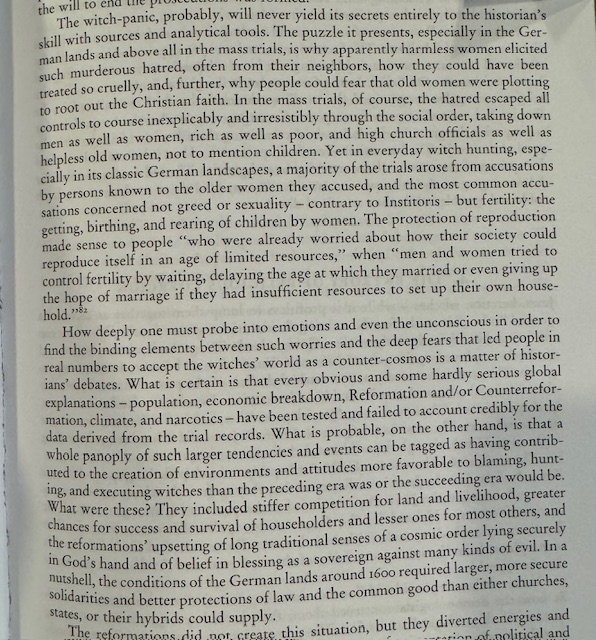
Agree that witch trials will never yield their secrets to the historian’s tools. Anyway: pleasing way to pass some time in a lethargic summer in Hollywood.
letters, LRB
Posted: July 18, 2024 Filed under: London Leave a comment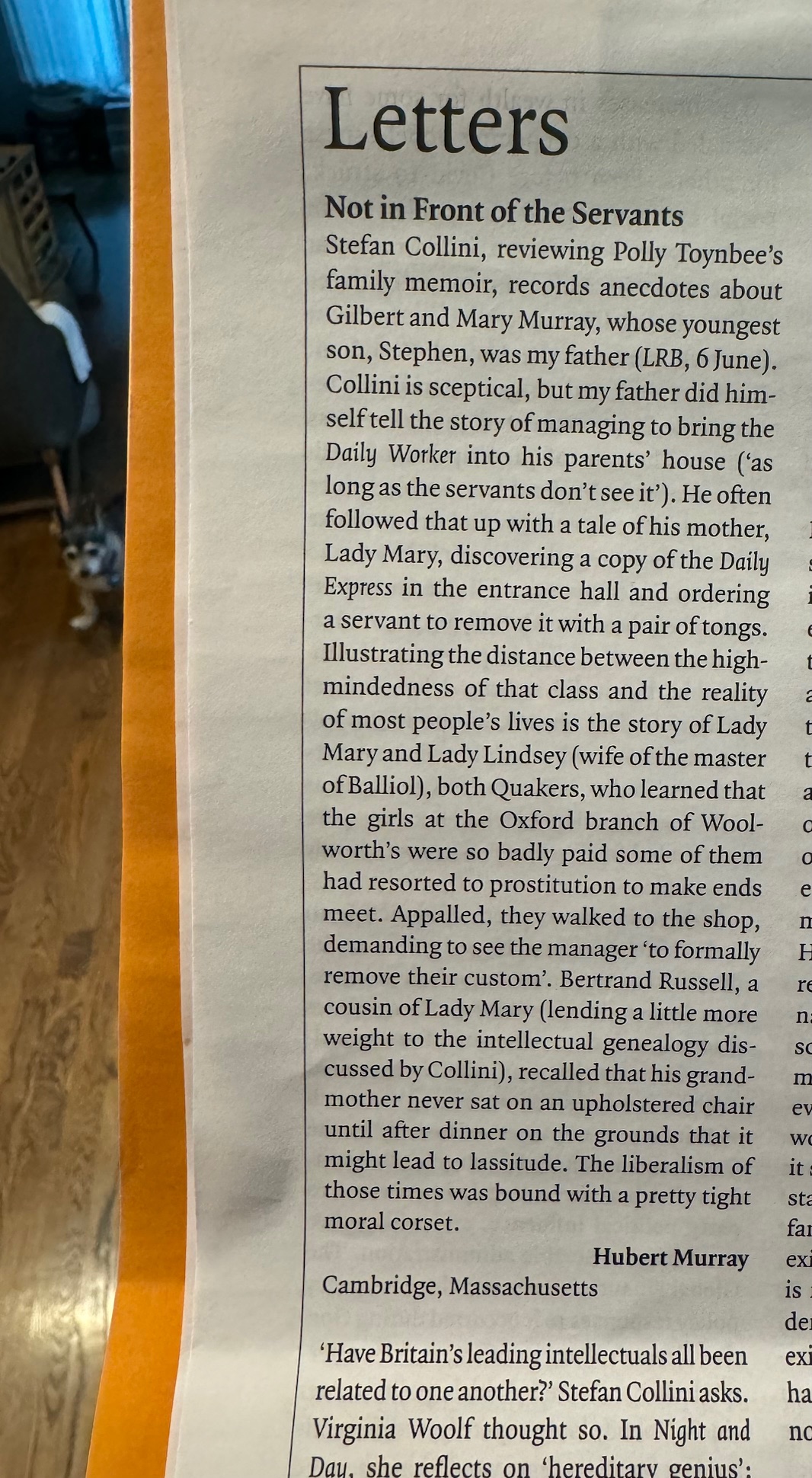
The letters are the real reason to subscribe to The London Review of Books. Reading English magazines and papers is stimulating, your brain has to work just that little bit harder to try and penetrate the layers.
What?
Posted: July 18, 2024 Filed under: beer, business Leave a comment

That’s from ValueLine. I’m long Diageo (Guinness has been popular for 250+ years and possesses pricing power, observe how few people buy the cheaper competitor Beamish) but I’m not seeing how putting on a VR helmet will help people experience tequila? Who is the dope here, Apple, Diageo, both? Feels degrading and cheap for both sides.
Amazing punchline
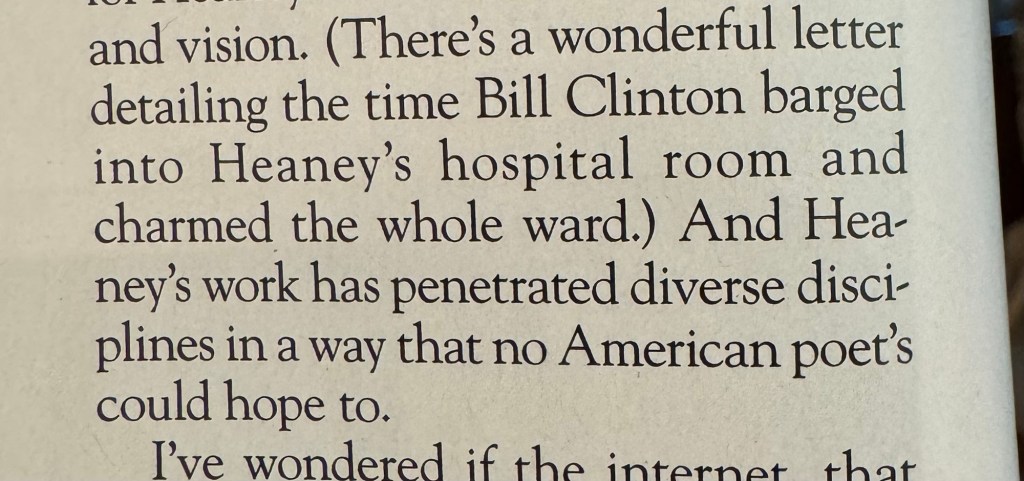
Posted: July 18, 2024 Filed under: Ireland Leave a commentTo this Harper’s review of the collected letters of Seamus Heaney:

Heard Seamus Heaney read from Beowulf once at Harvard, there were only about twenty people there, it was rad. His letters are none of my business. I guess I would read this one:
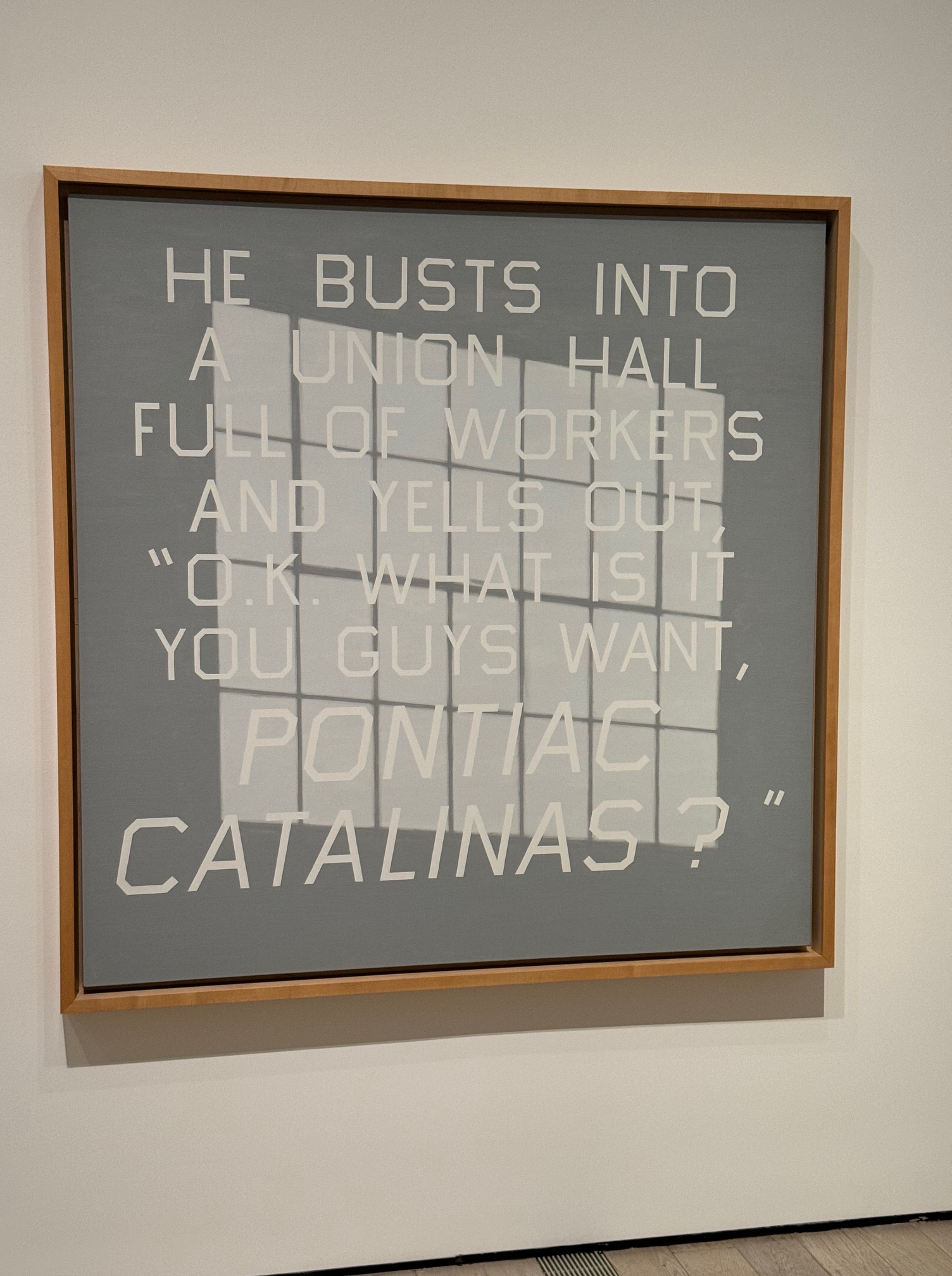
Ed Ruscha at LACMA
Posted: July 10, 2024 Filed under: America Since 1945, art history Leave a comment
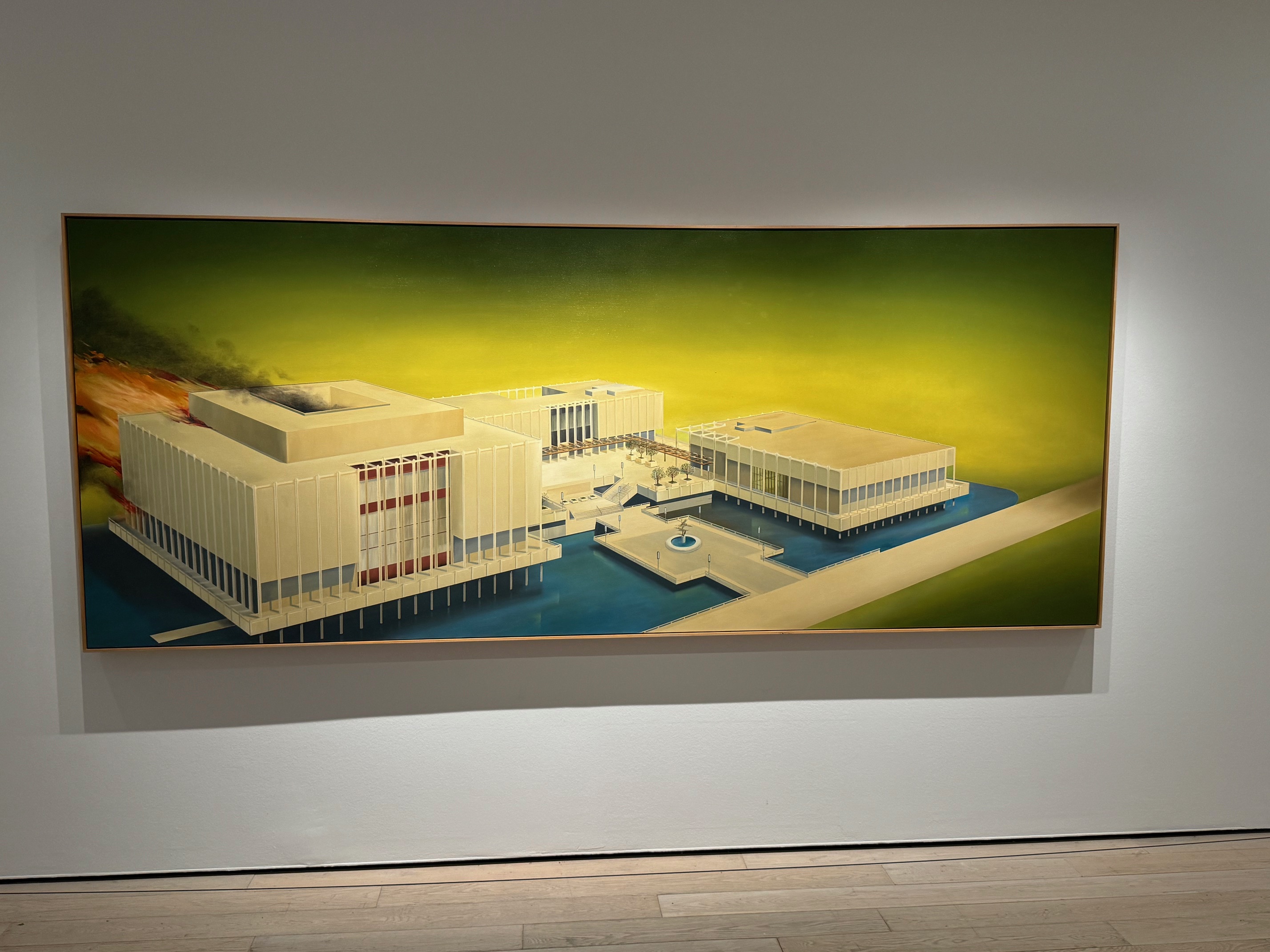
The Los Angeles County Museum on Fire, 1968

photo taken in Ireland, 1962:




Sigourney
Posted: June 29, 2024 Filed under: actors Leave a commentThe debate was so distressing that I started clicking around and landed on PBS where they were showing an episode of Doc Martin guest starring… Sigourney Weaver?

Very soothing!
Turns out Sigourney is good friends with Doc Martin actress Selina Cadell:
I loved Selina as soon as we met in that London pub. We stayed in touch the old-fashioned way after that first summer in London, sending letters and postcards. When I found out I’d got the part of Ripley in Alien, I phoned my parents and then Selina. I was thrilled that I was going to be filming in London.
When you have a friend who’s also an actress, but is as generous and as well-balanced as Selina, then you can call them up and tell them about a great job. There were plenty of friends I wouldn’t have been able to call, because their first instinct would’ve been, “Why am I not getting a movie?” But I knew she’d be happy for me.
And:
I said, “Are you kidding? I’d love to!” They sent messages via Selina asking if I’d appear in series seven and again in series eight. Of course I did! I made Avatar rework their schedules so I could be here.
People expect me to behave in a grand manner, but it’s not like I’m John Travolta. Having a cameo in Doc Martin is a dream job for me. Cornwall is the most beautiful place. I’ve read every novel about it I can and I watch Poldark on my iPad.
…
I admire you British: when things get tough, you reach for humour. Not firearms. I’d love to live closer to Selina, but however far away she might be, she is always with me. When I’m working I start each day by listening to a tape she recorded for me ten years ago. She tells me how to relax, how to catch my breath. It’s my safe place.
Source. Would Sigourney run?
Stompin’ at the Savoy
Posted: June 29, 2024 Filed under: music, UK Leave a commentWhen you are in Annecy, France you are in the department of Haute-Savoie, just above the department of Savoie. The counts of Savoy and the House of Savoy were a whole scene, and the Savoy is “a cultural-historical region in the Western Alps,” as Wiki tells us.
Situated on the cultural boundary between Occitania and Piedmont, the area extends from Lake Geneva in the north to the Dauphiné in the south and west and to the Aosta Valley in the east.
The Savoy does not include the city of Geneva itself. During an event known as the Escalade, in December 1602, the Savoyards attacked Geneva, but were repelled.

(Supposedly) the late night cooks caught the sneaking Savoyards and dumped boiling pots of stew on them and alerted everybody.

Although the armed conflict actually took place after midnight, in the early morning on 12 December, celebrations and other commemorative activities are usually held on 11 December or the closest weekend. Celebrations include a large marmite (cauldron) made of chocolate and filled with marzipan vegetables and candies wrapped in the Geneva colours of red and gold… Teenagers tend to throw eggs, shaving cream, and flour at each other as part of the celebration. The high school students parade together by first going to “conquer” each other and end up in the central square of the old town after walking through the rues basses to the plaine de Plainpalais and back.
On the sleepless cook does history turn, don’t let anyone tell you otherwise. So ended Savoyard expansion and Geneva stayed independent.
The first count of Savoy was Humbert I:
Humbert is the progenitor of the dynasty known as the House of Savoy. The origins of this dynasty are unknown, but Humbert’s ancestors are variously said to have come from Saxony, Burgundy or Provence.
That’s as far back as we can get on Savoy. As Bob Dylan says:
But that pedigree stuff, that only works so far. You can go back to the ten-hundreds, and people only had one name. Nobody’s gonna tell you they’re going to go back further than when people had one name.
In 1860 the Duchy of Savoy became part of France in a deal where France agreed to support unifying Italy. By then the House of Savoy was the royal family of Italy, and they kept on until 1946. Since then they’ve fallen rather hard, I recommend this wikpedia section, The House of Savoy Today. Vanity Fair article type stuff. Maybe Princess Vittoria is the current heiress, I dunno, it gets mixed up with the cousins. Suffice to say that the House of Savoy is at a low ebb in their thousand year journey.
The word Savoy associates in my mind to “Stompin at the Savoy” and The Savoy Hotel. How did this word spread?

Stompin’ at the Savoy took its name from the Savoy Ballroom, which was once at 596 Lenox Avenue in Harlem.

(those images from the Savoy Ballroom wiki)
That Savoy took its name from the famed London hotel:
Built by the impresario Richard D’Oyly Carte with profits from his Gilbert and Sullivan opera productions, it opened on 6 August 1889. It was the first in the Savoy group of hotels and restaurants owned by Carte’s family[a] for over a century. The Savoy was the first hotel in Britain to introduce electric lights throughout the building, electric lifts, bathrooms in most of the lavishly furnished rooms, constant hot and cold running water and many other innovations. Carte hired César Ritz as manager and Auguste Escoffier as chef de cuisine; they established an unprecedented standard of quality in hotel service, entertainment and elegant dining, attracting royalty and other rich and powerful guests and diners.
(Then Ritz and Escoffier left in a scandal, they were stealing booze and semi-embezzling. Ritz of course would go on to have his own chain, that also generated music:
https://www.youtube.com/watch?v=aNFffHQOXMc
)
The London hotel was called Savoy because it was on the location of the Savoy Palace. Eleanor of Provence married King Henry III in 1236. He was 28, she was maybe 12.

Wiki tells us:
she was very much hated by the Londoners. This was because she had brought many relatives with her to England in her retinue; these were known as “the Savoyards”, and they were given influential positions in the government and realm. On one occasion, Eleanor’s barge was attacked by angry Londoners who pelted her with stones, mud, pieces of paving, rotten eggs and vegetables.
One of these Savoyards was her uncle Peter, who was granted some land where he built Savoy Palace:
The Savoy was the most magnificent nobleman’s house in England. It was famous for its owner’s magnificent collection of tapestries, jewels, and other ornaments. Geoffrey Chaucer began writing The Canterbury Tales while working at the Savoy Palace as a clerk.
It was destroyed in the Peasants’ Revolt of 1351. Later on the site was built Savoy Hospital:

Later this area became a little precinct:

There was a chapel there, Savoy Chapel:

In 1912 it was the scene of a suffragette wedding between Victor and Una Duval. The wedding was attended by leading suffragettes and the wedding caused much debate because the bride refused to say “and obey”, despite the intervention of the Archbishop of Canterbury.
And nearby D’oyly Carte built the Savoy Theatre and the Savoy Hotel.

And there we have some history of “Savoy” as a concept. Once again a cultural and historical puzzle that’s come up in our travels has been followed towards the source, with illuminating new stories and details that have enriched our experience of life. We’ve shared it with you, the reader, and hope you’ve found it edifying.

Let’s all listen to Stompin’ At The Savoy, we’ll go with the version by… Art Tatum:
Quality data and Hapsburg AI
Posted: June 27, 2024 Filed under: America Since 1945, business Leave a comment

That’s from the June 7 issue of ValueLine. I subscribed after I saw this clip:
Not even sure what year that’s from.
Quality has been on my mind.
Quality … you know what it is, yet you don’t know what it is. But that’s self-contradictory. But some things are better than others, that is, they have more quality. But when you try to say what the quality is, apart from the things that have it, it all goes poof! There’s nothing to talk about. But if you can’t say what Quality is, how do you know what it is, or how do you know that it even exists? If no one knows what it is, then for all practical purposes it doesn’t exist at all. But for all practical purposes it really does exist. What else are the grades based on? Why else would people pay fortunes for some things and throw others in the trash pile? Obviously some things are better than others … but what’s the betterness? … So round and round you go, spinning mental wheels and nowhere finding anyplace to get traction. What the hell is Quality? What is it?
As the guy says in Zen and the Art of Motorcycle Maintenance. At the Smithsonian you can see Pirsig’s motorcycle:

I was at See’s Candy the other day:

Recently I read this book:


There are some interesting case studies (although they skew a bit Euro):

Will AI ever produce something of “quality”? I have yet to see it.
June 25-26
Posted: June 26, 2024 Filed under: America, the American West, Uncategorized 3 CommentsLt. James Bradley led a detachment of Crow Indian scouts up the Bighorn Valley during the summer of 1876. In his journal he records that early Monday morning, June 26, they saw the tracks of four ponies. Assuming the riders must be Sioux, they followed these tracks to the river and came upon one of the ponies, along with some equipment which evidently had been thrown away. An examination of the equipment disclosed, much to his surprise, that it belonged to some Crows from his own command who had been assigned to General Custer’s regiment a few days earlier.
While puzzling over this circumstance, Bradley discovered three men on the opposite side of the river. They were about two miles away and appeared to be watching. He instructed his scouts to signal with blankets that he was friendly, which they did, but for a long time there was no response. Then the distant men built a fire, messages were exchanged by smoke signal, and they were persuaded to come closer.
They were indeed Crow scouts: Hairy Moccasin, Goes Ahead, White Man Runs Him. They would not cross the river, but they were willing to talk.
Bradley did not want to believe the story they told, yet he had a feeling it was true. In his journal he states that he could only hope they were exaggerating, “that in the terror of the three fugitives from the fatal field their account of the disaster was somewhat overdrawn.”
The news deeply affected his own scouts. One by one they went aside and sat down, rocking to and fro, weeping and chanting. Apart from relatives and friends of the slain soldiers, he later wrote, “there were none in this whole horrified nation of forty millions of people to whom the tidings brought greater grief.”
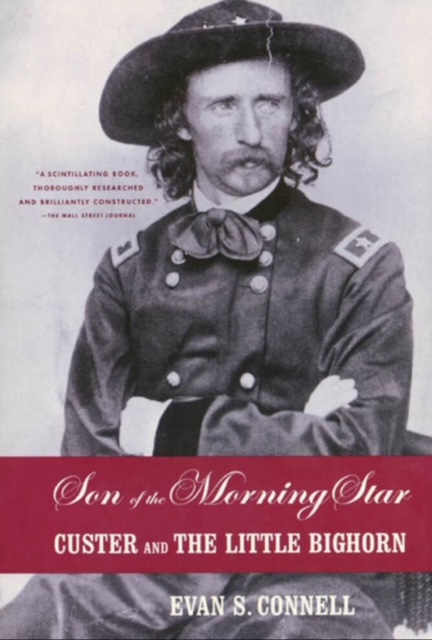
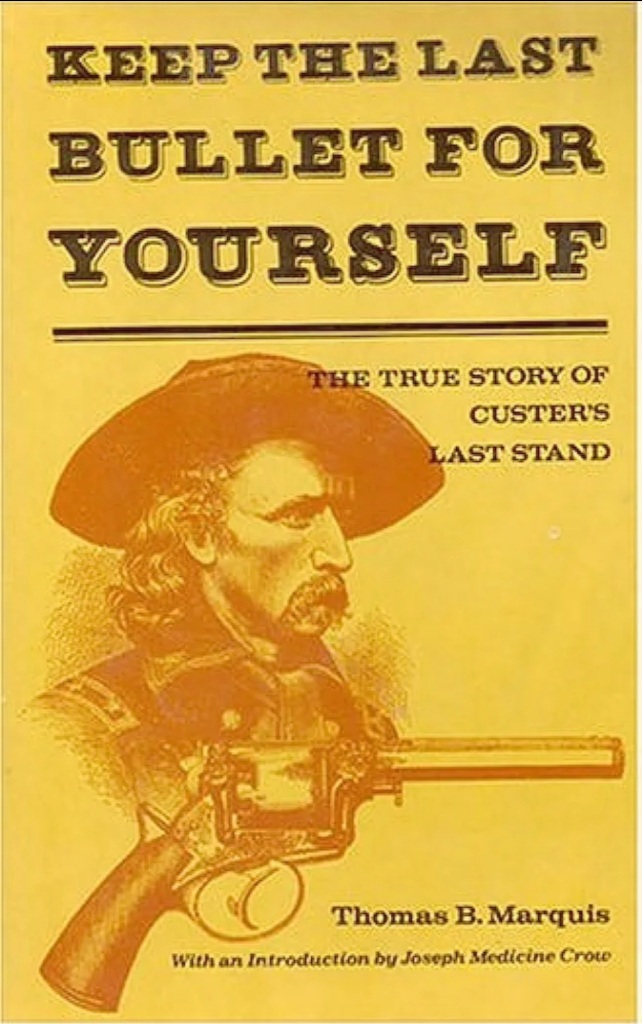
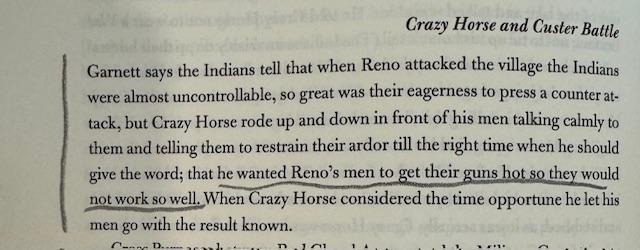
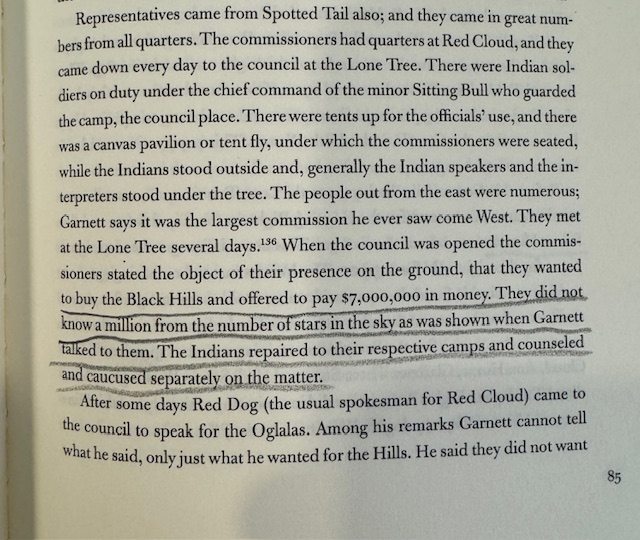
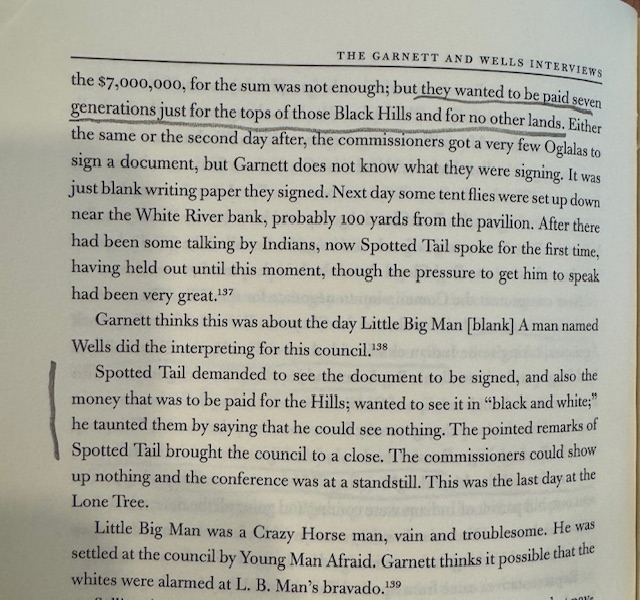
There were no literate survivors to the “last stand” event of June 25, 1876, so we have no firsthand written accounts. What happened was pieced together first from a sort of crime scene investigation. Later, interviews with participants were done, but cultural and linguistic gaps remained. Thomas Marquis, who lived among the Northern Cheyenne and knew many of them, wrote a book whose conclusions were so shocking it couldn’t be published in his lifetime.
Later, art, illustrations, apparently by eyewitnesses emerged, much of it quite vivid.
How about this:
or this:

Those found in:
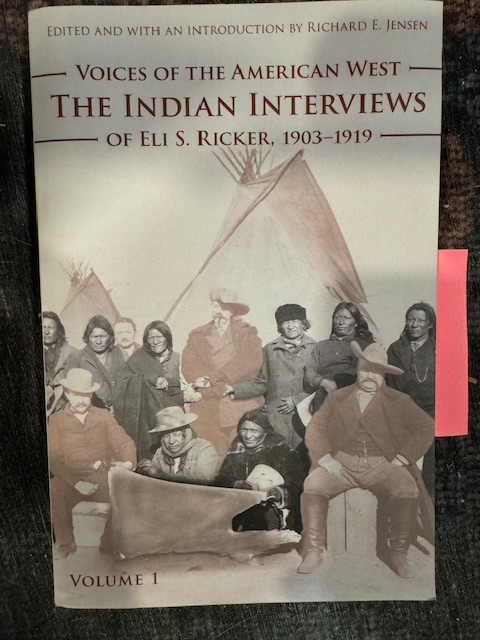
What was this war about, anyway?:
Geneva Conventions (Swiss History Part Seven)
Posted: June 9, 2024 Filed under: Switzerland 1 CommentI believe this will conclude our unit on the history of Switzerland. Here you can find Part One about pre-Switzerland to the Dark Ages, Part Two about the Bernese chronicles, Part Three about founding myths like William Tell and the Rütli oath, Part Four about the various leagues up to the Congress of Vienna, Part Five about Steinberg’s Why Switzerland, and Part Six about Calvin/Cauvin’s Geneva.

Henry Dunant was a thirty one year old Swiss businessman who was trying to arrange some deals in French-held Algeria. He was running into problems, the land and water rights were all a jumble. So he came up with a plan:
Dunant wrote a flattering book full of praise for Napoleon III with the intention to present it to the emperor, and then traveled to Solferino to meet with him personally.
Napoleon III, Emperor of France, was in a war with Austria at the time. Dunant arrived on the evening after a massive battle. There were something like 40,000 dead and wounded people around.

No one was helping them.
Shocked, Dunant himself took the initiative to organize the civilian population, especially the women and girls, to provide assistance to the injured and sick soldiers. They lacked sufficient materials and supplies, and Dunant himself organized the purchase of needed materials and helped erect makeshift hospitals. He convinced the population to service the wounded without regard to their side in the conflict as per the slogan “Tutti fratelli” (All are brothers) coined by the women of nearby city Castiglione delle Stiviere. He also succeeded in gaining the release of Austrian doctors captured by the French and British.
When he got home, he wrote up a book called A Memory of Soferino, in which he described what he saw and set forth the idea that a neutral organization that could help the wounded in war would be valuable.
On February 7, 1863, the Société genevoise d’utilité publique [Geneva Society for Public Welfare] appointed a committee of five, including Dunant, to examine the possibility of putting this plan into action. With its call for an international conference, this committee, in effect, founded the Red Cross.
That’s from the Nobel Prize website; Dunant won the first ever Nobel Peace Prize.
A year after the founding of the Red Cross, the government of Switzerland invited all European countries as well as the US, Mexico and Brazil to a conference where they agreed on the first Geneva Convention “for the Amelioration of the Condition of the Wounded in Armies in the Field”. They met in the Alabama room of Geneva’s city hall. Now, why was it called the Alabama room? Because that’s where an international tribunal met to work out the Alabama Claims, an international dispute between the US and the UK regarding grievances over Confederate raiders, including the Alabama, which were built in the UK and used against the US.

The Alabama.
So, Geneva already had a rep as a place for international meetings.
As for Dunant, he went bust. Says Nobel Prize.org:
After the disaster, which involved many of his Geneva friends, Dunant was no longer welcome in Genevan society. Within a few years he was literally living at the level of the beggar. There were times, he says, when he dined on a crust of bread, blackened his coat with ink, whitened his collar with chalk, slept out of doors.
For the next twenty years, from 1875 to 1895, Dunant disappeared into solitude. After brief stays in various places, he settled down in Heiden, a small Swiss village. Here a village teacher named Wilhelm Sonderegger found him in 1890 and informed the world that Dunant was alive, but the world took little note. Because he was ill, Dunant was moved in 1892 to the hospice at Heiden. And here, in Room 12, he spent the remaining eighteen years of his life. Not, however, as an unknown. After 1895 when he was once more rediscovered, the world heaped prizes and awards upon him.
Despite the prizes and the honors, Dunant did not move from Room 12. Upon his death, there was no funeral ceremony, no mourners, no cortege. In accordance with his wishes he was carried to his grave «like a dog»3.
The Red Cross calls me just about every day about giving blood. I’ve got to do that again.

Calvin’s Geneva (Swiss History Part Five or Six)
Posted: June 7, 2024 Filed under: religion, Switzerland Leave a commentPrevious posts on Swiss history.

Jean Cauvin was a twenty-four year old lawyer and scholar when his friend/ally gave a speech at the University of Paris that was so scandalous the guy had to leave town and move to Basel. The topic of the speech? Reforming the Catholic Church.
Shortly after events got so heated (y’all remember The Affair of the Placards) that Calvin had to leave town too. The Universal History of the World picks up:


The Universal History of the World, which I bought volume by volume for 50 cents each at the Needham Public Library, really fired up my youthful imagination. The book has a slight Protestant slant.
Wikipedia gives us Voltaire’s take on the reign of Calvin:
Voltaire wrote about Calvin, Luther and Zwingli, “If they condemned celibacy in the priests, and opened the gates of the convents, it was only to turn all society into a convent. Shows and entertainments were expressly forbidden by their religion; and for more than two hundred years there was not a single musical instrument allowed in the city of Geneva. They condemned auricular confession, but they enjoined a public one; and in Switzerland, Scotland, and Geneva it was performed the same as penance.”
Marilynne Robinson, in her Death of Adam, has a long essay sticking up for Calvin (she uses the spelling Cauvin):
Still, I would like to consider a little longer the strange figure of Jean Cauvin himself, because he is a true historical singularity. The theologian Karl Barth called him “a cataract, a primeval forest, something demonic, directly descending from the Himalayas, absolutely Chinese, marvelous, mythological.”
…
His commentaries on the Psalms and on Jeremiah are each about twenty-five hundred pages long in English translation, and he wrote commentary on almost the whole Bible, besides personal, pastoral, polemical, and diplomatic letters, treatises on points of doctrine, a catechism, and continuous revisions of his Institutes of the Christian Religion, the first, greatest, and most influential work of systematic theology the Reformation produced.
Robinson points out that by way of Geneva, many Protestant exiles who ended up in the future USA had an example of a republican type of government:
There are things for which we in this culture clearly are indebted to him, including relatively popular government, the relatively high status of women, the separation of church and state, what remains of universal schooling, and, while it lasted, liberal higher education, education in “the humanities.” All this, for our purposes, emanated from Geneva—in imperfect form, of course, but tending then toward improvement as it is now tending toward decline.
and:
In 1528 Geneva became an autonomous city governed by elected councils as the result of an insurrection against the ruling house of Savoy. Though the causes of the rebellion seem to have had little to do with the religious controversies of the period, in the course of it two preachers, Guillaume Farel and Pierre Viret, persuaded the city to align itself with the Reformation, then recruited Cauvin to guide the experiment of establishing a new religious culture in the newly emancipated city. That is to say, Calvinism developed with and within a civil regime of elections and town meetings…
Again, the republican institutions of Geneva were in place before Calvin set foot in that city; the Northern Netherlands freed itself and governed itself under Calvinist influence, which was strong but never exclusive; the New Englanders embraced a revolutionary order whose greatest exponents were Southerners.
She suggests we ease up on Calvin, after all he only executed the one heretic:
Bear in mind that Calvin approved the execution of only one man for heresy, the Spanish physician known as Michael Servetus, who had written books in which, among other things, he attacked the doctrine of the Trinity. One man is one too many, of course, but by the standards of the time, and considering Calvin’s embattled situation, the fact that he has only Servetus to answer for is evidence of astonishing restraint.
But she notes some difficult aspects:
Cauvin has an unsettling habit of referring to himself or to any human being as a “worm.”
I hope to learn more about John Calvin/Cauvin in Geneva. I find myself more drawn to Servetus:
Servetus also contributed enormously to medicine with other published works specifically related to the field, such as his Complete Explanation of Syrups
When Calvin died, they were worried his resting place would become a place of veneration, as for a saint, which he wouldn’t approve of, so he was buried in an unmarked grave.
History: rhyming or nah?
Posted: June 5, 2024 Filed under: America Since 1945, Mississippi 2 CommentsThis is from the annual letter of Kanbrick, an investment company run by Warren Buffett protege Tracy Britt Cool:

You’ve maybe heard this Mark Twain quote before. Here’s what bothers me: there’s no evidence Twain ever said this. It’s not anywhere in his writings (easily searchable). Maybe he said it to some person who wrote it down? Well, Quote Investigator can’t find that quote anywhere in print until 1970.
Twain did write this:
NOTE. November, 1903. When I became convinced that the “Jumping Frog” was a Greek story two or three thousand years old, I was sincerely happy, for apparently here was a most striking and satisfactory justification of a favorite theory of mine—to wit, that no occurrence is sole and solitary, but is merely a repetition of a thing which has happened before, and perhaps often.
but that’s not quite the same thing, is it?
Now, you might say, who cares? But, like, Kanbrick’s job is researching, and curiosity, and getting facts right. If Twain made this interesting statement, wouldn’t it be worth finding out to whom he said it? or where he wrote it? and in what context? Even Mark Twain didn’t go around saying aphorisms. He said stuff in a setting. If Kanbrick had gone looking for the context, they wouldn’t have found it. So, they weren’t curious?
Look, let’s let Kanbrick off the hook here, they’re an investment firm. But here’s Ken Burns in a graduation speech at Brandeis University:
We continually superimpose that complex and contradictory human nature over the seemingly random chaos of events, all of our inherent strengths and weaknesses, our greed and generosity, our puritanism and our prurience, our virtue, and our venality parade before our eyes, generation after generation after generation. This often gives us the impression that history repeats itself. It does not. “No event has ever happened twice, it just rhymes,” Mark Twain is supposed to have said. I have spent all of my professional life on the lookout for those rhymes, drawn inexorably to that power of history. I am interested in listening to the many varied voices of a true, honest, complicated past that is unafraid of controversy and tragedy, but equally drawn to those stories and moments that suggest an abiding faith in the human spirit, and particularly the unique role this remarkable and sometimes also dysfunctional republic seems to play in the positive progress of mankind.
Now, Ken Burns at least gives the qualifier “supposed to have said,” but… Ken Burns made a 212 minute long documentary about Mark Twain! He must’ve steeped himself in Mark Twain! Did he not want to check out the context? I would guess that he just found it too good a quote to lose, and Mark Twain too good a source to put it too.
Here’s the IMF slapping down the quote without even a “supposed to have said.”
People chalk up quotes to Mark Twain and Churchill and Einstein all the time. That’s sorta just human nature to give these witty remarks to folk heroes famous for wisdom and smarts. The part that bothers is me is that no one, even in annual letters to investors and graduation speeches, was curious enough to be like “what was the context here for this quote I like? What was Twain saying? Where did he say it?”
It’s never been easier to find something like that out, it can be done in a few minutes. In the old days you had to walk to Cambridge and find the bookseller Bartlett, who knew every quote. Eventually Bartlett got tired of the inquiries and published a book, which is now an app.
Perhaps you’re thinking, Steve, who cares? These folks wanted to sauce their speech a little bit, does it matter? Maybe not. But as Mark Twain said, “what’s a personal website for if not working out life’s little irritants?”
Related: did Fitzgerald mean that thing about “no second acts in American lives“? Or did he conclude the exact opposite? (I’ve sometimes wondered if F. meant no second acts in the sense of like a three act Broadway play, like: American lives go right from the first act to the third act.)
Why Switzerland? by Jonathan Steinberg
Posted: June 2, 2024 Filed under: Switzerland Leave a comment

Much to admire about this book.

About that civil war, 1847. A group of southern cantons decided they weren’t being treated well and wanted to separate. Here’s how it went down:

(Could our civil war have ended fast too, with a lighting strike at the heart of the Confederacy? Did we dither too much because the guy at the time was the obese Winfield Scott? It seems like Lincoln pushed for that, but the debacle at Bull Run ended the hope.)
On William Tell:

Religious segregation:

Huge distinction in Swiss political organization:

This strikes me as opposite the US. In the US the weight is at the top. Presidential elections are fanatical but local elections tend to be somewhat pathetic. The US President is a big deal. The Swiss president is elected for one year and has very few powers, they’re not even the head of state, they’re just sort of a tiebreaker if necessary. Right now it’s Viola Amherd:

There is an unwritten rule that the member of the Federal Council who has not been president the longest becomes president. Therefore, every Federal Council member gets a turn at least once every seven years. The only question in the elections that provides some tension is the question of how many votes the person who is to be elected president receives. This is seen as a popularity test.
The cover of the second edition is less spooky than the third:

Cheers to Steinberg for this valuable book full of insight.
 Helytimes


