Rubber bullet and non-lethal projectile collecting
Posted: June 22, 2020 Filed under: America Since 1945, the California Condition Leave a comment
Sunday morning four weeks ago on the streets of the Beverly – Fairfax district was a bonanza for us collectors of non-lethal shells and projectiles.

The Honus Wagner card of this kind of collection is the LAPD stamped bean bag shell
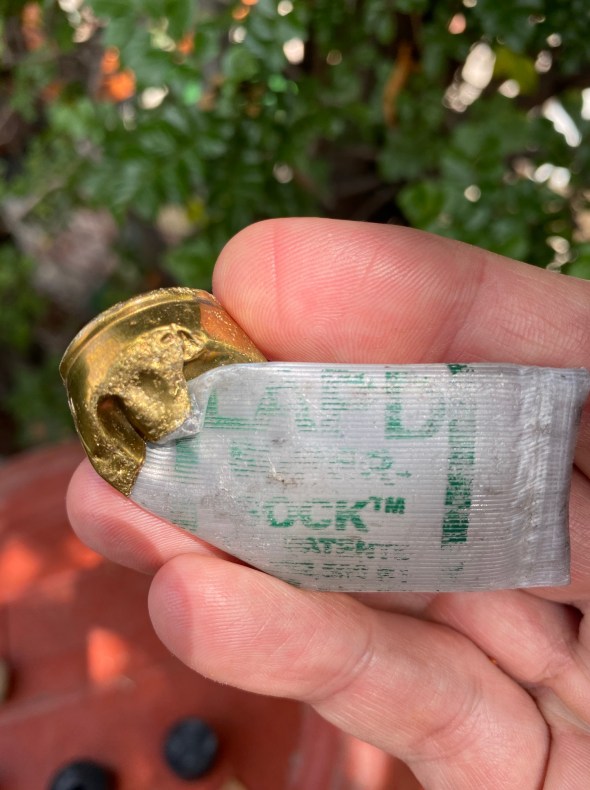
A key guide for the hobbyist is the LAPD’s equipment page.


I hope I don’t have any more opportunities to add to my collection.
(Always remember the scene in The Last Castle (2001) where James Gandolfini, a military history buff, hears Redford, a real veteran, assess his collection of Civil War bullets and Minié balls: “it’s just something that caused some poor bastard a whole lotta pain.”
Couple real good scenes in that movie. When Redford teaches Ruffalo the meaning of a salute!)
How to read a Racing Form // Belmont Stakes value picks
Posted: June 20, 2020 Filed under: America Since 1945, horses, sports Leave a comment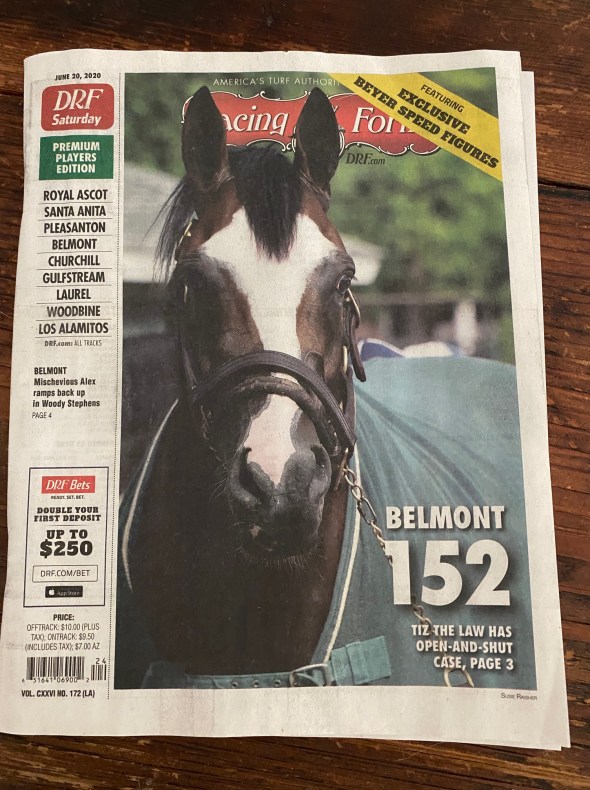
Every time I’m in Las Vegas I pass through the sports book and pick up a few racing sheets. I’ve never been able to make much out of them, but the life of the full-time degenerate who’s eating a hot dog and watching the 3rd at Gulfstream or Louisiana Downs is somehow attractive. Why is that? What is it about this that’s appealing? The songs and legends are part of it, for sure. I’ve always found sitting in the stands at Santa Anita an appealing afternoon. Less so since news of the frequent horse deaths.
Santa Anita is running right now, without spectators.
“I love to go back to Paris,” Hemingway said, his eyes still fixed on the road. “Am going in the back door and have no interviews and no publicity and never get a haircut, like in the old days. Want to go to cafés where I know no one but one waiter and his replacement, see all the new pictures and the old ones, go to the bike races and the fights, and see the new riders and fighters. Find good, cheap restaurants where you can keep your own napkin. Walk over all the town and see where we made our mistakes and where we had our few bright ideas. And learn the form and try and pick winners in the blue, smoky afternoons, and then go out the next day to play them at Auteuil and Enghien.”
“Papa is a good handicapper,” Mrs. Hemingway said.
“When I know the form,” he said.
from the Lillian Ross New Yorker profile of Hemingway.
How do you “learn the form”?
I chanced recently across this academic paper, Sports Betting As a New Asset Class, by Lovjit Thukral and Pedro Vergel. It addresses the possible money-making potential of a strategy of “laying the favorite.”
The authors take a simple betting strategy based on Horse races in the UK and invest consistently on laying (betting on the event not to occur) the 4 favourite horses (with the lowest odds) in each race. They find the following:
(1) this type of horse racing strategy provide uncorrelated returns to the market;
(2) the strategy outperforms the Credit Suisse Hedge fund Index and S&P 500 Total returns on average for the last 6 years.
Can this be so? A quick investigation reveals that “laying the favorite” in this way doesn’t seem to be a commonplace option in US horse betting. I don’t think this strategy would be financially viable here.
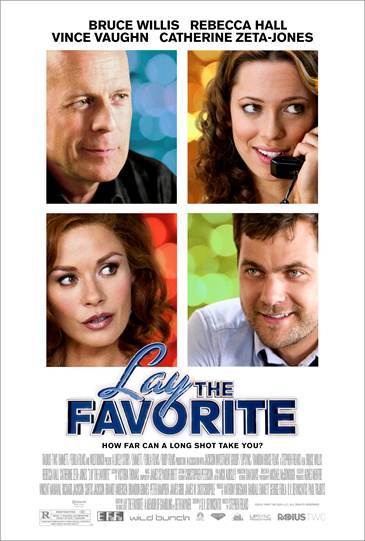
This talk of laying favorites reminded me of my friend Beth Raymer’s book, Lay The Favorite: A Memoir of Gambling.
The book was made into a 2012 film starring Bruce Willis and Catherine Zeta-Jones.
In the book, Raymer describes learning from the professional gambler and line-setter Dink:

Studying to find value — into it! I resolved to learn how to read a Racing Form, and try to glean some information from it that might give an edge.
Using the very helpful resources provided by the late Neil Benoit’s Getting Out Of The Gate website, which has a Racing 101-401 course, I was able to grasp the basics. This resource at Art of Manliness was also quite helpful, and there’s a Wikihow about racing forms, but it’s Benoit who really gave us a gift.
I’d like to try and summarize my learnings for you, to save you the time in case you’re interested, and because the easiest way to really learn something is to try and teach it.
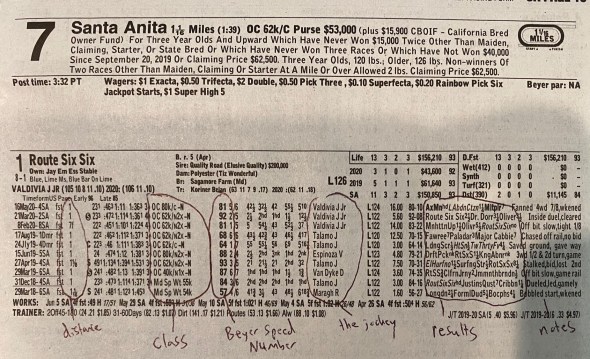
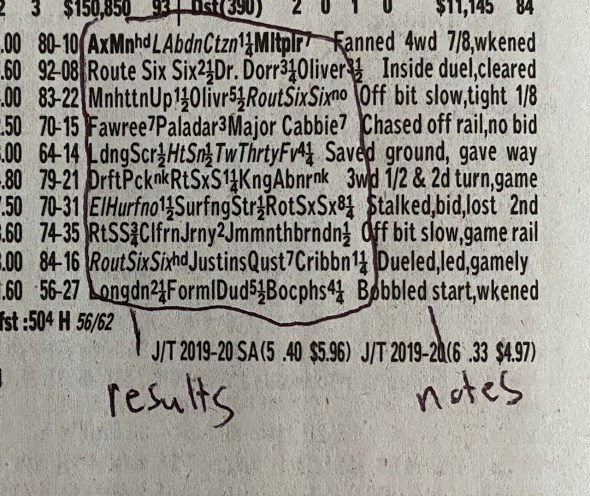
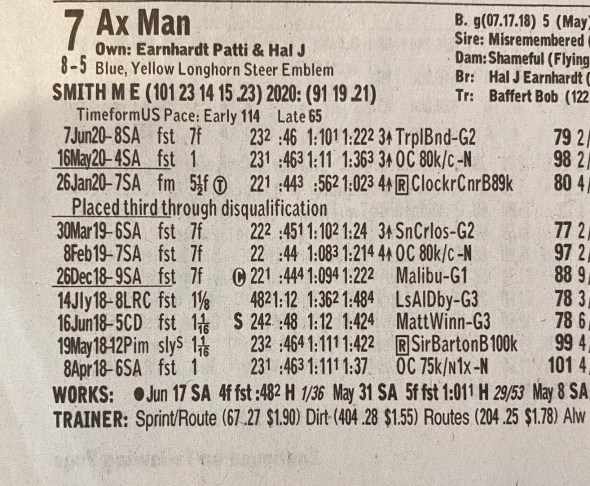
Let’s take as our example the first horse, Route Six Six, in the 7th race tomorrow (Saturday, June 20) at Santa Anita.
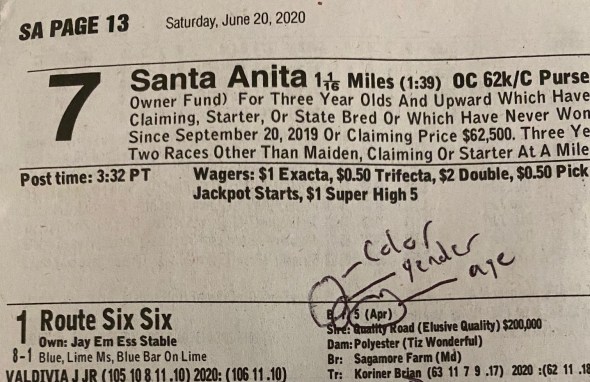
Up top we’ve got some basic info about the horse, like who owns her (f=filly), and her mom (Dam) and dad (Sire).
Personally, and this is based on zero study, but I suspect there’s all together too much focus on breeding in horses. It feels distracting and possibly irrelevant, like when the old-time scouts in Moneyball are focused on how hot a player’s girlfriend is. It just feels old-fashioned and unstatistical. But then again, since I haven’t run any statistical studies, this belief of mine is based on zero evidence as well.
You know what I want to find out from a racing form? One thing. How fast is this horse?
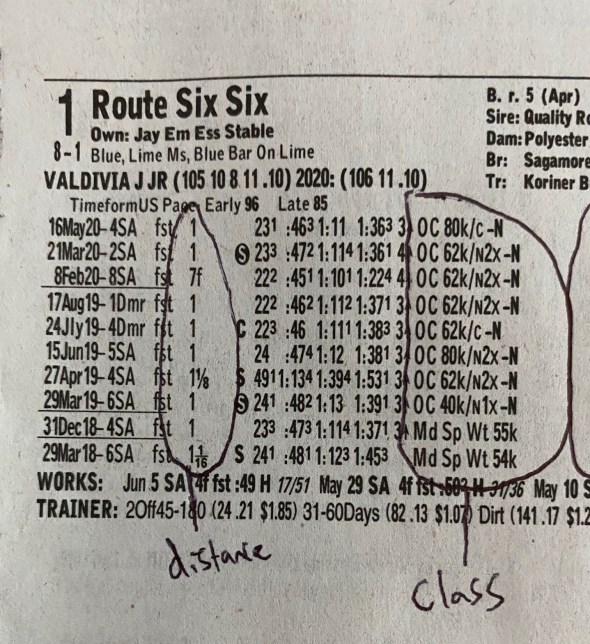
1) elimination of horses that seem unsuited to the distance of the race2) elimination of horses that do not seem in sufficiently sharp condition3) elimination of horses that seem outclassed4) elimination of horses at a serious disadvantage on today’s footing or in light of track biases

Beyer figures are a whole thing
Beyer took a stack of old Daily Racing Forms and did the laborious math by hand, sifting through years of data, applying the analytical skills he had developed as a games-playing child. “‘Six furlongs in 1:13 equals seven furlongs in 1:26 and a fifth’ was my E=MC2,” Beyer says, laughing. By 1972 he had managed to construct a reliable speed chart that incorporated the important element of track variance, a measure of track speed and bias, which was previously calculated by an antiquated–and, in most cases, inaccurate–system. Beyer devised a highly specific, sophisticated method for determining track variances, a method that accounted for the times turned in by different types of horses.
By combining his newly minted speed ratings with his fresh perspective on track speed, the young columnist invented the Beyer Speed Figures.
Interestingly, Beyer come up with his numbers specifically because so much of racing thinking at that time was centered around class:
“The orthodoxy back then said that ‘class’ was the measure of a race,” Beyer says, while making hieroglyphic notations in the margins of his race program. “For instance, if a $10,000 claimer was running against a slower $200,000 claimer, the assumption was that the slower but ‘classier’ horse would win. I was looking for a way to verify–or contradict–that assumption.”
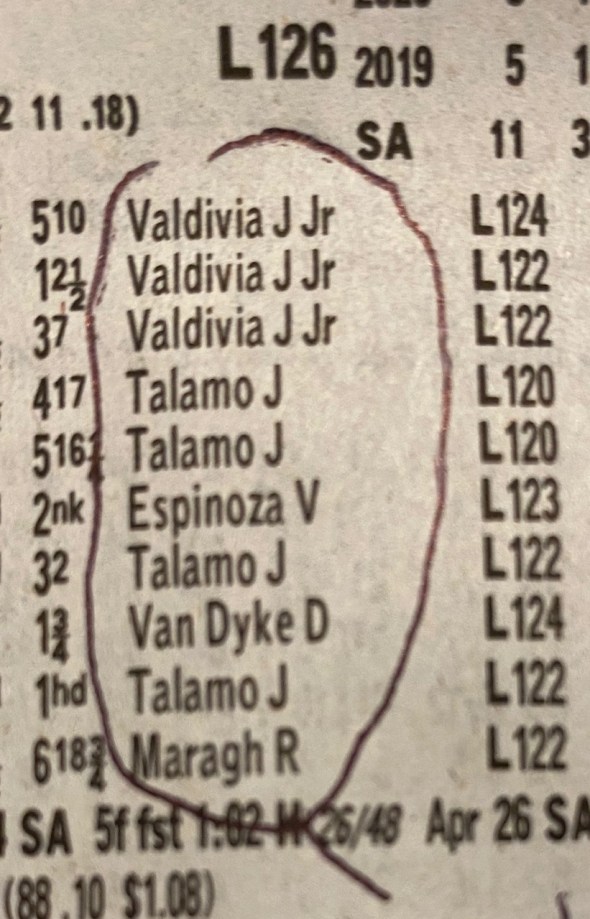
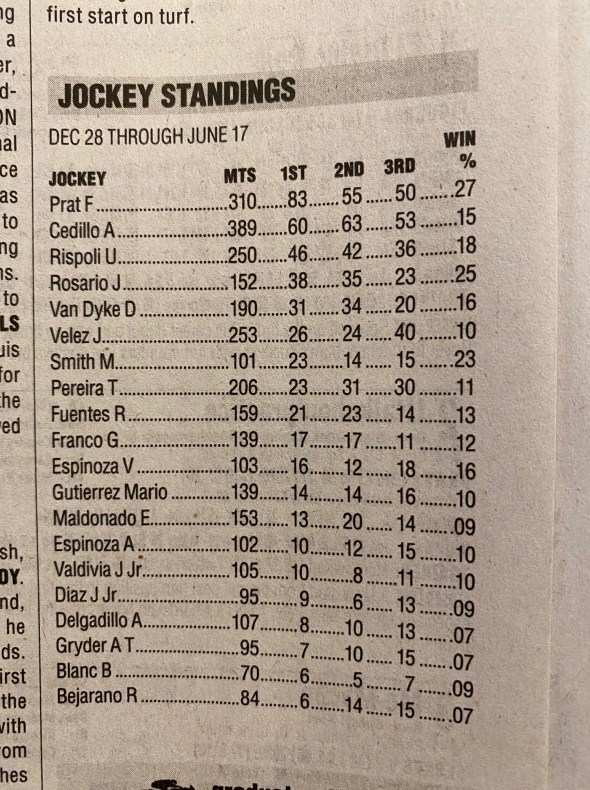
Don’t bet the horse, bet the jockey
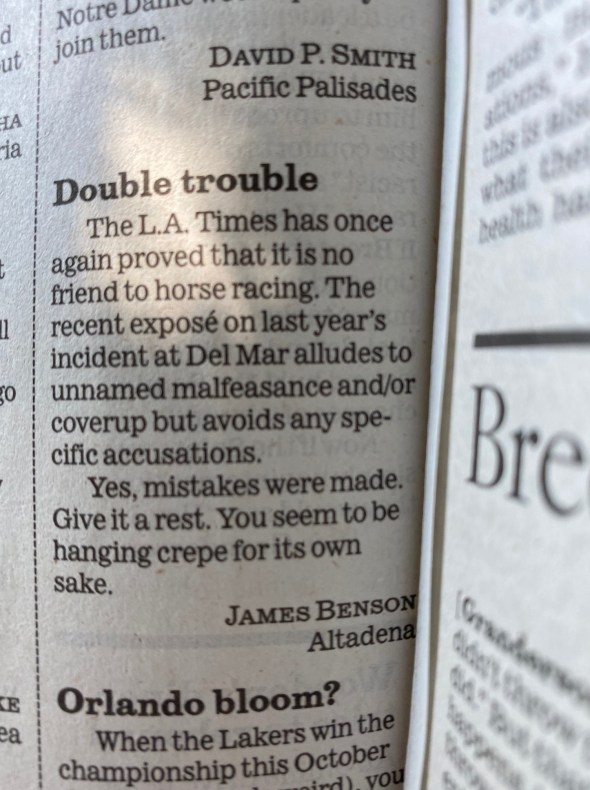
Benson has had it with this hanging crepe for its own sake!
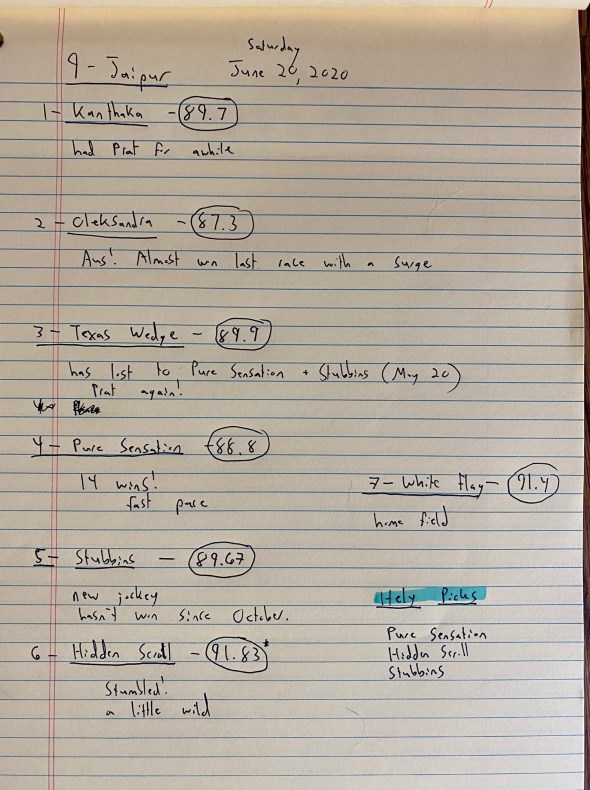
Jaipur Addendum!
Readers, I just idly checked out the 9th race at Belmont today, the Jaipur. Will be televised on NBC. I noticed Hidden Scroll, a very fast horse, had something aberrant in his last race:

What’s that about? Here we see the pleasures and oddness of the Racing Form as compressed storytelling:
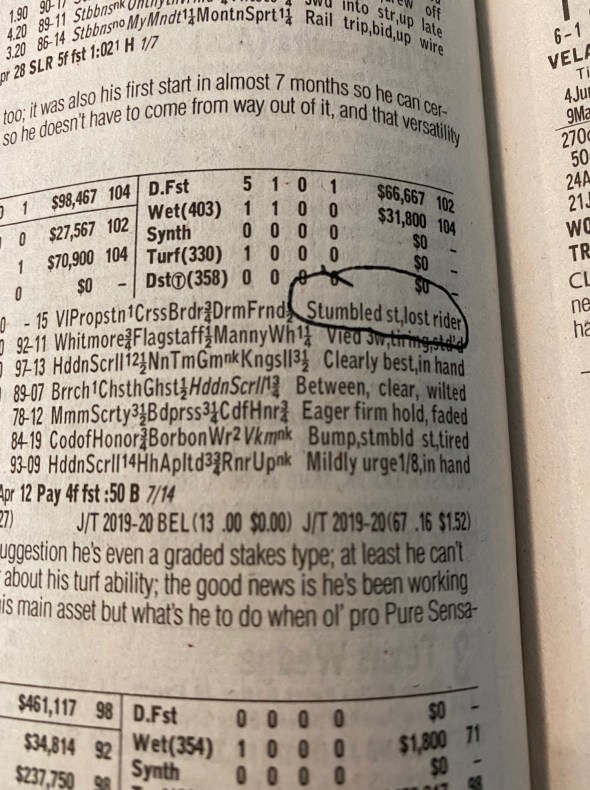
What?
Luckily in this glorious age of YouTube what Hidden Scroll did in his last race, this might be the craziest thing in a horse race I’ve ever seen:
Motherfucking horse nearly broke his own neck, lost his jockey, and still almost won! He’ll have the same jockey (JR Velazquez) today! That should be a very interesting race.
Bloomsday
Posted: June 16, 2020 Filed under: Ireland Leave a comment
Today. Bloom sees a walking advertisement for his former employer:
A procession of whitesmocked men marched slowly towards him along the gutter, scarlet sashes across their boards. Bargains. Like that priest they are this morning: we have sinned: we have suffered. He read the scarlet letters on their five tall white hats: H. E. L. Y. S. Wisdom Hely’s. Y lagging behind drew a chunk of bread from under his foreboard, crammed it into his mouth and munched as he walked. Our staple food. Three bob a day, walking along the gutters, street after street. Just keep skin and bone together, bread and skilly. They are not Boyl: no: M’Glade’s men. Doesn’t bring in any business either. I suggested to him about a transparent show cart with two smart girls sitting inside writing letters, copybooks, envelopes, blotting paper. I bet that would have caught on. Smart girls writing something catch the eye at once. Everyone dying to know what she’s writing.
Pools and regulations
Posted: June 12, 2020 Filed under: the California Condition Leave a comment
At swimming pools at hotels and apartment complexes here in California you’ll see this sign. Sometimes it causes quite a stir from people who’ve never seen it before, as it does summon up some graphic imagery, and violates the traditional taboo on not printing the word “diarrhea” on large public signs.
I’ve been pondering this sign for years. It’s not a choice to put it up. The uniform wording and ubiquity suggests there must be a rule. So that means there must’ve been some kind of meeting at a regulatory agency or the legislature where they discussed the diarrhea danger, and agreed to the diarrhea sign rule. Sometimes I’ve idly wondered if the sign were some kind of prank on pool owners, to force them to make all lucky pool users ponder the word “diarrhea” Did a bureaucrat harboring long-felt resentment against pool enjoyers push this through? Punishment for exclusion from a pool party, years ago?
Well, finally I decided to look into it, and quickly found the answer, in this Conejo Valley Guide post, “What’s The Deal With All of Those Signs Posted At The Swimming Pool.”
The requirement for this and other community pool signs comes from California Building Code Chapter 31B “Public Pools,” Section 3120B “Required Signs.”
Section 3120B.11 “Diarrhea” indicates the sign must have letters at least 1 inch high, clearly states what is noted above, and is posted at the entrance area of a public pool. Public pools include municipal/park district pools, hotel pools, water parks, swim schools, homeowner shared pools, apartment pools, campground pools, etc. One is thus not required to post this sign at your home pool (unless you really want to).
As the post notes, there have been outbreaks of waterborne disease from pools.
I’m inclined to give some benefit to common sense in the case of pool diarrhea. I think the California Building Code may have gone too far, living up to California’s reputation as a bit of a ninny when it comes to regulations. From a brief review, it seems like localities could make local amendments to the building code, and make themselves diarrhea-sign free zones. I would support that in my neighborhood. But it’s work to do that, and we can agree it’s not the most pressing problem.
What about the 14 days part? Must our language always be so bureaucratic? Do we just need a simpler sign that says: Be Cool About The Pool? Should the sign also be in Spanish?
Do we have a case study here in how rules, once made, tend to stay just through inertia? Is this a case of an annoying nanny state, or a reasonable public health measure? I suppose if it gives an occasional chuckle and a helpful reminder, it’s not so bad. Just a bit of local color.
George P.A. Healy (G.P.A. Healy)
Posted: June 10, 2020 Filed under: America, America Since 1945, art history Leave a comment
Healy was born in Boston, Massachusetts. He was the eldest of five children of an Irish captain in the merchant marine. Having been left fatherless at a young age, Healy helped to support his mother. At sixteen years of age he began drawing, and at developed an ambition to be an artist. Jane Stuart, daughter of Gilbert Stuart, aided him, loaning him a Guido’s “Ecce Homo”, which he copied in color and sold to a country priest. Later, she introduced him to Thomas Sully, by whose advice Healy profited, and gratefully repaid Sully in the days of the latter’s adversity.
so far as I know no relation, there are plenty of Healys and Helys from here to Australia.
He painted Tyler
and drew Grant.

He’s got a few that have appeared in the White House, like this one, The Peacemakers.

Earthquake?
Posted: June 3, 2020 Filed under: America Since 1945, the California Condition Leave a comment

or something more? Let’s get a more detailed atlas…

Lotta shakin’ and quakin’ going on at Naval Weapons Center China Lake (Restricted Area).
I’m prepared to conclude this was no earthquake, but the escape or an attempted escape of a captured UFO.

Interesting thing about this area: though desolate it’s dotted with petroglyphs, some alleged to be 10,000 years old.

Yolo -> Yo lo vi
Posted: June 2, 2020 Filed under: America Since 1945, art history Leave a comment
Interested in the Goya drawing, in his series Los Desastres de la Guerra, where his only commentary is “yo lo vi.” I saw it. What else is there to say sometimes?
RIP Larry Kramer
Posted: May 29, 2020 Filed under: America Leave a comment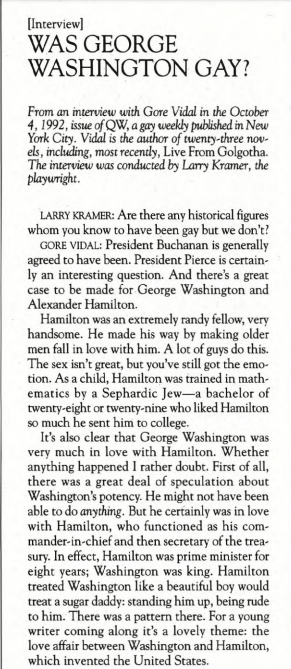
stolen from behind a Harper’s paywall and presented to you, the Helytimes reader.
The statement is not only humorous, but also it is literally true
Posted: May 29, 2020 Filed under: business Leave a comment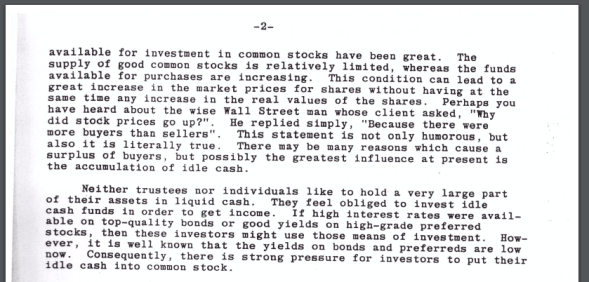
Tired: Buffett
Wired: Sir John Templeton
(Inspired: Charlie Munger)
Economist Digest, May 23, 2020
Posted: May 28, 2020 Filed under: Economista Leave a comment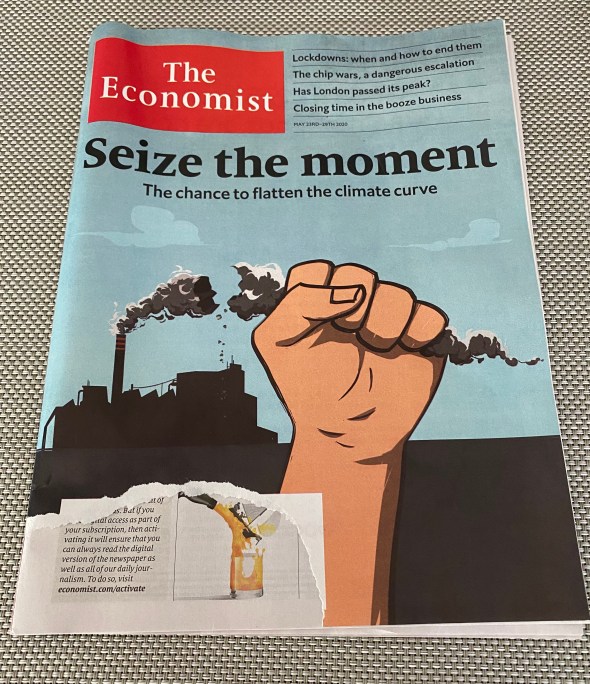
I’m doing it. I’m publishing a semi-regular digest of The Economist, as least during quar and semi-quar times. This is a public service I can provide with joy. So rare to find those opportunities, we must seize them.
Truly, only about one in four issues of The Economist really sinks in with me. More than that, well, it’s just too much information! The problem of our times. I don’t know how editor Zaddy Bellowes does it! Can she really read this whole thing, every week? And truly comprehend it?

Copyright by World Economic Forum swiss-image.ch/Photo Monika Flueckiger. This was taken at Davos, duh.
Same Q for David Remnick of The New Yorker. What a run! A pretty good magazine, every single week!
From this week we learn:
- Mexico’s President, AMLO, truly loves PEMEX, the state oil company.
Instead, he finds beauty in oil wells. He is openly nostalgic for the days when Pemex, the state oil company, was the engine of Mexico’s prosperity… he has promised $15 billion worth of aid to the company.
Worth noting that an oil company like Exxon Mobil is competing with the force of entire nations. $15 billion extra to PEMEX, how much is that by comparison? Well Exxon spends about $240 billion in a year. So not a drop in the bucket, exactly, but not nothing.
- How about this?
“He is a pleasant man who, without any important qualifications for the office, would very much like to be president.”
Joe Biden? No, FDR, to whom Lexington compares the former VP in their column. That description from an unnamed contemporary commentator.
“It’s striking how much time Joe is devoting to governing,” says Senator Chris Coons of Delaware, a Biden confident.
Really? What does that even mean? I saw Joe Biden on a fundraising Zoom the other day, he was chilling out in what looked like his living room. The Economist seems bullish on Joe, who’s having a good pandemic.
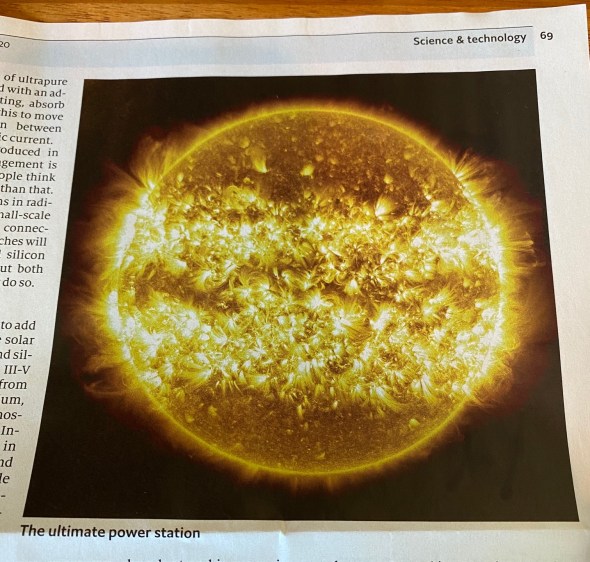
- from a piece about increased efficiency in solar panels (buy desert real estate, people!)
The amount of energy in artificial lighting is vastly less than that in sunshine. Nevertheless, dr. Brown and Dr. Fahlteich have found, according to a paper they published this month in Cell Reports Physical Science, that their cells can achieve a conversion efficiency of up to 22.6%, thereby producing enough juice to run small, low-power devices like wireless sensors and remote-control units, which would otherwise require batteries.
Though it may seem odd to turn artificial, indoor lighting into electrify, given that it has been created from electricity in the first place, the truth is that all such light which does not end up entering a human eye is wasted.
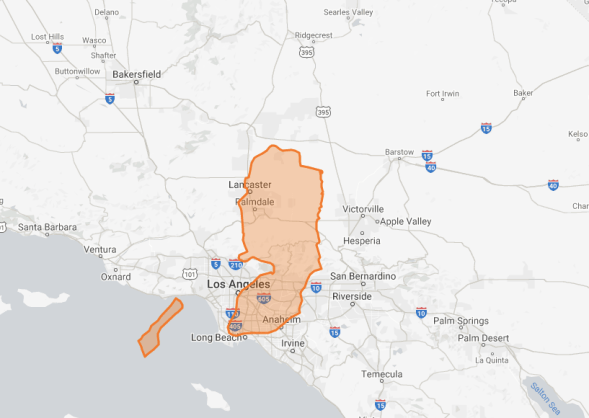
- Israel. I’ve saved a lot of time in my life by just staying out of arguments about Israel. What could I possibly offer? Look at the complexity of this map:

Consider the size of what we’re looking at here when compared to, say, LA:
- and finally, from an obituary for Little Richard:
“Goog Golly Miss Molly” was something is old toothless Aunt Lulu said when they put marijuana in her tobacco pipe
Dirty trick by Carousel Books
Posted: May 27, 2020 Filed under: books Leave a comment
Because anybody can publish and sell texts that are in the public domain, lots of crap publishers flood Amazon with cheaply printed paperbacks of the classics. These editions are flimsy, often with odd shapes and ugly typefaces. If you’re serious about reading a book, it’s worth it, in my opinion, to pay up for the Penguin edition. (This is especially true of translations, I learned this the hard way when I bought the Dover Thrift version of Chekhov’s The Seagull in college, which seemed like it had been translated by an ape).
The snakes over at Carousel Books, knowing this, deliberately made their cover look like a Penguin classic! Very sneaky, Carousel. Look close at the cover, you can see the degraded quality of the image, the shape is all off. It sucks!
Maybe it’s my fault for imagining Penguin, publishers of Morrissey, would include a clown like Chesterton in their ranks.
Guides to New Orleans
Posted: May 25, 2020 Filed under: America Since 1945, Louisiana Leave a comment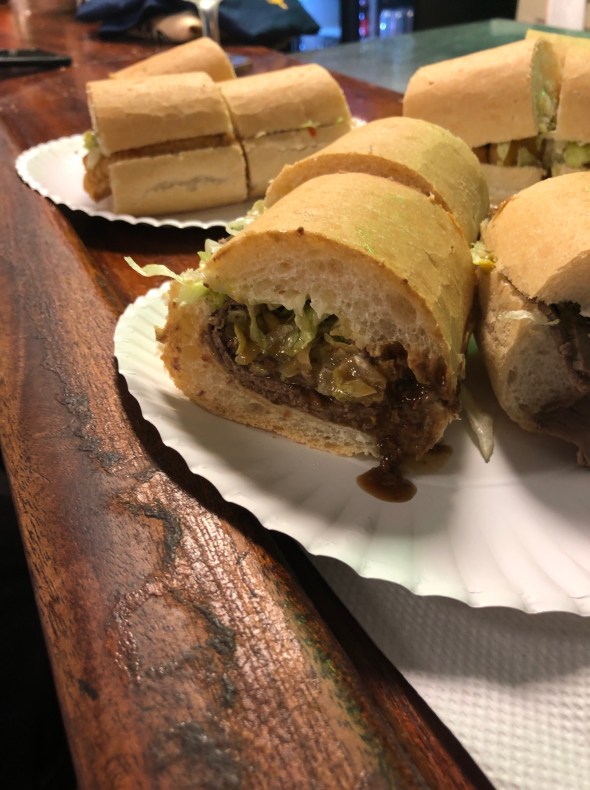
A medical expert once described the difficulty of surgery on the liver, a soft, fragile organ that can shred in your hands and rip with every stitch. The heart is a hard lump of muscle, but the liver is delicate spongy tissue. Manhattan is a rocky island, San Francisco is as solid and situation at the end of a long peninsula; those cities are as clearly defined as a fist or a heart. But think of New Orleans as a liver, an expanse of soggy land doing some of what a liver does, filtering poisons, keeping the body going, necessary to survival and infinitely fragile, hard to pull out of context, and nowadays deteriorating from more poison that it can absorb, including the ongoing toxins of the petroleum industry and the colossal overdose delivered by the 2010 BP blowout.
from:

The first thing you notice about New Orleans are the burying grounds – the cemeteries – and they’re a cold proposition, one of the best things there are here. Going by, you try to be as quiet as possible, better to let them sleep. Greek, Roman, sepulchres- palatial mausoleums made to order, phantomesque, signs and symbols of hidden decay – ghosts of women and men who have sinned and who’ve died and are now living in tombs. The past doesn’t pass away so quickly here.
You could be dead for a long time
so says Bob Dylan in Chronicles.
New Orleans is illogical, upsetting. It makes a mockery. You start in Chicago, sensible enough, but float down the river and you end in African jungle, a Caribbean outpost of a forgotten empire, ruled by French pretension – but pretending to what, exactly? No matter, it’s already forgotten. What the jazz player and the performing drunk and the crooked politician all act out is the tension: this shouldn’t be here.
Vivien Kent in The Fatback of America (1948, is she cancelled?)
The minute you land in New Orleans, something wet and dark leaps on you and starts humping you like a swamp dog in heat, and the only way to get that aspect of New Orleans off you is to eat it off. That means beignets and crayfish bisque and jambalaya, it means shrimp remoulade, pecan pie, and red beans with rice, it means elegant pompano au papillote, funky file z’herbes, and raw oysters by the dozen, it means grillades for breakfast, a po’ boy with chowchow at bedtime, and tubs of gumbo in between. It is not unusual for a visitor to the city to gain fifteen pounds in a week–yet the alternative is a whole lot worse. If you don’t eat day and night, if you don’t constantly funnel the indigenous flavors into your bloodstream, then the mystery beast will go right on humping you, and you will feel its sordid presence rubbing against you long after you have left town. In fact, like any sex offender, it can leave permanent psychological scars.
Tom Robbins in Jitterbug Perfume
Did not complete my reading of that book — it was too dense! Every page was packed! Every bite was sausage and spice, there was no rice.
In addition to the Atlas I had this one:

Books are good for getting ideas, but no information set in as permanent a form as a book should be trusted when it comes to New Orleans. Whether it’s open, what night is good, intel of that nature must be gathered by asking somebody, or a phone call, or maybe best of all by walking by.
One of these books gave us the notion to take the ferry to Algiers from the foot of Canal Street. The book claimed it was free, I believe it was $2.50. Small price to pay to be out on the river.
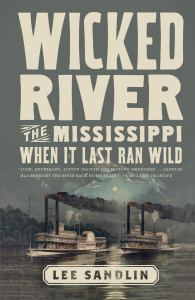
This book is just wonderful, I can’t recommend it enough. What gifts Lee Sandlin left the world! Lee begins his book by talking about how, when he waits for the bus in Chicago, the water under the grate at his feet is on its way to the Mississippi River, and on down to New Orleans. This book has it all: Mike Fink, the New Madrid Great Shakes, the siege of Vicksburg. And my God if he doesn’t make you feel like you’re really there in Congo Square, or at one of the true old Mardi Gras nights, a candlelight carnival, when the wildness could turn deadly, when they really thought they might summon the dead or the devil or worse. I keep meaning to devote a longer post to Wicked River, but I shouldn’t miss this chance to recommend it.
New Orleans, populationwise, at 391,006, is about the size of Bakersfield, significantly smaller than Fresno. Just a hair ahead of Wichita, Kansas.
One idea I really got out of the Snedeker Solnit Atlas is New Orleans as part of the Caribbean. Bananas were shipped through here. United Fruit Company, it was going down. District Attorney Jim Garrison may have been off but he was not wrong to smell conspiracy everywhere.
There actually used to be an overnight ferry between here and Havana. The mambo figures prominantly in New Orleans piano. Professor Longhair. It’s the Cuba Connection.
Steve Zahn’s character says in Treme. It was really funny in Treme to have a character whose main quality was how annoying he was about being “into” New Orleans. If you’re really “into” New Orleans, does that not by itself prove that you don’t get it? Is that all part of the joke?
Re: the banana connection, The Atlas had me go listen to Lil Wayne’s Six Foot Seven Foot.
Life is a bitch and Death is her sister
Sleep is the cousin what a fuckin’ family picture
This time last year I was in New Orleans. From The Atlas we learned the time of the Money Wasters second line was coming around. The WWOZ website confirms the date and a route for the parade, ending Under The 10, in the epic sonic canyon created by the concrete freeway overpass that takes I-10 across the city on its way to Los Angeles and Jacksonville, Florida. What a time! What a place! When will we feel that free again?
A guy at the second line said to me
if it’s Sunday in New Orleans and you ain’t at the second line you’re either stupid or dumb
When the wind is right it’s said you can see a dead body in the ruins of the Hard Rock Hotel. A living ghost story: how New Orleans is that?

Commerce
I’ve been thinking about New Orleans, and listening to WWOZ.
Yes! Same!
Posted: May 25, 2020 Filed under: business, travel Leave a comment
from the WSJ’s obituary of James Sherwood (paywall, prob’ly)

His work with cargoes in France and England exposed Mr. Sherwood to the inefficiencies of loading goods at docks with rigid union work rules. That experience made him an early convert to the use of standardized steel containers, which could be loaded elsewhere and delivered to docks by train or truck.
In 1965, he founded London-based Sea Containers to buy containers and lease them to companies moving goods. His initial investment of $25,000 gave him a 50% stake. When the company went public in the late 1960s, he was suddenly rich, “free to move my life forward any way I wanted,” as he later put it.
Though I’ve thought much and even written about containerization, I never fully considered the union busting aspect.
Containerization is incredible. That such a simple idea – use a standardized box – took so long to come up with. That is was willed into reality by one man. The amount that it changed the world. Every port city in the world was changed. The ports became charmless factory zones. No more On The Waterfront. Walmart could not exist without containerization. The relationship of the United States and China is formed by what containerization did to shipping. We send them empty boxes, they send us full boxes.
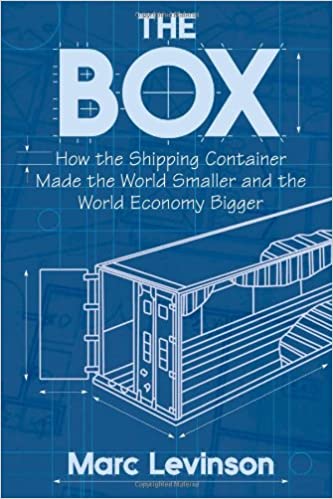
Must relocate my copy!
Still can’t believe they did this to us
Posted: May 25, 2020 Filed under: food Leave a comment
is the Food Pyramid the greatest conspiracy of all time?
This was EVERYWHERE when I was a kid, firmer and more common than the Ten Commandments.
I’m sure there’s a podcast about it, or a Slate piece.
Maybe my new thing will be “mild conspiracy theories” (the conspiracies themselves will be mild, not the theories. The theories will be wild).
Coming out of quar
Posted: May 10, 2020 Filed under: America Since 1945 1 Comment
I call this picture “Reflection”
Once I was in Yellowknife in the Northwest Territories of Canada doing a ridealong with the Royal Canadian Mounted Police. In Yellowknife in the winter the sun comes up at 10am and goes down again by 3:15pm. It’s dark and cold and tough to get through the winter. But the Mountie sergeant told me the problems happen when spring starts. It’s the coming out that people can’t handle.
It’s my perception here in southern California that people are beginning to re-enter the world. Traffic is returning to upsetting levels. We’re still a long way from where we were, most stores are shut down, but I get the sense people consider themselves done with lockdown.
I wonder if coming out of quarantine will be harder or at least crazier than being in it!
What is up with the stock market?
Posted: May 10, 2020 Filed under: America Since 1945, business Leave a comment
The US unemployment rate is 14.7%, the worst since the Depression. Here in LA County it’s 24%. We’re not supposed to leave our houses for non-essential purposes or go to the beach. Every bar is closed, almost every store is closed.
And yet the “stock market” is not really down that much. Here is a one year chart of the S&P 500, which The Wall Street Journal often uses as a standard benchmark for “the stock market.”

Actually a little higher than it was same time last year.
How can this be?
There are many explanations offered by people better informed than me. Here is Gunjan Banerji’s take in WSJ, and Joe Weisenthal in Bloomberg.
Both point out:
- the belief in a v-shaped or “Nike swoosh”* recovery
- the Federal Reserve keeping interest rates at close to zero
- the Federal Reserve buying $2.4 trillion in government debt, and indicating it would buy more, making it clear that the government can inject essentially infinite money into the economy, “backstopping” everything.
As an amateur enthusiast on this topic, I’d like to offer some additional explanations.
- The stock market is rigged to go up. This is just a sort of understood but rarely stated fact. The stock market is one of the few measures the President cares about. Every tool at the disposal of the administration and at the supposedly independent Fed is used to keep the stock market up.
- The stock market by definition is big, public companies. These are the S&P 500 companies. Big companies are benefitting from the demise of their various small competitors. Big companies can survive by taking on debt in ways small businesses can’t. They did a great job getting a chunk of the federal money made available. Consider if I have Steve’s Burger Stand. I just don’t have the bureaucratic ability, relationships, time, to get a loan the way Shake Shack did. If anything, are huge companies are seeing their small scale competitors destroyed?
- Kind of an addendum to the last one: the federal government gave out the free money via big banks like Wells Fargo, Bank of America, BlackRock which themselves are part of the S&P 500! Big boys feed first!
- Money has nowhere else to go. The Fed’s actions reduce the benefits of alternative investments like bonds or just putting your money in the bank.
- Trading has become free! I feel crazy that this never gets mentioned. Starting with Schwab (I think?) last fall, and then flowing on to competitors, trading stocks became free. Instead of $8 or $4 to trade stocks, it’s free! You might think this might’ve just created more volatility, maybe it did, but once the barrier to entry for the retail investor is zero, it’s as easy to flow your extra money into the stock market as it is into the bank. This is, in my opinion, a dangerous or at least explosive change that hasn’t really been reckoned with. See what Robin Hood is up to. It might be as easy to bet your money on Tesla or Amazon as it is to tuck it away in the bank. It’s frictionless, it can be done on your phone. That might be dangerous!
- There’s nowhere else to gamble. Again, I feel crazy that this is never acknowledged as a factor. Consider that Americans spend something like $100 billion on gambling a year. At the moment, there’s nowhere to do that! Casinos are closed. Sports are stopped. I do not think it’s unreasonable to imagine there are billions of dollars in gambling money going into the stock market as simply a place to gamble and trade. See Dave Portnoy of Barstool Sports, who personally injected half a million dollars.
I’m not here to make predictions. It’s probably a cognitive bias to believe the stock market “deserves” to go down, but that’s what I believe. Then again, when you think about the stock market, it’s not just rich assholes, it’s like the pensions of firefighters and teachers.
Is it possible that the stock market is not calculating the biggest risk, some kind of massive social upheaval coming from disgust at this system? The stock market is not built to calculate “what if we ruin society, make things so unequal and so unfair and grotesque that this system no longer functions?”
Maybe that’s “baked in” as they say.

So said Warren Buffett at the annual meeting. Happened to be reading this speech by Stanley Druckenmiller from 2015 which I found on Valuewalk:
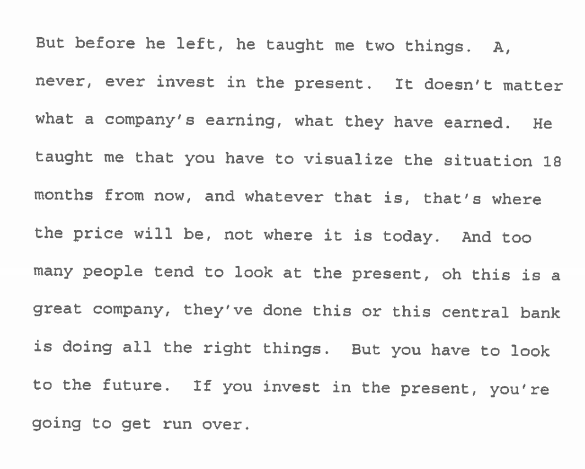
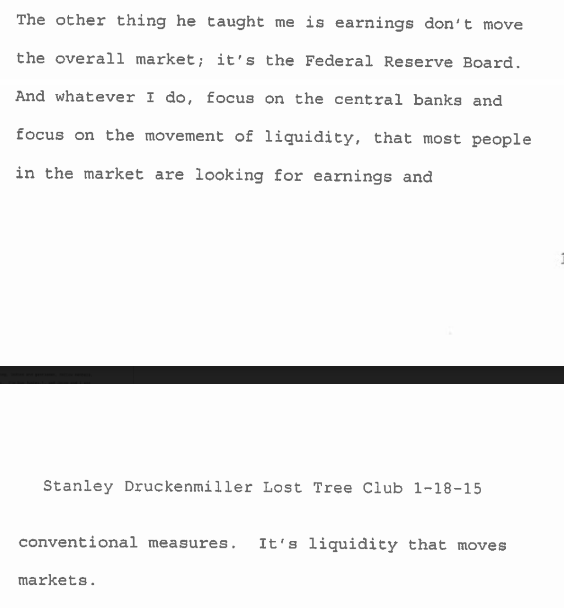
Remember your competition:

This chart is illuminating:
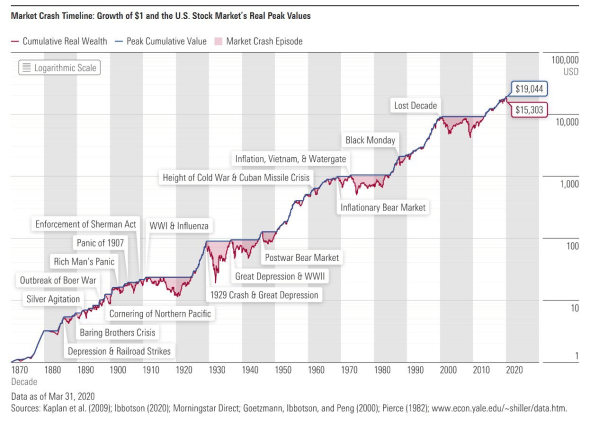
It’s good for me to write about the stock market, because I’m guaranteed to get an email saying something like you stupid clown you don’t understand anything. But the more I study the stock market, the more convinced I am that sometimes the experts, overwhelmed by information, become blind to the obvious. Consider this case reported by Bloomberg as a representative example. Do you really need to use a machine-reading program to determine that things are looking a bit grim?
There’s the famous story about Joe Kennedy knowing it was time to sell when the shoeshine boy gave him stock tips (bullshit, he was insider trading). What if you’re the shoeshine boy?
* I don’t understand the Nike swoosh recovery idea. Isn’t the long part of the swoosh roughly equal to the short part? So in a swoosh recovery, wouldn’t we just take a very long time to get back to where we were? and that’s the optimistic take!

Buffett bits (and Munger)
Posted: May 5, 2020 Filed under: America Since 1945, business Leave a comment
Did not watch, but read a transcript of this year’s Berkshire Annual Meeting. Even though he tends to repeat himself, especially once you’ve gone over a few of his letters, there’s something comforting and eternal about going over the wisdom again, like reading The Bible.
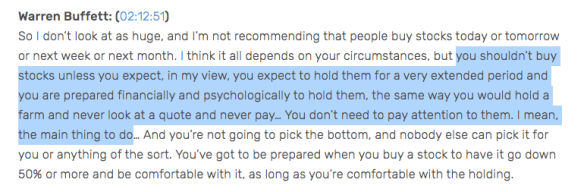
Is there simpler investment advice?
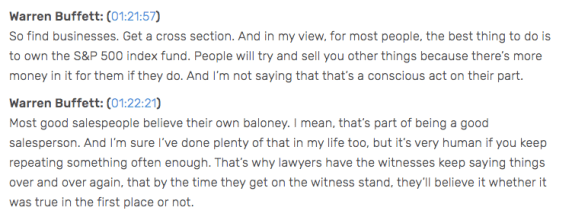
I would love to talk to Ajit Jain for a few minutes:
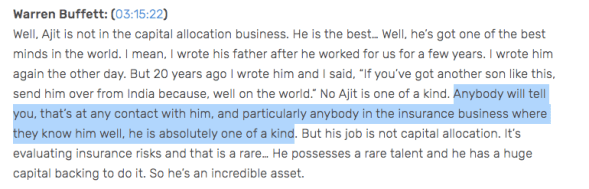
I didn’t know about this event:
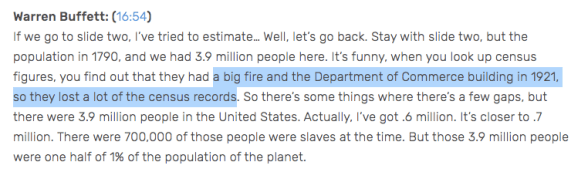
from the National Archives:
The morning after was an archivist’s nightmare, with ankle-deep water covering records in many areas. Although the basement vault was considered fireproof and watertight, water seeped through a broken wired-glass panel in the door and under the floor, damaging some earlier and later census schedules on the lower tiers. The 1890 census, however, was stacked outside the vault and was, according to one source, “first in the path of the firemen.”(11)
Could be a good clue in a National Treasure style mystery.
Speculation and rumors about the cause of the blaze ran rampant. Some newspapers claimed, and many suspected, it was caused by a cigarette or a lighted match. Employees were keenly questioned about their smoking habits. Others believed the fire started among shavings in the carpenter shop or was the result of spontaneous combustion. At least one woman from Ohio felt certain the fire was part of a conspiracy to defraud her family of their rightful estate by destroying every vestige of evidence proving heirship.(15) Most seemed to agree that the fire could not have been burning long and had made quick and intense headway; shavings and debris in the carpenter shop, wooden shelving, and the paper records would have made for a fierce blaze. After all, a watchman and engineers had been in the basement as late as 4:35 and not detected any smoke.(16) Others, however, believed the fire had been burning for hours, considering its stubbornness. Although, once the firemen were finished, it was difficult to tell if one spot in the files had burned longer than any other, the fire’s point of origin was determined to have been in the northeastern portion of the file room (also known as the storage room) under the stock and mail room.(17) Despite every investigative effort, Chief Census Clerk E. M. Libbey reported, no conclusion as to the cause was reached.
previous coverage of Buffett and Charlie Munger.
Charlie Munger unfortunately couldn’t be in Omaha, but looks like he had interesting things to say as always at the Daily Journal annual meeting in February:
Question 28: You talk frequently about having the moral imperative to be rational. And yet as humans, we’re constantly carrying this evolutionary baggage which gets in the way of us thinking rationally. Are there any tools or behaviors you embrace to facilitate your rational thinking?
Charlie: The answer is, of course. I hardly do anything else. One of my favorite tricks is the inversion process. I’ll give you an example. When I was a meteorologist in World War II. They told me how to draw weather maps and predict the weather. But what I was actually doing is clearing pilots to take flights.
I just reverse the problem. I inverted. I said, “Suppose I wanted to kill a lot of pilots, what would be the easy way to do it?” And I soon concluded that the only easy way to do it, would be to get the planes into icing the planes couldn’t handle. Or to get the pilot to a place where he’d run out of fuel before he could safely land. So I made up my mind that I was going to stay miles away from killing pilots. By either icing or getting him into (inaudible) conditions when they couldn’t land. I think that helped me be a better meteorologist in World War II. I just reversed the problem.
And if somebody hired me to fix India, I would immediately say, “What could I do if I really want to hurt India?” And I’d figure out all the things that could most easily hurt India and then I’d figure out how to avoid them. Now you’d say it’s the same thing, it’s just in reverse. But it works better to frequently invert the problem. If you’re a meteorologist, it really helps if you really know how to avoid something which is the only thing that’s going to kill your pilot. And you can help India best, if you understand what will really hurt India the easiest and worst.
Algebra works the same way. Every great algebraist inverts all the time because the problems are solved easier. Human beings should do the same thing in the ordinary walks of life. Just constantly invert. You don’t think of what you want. You think what you want to avoid. Or when you’re thinking what you want to avoid, you also think about what you want. And you just go back and forth all the time.
How about this:
Question 30: My question is about electric vehicles and BYD. Why are electric vehicles sales at BYD down 50 to 70 percent while Tesla is growing 50 percent? And what’s the future hold for BYD?
Charlie: Well, I’m not sure I’m the world’s greatest expert on the future of electric vehicles, except I think they’re coming generally and somebody’s going to make them. BYD’s vehicle sales went down because the Chinese reduce the incentives they were giving to the buyers of electric cars. And Telsa’s sales went up because Elon has convinced people that he can cure cancer. (laughter)
And then by Question 33 he really gets going.
Lots of luck if you’re an impulsive person that has to be gratified immediately, you’re probably not going to have a very good life and we can’t fix you. (laughter)
Buffett is like beer, Munger is like whiskey.
The Economist Digest
Posted: May 3, 2020 Filed under: Africa, economist Leave a comment
Considering converting Helytimes into just a summary of each week’s issue of The Economist. That would provide a public service.
From this week’s issue
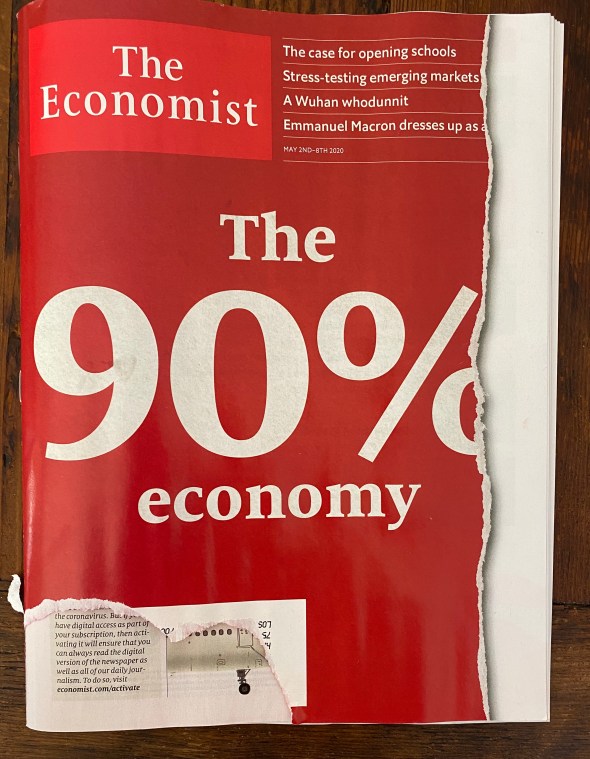
I learn
- the President of Liberia, George Weah, a former striker for AC Milan, has recorded a song about Coronavirus. (Learning more about this story led me to the BBC Pidgin page, which will be bookmarked for future return). Meanwhile the Governor of Nairobi distributed mini bottles of Hennessey, which he calls “throat sanitizer”
- The price to book value of the German DAX Index fell below one? Must investigate. The S&P 500 by comparison fell to 2.35 at its lowest (March 23) of 2020. It was at 1.39 on its lowest day in the 2008-2009 crisis. Are German companies “cheap”? Paging Ben Graham!
- Flogging has been banned as a punishment in Saudi Arabia
- “Eating pangolins is illegal in China, but putting their scales into medical concoctions is not.”
- Good piece on the Toyota Hilux as a desired vehicle for warlords: “they can cram 30 people into one and can still climb a sand dune.” You can’t buy a Toyota Hilux in the USA, which pisses me off. Why wouldn’t you want a tougher, stronger, truck in a more compact form? It’s the warlord’s choice!
- Melissa Dell won the John Bates Clark Medal for economists under 40 for work showing that the colonial “mita” system, which between 1573 and 1812 forced indigenous men in Bolivia and Peru to work in silver mines, had negative effects that persist to this day (uh, no shit? just kidding Professor Dell)
- Most US states begin their fiscal year on July 1. Because they’re obligated by “a combination of constitutional requirement, statute and tradition” to balance their budgets, there are gonna have to be tax increases or layoffs. (Interesting that The Economist, a very Oxford publication, doesn’t use the Oxford comma).
- I didn’t know Samsung began as “a provincial vegetable and dried fish shop”
- Jair Bolsonaro of Brazil is in trouble. He too, like our president, has a shithead son who’s in the online fake-news business.
- The Economist puts Joe Biden up six points over Donald Trump
- Italy’s foreign minister is 33?

La delegazione dei GRUPPI PARLAMENTARI “MOVIMENTO 5 STELLE” DEL SENATO DELLA REPUBBLICA E DELLA CAMERA DEI DEPUTATI,in occasione delle consultazioni
(foto di Francesco Ammendola – Ufficio per la Stampa e la Comunicazione della Presidenza della Repubblica)
- An obituary for rock climber Joe Brown, who climbed the south side of the Old Man of Hoy

source: Svrban
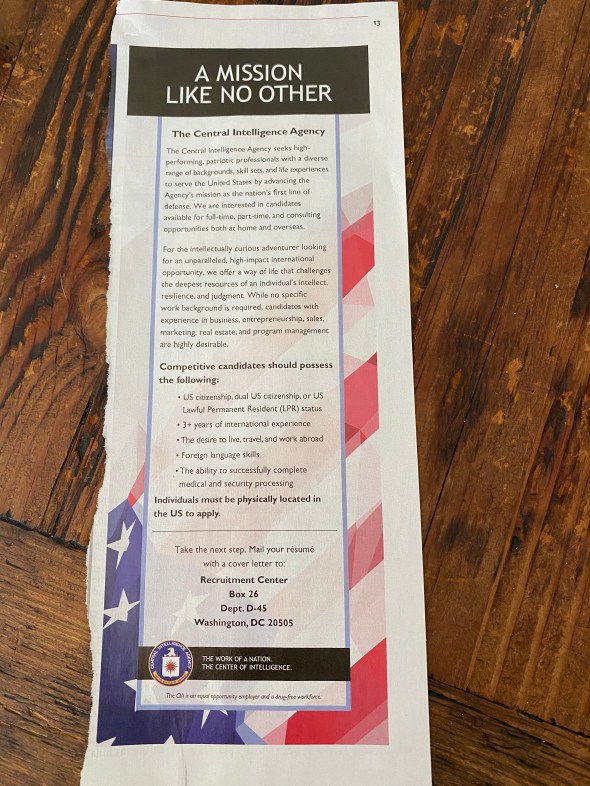
Also if any Helytimes readers are looking for work:
More on sound in Nintendo
Posted: April 27, 2020 Filed under: music Leave a comment
After we discussed Nintendo soundscapes, a correspondent writes:
So the simplest reason is that Nintendo a whole are like that, gentle, pleasing in aesthetic with musical rhythms to fit. When making the old games like Donkey Kong in the arcades, where they had wanted to a) get kids hooked to Keep spending quarters b) not sound dark or dangerous to scare off any young kids or parents worried about the new technology and c) being forced to create an earworm that, because of the chip being limited yet the amount of time they want you playing, be a sound loop that keeps it bouncy, happy, and remain in players head so you would think of it after leaving the arcade.When they moved home consoles, to the NES there wasn’t anything they could do as music really, the Commodore 64 had only the beeps that the computer chip itself could make, (kind of like what a modem would do). But Nintendo improvised. Say they only had a chip that could make 8 bit tunes, memory space of a few kb which were utilising system itself. No synth or midi or anything like that, 4 channels, because all the memory had to go towards the sprites basically. So you had just a small number or door bell tones basically making the sound effects nd the music at the same time. (Mario bopping a block, grabbing a coin playing along with a tune could go up or down a tiny bit then have to loop back again almost imperceptibly. Staying in c and returning back to the same notes as often as possible in different ways like the song that Never ends til you haven’t even noticed it hasn’t.They also, seeing as budgets and schedules were tight and with almost no memory for music music conposers werent hired, so the programmers had to do this, a little known tidbit is the origin of the Zelda song came from an all nighter. The developers planned on using a tiny orchestration of Ravel’s Bolero as the title crawl, seeing as the arrangement was so old. So that was the idea for the mario kinda games. With something like Zelda, still operating under the same rules but wanting a more grand brave adventurous sound they chose an old arrangement, Rachel’s bolero to go with it, they found out like the night before it had to go to print that it was one month before it would go to public domain so the composer made a whole new score in one night to make one of the most memorable and recognisable tunes ever. 49 years and 11 months and if Zelda was delayed by one month it would have rewritten video game history. But I’m getting off track.The biggest thing to happen after the Nes with the Super Nintendo music was Donkey Kong Country and a fella called David Wise. Nintendo had figured out a way to create a 3D look to a dimensional platforms, by shading the characters differently and moving them along deceptively deep but static backgrounds (kinda like tv animation) so he worked out a way to do the same thing with the same musical limitations. Rare and Nintendo hired him to make one jungle themed tune, link here, and he wrote the music along one string, moved the entire string down a few octaves and then just wrote over that with the melody going over it to basically make it one track sounding like multiple instruments rather than a tiny synth out tracking from less than 10 bits. It seems like it might be simple now but it was revolutionary, it sounded live instrument quality but it was tiny in size in reality. so they hired him to do the whole score. So with Koji Kondo creating Zelda and Mario’s basic looping almost gambling sound effects into what couldn’t really be considered a tune to something you can hum thirty years on to DavidWwise creating 2d soundtracks that sounded 3d by keeping music simple they tapped into repetition and psychological depth that you are still nostalgic for these daysTldr a cartridge has only so many chips back then and so you had to twist the chip to make it repeat the same noise only mildly different to look back to the same chip doorbell which makes it almost 4chord Beatles ish in its genetic simplicity.They’d also loop say four notes a few times then one loop then go back to those same 4 notes and repeat so it wouldn’t sound the same but it would be … familiar maybe why you have such nostalgic memories of them


